Working in Teams
Systems Development Lifecycle Roles
Negotiation Skills & Contract
2
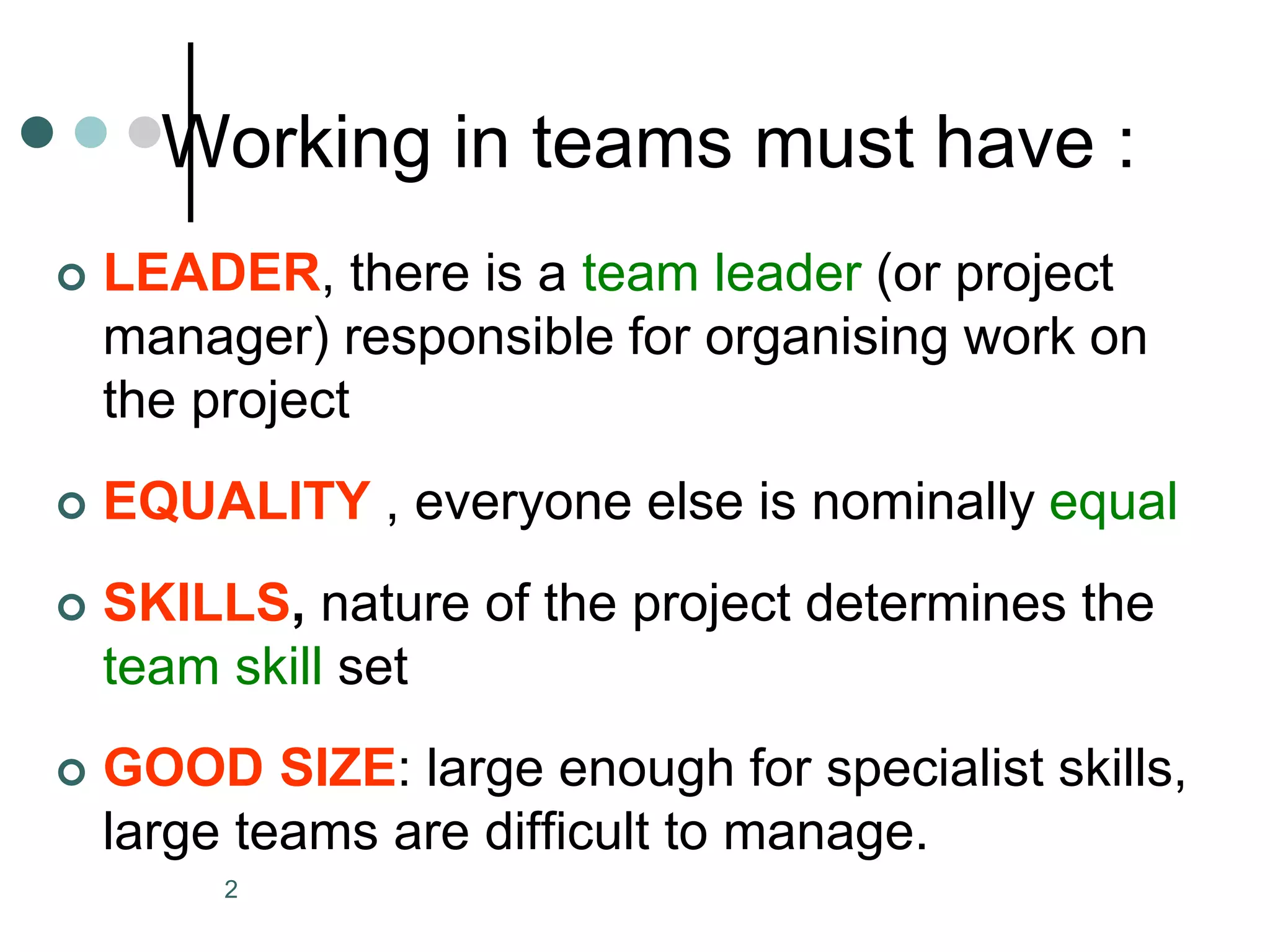
 LEADER, there is a team leader (or project
manager) responsible for organising work on
the project
 EQUALITY , everyone else is nominally equal
 SKILLS, nature of the project determines the
team skill set
 GOOD SIZE: large enough for specialist skills,
large teams are difficult to manage.
Working in teams must have :
3
 team success depends on
 the team’s skills - how the group is
assembled
 the efforts of the team: participation and
productivity
 the management of the team: the leader
must be organised, informed, with good
communication and human relations skills
Working in teams
4
Characteristics of good teams
 diversity
 tolerance
 communication
 trust
 put the team first
 reward structure
5
 diversity
 backgrounds, skills, goals
 increases likely acceptance of the system
 exposes team members to a range of ideas
and views
Characteristics of good teams
6
 tolerance
 of diversity, uncertainty, ambiguity
 of new or different ideas: may help to generate
better solutions
 communication
 team members must communicate clearly and
completely with each other
Characteristics of good teams
7
 trust
 requires mutual respect
 improves effectiveness of communication
 put the team first
 team members’ own views and goals should
be secondary to the goals and views of the
group
 commitment to the team
Characteristics of good teams
8
 reward structure
 should promote shared responsibility
 should promote accountability
 reward team members for effective
contribution to the group
 high performance teams also have
 small team size (max 8-10 people)
 high level of enjoyment
Characteristics of good teams
9
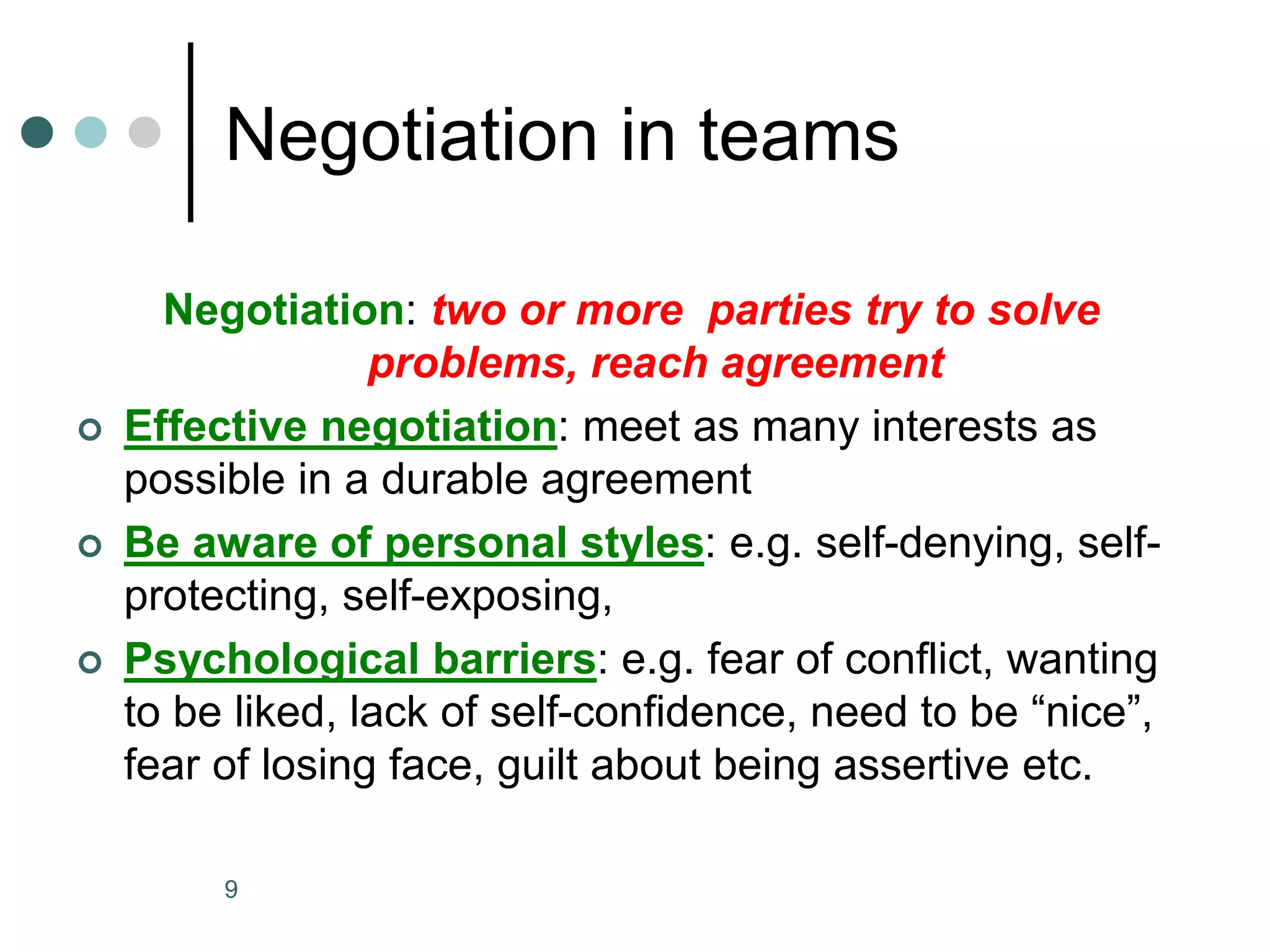
Negotiation in teams
Negotiation: two or more parties try to solve
problems, reach agreement
 Effective negotiation: meet as many interests as
possible in a durable agreement
 Be aware of personal styles: e.g. self-denying, self-
protecting, self-exposing,
 Psychological barriers: e.g. fear of conflict, wanting
to be liked, lack of self-confidence, need to be “nice”,
fear of losing face, guilt about being assertive etc.
10
Five steps approach:
 Plan: prepare objectives, gather information, sequence of
issues, other parties’ objectives etc.
 Discuss: establish trust, confirm facts, identify each
party’s objectives, views, areas of agreement
 Propose: define issues and what has to be resolved, deal
with one at a time, avoid passing judgment, summaries
content, views to confirm understanding
 Negotiate the issue: ask for what you want, accept
compromise for satisfactory outcomes for all, generate
many options etc.
 Check: the agreement made, confirm commitment
Negotiation: the process
11
Principled negotiation method:
 People - separate the people from the problem
 Interests - focus on interests, not positions
 Options - generate a variety of possibilities before
choosing an option
 Criteria - ensure results are based on some objective
standard
Negotiation: the process
12
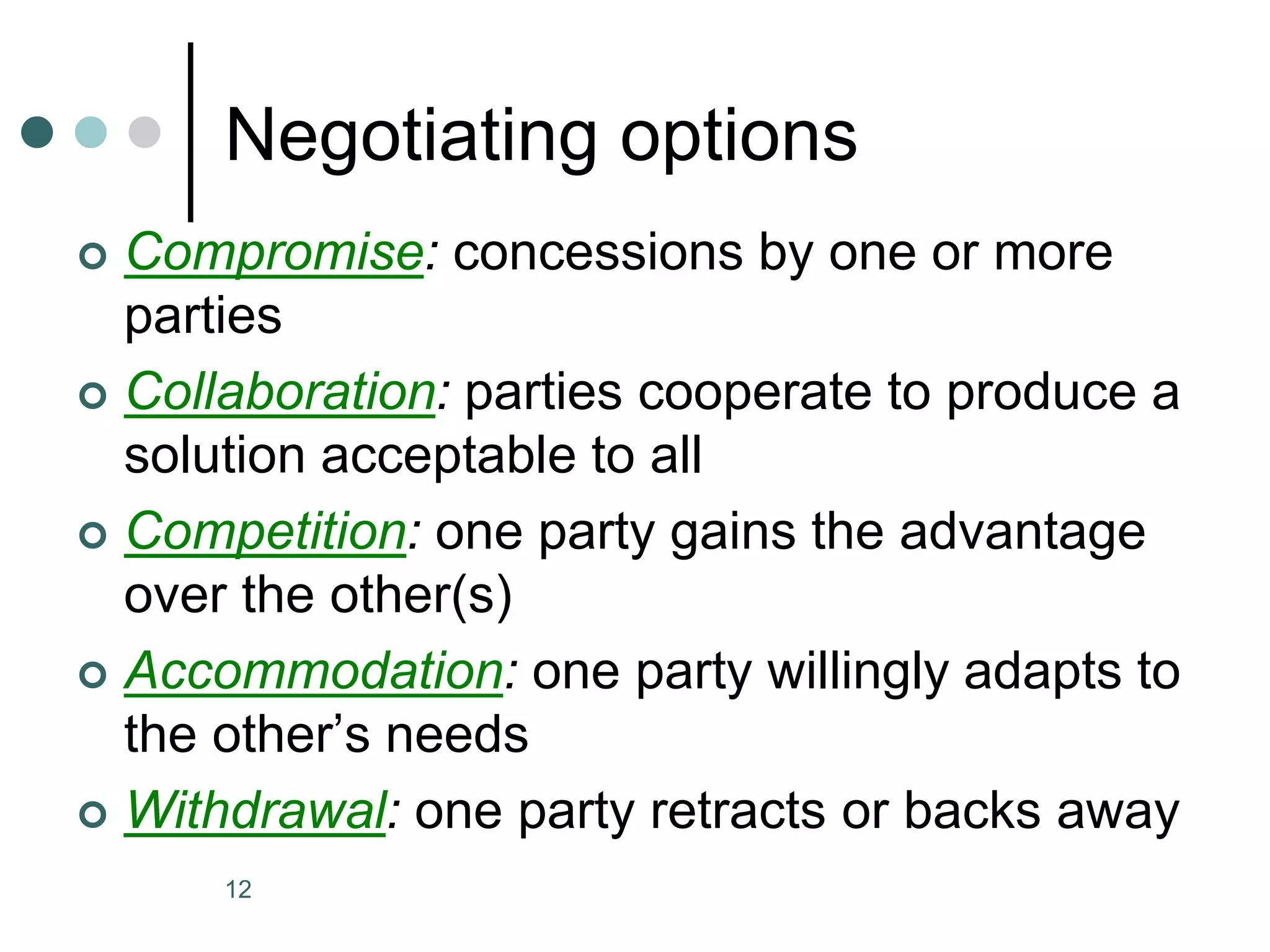
Negotiating options
 Compromise: concessions by one or more
parties
 Collaboration: parties cooperate to produce a
solution acceptable to all
 Competition: one party gains the advantage
over the other(s)
 Accommodation: one party willingly adapts to
the other’s needs
 Withdrawal: one party retracts or backs away
13
Conflict resolution options
 Compromise – (win-win) will it last?
 Collaboration – (win-win) will it continue?
 Competition – (win-lose) revenge?
 Accommodation – (lose-win)
“thin end of the wedge”?
 Avoidance – (no resolution) repeat?
14
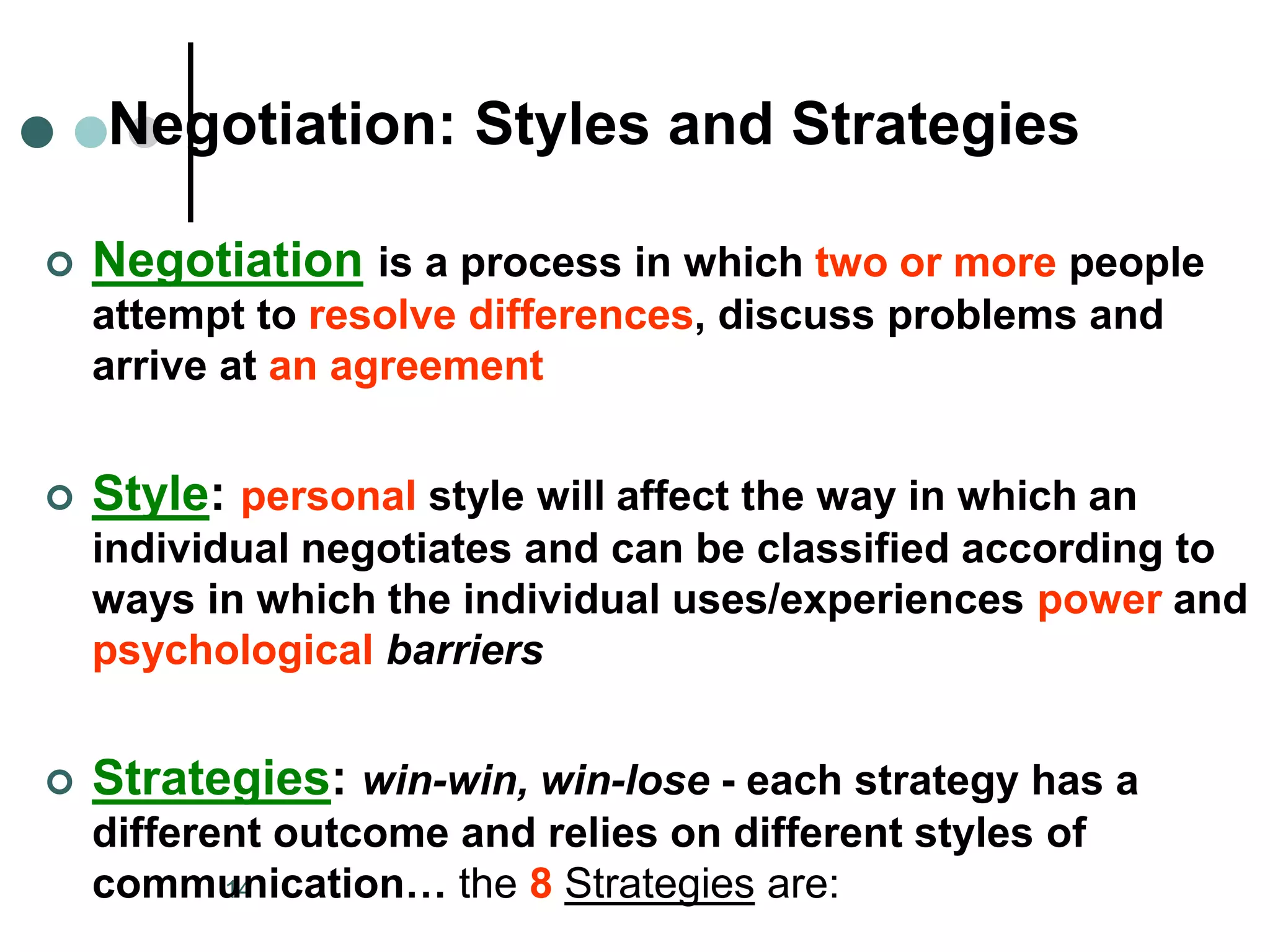
Negotiation: Styles and Strategies
 Negotiation is a process in which two or more people
attempt to resolve differences, discuss problems and
arrive at an agreement
 Style: personal style will affect the way in which an
individual negotiates and can be classified according to
ways in which the individual uses/experiences power and
psychological barriers
 Strategies: win-win, win-lose - each strategy has a
different outcome and relies on different styles of
communication… the 8 Strategies are:
15
Negotiating strategies
 1- Fait accompli strategy.
The fait accompli strategy is a risky one. Basically, one side does
whatever it wants and expects the other side to accept the
terms and the outcome.
 2- Standard practice strategy.
The "standard practice" claim infers that what is being suggested
is acceptable because it is "standard practice. " This strategy is
another reason why doing your homework is important.
 3- Deadline strategy.
Time can be a powerful weapon in a negotiation. If the other side
knows your deadlines, they may delay giving you a draft of the
contract (and possibly throw in a few changes) until the last
minute to gain the advantage.
16
Negotiating strategies
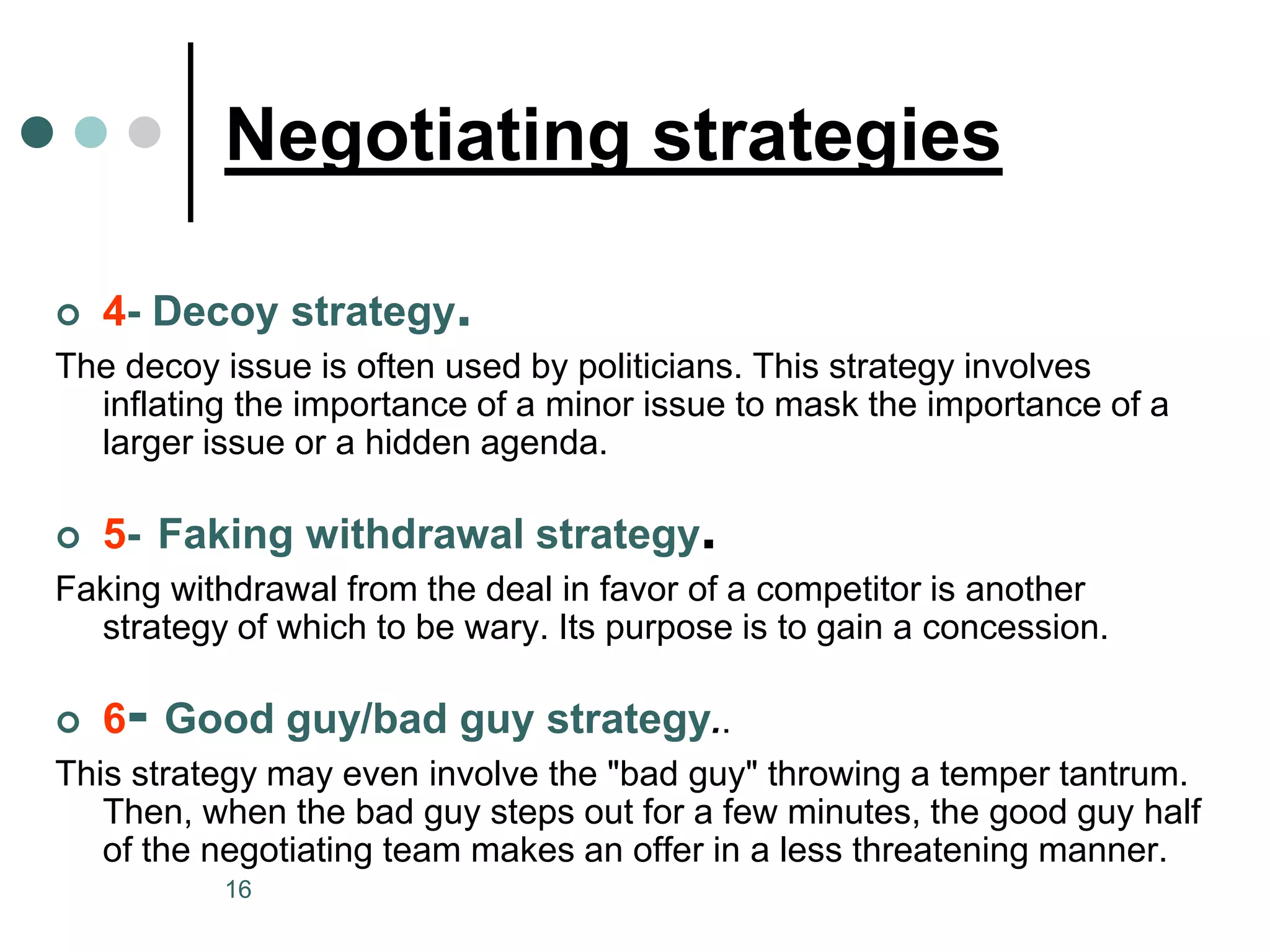
 4- Decoy strategy.
The decoy issue is often used by politicians. This strategy involves
inflating the importance of a minor issue to mask the importance of a
larger issue or a hidden agenda.
 5- Faking withdrawal strategy.
Faking withdrawal from the deal in favor of a competitor is another
strategy of which to be wary. Its purpose is to gain a concession.
 6- Good guy/bad guy strategy..
This strategy may even involve the "bad guy" throwing a temper tantrum.
Then, when the bad guy steps out for a few minutes, the good guy half
of the negotiating team makes an offer in a less threatening manner.
17
Negotiating strategies
 7- Limited authority strategy.
The limited authority strategy involves the other side trying to make
concessions by claiming they don't have the authority to make
concessions on their own.
 8- Salami strategy.
The salami technique is used to gain concessions piece by piece. The
basic premise is this: Instead of trying to grab the whole salami, cut off
thin slices over time.
18
Secrets of Power Negotiating
19
Introduction
Secrets of Power Negotiating covers every aspect of the
negotiating process with practical, proven advice: from
beginning steps to critical final moves, how to
recognize unethical tactics, key principles to the Power
Negotiating strategy, why money is not as important as
everyone thinks, negotiating pressure points,
understanding the other party and gaining the upper
hand, and analyses of different negotiating styles.
20
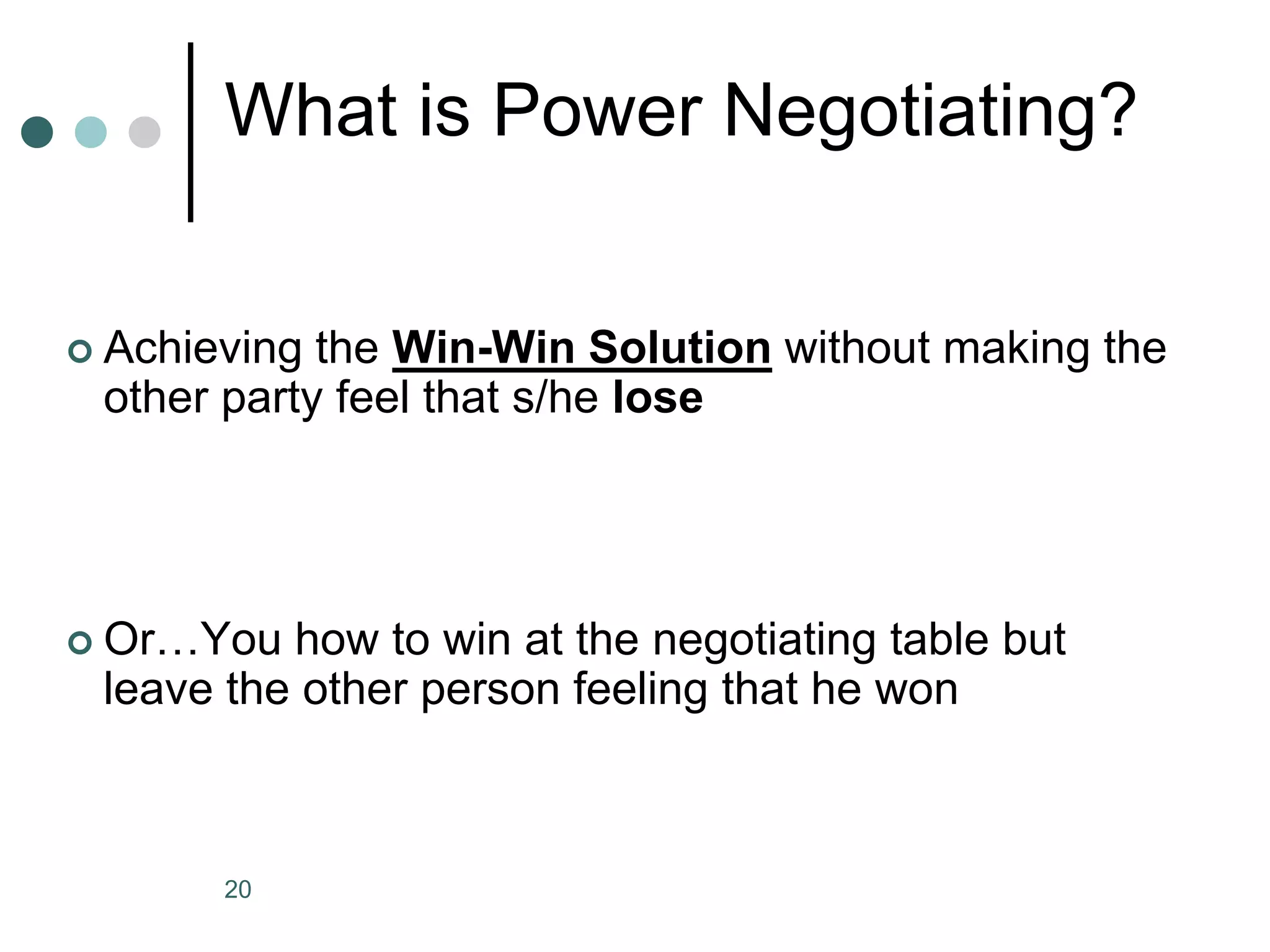
What is Power Negotiating?
 Achieving the Win-Win Solution without making the
other party feel that s/he lose
 Or…You how to win at the negotiating table but
leave the other person feeling that he won
21
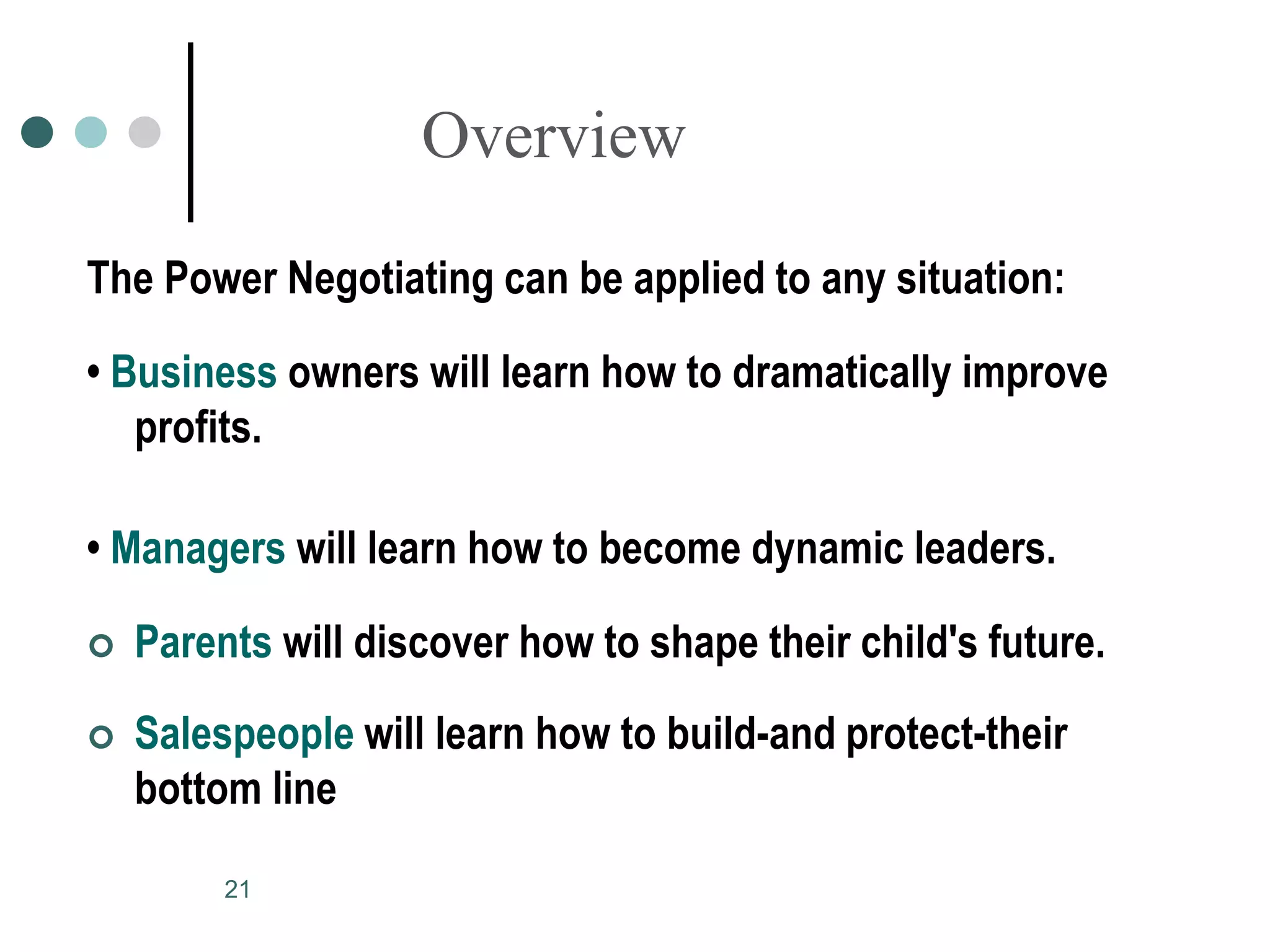
Overview
The Power Negotiating can be applied to any situation:
• Business owners will learn how to dramatically improve
profits.
• Managers will learn how to become dynamic leaders.
 Parents will discover how to shape their child's future.
 Salespeople will learn how to build-and protect-their
bottom line
22
Questions
 Mention 3 tactics of the power negotiations
with Examples?
 2 ways to avoid the mistrust that can develop
in your counterpart?
 What is the most dangerous moment in your
negotiating process?
 What is the most powerful weapon in your
negotiating process?
23
Ask for more than you expect to get
Don’t put your minimum demands on the
negotiating table
24
Ask for more you expect to get
 This technique raises the perceived value of
what you are offer and prevents deadlocking.
 In case you are the buyer, you’ll be welling to
pay more than the seller think and vice versa.
The car dealer asking for $15000 for the car and
you want it for $13000, so you offer $11000.
25
 “The less you know about whomever
you’re up against, the higher your initial
position should be”
 Showing flexibility (modifying when
being more specified)
 Never Say Yes to the First Offer
26
A Flinch
• Always RE-ACT with shock and surprise at
the other side’s proposals
Avoid Confrontation ‫تحد‬
• “Feel, Felt, Found” Formula
“ I understand exactly how you Feel about that.
Many other people have Felt Exactly the same
way. But you know what we have always Found?
When we took a closer look, we found… ”
27
 The Technique
By saying “You’ll have to do better than that”
 Only try to convince
 Don’t narrow the negotiation down to just one
issue
• Find other ways to make him feel he’s winning
28
 Set It Aside
1. Set something on aside to not lose the
whole deal
2. If there is no progress
1. Change the team
2. Change the place
3. Change the topic
29
The Most Dangerous Moment
 It is the moment when the negotiations are
getting over and the other party agreed to go
ahead.
 Watch up your emotions.
 In this stage don’t make any concessions & your
protection is to say “ I don’t have the authority”.
30
Your Most Powerful Weapon
The most powerful point is learn to develop
walk- away power.
Negotiators always made mistakes when they
past the point where they willing to walk away.
“I am going to buy this car. I am going to get it the
best price I can, but I’m not leaving until I get it”
31
Who is a Power Negotiator
(Master Negotiator)
Become a Life-long Learner
Very important thing to:
• Learn how to negotiate
• Learn from our negotiations
32
Thank You

# 3 Team Work for Negotiation.ppt

  • 1.
    Working in Teams SystemsDevelopment Lifecycle Roles Negotiation Skills & Contract
  • 2.
    2  LEADER, thereis a team leader (or project manager) responsible for organising work on the project  EQUALITY , everyone else is nominally equal  SKILLS, nature of the project determines the team skill set  GOOD SIZE: large enough for specialist skills, large teams are difficult to manage. Working in teams must have :
  • 3.
    3  team successdepends on  the team’s skills - how the group is assembled  the efforts of the team: participation and productivity  the management of the team: the leader must be organised, informed, with good communication and human relations skills Working in teams
  • 4.
    4 Characteristics of goodteams  diversity  tolerance  communication  trust  put the team first  reward structure
  • 5.
    5  diversity  backgrounds,skills, goals  increases likely acceptance of the system  exposes team members to a range of ideas and views Characteristics of good teams
  • 6.
    6  tolerance  ofdiversity, uncertainty, ambiguity  of new or different ideas: may help to generate better solutions  communication  team members must communicate clearly and completely with each other Characteristics of good teams
  • 7.
    7  trust  requiresmutual respect  improves effectiveness of communication  put the team first  team members’ own views and goals should be secondary to the goals and views of the group  commitment to the team Characteristics of good teams
  • 8.
    8  reward structure should promote shared responsibility  should promote accountability  reward team members for effective contribution to the group  high performance teams also have  small team size (max 8-10 people)  high level of enjoyment Characteristics of good teams
  • 9.
    9 Negotiation in teams Negotiation:two or more parties try to solve problems, reach agreement  Effective negotiation: meet as many interests as possible in a durable agreement  Be aware of personal styles: e.g. self-denying, self- protecting, self-exposing,  Psychological barriers: e.g. fear of conflict, wanting to be liked, lack of self-confidence, need to be “nice”, fear of losing face, guilt about being assertive etc.
  • 10.
    10 Five steps approach: Plan: prepare objectives, gather information, sequence of issues, other parties’ objectives etc.  Discuss: establish trust, confirm facts, identify each party’s objectives, views, areas of agreement  Propose: define issues and what has to be resolved, deal with one at a time, avoid passing judgment, summaries content, views to confirm understanding  Negotiate the issue: ask for what you want, accept compromise for satisfactory outcomes for all, generate many options etc.  Check: the agreement made, confirm commitment Negotiation: the process
  • 11.
    11 Principled negotiation method: People - separate the people from the problem  Interests - focus on interests, not positions  Options - generate a variety of possibilities before choosing an option  Criteria - ensure results are based on some objective standard Negotiation: the process
  • 12.
    12 Negotiating options  Compromise:concessions by one or more parties  Collaboration: parties cooperate to produce a solution acceptable to all  Competition: one party gains the advantage over the other(s)  Accommodation: one party willingly adapts to the other’s needs  Withdrawal: one party retracts or backs away
  • 13.
    13 Conflict resolution options Compromise – (win-win) will it last?  Collaboration – (win-win) will it continue?  Competition – (win-lose) revenge?  Accommodation – (lose-win) “thin end of the wedge”?  Avoidance – (no resolution) repeat?
  • 14.
    14 Negotiation: Styles andStrategies  Negotiation is a process in which two or more people attempt to resolve differences, discuss problems and arrive at an agreement  Style: personal style will affect the way in which an individual negotiates and can be classified according to ways in which the individual uses/experiences power and psychological barriers  Strategies: win-win, win-lose - each strategy has a different outcome and relies on different styles of communication… the 8 Strategies are:
  • 15.
    15 Negotiating strategies  1-Fait accompli strategy. The fait accompli strategy is a risky one. Basically, one side does whatever it wants and expects the other side to accept the terms and the outcome.  2- Standard practice strategy. The "standard practice" claim infers that what is being suggested is acceptable because it is "standard practice. " This strategy is another reason why doing your homework is important.  3- Deadline strategy. Time can be a powerful weapon in a negotiation. If the other side knows your deadlines, they may delay giving you a draft of the contract (and possibly throw in a few changes) until the last minute to gain the advantage.
  • 16.
    16 Negotiating strategies  4-Decoy strategy. The decoy issue is often used by politicians. This strategy involves inflating the importance of a minor issue to mask the importance of a larger issue or a hidden agenda.  5- Faking withdrawal strategy. Faking withdrawal from the deal in favor of a competitor is another strategy of which to be wary. Its purpose is to gain a concession.  6- Good guy/bad guy strategy.. This strategy may even involve the "bad guy" throwing a temper tantrum. Then, when the bad guy steps out for a few minutes, the good guy half of the negotiating team makes an offer in a less threatening manner.
  • 17.
    17 Negotiating strategies  7-Limited authority strategy. The limited authority strategy involves the other side trying to make concessions by claiming they don't have the authority to make concessions on their own.  8- Salami strategy. The salami technique is used to gain concessions piece by piece. The basic premise is this: Instead of trying to grab the whole salami, cut off thin slices over time.
  • 18.
  • 19.
    19 Introduction Secrets of PowerNegotiating covers every aspect of the negotiating process with practical, proven advice: from beginning steps to critical final moves, how to recognize unethical tactics, key principles to the Power Negotiating strategy, why money is not as important as everyone thinks, negotiating pressure points, understanding the other party and gaining the upper hand, and analyses of different negotiating styles.
  • 20.
    20 What is PowerNegotiating?  Achieving the Win-Win Solution without making the other party feel that s/he lose  Or…You how to win at the negotiating table but leave the other person feeling that he won
  • 21.
    21 Overview The Power Negotiatingcan be applied to any situation: • Business owners will learn how to dramatically improve profits. • Managers will learn how to become dynamic leaders.  Parents will discover how to shape their child's future.  Salespeople will learn how to build-and protect-their bottom line
  • 22.
    22 Questions  Mention 3tactics of the power negotiations with Examples?  2 ways to avoid the mistrust that can develop in your counterpart?  What is the most dangerous moment in your negotiating process?  What is the most powerful weapon in your negotiating process?
  • 23.
    23 Ask for morethan you expect to get Don’t put your minimum demands on the negotiating table
  • 24.
    24 Ask for moreyou expect to get  This technique raises the perceived value of what you are offer and prevents deadlocking.  In case you are the buyer, you’ll be welling to pay more than the seller think and vice versa. The car dealer asking for $15000 for the car and you want it for $13000, so you offer $11000.
  • 25.
    25  “The lessyou know about whomever you’re up against, the higher your initial position should be”  Showing flexibility (modifying when being more specified)  Never Say Yes to the First Offer
  • 26.
    26 A Flinch • AlwaysRE-ACT with shock and surprise at the other side’s proposals Avoid Confrontation ‫تحد‬ • “Feel, Felt, Found” Formula “ I understand exactly how you Feel about that. Many other people have Felt Exactly the same way. But you know what we have always Found? When we took a closer look, we found… ”
  • 27.
    27  The Technique Bysaying “You’ll have to do better than that”  Only try to convince  Don’t narrow the negotiation down to just one issue • Find other ways to make him feel he’s winning
  • 28.
    28  Set ItAside 1. Set something on aside to not lose the whole deal 2. If there is no progress 1. Change the team 2. Change the place 3. Change the topic
  • 29.
    29 The Most DangerousMoment  It is the moment when the negotiations are getting over and the other party agreed to go ahead.  Watch up your emotions.  In this stage don’t make any concessions & your protection is to say “ I don’t have the authority”.
  • 30.
    30 Your Most PowerfulWeapon The most powerful point is learn to develop walk- away power. Negotiators always made mistakes when they past the point where they willing to walk away. “I am going to buy this car. I am going to get it the best price I can, but I’m not leaving until I get it”
  • 31.
    31 Who is aPower Negotiator (Master Negotiator) Become a Life-long Learner Very important thing to: • Learn how to negotiate • Learn from our negotiations
  • 32.