ADR & GDR
                PRESENTED BY:
                YASHAL SHAH
               DHAVAL KARIA
           VRUTANT VAKHARIA
            VISHAL JHAMNANI
       VIDYALAKSHMI SHARMA
      ABHIMANYU SHRIVASTAV
TABLE OF CONTENTS

•   DEPOSITORY RECEIPTS
•   AMERICAN DEPOSITORY RECEIPTS (ADR)
•   PROCESS TO ISSUE ADR/GDR
•   ADVANTAGES OF ADR
•   TYPES OF ADR
•   LEVELS OF ADR
•   GLOBAL DEPOSITORY RECEIPTS (GDR)
•   TYPES OF GDR
•   DIFFERENCE BETWEEN ADR & GDR
•   EXAMPLES OF ADR & GDR
Depository receipts

• Depository receipts are instruments issued by
  international depositories (ODB), and they represent
  an interest in the underlying shares held by them in
  the issuer company (Indian Company). The shares
  are usually held by a domestic custodian on behalf
  of the depositories in turn issue the depository
  receipts, which entitle the holder of the receipts to
  get the underlying shares on demand.
• DRs are traded on Stock Exchanges in the US,
  Singapore, Luxembourg, London, etc.
• DRs listed and traded in US markets are known as
  American Depository Receipts (ADRs) and those
  listed and traded elsewhere are known as Global
  Depository Receipts (GDRs). In Indian context, DRs
  are treated as FDI
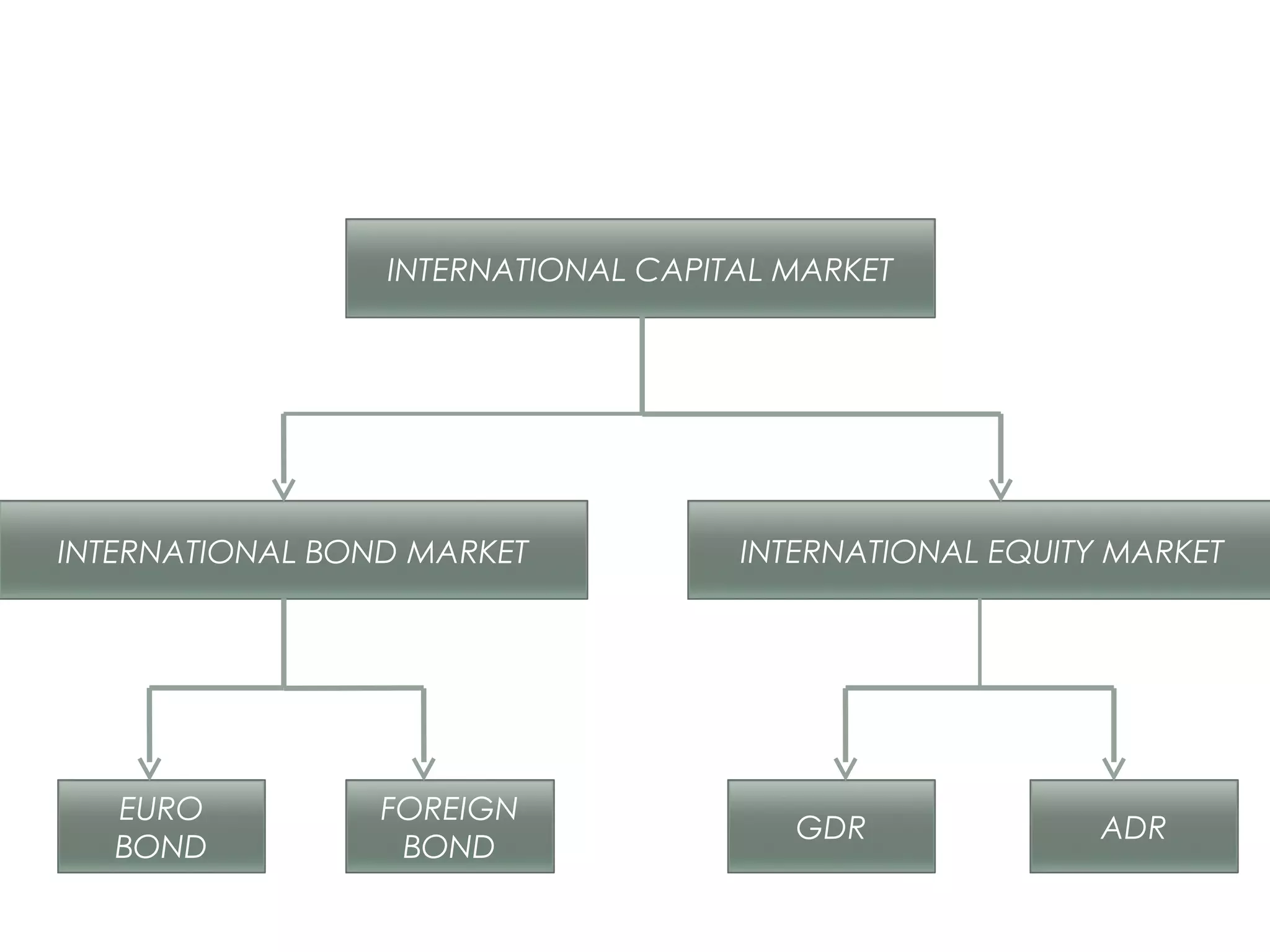
INTERNATIONAL CAPITAL MARKET


INTERNATIONAL BOND MARKET           INTERNATIONAL EQUITY MARKET


   EURO          FOREIGN
                                       GDR              ADR
   BOND           BOND
AMERICAN DEPOSITORY RECEIPTS

• ADR is a dollar-denominated negotiable certificate.
  It represents a non-US company’s publicly traded
  equity. It was devised in the late 1920s to help
  Americans invest in overseas securities and to assist
  non-US companies wishing to have their stock
  traded in the American Markets.
• ADR were introduced as a result of of the
  complexities involved in buying shares in foreign
  countries and the difficulties associated with trading
  at different prices and currency values.
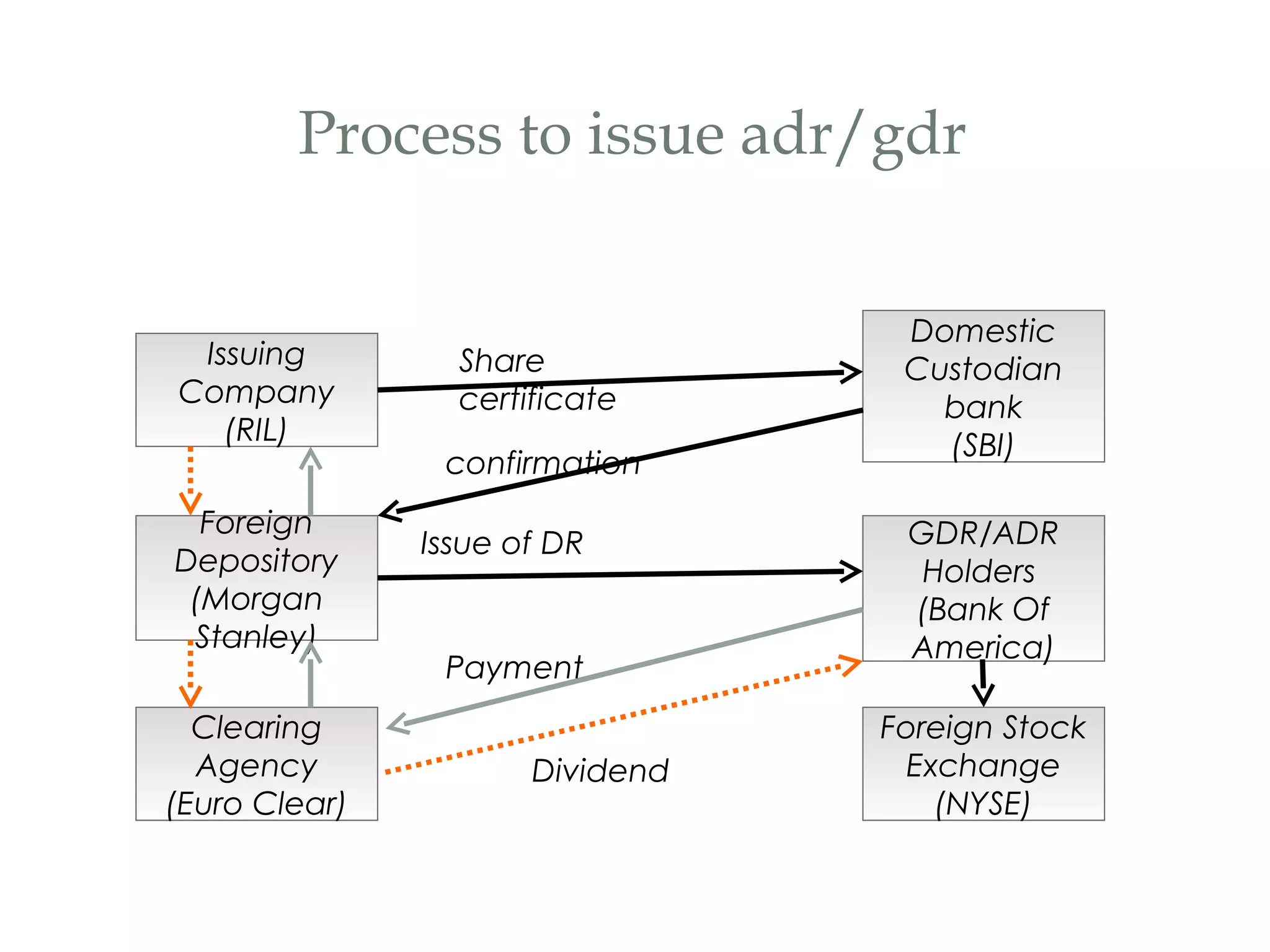
Process to issue adr/gdr


                                  Domestic
 Issuing         Share            Custodian
Company          certificate        bank
   (RIL)                            (SBI)
                confirmation
  Foreign                         GDR/ADR
               Issue of DR
Depository                         Holders
 (Morgan                          (Bank Of
 Stanley)                         America)
                Payment
  Clearing                       Foreign Stock
  Agency              Dividend     Exchange
(Euro Clear)                         (NYSE)
ADVANTAGES OF ADR/GDR

• Can be listed on any of the overseas stock
  exchanges /OTC/Book entry transfer system.
• Freely transferable by non-resident.
• They can be redeemed by ODB.
• The ODB should request DCB to get the
  corresponding underlying shares released in favor
  of non resident of investors. (Shareholders of issuing
  companies).
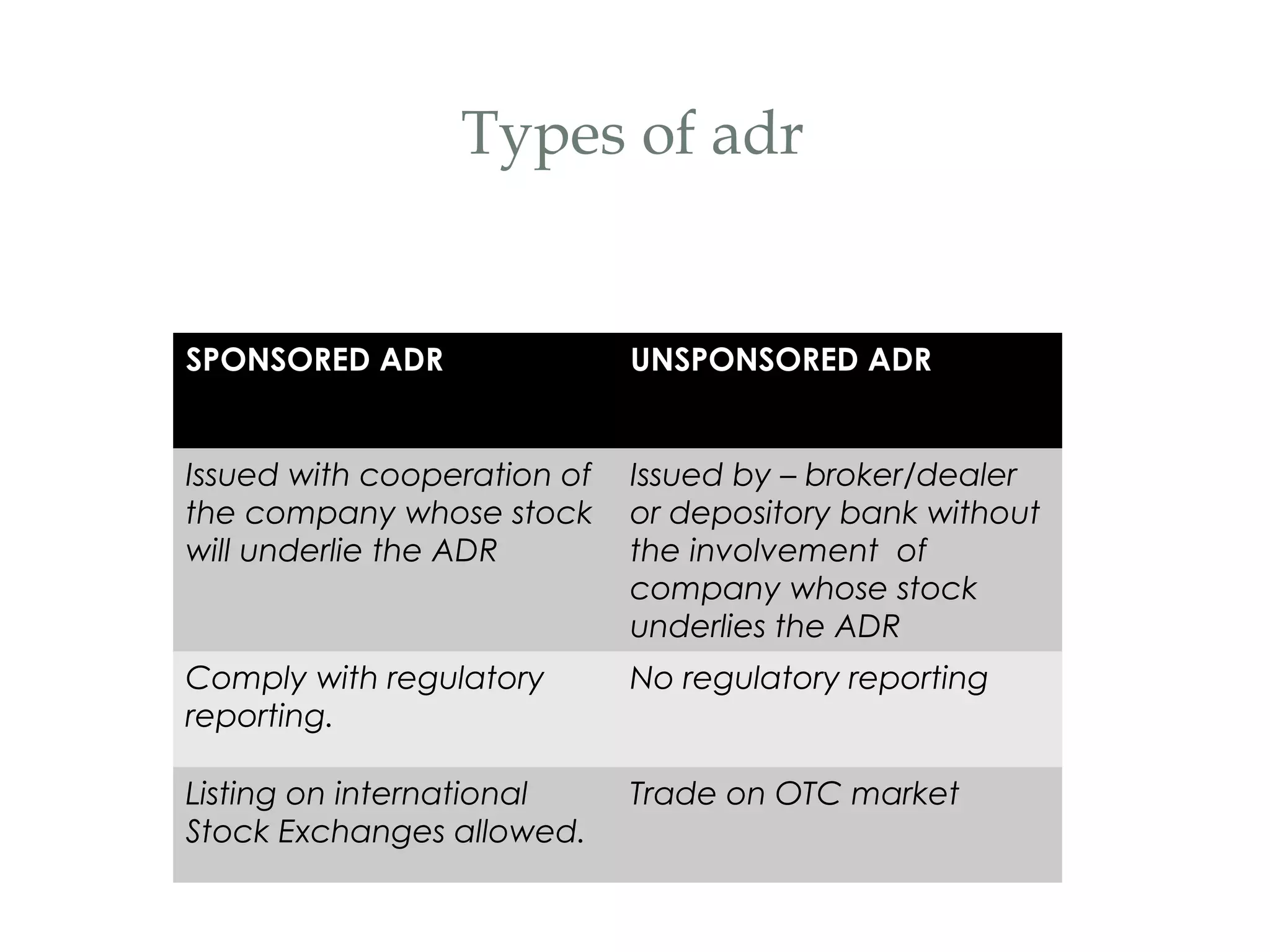
Types of adr


SPONSORED ADR                UNSPONSORED ADR


Issued with cooperation of   Issued by – broker/dealer
the company whose stock      or depository bank without
will underlie the ADR        the involvement of
                             company whose stock
                             underlies the ADR
Comply with regulatory       No regulatory reporting
reporting.

Listing on international     Trade on OTC market
Stock Exchanges allowed.
Levels of adr

• Level 1- Level 1 depositary receipts are the lowest level of
  sponsored ADRs that can be issued. When a company issues
  sponsored ADRs, it has one designated depositary who also
  acts as its transfer agent.
• Level 1 shares can only be traded on the OTC market and the
  company has minimal reporting requirements with the U.S.
  Securities and Exchange Commission [SEC].
• Level 2- Level 2 depositary receipt programs are more
  complicated for a foreign company. When a foreign company
  wants to set up a Level 2 program, it must file a registration
  statement with the U.S. SEC and is under SEC regulation.
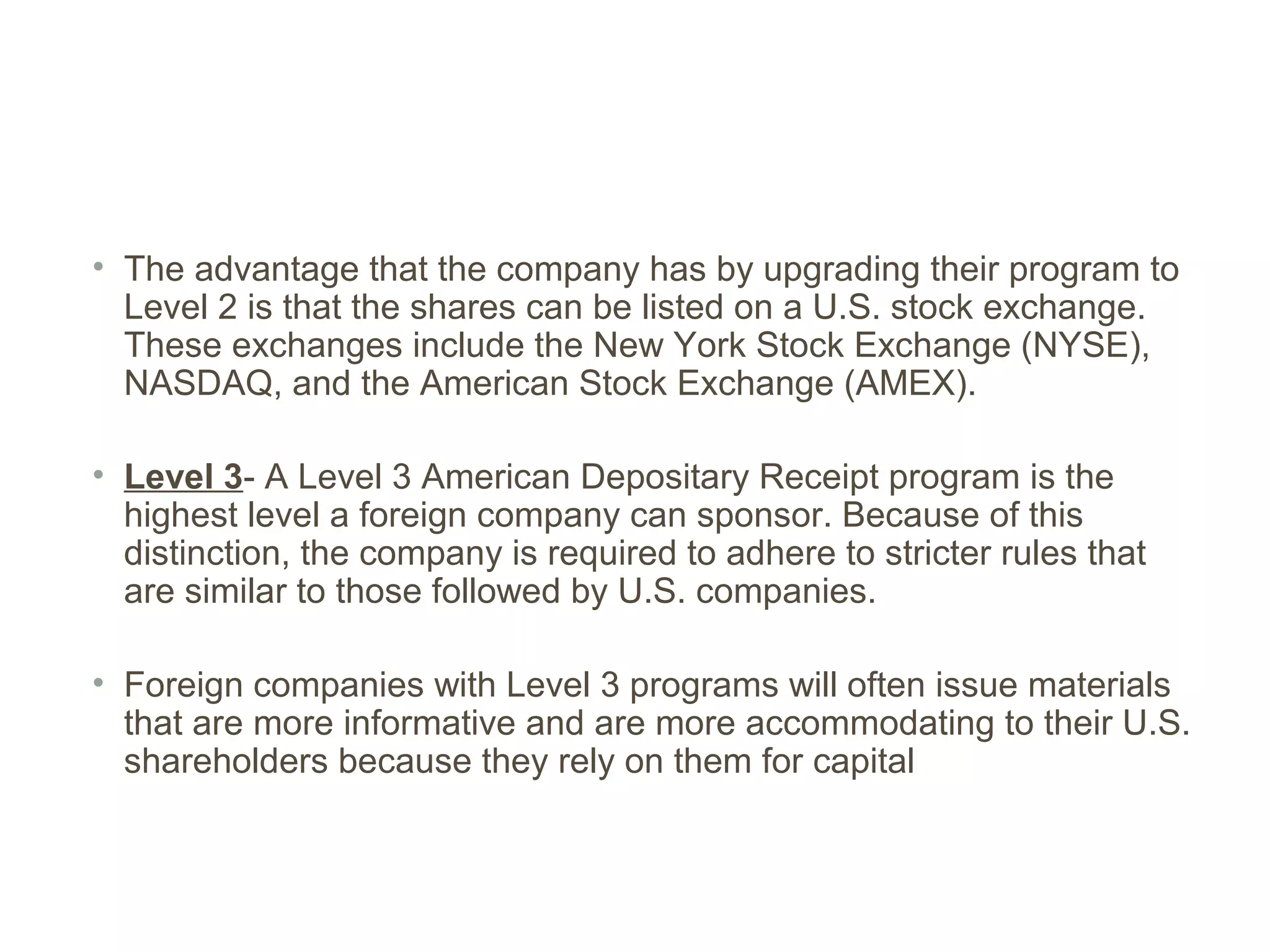
• The advantage that the company has by upgrading their program to
  Level 2 is that the shares can be listed on a U.S. stock exchange.
  These exchanges include the New York Stock Exchange (NYSE),
  NASDAQ, and the American Stock Exchange (AMEX).

• Level 3- A Level 3 American Depositary Receipt program is the
  highest level a foreign company can sponsor. Because of this
  distinction, the company is required to adhere to stricter rules that
  are similar to those followed by U.S. companies.

• Foreign companies with Level 3 programs will often issue materials
  that are more informative and are more accommodating to their U.S.
  shareholders because they rely on them for capital
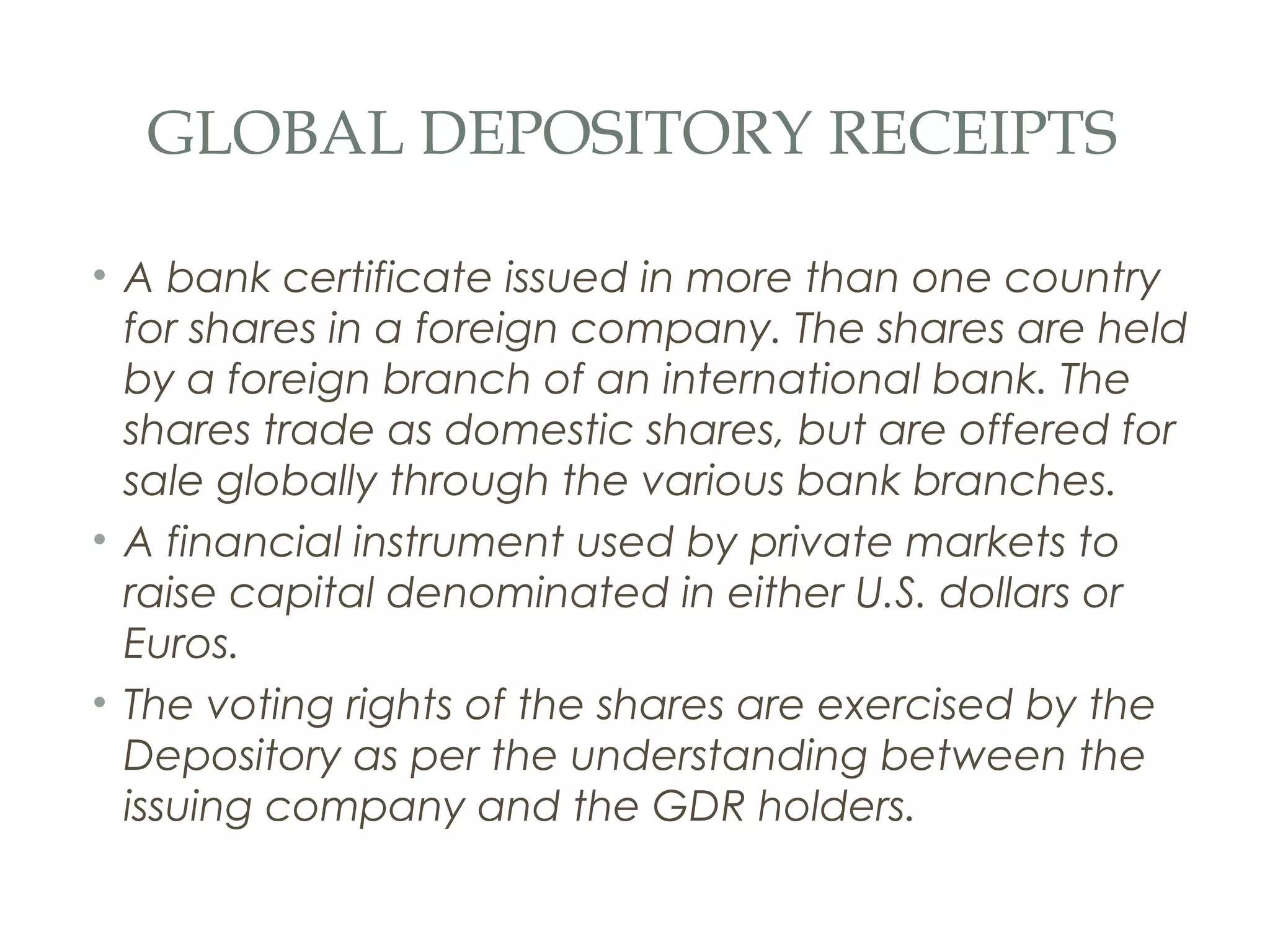
GLOBAL DEPOSITORY RECEIPTS

• A bank certificate issued in more than one country
  for shares in a foreign company. The shares are held
  by a foreign branch of an international bank. The
  shares trade as domestic shares, but are offered for
  sale globally through the various bank branches.
• A financial instrument used by private markets to
  raise capital denominated in either U.S. dollars or
  Euros.
• The voting rights of the shares are exercised by the
  Depository as per the understanding between the
  issuing company and the GDR holders.
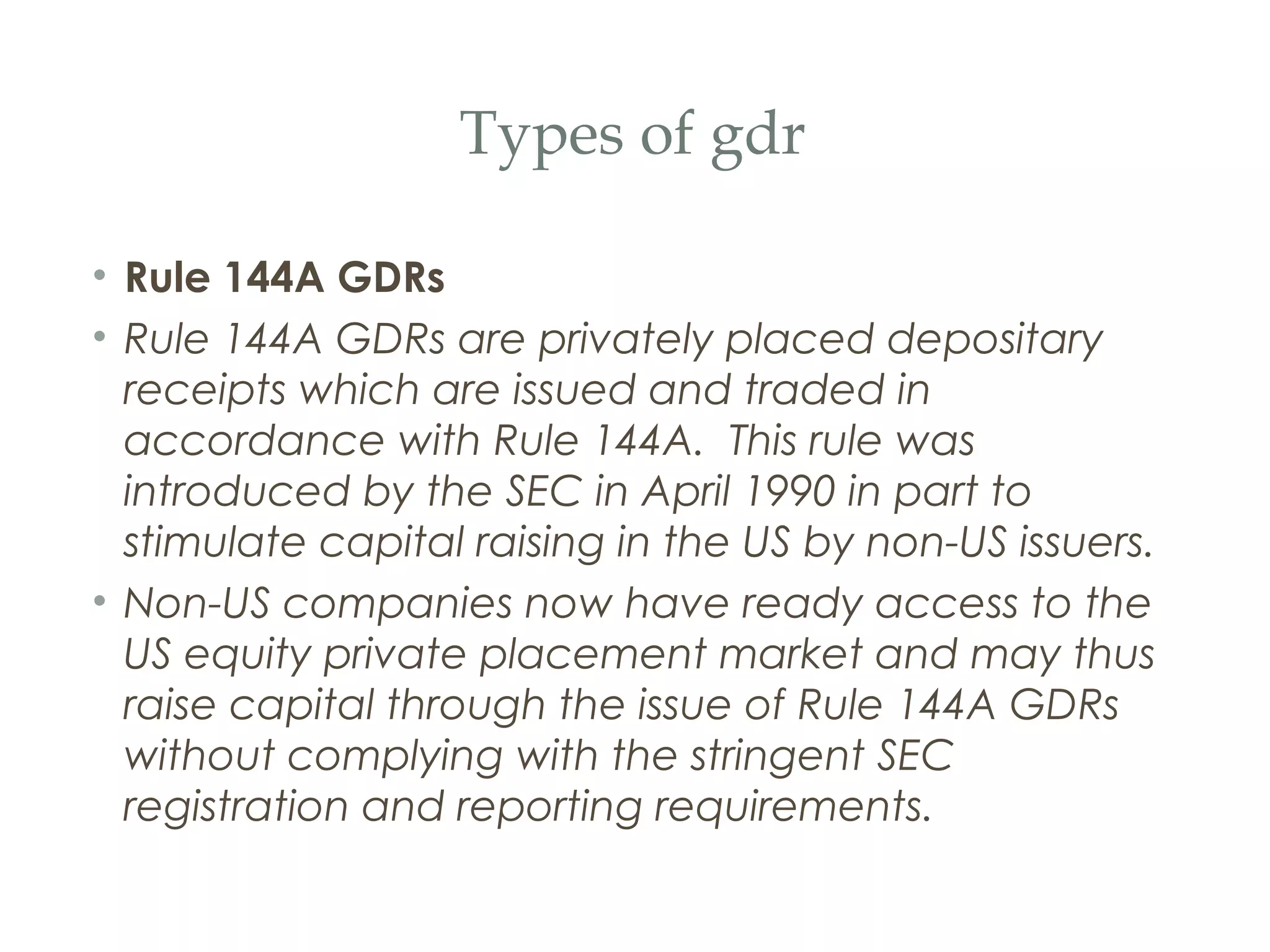
Types of gdr

• Rule 144A GDRs
• Rule 144A GDRs are privately placed depositary
  receipts which are issued and traded in
  accordance with Rule 144A.  This rule was
  introduced by the SEC in April 1990 in part to
  stimulate capital raising in the US by non-US issuers.
• Non-US companies now have ready access to the
  US equity private placement market and may thus
  raise capital through the issue of Rule 144A GDRs
  without complying with the stringent SEC
  registration and reporting requirements.
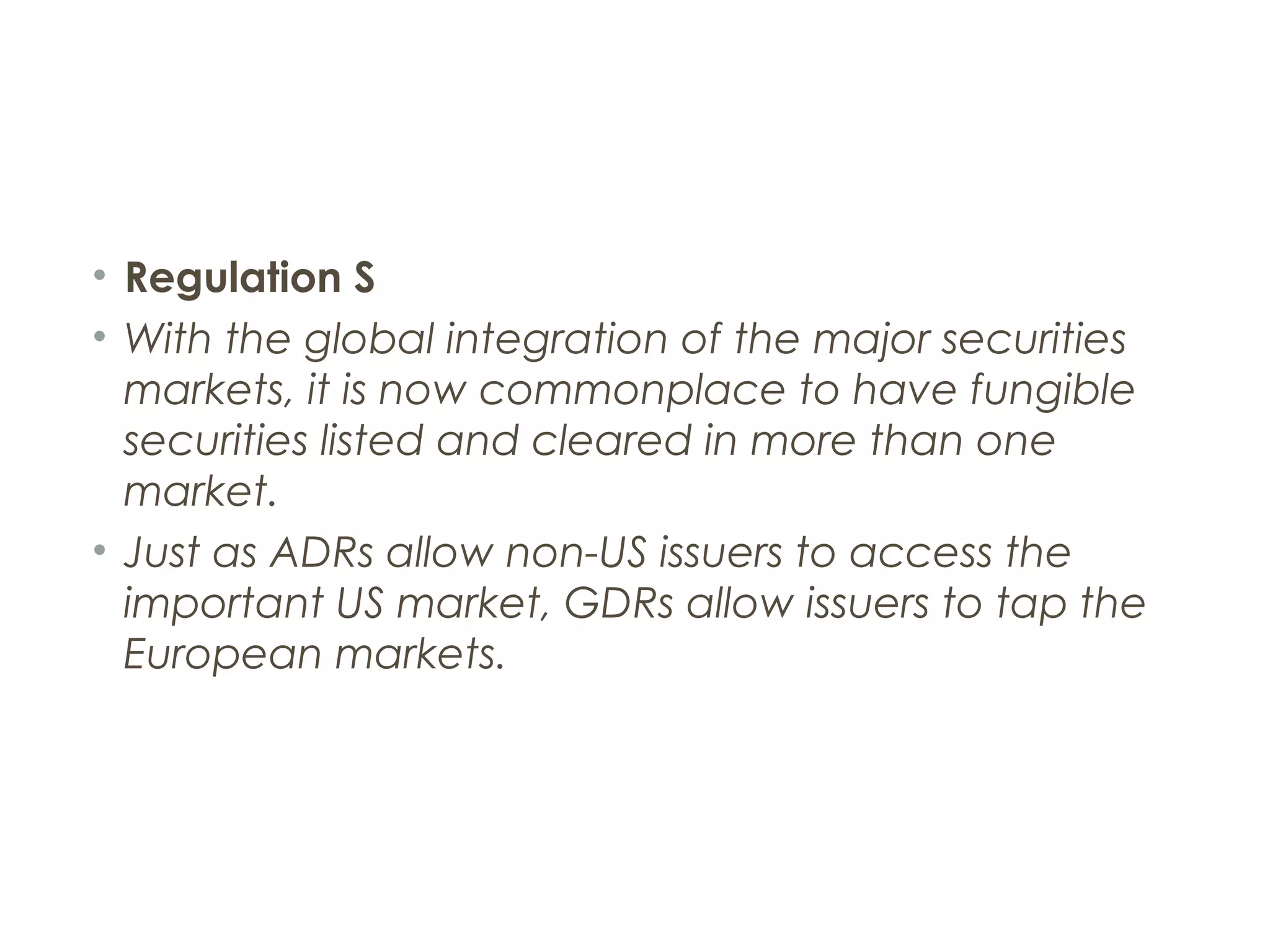
• Regulation S
• With the global integration of the major securities
  markets, it is now commonplace to have fungible
  securities listed and cleared in more than one
  market.
• Just as ADRs allow non-US issuers to access the
  important US market, GDRs allow issuers to tap the
  European markets.
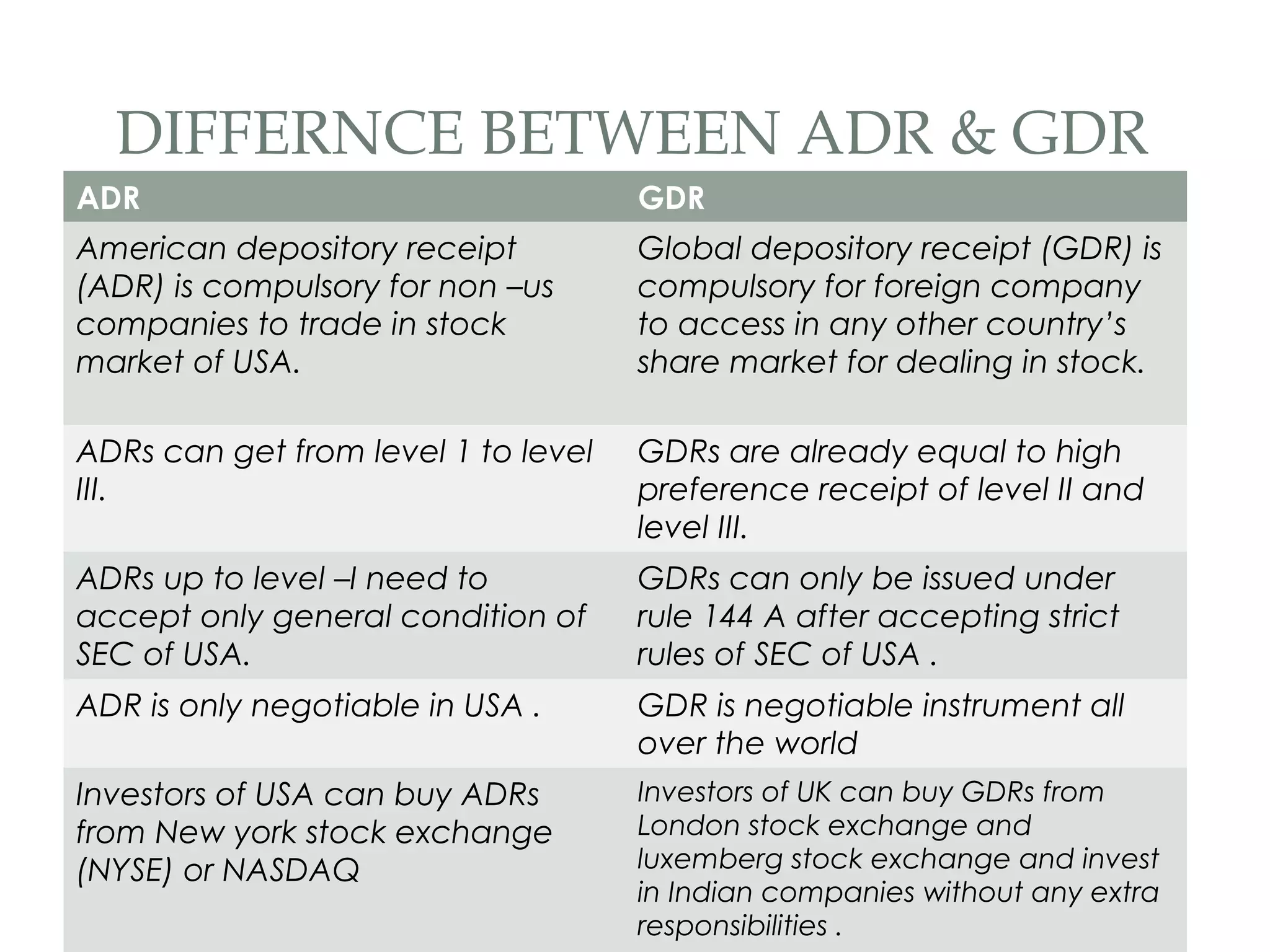
DIFFERNCE BETWEEN ADR & GDR
ADR                                  GDR
American depository receipt          Global depository receipt (GDR) is
(ADR) is compulsory for non –us      compulsory for foreign company
companies to trade in stock          to access in any other country’s
market of USA.                       share market for dealing in stock.

ADRs can get from level 1 to level   GDRs are already equal to high
III.                                 preference receipt of level II and
                                     level III.
ADRs up to level –I need to          GDRs can only be issued under
accept only general condition of     rule 144 A after accepting strict
SEC of USA.                          rules of SEC of USA .
ADR is only negotiable in USA .      GDR is negotiable instrument all
                                     over the world
Investors of USA can buy ADRs        Investors of UK can buy GDRs from
from New york stock exchange         London stock exchange and
(NYSE) or NASDAQ                     luxemberg stock exchange and invest
                                     in Indian companies without any extra
                                     responsibilities .
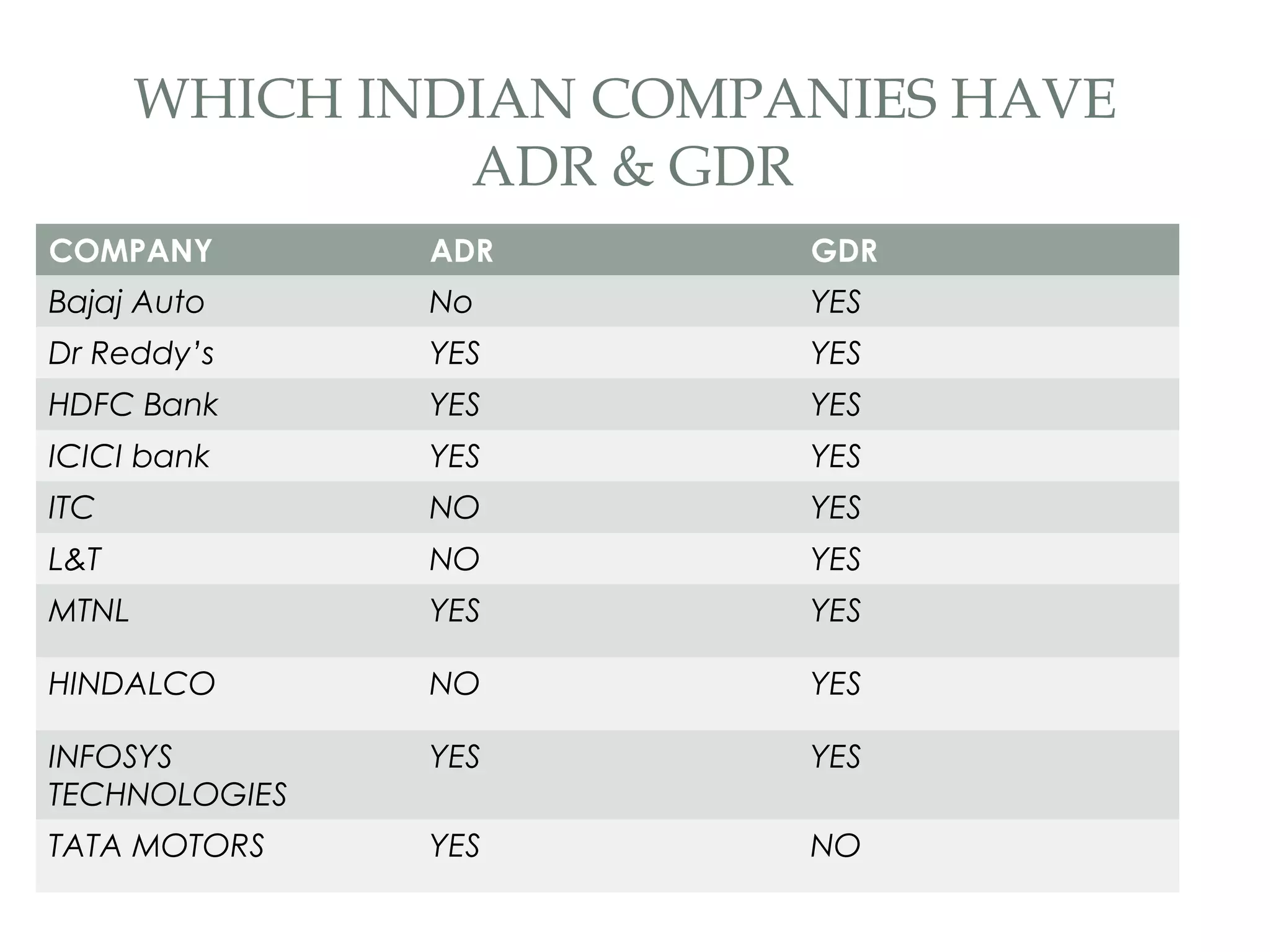
WHICH INDIAN COMPANIES HAVE
                ADR & GDR
COMPANY        ADR       GDR
Bajaj Auto     No        YES
Dr Reddy’s     YES       YES
HDFC Bank      YES       YES
ICICI bank     YES       YES
ITC            NO        YES
L&T            NO        YES
MTNL           YES       YES

HINDALCO       NO        YES

INFOSYS        YES       YES
TECHNOLOGIES
TATA MOTORS    YES       NO
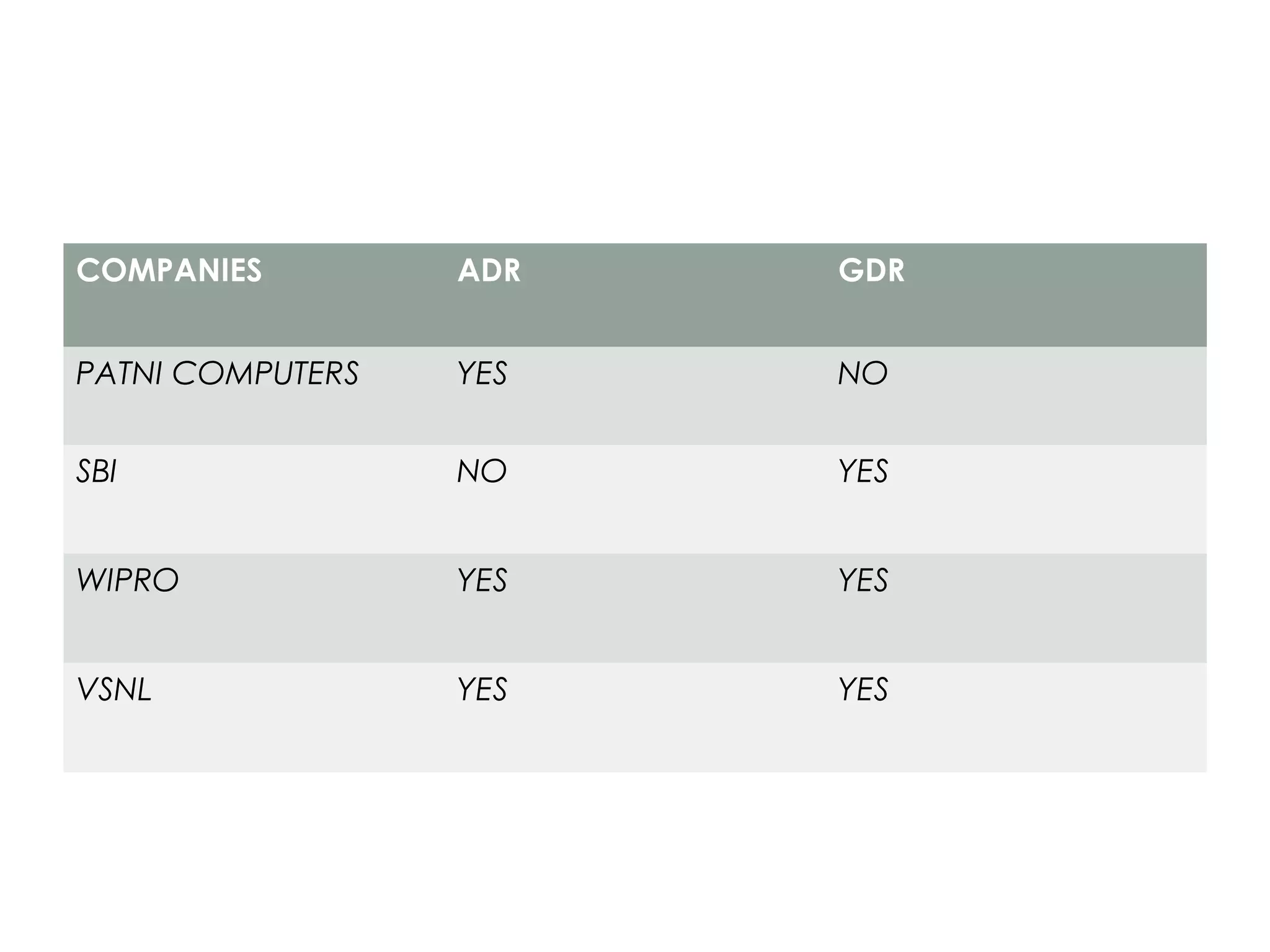
COMPANIES         ADR   GDR


PATNI COMPUTERS   YES   NO


SBI               NO    YES


WIPRO             YES   YES


VSNL              YES   YES
THANK YOU

ADR and GDR

  • 1.
    ADR & GDR PRESENTED BY: YASHAL SHAH DHAVAL KARIA VRUTANT VAKHARIA VISHAL JHAMNANI VIDYALAKSHMI SHARMA ABHIMANYU SHRIVASTAV
  • 2.
    TABLE OF CONTENTS • DEPOSITORY RECEIPTS • AMERICAN DEPOSITORY RECEIPTS (ADR) • PROCESS TO ISSUE ADR/GDR • ADVANTAGES OF ADR • TYPES OF ADR • LEVELS OF ADR • GLOBAL DEPOSITORY RECEIPTS (GDR) • TYPES OF GDR • DIFFERENCE BETWEEN ADR & GDR • EXAMPLES OF ADR & GDR
  • 3.
    Depository receipts • Depositoryreceipts are instruments issued by international depositories (ODB), and they represent an interest in the underlying shares held by them in the issuer company (Indian Company). The shares are usually held by a domestic custodian on behalf of the depositories in turn issue the depository receipts, which entitle the holder of the receipts to get the underlying shares on demand.
  • 4.
    • DRs aretraded on Stock Exchanges in the US, Singapore, Luxembourg, London, etc. • DRs listed and traded in US markets are known as American Depository Receipts (ADRs) and those listed and traded elsewhere are known as Global Depository Receipts (GDRs). In Indian context, DRs are treated as FDI
  • 5.
    INTERNATIONAL CAPITAL MARKET INTERNATIONALBOND MARKET INTERNATIONAL EQUITY MARKET EURO FOREIGN GDR ADR BOND BOND
  • 6.
    AMERICAN DEPOSITORY RECEIPTS •ADR is a dollar-denominated negotiable certificate. It represents a non-US company’s publicly traded equity. It was devised in the late 1920s to help Americans invest in overseas securities and to assist non-US companies wishing to have their stock traded in the American Markets. • ADR were introduced as a result of of the complexities involved in buying shares in foreign countries and the difficulties associated with trading at different prices and currency values.
  • 7.
    Process to issueadr/gdr Domestic Issuing Share Custodian Company certificate bank (RIL) (SBI) confirmation Foreign GDR/ADR Issue of DR Depository Holders (Morgan (Bank Of Stanley) America) Payment Clearing Foreign Stock Agency Dividend Exchange (Euro Clear) (NYSE)
  • 8.
    ADVANTAGES OF ADR/GDR •Can be listed on any of the overseas stock exchanges /OTC/Book entry transfer system. • Freely transferable by non-resident. • They can be redeemed by ODB. • The ODB should request DCB to get the corresponding underlying shares released in favor of non resident of investors. (Shareholders of issuing companies).
  • 9.
    Types of adr SPONSOREDADR UNSPONSORED ADR Issued with cooperation of Issued by – broker/dealer the company whose stock or depository bank without will underlie the ADR the involvement of company whose stock underlies the ADR Comply with regulatory No regulatory reporting reporting. Listing on international Trade on OTC market Stock Exchanges allowed.
  • 10.
    Levels of adr •Level 1- Level 1 depositary receipts are the lowest level of sponsored ADRs that can be issued. When a company issues sponsored ADRs, it has one designated depositary who also acts as its transfer agent. • Level 1 shares can only be traded on the OTC market and the company has minimal reporting requirements with the U.S. Securities and Exchange Commission [SEC]. • Level 2- Level 2 depositary receipt programs are more complicated for a foreign company. When a foreign company wants to set up a Level 2 program, it must file a registration statement with the U.S. SEC and is under SEC regulation.
  • 11.
    • The advantagethat the company has by upgrading their program to Level 2 is that the shares can be listed on a U.S. stock exchange. These exchanges include the New York Stock Exchange (NYSE), NASDAQ, and the American Stock Exchange (AMEX). • Level 3- A Level 3 American Depositary Receipt program is the highest level a foreign company can sponsor. Because of this distinction, the company is required to adhere to stricter rules that are similar to those followed by U.S. companies. • Foreign companies with Level 3 programs will often issue materials that are more informative and are more accommodating to their U.S. shareholders because they rely on them for capital
  • 12.
    GLOBAL DEPOSITORY RECEIPTS •A bank certificate issued in more than one country for shares in a foreign company. The shares are held by a foreign branch of an international bank. The shares trade as domestic shares, but are offered for sale globally through the various bank branches. • A financial instrument used by private markets to raise capital denominated in either U.S. dollars or Euros. • The voting rights of the shares are exercised by the Depository as per the understanding between the issuing company and the GDR holders.
  • 13.
    Types of gdr •Rule 144A GDRs • Rule 144A GDRs are privately placed depositary receipts which are issued and traded in accordance with Rule 144A.  This rule was introduced by the SEC in April 1990 in part to stimulate capital raising in the US by non-US issuers. • Non-US companies now have ready access to the US equity private placement market and may thus raise capital through the issue of Rule 144A GDRs without complying with the stringent SEC registration and reporting requirements.
  • 14.
    • Regulation S •With the global integration of the major securities markets, it is now commonplace to have fungible securities listed and cleared in more than one market. • Just as ADRs allow non-US issuers to access the important US market, GDRs allow issuers to tap the European markets.
  • 15.
    DIFFERNCE BETWEEN ADR& GDR ADR GDR American depository receipt Global depository receipt (GDR) is (ADR) is compulsory for non –us compulsory for foreign company companies to trade in stock to access in any other country’s market of USA. share market for dealing in stock. ADRs can get from level 1 to level GDRs are already equal to high III. preference receipt of level II and level III. ADRs up to level –I need to GDRs can only be issued under accept only general condition of rule 144 A after accepting strict SEC of USA. rules of SEC of USA . ADR is only negotiable in USA . GDR is negotiable instrument all over the world Investors of USA can buy ADRs Investors of UK can buy GDRs from from New york stock exchange London stock exchange and (NYSE) or NASDAQ luxemberg stock exchange and invest in Indian companies without any extra responsibilities .
  • 16.
    WHICH INDIAN COMPANIESHAVE ADR & GDR COMPANY ADR GDR Bajaj Auto No YES Dr Reddy’s YES YES HDFC Bank YES YES ICICI bank YES YES ITC NO YES L&T NO YES MTNL YES YES HINDALCO NO YES INFOSYS YES YES TECHNOLOGIES TATA MOTORS YES NO
  • 17.
    COMPANIES ADR GDR PATNI COMPUTERS YES NO SBI NO YES WIPRO YES YES VSNL YES YES
  • 18.