The Cadence Distinguished Speaker Series Presents Thank you for joining us.  The session will begin momentarily. Negotiating For Project Success with Randy Englund
Introduction with John Patton CEO, Cadence Management Corporation The Cadence Distinguished Speaker Series Presents Negotiating For Project Success with Randy Englund
Are You Prepared? Randall L. Englund ,  MBA, BSEE, NPDP, CBM Englund Project Management Consultancy www.englundpmc.com “ Choose always the way that seems the best, however rough it may be.  Custom will soon render it easy and agreeable.”  -  Pythagoreas
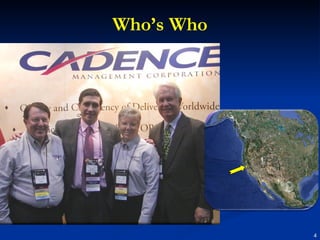
Who’s Who
Premises (1) The results delivered by projects depend upon what you negotiate Successful project leaders: Explore a perspective, principles, tools, and recommendations to achieve better results through the power of negotiations Avoid being set up for failure by recognizing and developing skills that lead to greater success Negotiating is fun, and it is productive Everything is negotiable, both at work and in everyday lives. "If you want to build a ship, do not start by looking for lumber, cutting boards or sorting out the work.  First evoke in men the longing for the wide open sea."   - Antoine de Saint Exupery
Premises (2) It is in our best interests, and for your team and organization, that you embrace negotiating as a requisite skill…and implement it dutifully. Are you fully equipped to get the best outcomes possible?  Learn ten basic “rules,” develop negotiating skills, and reap the benefits. This effort will change your life.
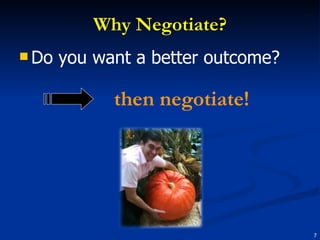
Why Negotiate? Do you want a better outcome? then negotiate!
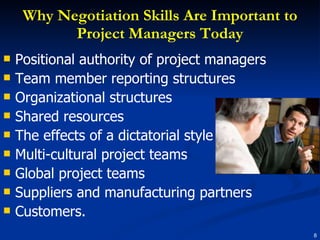
Why Negotiation Skills Are Important to Project Managers Today Positional authority of project managers Team member reporting structures Organizational structures Shared resources The effects of a dictatorial style Multi-cultural project teams Global project teams Suppliers and manufacturing partners Customers.
Benefits of Negotiation What if you could  improve  your negotiating  abilities  by five to ten percent? Negotiate clear success criteria and set yourself up for  success  instead of failure Efficiently and amicably arrive at fair business  outcomes Obtain reliable and well-understood  commitments  from project contributors Better  value  and lower costs Maintain and build  relationships Unanticipated, valuable  outcomes . “ I f you are planning on doing business with someone again, don't be too tough in the negotiations.  If you're going to skin a cat, don't keep it as a house cat.” - Marvin S. Levin
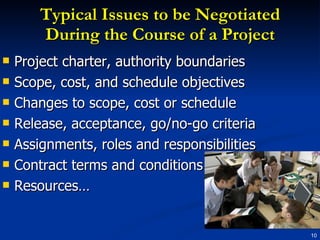
Typical Issues to be Negotiated During the Course of a Project Project charter, authority boundaries Scope, cost, and schedule objectives Changes to scope, cost or schedule Release, acceptance, go/no-go criteria Assignments, roles and responsibilities Contract terms and conditions Resources…
Substantive Issues that Need to be Negotiated Terms Conditions Prices Dates Numbers Liabilities What about…the definition of project success?
What is Negotiation? Negotiation is  communication  back and forth for the purpose of making a joint  decision . Negotiating is a way of finding a mutually acceptable  solution  to a shared problem. Mediation is negotiation with the assistance of a neutral third party. “ Your real purpose:  to get the other guy to choose what  you  want – for  his  own reasons.” Ideal  outcome :  A  wise decision ,  efficiently  and  amicably  agreed upon. “ A s long as you keep a person down, some part of you has to be down there to hold him down, so it means you cannot soar as you otherwise might.”  - Marian Anderson
Negotiation Styles Hard  (controlling) Hard bargaining is  adversarial —you assume that your opponent is your enemy and the only way you can win is if he or she loses.  So you bargain in a very aggressive, competitive way. Soft  (giving in) Soft bargaining is just the opposite.  Your  relationship  with your opponent is so important that you concede much more easily than you should.  You get taken advantage of in your effort to please, and while agreement is reached easily, it is seldom a wise one. Principled. Ref: Roger Fisher, William Ury, and Bruce Patton's best-selling book,  Getting to Yes  (1991)
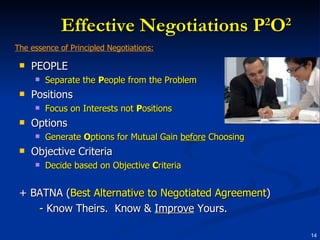
Effective Negotiations P 2 O 2 PEOPLE Separate the  P eople from the Problem Positions Focus on Interests not  P ositions Options Generate  O ptions for Mutual Gain  before  Choosing Objective Criteria Decide based on Objective  C riteria + BATNA ( Best Alternative to Negotiated Agreement ) - Know Theirs.  Know &  Improve  Yours. The essence of Principled Negotiations:
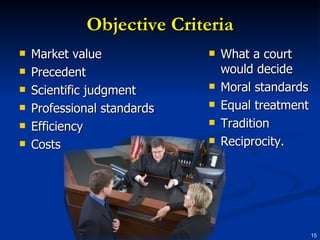
Objective Criteria Market value Precedent Scientific judgment Professional standards Efficiency Costs What a court would decide Moral standards Equal treatment Tradition Reciprocity.
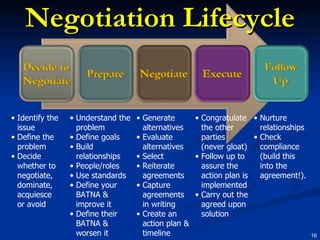
Negotiation Lifecycle Identify the issue Define the problem Decide whether to negotiate, dominate, acquiesce or avoid Congratulate the other parties (never gloat) Follow up to assure the action plan is implemented Carry out the agreed upon solution Nurture relationships Check compliance (build this into the agreement!). Generate alternatives Evaluate alternatives Select  Reiterate agreements Capture agreements in writing Create an action plan & timeline Understand the problem Define goals Build relationships People/roles Use standards Define your BATNA & improve it Define their BATNA & worsen it
Preparation Phase Can it be negotiated? Should it be? If yes, when? (timing) BATNAS Preparation checklist “ Framework” agreements: boiler plates, fill in the blanks. “ Where facts are few, experts are many.”  -  Donald R. Gannon
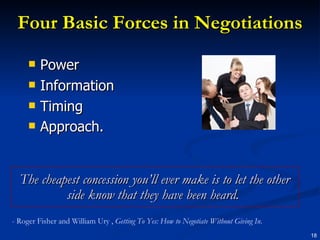
Four Basic Forces in Negotiations Power Information Timing Approach.   The cheapest concession you’ll ever make is to let the other side know that they have been heard.  - Roger Fisher and William Ury ,  Getting To Yes: How to Negotiate Without Giving In .
Power Within the Organization Influencing within the organization is the ability to “get things done” Influencing involves politics and power Power is the potential ability to influence behavior, to change the course of events, to overcome resistance, and to get people to do things that they would not otherwise do Politics is about getting collective action from  a group of people who may have quite different interests.  Ref: PMBOK, 2000 “ No man ever listened himself out of a job.”  - Calvin Coolidge
Sources of Power in Negotiations Influencing involves politics and power Developing good working relationships among people negotiating Understanding interests Inventing an elegant option Using external standards and benchmarks Developing a good BATNA Understanding their BATNA Making a carefully crafted commitment:  an offer, something you will do, something you will not do. Ref: Fisher & Ury,  Getting to Yes .
The Third Alternative We humans are presently conditioned to expect our relationships to be win/lose.  View most situations from an “either/or” point of view:  either I win or I lose It has to be one or the other.  There is a  third alternative .  May be harder to find, but there almost always exists a third way of doing things where no one loses Or at worst are assured that the loss has been minimized and fairly shared  Minimizes and distributes the loss so it has the least negative effect  This is the  win-win  way — this is synergy.  Ref: Future Positive, Synearth. http://futurepositive.synearth.net/2003/07/24
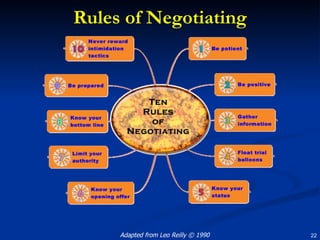
Rules of Negotiating Adapted from Leo Reilly © 1990
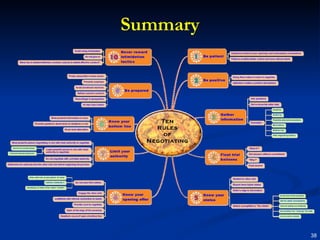
Be patient Impatience leads to poor openings and unnecessary concessions Patience enables better control and more rational deals.
Be positive Being liked makes it easier to negotiate Optimism creates a positive atmosphere.
Gather information Ask questions Get to know the other side Examples: Deadline Authority Possible alternative solutions Motivations Bottom line Past negotiating history.
Float trial balloons "What if?" Get answers without commitment "Why?" Float several.
Know your status Relation to other side Buyers have higher status Seller's edge is information Sellers susceptible to "the nibble" at the end of the process ask for small concessions that are easily surrendered as condition for "closing" the sale are not price related.
Know your opening offer (1) Do not open first unless: other side has no perception of value tradition demands it necessary to lower other side's "shield" Engage the other side Justifiable with rational connection to needs…
Know your opening offer (2) Provide room to negotiate Open at the edge of the envelope Deadlock occurs if open at bottom line.
Limit your authority (1) Most powerful person negotiating is one with least authority to negotiate Least powerful person is one with most authority to negotiate…
Limit your authority (2) Do not negotiate with unlimited authority cannot be pinned down "institutionalized patience” Determine the authority that the other side has before beginning the process.
Know your bottom line Most powerful information to have Provides guidance about when to deadlock or not Know best alternative.
Be prepared Proper preparation means power Prevents surprises Avoid emotional reactions Defuse coercive conduct Place things in perspective Or else lose control.
Never reward intimidation tactics Avoid being intimidated Do not give in Never try to negotiate with ineffective conduct; only try to negotiate with effective conduct.
Another Rule: for every concession you make,  get something in return!
Closing a Negotiation Reach agreement Reiterate Capture Follow up Execute  Nurture the relationships. “ In the business world, the rearview mirror is always clearer than the windshield.”   - Warren Buffett
Ten Negotiation Techniques Make the pie bigger Use humor Show your strength  Ask a question Review your preparation (privately) Breathe deeply Name hard-line tactics Take a break Use silence (after your proposal) Reframe an issue. “ Tis better to be silent and be thought a fool, than to speak and remove all doubt.”   -   Abraham Lincoln
Summary
References Englund Project Management Consultancy www.englundpmc.com [email_address]
The Cadence Distinguished Speaker Series Presents Thank you for joining us! Negotiating For Project Success with Randy Englund
Beyond the Webinar Professional Development Units (PDUs)  Our courses qualify for PDU credit or Education Contact hours from the Project Management Institute. Contact PMI at  www.pmi.org  for processing details. cadencemc.com/training The award-winning Cadence project management methodology is the foundation of all our project management training, consulting, tools, and software. Learn more about how world-class companies are delivering business results with Cadence. Award-winning Project Management Training from Cadence Cadence Graduates on LinkedIn cadencemc.com/linkedin Follow @AskCadence on Twitter twitter.com/askcadence Join the Cadence Fan Page on Facebook cadencemc.com/facebook Subscribe to the Cadence Mailing List cadencemc.com/enews

Negotiating for project success

  • 1.
    The Cadence DistinguishedSpeaker Series Presents Thank you for joining us. The session will begin momentarily. Negotiating For Project Success with Randy Englund
  • 2.
    Introduction with JohnPatton CEO, Cadence Management Corporation The Cadence Distinguished Speaker Series Presents Negotiating For Project Success with Randy Englund
  • 3.
    Are You Prepared?Randall L. Englund , MBA, BSEE, NPDP, CBM Englund Project Management Consultancy www.englundpmc.com “ Choose always the way that seems the best, however rough it may be. Custom will soon render it easy and agreeable.” - Pythagoreas
  • 4.
  • 5.
    Premises (1) Theresults delivered by projects depend upon what you negotiate Successful project leaders: Explore a perspective, principles, tools, and recommendations to achieve better results through the power of negotiations Avoid being set up for failure by recognizing and developing skills that lead to greater success Negotiating is fun, and it is productive Everything is negotiable, both at work and in everyday lives. "If you want to build a ship, do not start by looking for lumber, cutting boards or sorting out the work. First evoke in men the longing for the wide open sea." - Antoine de Saint Exupery
  • 6.
    Premises (2) Itis in our best interests, and for your team and organization, that you embrace negotiating as a requisite skill…and implement it dutifully. Are you fully equipped to get the best outcomes possible?  Learn ten basic “rules,” develop negotiating skills, and reap the benefits. This effort will change your life.
  • 7.
    Why Negotiate? Doyou want a better outcome? then negotiate!
  • 8.
    Why Negotiation SkillsAre Important to Project Managers Today Positional authority of project managers Team member reporting structures Organizational structures Shared resources The effects of a dictatorial style Multi-cultural project teams Global project teams Suppliers and manufacturing partners Customers.
  • 9.
    Benefits of NegotiationWhat if you could improve your negotiating abilities by five to ten percent? Negotiate clear success criteria and set yourself up for success instead of failure Efficiently and amicably arrive at fair business outcomes Obtain reliable and well-understood commitments from project contributors Better value and lower costs Maintain and build relationships Unanticipated, valuable outcomes . “ I f you are planning on doing business with someone again, don't be too tough in the negotiations. If you're going to skin a cat, don't keep it as a house cat.” - Marvin S. Levin
  • 10.
    Typical Issues tobe Negotiated During the Course of a Project Project charter, authority boundaries Scope, cost, and schedule objectives Changes to scope, cost or schedule Release, acceptance, go/no-go criteria Assignments, roles and responsibilities Contract terms and conditions Resources…
  • 11.
    Substantive Issues thatNeed to be Negotiated Terms Conditions Prices Dates Numbers Liabilities What about…the definition of project success?
  • 12.
    What is Negotiation?Negotiation is communication back and forth for the purpose of making a joint decision . Negotiating is a way of finding a mutually acceptable solution to a shared problem. Mediation is negotiation with the assistance of a neutral third party. “ Your real purpose: to get the other guy to choose what you want – for his own reasons.” Ideal outcome : A wise decision , efficiently and amicably agreed upon. “ A s long as you keep a person down, some part of you has to be down there to hold him down, so it means you cannot soar as you otherwise might.” - Marian Anderson
  • 13.
    Negotiation Styles Hard (controlling) Hard bargaining is adversarial —you assume that your opponent is your enemy and the only way you can win is if he or she loses. So you bargain in a very aggressive, competitive way. Soft (giving in) Soft bargaining is just the opposite. Your relationship with your opponent is so important that you concede much more easily than you should. You get taken advantage of in your effort to please, and while agreement is reached easily, it is seldom a wise one. Principled. Ref: Roger Fisher, William Ury, and Bruce Patton's best-selling book, Getting to Yes (1991)
  • 14.
    Effective Negotiations P2 O 2 PEOPLE Separate the P eople from the Problem Positions Focus on Interests not P ositions Options Generate O ptions for Mutual Gain before Choosing Objective Criteria Decide based on Objective C riteria + BATNA ( Best Alternative to Negotiated Agreement ) - Know Theirs. Know & Improve Yours. The essence of Principled Negotiations:
  • 15.
    Objective Criteria Marketvalue Precedent Scientific judgment Professional standards Efficiency Costs What a court would decide Moral standards Equal treatment Tradition Reciprocity.
  • 16.
    Negotiation Lifecycle Identifythe issue Define the problem Decide whether to negotiate, dominate, acquiesce or avoid Congratulate the other parties (never gloat) Follow up to assure the action plan is implemented Carry out the agreed upon solution Nurture relationships Check compliance (build this into the agreement!). Generate alternatives Evaluate alternatives Select Reiterate agreements Capture agreements in writing Create an action plan & timeline Understand the problem Define goals Build relationships People/roles Use standards Define your BATNA & improve it Define their BATNA & worsen it
  • 17.
    Preparation Phase Canit be negotiated? Should it be? If yes, when? (timing) BATNAS Preparation checklist “ Framework” agreements: boiler plates, fill in the blanks. “ Where facts are few, experts are many.” - Donald R. Gannon
  • 18.
    Four Basic Forcesin Negotiations Power Information Timing Approach. The cheapest concession you’ll ever make is to let the other side know that they have been heard. - Roger Fisher and William Ury , Getting To Yes: How to Negotiate Without Giving In .
  • 19.
    Power Within theOrganization Influencing within the organization is the ability to “get things done” Influencing involves politics and power Power is the potential ability to influence behavior, to change the course of events, to overcome resistance, and to get people to do things that they would not otherwise do Politics is about getting collective action from a group of people who may have quite different interests. Ref: PMBOK, 2000 “ No man ever listened himself out of a job.” - Calvin Coolidge
  • 20.
    Sources of Powerin Negotiations Influencing involves politics and power Developing good working relationships among people negotiating Understanding interests Inventing an elegant option Using external standards and benchmarks Developing a good BATNA Understanding their BATNA Making a carefully crafted commitment: an offer, something you will do, something you will not do. Ref: Fisher & Ury, Getting to Yes .
  • 21.
    The Third AlternativeWe humans are presently conditioned to expect our relationships to be win/lose. View most situations from an “either/or” point of view: either I win or I lose It has to be one or the other. There is a third alternative . May be harder to find, but there almost always exists a third way of doing things where no one loses Or at worst are assured that the loss has been minimized and fairly shared Minimizes and distributes the loss so it has the least negative effect This is the win-win way — this is synergy. Ref: Future Positive, Synearth. http://futurepositive.synearth.net/2003/07/24
  • 22.
    Rules of NegotiatingAdapted from Leo Reilly © 1990
  • 23.
    Be patient Impatienceleads to poor openings and unnecessary concessions Patience enables better control and more rational deals.
  • 24.
    Be positive Beingliked makes it easier to negotiate Optimism creates a positive atmosphere.
  • 25.
    Gather information Askquestions Get to know the other side Examples: Deadline Authority Possible alternative solutions Motivations Bottom line Past negotiating history.
  • 26.
    Float trial balloons"What if?" Get answers without commitment "Why?" Float several.
  • 27.
    Know your statusRelation to other side Buyers have higher status Seller's edge is information Sellers susceptible to "the nibble" at the end of the process ask for small concessions that are easily surrendered as condition for "closing" the sale are not price related.
  • 28.
    Know your openingoffer (1) Do not open first unless: other side has no perception of value tradition demands it necessary to lower other side's "shield" Engage the other side Justifiable with rational connection to needs…
  • 29.
    Know your openingoffer (2) Provide room to negotiate Open at the edge of the envelope Deadlock occurs if open at bottom line.
  • 30.
    Limit your authority(1) Most powerful person negotiating is one with least authority to negotiate Least powerful person is one with most authority to negotiate…
  • 31.
    Limit your authority(2) Do not negotiate with unlimited authority cannot be pinned down "institutionalized patience” Determine the authority that the other side has before beginning the process.
  • 32.
    Know your bottomline Most powerful information to have Provides guidance about when to deadlock or not Know best alternative.
  • 33.
    Be prepared Properpreparation means power Prevents surprises Avoid emotional reactions Defuse coercive conduct Place things in perspective Or else lose control.
  • 34.
    Never reward intimidationtactics Avoid being intimidated Do not give in Never try to negotiate with ineffective conduct; only try to negotiate with effective conduct.
  • 35.
    Another Rule: forevery concession you make, get something in return!
  • 36.
    Closing a NegotiationReach agreement Reiterate Capture Follow up Execute Nurture the relationships. “ In the business world, the rearview mirror is always clearer than the windshield.” - Warren Buffett
  • 37.
    Ten Negotiation TechniquesMake the pie bigger Use humor Show your strength Ask a question Review your preparation (privately) Breathe deeply Name hard-line tactics Take a break Use silence (after your proposal) Reframe an issue. “ Tis better to be silent and be thought a fool, than to speak and remove all doubt.” - Abraham Lincoln
  • 38.
  • 39.
    References Englund ProjectManagement Consultancy www.englundpmc.com [email_address]
  • 40.
    The Cadence DistinguishedSpeaker Series Presents Thank you for joining us! Negotiating For Project Success with Randy Englund
  • 41.
    Beyond the WebinarProfessional Development Units (PDUs) Our courses qualify for PDU credit or Education Contact hours from the Project Management Institute. Contact PMI at www.pmi.org for processing details. cadencemc.com/training The award-winning Cadence project management methodology is the foundation of all our project management training, consulting, tools, and software. Learn more about how world-class companies are delivering business results with Cadence. Award-winning Project Management Training from Cadence Cadence Graduates on LinkedIn cadencemc.com/linkedin Follow @AskCadence on Twitter twitter.com/askcadence Join the Cadence Fan Page on Facebook cadencemc.com/facebook Subscribe to the Cadence Mailing List cadencemc.com/enews

Editor's Notes

  • #2 © 2010 Randall L. Englund Negotiating for Project Success www.englundpmc.com
  • #3 © 2010 Randall L. Englund Negotiating for Project Success www.englundpmc.com
  • #4 © 2010 Randall L. Englund Negotiating for Project Success www.englundpmc.com Randall L. Englund , is an independent management executive consultant, author, trainer, speaker, and professional facilitator. He founded his own consulting business, Englund Project Management Consultancy (www.englundpmc.com) . He speaks and consults world-wide to client management teams and coaches executives about their role in creating an environment that optimizes results from project-based work. In addition to numerous papers and articles, Randy co-authored three best selling business management books: Creating an Environment for Successful Projects, Creating the Project Office, and Project Sponsorship . His previous experience was as a senior project manager at Hewlett-Packard Company in the Project Management Initiative, whose purpose as a project office was to lead the continuous improvement of project management across the company.  At HP, Randy led workshops and consulted with product developers on cross-organizational projects. During his 22 years at HP, Randy was a program manager in computer system product development and participated in new product development teams, bringing personal computer systems to market and resolving difficult cross-organizational issues. He was a major account marketing engineer and a manufacturing engineer for real time computer systems. Randy also worked for General Electric Medical Systems as a field service installation supervisor. Randy holds a B.S.E.E. from the University of California, Santa Barbara, an M.B.A. in Management from San Francisco State University, an honorary Engineering and Management degree from Cal Poly State University, San Luis Obispo, and attended Stanford University's “Converting Strategy into Action” and “Mastering the Project Portfolio” programs. He is a certified by PDMA as a New Product Development Professional (NPDP) and as a Certified Business Manager (CBM) by the Association of Professionals in Business Management. He was awarded as a Beta Gamma Sigma member, earning lifetime recognition for exemplary achievements in business academics. Contact Randy at englundr@pacbell.net.
  • #5 © 2010 Randall L. Englund Negotiating for Project Success www.englundpmc.com Randy Englund is an independent project management consultant, author, and speaker. He’s a former senior project manager at HP’s Project Management Initiative and new product development. View his web page at www.englundpmc.com and email at [email_address] Randy offers consulting and training services to people in management, managing projects, and working on project teams.  His approach includes the behavioral, technical, business, and change management aspects that create an environment for project success.  Randy uniquely blends metaphors, multimedia, examples, and insights to motivate others and attain desired results. An organic approach adapts effective concepts from nature to make organizations more project-friendly. Alfonso Bucero, PMP is an independent consultant, founder, partner and director of BUCERO PM Consulting in Spain. Alfonso contributed to the book Creating the Project Office , and co-authored the book Project Sponsorship with Randall L. Englund. Drawing from many years as an HP project manager, he has presented and written numerous papers in the project management field. He is a Contributing Editor of PM Network (Project Management Institute). View his web page at www.abucero.com and email at alfonso.bucero@abucero.com. Cadence Management Corporation is a full-service project management training and consulting firm. John Patton is President, and Connie Plowman is Chief Operating Officer. View Cadence on the web at www.cadencemc.com.
  • #6 © 2010 Randall L. Englund Negotiating for Project Success www.englundpmc.com
  • #7 © 2010 Randall L. Englund Negotiating for Project Success www.englundpmc.com
  • #8 © 2010 Randall L. Englund Negotiating for Project Success www.englundpmc.com
  • #9 © 2010 Randall L. Englund Negotiating for Project Success www.englundpmc.com
  • #10 © 2010 Randall L. Englund Negotiating for Project Success www.englundpmc.com
  • #11 © 2010 Randall L. Englund Negotiating for Project Success www.englundpmc.com
  • #12 © 2010 Randall L. Englund Negotiating for Project Success www.englundpmc.com
  • #13 © 2010 Randall L. Englund Negotiating for Project Success www.englundpmc.com (Ask them what THEY think and capture.) Negotiation is communicating back and forth about something in order to arrive at a mutually acceptable solution.
  • #14 © 2010 Randall L. Englund Negotiating for Project Success www.englundpmc.com
  • #15 © 2010 Randall L. Englund Negotiating for Project Success www.englundpmc.com
  • #16 © 2010 Randall L. Englund Negotiating for Project Success www.englundpmc.com
  • #17 © 2010 Randall L. Englund Negotiating for Project Success www.englundpmc.com
  • #18 © 2010 Randall L. Englund Negotiating for Project Success www.englundpmc.com
  • #19 © 2010 Randall L. Englund Negotiating for Project Success www.englundpmc.com
  • #20 © 2010 Randall L. Englund Negotiating for Project Success www.englundpmc.com
  • #21 © 2010 Randall L. Englund Negotiating for Project Success www.englundpmc.com
  • #22 © 2010 Randall L. Englund Negotiating for Project Success www.englundpmc.com Frisbee game story - - - “Who’s winning?”
  • #23 © 2010 Randall L. Englund Negotiating for Project Success www.englundpmc.com
  • #24 © 2010 Randall L. Englund Negotiating for Project Success www.englundpmc.com
  • #25 © 2010 Randall L. Englund Negotiating for Project Success www.englundpmc.com
  • #26 © 2010 Randall L. Englund Negotiating for Project Success www.englundpmc.com
  • #27 © 2010 Randall L. Englund Negotiating for Project Success www.englundpmc.com
  • #28 © 2010 Randall L. Englund Negotiating for Project Success www.englundpmc.com
  • #29 © 2010 Randall L. Englund Negotiating for Project Success www.englundpmc.com
  • #30 © 2010 Randall L. Englund Negotiating for Project Success www.englundpmc.com
  • #31 © 2010 Randall L. Englund Negotiating for Project Success www.englundpmc.com
  • #32 © 2010 Randall L. Englund Negotiating for Project Success www.englundpmc.com
  • #33 © 2010 Randall L. Englund Negotiating for Project Success www.englundpmc.com
  • #34 © 2010 Randall L. Englund Negotiating for Project Success www.englundpmc.com
  • #35 © 2010 Randall L. Englund Negotiating for Project Success www.englundpmc.com
  • #36 © 2010 Randall L. Englund Negotiating for Project Success www.englundpmc.com
  • #37 © 2010 Randall L. Englund Negotiating for Project Success www.englundpmc.com
  • #38 © 2010 Randall L. Englund Negotiating for Project Success www.englundpmc.com
  • #39 © 2010 Randall L. Englund Negotiating for Project Success www.englundpmc.com
  • #40 © 2010 Randall L. Englund Negotiating for Project Success www.englundpmc.com In their latest book on Project Sponsorship , Randall Englund and Alfonso Bucero’s objective is to unlock and open the door to excellence in project sponsorship. Executives need training, experience, and practice to be effective sponsors. Sponsorship is a required and critical success factor for all projects, in all industries and disciplines. Move forward, because every day is a good day for change.
  • #41 © 2010 Randall L. Englund Negotiating for Project Success www.englundpmc.com