NEGOTIABLE INSTRUMENTS
BILL OF EXCHANGE, PROMISSORY NOTE
AND CHEQUE
ASST. PROF.VAGHELA NAYAN
SDJ INTERNATIONAL COLLEGE
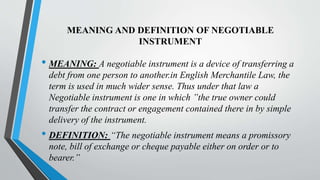
MEANING AND DEFINITION OF NEGOTIABLE
INSTRUMENT
• MEANING: A negotiable instrument is a device of transferring a
debt from one person to another.in English Merchantile Law, the
term is used in much wider sense. Thus under that law a
Negotiable instrument is one in which ”the true owner could
transfer the contract or engagement contained there in by simple
delivery of the instrument.
• DEFINITION: “The negotiable instrument means a promissory
note, bill of exchange or cheque payable either on order or to
bearer.”
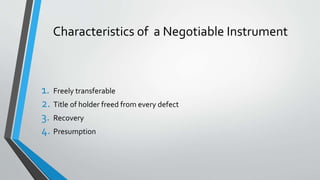
Characteristics of a Negotiable Instrument
1. Freely transferable
2. Title of holder freed from every defect
3. Recovery
4. Presumption
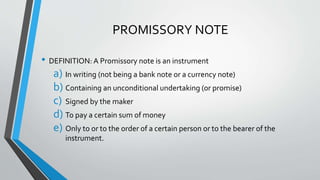
PROMISSORY NOTE
• DEFINITION: A Promissory note is an instrument
a) In writing (not being a bank note or a currency note)
b) Containing an unconditional undertaking (or promise)
c) Signed by the maker
d) To pay a certain sum of money
e) Only to or to the order of a certain person or to the bearer of the
instrument.
Essential Characteristics of Promissory Note
1. An instrument in writing
2. Signed by the maker
3. Promise to pay
4. Unconditional
5. Definite
6. Stamped
7. Certain sum of money
8. Promise to pay money only
9. To a certain person
10.Payable on demand or after a certain period of time
11.Promissory note payable to bearer is prohibited by RBI Act
Bill of Exchange
• Definition: A Bill of Exchange is an instrument
a) In writing
b) Containing an unconditional order
c) Signed by the maker
d) Directing a certain person to pay
e) A certain sum of money
f) Only to or to the order of a certain person or to the bearer of the
instrument.
Parties to a Bill of Exchange
1. Drawer: the person who makes the instrument.
2. Drawee: the person who is directed to pay.
3. Payee: the receiver of the payment.
4. Holder: the person who possesses the instrument . (Drawer/Payee)
5. Acceptor: the person who accepts to pay certain sum of money by signing
the instrument.
6. Acceptor for honour: the third person other than Payee when accepts to
pay on his behalf.
Features of Bill of Exchange
1. It must be in writing.
2. Signed by the drawer.
3. Containing an order to pay.
4. Drawer, drawee and payee must be certain and definite individuals.
5. Certain sum of money.
6. Payment in LegalTender Money only.
7. Properly stamped.
8. Payable on demand or after a certain period of time.
9. Cannot be drawn as payable on demand to bearer originally.
Cheque
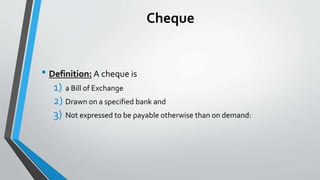
• Definition: A cheque is
1) a Bill of Exchange
2) Drawn on a specified bank and
3) Not expressed to be payable otherwise than on demand:
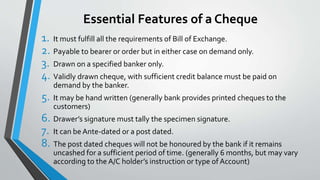
Essential Features of a Cheque
1. It must fulfill all the requirements of Bill of Exchange.
2. Payable to bearer or order but in either case on demand only.
3. Drawn on a specified banker only.
4. Validly drawn cheque, with sufficient credit balance must be paid on
demand by the banker.
5. It may be hand written (generally bank provides printed cheques to the
customers)
6. Drawer’s signature must tally the specimen signature.
7. It can be Ante-dated or a post dated.
8. The post dated cheques will not be honoured by the bank if it remains
uncashed for a sufficient period of time. (generally 6 months, but may vary
according to the A/C holder’s instruction or type of Account)
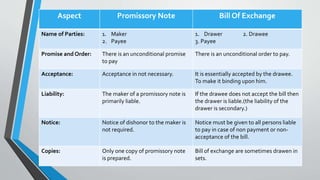
Aspect Promissory Note Bill Of Exchange
Name of Parties: 1. Maker
2. Payee
1. Drawer 2. Drawee
3. Payee
Promise and Order: There is an unconditional promise
to pay
There is an unconditional order to pay.
Acceptance: Acceptance in not necessary. It is essentially accepted by the drawee.
To make it binding upon him.
Liability: The maker of a promissory note is
primarily liable.
If the drawee does not accept the bill then
the drawer is liable.(the liability of the
drawer is secondary.)
Notice: Notice of dishonor to the maker is
not required.
Notice must be given to all persons liable
to pay in case of non payment or non-
acceptance of the bill.
Copies: Only one copy of promissory note
is prepared.
Bill of exchange are sometimes drawen in
sets.
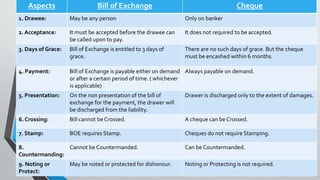
Aspects Bill of Exchange Cheque
1. Drawee: May be any person Only on banker
2. Acceptance: It must be accepted before the drawee can
be called upon to pay.
It does not required to be accepted.
3. Days of Grace: Bill of Exchange is entitled to 3 days of
grace.
There are no such days of grace. But the cheque
must be encashed within 6 months.
4. Payment: Bill of Exchange is payable either on demand
or after a certain period of time. ( whichever
is applicable)
Always payable on demand.
5. Presentation: On the non presentation of the bill of
exchange for the payment, the drawer will
be discharged from the liability.
Drawer is discharged only to the extent of damages.
6. Crossing: Bill cannot be Crossed. A cheque can be Crossed.
7. Stamp: BOE requires Stamp. Cheques do not require Stamping.
8.
Countermanding:
Cannot be Countermanded. Can be Countermanded.
9. Noting or
Protect:
May be noted or protected for dishonour. Noting or Protecting is not required.
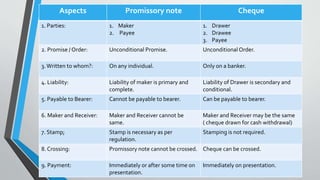
Aspects Promissory note Cheque
1. Parties: 1. Maker
2. Payee
1. Drawer
2. Drawee
3. Payee
2. Promise / Order: Unconditional Promise. Unconditional Order.
3.Written to whom?: On any individual. Only on a banker.
4. Liability: Liability of maker is primary and
complete.
Liability of Drawer is secondary and
conditional.
5. Payable to Bearer: Cannot be payable to bearer. Can be payable to bearer.
6. Maker and Receiver: Maker and Receiver cannot be
same.
Maker and Receiver may be the same
( cheque drawn for cash withdrawal)
7. Stamp; Stamp is necessary as per
regulation.
Stamping is not required.
8. Crossing: Promissory note cannot be crossed. Cheque can be crossed.
9. Payment: Immediately or after some time on
presentation.
Immediately on presentation.
ThankYou

Negotiable instruments

  • 1.
    NEGOTIABLE INSTRUMENTS BILL OFEXCHANGE, PROMISSORY NOTE AND CHEQUE ASST. PROF.VAGHELA NAYAN SDJ INTERNATIONAL COLLEGE
  • 2.
    MEANING AND DEFINITIONOF NEGOTIABLE INSTRUMENT • MEANING: A negotiable instrument is a device of transferring a debt from one person to another.in English Merchantile Law, the term is used in much wider sense. Thus under that law a Negotiable instrument is one in which ”the true owner could transfer the contract or engagement contained there in by simple delivery of the instrument. • DEFINITION: “The negotiable instrument means a promissory note, bill of exchange or cheque payable either on order or to bearer.”
  • 3.
    Characteristics of aNegotiable Instrument 1. Freely transferable 2. Title of holder freed from every defect 3. Recovery 4. Presumption
  • 4.
    PROMISSORY NOTE • DEFINITION:A Promissory note is an instrument a) In writing (not being a bank note or a currency note) b) Containing an unconditional undertaking (or promise) c) Signed by the maker d) To pay a certain sum of money e) Only to or to the order of a certain person or to the bearer of the instrument.
  • 5.
    Essential Characteristics ofPromissory Note 1. An instrument in writing 2. Signed by the maker 3. Promise to pay 4. Unconditional 5. Definite 6. Stamped 7. Certain sum of money 8. Promise to pay money only 9. To a certain person 10.Payable on demand or after a certain period of time 11.Promissory note payable to bearer is prohibited by RBI Act
  • 6.
    Bill of Exchange •Definition: A Bill of Exchange is an instrument a) In writing b) Containing an unconditional order c) Signed by the maker d) Directing a certain person to pay e) A certain sum of money f) Only to or to the order of a certain person or to the bearer of the instrument.
  • 7.
    Parties to aBill of Exchange 1. Drawer: the person who makes the instrument. 2. Drawee: the person who is directed to pay. 3. Payee: the receiver of the payment. 4. Holder: the person who possesses the instrument . (Drawer/Payee) 5. Acceptor: the person who accepts to pay certain sum of money by signing the instrument. 6. Acceptor for honour: the third person other than Payee when accepts to pay on his behalf.
  • 8.
    Features of Billof Exchange 1. It must be in writing. 2. Signed by the drawer. 3. Containing an order to pay. 4. Drawer, drawee and payee must be certain and definite individuals. 5. Certain sum of money. 6. Payment in LegalTender Money only. 7. Properly stamped. 8. Payable on demand or after a certain period of time. 9. Cannot be drawn as payable on demand to bearer originally.
  • 9.
    Cheque • Definition: Acheque is 1) a Bill of Exchange 2) Drawn on a specified bank and 3) Not expressed to be payable otherwise than on demand:
  • 10.
    Essential Features ofa Cheque 1. It must fulfill all the requirements of Bill of Exchange. 2. Payable to bearer or order but in either case on demand only. 3. Drawn on a specified banker only. 4. Validly drawn cheque, with sufficient credit balance must be paid on demand by the banker. 5. It may be hand written (generally bank provides printed cheques to the customers) 6. Drawer’s signature must tally the specimen signature. 7. It can be Ante-dated or a post dated. 8. The post dated cheques will not be honoured by the bank if it remains uncashed for a sufficient period of time. (generally 6 months, but may vary according to the A/C holder’s instruction or type of Account)
  • 11.
    Aspect Promissory NoteBill Of Exchange Name of Parties: 1. Maker 2. Payee 1. Drawer 2. Drawee 3. Payee Promise and Order: There is an unconditional promise to pay There is an unconditional order to pay. Acceptance: Acceptance in not necessary. It is essentially accepted by the drawee. To make it binding upon him. Liability: The maker of a promissory note is primarily liable. If the drawee does not accept the bill then the drawer is liable.(the liability of the drawer is secondary.) Notice: Notice of dishonor to the maker is not required. Notice must be given to all persons liable to pay in case of non payment or non- acceptance of the bill. Copies: Only one copy of promissory note is prepared. Bill of exchange are sometimes drawen in sets.
  • 12.
    Aspects Bill ofExchange Cheque 1. Drawee: May be any person Only on banker 2. Acceptance: It must be accepted before the drawee can be called upon to pay. It does not required to be accepted. 3. Days of Grace: Bill of Exchange is entitled to 3 days of grace. There are no such days of grace. But the cheque must be encashed within 6 months. 4. Payment: Bill of Exchange is payable either on demand or after a certain period of time. ( whichever is applicable) Always payable on demand. 5. Presentation: On the non presentation of the bill of exchange for the payment, the drawer will be discharged from the liability. Drawer is discharged only to the extent of damages. 6. Crossing: Bill cannot be Crossed. A cheque can be Crossed. 7. Stamp: BOE requires Stamp. Cheques do not require Stamping. 8. Countermanding: Cannot be Countermanded. Can be Countermanded. 9. Noting or Protect: May be noted or protected for dishonour. Noting or Protecting is not required.
  • 13.
    Aspects Promissory noteCheque 1. Parties: 1. Maker 2. Payee 1. Drawer 2. Drawee 3. Payee 2. Promise / Order: Unconditional Promise. Unconditional Order. 3.Written to whom?: On any individual. Only on a banker. 4. Liability: Liability of maker is primary and complete. Liability of Drawer is secondary and conditional. 5. Payable to Bearer: Cannot be payable to bearer. Can be payable to bearer. 6. Maker and Receiver: Maker and Receiver cannot be same. Maker and Receiver may be the same ( cheque drawn for cash withdrawal) 7. Stamp; Stamp is necessary as per regulation. Stamping is not required. 8. Crossing: Promissory note cannot be crossed. Cheque can be crossed. 9. Payment: Immediately or after some time on presentation. Immediately on presentation.
  • 14.