CONSIDERATION
DEFINITION OF CONSIDERATION
According to Pollock ,“Consideration is the
price for which the promise of other is brought & the
promise thus given for value is enforceable.”
According to section 2(d),
When at the desire of the promisor, the promisee or any other
person:
(a) has done or abstained from doing , or [Past
consideration]
(b) does or abstains from doing, or [Present consideration]
(c) promises to do or abstain from doing something [Future
consideration ] such act or abstinence or promise is
called a consideration for the promise.
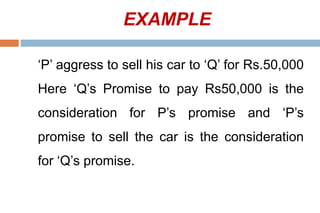
EXAMPLE
‘P’ aggress to sell his car to ‘Q’ for Rs.50,000
Here ‘Q’s Promise to pay Rs50,000 is the
consideration for P’s promise and ‘P’s
promise to sell the car is the consideration
for ‘Q’s promise.
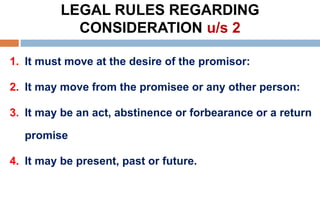
LEGAL RULES REGARDING
CONSIDERATION u/s 2
1. It must move at the desire of the promisor:
2. It may move from the promisee or any other person:
3. It may be an act, abstinence or forbearance or a return
promise
4. It may be present, past or future.
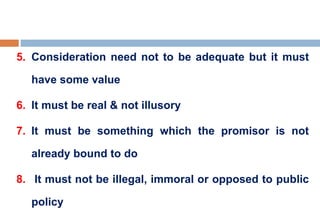
5. Consideration need not to be adequate but it must
have some value
6. It must be real & not illusory
7. It must be something which the promisor is not
already bound to do
8. It must not be illegal, immoral or opposed to public
policy
1. It must move at the desire of the
promisor:
It must be offered by the promisee at the
desire or request of the promisor. An act
done at the desire or request of the third
party does not form a valid consideration.
2. It may move from the promisee
or any other person:
Consideration may move from the
promisee or any other person i.e. even a
stranger.
3. It may be an act, abstinence or
forbearance or a return promise
The following are good consideration for the
contract:
i. Forbearance To Sue
ii. Compromise Of A Disputed Claim
iii. Composition With Creditors
4. It may be present, past or
future.
i. Past Consideration
ii. Present Or Executed Consideration
iii. Future Or Executory Consideration
5. Consideration need not to be
adequate
Consideration need not to be adequate but it
must have some value
6. It must be real & not illusory
There is no consideration in the following
cases:
i. Physical impossibility
ii. Legal impossibility
iii. Uncertain consideration
7. It must be something which the
promisor is not already bound to do
A promise to do what one is bound to do ,either
by general law or under an existing contract, is
not a good consideration
8. It must not be illegal, immoral or
opposed to public policy
Unlawful consideration includes any activities
which:
1. Is forbidden by law.
2. Is fraudulent.
3. Is of such nature that, it will defeat a provision
of any law.
4. Involves any injury to the person or property of
another.
5. The Court regards it as immoral or opposed to
public policy.
EXCEPTIONS OF THE RULE
“NO CONSIDERATION NO CONTRACT” U/S 25
1. On account of Natural Love & Affection u/s 25(1)
2. For voluntary services u/s 25(2)
3. For promise to pay time-barred debts 25(3)
4. In the case of completed gifts
5. In the case of Agency u/s 185
6. Remission by the promisee, of performance of the
promise.
1. ON ACCOUNT OF NATURAL
LOVE & AFFECTION U/S 25(1)
Such agreements are enforceable even without
consideration
2. FOR VOLUNTARY SERVICES U/S 25(2)
A promise to compensate wholly or in part, a
person who has voluntarily done something for
the promisor, is enforceable, even without
consideration.
3. FOR PROMISE TO PAY TIME-BARRED
DEBTS 25(3)
A promise by a debtor to pay a time barred debt
is enforceable provided it is in writing and signed
by the debtor or his agent.
4. IN THE CASE OF COMPLETED GIFTS
The rule no consideration no contract does not
apply.
5. IN THE CASE OF AGENCY U/S 185
To create an agency relationship consideration is
not necessary.
6. REMISSION BY THE PROMISEE, ON
PERFORMANCE OF THE PROMISE U/S 63
 A creditor can agree to excuse a whole debt or
a part of it without any consideration for doing
so.
 A promisee can agree to extend the time of
performance of promise.
example: X ows Rs. 500 to Y. X pays Rs. 100 &
Y accepts in full satisfaction of his claim.

Consideration

  • 1.
  • 2.
    DEFINITION OF CONSIDERATION Accordingto Pollock ,“Consideration is the price for which the promise of other is brought & the promise thus given for value is enforceable.”
  • 3.
    According to section2(d), When at the desire of the promisor, the promisee or any other person: (a) has done or abstained from doing , or [Past consideration] (b) does or abstains from doing, or [Present consideration] (c) promises to do or abstain from doing something [Future consideration ] such act or abstinence or promise is called a consideration for the promise.
  • 4.
    EXAMPLE ‘P’ aggress tosell his car to ‘Q’ for Rs.50,000 Here ‘Q’s Promise to pay Rs50,000 is the consideration for P’s promise and ‘P’s promise to sell the car is the consideration for ‘Q’s promise.
  • 5.
    LEGAL RULES REGARDING CONSIDERATIONu/s 2 1. It must move at the desire of the promisor: 2. It may move from the promisee or any other person: 3. It may be an act, abstinence or forbearance or a return promise 4. It may be present, past or future.
  • 6.
    5. Consideration neednot to be adequate but it must have some value 6. It must be real & not illusory 7. It must be something which the promisor is not already bound to do 8. It must not be illegal, immoral or opposed to public policy
  • 7.
    1. It mustmove at the desire of the promisor: It must be offered by the promisee at the desire or request of the promisor. An act done at the desire or request of the third party does not form a valid consideration.
  • 8.
    2. It maymove from the promisee or any other person: Consideration may move from the promisee or any other person i.e. even a stranger.
  • 9.
    3. It maybe an act, abstinence or forbearance or a return promise The following are good consideration for the contract: i. Forbearance To Sue ii. Compromise Of A Disputed Claim iii. Composition With Creditors
  • 10.
    4. It maybe present, past or future. i. Past Consideration ii. Present Or Executed Consideration iii. Future Or Executory Consideration
  • 11.
    5. Consideration neednot to be adequate Consideration need not to be adequate but it must have some value
  • 12.
    6. It mustbe real & not illusory There is no consideration in the following cases: i. Physical impossibility ii. Legal impossibility iii. Uncertain consideration
  • 13.
    7. It mustbe something which the promisor is not already bound to do A promise to do what one is bound to do ,either by general law or under an existing contract, is not a good consideration
  • 14.
    8. It mustnot be illegal, immoral or opposed to public policy Unlawful consideration includes any activities which: 1. Is forbidden by law. 2. Is fraudulent. 3. Is of such nature that, it will defeat a provision of any law. 4. Involves any injury to the person or property of another. 5. The Court regards it as immoral or opposed to public policy.
  • 15.
    EXCEPTIONS OF THERULE “NO CONSIDERATION NO CONTRACT” U/S 25 1. On account of Natural Love & Affection u/s 25(1) 2. For voluntary services u/s 25(2) 3. For promise to pay time-barred debts 25(3) 4. In the case of completed gifts 5. In the case of Agency u/s 185 6. Remission by the promisee, of performance of the promise.
  • 16.
    1. ON ACCOUNTOF NATURAL LOVE & AFFECTION U/S 25(1) Such agreements are enforceable even without consideration
  • 17.
    2. FOR VOLUNTARYSERVICES U/S 25(2) A promise to compensate wholly or in part, a person who has voluntarily done something for the promisor, is enforceable, even without consideration.
  • 18.
    3. FOR PROMISETO PAY TIME-BARRED DEBTS 25(3) A promise by a debtor to pay a time barred debt is enforceable provided it is in writing and signed by the debtor or his agent.
  • 19.
    4. IN THECASE OF COMPLETED GIFTS The rule no consideration no contract does not apply.
  • 20.
    5. IN THECASE OF AGENCY U/S 185 To create an agency relationship consideration is not necessary.
  • 21.
    6. REMISSION BYTHE PROMISEE, ON PERFORMANCE OF THE PROMISE U/S 63  A creditor can agree to excuse a whole debt or a part of it without any consideration for doing so.  A promisee can agree to extend the time of performance of promise. example: X ows Rs. 500 to Y. X pays Rs. 100 & Y accepts in full satisfaction of his claim.