Negotiable Instruments Act 1881
Evolution of this Act
 The act was originally drafted in 1866 by the 3rd indian law commission and
introduced in Dec.1867 in the council and it was referred to a selction committee.
 Objections were raised by the mercantile community to the numerous deviations
from the English law which it contained.
 The bill had to be redrafted in 1877. After the lapse of a sufficient period for
criticism by local governments, the high courts and the chambers of commerce, the
bill was revised by the selection committee. In spite of this bill could not reach the
final stage
 In 1880, by the order of the secretary of state, the bill had to referred to a new La
Commission. On the recommendation of the Bill was re-drafted and again it was
sent to a selection committee
 The draft thus prepared fro the fourth time was introduced in the council and was
passed into law in 1881 being the Negotiable Instruments Act 1881.
Negotiable Instruments
A negotiable instrument is a piece of paper which entitles a person to a certain sum of money and
which is transferable from one to another person by a delivery or by endorsement and delivery.
A negotiable instrument is a document guaranteeing the payment of a specific amount of money,
either on demand, or at a set time, with the payer named on the document
The term Negotiable instrument literally means a written document transferable by delivery.
• According to this Act ―A negotiable instrument means a Promissory Note, Bill of exchange
or Cheque payable either to order or to bearer.
Definition of a Negotiable Instrument
• A “Negotiable instrument” means a promissory note, bill of exchange or cheque payable either to
order to bearer (Section 13)
• An instrument may be negotiable either by (1) Statute or (2) by usage Promissory note, bill of
exchange, Cheque – By statute, Bank notes, Bank drafts, share warrants, bearer adventures, dividend
warrants, scripts and treasury bills by usage.
Nature
1. A negotiable instrument must be in writing
2. A negotiable instrument must be signed by its maker
3. A negotiable instrument must contain an unconditional promise or order today some money
4. A negotiable instrument must contain a certain amount of money only
5. A negotiable instrument must be freely transferable from one person to
another
6. On the transfer of a negotiable instrument from one person to another, the transferee who receives it in a good
faith and for value has the right to recover the amount mentioned in the negotiable instrument in his own
name. Such person is known as holder in due course. His rights are not affected by any defect in the title of the
transferee or any prior party
7. Drawn on consideration
8. Transfer by delivery
9. Bonafide transferee
10. The holder can sue in his own name
11. Can be transferred any number of times (Infinity) still its maturity.
12. It is subject to certain presumptions
Presumptions and Perquisites
(section 118 & 119)
1. As to consideration : Every negotiable instrument is deemed to have been made, drawn,
accepted, endorsed, negotiated or transferred or transformed for consideration (Marimuthu
Kounder Vs Radakrishnan and other AIR 1991, Kerala 39)
2. As to date: Every negotiable instrument bear the date on which it is made or drawn.
3. As to acceptance: Every bill of exchange was accepted within a reasonable time after the date
mentioned therein and before the date of its maturity.
4. As to transfer: Transfer was made before the date of maturity, in the case of an instrument
payable, otherwise than or demand.
5. As to be order of endorsement: The endorsement appearing on it were made in the order in
which they have taken.
6. As to lost instruments: Where an instrument has been lost or destroyed, that it was duly stamped
and the stamp was duly cancelled.
7. As to the hidden in due course: The holder of the instrument is a holder in due course.
8. As to dishonor: Court shall on the proof of protest, pressure the fact of dishonor unless it is
disproved.
Promissory Note
Promissory Note
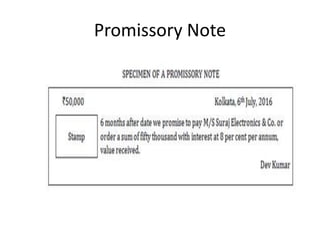
According to section 4 of the Act, A promissory
note is:
a. an instrument (not being a bank note or a
currency-note) in writing;
b. containing an unconditional undertaking;
c. signed by the maker;
d. to pay a certain sum of money only to, or to
the order of, a certain person, or to the bearer
of the instrument.
Characteristics
1. Should be in writing
2. Promise to pay: We have received a sum of Rs. 9000 from Shri R.R. Sharma. This amount will be repaid
on demand. We have received the amount in cash. Use of word promise is not essential to constitute an
instrument as ‘Promissory Note’.
3. Unconditional
4. Signed by the maker
5. (Certain parties
6. Certain sum of money
7. (Promise to pay money only
8. (Number, place, date etc – usually found but aspect essential in law – If it is undated it is deemed to
have been made when it was delivered.
9. May be payable in installments
10. (It may be payable on demand or after a definite period (A demand promissory note becomes times
barred on expiry of 3 years from the date it bears)
11. It cannot be made payable to bearer on demand or even payable to bearer after a certain period (sec 31 of
RBI Act)
12. It must be duly stamped under the Indian Stamp Act.
13. Parties: Promisor/ Payer or Promisee/Payee
Examples of promissory note
Example of Promissory Notes
• (a) I promise to pay “B” or order Rs. 500
• (b) I acknowledge myself to be indebted to B for Rs. 1000
to be paid on demand for value received.
Not Promissory Notes
• a) “Mr. B, I.O.U. (I owe you) Rs. 1000
• b) I am liable to pay you Rs. 500
• c) I promise to pay B Rs. 500 and all other sums which
shall be due to.
• d) I promise to pay B Rs. 500; first deducting there out any
money in own me.
• e) I promise to pay Rs. 1500 on D’s death, provided be
leaves me enough to pay that sum.
• f) I promise to pay ‘B’ Rs. 500 seven days after my
marriage with C.
• g) I promise to pay ‘B’ Rs. 500 and to deliver him my
scooter on 1st January 2004.
Bill of Exchange
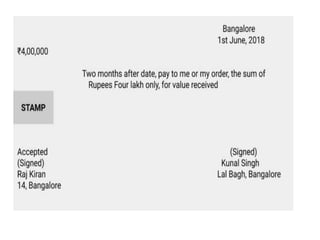
A bill of exchange is:
a. an instrument in writing
b. containing an unconditional order,
c. signed by the maker,
d. directing a certain person, to pay a certain
sum of money
e. only to, or to the order of, a certain person or
to the bearer of the instrument.
Requirements of Bill of Exchange
1. It must be in writing
2. It must be order to pay
3. The order to pay must be unconditional
4. The amount ordered must be certain and definite sum
of money
5. The instruments must be signed by drawer/acceptor
6. Parties involved in Bill of exchange, Drawer, Drawee,
Payee
7. The parties of bill of exchange must be a definite
person
8. Order to pay and money only
9. Delivered to payee
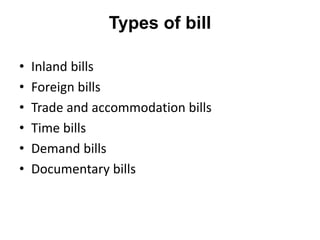
Types of bill
• Inland bills
• Foreign bills
• Trade and accommodation bills
• Time bills
• Demand bills
• Documentary bills
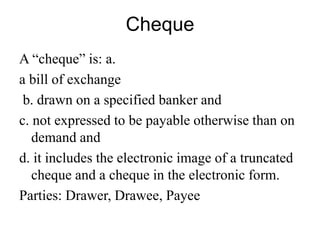
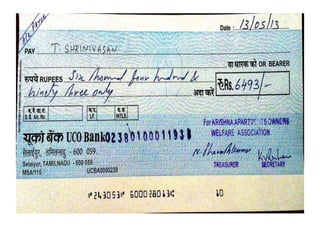
Cheque
A “cheque” is: a.
a bill of exchange
b. drawn on a specified banker and
c. not expressed to be payable otherwise than on
demand and
d. it includes the electronic image of a truncated
cheque and a cheque in the electronic form.
Parties: Drawer, Drawee, Payee
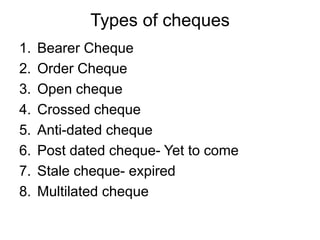
Types of cheques
1. Bearer Cheque
2. Order Cheque
3. Open cheque
4. Crossed cheque
5. Anti-dated cheque
6. Post dated cheque- Yet to come
7. Stale cheque- expired
8. Multilated cheque
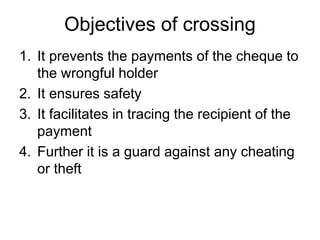
Objectives of crossing
1. It prevents the payments of the cheque to
the wrongful holder
2. It ensures safety
3. It facilitates in tracing the recipient of the
payment
4. Further it is a guard against any cheating
or theft
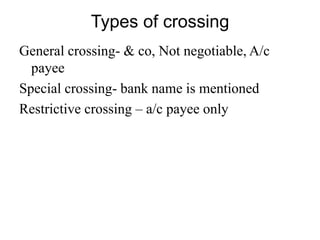
Types of crossing
General crossing- & co, Not negotiable, A/c
payee
Special crossing- bank name is mentioned
Restrictive crossing – a/c payee only
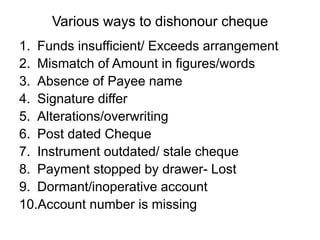
Various ways to dishonour cheque
1. Funds insufficient/ Exceeds arrangement
2. Mismatch of Amount in figures/words
3. Absence of Payee name
4. Signature differ
5. Alterations/overwriting
6. Post dated Cheque
7. Instrument outdated/ stale cheque
8. Payment stopped by drawer- Lost
9. Dormant/inoperative account
10.Account number is missing
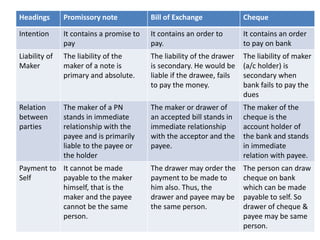
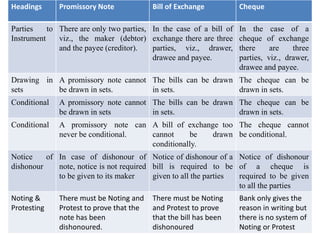
Headings Promissory note Bill of Exchange Cheque
Intention It contains a promise to
pay
It contains an order to
pay.
It contains an order
to pay on bank
Liability of
Maker
The liability of the
maker of a note is
primary and absolute.
The liability of the drawer
is secondary. He would be
liable if the drawee, fails
to pay the money.
The liability of maker
(a/c holder) is
secondary when
bank fails to pay the
dues
Relation
between
parties
The maker of a PN
stands in immediate
relationship with the
payee and is primarily
liable to the payee or
the holder
The maker or drawer of
an accepted bill stands in
immediate relationship
with the acceptor and the
payee.
The maker of the
cheque is the
account holder of
the bank and stands
in immediate
relation with payee.
Payment to
Self
It cannot be made
payable to the maker
himself, that is the
maker and the payee
cannot be the same
person.
The drawer may order the
payment to be made to
him also. Thus, the
drawer and payee may be
the same person.
The person can draw
cheque on bank
which can be made
payable to self. So
drawer of cheque &
payee may be same
person.
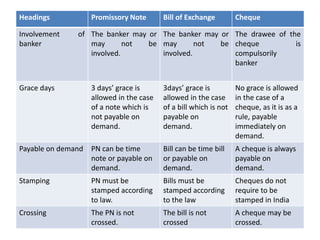
Headings Promissory Note Bill of Exchange Cheque
Parties to
Instrument
There are only two parties,
viz., the maker (debtor)
and the payee (creditor).
In the case of a bill of
exchange there are three
parties, viz., drawer,
drawee and payee.
In the case of a
cheque of exchange
there are three
parties, viz., drawer,
drawee and payee.
Drawing in
sets
A promissory note cannot
be drawn in sets.
The bills can be drawn
in sets.
The cheque can be
drawn in sets.
Conditional A promissory note cannot
be drawn in sets
The bills can be drawn
in sets.
The cheque can be
drawn in sets.
Conditional A promissory note can
never be conditional.
A bill of exchange too
cannot be drawn
conditionally.
The cheque cannot
be conditional.
Notice of
dishonour
In case of dishonour of
note, notice is not required
to be given to its maker
Notice of dishonour of a
bill is required to be
given to all the parties
Notice of dishonour
of a cheque is
required to be given
to all the parties
Noting &
Protesting
There must be Noting and
Protest to prove that the
note has been
dishonoured.
There must be Noting
and Protest to prove
that the bill has been
dishonoured
Bank only gives the
reason in writing but
there is no system of
Noting or Protest
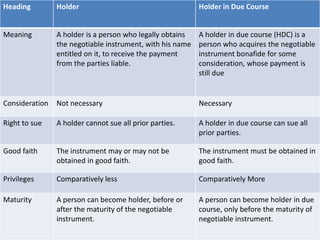
Headings Promissory Note Bill of Exchange Cheque
Involvement of
banker
The banker may or
may not be
involved.
The banker may or
may not be
involved.
The drawee of the
cheque is
compulsorily
banker
Grace days 3 days’ grace is
allowed in the case
of a note which is
not payable on
demand.
3days’ grace is
allowed in the case
of a bill which is not
payable on
demand.
No grace is allowed
in the case of a
cheque, as it is as a
rule, payable
immediately on
demand.
Payable on demand PN can be time
note or payable on
demand.
Bill can be time bill
or payable on
demand.
A cheque is always
payable on
demand.
Stamping PN must be
stamped according
to law.
Bills must be
stamped according
to the law
Cheques do not
require to be
stamped in India
Crossing The PN is not
crossed.
The bill is not
crossed
A cheque may be
crossed.
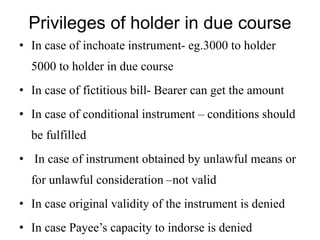
Heading Holder Holder in Due Course
Meaning A holder is a person who legally obtains
the negotiable instrument, with his name
entitled on it, to receive the payment
from the parties liable.
A holder in due course (HDC) is a
person who acquires the negotiable
instrument bonafide for some
consideration, whose payment is
still due
Consideration Not necessary Necessary
Right to sue A holder cannot sue all prior parties. A holder in due course can sue all
prior parties.
Good faith The instrument may or may not be
obtained in good faith.
The instrument must be obtained in
good faith.
Privileges Comparatively less Comparatively More
Maturity A person can become holder, before or
after the maturity of the negotiable
instrument.
A person can become holder in due
course, only before the maturity of
negotiable instrument.
Privileges of holder in due course
• In case of inchoate instrument- eg.3000 to holder
5000 to holder in due course
• In case of fictitious bill- Bearer can get the amount
• In case of conditional instrument – conditions should
be fulfilled
• In case of instrument obtained by unlawful means or
for unlawful consideration –not valid
• In case original validity of the instrument is denied
• In case Payee’s capacity to indorse is denied
Endorsement
The word “endorsement‘ in its literal sense means,
writing on the back of an instrument.
The person who effects an endorsement is called
an "endorser‘, and the person to whom
negotiable instrument is transferred by
endorsement is called the "endorsee‘.
Conditions of Endorsement
1. It must be on the instrument. The endorsement may be on the back or face of the instrument and if no space is left
on the instrument, it may be made on a separate paper attached to it called allonage. It should usually be in ink.
2. It must be made by the maker or holder of the instrument. A stranger cannot endorse it.
3. It must be signed by the endorser. Full name is not essential. Initials may suffice. Thumb-impression should be
attested. Signature may be made on any part of the instrument. A rubber stamp is not accepted but the designation
of the holder can be done by a rubber stamp.
4. It may be made either by the endorser merely signing his name on the instrument (it is a blank endorsement) or
by any words showing an intention to endorse or transfer the instrument to a specified perso (it is an endorsement
in full). No specific form of words is prescribed for an endorsement. But intention to transfer must be present.
When in a bill or note payable to order the endorsee‘s name is wrongly spelt, he should when he endorses it, sign
the name as spelt in the instrument and write the correct spelling within brackets after his endorsement.
5. It must be completed by delivery of the instrument. The delivery must be made by the endorser himself or by
somebody on his behalf with the intention of passing property therein. Thus, where a person endorses an
instrument to another and keeps it in his papers where it is found after his death and then delivered to the
endorsee, the latter gets no right on the instrument.
6. It must be an endorsement of the entire bill. A partial endorsement i.e. which purports to transfer to endorse a part
only of the amount payable does not operate as a valid endorsement.
7. If delivery is conditional, endorsement is not complete until the condition is fulfilled.
Types of Endorsement
1. Endorsement in blank-bearer can get the
amount
2. Endorsement in full- Amount with interest
3. Restrictive endorsement- Pay only endorsee
4. Endorsement sans recourse- No risk
5. Conditional endorsement –
6. Partial Endorsement
Liability of parties in negotiable instruments Act
1. Liability of drawer
2. Liability of drawee
3. Liability of payee
Discharge of Negotiable Instruments
• By cancellation –holder strikeout the
endorser name
• By release – holder attempt to remove some
parties
• By payment in the due course- payment
made
• By allowing drawee
• Material alteration -alteration made without
consent
• Notice of dishonour- holder fail to issue notice
of dishonour
• By operation of law
1. Insolvency of debtor

Negotiable instruments act

  • 1.
  • 2.
    Evolution of thisAct  The act was originally drafted in 1866 by the 3rd indian law commission and introduced in Dec.1867 in the council and it was referred to a selction committee.  Objections were raised by the mercantile community to the numerous deviations from the English law which it contained.  The bill had to be redrafted in 1877. After the lapse of a sufficient period for criticism by local governments, the high courts and the chambers of commerce, the bill was revised by the selection committee. In spite of this bill could not reach the final stage  In 1880, by the order of the secretary of state, the bill had to referred to a new La Commission. On the recommendation of the Bill was re-drafted and again it was sent to a selection committee  The draft thus prepared fro the fourth time was introduced in the council and was passed into law in 1881 being the Negotiable Instruments Act 1881.
  • 3.
    Negotiable Instruments A negotiableinstrument is a piece of paper which entitles a person to a certain sum of money and which is transferable from one to another person by a delivery or by endorsement and delivery. A negotiable instrument is a document guaranteeing the payment of a specific amount of money, either on demand, or at a set time, with the payer named on the document The term Negotiable instrument literally means a written document transferable by delivery. • According to this Act ―A negotiable instrument means a Promissory Note, Bill of exchange or Cheque payable either to order or to bearer. Definition of a Negotiable Instrument • A “Negotiable instrument” means a promissory note, bill of exchange or cheque payable either to order to bearer (Section 13) • An instrument may be negotiable either by (1) Statute or (2) by usage Promissory note, bill of exchange, Cheque – By statute, Bank notes, Bank drafts, share warrants, bearer adventures, dividend warrants, scripts and treasury bills by usage.
  • 4.
    Nature 1. A negotiableinstrument must be in writing 2. A negotiable instrument must be signed by its maker 3. A negotiable instrument must contain an unconditional promise or order today some money 4. A negotiable instrument must contain a certain amount of money only 5. A negotiable instrument must be freely transferable from one person to another 6. On the transfer of a negotiable instrument from one person to another, the transferee who receives it in a good faith and for value has the right to recover the amount mentioned in the negotiable instrument in his own name. Such person is known as holder in due course. His rights are not affected by any defect in the title of the transferee or any prior party 7. Drawn on consideration 8. Transfer by delivery 9. Bonafide transferee 10. The holder can sue in his own name 11. Can be transferred any number of times (Infinity) still its maturity. 12. It is subject to certain presumptions
  • 5.
    Presumptions and Perquisites (section118 & 119) 1. As to consideration : Every negotiable instrument is deemed to have been made, drawn, accepted, endorsed, negotiated or transferred or transformed for consideration (Marimuthu Kounder Vs Radakrishnan and other AIR 1991, Kerala 39) 2. As to date: Every negotiable instrument bear the date on which it is made or drawn. 3. As to acceptance: Every bill of exchange was accepted within a reasonable time after the date mentioned therein and before the date of its maturity. 4. As to transfer: Transfer was made before the date of maturity, in the case of an instrument payable, otherwise than or demand. 5. As to be order of endorsement: The endorsement appearing on it were made in the order in which they have taken. 6. As to lost instruments: Where an instrument has been lost or destroyed, that it was duly stamped and the stamp was duly cancelled. 7. As to the hidden in due course: The holder of the instrument is a holder in due course. 8. As to dishonor: Court shall on the proof of protest, pressure the fact of dishonor unless it is disproved.
  • 6.
  • 7.
    Promissory Note According tosection 4 of the Act, A promissory note is: a. an instrument (not being a bank note or a currency-note) in writing; b. containing an unconditional undertaking; c. signed by the maker; d. to pay a certain sum of money only to, or to the order of, a certain person, or to the bearer of the instrument.
  • 8.
    Characteristics 1. Should bein writing 2. Promise to pay: We have received a sum of Rs. 9000 from Shri R.R. Sharma. This amount will be repaid on demand. We have received the amount in cash. Use of word promise is not essential to constitute an instrument as ‘Promissory Note’. 3. Unconditional 4. Signed by the maker 5. (Certain parties 6. Certain sum of money 7. (Promise to pay money only 8. (Number, place, date etc – usually found but aspect essential in law – If it is undated it is deemed to have been made when it was delivered. 9. May be payable in installments 10. (It may be payable on demand or after a definite period (A demand promissory note becomes times barred on expiry of 3 years from the date it bears) 11. It cannot be made payable to bearer on demand or even payable to bearer after a certain period (sec 31 of RBI Act) 12. It must be duly stamped under the Indian Stamp Act. 13. Parties: Promisor/ Payer or Promisee/Payee
  • 9.
    Examples of promissorynote Example of Promissory Notes • (a) I promise to pay “B” or order Rs. 500 • (b) I acknowledge myself to be indebted to B for Rs. 1000 to be paid on demand for value received. Not Promissory Notes • a) “Mr. B, I.O.U. (I owe you) Rs. 1000 • b) I am liable to pay you Rs. 500 • c) I promise to pay B Rs. 500 and all other sums which shall be due to. • d) I promise to pay B Rs. 500; first deducting there out any money in own me. • e) I promise to pay Rs. 1500 on D’s death, provided be leaves me enough to pay that sum. • f) I promise to pay ‘B’ Rs. 500 seven days after my marriage with C. • g) I promise to pay ‘B’ Rs. 500 and to deliver him my scooter on 1st January 2004.
  • 10.
    Bill of Exchange Abill of exchange is: a. an instrument in writing b. containing an unconditional order, c. signed by the maker, d. directing a certain person, to pay a certain sum of money e. only to, or to the order of, a certain person or to the bearer of the instrument.
  • 12.
    Requirements of Billof Exchange 1. It must be in writing 2. It must be order to pay 3. The order to pay must be unconditional 4. The amount ordered must be certain and definite sum of money 5. The instruments must be signed by drawer/acceptor 6. Parties involved in Bill of exchange, Drawer, Drawee, Payee 7. The parties of bill of exchange must be a definite person 8. Order to pay and money only 9. Delivered to payee
  • 13.
    Types of bill •Inland bills • Foreign bills • Trade and accommodation bills • Time bills • Demand bills • Documentary bills
  • 14.
    Cheque A “cheque” is:a. a bill of exchange b. drawn on a specified banker and c. not expressed to be payable otherwise than on demand and d. it includes the electronic image of a truncated cheque and a cheque in the electronic form. Parties: Drawer, Drawee, Payee
  • 16.
    Types of cheques 1.Bearer Cheque 2. Order Cheque 3. Open cheque 4. Crossed cheque 5. Anti-dated cheque 6. Post dated cheque- Yet to come 7. Stale cheque- expired 8. Multilated cheque
  • 17.
    Objectives of crossing 1.It prevents the payments of the cheque to the wrongful holder 2. It ensures safety 3. It facilitates in tracing the recipient of the payment 4. Further it is a guard against any cheating or theft
  • 18.
    Types of crossing Generalcrossing- & co, Not negotiable, A/c payee Special crossing- bank name is mentioned Restrictive crossing – a/c payee only
  • 19.
    Various ways todishonour cheque 1. Funds insufficient/ Exceeds arrangement 2. Mismatch of Amount in figures/words 3. Absence of Payee name 4. Signature differ 5. Alterations/overwriting 6. Post dated Cheque 7. Instrument outdated/ stale cheque 8. Payment stopped by drawer- Lost 9. Dormant/inoperative account 10.Account number is missing
  • 20.
    Headings Promissory noteBill of Exchange Cheque Intention It contains a promise to pay It contains an order to pay. It contains an order to pay on bank Liability of Maker The liability of the maker of a note is primary and absolute. The liability of the drawer is secondary. He would be liable if the drawee, fails to pay the money. The liability of maker (a/c holder) is secondary when bank fails to pay the dues Relation between parties The maker of a PN stands in immediate relationship with the payee and is primarily liable to the payee or the holder The maker or drawer of an accepted bill stands in immediate relationship with the acceptor and the payee. The maker of the cheque is the account holder of the bank and stands in immediate relation with payee. Payment to Self It cannot be made payable to the maker himself, that is the maker and the payee cannot be the same person. The drawer may order the payment to be made to him also. Thus, the drawer and payee may be the same person. The person can draw cheque on bank which can be made payable to self. So drawer of cheque & payee may be same person.
  • 21.
    Headings Promissory NoteBill of Exchange Cheque Parties to Instrument There are only two parties, viz., the maker (debtor) and the payee (creditor). In the case of a bill of exchange there are three parties, viz., drawer, drawee and payee. In the case of a cheque of exchange there are three parties, viz., drawer, drawee and payee. Drawing in sets A promissory note cannot be drawn in sets. The bills can be drawn in sets. The cheque can be drawn in sets. Conditional A promissory note cannot be drawn in sets The bills can be drawn in sets. The cheque can be drawn in sets. Conditional A promissory note can never be conditional. A bill of exchange too cannot be drawn conditionally. The cheque cannot be conditional. Notice of dishonour In case of dishonour of note, notice is not required to be given to its maker Notice of dishonour of a bill is required to be given to all the parties Notice of dishonour of a cheque is required to be given to all the parties Noting & Protesting There must be Noting and Protest to prove that the note has been dishonoured. There must be Noting and Protest to prove that the bill has been dishonoured Bank only gives the reason in writing but there is no system of Noting or Protest
  • 22.
    Headings Promissory NoteBill of Exchange Cheque Involvement of banker The banker may or may not be involved. The banker may or may not be involved. The drawee of the cheque is compulsorily banker Grace days 3 days’ grace is allowed in the case of a note which is not payable on demand. 3days’ grace is allowed in the case of a bill which is not payable on demand. No grace is allowed in the case of a cheque, as it is as a rule, payable immediately on demand. Payable on demand PN can be time note or payable on demand. Bill can be time bill or payable on demand. A cheque is always payable on demand. Stamping PN must be stamped according to law. Bills must be stamped according to the law Cheques do not require to be stamped in India Crossing The PN is not crossed. The bill is not crossed A cheque may be crossed.
  • 23.
    Heading Holder Holderin Due Course Meaning A holder is a person who legally obtains the negotiable instrument, with his name entitled on it, to receive the payment from the parties liable. A holder in due course (HDC) is a person who acquires the negotiable instrument bonafide for some consideration, whose payment is still due Consideration Not necessary Necessary Right to sue A holder cannot sue all prior parties. A holder in due course can sue all prior parties. Good faith The instrument may or may not be obtained in good faith. The instrument must be obtained in good faith. Privileges Comparatively less Comparatively More Maturity A person can become holder, before or after the maturity of the negotiable instrument. A person can become holder in due course, only before the maturity of negotiable instrument.
  • 24.
    Privileges of holderin due course • In case of inchoate instrument- eg.3000 to holder 5000 to holder in due course • In case of fictitious bill- Bearer can get the amount • In case of conditional instrument – conditions should be fulfilled • In case of instrument obtained by unlawful means or for unlawful consideration –not valid • In case original validity of the instrument is denied • In case Payee’s capacity to indorse is denied
  • 25.
    Endorsement The word “endorsement‘in its literal sense means, writing on the back of an instrument. The person who effects an endorsement is called an "endorser‘, and the person to whom negotiable instrument is transferred by endorsement is called the "endorsee‘.
  • 26.
    Conditions of Endorsement 1.It must be on the instrument. The endorsement may be on the back or face of the instrument and if no space is left on the instrument, it may be made on a separate paper attached to it called allonage. It should usually be in ink. 2. It must be made by the maker or holder of the instrument. A stranger cannot endorse it. 3. It must be signed by the endorser. Full name is not essential. Initials may suffice. Thumb-impression should be attested. Signature may be made on any part of the instrument. A rubber stamp is not accepted but the designation of the holder can be done by a rubber stamp. 4. It may be made either by the endorser merely signing his name on the instrument (it is a blank endorsement) or by any words showing an intention to endorse or transfer the instrument to a specified perso (it is an endorsement in full). No specific form of words is prescribed for an endorsement. But intention to transfer must be present. When in a bill or note payable to order the endorsee‘s name is wrongly spelt, he should when he endorses it, sign the name as spelt in the instrument and write the correct spelling within brackets after his endorsement. 5. It must be completed by delivery of the instrument. The delivery must be made by the endorser himself or by somebody on his behalf with the intention of passing property therein. Thus, where a person endorses an instrument to another and keeps it in his papers where it is found after his death and then delivered to the endorsee, the latter gets no right on the instrument. 6. It must be an endorsement of the entire bill. A partial endorsement i.e. which purports to transfer to endorse a part only of the amount payable does not operate as a valid endorsement. 7. If delivery is conditional, endorsement is not complete until the condition is fulfilled.
  • 27.
    Types of Endorsement 1.Endorsement in blank-bearer can get the amount 2. Endorsement in full- Amount with interest 3. Restrictive endorsement- Pay only endorsee 4. Endorsement sans recourse- No risk 5. Conditional endorsement – 6. Partial Endorsement
  • 28.
    Liability of partiesin negotiable instruments Act 1. Liability of drawer 2. Liability of drawee 3. Liability of payee
  • 29.
    Discharge of NegotiableInstruments • By cancellation –holder strikeout the endorser name • By release – holder attempt to remove some parties • By payment in the due course- payment made • By allowing drawee • Material alteration -alteration made without consent • Notice of dishonour- holder fail to issue notice of dishonour • By operation of law 1. Insolvency of debtor