Process Oriented  Guided Inquiry Learning  for Entrepreneurship Clif Kussmaul, PhD Associate Professor of Computer Science Muhlenberg College, Allentown, PA [email_address] NCIIA 2011
Student learning is enhanced  by a variety of factors: work in teams combine content & process construct knowledge follow learning cycles connect multiple concepts & representations receive prompt, regular feedback reflect on process & progress
Teams & processes help students  to learn from each other. Students teams learn, understand,  & remember more. Processes provide helpful scaffolding. Students also learn process skills,  such as communication & teamwork. Students can answer each others’ questions; teacher answers more difficult questions. The best way to learn is to teach.
Process Oriented Guided Inquiry Learning (www.pogil.org) Learners work in  teams  (typically 3-5)  on  scripted activities  with  questions that guide them through  inquiries  (investigations) which often model discovery & research, to help learners  construct knowledge . Teams follow  processes with specific roles, steps, reports, etc. Facilitator circulates to monitor & support. Activities & processes are designed  to achieve  content & process objectives .
Example: Project Scheduling (see paper & supporting docs) Estimate time to make a batch of cookies. Study & organize steps in a recipe, resulting in a  work breakdown structure . Estimate time for each step, & implications. Identify dependencies & sequence of steps, resulting in a  Gantt chart . Explore resource implications. Identify steps that can’t & can be shifted, resulting in a  critical path .
POGIL has evolved over time. David Hanson, Stony Brook University, 1994 series of 20+ NSF grants originally in chemistry, spreading elsewhere regular workshops & regional meetings useful resources & active community http://www.pogil.org
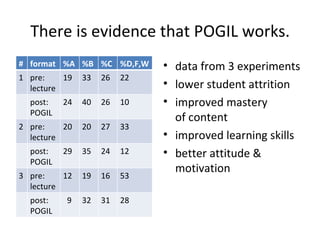
There is evidence that POGIL works. data from 3 experiments lower student attrition improved mastery  of content improved learning skills better attitude & motivation # format %A %B %C %D,F,W 1 pre:  lecture 19 33 26 22 post:  POGIL 24 40 26 10 2 pre:  lecture 20 20 27 33 post:  POGIL 29 35 24 12 3 pre:  lecture 12 19 16 53 post:  POGIL 9 32 31 28
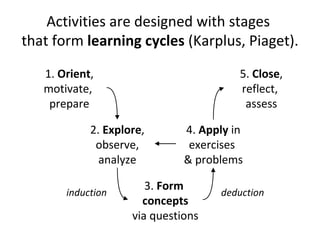
Activities are designed with stages  that form  learning cycles  (Karplus, Piaget). 1.  Orient , motivate,  prepare 2.  Explore , observe, analyze 3.  Form   concepts via questions 4.  Apply  in exercises  & problems 5.  Close , reflect,  assess induction deduction
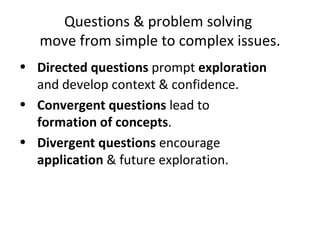
Questions & problem solving  move from simple to complex issues. Directed questions  prompt  exploration  and develop context & confidence. Convergent questions  lead to formation of concepts . Divergent questions  encourage  application  & future exploration.
Reporting & meta-cognition  help students learn how to learn. Reports help learners & teachers  see & think about what happened in team. Getting learners to think about their learning is key to becoming better learners.
Responsibility & evaluation  provide incentives & avoid problems. Each student has a role, and roles rotate. Students know they depend on each other. Free-loading is discouraged. Depending on the academic environment, reports may or may not be graded.
Example: Stage Gate Models  for New Product Development (NPD) Explore set of NPD activities, consider expected costs, hit rates, & returns. Sort activities into groups & sequence, resulting in a set of  stages . Consider costs & risks over time, and ways to minimize both. Develop criteria to apply after each stage, resulting in a set of  gates . Re-consider expected costs, hit rates, returns.
In summary, POGIL uses 7 key components. Learning teams Guided-inquiry activities Questions to promote critical thinking Problem solving Reporting Meta-cognition Individual responsibility Grades (when necessary)
POGIL has variations, pros & cons. Small & large courses (scales reasonably well). Daily, weekly, or occasionally. Paper and/or technology for activities & reporting. Adapts to varied languages & cultures. Teacher as “guide on the side”  not “sage on the stage”. Harder to predict & control class. Requires time & effort to design activities.
My experiences with POGIL  are recent & exciting. ongoing interest in active learning chemistry colleagues who use POGIL POGIL workshop at ASEE 2009 POGIL activities for soft computing in India regional POGIL meeting 2010 POGIL activities for other topics project management, e’ship, computer science NSF TUES grant to develop & validate activities possible reviewers & collaborators?
Work backwards to  create POGIL activities. Choose the key  concept(s)  to be learned. Decide how to  apply  the concept in order to evaluate mastery. Design steps & key questions to guide learners as they  explore  toward concept. Decide how to  orient  learners through  motivation & background information. Design reporting & reflection for  closure . Try the activity and  revise  as necessary.
Questions & Discussion & Evaluation Clif Kussmaul [email_address] The POGIL Project http://www.pogil.org Hanson. Instructor’s Guide to POGIL. Hanson. Designing POGIL Activities. Summer 2011: Regional POGIL Meetings invaluable to get started Eberlein, Kampmeier, Minderhout, et al. (2008)  Pedagogies of engagement in science:  A comparison of PBL, POGIL, and PLTL. Biochemistry & Mol. Bio. Education  36(4):262–273

Muhlenberg - Process-Oriented Guided Inquiry - Open 2011

  • 1.
    Process Oriented Guided Inquiry Learning for Entrepreneurship Clif Kussmaul, PhD Associate Professor of Computer Science Muhlenberg College, Allentown, PA [email_address] NCIIA 2011
  • 2.
    Student learning isenhanced by a variety of factors: work in teams combine content & process construct knowledge follow learning cycles connect multiple concepts & representations receive prompt, regular feedback reflect on process & progress
  • 3.
    Teams & processeshelp students to learn from each other. Students teams learn, understand, & remember more. Processes provide helpful scaffolding. Students also learn process skills, such as communication & teamwork. Students can answer each others’ questions; teacher answers more difficult questions. The best way to learn is to teach.
  • 4.
    Process Oriented GuidedInquiry Learning (www.pogil.org) Learners work in teams (typically 3-5) on scripted activities with questions that guide them through inquiries (investigations) which often model discovery & research, to help learners construct knowledge . Teams follow processes with specific roles, steps, reports, etc. Facilitator circulates to monitor & support. Activities & processes are designed to achieve content & process objectives .
  • 5.
    Example: Project Scheduling(see paper & supporting docs) Estimate time to make a batch of cookies. Study & organize steps in a recipe, resulting in a work breakdown structure . Estimate time for each step, & implications. Identify dependencies & sequence of steps, resulting in a Gantt chart . Explore resource implications. Identify steps that can’t & can be shifted, resulting in a critical path .
  • 6.
    POGIL has evolvedover time. David Hanson, Stony Brook University, 1994 series of 20+ NSF grants originally in chemistry, spreading elsewhere regular workshops & regional meetings useful resources & active community http://www.pogil.org
  • 7.
    There is evidencethat POGIL works. data from 3 experiments lower student attrition improved mastery of content improved learning skills better attitude & motivation # format %A %B %C %D,F,W 1 pre: lecture 19 33 26 22 post: POGIL 24 40 26 10 2 pre: lecture 20 20 27 33 post: POGIL 29 35 24 12 3 pre: lecture 12 19 16 53 post: POGIL 9 32 31 28
  • 8.
    Activities are designedwith stages that form learning cycles (Karplus, Piaget). 1. Orient , motivate, prepare 2. Explore , observe, analyze 3. Form concepts via questions 4. Apply in exercises & problems 5. Close , reflect, assess induction deduction
  • 9.
    Questions & problemsolving move from simple to complex issues. Directed questions prompt exploration and develop context & confidence. Convergent questions lead to formation of concepts . Divergent questions encourage application & future exploration.
  • 10.
    Reporting & meta-cognition help students learn how to learn. Reports help learners & teachers see & think about what happened in team. Getting learners to think about their learning is key to becoming better learners.
  • 11.
    Responsibility & evaluation provide incentives & avoid problems. Each student has a role, and roles rotate. Students know they depend on each other. Free-loading is discouraged. Depending on the academic environment, reports may or may not be graded.
  • 12.
    Example: Stage GateModels for New Product Development (NPD) Explore set of NPD activities, consider expected costs, hit rates, & returns. Sort activities into groups & sequence, resulting in a set of stages . Consider costs & risks over time, and ways to minimize both. Develop criteria to apply after each stage, resulting in a set of gates . Re-consider expected costs, hit rates, returns.
  • 13.
    In summary, POGILuses 7 key components. Learning teams Guided-inquiry activities Questions to promote critical thinking Problem solving Reporting Meta-cognition Individual responsibility Grades (when necessary)
  • 14.
    POGIL has variations,pros & cons. Small & large courses (scales reasonably well). Daily, weekly, or occasionally. Paper and/or technology for activities & reporting. Adapts to varied languages & cultures. Teacher as “guide on the side” not “sage on the stage”. Harder to predict & control class. Requires time & effort to design activities.
  • 15.
    My experiences withPOGIL are recent & exciting. ongoing interest in active learning chemistry colleagues who use POGIL POGIL workshop at ASEE 2009 POGIL activities for soft computing in India regional POGIL meeting 2010 POGIL activities for other topics project management, e’ship, computer science NSF TUES grant to develop & validate activities possible reviewers & collaborators?
  • 16.
    Work backwards to create POGIL activities. Choose the key concept(s) to be learned. Decide how to apply the concept in order to evaluate mastery. Design steps & key questions to guide learners as they explore toward concept. Decide how to orient learners through motivation & background information. Design reporting & reflection for closure . Try the activity and revise as necessary.
  • 17.
    Questions & Discussion& Evaluation Clif Kussmaul [email_address] The POGIL Project http://www.pogil.org Hanson. Instructor’s Guide to POGIL. Hanson. Designing POGIL Activities. Summer 2011: Regional POGIL Meetings invaluable to get started Eberlein, Kampmeier, Minderhout, et al. (2008) Pedagogies of engagement in science: A comparison of PBL, POGIL, and PLTL. Biochemistry & Mol. Bio. Education 36(4):262–273

Editor's Notes

  • #3 Constructivism (constructing knowledge) vs. Constructionism (constructing artifacts)
  • #14 TODO: expand from notes in Hanson, Instructor’s Guide to POGIL
  • #15 frequency : all-POGIL class, weekly POGIL sessions/sections, occasional experiments approach : consider effort to create, complete, modify, share, assess; cost & environmental impact - all paper: - powerpoint + paper: - web-based (e.g. Moodle): scaling : learner:teacher ratio – extend through process & assistants language/culture : teacher-student and student-student control : learners are thinking, and may ask questions or find problems – must be ready to respond development :