
PSU Sparkplug
           Igniting student ideas

    Matthew Poese and Liz Kisenwether

Penn State University’s Engineering Leadership and
           Entrepreneurship Programs
Problem
• Student groups have good ideas
  – rarely move them forward
  – meager resources for parts to build prototypes

                      Solution
• A funding platform to capitalize an idea
  – students articulate a value proposition
  – students enlist stakeholders
  – stakeholders back the project
     • typical contribution is $5-$50
SparkPlug
• Give a $500 grant to student groups
  – groups mount a crowd-sourced funding drive
    • Kickstarter, Indie-Go-Go
  – faculty advisor keeps them on track
  – use the grant to:
    •   buy materials for prototype
    •   shoot a video
    •   buy advertisement
    •   get web hosting space
Application
• Short, simple
• Evaluate the value proposition
  – is it suited for Kickstarter or similar?
  – does it appear to have a market?
     • ask for a quick market survey as first step
• Evaluate the functionality
  – Students have big dreams
  – Try to fund reasonable pieces of the dream
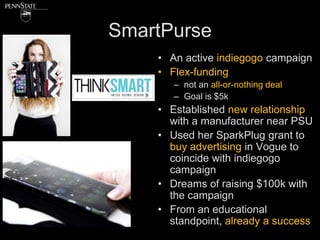
SmartPurse
    • An active indiegogo campaign
    • Flex-funding
       – not an all-or-nothing deal
       – Goal is $5k
    • Established new relationship
      with a manufacturer near PSU
    • Used her SparkPlug grant to
      buy advertising in Vogue to
      coincide with indiegogo
      campaign
    • Dreams of raising $100k with
      the campaign
    • From an educational
      standpoint, already a success
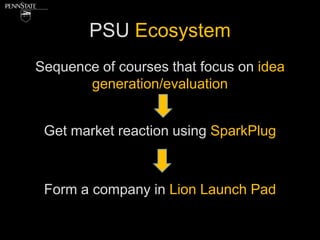
PSU Ecosystem
Sequence of courses that focus on idea
       generation/evaluation


 Get market reaction using SparkPlug


 Form a company in Lion Launch Pad
Other Connectivity
• SparkPlug team sponsors an engineering
  senior design team
  – Business students have good idea
  – hack a prototype
  – use engineering senior design team to:
    • clean up prototype
    • create a design-for-manufacture
Clipboard+
What we’ve seen
• Seeding student ideas leads to:
  – Increased collaboration between students of
    many disciplines
  – Increased self-efficacy
  – Like an internship:
     • experience non-academic lessons
        –   Order fulfillment
        –   Customer service
        –   Inventory management
        –   Production problems

Open 2013: Funding Student Ideas

  • 1.
    PSU Sparkplug Igniting student ideas Matthew Poese and Liz Kisenwether Penn State University’s Engineering Leadership and Entrepreneurship Programs
  • 2.
    Problem • Student groupshave good ideas – rarely move them forward – meager resources for parts to build prototypes Solution • A funding platform to capitalize an idea – students articulate a value proposition – students enlist stakeholders – stakeholders back the project • typical contribution is $5-$50
  • 3.
    SparkPlug • Give a$500 grant to student groups – groups mount a crowd-sourced funding drive • Kickstarter, Indie-Go-Go – faculty advisor keeps them on track – use the grant to: • buy materials for prototype • shoot a video • buy advertisement • get web hosting space
  • 4.
    Application • Short, simple •Evaluate the value proposition – is it suited for Kickstarter or similar? – does it appear to have a market? • ask for a quick market survey as first step • Evaluate the functionality – Students have big dreams – Try to fund reasonable pieces of the dream
  • 5.
    SmartPurse • An active indiegogo campaign • Flex-funding – not an all-or-nothing deal – Goal is $5k • Established new relationship with a manufacturer near PSU • Used her SparkPlug grant to buy advertising in Vogue to coincide with indiegogo campaign • Dreams of raising $100k with the campaign • From an educational standpoint, already a success
  • 6.
    PSU Ecosystem Sequence ofcourses that focus on idea generation/evaluation Get market reaction using SparkPlug Form a company in Lion Launch Pad
  • 7.
    Other Connectivity • SparkPlugteam sponsors an engineering senior design team – Business students have good idea – hack a prototype – use engineering senior design team to: • clean up prototype • create a design-for-manufacture
  • 8.
  • 9.
    What we’ve seen •Seeding student ideas leads to: – Increased collaboration between students of many disciplines – Increased self-efficacy – Like an internship: • experience non-academic lessons – Order fulfillment – Customer service – Inventory management – Production problems