A Virtual Incubator to Promote Information
                    Technology Innovations


Abdullah Konak              Sadan Kulturel-Konak

                 Penn State Berks
                   Reading, PA
Penn State Berks
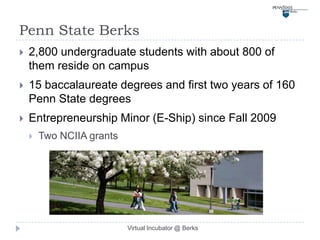
   2,800 undergraduate students with about 800 of
    them reside on campus
   15 baccalaureate degrees and first two years of 160
    Penn State degrees
   Entrepreneurship Minor (E-Ship) since Fall 2009
       Two NCIIA grants


                           Virtual Incubator @ Berks
E-Ship Minor Learning Objectives
   Demonstrate communication skills (verbal, non-
    verbal, and written skills) needed to share innovative
    product/ideas.
   Identify opportunity including seeing market
    possibilities and the product/idea from a customer’s
    perspective.
   Define and solve problems.
   Work in a team environment.
   Demonstrate appropriate critical thinking skills
    requisite in an entrepreneurship environment.
   Demonstrate ability to be an “ambidextrous thinker”,
                       Virtual Incubator @ Berks
    one who can appropriately blend rigor with creativity.
Motivations
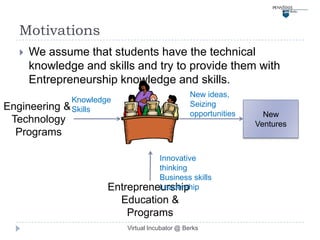
     We assume that students have the technical
      knowledge and skills and try to provide them with
      Entrepreneurship knowledge and skills.
                                                 New ideas,
              Knowledge
Engineering & Skills                             Seizing
                                                 opportunities     New
 Technology                                                      Ventures
  Programs

                                Innovative
                                thinking
                                Business skills
                      Entrepreneurship
                                Leadership
                          Education &
                           Programs
                           Virtual Incubator @ Berks
Challenges in IT Education &
Innovations
   Strict IT policies on campus computers
   Lack of secure computing environments to test
    critical tasks
   Challenges to dedicate specialty computer labs to
    the exclusive use of E-teams for extended periods of
    time
   Projects limited to a semester time frame
   Limited access to specialty software and operating
    systems
   A steep-learning curve
                       Virtual Incubator @ Berks
A Solution: Virtual Computers
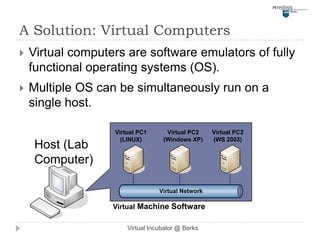
   Virtual computers are software emulators of fully
    functional operating systems (OS).
   Multiple OS can be simultaneously run on a
    single host.

                   Virtual PC1      Virtual PC2     Virtual PC2
                     (LINUX)       (Windows XP)     (WS 2003)
     Host (Lab
     Computer)

                                  Virtual Network
            `

                   Virtual Machine Software

                       Virtual Incubator @ Berks
The Collaborative Virtual Computer
Labratory (CVCLAB)- Penn State Berks
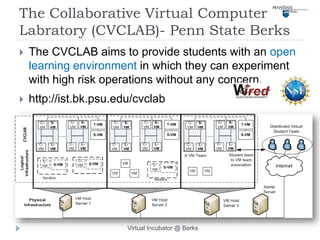
   The CVCLAB aims to provide students with an open
    learning environment in which they can experiment
    with high risk operations without any concern.
   http://ist.bk.psu.edu/cvclab


                        Virtual Incubator @ Berks
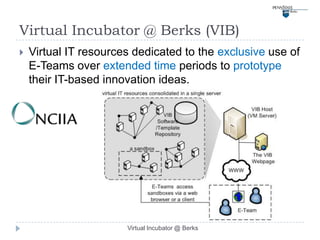
Virtual Incubator @ Berks (VIB)
   Virtual IT resources dedicated to the exclusive use of
    E-Teams over extended time periods to prototype
    their IT-based innovation ideas.


                       Virtual Incubator @ Berks
Objectives
   Instill entrepreneurship spirit into IT students
    

   Shorten the lead time from idea to prototype
       Pre-configured computers
       Software repository
       Tutorials
   Engage entrepreneurship students in local business
    and community needs for economic development
       Business and community partnerships
       Internships
                              Virtual Incubator @ Berks
Target Technologies
   Distributed object computing with an emphasis on
    database and web applications
   Application development for mobile devices
   Open source technologies
   Data mining (Big Data)


                      Virtual Incubator @ Berks
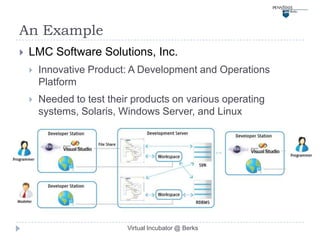
An Example
   LMC Software Solutions, Inc.
       Innovative Product: A Development and Operations
        Platform
       Needed to test their products on various operating
        systems, Solaris, Windows Server, and Linux


                           Virtual Incubator @ Berks
Challenges
   Rapid changes in IT
   Creating policies that make both our students and IT
    happy
   Recruitment
       Competitions
       Integration into classes


                            Virtual Incubator @ Berks
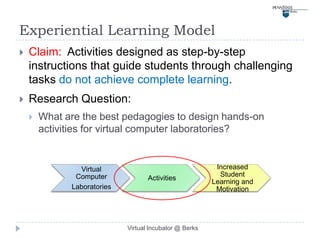
Experiential Learning Model
   Claim: Activities designed as step-by-step
    instructions that guide students through challenging
    tasks do not achieve complete learning.
   Research Question:
       What are the best pedagogies to design hands-on
        activities for virtual computer laboratories?


                Virtual                                   Increased
               Computer                                    Student
                                    Activities
                                                         Learning and
              Laboratories                                Motivation


                             Virtual Incubator @ Berks
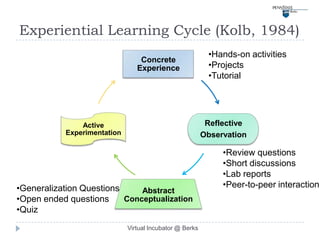
Experiential Learning Cycle (Kolb, 1984)
                                                          •Hands-on activities
                                 Concrete
                                Experience                •Projects
                                                          •Tutorial


               Active                                     Reflective
           Experimentation                               Observation

                                                              •Review questions
                                                              •Short discussions
                                                              •Lab reports
•Generalization Questions                                     •Peer-to-peer interaction
                              Abstract
•Open ended questions     Conceptualization
•Quiz
                             Virtual Incubator @ Berks
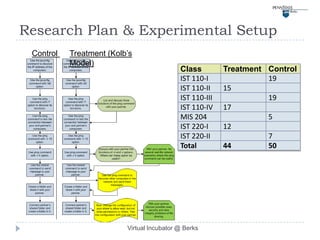
Research Plan & Experimental Setup
 Control   Treatment (Kolb’s
           Model)
                                            Class         Treatment Control
                                            IST 110-I               19
                                            IST 110-II    15
                                            IST 110-III             19
                                            IST 110-IV    17
                                            MIS 204                 5
                                            IST 220-I     12
                                            IST 220-II              7
                                            Total         44        50


                          Virtual Incubator @ Berks
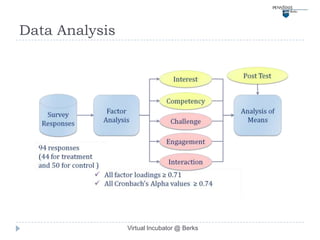
Data Analysis


                Virtual Incubator @ Berks
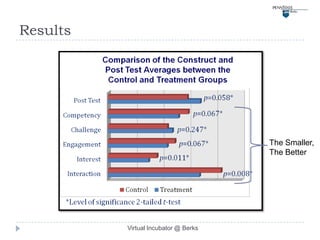
Results


                                      The Smaller,
                                      The Better


          Virtual Incubator @ Berks
Discussions
   We can foster more comprehensive learning by
    including all stages of Kolb’s Experiential Learning
    Cycle in hands-on activities.
   Design activities based on an inquiry-based
    framework rather than a cookbook methodology.


                       Virtual Incubator @ Berks

Open 2013: A Virtual Incubator to Promote Information Technology Innovations

  • 1.
    A Virtual Incubatorto Promote Information Technology Innovations Abdullah Konak Sadan Kulturel-Konak Penn State Berks Reading, PA
  • 2.
    Penn State Berks  2,800 undergraduate students with about 800 of them reside on campus  15 baccalaureate degrees and first two years of 160 Penn State degrees  Entrepreneurship Minor (E-Ship) since Fall 2009  Two NCIIA grants Virtual Incubator @ Berks
  • 3.
    E-Ship Minor LearningObjectives  Demonstrate communication skills (verbal, non- verbal, and written skills) needed to share innovative product/ideas.  Identify opportunity including seeing market possibilities and the product/idea from a customer’s perspective.  Define and solve problems.  Work in a team environment.  Demonstrate appropriate critical thinking skills requisite in an entrepreneurship environment.  Demonstrate ability to be an “ambidextrous thinker”, Virtual Incubator @ Berks one who can appropriately blend rigor with creativity.
  • 4.
    Motivations  We assume that students have the technical knowledge and skills and try to provide them with Entrepreneurship knowledge and skills. New ideas, Knowledge Engineering & Skills Seizing opportunities New Technology Ventures Programs Innovative thinking Business skills Entrepreneurship Leadership Education & Programs Virtual Incubator @ Berks
  • 5.
    Challenges in ITEducation & Innovations  Strict IT policies on campus computers  Lack of secure computing environments to test critical tasks  Challenges to dedicate specialty computer labs to the exclusive use of E-teams for extended periods of time  Projects limited to a semester time frame  Limited access to specialty software and operating systems  A steep-learning curve Virtual Incubator @ Berks
  • 6.
    A Solution: VirtualComputers  Virtual computers are software emulators of fully functional operating systems (OS).  Multiple OS can be simultaneously run on a single host. Virtual PC1 Virtual PC2 Virtual PC2 (LINUX) (Windows XP) (WS 2003) Host (Lab Computer) Virtual Network ` Virtual Machine Software Virtual Incubator @ Berks
  • 7.
    The Collaborative VirtualComputer Labratory (CVCLAB)- Penn State Berks  The CVCLAB aims to provide students with an open learning environment in which they can experiment with high risk operations without any concern.  http://ist.bk.psu.edu/cvclab Virtual Incubator @ Berks
  • 8.
    Virtual Incubator @Berks (VIB)  Virtual IT resources dedicated to the exclusive use of E-Teams over extended time periods to prototype their IT-based innovation ideas. Virtual Incubator @ Berks
  • 9.
    Objectives  Instill entrepreneurship spirit into IT students   Shorten the lead time from idea to prototype  Pre-configured computers  Software repository  Tutorials  Engage entrepreneurship students in local business and community needs for economic development  Business and community partnerships  Internships Virtual Incubator @ Berks
  • 10.
    Target Technologies  Distributed object computing with an emphasis on database and web applications  Application development for mobile devices  Open source technologies  Data mining (Big Data) Virtual Incubator @ Berks
  • 11.
    An Example  LMC Software Solutions, Inc.  Innovative Product: A Development and Operations Platform  Needed to test their products on various operating systems, Solaris, Windows Server, and Linux Virtual Incubator @ Berks
  • 12.
    Challenges  Rapid changes in IT  Creating policies that make both our students and IT happy  Recruitment  Competitions  Integration into classes Virtual Incubator @ Berks
  • 13.
    Experiential Learning Model  Claim: Activities designed as step-by-step instructions that guide students through challenging tasks do not achieve complete learning.  Research Question:  What are the best pedagogies to design hands-on activities for virtual computer laboratories? Virtual Increased Computer Student Activities Learning and Laboratories Motivation Virtual Incubator @ Berks
  • 14.
    Experiential Learning Cycle(Kolb, 1984) •Hands-on activities Concrete Experience •Projects •Tutorial Active Reflective Experimentation Observation •Review questions •Short discussions •Lab reports •Generalization Questions •Peer-to-peer interaction Abstract •Open ended questions Conceptualization •Quiz Virtual Incubator @ Berks
  • 15.
    Research Plan &Experimental Setup Control Treatment (Kolb’s Model) Class Treatment Control IST 110-I 19 IST 110-II 15 IST 110-III 19 IST 110-IV 17 MIS 204 5 IST 220-I 12 IST 220-II 7 Total 44 50 Virtual Incubator @ Berks
  • 16.
    Data Analysis Virtual Incubator @ Berks
  • 17.
    Results The Smaller, The Better Virtual Incubator @ Berks
  • 18.
    Discussions  We can foster more comprehensive learning by including all stages of Kolb’s Experiential Learning Cycle in hands-on activities.  Design activities based on an inquiry-based framework rather than a cookbook methodology. Virtual Incubator @ Berks