IMPORTANT NOTE CONCERNING NBDE PART II ENDODONTICS TERMINOLOGY

Although the new endodontic terms adopted by the American Association of Endodontists were anticipated to be incorporated into
the NBDE Part II in 2012, technical issues were encountered that caused an unexpected delay. These terms will now be
implemented in 2013. During this transitionary period, it is recommended that individuals become knowledgeable of both sets of
terms, because individual researchers, practitioners, and existing textbooks can communicate information using either set of
terms. The NBDE Part II Guide has been updated to reflect this change.


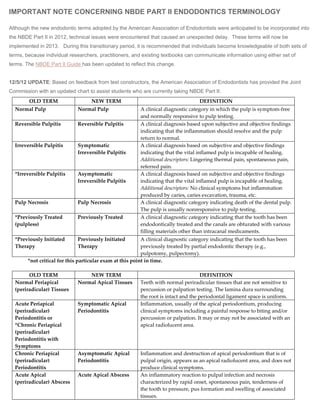
12/5/12 UPDATE: Based on feedback from test constructors, the American Association of Endodontists has provided the Joint
Commission with an updated chart to assist students who are currently taking NBDE Part II:
        OLD TERM                    NEW TERM                                        DEFINITION
  Normal Pulp                 Normal Pulp                 A clinical diagnostic category in which the pulp is symptom-free
                                                          and normally responsive to pulp testing.
  Reversible Pulpitis         Reversible Pulpitis         A clinical diagnosis based upon subjective and objective findings
                                                          indicating that the inflammation should resolve and the pulp
                                                          return to normal.
  Irreversible Pulpitis       Symptomatic                 A clinical diagnosis based on subjective and objective findings
                              Irreversible Pulpitis       indicating that the vital inflamed pulp is incapable of healing.
                                                          Additional descriptors: Lingering thermal pain, spontaneous pain,
                                                          referred pain.
  *Irreversible Pulpitis      Asymptomatic                A clinical diagnosis based on subjective and objective findings
                              Irreversible Pulpitis       indicating that the vital inflamed pulp is incapable of healing.
                                                          Additional descriptors: No clinical symptoms but inflammation
                                                          produced by caries, caries excavation, trauma, etc.
  Pulp Necrosis               Pulp Necrosis               A clinical diagnostic category indicating death of the dental pulp.
                                                          The pulp is usually nonresponsive to pulp testing.
  *Previously Treated         Previously Treated          A clinical diagnostic category indicating that the tooth has been
  (pulpless)                                              endodontically treated and the canals are obturated with various
                                                          filling materials other than intracanal medicaments.
  *Previously Initiated       Previously Initiated         A clinical diagnostic category indicating that the tooth has been
  Therapy                     Therapy                      previously treated by partial endodontic therapy (e.g.,
                                                           pulpotomy, pulpectomy).
        *not critical for this particular exam at this point in time.

        OLD TERM                  NEW TERM                                            DEFINITION
  Normal Periapical           Normal Apical Tissues       Teeth with normal periradicular tissues that are not sensitive to
  (periradicular) Tissues                                 percussion or palpation testing. The lamina dura surrounding
                                                          the root is intact and the periodontal ligament space is uniform.
  Acute Periapical            Symptomatic Apical          Inflammation, usually of the apical periodontium, producing
  (periradicular)             Periodontitis               clinical symptoms including a painful response to biting and/or
  Periodontitis or                                        percussion or palpation. It may or may not be associated with an
  *Chronic Periapical                                     apical radiolucent area.
  (periradicular)
  Periodontitis with
  Symptoms
  Chronic Periapical          Asymptomatic Apical         Inflammation and destruction of apical periodontium that is of
  (periradicular)             Periodontitis               pulpal origin, appears as an apical radiolucent area, and does not
  Periodontitis                                           produce clinical symptoms.
  Acute Apical                Acute Apical Abscess        An inflammatory reaction to pulpal infection and necrosis
  (periradicular) Abscess                                 characterized by rapid onset, spontaneous pain, tenderness of
                                                          the tooth to pressure, pus formation and swelling of associated
                                                          tissues.
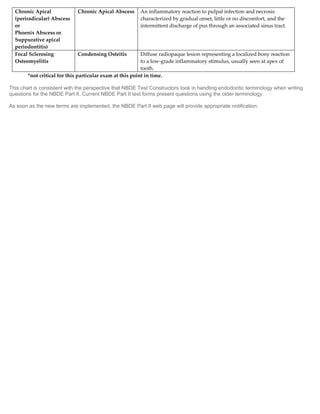
Chronic Apical             Chronic Apical Abscess      An inflammatory reaction to pulpal infection and necrosis
  (periradicular) Abscess                                characterized by gradual onset, little or no discomfort, and the
  or                                                     intermittent discharge of pus through an associated sinus tract.
  Phoenix Abscess or
  Suppurative apical
  periodontitis)
  Focal Sclerosing           Condensing Osteitis           Diffuse radiopaque lesion representing a localized bony reaction
  Osteomyelitis                                            to a low-grade inflammatory stimulus, usually seen at apex of
                                                           tooth.
        *not critical for this particular exam at this point in time.

This chart is consistent with the perspective that NBDE Test Constructors took in handling endodontic terminology when writing
questions for the NBDE Part II. Current NBDE Part II test forms present questions using the older terminology.

As soon as the new terms are implemented, the NBDE Part II web page will provide appropriate notification.

Nbde endo note_dec12

  • 1.
    IMPORTANT NOTE CONCERNINGNBDE PART II ENDODONTICS TERMINOLOGY Although the new endodontic terms adopted by the American Association of Endodontists were anticipated to be incorporated into the NBDE Part II in 2012, technical issues were encountered that caused an unexpected delay. These terms will now be implemented in 2013. During this transitionary period, it is recommended that individuals become knowledgeable of both sets of terms, because individual researchers, practitioners, and existing textbooks can communicate information using either set of terms. The NBDE Part II Guide has been updated to reflect this change. 12/5/12 UPDATE: Based on feedback from test constructors, the American Association of Endodontists has provided the Joint Commission with an updated chart to assist students who are currently taking NBDE Part II: OLD TERM NEW TERM DEFINITION Normal Pulp Normal Pulp A clinical diagnostic category in which the pulp is symptom-free and normally responsive to pulp testing. Reversible Pulpitis Reversible Pulpitis A clinical diagnosis based upon subjective and objective findings indicating that the inflammation should resolve and the pulp return to normal. Irreversible Pulpitis Symptomatic A clinical diagnosis based on subjective and objective findings Irreversible Pulpitis indicating that the vital inflamed pulp is incapable of healing. Additional descriptors: Lingering thermal pain, spontaneous pain, referred pain. *Irreversible Pulpitis Asymptomatic A clinical diagnosis based on subjective and objective findings Irreversible Pulpitis indicating that the vital inflamed pulp is incapable of healing. Additional descriptors: No clinical symptoms but inflammation produced by caries, caries excavation, trauma, etc. Pulp Necrosis Pulp Necrosis A clinical diagnostic category indicating death of the dental pulp. The pulp is usually nonresponsive to pulp testing. *Previously Treated Previously Treated A clinical diagnostic category indicating that the tooth has been (pulpless) endodontically treated and the canals are obturated with various filling materials other than intracanal medicaments. *Previously Initiated Previously Initiated A clinical diagnostic category indicating that the tooth has been Therapy Therapy previously treated by partial endodontic therapy (e.g., pulpotomy, pulpectomy). *not critical for this particular exam at this point in time. OLD TERM NEW TERM DEFINITION Normal Periapical Normal Apical Tissues Teeth with normal periradicular tissues that are not sensitive to (periradicular) Tissues percussion or palpation testing. The lamina dura surrounding the root is intact and the periodontal ligament space is uniform. Acute Periapical Symptomatic Apical Inflammation, usually of the apical periodontium, producing (periradicular) Periodontitis clinical symptoms including a painful response to biting and/or Periodontitis or percussion or palpation. It may or may not be associated with an *Chronic Periapical apical radiolucent area. (periradicular) Periodontitis with Symptoms Chronic Periapical Asymptomatic Apical Inflammation and destruction of apical periodontium that is of (periradicular) Periodontitis pulpal origin, appears as an apical radiolucent area, and does not Periodontitis produce clinical symptoms. Acute Apical Acute Apical Abscess An inflammatory reaction to pulpal infection and necrosis (periradicular) Abscess characterized by rapid onset, spontaneous pain, tenderness of the tooth to pressure, pus formation and swelling of associated tissues.
  • 2.
    Chronic Apical Chronic Apical Abscess An inflammatory reaction to pulpal infection and necrosis (periradicular) Abscess characterized by gradual onset, little or no discomfort, and the or intermittent discharge of pus through an associated sinus tract. Phoenix Abscess or Suppurative apical periodontitis) Focal Sclerosing Condensing Osteitis Diffuse radiopaque lesion representing a localized bony reaction Osteomyelitis to a low-grade inflammatory stimulus, usually seen at apex of tooth. *not critical for this particular exam at this point in time. This chart is consistent with the perspective that NBDE Test Constructors took in handling endodontic terminology when writing questions for the NBDE Part II. Current NBDE Part II test forms present questions using the older terminology. As soon as the new terms are implemented, the NBDE Part II web page will provide appropriate notification.