Lesson 16: Advanced
Navigation Systems
• AGENDA:
– NAVSTAR Global Positioning System
– Ship’s Inertial Navigation Systems (SINS)
– Bottom Contour Navigation
– LORAN-C
– Electronic Charts (Raster & Vector)
– Navigation Sensor System Interface (NAVSSI)
• Applicable reading: Hobbs pp. 540-572.
Lesson 20: Advanced
Navigation Systems
NAVSTAR Global
Positioning System (GPS)
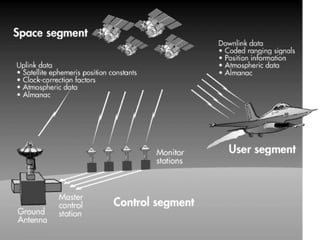
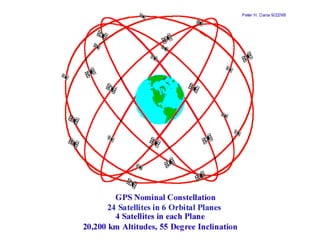
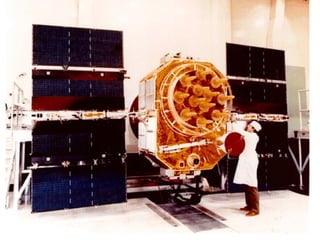
• GPS = Global Positioning System
– A space based, all-weather, jam resistant,
continuous operation, worldwide radio
navigation system.
• Provides extremely accurate 3D location
data as well as velocity and time.
• 3 LOPs provide a Lat. & Long.
• 4 LOPs provide Lat., Long. & Altitude
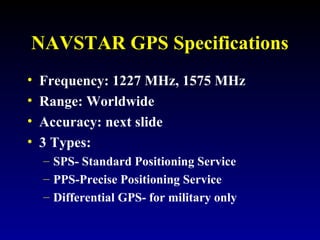
NAVSTAR GPS Specifications
• Frequency: 1227 MHz, 1575 MHz
• Range: Worldwide
• Accuracy: next slide
• 3 Types:
– SPS- Standard Positioning Service
– PPS-Precise Positioning Service
– Differential GPS- for military only
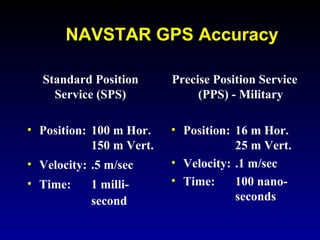
NAVSTAR GPS Accuracy
Standard Position
Service (SPS)
• Position: 100 m Hor.
150 m Vert.
• Velocity: .5 m/sec
• Time: 1 milli-
second
Precise Position Service
(PPS) - Military
• Position: 16 m Hor.
25 m Vert.
• Velocity: .1 m/sec
• Time: 100 nano-
seconds
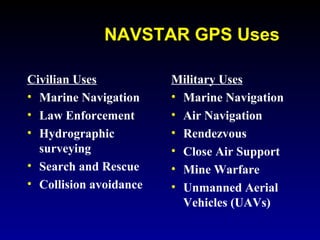
NAVSTAR GPS Uses
Civilian Uses
• Marine Navigation
• Law Enforcement
• Hydrographic
surveying
• Search and Rescue
• Collision avoidance
Military Uses
• Marine Navigation
• Air Navigation
• Rendezvous
• Close Air Support
• Mine Warfare
• Unmanned Aerial
Vehicles (UAVs)
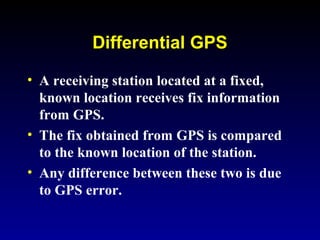
Differential GPS
• A receiving station located at a fixed,
known location receives fix information
from GPS.
• The fix obtained from GPS is compared
to the known location of the station.
• Any difference between these two is due
to GPS error.
Differential GPS
• GPS error information is then
transmitted to vessels operating in the
area.
• The resulting fix accuracy is 2-5 meters
using the differential technique
• Requires more than 1 receiver
GPS
Advantages
• Continuous Coverage
(regardless of weather)
• worldwide coverage
• 3-D locator
• Precise Timing Standard
Disadvantages
• Vulnerable to Attack
Inertial Navigation Systems
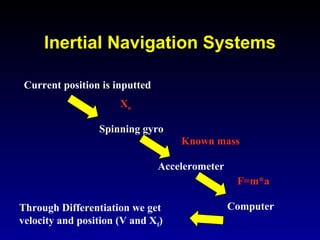
• Inertial Navigation: the process of
directing the movements of a vessel based
on sensed accelerations in known spatial
directions.
• System uses:
– Gyroscopes
– Accelerometers
– Electronic computers
Inertial Navigation Systems
Current position is inputted
Spinning gyro
Accelerometer
Computer
Xo
F=m*a
Through Differentiation we get
velocity and position (V and Xf)
Known mass
Inertial Navigation Systems
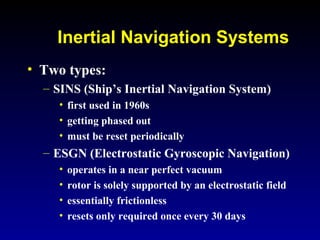
• Two types:
– SINS (Ship’s Inertial Navigation System)
• first used in 1960s
• getting phased out
• must be reset periodically
– ESGN (Electrostatic Gyroscopic Navigation)
• operates in a near perfect vacuum
• rotor is solely supported by an electrostatic field
• essentially frictionless
• resets only required once every 30 days
Bottom Contour
Navigation
• Establishes position by using the
geographic features of the ocean floor.
• An echo sounder (fathometer) is used to
produce a trace of the ocean floor
beneath the vessel, which can be
compared to a bottom contour chart to
establish the ship’s position.
Bottom Contour Navigation
• 2 Techniques:
– Line-of-Soundings (page 567 in Hobbs)
– Contour Advancement (page 568 in Hobbs)
Bottom Contour Navigation
Advantages
• no satelites required
• subs=> no need to go
to Periscope Depth
(PD)
• not vulnerable
Disadvantages
• not very accurate
• requires a
cooperative sea
bottom
LORAN
(Long Range Navigation)
• Over the years, many ground based
electronic navigation systems were
developed prior to satellite based systems
becoming possible.
• Most of these have been taken out of
service, but LORAN still enjoys
popularity and is still widely used.
LORAN (cont)
• The operating principles of the system
are similar to those now used by GPS.
• Ground stations, at known locations,
transmit signals at a predetermined time.
• These signals are received by vessels at
sea, and the time delay is used to form a
range LOP.
LORAN (cont)
• First established in 1957.
• Theory-hyperbolic LOPs based on time
differences between master and
secondary stations.
• Run by the Coast Guard
• Frequency: 100 kHz (LF)
• Range: 1200 nm
• Accuracy: 200-500 yds
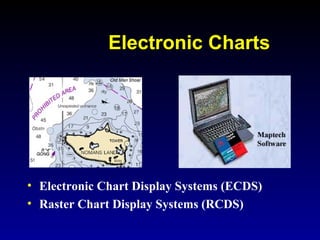
Electronic Charts
• Electronic Chart Display Systems (ECDS)
• Raster Chart Display Systems (RCDS)
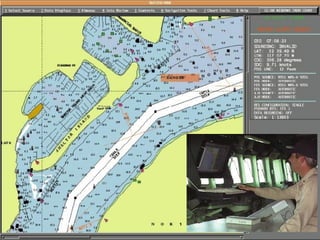
Navigation Sensor System
Interface (NAVSSI)
• Provides/Distributes NAV data (precise
position, time, velocity, pitch-roll-yaw) to
multiple users.
• NAVSSI has been successfully installed,
interfaced, and tested with WSN-5,
WRN-6, EM Log, Tomahawk, Outboard,
and NTCS-A.
Homework
• Ch. 30
– Section 1: 1
– Section 2: 1, 5, 6, 9
• Ch. 31
– #4c, 5, 6

Navr4030 16(tides)

  • 1.
  • 2.
    • AGENDA: – NAVSTARGlobal Positioning System – Ship’s Inertial Navigation Systems (SINS) – Bottom Contour Navigation – LORAN-C – Electronic Charts (Raster & Vector) – Navigation Sensor System Interface (NAVSSI) • Applicable reading: Hobbs pp. 540-572. Lesson 20: Advanced Navigation Systems
  • 3.
    NAVSTAR Global Positioning System(GPS) • GPS = Global Positioning System – A space based, all-weather, jam resistant, continuous operation, worldwide radio navigation system. • Provides extremely accurate 3D location data as well as velocity and time. • 3 LOPs provide a Lat. & Long. • 4 LOPs provide Lat., Long. & Altitude
  • 7.
    NAVSTAR GPS Specifications •Frequency: 1227 MHz, 1575 MHz • Range: Worldwide • Accuracy: next slide • 3 Types: – SPS- Standard Positioning Service – PPS-Precise Positioning Service – Differential GPS- for military only
  • 8.
    NAVSTAR GPS Accuracy StandardPosition Service (SPS) • Position: 100 m Hor. 150 m Vert. • Velocity: .5 m/sec • Time: 1 milli- second Precise Position Service (PPS) - Military • Position: 16 m Hor. 25 m Vert. • Velocity: .1 m/sec • Time: 100 nano- seconds
  • 9.
    NAVSTAR GPS Uses CivilianUses • Marine Navigation • Law Enforcement • Hydrographic surveying • Search and Rescue • Collision avoidance Military Uses • Marine Navigation • Air Navigation • Rendezvous • Close Air Support • Mine Warfare • Unmanned Aerial Vehicles (UAVs)
  • 10.
    Differential GPS • Areceiving station located at a fixed, known location receives fix information from GPS. • The fix obtained from GPS is compared to the known location of the station. • Any difference between these two is due to GPS error.
  • 11.
    Differential GPS • GPSerror information is then transmitted to vessels operating in the area. • The resulting fix accuracy is 2-5 meters using the differential technique • Requires more than 1 receiver
  • 12.
    GPS Advantages • Continuous Coverage (regardlessof weather) • worldwide coverage • 3-D locator • Precise Timing Standard Disadvantages • Vulnerable to Attack
  • 13.
    Inertial Navigation Systems •Inertial Navigation: the process of directing the movements of a vessel based on sensed accelerations in known spatial directions. • System uses: – Gyroscopes – Accelerometers – Electronic computers
  • 14.
    Inertial Navigation Systems Currentposition is inputted Spinning gyro Accelerometer Computer Xo F=m*a Through Differentiation we get velocity and position (V and Xf) Known mass
  • 15.
    Inertial Navigation Systems •Two types: – SINS (Ship’s Inertial Navigation System) • first used in 1960s • getting phased out • must be reset periodically – ESGN (Electrostatic Gyroscopic Navigation) • operates in a near perfect vacuum • rotor is solely supported by an electrostatic field • essentially frictionless • resets only required once every 30 days
  • 16.
    Bottom Contour Navigation • Establishesposition by using the geographic features of the ocean floor. • An echo sounder (fathometer) is used to produce a trace of the ocean floor beneath the vessel, which can be compared to a bottom contour chart to establish the ship’s position.
  • 17.
    Bottom Contour Navigation •2 Techniques: – Line-of-Soundings (page 567 in Hobbs) – Contour Advancement (page 568 in Hobbs)
  • 18.
    Bottom Contour Navigation Advantages •no satelites required • subs=> no need to go to Periscope Depth (PD) • not vulnerable Disadvantages • not very accurate • requires a cooperative sea bottom
  • 19.
    LORAN (Long Range Navigation) •Over the years, many ground based electronic navigation systems were developed prior to satellite based systems becoming possible. • Most of these have been taken out of service, but LORAN still enjoys popularity and is still widely used.
  • 20.
    LORAN (cont) • Theoperating principles of the system are similar to those now used by GPS. • Ground stations, at known locations, transmit signals at a predetermined time. • These signals are received by vessels at sea, and the time delay is used to form a range LOP.
  • 21.
    LORAN (cont) • Firstestablished in 1957. • Theory-hyperbolic LOPs based on time differences between master and secondary stations. • Run by the Coast Guard • Frequency: 100 kHz (LF) • Range: 1200 nm • Accuracy: 200-500 yds
  • 22.
    Electronic Charts • ElectronicChart Display Systems (ECDS) • Raster Chart Display Systems (RCDS)
  • 23.
    Navigation Sensor System Interface(NAVSSI) • Provides/Distributes NAV data (precise position, time, velocity, pitch-roll-yaw) to multiple users. • NAVSSI has been successfully installed, interfaced, and tested with WSN-5, WRN-6, EM Log, Tomahawk, Outboard, and NTCS-A.
  • 25.
    Homework • Ch. 30 –Section 1: 1 – Section 2: 1, 5, 6, 9 • Ch. 31 – #4c, 5, 6

Editor's Notes

  • #2 “Getting Acquainted Lecture” Instructor Bio: Commissioned May, 1993; NROTC Unit, IIT Reported to Hue City (CG-66) homeported in Mayport, FL for a 42 mos tour 24 mos - Engineering Dept (Auxiliaries Officer & Damage Control Assistant) 18 mos - Operations Dept (Air Warfare Officer/BW Flag Liaison Officer) Command Employment (while aboard Hue City) 1995 Med Deployment 95-2 with USS Theodore Roosevelt 1996 Baltops ‘96 (Scandinavian countries) 1997 Med Deployment 97-2 with USS John F. Kennedy Midshipmen Cruises (emphasize student contribution to course) CV (CV 63) - Secrest Tico’s (LKE, VLG) -Waterston, Pope, Sullivan Burkes (DDG 61) - Kuckel OH Perry (FFG 61) - Phillips LHA/LHD (LSD 44) - Fink, Sutherland AOE (AOE-8) - Hertel Review Syllabus: Course objectives Course resources (webpage, Textbook, Workbook) Case studies - provide vivid and intriguing examples of the the fundamental principles taught in this course.