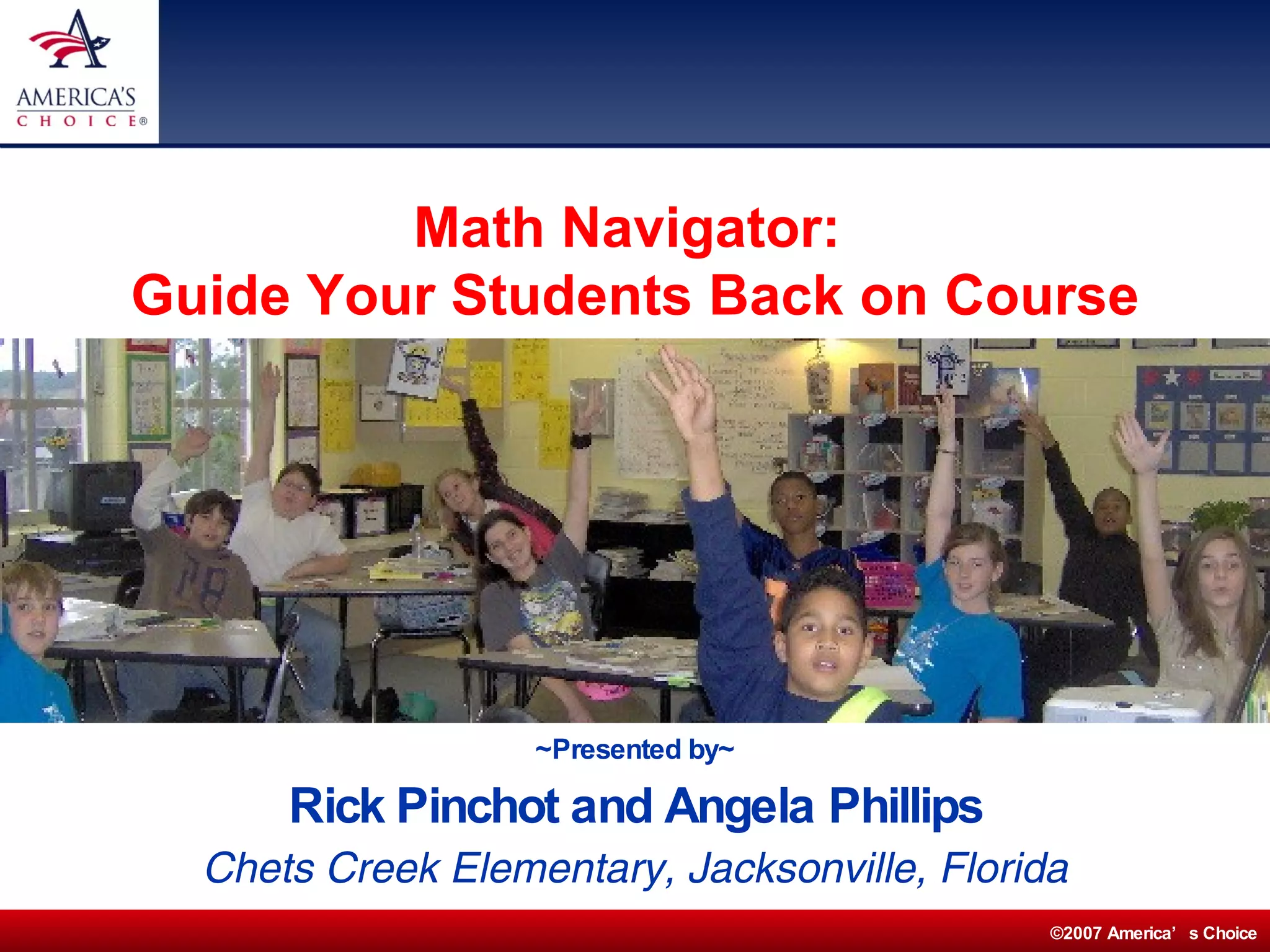
~Presented by~ Rick Pinchot and Angela Phillips Chets Creek Elementary, Jacksonville, Florida Math Navigator:  Guide Your Students Back on Course
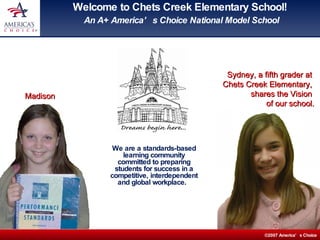
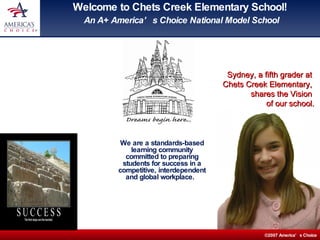
Welcome to Chets Creek Elementary School!  An A+ America’s Choice National Model School We are a standards-based learning community committed to preparing students for success in a competitive, interdependent and global workplace.  Sydney, a fifth grader at  Chets Creek Elementary,  shares the Vision  of our school. Madison
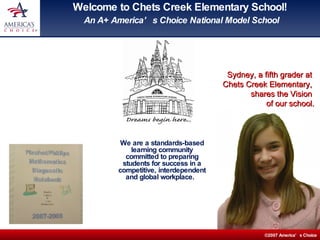
Welcome to Chets Creek Elementary School!  An A+ America’s Choice National Model School We are a standards-based learning community committed to preparing students for success in a competitive, interdependent and global workplace.  Sydney, a fifth grader at  Chets Creek Elementary,  shares the Vision  of our school.
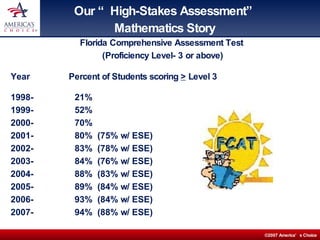
Our “High-Stakes Assessment” Mathematics Story  Florida Comprehensive Assessment Test  (Proficiency Level- 3 or above) Year  Percent of Students scoring  >  Level 3 1998- 21% 1999- 52%  2000- 70%  2001- 80%  (75% w/ ESE)  2002- 83%  (78% w/ ESE) 2003- 84%  (76% w/ ESE) 2004- 88%  (83% w/ ESE) 2005- 89%  (84% w/ ESE) 2006- 93%  (84% w/ ESE) 2007- 94%  (88% w/ ESE)
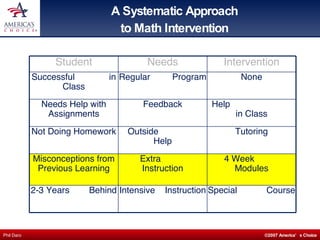
A Systematic Approach  to Math Intervention  Special  Course  Intensive  Instruction 2-3 Years  Behind 4 Week  Modules Extra  Instruction Misconceptions from Previous Learning Tutoring Outside  Help Not Doing Homework Help  in Class Feedback Needs Help with Assignments None Regular  Program Successful  in Class Intervention Needs Student
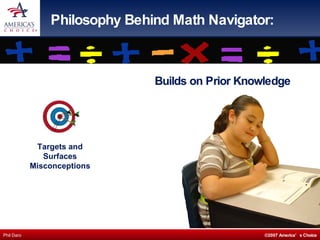
Philosophy Behind Math Navigator: Builds on Prior Knowledge Targets and Surfaces Misconceptions
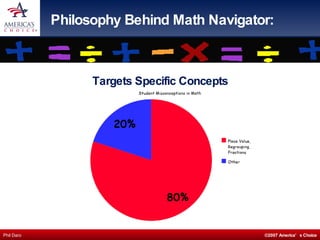
Philosophy Behind Math Navigator: Targets Specific Concepts
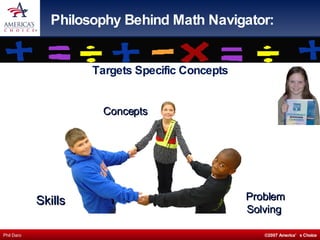
Philosophy Behind Math Navigator: Targets Specific Concepts Skills Concepts  Problem Solving
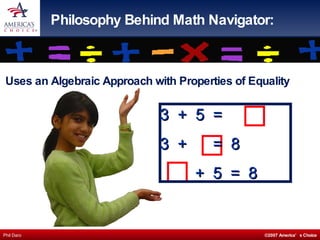
Philosophy Behind Math Navigator: Uses an Algebraic Approach with Properties of Equality 3  +  5  =  3  +  =  8 +  5  =  8
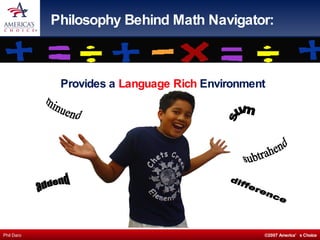
Philosophy Behind Math Navigator: Provides a  Language   Rich  Environment addend minuend sum subtrahend difference
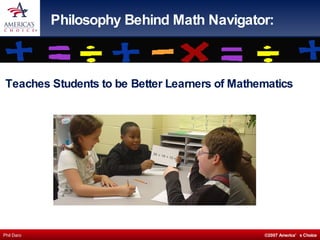
Philosophy Behind Math Navigator: Teaches Students to be Better Learners of Mathematics
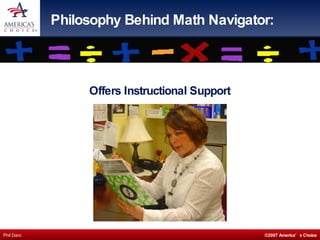
Philosophy Behind Math Navigator: Offers Instructional Support
Professional Development Teachers learn how to identify and remedy misconceptions Teachers learn how to teach for conceptual understanding Teachers learn how to develop and nurture a problem solving and collaborative environment Teachers develop their pedagogy about mathematics
Addressing Student Misconceptions
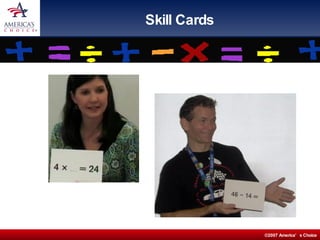
Skill Cards
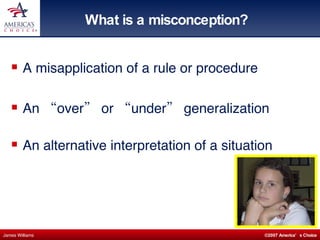
What is a misconception? A misapplication of a rule or procedure An “over” or “under” generalization  An alternative interpretation of a situation
Looking at a “Lesson”
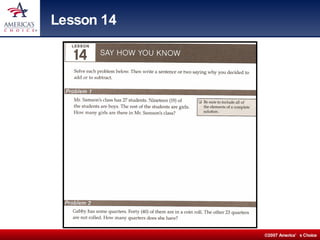
Lesson 14
Addressing Student Misconceptions
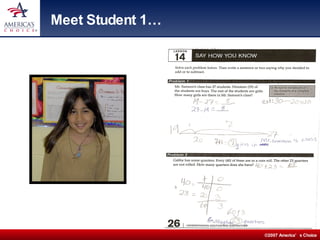
Meet Student 1…
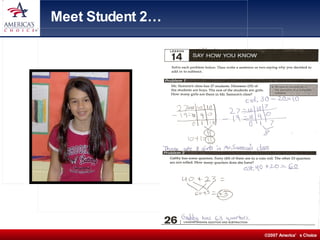
Meet Student 2…
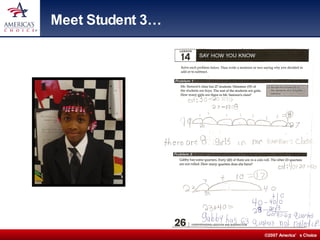
Meet Student 3…
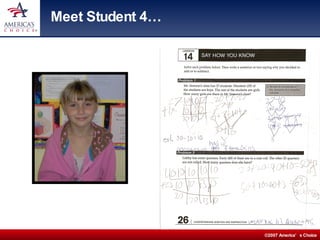
Meet Student 4…
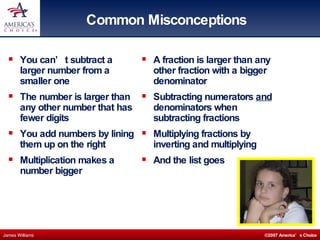
Common Misconceptions You can’t subtract a larger number from a smaller one The number is larger than any other number that has fewer digits You add numbers by lining them up on the right Multiplication makes a number bigger A fraction is larger than any other fraction with a bigger denominator Subtracting numerators  and  denominators when subtracting fractions Multiplying fractions by inverting and multiplying And the list goes  on
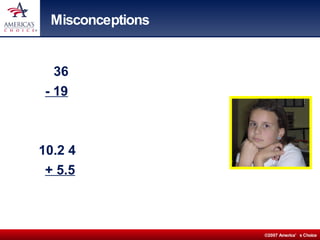
Misconceptions   36 - 19 10.2 4 + 5.5
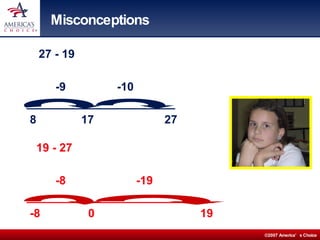
Misconceptions 27 - 19  -9  -10 _______________________ 8  17  27 19 - 27  -8  -19 _____________________________ -8  0  19
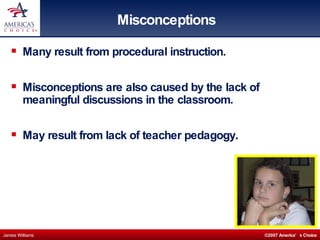
Misconceptions Many result from procedural instruction. Misconceptions are also caused by the lack of  meaningful discussions in the classroom. May result from lack of teacher pedagogy.
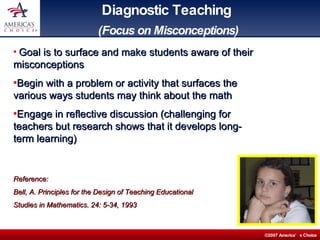
Diagnostic Teaching   (Focus on Misconceptions) Goal is to surface and make students aware of their misconceptions Begin with a problem or activity that surfaces the various ways students may think about the math Engage in reflective discussion (challenging for teachers but research shows that it develops long-term learning) Reference:  Bell, A. Principles for the Design of Teaching Educational  Studies in Mathematics. 24: 5-34, 1993
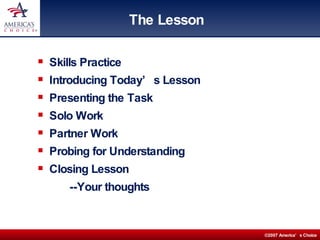
The Lesson Skills Practice Introducing Today’s Lesson Presenting the Task Solo Work Partner Work Probing for Understanding Closing Lesson --Your thoughts
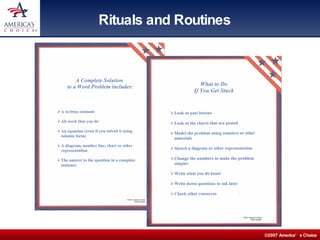
Rituals and Routines
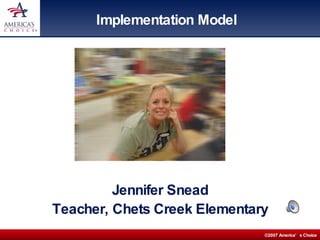
Implementation Model Jennifer Snead Teacher, Chets Creek Elementary
Implementation Model
Special Education Challenge Special education students share the same characteristics as struggling students. Intervention for special education students also have the following challenges. Teachers are typically Literacy Specialists. Some students have difficulty reading and comprehending text. Perception among many teachers that success for students require sacrifice of rigor.
Navigator and Special Education Intervention Modular approach to remediation allows for a focused and coherent presentation of mathematics.  This is extremely beneficial to special education students in that it minimizes confusion and distractions by other unrelated content. Intervention outside of regular class allows students to remain in inclusion setting and still receive additional assistance. Present students with a simple approach to what can often be complex and confusing mathematics content.
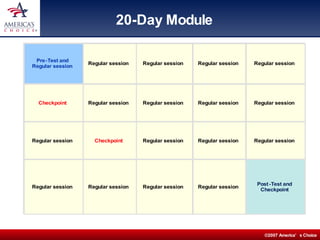
20-Day Module
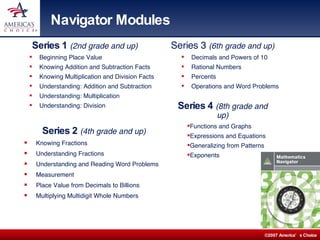
Navigator Modules Series 1  (2nd grade and up) Beginning Place Value Knowing Addition and Subtraction Facts Knowing Multiplication and Division Facts Understanding: Addition and Subtraction Understanding: Multiplication Understanding: Division Series 2  (4th grade and up) Knowing Fractions Understanding Fractions  Understanding and Reading Word Problems Measurement  Place Value from Decimals to Billions Multiplying Multidigit Whole Numbers Series 3  (6th grade and up) Decimals and Powers of 10 Rational Numbers Percents Operations and Word Problems Series 4  (8th grade and up) Functions and Graphs  Expressions and Equations Generalizing from Patterns Exponents
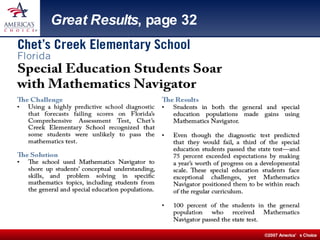
Great Results , page 32
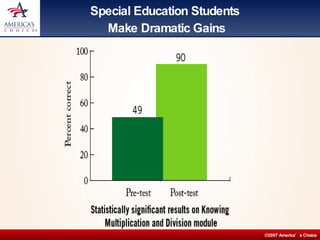
Special Education Students  Make Dramatic Gains
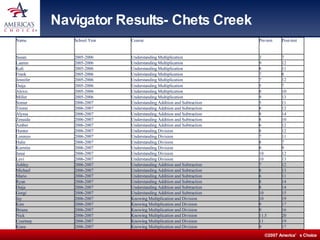
Navigator Results- Chets Creek  17 9 Knowing Multiplication and Division 2006-2007 Kiara  19 11 Knowing Multiplication and Division 2006-2007 Courtney  20 11.5 Knowing Multiplication and Division 2006-2007 Nick 16 9 Knowing Multiplication and Division 2006-2007 Briana  17 9 Knowing Multiplication and Division 2006-2007 Kim 19 10 Knowing Multiplication and Division 2006-2007 Jay  15 10 Understanding Addition and Subtraction 2006-2007 Gorgi  14 8 Understanding Addition and Subtraction 2006-2007 Daija  14 8 Understanding Addition and Subtraction 2006-2007 Ryan  11 6 Understanding Addition and Subtraction 2006-2007 Mario  13 8 Understanding Addition and Subtraction 2006-2007 Michael  12 7 Understanding Addition and Subtraction 2006-2007 Ashley  13 10 Understanding Division 2006-2007 Levi  12 10 Understanding Division 2006-2007 Janai  9 8 Understanding Division 2006-2007 Kierstin  7 8 Understanding Division 2006-2007 Halie  11 7 Understanding Division 2006-2007 Lorenzo  12 8 Understanding Division 2006-2007 Hunter  12 6 Understanding Addition and Subtraction 2006-2007 Amber  10 8 Understanding Addition and Subtraction 2006-2007 Zenaida  14 8 Understanding Addition and Subtraction 2006-2007 Alyssa  12 8 Understanding Addition and Subtraction 2006-2007 Tristin  11 5 Understanding Addition and Subtraction 2006-2007 Somer  13 9 Understanding Multiplication 2005-2006 Miller  10 8 Understanding Multiplication 2005-2006 Alexis  7 5 Understanding Multiplication 2005-2006 Daija  12 7 Understanding Multiplication 2005-2006 Jennifer  8 7 Understanding Multiplication 2005-2006 Frank  11 8 Understanding Multiplication 2005-2006 Kali  12 9 Understanding Multiplication 2005-2006 Lauren  7 3 Understanding Multiplication 2005-2006 Susan  Post-test Pre-test Course School Year Name

Navigator Presentation Powerpoint

  • 1.
    ~Presented by~ RickPinchot and Angela Phillips Chets Creek Elementary, Jacksonville, Florida Math Navigator: Guide Your Students Back on Course
  • 2.
    Welcome to ChetsCreek Elementary School! An A+ America’s Choice National Model School We are a standards-based learning community committed to preparing students for success in a competitive, interdependent and global workplace. Sydney, a fifth grader at Chets Creek Elementary, shares the Vision of our school. Madison
  • 3.
    Welcome to ChetsCreek Elementary School! An A+ America’s Choice National Model School We are a standards-based learning community committed to preparing students for success in a competitive, interdependent and global workplace. Sydney, a fifth grader at Chets Creek Elementary, shares the Vision of our school.
  • 4.
    Welcome to ChetsCreek Elementary School! An A+ America’s Choice National Model School We are a standards-based learning community committed to preparing students for success in a competitive, interdependent and global workplace. Sydney, a fifth grader at Chets Creek Elementary, shares the Vision of our school.
  • 5.
    Our “High-Stakes Assessment”Mathematics Story Florida Comprehensive Assessment Test (Proficiency Level- 3 or above) Year Percent of Students scoring > Level 3 1998- 21% 1999- 52% 2000- 70% 2001- 80% (75% w/ ESE) 2002- 83% (78% w/ ESE) 2003- 84% (76% w/ ESE) 2004- 88% (83% w/ ESE) 2005- 89% (84% w/ ESE) 2006- 93% (84% w/ ESE) 2007- 94% (88% w/ ESE)
  • 6.
    A Systematic Approach to Math Intervention Special Course Intensive Instruction 2-3 Years Behind 4 Week Modules Extra Instruction Misconceptions from Previous Learning Tutoring Outside Help Not Doing Homework Help in Class Feedback Needs Help with Assignments None Regular Program Successful in Class Intervention Needs Student
  • 7.
    Philosophy Behind MathNavigator: Builds on Prior Knowledge Targets and Surfaces Misconceptions
  • 8.
    Philosophy Behind MathNavigator: Targets Specific Concepts
  • 9.
    Philosophy Behind MathNavigator: Targets Specific Concepts Skills Concepts Problem Solving
  • 10.
    Philosophy Behind MathNavigator: Uses an Algebraic Approach with Properties of Equality 3 + 5 = 3 + = 8 + 5 = 8
  • 11.
    Philosophy Behind MathNavigator: Provides a Language Rich Environment addend minuend sum subtrahend difference
  • 12.
    Philosophy Behind MathNavigator: Teaches Students to be Better Learners of Mathematics
  • 13.
    Philosophy Behind MathNavigator: Offers Instructional Support
  • 14.
    Professional Development Teacherslearn how to identify and remedy misconceptions Teachers learn how to teach for conceptual understanding Teachers learn how to develop and nurture a problem solving and collaborative environment Teachers develop their pedagogy about mathematics
  • 15.
  • 16.
  • 17.
    What is amisconception? A misapplication of a rule or procedure An “over” or “under” generalization An alternative interpretation of a situation
  • 18.
    Looking at a“Lesson”
  • 19.
  • 20.
  • 21.
  • 22.
  • 23.
  • 24.
  • 25.
    Common Misconceptions Youcan’t subtract a larger number from a smaller one The number is larger than any other number that has fewer digits You add numbers by lining them up on the right Multiplication makes a number bigger A fraction is larger than any other fraction with a bigger denominator Subtracting numerators and denominators when subtracting fractions Multiplying fractions by inverting and multiplying And the list goes on
  • 26.
    Misconceptions 36 - 19 10.2 4 + 5.5
  • 27.
    Misconceptions 27 -19 -9 -10 _______________________ 8 17 27 19 - 27 -8 -19 _____________________________ -8 0 19
  • 28.
    Misconceptions Many resultfrom procedural instruction. Misconceptions are also caused by the lack of meaningful discussions in the classroom. May result from lack of teacher pedagogy.
  • 29.
    Diagnostic Teaching (Focus on Misconceptions) Goal is to surface and make students aware of their misconceptions Begin with a problem or activity that surfaces the various ways students may think about the math Engage in reflective discussion (challenging for teachers but research shows that it develops long-term learning) Reference: Bell, A. Principles for the Design of Teaching Educational Studies in Mathematics. 24: 5-34, 1993
  • 30.
    The Lesson SkillsPractice Introducing Today’s Lesson Presenting the Task Solo Work Partner Work Probing for Understanding Closing Lesson --Your thoughts
  • 31.
  • 32.
    Implementation Model JenniferSnead Teacher, Chets Creek Elementary
  • 33.
  • 34.
    Special Education ChallengeSpecial education students share the same characteristics as struggling students. Intervention for special education students also have the following challenges. Teachers are typically Literacy Specialists. Some students have difficulty reading and comprehending text. Perception among many teachers that success for students require sacrifice of rigor.
  • 35.
    Navigator and SpecialEducation Intervention Modular approach to remediation allows for a focused and coherent presentation of mathematics. This is extremely beneficial to special education students in that it minimizes confusion and distractions by other unrelated content. Intervention outside of regular class allows students to remain in inclusion setting and still receive additional assistance. Present students with a simple approach to what can often be complex and confusing mathematics content.
  • 36.
  • 37.
    Navigator Modules Series1 (2nd grade and up) Beginning Place Value Knowing Addition and Subtraction Facts Knowing Multiplication and Division Facts Understanding: Addition and Subtraction Understanding: Multiplication Understanding: Division Series 2 (4th grade and up) Knowing Fractions Understanding Fractions Understanding and Reading Word Problems Measurement Place Value from Decimals to Billions Multiplying Multidigit Whole Numbers Series 3 (6th grade and up) Decimals and Powers of 10 Rational Numbers Percents Operations and Word Problems Series 4 (8th grade and up) Functions and Graphs Expressions and Equations Generalizing from Patterns Exponents
  • 38.
  • 39.
    Special Education Students Make Dramatic Gains
  • 40.
    Navigator Results- ChetsCreek 17 9 Knowing Multiplication and Division 2006-2007 Kiara 19 11 Knowing Multiplication and Division 2006-2007 Courtney 20 11.5 Knowing Multiplication and Division 2006-2007 Nick 16 9 Knowing Multiplication and Division 2006-2007 Briana 17 9 Knowing Multiplication and Division 2006-2007 Kim 19 10 Knowing Multiplication and Division 2006-2007 Jay 15 10 Understanding Addition and Subtraction 2006-2007 Gorgi 14 8 Understanding Addition and Subtraction 2006-2007 Daija 14 8 Understanding Addition and Subtraction 2006-2007 Ryan 11 6 Understanding Addition and Subtraction 2006-2007 Mario 13 8 Understanding Addition and Subtraction 2006-2007 Michael 12 7 Understanding Addition and Subtraction 2006-2007 Ashley 13 10 Understanding Division 2006-2007 Levi 12 10 Understanding Division 2006-2007 Janai 9 8 Understanding Division 2006-2007 Kierstin 7 8 Understanding Division 2006-2007 Halie 11 7 Understanding Division 2006-2007 Lorenzo 12 8 Understanding Division 2006-2007 Hunter 12 6 Understanding Addition and Subtraction 2006-2007 Amber 10 8 Understanding Addition and Subtraction 2006-2007 Zenaida 14 8 Understanding Addition and Subtraction 2006-2007 Alyssa 12 8 Understanding Addition and Subtraction 2006-2007 Tristin 11 5 Understanding Addition and Subtraction 2006-2007 Somer 13 9 Understanding Multiplication 2005-2006 Miller 10 8 Understanding Multiplication 2005-2006 Alexis 7 5 Understanding Multiplication 2005-2006 Daija 12 7 Understanding Multiplication 2005-2006 Jennifer 8 7 Understanding Multiplication 2005-2006 Frank 11 8 Understanding Multiplication 2005-2006 Kali 12 9 Understanding Multiplication 2005-2006 Lauren 7 3 Understanding Multiplication 2005-2006 Susan Post-test Pre-test Course School Year Name