
Mathematics
Scope & Sequence
for the Common Core State Standards
Presented By: Dorea Hardy, Shani Moore, & Torrey Williams
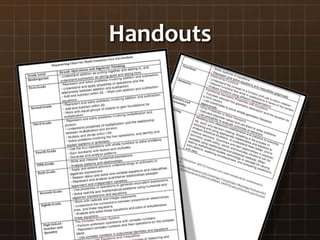
Handouts
Objectives
To define curriculum
To discuss the historical perspective on
mathematics curriculum
To understand the implementation of scope and
sequence in K-12 mathematics curriculum.
To understand how to read grade level standards
What is Curriculum?
“Field of Utter Confusion”
(Oliva, 2000, p. 3)
Various interpretations
“A unit, a course, a sequence
of courses, the school's entire
program of studies…”
(Oliva, 2000, p. 8)
History
A decade’s worth of research
International Competition
Country Wide Improvement
(Georgia Department of Education, 2013)
What is…
Scope in education?
The extent of a curriculum (aim & purpose)
A K-12 scope = curriculum mastery
Horizontal Axis (y)
Sequence in education?
Arranged organized elements or centers
Recurrence, Repetition and Depth
Vertical Axis (x)
Types of Sequences
Psychological Approaches
Familiar-to-Unfamiliar Sequence
Concrete-Pictorial-Abstract Sequence
(Sowell, 2004, pp. 53-54)
Logical Approach
Part-to-Whole Sequence
Whole-to-Part Sequence
Scope & Sequence
Questions to ask
What have the students learned prior to the current
grade level? What skills have already been mastered?
What new skills and knowledge should students be
mastering in this scope and sequence?
How long should this scope & sequence last, and how
will it be broken down and fit in over the year?
Which of the Common Core Standards should be the
focus of mastery for the students during this time?
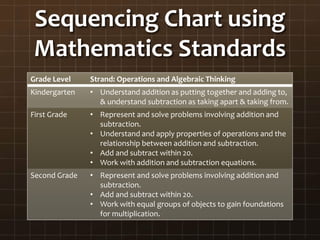
Sequencing Chart using
Mathematics Standards
Grade Level Strand: Operations and Algebraic Thinking
Kindergarten • Understand addition as putting together and adding to,
& understand subtraction as taking apart & taking from.
First Grade • Represent and solve problems involving addition and
subtraction.
• Understand and apply properties of operations and the
relationship between addition and subtraction.
• Add and subtract within 20.
• Work with addition and subtraction equations.
Second Grade • Represent and solve problems involving addition and
subtraction.
• Add and subtract within 20.
• Work with equal groups of objects to gain foundations
for multiplication.
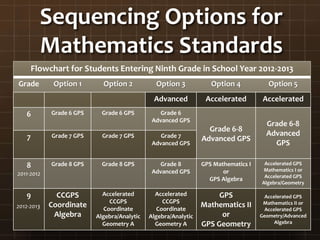
Sequencing Options for
Mathematics Standards
Flowchart for Students Entering Ninth Grade in School Year 2012-2013
Grade Option 1 Option 2 Option 3 Option 4 Option 5
Advanced Accelerated Accelerated
6 Grade 6 GPS Grade 6 GPS Grade 6
Advanced GPS
Grade 6-8
Advanced GPS
Grade 6-8
Advanced
GPS
7 Grade 7 GPS Grade 7 GPS Grade 7
Advanced GPS
8
2011-2012
Grade 8 GPS Grade 8 GPS Grade 8
Advanced GPS
GPS Mathematics I
or
GPS Algebra
Accelerated GPS
Mathematics I or
Accelerated GPS
Algebra/Geometry
9
2012-2013
CCGPS
Coordinate
Algebra
Accelerated
CCGPS
Coordinate
Algebra/Analytic
Geometry A
Accelerated
CCGPS
Coordinate
Algebra/Analytic
Geometry A
GPS
Mathematics II
or
GPS Geometry
Accelerated GPS
Mathematics II or
Accelerated GPS
Geometry/Advanced
Algebra
Standards
Fewer versus Focused
Standards
Fewer versus Focused
Design towards:
Key ideas
Organizing principles
Standards
Fewer versus Focused
Design towards:
Key ideas
Organizing principles
Sequence must respect the students
Understanding
Mathematics
Ability to justify /
Explaining the “rules”
Understanding &
Procedural Skills
Standards are not…
Intervention Methods
Materials
Complete Support
Standards allow for…
Widest range of students
Appropriate accommodations
Clear Signposts
How to read the
Grade Level Standards
Term: Standards
Define what students should
understand and be able to do.
(Georgia Department of Education, 2013, p. 5)
Term: Clusters
Groups of related standards.
Note that standards from different
clusters may sometimes be closely
related, because mathematics is a
connected subject.
(Georgia Department of Education, 2013, p. 5)
Term: Domains
Larger groups of related
standards.
Standards from different domains
may sometimes be closely related.
(Georgia Department of Education, 2013, p. 5)
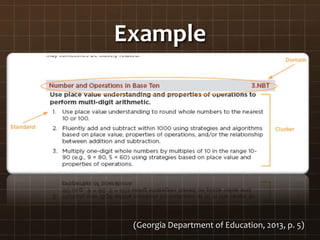
Example
(Georgia Department of Education, 2013, p. 5)
The End
Questions?
Comments?
Contact Us
Hardy, Dorea
dmhardy@valdosta.edu
Moore, Shani
snmcarth@valdosta.edu
Williams, Torrey
torrwilliams@valdosta.edu
References
Georgia Department of Education. (2013) Common core state standards for
mathematics. Online. Available:
https://eboard.eboardsolutions.com/meetings/TempFolder/Meetings/Common
%20Core%20State%20Standards%20for%20Math_245076rodujz55jwtn4ujqra3cnn
ml.pdf
Georgia Department of Education. (2011) Mathematics Course Sequence
Information for Students Entering Ninth Grade in 2012-2013. Online. Available:
http://www.doe.k12.ga.us/Curriculum-Instruction-and-Assessment/Curriculum-
and-Instruction/Documents/Mathematics/7.11.122012-
2013MathematicsGraduationRequirementGuidance.pdf.
References
Oliva, P. (2000). Developing the curriculum. Boston: Allyn &
Bacon.
Sowell, E. (2004). Curriculum: An integrative introduction. New
Jersey: Prentice Hall.
Appendix
Grade Level Strand: Operations and Algebraic Thinking
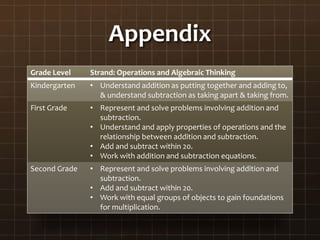
Kindergarten • Understand addition as putting together and adding to,
& understand subtraction as taking apart & taking from.
First Grade • Represent and solve problems involving addition and
subtraction.
• Understand and apply properties of operations and the
relationship between addition and subtraction.
• Add and subtract within 20.
• Work with addition and subtraction equations.
Second Grade • Represent and solve problems involving addition and
subtraction.
• Add and subtract within 20.
• Work with equal groups of objects to gain foundations
for multiplication.
Appendix
Grade Level Strand: Operations and Algebraic Thinking
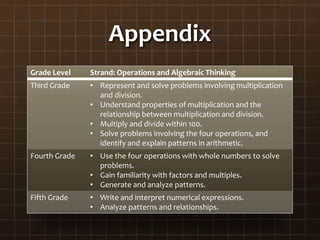
Third Grade • Represent and solve problems involving multiplication
and division.
• Understand properties of multiplication and the
relationship between multiplication and division.
• Multiply and divide within 100.
• Solve problems involving the four operations, and
identify and explain patterns in arithmetic.
Fourth Grade • Use the four operations with whole numbers to solve
problems.
• Gain familiarity with factors and multiples.
• Generate and analyze patterns.
Fifth Grade • Write and interpret numerical expressions.
• Analyze patterns and relationships.
Appendix
Grade Level Strand: Operations and Algebraic Thinking
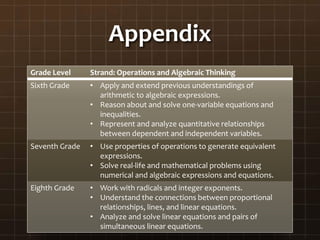
Sixth Grade • Apply and extend previous understandings of
arithmetic to algebraic expressions.
• Reason about and solve one-variable equations and
inequalities.
• Represent and analyze quantitative relationships
between dependent and independent variables.
Seventh Grade • Use properties of operations to generate equivalent
expressions.
• Solve real-life and mathematical problems using
numerical and algebraic expressions and equations.
Eighth Grade • Work with radicals and integer exponents.
• Understand the connections between proportional
relationships, lines, and linear equations.
• Analyze and solve linear equations and pairs of
simultaneous linear equations.
Appendix
Grade Level Strand: Operations and Algebraic Thinking
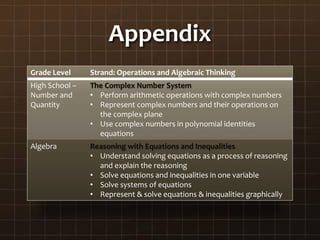
High School –
Number and
Quantity
The Complex Number System
• Perform arithmetic operations with complex numbers
• Represent complex numbers and their operations on
the complex plane
• Use complex numbers in polynomial identities
equations
Algebra Reasoning with Equations and Inequalities
• Understand solving equations as a process of reasoning
and explain the reasoning
• Solve equations and inequalities in one variable
• Solve systems of equations
• Represent & solve equations & inequalities graphically
Appendix
Grade Level Strand: Operations and Algebraic Thinking
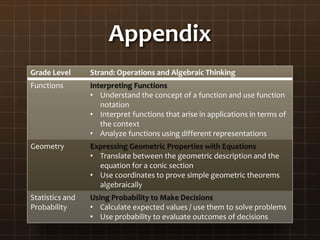
Functions Interpreting Functions
• Understand the concept of a function and use function
notation
• Interpret functions that arise in applications in terms of
the context
• Analyze functions using different representations
Geometry Expressing Geometric Properties with Equations
• Translate between the geometric description and the
equation for a conic section
• Use coordinates to prove simple geometric theorems
algebraically
Statistics and
Probability
Using Probability to Make Decisions
• Calculate expected values / use them to solve problems
• Use probability to evaluate outcomes of decisions
Appendix
Grade Level Strand: Operations and Algebraic Thinking
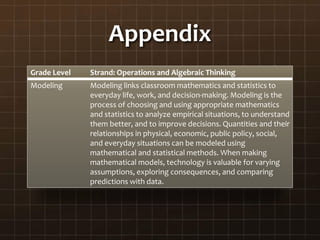
Modeling Modeling links classroom mathematics and statistics to
everyday life, work, and decision-making. Modeling is the
process of choosing and using appropriate mathematics
and statistics to analyze empirical situations, to understand
them better, and to improve decisions. Quantities and their
relationships in physical, economic, public policy, social,
and everyday situations can be modeled using
mathematical and statistical methods. When making
mathematical models, technology is valuable for varying
assumptions, exploring consequences, and comparing
predictions with data.

Mathematics Scope & Sequence for the Common Core State Standards

  • 1.
    Mathematics Scope & Sequence forthe Common Core State Standards Presented By: Dorea Hardy, Shani Moore, & Torrey Williams
  • 2.
  • 3.
    Objectives To define curriculum Todiscuss the historical perspective on mathematics curriculum To understand the implementation of scope and sequence in K-12 mathematics curriculum. To understand how to read grade level standards
  • 4.
    What is Curriculum? “Fieldof Utter Confusion” (Oliva, 2000, p. 3) Various interpretations “A unit, a course, a sequence of courses, the school's entire program of studies…” (Oliva, 2000, p. 8)
  • 5.
    History A decade’s worthof research International Competition Country Wide Improvement (Georgia Department of Education, 2013)
  • 6.
    What is… Scope ineducation? The extent of a curriculum (aim & purpose) A K-12 scope = curriculum mastery Horizontal Axis (y) Sequence in education? Arranged organized elements or centers Recurrence, Repetition and Depth Vertical Axis (x)
  • 7.
    Types of Sequences PsychologicalApproaches Familiar-to-Unfamiliar Sequence Concrete-Pictorial-Abstract Sequence (Sowell, 2004, pp. 53-54) Logical Approach Part-to-Whole Sequence Whole-to-Part Sequence
  • 8.
    Scope & Sequence Questionsto ask What have the students learned prior to the current grade level? What skills have already been mastered? What new skills and knowledge should students be mastering in this scope and sequence? How long should this scope & sequence last, and how will it be broken down and fit in over the year? Which of the Common Core Standards should be the focus of mastery for the students during this time?
  • 9.
    Sequencing Chart using MathematicsStandards Grade Level Strand: Operations and Algebraic Thinking Kindergarten • Understand addition as putting together and adding to, & understand subtraction as taking apart & taking from. First Grade • Represent and solve problems involving addition and subtraction. • Understand and apply properties of operations and the relationship between addition and subtraction. • Add and subtract within 20. • Work with addition and subtraction equations. Second Grade • Represent and solve problems involving addition and subtraction. • Add and subtract within 20. • Work with equal groups of objects to gain foundations for multiplication.
  • 10.
    Sequencing Options for MathematicsStandards Flowchart for Students Entering Ninth Grade in School Year 2012-2013 Grade Option 1 Option 2 Option 3 Option 4 Option 5 Advanced Accelerated Accelerated 6 Grade 6 GPS Grade 6 GPS Grade 6 Advanced GPS Grade 6-8 Advanced GPS Grade 6-8 Advanced GPS 7 Grade 7 GPS Grade 7 GPS Grade 7 Advanced GPS 8 2011-2012 Grade 8 GPS Grade 8 GPS Grade 8 Advanced GPS GPS Mathematics I or GPS Algebra Accelerated GPS Mathematics I or Accelerated GPS Algebra/Geometry 9 2012-2013 CCGPS Coordinate Algebra Accelerated CCGPS Coordinate Algebra/Analytic Geometry A Accelerated CCGPS Coordinate Algebra/Analytic Geometry A GPS Mathematics II or GPS Geometry Accelerated GPS Mathematics II or Accelerated GPS Geometry/Advanced Algebra
  • 11.
  • 12.
    Standards Fewer versus Focused Designtowards: Key ideas Organizing principles
  • 13.
    Standards Fewer versus Focused Designtowards: Key ideas Organizing principles Sequence must respect the students
  • 14.
    Understanding Mathematics Ability to justify/ Explaining the “rules” Understanding & Procedural Skills
  • 15.
    Standards are not… InterventionMethods Materials Complete Support
  • 16.
    Standards allow for… Widestrange of students Appropriate accommodations Clear Signposts
  • 17.
    How to readthe Grade Level Standards
  • 18.
    Term: Standards Define whatstudents should understand and be able to do. (Georgia Department of Education, 2013, p. 5)
  • 19.
    Term: Clusters Groups ofrelated standards. Note that standards from different clusters may sometimes be closely related, because mathematics is a connected subject. (Georgia Department of Education, 2013, p. 5)
  • 20.
    Term: Domains Larger groupsof related standards. Standards from different domains may sometimes be closely related. (Georgia Department of Education, 2013, p. 5)
  • 21.
    Example (Georgia Department ofEducation, 2013, p. 5)
  • 22.
  • 23.
    Contact Us Hardy, Dorea dmhardy@valdosta.edu Moore,Shani snmcarth@valdosta.edu Williams, Torrey torrwilliams@valdosta.edu
  • 24.
    References Georgia Department ofEducation. (2013) Common core state standards for mathematics. Online. Available: https://eboard.eboardsolutions.com/meetings/TempFolder/Meetings/Common %20Core%20State%20Standards%20for%20Math_245076rodujz55jwtn4ujqra3cnn ml.pdf Georgia Department of Education. (2011) Mathematics Course Sequence Information for Students Entering Ninth Grade in 2012-2013. Online. Available: http://www.doe.k12.ga.us/Curriculum-Instruction-and-Assessment/Curriculum- and-Instruction/Documents/Mathematics/7.11.122012- 2013MathematicsGraduationRequirementGuidance.pdf.
  • 25.
    References Oliva, P. (2000).Developing the curriculum. Boston: Allyn & Bacon. Sowell, E. (2004). Curriculum: An integrative introduction. New Jersey: Prentice Hall.
  • 26.
    Appendix Grade Level Strand:Operations and Algebraic Thinking Kindergarten • Understand addition as putting together and adding to, & understand subtraction as taking apart & taking from. First Grade • Represent and solve problems involving addition and subtraction. • Understand and apply properties of operations and the relationship between addition and subtraction. • Add and subtract within 20. • Work with addition and subtraction equations. Second Grade • Represent and solve problems involving addition and subtraction. • Add and subtract within 20. • Work with equal groups of objects to gain foundations for multiplication.
  • 27.
    Appendix Grade Level Strand:Operations and Algebraic Thinking Third Grade • Represent and solve problems involving multiplication and division. • Understand properties of multiplication and the relationship between multiplication and division. • Multiply and divide within 100. • Solve problems involving the four operations, and identify and explain patterns in arithmetic. Fourth Grade • Use the four operations with whole numbers to solve problems. • Gain familiarity with factors and multiples. • Generate and analyze patterns. Fifth Grade • Write and interpret numerical expressions. • Analyze patterns and relationships.
  • 28.
    Appendix Grade Level Strand:Operations and Algebraic Thinking Sixth Grade • Apply and extend previous understandings of arithmetic to algebraic expressions. • Reason about and solve one-variable equations and inequalities. • Represent and analyze quantitative relationships between dependent and independent variables. Seventh Grade • Use properties of operations to generate equivalent expressions. • Solve real-life and mathematical problems using numerical and algebraic expressions and equations. Eighth Grade • Work with radicals and integer exponents. • Understand the connections between proportional relationships, lines, and linear equations. • Analyze and solve linear equations and pairs of simultaneous linear equations.
  • 29.
    Appendix Grade Level Strand:Operations and Algebraic Thinking High School – Number and Quantity The Complex Number System • Perform arithmetic operations with complex numbers • Represent complex numbers and their operations on the complex plane • Use complex numbers in polynomial identities equations Algebra Reasoning with Equations and Inequalities • Understand solving equations as a process of reasoning and explain the reasoning • Solve equations and inequalities in one variable • Solve systems of equations • Represent & solve equations & inequalities graphically
  • 30.
    Appendix Grade Level Strand:Operations and Algebraic Thinking Functions Interpreting Functions • Understand the concept of a function and use function notation • Interpret functions that arise in applications in terms of the context • Analyze functions using different representations Geometry Expressing Geometric Properties with Equations • Translate between the geometric description and the equation for a conic section • Use coordinates to prove simple geometric theorems algebraically Statistics and Probability Using Probability to Make Decisions • Calculate expected values / use them to solve problems • Use probability to evaluate outcomes of decisions
  • 31.
    Appendix Grade Level Strand:Operations and Algebraic Thinking Modeling Modeling links classroom mathematics and statistics to everyday life, work, and decision-making. Modeling is the process of choosing and using appropriate mathematics and statistics to analyze empirical situations, to understand them better, and to improve decisions. Quantities and their relationships in physical, economic, public policy, social, and everyday situations can be modeled using mathematical and statistical methods. When making mathematical models, technology is valuable for varying assumptions, exploring consequences, and comparing predictions with data.

Editor's Notes

  • #2 Hello everyone! The following presentation will be lead by Dorea Hardy, Shani Moore and Torrey Williams. In this presentation, we will identify the strand that is repeated through the K-12 range in mathematics and communicate concepts associated with scope and sequence.
  • #3 Please have your handouts ready to review as we go through material. If you didn’t receive a copy of the handout, please raise your hand. For those who miss this presentation, handouts will be included in the Appendix of this presentation.
  • #4 Our objective during this presentation is to: 1) Define curriculum, so that 2) To discuss the historical perspective on mathematics curriculum 3) To understand the implementation of scope and sequence in K-12 mathematics curriculum, and 4) To provide understanding on how to read grade level standards.
  • #5 Madeline Grumet defined curriculum as “the field of utter confusion” (Oliva, 2000, p. 3). Known for its many interpretations, such as content, what is taught in school, and a set of performance activities, the definition of curriculum is subject to various perceptions of schools and educators. During this presentation, curriculum will be defined as “…a unit, a course, a sequence of courses, the school's entire program of studies—and may take place outside of class or school when directed by the personnel of the school” (Olivia, 2000, p.8).
  • #6 Historically, the quality of the mathematics curriculum in the United States has been in need of dire improvement. Internationally, other “high-performing countries have pointed to the conclusion that the mathematics curriculum in the United States must become substantially more focused and coherent in order to improve mathematics achievement in this country” (Georgia Dept. of Education, 2013). To address this issue, national common standards were created to establish to greater clarity and precision within the curriculum.
  • #7 To develop effective standards, one must be able to identify the scope and sequence of the curriculum. Scope in education is defined as the extent or “breadth” of the curriculum. The scope of a curriculum refers to “…the breadth, variety, and types of educational experiences that are to be provided pupils as they progress through the school program” (Olivia, 2000, p. 446). Scope is also known as the “horizontal” or “latitudinal axis for selecting curriculum experiences”. When defining sequence in education, one would establish the time order in which educational experiences are presented. Olivia (2000) states, “Sequence is the order in which the organizing elements or centers are arranged by the curriculum planners” (pg. 458). The sequence in education refers to the recurrence, repetition and depth of the subject matter. As the scope of the course is the horizontal axis, the sequence of the course’s units are aligned on the vertical axis.
  • #8 Content can be sequenced in various ways: psychological or logical approaches. Examples of psychological approaches would include “familiar-to-unfamiliar sequence”, which is and beginning with what the student is familiar with and mounting from there into the unfamiliar. The second psychological approach is the “concrete-pictorial-abstract” sequence which students are challenged to associate a label with a concept. Teachers show models/pictures to connect to concepts and when students are able to associate meanings with ideas, students will then attach labels or names, the “abstract representations, to the ideas” (Sowell, 2004, pp. 53-54). Examples of logical approaches would include “part-to-whole” sequence, which presents basic fundamentals before more complex components. (Eg. Adding single digits numbers before double digits numbers). Another logical approach is “whole-to-part” sequence. This sequence is the opposite of “part-to-whole” sequence, as it provides general information first and then continues toward specific content ahead of specific information.
  • #9 Here are a few questions, teachers should ask themselves when establishing the scope and sequence of a particular standard. 1. What have the students learned prior to the current grade level? What skills have already been mastered? a. This allows you to recognize what students should already know before entering their current grade level and also what skills they should have already become proficient at. This allows teachers to discern what needs to be reviewed and what needs to be taught. In addition, teachers will also be aware of what they have to build upon. 2. What new skills and knowledge should students be mastering in this scope and sequence? a. Here teachers will examine the new skills they are responsible for teaching and the information chosen to teach the curriculum. E.g. “How long will this lesson last? Will the lesson be taught in 2 week intervals or 5 weeks? What lessons should be covered during this unit? 3. How long should this scope & sequence last, and how will it be broken down and fit in over the year? a. This is pretty self explanatory. As stated in the definition of scope and sequence, teachers should know the goal for the lesson and the structure of how the information will be taught over a given period of time. 4. Which of the Common Core Standards should be the focus of mastery for the students during this time. a. This is simply a reminder for teachers to be careful when pulling the list of standards during your preparation. Be sure to select the correct ones for the level of students you are teaching. It is important for teachers to remain focused on what standards are to be achieved during the timeframe given.
  • #10 The purpose of understanding strand within the sequence of standards is to know several aspects about curriculum. The first concept to understand is the “expectation” of students’ level of prior knowledge. Simply, what is the student expected to have mastered prior to completing one grade level and entering the next? The next concept is understanding the development of the particular subject areas strand, which is focused more on objective concepts within a strand. In this example, we will examine the “Operations and Algebraic Thinking” strand within each grade level. If you notice, as the grade levels progress, the expectation of the students’ level of learning increases with more application for the strand. It is extremely important that teachers understand the strand for the minimum grade level prior the current grade level, and the next grade level to ensure the student has the best opportunity to master the strand. Teacher collaboration among grade levels is very important.
  • #11 Within this sequencing chart, one will notice that the curriculum changes that have taken place are focused on GPS (Georgia Performance Standards). The new adopted curriculum is CCSS (Common Core State Standards). The question that lies with most educators and parents is, “What happens to the curriculum my child begin with?, and How are they going to be assessed when using these standards?” If you notice the title of the chart states for students entering the Ninth Grade in a particular school year, this represents students who have the opportunity to maintain the taught curriculum, without penalization for the change. In addition, this means students will be tested using the former curriculum standards (GPS), which allows future students entering Ninth Grade to be taught and tested using the Common Core Standards, as those standards are “unpacked” in subsequent lower grade levels. The term unpacked simply means being taught in a sequence of years that allows students the opportunity to adjust to the curriculum changes and manage the appropriate testing of the standards.
  • #12 The goal for fewer standards is for student mastery. One of the tenants for common core, is to minimize rhetoric and maximize content mastery. Your goal as an instructor is while you have fewer standards, these standards must remain focused on key components.
  • #13 These standards endeavor to follow such a design, not only by stressing conceptual understanding of key ideas, but also by continually returning to organizing principles such as place value or the properties of operations to structure those ideas.  
  • #14 The learning styles of students must be respected when establishing the sequencing and scope of instruction. As Confrey (2007) points out, developing “sequenced obstacles and challenges for students...absent the insights about meaning that derive from careful study of learning, would be unfortunate and unwise.” (Georgia Department of Education, 2013).
  • #15 How do we measure whether a student has achieved the math standards for his or her grade level? We must prove whether the students meet the core standards by assessing their knowledge of math with proper evaluations (tests) of their skills. Our goal for the students is that they will have obtained the ability to explain the math they are performing, the rules behind the functions. Students who are able to both perform the mathematical functions and explain the rules behind those functions can be said to have successfully met the mathematical standards.
  • #16 Do not expect the standards to tell you: 1. How to teach 2. When or what intervention methods to use or 3. What materials to utilize Also, do not expect a complete support system to be built into the standards. These things you must develop yourself.
  • #17 These standards were designed to serve a wide range of students and allow them all to participate. No one can predict the needs of your students. YOU must be prepared to service mental, emotional, and physical barriers in your students’ abilities to learn. These standards are providing directions to reach goals and will provide multiple signposts along the way. (Joke: Don’t forget to read the map!)
  • #18 Lastly, we will give your information on how to read grade level standards. When reading grade level standards, one must understand certain definitions. Today we will highlight three important terms: Standards, Clusters and Domains and show you how they are interconnected.
  • #19 The first term standard is defined as what students should understand and be able to do. (Georgia Dept. of Ed., 2013, p.5)
  • #20 The second term defined is clusters. Clusters are groups of related standards. Please be sure to note, “standards from different clusters may sometimes be closely related, because mathematics is a connected subject” (Georgia Dept. of Ed., 2013, p.5).
  • #21 The final term domain is defined as larger groups of related standards. The standards from different domains may be closely related at times. (Georgia Dept. of Ed., 2013, p.5)
  • #22 Here we have an example of how Standards, Clusters and Domains come together visually on paper. (Georgia Dept. of Ed., 2013, p.5)