CHAPTER TWELVE TEACHING MATH
 
It is estimated that between 5 and 10 percent of school age children have some form of math learning disabilities. (Fuchs, Fuchs, & Hollenbeck 2007; Geary, 2004)
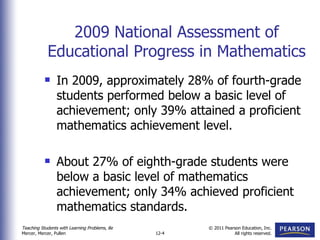
2009 National Assessment of Educational Progress in Mathematics In 2009, approximately 28% of fourth-grade students performed below a basic level of achievement; only 39% attained a proficient mathematics achievement level. About 27% of eighth-grade students were below a basic level of mathematics achievement; only 34% achieved proficient mathematics standards.
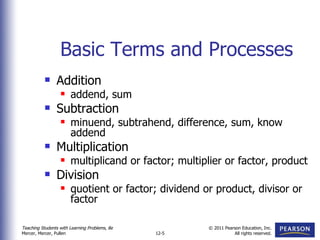
Basic Terms and Processes Addition addend, sum Subtraction minuend, subtrahend, difference, sum, know addend Multiplication multiplicand or factor; multiplier or factor, product Division quotient or factor; dividend or product, divisor or factor
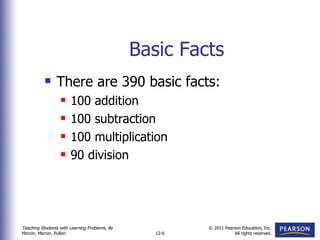
Basic Facts There are 390 basic facts: 100 addition 100 subtraction 100 multiplication 90 division
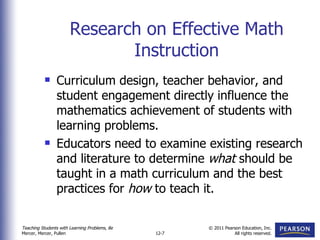
Research on Effective Math Instruction Curriculum design, teacher behavior, and student engagement directly influence the mathematics achievement of students with learning problems. Educators need to examine existing research and literature to determine  what  should be taught in a math curriculum and the best practices for  how  to teach it.
Prevention of Math Difficulties 4 principles: Instruct at a quick pace with varied instructional activities and high levels of engagement Set challenging standards for achievement Incorporate self-verbalization methods Present physical and visual representation of number concepts or problem-solving situations
Components of Effective Math Instruction Selecting appropriate mathematics content Teaching the acquisition of math Teaching mastery Teaching problem solving Teaching generalization Using explicit-implicit math instruction Promoting a positive attitude toward math
Twelve Components of Essential Mathematics 1. Problem solving. 2. Communication of mathematical ideas.  3. Mathematical reasoning.  4. Application of mathematics to everyday situations.  5. Alertness to the reasonableness of results. 6. Estimation. 7. Appropriate computational skills.  8. Algebraic thinking.  9. Measurement.  10. Geometry. 11. Statistics.  12. Probability.
Mathematics proficiency includes  conceptual understanding,  procedural fluency,  strategic competence,  adaptive reasoning,  and productive disposition.
Instructional Practices for Computation and Problem Solving  Two math facts programs Concrete-Semiconcrete-Abstract (CSA) activities Basic rules and algorithms Problem-solving interventions Life Skills math Estimation Calculators
Instructional Practices for Computation and Problem Solving (cont’d) Because many students with learning problems fail to master basic facts, two programs are discussed in the text for teaching math facts: Thornton and Toohey Math Facts Program Mercer and Miller Math Facts Program
Instructional Practices for Computation and Problem Solving (cont’d) Concrete-Semiconcrete-Abstract Activities: Place value Addition:  sums-to-9 Addition:  sums-to-18 Addition with regrouping Subtraction facts (1-9) Subtraction facts (10-18) Subtraction with regrouping
Concrete-Semiconcrete-Abstract Activities (cont’d) Multiplication Division Division with remainder Recognition of unit fractions Addition of fractions with the same denominators Addition and subtraction of mixed fractions
Instructional Practices for Computation and Problem Solving (cont’d) Basic Rules and Algorithms: Addition rules Additional algorithms Subtraction rules Subtraction algorithms Multiplication rules Multiplication algorithms Division rules Division algorithms Fraction algorithm
Instructional Practices for Computation and Problem Solving (cont’d) Problem-Solving Interventions: Interventions that use sequential steps Interventions that use the CSA (concrete-semiconcrete-abstract) sequence Interventions that use graphic representation
Instructional Practices for Computation and Problem Solving (cont’d) Life Skills Math Estimation Calculators
Math Activities Readiness Classification Ordering One-to-One Correspondence Counting Greater Than, Less Than
Math Activities (cont’d) Place Value: Chip Trading Games Bank Game Making Columns Pegboard Place Value Cards Place Value Table
Math Activities (cont’d) General Computation: Small Work Samples Mystery Math Learning Ladders
Math Activities (cont’d) Addition: Nail Abacus Number Line Dot Addition Computational Cues Addition Facts Family
Math Activities (cont’d) Subtraction: Nail Abacus Number Line Addition-Subtraction Pattern Self-Monitoring Subtraction Strategy
Math Activities (cont’d) Multiplication: Array Multiplication Napier’s Rods Multiplication Chart Addition-Multiplication Pattern Dot Cards
Math Activities (cont’d) Division: Number Line Dividing Numbers Into Parts Dot Division Long Division Steps
Math Activities (cont’d) Fractions: Number Line Fraction Chart Fraction Bars Multiplying Fractions with Grids
Math Activities (cont’d) Time: Number Line Record Schedule Examining Schedules Calendar Quiz
Math Activities (cont’d) Decimals/Money: Number Line Completion of Missing Parts Expanded Place Value Chart Money Cards Real Money Coupon Shopping Taking Orders Check the Charge
Math Activities (cont’d) Measurement: Measure Box Measurement and You
Math Activities (cont’d) Word Problems: Story Problems Table Problems
Instructional Games in Math Math War Pig Game Make the Numbers Count Rook Math Math Concentration Fraction Game Toss a Bean Bag Multiplication and Division Facts Rummy Travel Game Basketball Math Counting Coins Rate Game Fraction Blackjack Fraction Removal Decimal Shapes
Self-Correcting Math Materials Flip-Sider Math Cards Clipping Answers Math Squares Color Code Folders Fast Facts Snoopy Math Equivalent Fractions, Decimals, Percents
Commercial Math Programs Connecting Math Concepts Corrective Mathematics Great Leaps Math Key Math 3 – Essential Resources Strategic Math Series TransMath
Computer Software Programs in Math Fraction Attraction Math Blaster Math FACTMASTER Math Munchers for the 21 st  Century

ch12lectPP420

  • 1.
  • 2.
  • 3.
    It is estimatedthat between 5 and 10 percent of school age children have some form of math learning disabilities. (Fuchs, Fuchs, & Hollenbeck 2007; Geary, 2004)
  • 4.
    2009 National Assessmentof Educational Progress in Mathematics In 2009, approximately 28% of fourth-grade students performed below a basic level of achievement; only 39% attained a proficient mathematics achievement level. About 27% of eighth-grade students were below a basic level of mathematics achievement; only 34% achieved proficient mathematics standards.
  • 5.
    Basic Terms andProcesses Addition addend, sum Subtraction minuend, subtrahend, difference, sum, know addend Multiplication multiplicand or factor; multiplier or factor, product Division quotient or factor; dividend or product, divisor or factor
  • 6.
    Basic Facts Thereare 390 basic facts: 100 addition 100 subtraction 100 multiplication 90 division
  • 7.
    Research on EffectiveMath Instruction Curriculum design, teacher behavior, and student engagement directly influence the mathematics achievement of students with learning problems. Educators need to examine existing research and literature to determine what should be taught in a math curriculum and the best practices for how to teach it.
  • 8.
    Prevention of MathDifficulties 4 principles: Instruct at a quick pace with varied instructional activities and high levels of engagement Set challenging standards for achievement Incorporate self-verbalization methods Present physical and visual representation of number concepts or problem-solving situations
  • 9.
    Components of EffectiveMath Instruction Selecting appropriate mathematics content Teaching the acquisition of math Teaching mastery Teaching problem solving Teaching generalization Using explicit-implicit math instruction Promoting a positive attitude toward math
  • 10.
    Twelve Components ofEssential Mathematics 1. Problem solving. 2. Communication of mathematical ideas. 3. Mathematical reasoning. 4. Application of mathematics to everyday situations. 5. Alertness to the reasonableness of results. 6. Estimation. 7. Appropriate computational skills. 8. Algebraic thinking. 9. Measurement. 10. Geometry. 11. Statistics. 12. Probability.
  • 11.
    Mathematics proficiency includes conceptual understanding, procedural fluency, strategic competence, adaptive reasoning, and productive disposition.
  • 12.
    Instructional Practices forComputation and Problem Solving Two math facts programs Concrete-Semiconcrete-Abstract (CSA) activities Basic rules and algorithms Problem-solving interventions Life Skills math Estimation Calculators
  • 13.
    Instructional Practices forComputation and Problem Solving (cont’d) Because many students with learning problems fail to master basic facts, two programs are discussed in the text for teaching math facts: Thornton and Toohey Math Facts Program Mercer and Miller Math Facts Program
  • 14.
    Instructional Practices forComputation and Problem Solving (cont’d) Concrete-Semiconcrete-Abstract Activities: Place value Addition: sums-to-9 Addition: sums-to-18 Addition with regrouping Subtraction facts (1-9) Subtraction facts (10-18) Subtraction with regrouping
  • 15.
    Concrete-Semiconcrete-Abstract Activities (cont’d)Multiplication Division Division with remainder Recognition of unit fractions Addition of fractions with the same denominators Addition and subtraction of mixed fractions
  • 16.
    Instructional Practices forComputation and Problem Solving (cont’d) Basic Rules and Algorithms: Addition rules Additional algorithms Subtraction rules Subtraction algorithms Multiplication rules Multiplication algorithms Division rules Division algorithms Fraction algorithm
  • 17.
    Instructional Practices forComputation and Problem Solving (cont’d) Problem-Solving Interventions: Interventions that use sequential steps Interventions that use the CSA (concrete-semiconcrete-abstract) sequence Interventions that use graphic representation
  • 18.
    Instructional Practices forComputation and Problem Solving (cont’d) Life Skills Math Estimation Calculators
  • 19.
    Math Activities ReadinessClassification Ordering One-to-One Correspondence Counting Greater Than, Less Than
  • 20.
    Math Activities (cont’d)Place Value: Chip Trading Games Bank Game Making Columns Pegboard Place Value Cards Place Value Table
  • 21.
    Math Activities (cont’d)General Computation: Small Work Samples Mystery Math Learning Ladders
  • 22.
    Math Activities (cont’d)Addition: Nail Abacus Number Line Dot Addition Computational Cues Addition Facts Family
  • 23.
    Math Activities (cont’d)Subtraction: Nail Abacus Number Line Addition-Subtraction Pattern Self-Monitoring Subtraction Strategy
  • 24.
    Math Activities (cont’d)Multiplication: Array Multiplication Napier’s Rods Multiplication Chart Addition-Multiplication Pattern Dot Cards
  • 25.
    Math Activities (cont’d)Division: Number Line Dividing Numbers Into Parts Dot Division Long Division Steps
  • 26.
    Math Activities (cont’d)Fractions: Number Line Fraction Chart Fraction Bars Multiplying Fractions with Grids
  • 27.
    Math Activities (cont’d)Time: Number Line Record Schedule Examining Schedules Calendar Quiz
  • 28.
    Math Activities (cont’d)Decimals/Money: Number Line Completion of Missing Parts Expanded Place Value Chart Money Cards Real Money Coupon Shopping Taking Orders Check the Charge
  • 29.
    Math Activities (cont’d)Measurement: Measure Box Measurement and You
  • 30.
    Math Activities (cont’d)Word Problems: Story Problems Table Problems
  • 31.
    Instructional Games inMath Math War Pig Game Make the Numbers Count Rook Math Math Concentration Fraction Game Toss a Bean Bag Multiplication and Division Facts Rummy Travel Game Basketball Math Counting Coins Rate Game Fraction Blackjack Fraction Removal Decimal Shapes
  • 32.
    Self-Correcting Math MaterialsFlip-Sider Math Cards Clipping Answers Math Squares Color Code Folders Fast Facts Snoopy Math Equivalent Fractions, Decimals, Percents
  • 33.
    Commercial Math ProgramsConnecting Math Concepts Corrective Mathematics Great Leaps Math Key Math 3 – Essential Resources Strategic Math Series TransMath
  • 34.
    Computer Software Programsin Math Fraction Attraction Math Blaster Math FACTMASTER Math Munchers for the 21 st Century