Topic: 9
The Teaching of Addition and
Subtraction
Introduction
• Besides learning about whole numbers and basic number concepts, children
in primary schools also need to acquire basic computational skills.
• The four basic operations that children need to know and master include
addition, subtraction, multiplication and division.
• This topic focuses on two basic operations , that is addition and subtraction.
Addition and subtraction are introduced in Kindergarten and Primary One.
These two operations are taught in school every year by reviewing
operations introduced previously and extending algorithms for work with
larger numbers.
By the end of this topic, you will be able to:
1. list out the pedagogical content knowledge for addition
and subtraction; and
2. plan teaching and learning activities for addition and
subtraction.
Major Mathematical Skills
Addition and Subtraction
• In order to learn addition and subtraction meaningfully, young children
need to understand these operations and their relationships.
• Although it is important for young children to develop good foundation in
computational skills, the availability of inexpensive calculators and
microcomputers raises the question as to whether learning to calculate with
large numbers quickly and accurately should remain a primary goal for
primary school children.
• As such, the ability to apply the appropriate technology and to estimate
computational results prior to solving a problem is likely to become
increasingly valuable mathematical skills amongst children.
• Specifically, major mathematical skills related to addition and subtraction
are as stated below:
• To find the sum and the difference of two numbers.
• To recall rapidly basic facts of addition and subtraction.
• To write number sentences for addition and subtraction.
• To perform addition and subtraction in which regrouping is not involved.
• To perform addition and subtraction in which regrouping is involved.
• To solve real-life problems involving addition and subtraction.
Stages of Learning Addition and Subtraction
• When teaching addition and subtraction of whole numbers, you need to
follow a hierarchy of systematic steps. There are 3 basic stages in learning
addition and subtraction:
• Addition and subtraction up to 10 – which include early counting
experiences and emphasize on developing conceptual understanding on the
meaning of addition and subtraction.
• Addition and subtraction up to 18 – which emphasize developing skills in
recalling basic facts of addition and subtraction.
• Addition and subtraction of numbers more than 2 digits – which
emphasize on learning the symbolic algorithms of addition and subtraction.
• Addition is an operation that combines two numbers (addends)
to create a unique third value called the sum. In the
mathematical sentence for addition, for example,
• 3 + 4 = 7, 3 and 4 are the two addends, whereas 7 is the sum.
• In subtraction, we start with the sum and take away one of the
addends to find the other addend. The original sum is called
the minuend; the addend that is being subtracted, the
subtrahend; and the remaining addend, the remainder or the
difference. Thus, in the mathematical sentence for
subtraction, for instance, 7 – 3 = 4, 7 is the minuend, 3 is the
subtrahend, and 4 is the remainder or difference.
How can the teacher teach addition and
subtraction
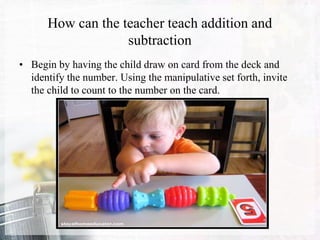
• Begin by having the child draw on card from the deck and
identify the number. Using the manipulative set forth, invite
the child to count to the number on the card.
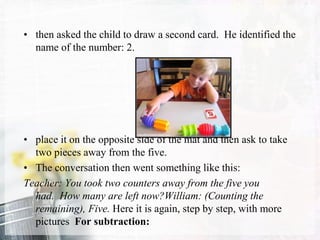
• then asked the child to draw a second card. He identified the
name of the number: 2.
• place it on the opposite side of the mat and then ask to take
two pieces away from the five.
• The conversation then went something like this:
Teacher: You took two counters away from the five you
had. How many are left now?William: (Counting the
remaining), Five. Here it is again, step by step, with more
pictures For subtraction:
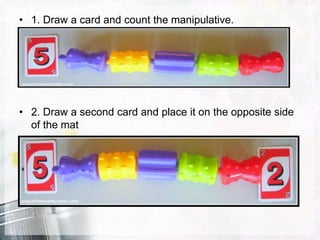
• 1. Draw a card and count the manipulative.
• 2. Draw a second card and place it on the opposite side
of the mat
• 3. Subtract from the current manipulative set
• 4. Count the remaining. We started with five, but took
two away. So now we have three left over. Five take
away two gives us three
Addition.
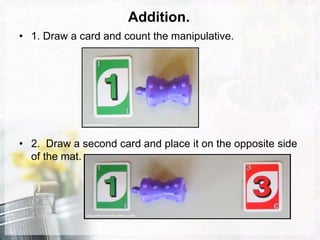
• 1. Draw a card and count the manipulative.
• 2. Draw a second card and place it on the opposite side
of the mat.
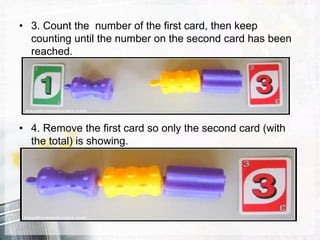
• 3. Count the number of the first card, then keep
counting until the number on the second card has been
reached.
• 4. Remove the first card so only the second card (with
the total) is showing.
How to Teach Your Child Math
• Encourage your child. What do you think would make for a more
enriching class-time experience, an excited and ambitious one or a defiant,
uninspired one?
• Begin teaching them with an interactive activity. There's plenty of
options. you can use flashcards or a simple sheet of problems. Give them a
handful of small objects and let them use those to count out the answers to
the problems. Make sure you also have them learn to use their fingers in
case no objects are available.
• Teach concepts, not just memorization. While memorization can
certainly be helpful, it's even more helpful to have the child learn exactly
how mathematic functions work. This way, they can also begin to apply
their knowledge in other ways. That will help them when they begin to
move on to more complicated math.
• Always make sure that your child completely understands
a concept before moving on. If you skip out on anything, it
will be confusing for them and they will not be able to work as
well as they should be able to when you apply it in other ways.
• Enhance the learning experience by playing games with the
things around you. For example, ask them to say how many
more pictures on the wall there is in the living room than the
dining room. Have them count them both, then subtract.
• Reward your child. At the end of your time sitting down to
work with them, you should reward them somehow. Whether
you give them a small piece of candy or you just hug them and
express how smart they are, it will give them confidence and
help them strive to do better.
• Keep teaching them at a consistent pace. Sit down with
them daily or at least biweekly to fuse the concepts into their
minds. Never forget to keep it fun!
• Bring up problems when you're out with your child. In the
grocery store, for example, ask them how much money out of
rf10 you'd have left if you bought green beans for rf5. This
will also help make the connections in their mind to make
them better at math.
• Main points to address:
• Use fun stuff to count with.
• Start out with easy addition problems.
• Use everyday activities to teach.

Addition and subtraction

  • 1.
    Topic: 9 The Teachingof Addition and Subtraction
  • 2.
    Introduction • Besides learningabout whole numbers and basic number concepts, children in primary schools also need to acquire basic computational skills. • The four basic operations that children need to know and master include addition, subtraction, multiplication and division. • This topic focuses on two basic operations , that is addition and subtraction. Addition and subtraction are introduced in Kindergarten and Primary One. These two operations are taught in school every year by reviewing operations introduced previously and extending algorithms for work with larger numbers.
  • 3.
    By the endof this topic, you will be able to: 1. list out the pedagogical content knowledge for addition and subtraction; and 2. plan teaching and learning activities for addition and subtraction.
  • 4.
    Major Mathematical Skills Additionand Subtraction • In order to learn addition and subtraction meaningfully, young children need to understand these operations and their relationships. • Although it is important for young children to develop good foundation in computational skills, the availability of inexpensive calculators and microcomputers raises the question as to whether learning to calculate with large numbers quickly and accurately should remain a primary goal for primary school children.
  • 5.
    • As such,the ability to apply the appropriate technology and to estimate computational results prior to solving a problem is likely to become increasingly valuable mathematical skills amongst children. • Specifically, major mathematical skills related to addition and subtraction are as stated below: • To find the sum and the difference of two numbers. • To recall rapidly basic facts of addition and subtraction. • To write number sentences for addition and subtraction. • To perform addition and subtraction in which regrouping is not involved. • To perform addition and subtraction in which regrouping is involved. • To solve real-life problems involving addition and subtraction.
  • 6.
    Stages of LearningAddition and Subtraction • When teaching addition and subtraction of whole numbers, you need to follow a hierarchy of systematic steps. There are 3 basic stages in learning addition and subtraction: • Addition and subtraction up to 10 – which include early counting experiences and emphasize on developing conceptual understanding on the meaning of addition and subtraction. • Addition and subtraction up to 18 – which emphasize developing skills in recalling basic facts of addition and subtraction. • Addition and subtraction of numbers more than 2 digits – which emphasize on learning the symbolic algorithms of addition and subtraction.
  • 7.
    • Addition isan operation that combines two numbers (addends) to create a unique third value called the sum. In the mathematical sentence for addition, for example, • 3 + 4 = 7, 3 and 4 are the two addends, whereas 7 is the sum. • In subtraction, we start with the sum and take away one of the addends to find the other addend. The original sum is called the minuend; the addend that is being subtracted, the subtrahend; and the remaining addend, the remainder or the difference. Thus, in the mathematical sentence for subtraction, for instance, 7 – 3 = 4, 7 is the minuend, 3 is the subtrahend, and 4 is the remainder or difference.
  • 8.
    How can theteacher teach addition and subtraction • Begin by having the child draw on card from the deck and identify the number. Using the manipulative set forth, invite the child to count to the number on the card.
  • 9.
    • then askedthe child to draw a second card. He identified the name of the number: 2. • place it on the opposite side of the mat and then ask to take two pieces away from the five. • The conversation then went something like this: Teacher: You took two counters away from the five you had. How many are left now?William: (Counting the remaining), Five. Here it is again, step by step, with more pictures For subtraction:
  • 10.
    • 1. Drawa card and count the manipulative. • 2. Draw a second card and place it on the opposite side of the mat
  • 11.
    • 3. Subtractfrom the current manipulative set • 4. Count the remaining. We started with five, but took two away. So now we have three left over. Five take away two gives us three
  • 12.
    Addition. • 1. Drawa card and count the manipulative. • 2. Draw a second card and place it on the opposite side of the mat.
  • 13.
    • 3. Countthe number of the first card, then keep counting until the number on the second card has been reached. • 4. Remove the first card so only the second card (with the total) is showing.
  • 14.
    How to TeachYour Child Math
  • 15.
    • Encourage yourchild. What do you think would make for a more enriching class-time experience, an excited and ambitious one or a defiant, uninspired one? • Begin teaching them with an interactive activity. There's plenty of options. you can use flashcards or a simple sheet of problems. Give them a handful of small objects and let them use those to count out the answers to the problems. Make sure you also have them learn to use their fingers in case no objects are available. • Teach concepts, not just memorization. While memorization can certainly be helpful, it's even more helpful to have the child learn exactly how mathematic functions work. This way, they can also begin to apply their knowledge in other ways. That will help them when they begin to move on to more complicated math.
  • 16.
    • Always makesure that your child completely understands a concept before moving on. If you skip out on anything, it will be confusing for them and they will not be able to work as well as they should be able to when you apply it in other ways. • Enhance the learning experience by playing games with the things around you. For example, ask them to say how many more pictures on the wall there is in the living room than the dining room. Have them count them both, then subtract.
  • 17.
    • Reward yourchild. At the end of your time sitting down to work with them, you should reward them somehow. Whether you give them a small piece of candy or you just hug them and express how smart they are, it will give them confidence and help them strive to do better. • Keep teaching them at a consistent pace. Sit down with them daily or at least biweekly to fuse the concepts into their minds. Never forget to keep it fun! • Bring up problems when you're out with your child. In the grocery store, for example, ask them how much money out of rf10 you'd have left if you bought green beans for rf5. This will also help make the connections in their mind to make them better at math.
  • 18.
    • Main pointsto address: • Use fun stuff to count with. • Start out with easy addition problems. • Use everyday activities to teach.