Welcome to our 2020 Maths
Mastery Presentation
What is mastery?
What happens in a maths lesson?
What calculation methods are the children taught?
How can parents can help at home?
What does it mean to master
something…?
• You have a wealth of knowledge on the subject
• You have relevant skills at your disposal
• You can problem solve and know which method works best
• You don’t expend much energy on the basics – they become
second nature.
• You can explain and teach someone else effectively
• You can apply your knowledge and skills to slightly different
variations
THE MASTERY APPROACH FOR MATHS
(and other subjects):
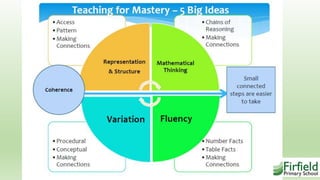
• Fluency: the ability to recall and apply knowledge rapidly and
accurately.
• Reasoning: explain their mathematical thinking
• Problem solving: apply their knowledge to solve problems in
varied contexts.
The National Curriculum states:
‘There is an expectation that the
majority of pupils will move through the
programme of study at broadly the same
pace and that pupils who grasp concept
rapidly should be challenged through rich
and sophisticated problems before any
acceleration to new content.’
OUR METHODOLOGY
• A high level of performance for all
• Keeping the class working together whilst addressing the
needs for all pupils to master the curriculum and for some
to gain greater depth and proficiency
• A mind-set that children can achieve with good teaching,
appropriate resources, effort and a ‘can-do’ attitude.
• Making use of in-depth, repetition and application.
• All pupils have access to the ideas and concepts.
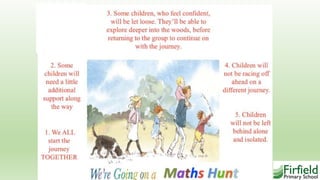
ALL ON BOARD THE SAME LIFT…
• NOT working on content from the next year group.
• More Able pupils NOT practising the same concept with
bigger numbers.
• Reasoning and problem solving NOT just the domain of ‘more
able’ pupils.
• Keeping the class working together: Quick intervention keep
up, not catch up.
WHY THE MASTERY APPROACH?
• It develops the ability to reason about a concept and make
connections
• It cuts down on the amount I need to learn eg relating
concepts of division, fractions and ratio
• It deepens conceptual understanding, conceptual and
procedural fluency
• It moves maths from one context to another.
• It helps us recognise concepts in unfamiliar situations.
• It ensures we know our number facts and tables and have
efficient procedures.
A SHIFT IN OUR EXPECTATIONS
• Complete change in mindset for teachers, parents and the
children themselves
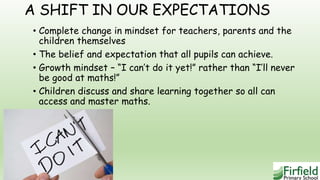
• The belief and expectation that all pupils can achieve.
• Growth mindset – “I can’t do it yet!” rather than “I’ll never
be good at maths!”
• Children discuss and share learning together so all can
access and master maths.
A typical maths lesson structure…
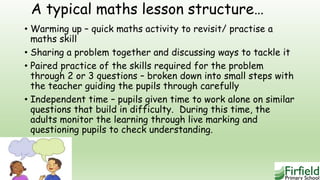
• Warming up – quick maths activity to revisit/ practise a
maths skill
• Sharing a problem together and discussing ways to tackle it
• Paired practice of the skills required for the problem
through 2 or 3 questions – broken down into small steps with
the teacher guiding the pupils through carefully
• Independent time – pupils given time to work alone on similar
questions that build in difficulty. During this time, the
adults monitor the learning through live marking and
questioning pupils to check understanding.
Hearing from the Horses’ Mouths!
•Miss Lemon (EYFS)
•Mr Tolson (Y2)
•Mr Lawson (Y4)
SOME TEACHING METHODS AND
STRATEGIES
• Develop reasoning with all
• What do you notice?
• What’s the same?
• What’s different?
• Convince me!
• Spot the odd one out!
• True or false….or sometimes both?
• Give an example of…
• The missing digit/number (empty box)
• Here's the answer, create the question
SOME TEACHING METHODS AND
STRATEGIES
• Use of precise language and speaking in full sentences gives
children the language in order to express the maths and
hang learning on – use of stem sentences
Eg There are _________ packets in ______boxes in the
shop.
• Memorisation – Rehearsal and repetition.
WHAT ABOUT DIFFERENTIATION?
• Emphasis on developing deep understanding
not pushing children on to new content
• Support for those struggling through‘ keep
up’ not ‘catch up’
• Use of resources to support/ scaffold
learning
• Use of pre-teaching
• Starting with a misconception from a
previous lesson to unpick errors.
EXAMPLES
IN RECEPTION - Using Spot The Mistake:
5,6,8,9
What is wrong with this sequence of numbers?
IN YEAR ONE – Using True or False?
I start at 2 and count in twos. I will say 9. True or False?
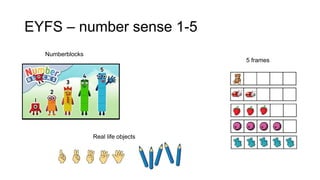
EYFS – number sense 1-5
Numberblocks
5 frames
Real life objects
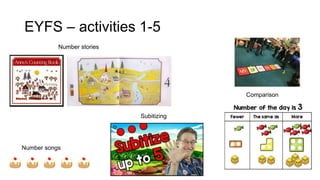
EYFS – activities 1-5
Comparison
Number songs
Number stories
Subitizing
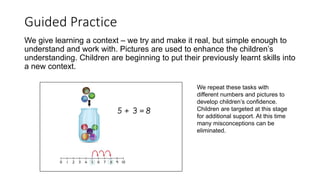
Guided Practice
We give learning a context – we try and make it real, but simple enough to
understand and work with. Pictures are used to enhance the children’s
understanding. Children are beginning to put their previously learnt skills into
a new context.
We repeat these tasks with
different numbers and pictures to
develop children’s confidence.
Children are targeted at this stage
for additional support. At this time
many misconceptions can be
eliminated.
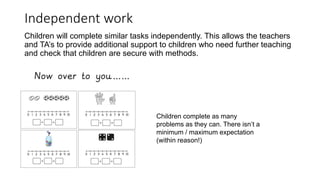
Independent work
Children will complete similar tasks independently. This allows the teachers
and TA’s to provide additional support to children who need further teaching
and check that children are secure with methods.
Children complete as many
problems as they can. There isn’t a
minimum / maximum expectation
(within reason!)
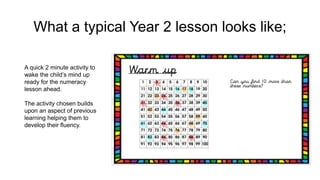
What a typical Year 2 lesson looks like;
A quick 2 minute activity to
wake the child’s mind up
ready for the numeracy
lesson ahead.
The activity chosen builds
upon an aspect of previous
learning helping them to
develop their fluency.
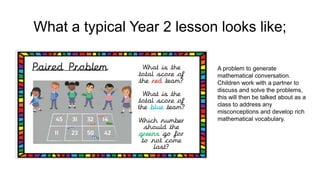
What a typical Year 2 lesson looks like;
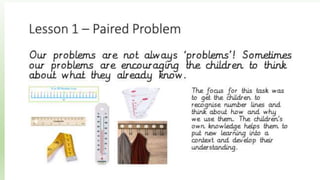
A problem to generate
mathematical conversation.
Children work with a partner to
discuss and solve the problems,
this will then be talked about as a
class to address any
misconceptions and develop rich
mathematical vocabulary.
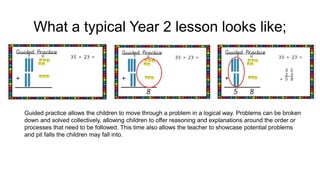
What a typical Year 2 lesson looks like;
Guided practice allows the children to move through a problem in a logical way. Problems can be broken
down and solved collectively, allowing children to offer reasoning and explanations around the order or
processes that need to be followed. This time also allows the teacher to showcase potential problems
and pit falls the children may fall into.
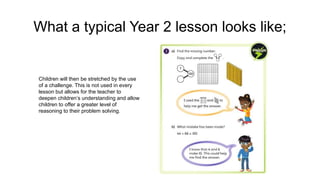
What a typical Year 2 lesson looks like;
Children will then be stretched by the use
of a challenge. This is not used in every
lesson but allows for the teacher to
deepen children’s understanding and allow
children to offer a greater level of
reasoning to their problem solving.
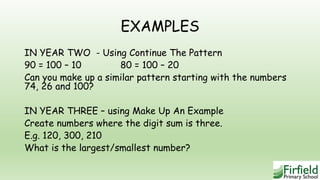
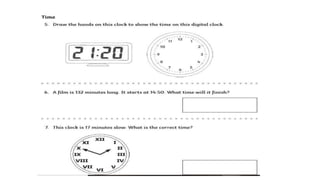
EXAMPLES
IN YEAR TWO - Using Continue The Pattern
90 = 100 – 10 80 = 100 – 20
Can you make up a similar pattern starting with the numbers
74, 26 and 100?
IN YEAR THREE – using Make Up An Example
Create numbers where the digit sum is three.
E.g. 120, 300, 210
What is the largest/smallest number?
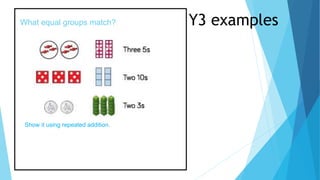
What equal groups match?
Show it using repeated addition.
Y3 examples
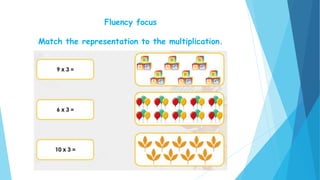
Fluency focus
Match the representation to the multiplication.
EXAMPLES
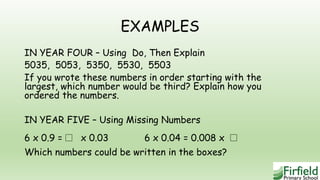
IN YEAR FOUR – Using Do, Then Explain
5035, 5053, 5350, 5530, 5503
If you wrote these numbers in order starting with the
largest, which number would be third? Explain how you
ordered the numbers.
IN YEAR FIVE – Using Missing Numbers
6 x 0.9 =□ x 0.03 6 x 0.04 = 0.008 x □
Which numbers could be written in the boxes?
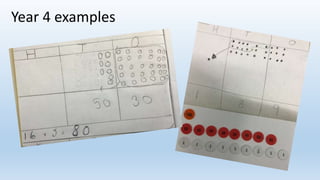
Year 4 examples
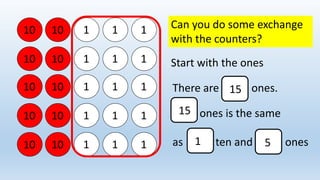
10 1
10 1 1
10 1
10 1 1
10 1
10 1 1
10 1
10 1 1
10 1
10 1 1
Can you do some exchange
with the counters?
Start with the ones
There are ones.
15
ones is the same
as ten and ones
15
1 5
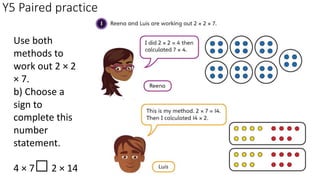
Y5 Paired practice
Use both
methods to
work out 2 × 2
× 7.
b) Choose a
sign to
complete this
number
statement.
4 × 7□2 × 14
Y5 Paired practice
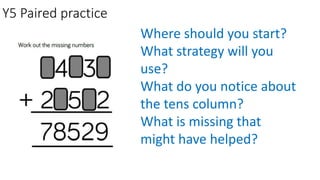
Where should you start?
What strategy will you
use?
What do you notice about
the tens column?
What is missing that
might have helped?
EXAMPLES
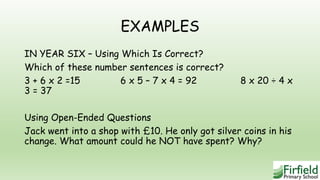
IN YEAR SIX – Using Which Is Correct?
Which of these number sentences is correct?
3 + 6 x 2 =15 6 x 5 – 7 x 4 = 92 8 x 20 ÷ 4 x
3 = 37
Using Open-Ended Questions
Jack went into a shop with £10. He only got silver coins in his
change. What amount could he NOT have spent? Why?
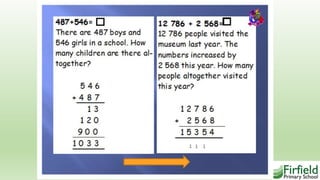
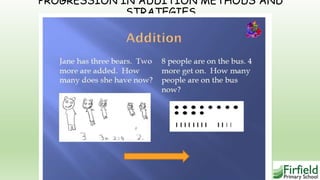
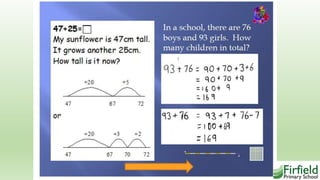
PROGRESSION IN ADDITION METHODS AND
STRATEGIES
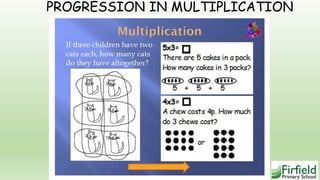
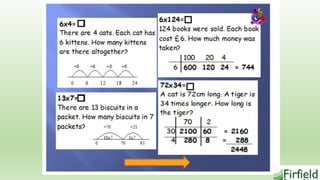
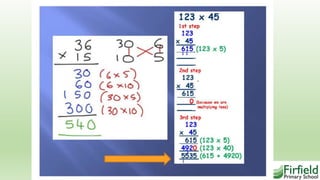
PROGRESSION IN MULTIPLICATION
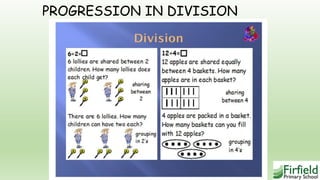
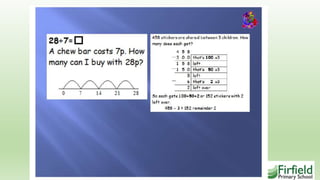
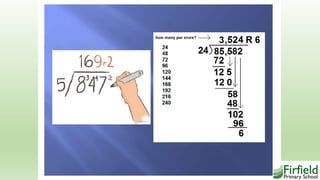
PROGRESSION IN DIVISION
How To Help At Home - EYFS
• Cooking – measure out ingredients and use a timer together.
• Practise counting to 20 and back to 1.
• Find the same amount of different items eg 3 socks, 3 pens,
3 cups etc.
• Play shops using real or pretend Monopoly money
Helping At Home – Yrs 1-3
• Use playing cards to add together 2 cards. Try with
subtraction and multiplication too.
• Keep cooking!
• Play traditional board games.
• Explore different ways to make money totals.
Helping At Home – Yrs 4-6
• Keep cooking – develop ideas of what time food needs
to go into the oven/ come out based on cooking times
and when the meal is required.
• Use TV schedules to look at duration of programmes.
• Look at weather APPs to explore the probability of rain
etc.
• Compare and find differences in salaries in the jobs
sections of newspapers.
• When on the move, discuss journey lengths and how the
speed can affect the time of arrival etc.
Maths Mastery Presentation 2020.ppt

Maths Mastery Presentation 2020.ppt

  • 1.
    Welcome to our2020 Maths Mastery Presentation What is mastery? What happens in a maths lesson? What calculation methods are the children taught? How can parents can help at home?
  • 2.
    What does itmean to master something…? • You have a wealth of knowledge on the subject • You have relevant skills at your disposal • You can problem solve and know which method works best • You don’t expend much energy on the basics – they become second nature. • You can explain and teach someone else effectively • You can apply your knowledge and skills to slightly different variations
  • 3.
    THE MASTERY APPROACHFOR MATHS (and other subjects): • Fluency: the ability to recall and apply knowledge rapidly and accurately. • Reasoning: explain their mathematical thinking • Problem solving: apply their knowledge to solve problems in varied contexts.
  • 4.
    The National Curriculumstates: ‘There is an expectation that the majority of pupils will move through the programme of study at broadly the same pace and that pupils who grasp concept rapidly should be challenged through rich and sophisticated problems before any acceleration to new content.’
  • 5.
    OUR METHODOLOGY • Ahigh level of performance for all • Keeping the class working together whilst addressing the needs for all pupils to master the curriculum and for some to gain greater depth and proficiency • A mind-set that children can achieve with good teaching, appropriate resources, effort and a ‘can-do’ attitude. • Making use of in-depth, repetition and application. • All pupils have access to the ideas and concepts.
  • 6.
    ALL ON BOARDTHE SAME LIFT… • NOT working on content from the next year group. • More Able pupils NOT practising the same concept with bigger numbers. • Reasoning and problem solving NOT just the domain of ‘more able’ pupils. • Keeping the class working together: Quick intervention keep up, not catch up.
  • 7.
    WHY THE MASTERYAPPROACH? • It develops the ability to reason about a concept and make connections • It cuts down on the amount I need to learn eg relating concepts of division, fractions and ratio • It deepens conceptual understanding, conceptual and procedural fluency • It moves maths from one context to another. • It helps us recognise concepts in unfamiliar situations. • It ensures we know our number facts and tables and have efficient procedures.
  • 8.
    A SHIFT INOUR EXPECTATIONS • Complete change in mindset for teachers, parents and the children themselves • The belief and expectation that all pupils can achieve. • Growth mindset – “I can’t do it yet!” rather than “I’ll never be good at maths!” • Children discuss and share learning together so all can access and master maths.
  • 10.
    A typical mathslesson structure… • Warming up – quick maths activity to revisit/ practise a maths skill • Sharing a problem together and discussing ways to tackle it • Paired practice of the skills required for the problem through 2 or 3 questions – broken down into small steps with the teacher guiding the pupils through carefully • Independent time – pupils given time to work alone on similar questions that build in difficulty. During this time, the adults monitor the learning through live marking and questioning pupils to check understanding.
  • 11.
    Hearing from theHorses’ Mouths! •Miss Lemon (EYFS) •Mr Tolson (Y2) •Mr Lawson (Y4)
  • 12.
    SOME TEACHING METHODSAND STRATEGIES • Develop reasoning with all • What do you notice? • What’s the same? • What’s different? • Convince me! • Spot the odd one out! • True or false….or sometimes both? • Give an example of… • The missing digit/number (empty box) • Here's the answer, create the question
  • 13.
    SOME TEACHING METHODSAND STRATEGIES • Use of precise language and speaking in full sentences gives children the language in order to express the maths and hang learning on – use of stem sentences Eg There are _________ packets in ______boxes in the shop. • Memorisation – Rehearsal and repetition.
  • 14.
    WHAT ABOUT DIFFERENTIATION? •Emphasis on developing deep understanding not pushing children on to new content • Support for those struggling through‘ keep up’ not ‘catch up’ • Use of resources to support/ scaffold learning • Use of pre-teaching • Starting with a misconception from a previous lesson to unpick errors.
  • 15.
    EXAMPLES IN RECEPTION -Using Spot The Mistake: 5,6,8,9 What is wrong with this sequence of numbers? IN YEAR ONE – Using True or False? I start at 2 and count in twos. I will say 9. True or False?
  • 16.
    EYFS – numbersense 1-5 Numberblocks 5 frames Real life objects
  • 17.
    EYFS – activities1-5 Comparison Number songs Number stories Subitizing
  • 19.
    Guided Practice We givelearning a context – we try and make it real, but simple enough to understand and work with. Pictures are used to enhance the children’s understanding. Children are beginning to put their previously learnt skills into a new context. We repeat these tasks with different numbers and pictures to develop children’s confidence. Children are targeted at this stage for additional support. At this time many misconceptions can be eliminated.
  • 20.
    Independent work Children willcomplete similar tasks independently. This allows the teachers and TA’s to provide additional support to children who need further teaching and check that children are secure with methods. Children complete as many problems as they can. There isn’t a minimum / maximum expectation (within reason!)
  • 21.
    What a typicalYear 2 lesson looks like; A quick 2 minute activity to wake the child’s mind up ready for the numeracy lesson ahead. The activity chosen builds upon an aspect of previous learning helping them to develop their fluency.
  • 22.
    What a typicalYear 2 lesson looks like; A problem to generate mathematical conversation. Children work with a partner to discuss and solve the problems, this will then be talked about as a class to address any misconceptions and develop rich mathematical vocabulary.
  • 23.
    What a typicalYear 2 lesson looks like; Guided practice allows the children to move through a problem in a logical way. Problems can be broken down and solved collectively, allowing children to offer reasoning and explanations around the order or processes that need to be followed. This time also allows the teacher to showcase potential problems and pit falls the children may fall into.
  • 24.
    What a typicalYear 2 lesson looks like; Children will then be stretched by the use of a challenge. This is not used in every lesson but allows for the teacher to deepen children’s understanding and allow children to offer a greater level of reasoning to their problem solving.
  • 25.
    EXAMPLES IN YEAR TWO- Using Continue The Pattern 90 = 100 – 10 80 = 100 – 20 Can you make up a similar pattern starting with the numbers 74, 26 and 100? IN YEAR THREE – using Make Up An Example Create numbers where the digit sum is three. E.g. 120, 300, 210 What is the largest/smallest number?
  • 26.
    What equal groupsmatch? Show it using repeated addition. Y3 examples
  • 27.
    Fluency focus Match therepresentation to the multiplication.
  • 28.
    EXAMPLES IN YEAR FOUR– Using Do, Then Explain 5035, 5053, 5350, 5530, 5503 If you wrote these numbers in order starting with the largest, which number would be third? Explain how you ordered the numbers. IN YEAR FIVE – Using Missing Numbers 6 x 0.9 =□ x 0.03 6 x 0.04 = 0.008 x □ Which numbers could be written in the boxes?
  • 29.
  • 30.
    10 1 10 11 10 1 10 1 1 10 1 10 1 1 10 1 10 1 1 10 1 10 1 1 Can you do some exchange with the counters? Start with the ones There are ones. 15 ones is the same as ten and ones 15 1 5
  • 31.
    Y5 Paired practice Useboth methods to work out 2 × 2 × 7. b) Choose a sign to complete this number statement. 4 × 7□2 × 14
  • 32.
    Y5 Paired practice Whereshould you start? What strategy will you use? What do you notice about the tens column? What is missing that might have helped?
  • 33.
    EXAMPLES IN YEAR SIX– Using Which Is Correct? Which of these number sentences is correct? 3 + 6 x 2 =15 6 x 5 – 7 x 4 = 92 8 x 20 ÷ 4 x 3 = 37 Using Open-Ended Questions Jack went into a shop with £10. He only got silver coins in his change. What amount could he NOT have spent? Why?
  • 37.
    PROGRESSION IN ADDITIONMETHODS AND STRATEGIES
  • 40.
  • 43.
  • 46.
    How To HelpAt Home - EYFS • Cooking – measure out ingredients and use a timer together. • Practise counting to 20 and back to 1. • Find the same amount of different items eg 3 socks, 3 pens, 3 cups etc. • Play shops using real or pretend Monopoly money
  • 47.
    Helping At Home– Yrs 1-3 • Use playing cards to add together 2 cards. Try with subtraction and multiplication too. • Keep cooking! • Play traditional board games. • Explore different ways to make money totals.
  • 48.
    Helping At Home– Yrs 4-6 • Keep cooking – develop ideas of what time food needs to go into the oven/ come out based on cooking times and when the meal is required. • Use TV schedules to look at duration of programmes. • Look at weather APPs to explore the probability of rain etc. • Compare and find differences in salaries in the jobs sections of newspapers. • When on the move, discuss journey lengths and how the speed can affect the time of arrival etc.

Editor's Notes

  • #11 TIME FOR JESS, JAMES AND ANDREW
  • #32 Question 1 a): Which method would you have chosen to solve the problem? Why? What is similar and di fferent about the two methods? Which method is more e fficient? Why? How can these representations help you explain which calculation is more efficient?,<>or = For 1b, the children need to understand that they need to calculate each side of the empty box before working out if it is Answer: Question 1 a): 2 × 2 × 7 = 28 Question 1 b): 4 × 7 = 2 × 14
  • #33 Answer 54,937 + 23,592 =78,529
  • #35 Now the pupils are expected to complete with fewer supporting questions from the teacher.