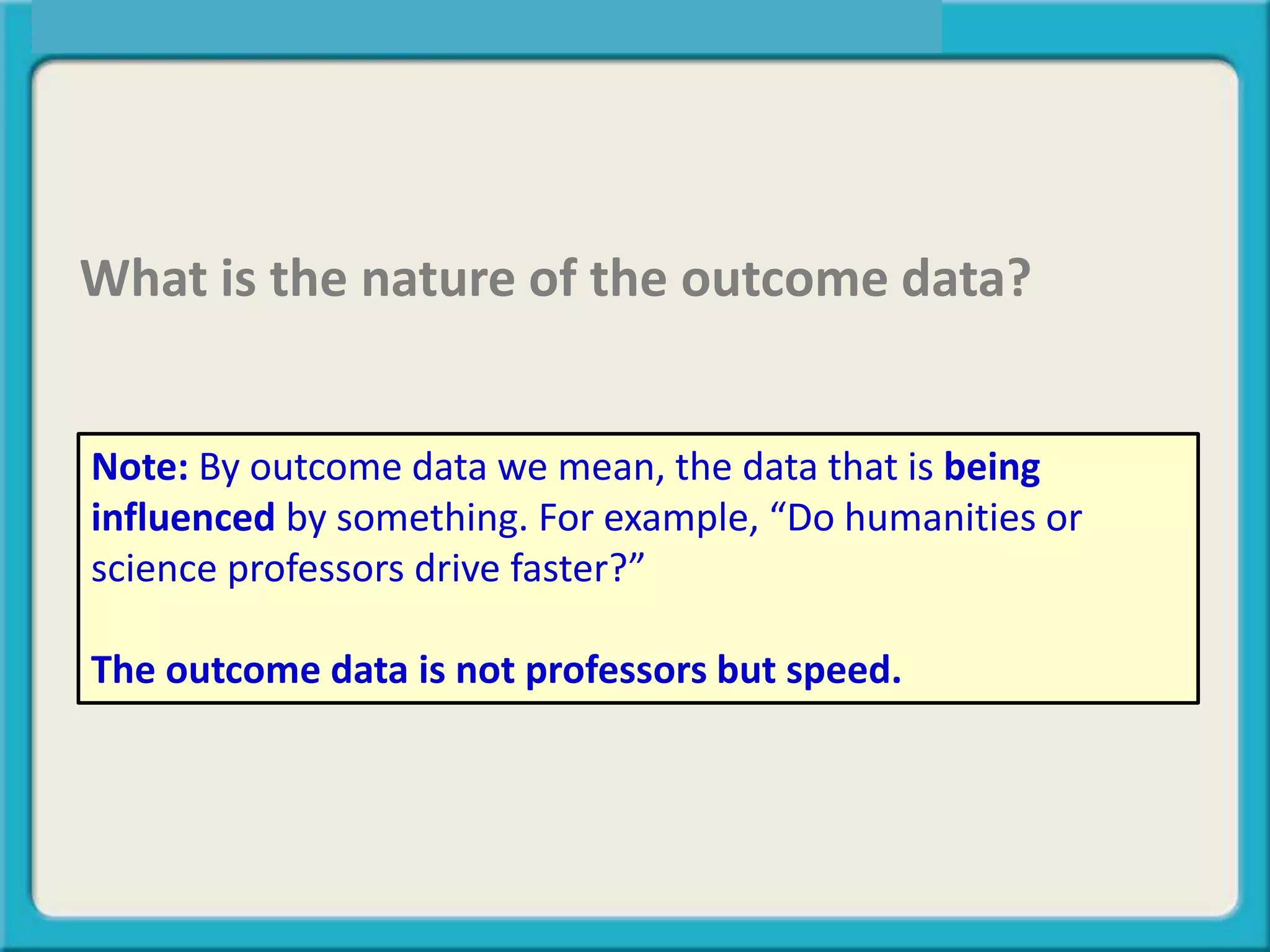
What is the nature of the outcome data?
Scaled? Ordinal?
Nominal Proportional?Nominal?
What is the nature of the outcome data?
Note: By outcome data we mean, the data that is being
influenced by something. For example, “Do humanities or
science professors drive faster?”
The outcome data is not professors but speed.
Scaled data provides exact amounts.
Central Tendency, Spread, or Symmetry?
12.5 feet60 degrees
Scaled data provides exact amounts.
Central Tendency, Spread, or Symmetry?
80 Miles per hour
12.5 feet60 degrees
1st Place 2nd Place 3rd Place
Ordinal or ranked data provides comparative amounts.
Scaled data provides exact amounts.
Central Tendency, Spread, or Symmetry?
80 Miles per hour
12.5 feet60 degrees
1st Place 2nd Place 3rd Place
Ordinal or ranked data provides comparative amounts.
Nominal data names or puts values in categories.
Republican or DemocratFor or Against Mexican, Canadian, or American
Scaled data provides exact amounts.
Central Tendency, Spread, or Symmetry?
80 Miles per hour
12.5 feet60 degrees
1st Place 2nd Place 3rd Place
Ordinal or ranked data provides comparative amounts.
Nominal data names or puts values in categories.
Republican or DemocratFor or Against Mexican, Canadian, or American
Nominal proportional data are simply percentages.
Republican 45% or Democrat 55%
In Summary
Scaled data provides exact amounts.
Central Tendency, Spread, or Symmetry?
80 Miles per hour
12.5 feet60 degrees
Ordinal or ranked data provides comparative amounts.
1st Place 2nd Place 3rd Place
Nominal data names or puts values in categories.
Republican or DemocratFor or Against Mexican, Canadian, or American
Nominal proportional data are simply percentages.
Republican 45% or Democrat 55%
Let’s Practice!
Determine the type of data in each question
that follows:
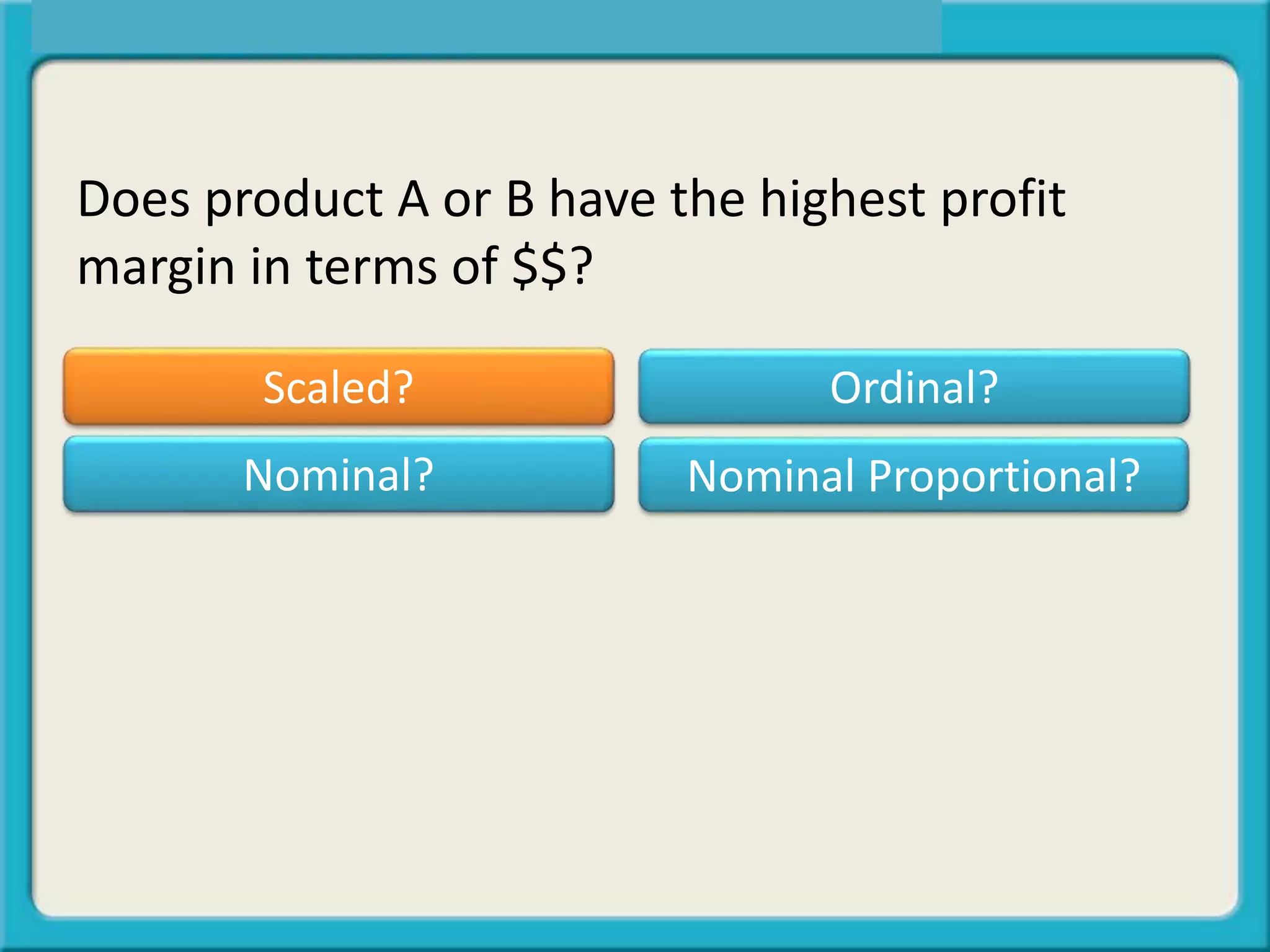
Does product A or B have the highest profit
margin in terms of $$?
Scaled? Ordinal?
Nominal Proportional?Nominal?
Does product A or B have the highest profit
margin in terms of $$?
Scaled? Ordinal?
Nominal Proportional?Nominal?
Does product A or B have the highest profit
margin in terms of $$?
Scaled? Ordinal?
Nominal Proportional?Nominal?
Does product A or B have the highest profit
margin in terms of $$?
Scaled? Ordinal?
Nominal Proportional?Nominal?
Note – even though product A and B are categories and
thus nominal, the focus is on what we call the outcome
which in this case is $$.
Does product A or B have the highest profit
margin in terms of $$?
Scaled data is data that gives you exact amounts.
80 Miles per hour 12.5 feet
60 degrees
Scaled? Ordinal?
Nominal Proportional?Nominal?
Next Question
Does where you grow up influence your
religious affiliation?
Scaled? Ordinal?
Nominal Proportional?Nominal?
Does where you grow up influence your
religious affiliation?
Scaled? Ordinal?
Nominal Proportional?Nominal?
Does where you grow up influence your
religious affiliation?
Scaled? Ordinal?
Nominal Proportional?Nominal?
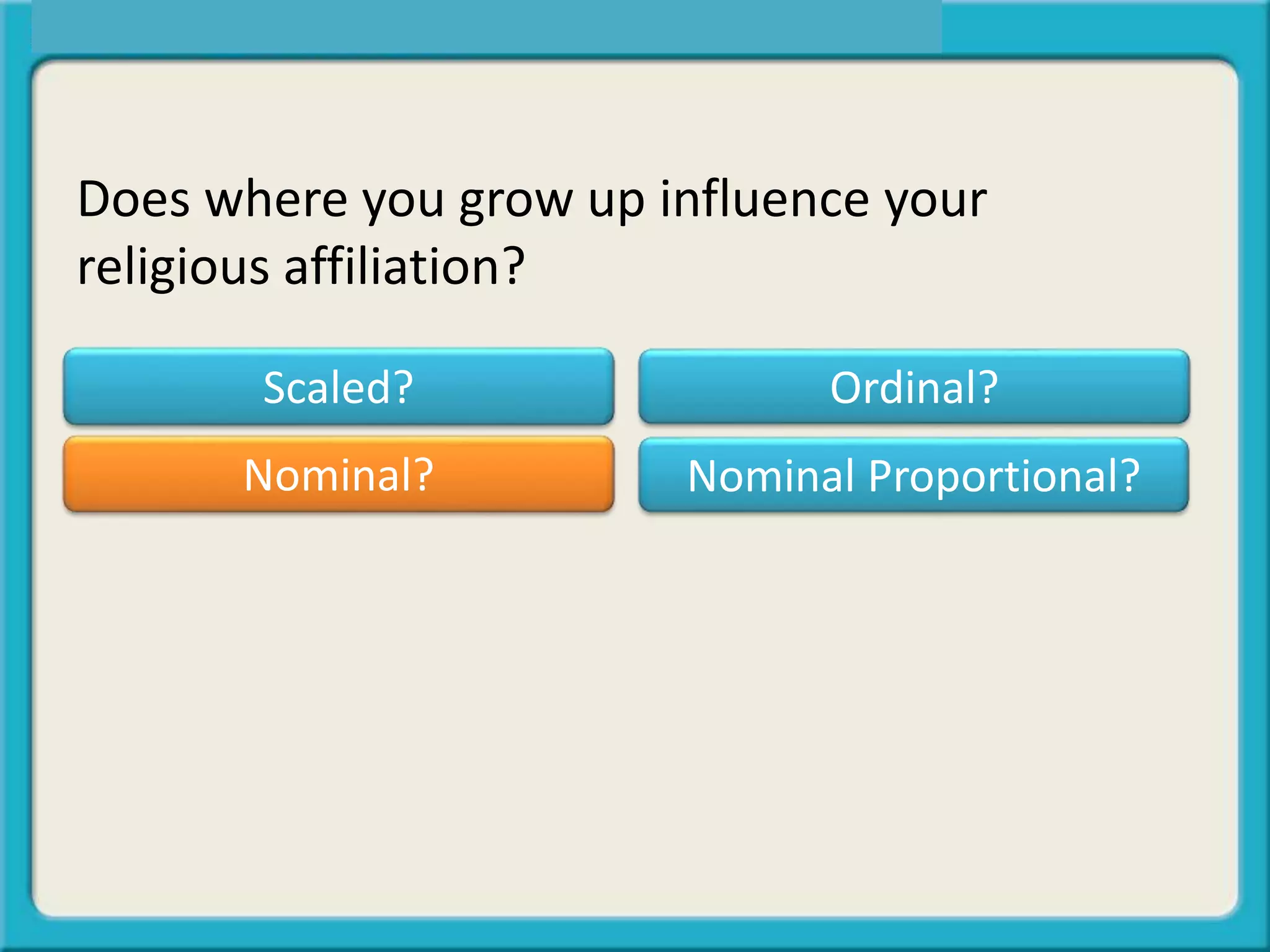
Does where you grow up influence your
religious affiliation?
Nominal data is categorical.
Republican or DemocratFor or Against Mexican, Canadian, or American
Scaled? Ordinal?
Nominal Proportional?Nominal?
Next Question
Which school ranks higher in terms of overall
ACT scores?
Scaled? Ordinal?
Nominal Proportional?Nominal?
Which school ranks higher in terms of overall
ACT scores?
Scaled? Ordinal?
Nominal Proportional?Nominal?
Which school ranks higher in terms of overall
ACT scores?
Scaled? Ordinal?
Nominal Proportional?Nominal?
Which school ranks higher in terms of overall
ACT scores?
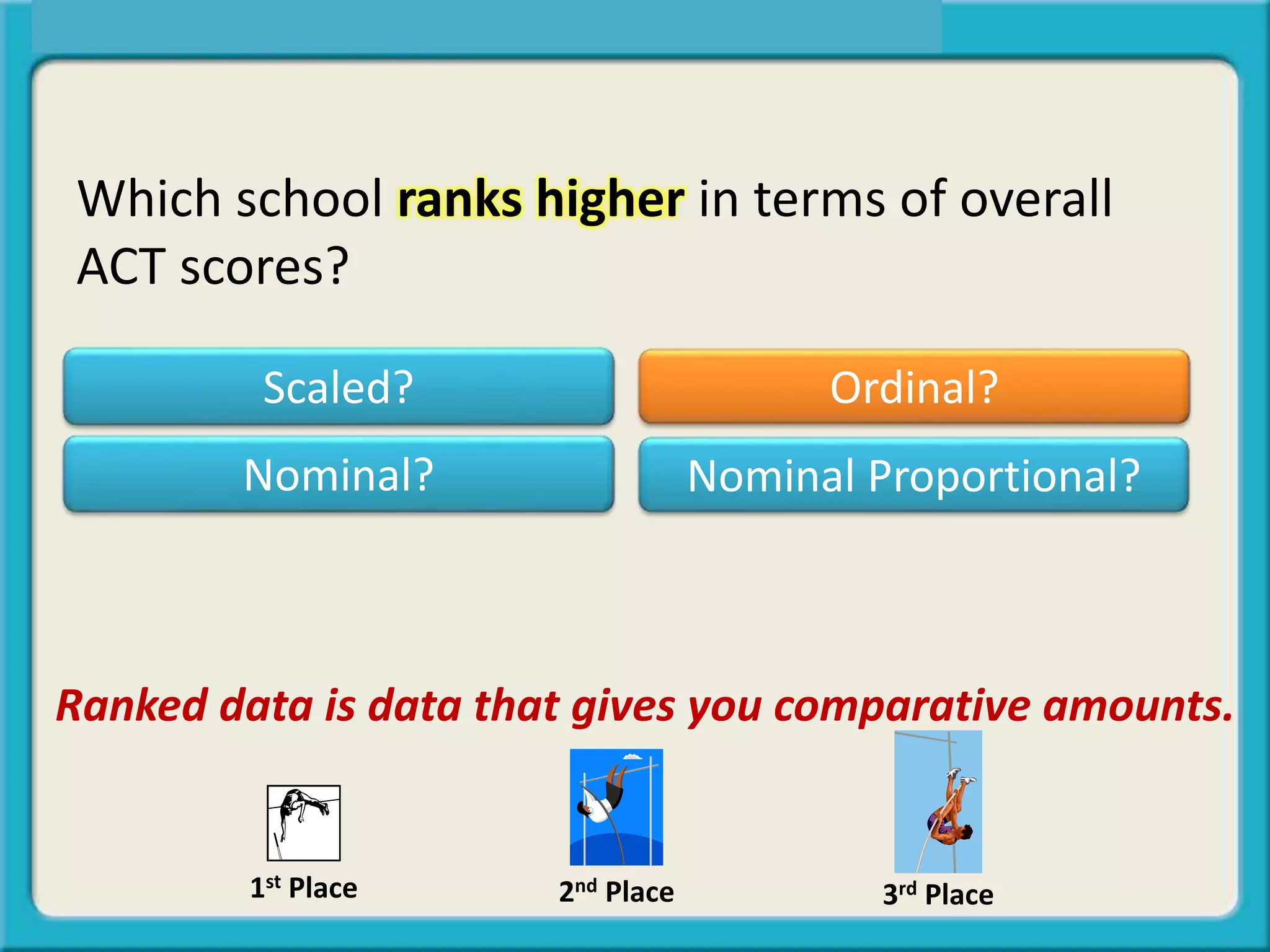
Ranked data is data that gives you comparative amounts.
1st Place 2nd Place 3rd Place
Scaled? Ordinal?
Nominal Proportional?Nominal?
Final Question
Do those enrolled in a test prep course have
higher exam percentages than those not
enrolled?
Scaled? Ordinal?
Nominal Proportional?Nominal?
Do those enrolled in a test prep course have
higher exam percentages than those not
enrolled?
Scaled? Ordinal?
Nominal Proportional?Nominal?
Do those enrolled in a test prep course have
higher exam percentages than those not
enrolled?
Scaled? Ordinal?
Nominal Proportional?Nominal?
Do those enrolled in a test prep course have
higher exam percentages than those not
enrolled?
Scaled? Ordinal?
Nominal Proportional?Nominal?
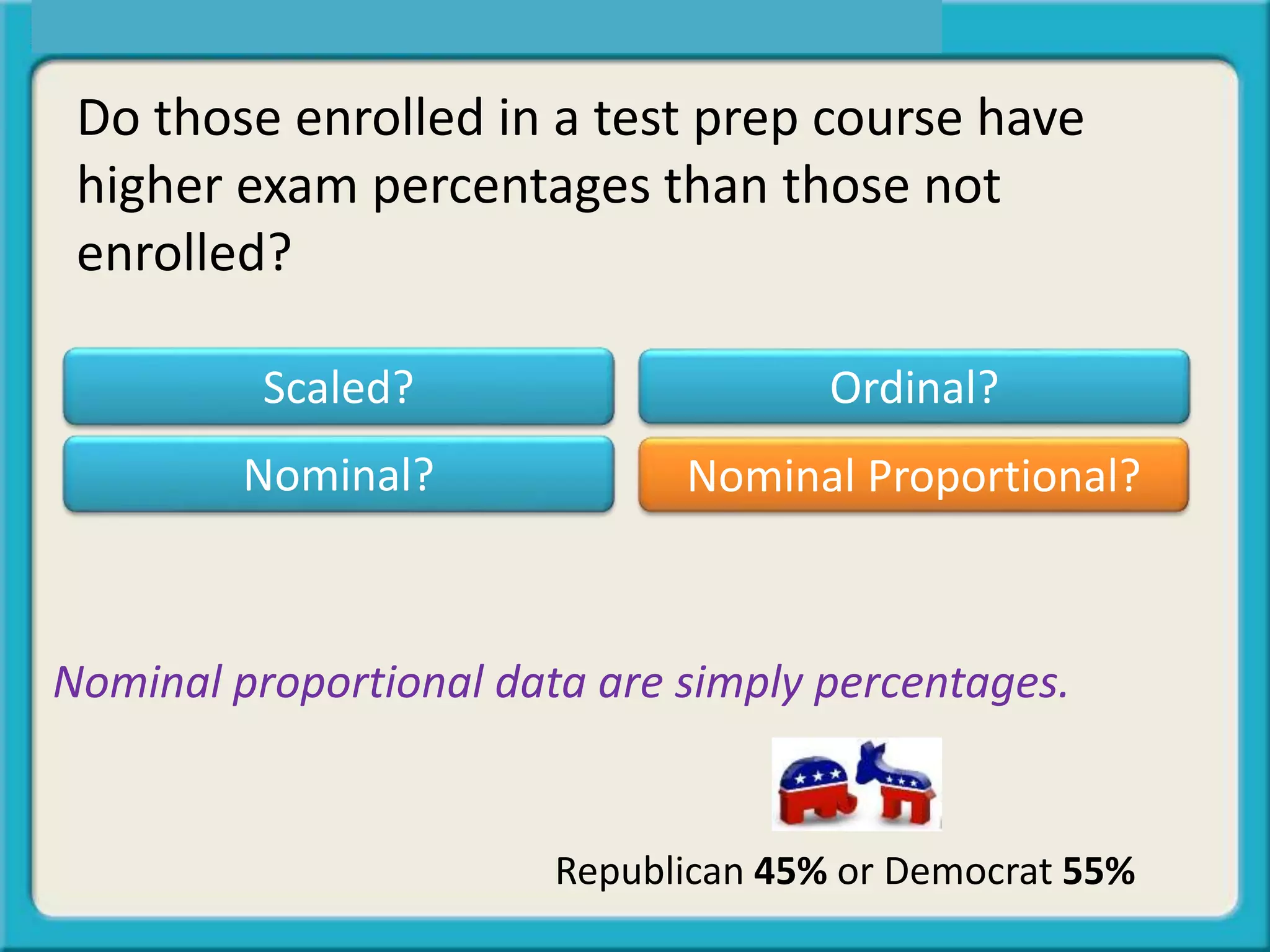
Nominal proportional data are simply percentages.
Republican 45% or Democrat 55%
Important Note
Important Note
There are two types of inferential statistics:
Parametric and non-parametric.
Important Note
Parametric statistics under (the difference
category) are those statistics that use scaled
data. Because scaled data can use the mean in
their calculations, parametric tests use the
mean.
Important Note
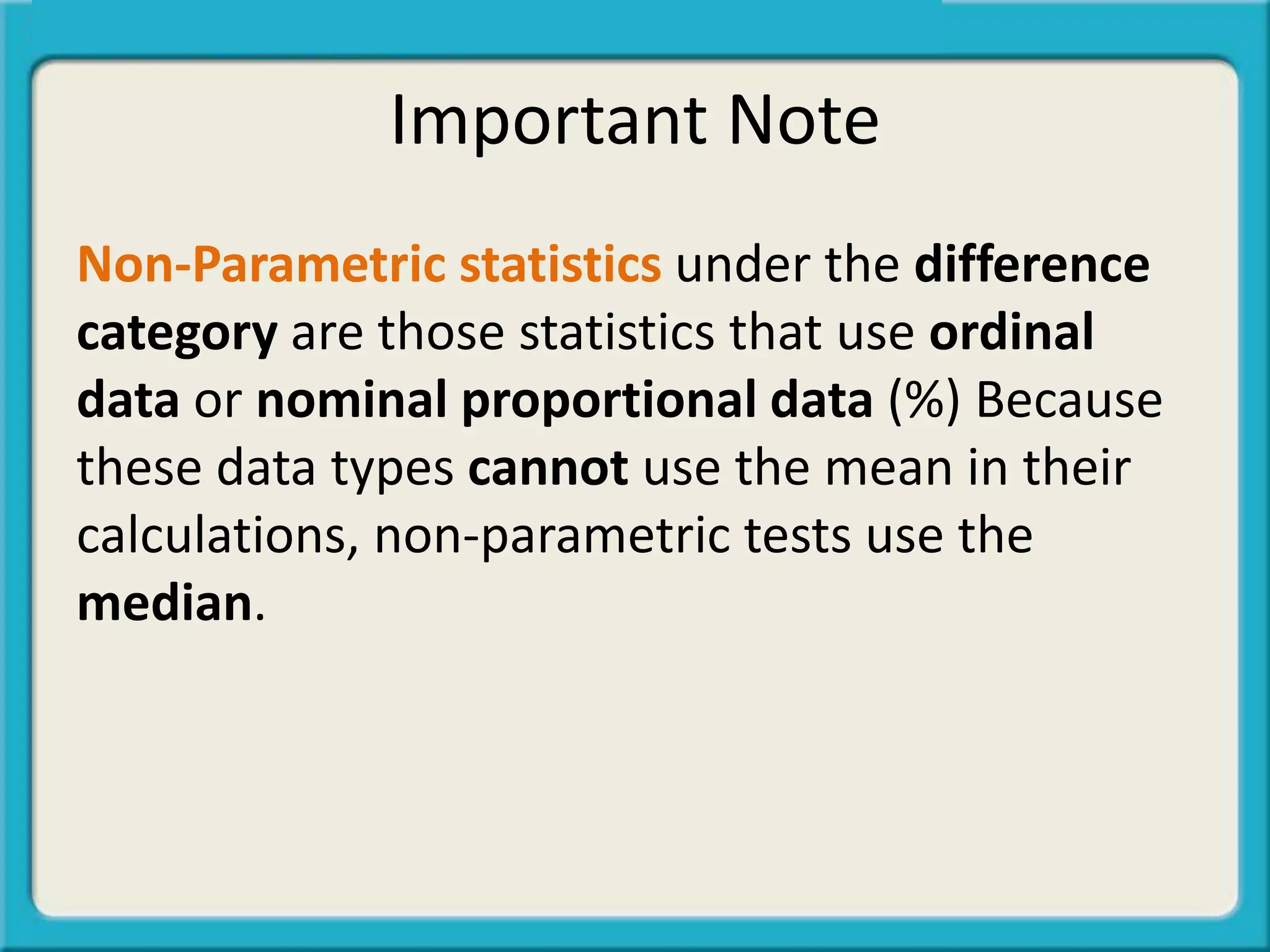
Non-Parametric statistics under the difference
category are those statistics that use ordinal
data or nominal proportional data (%) Because
these data types cannot use the mean in their
calculations, non-parametric tests use the
median.
In this course you will not learn how to use non-
parametric tests under the difference category.
But, you will learn the parametric tests under
the difference category.
But, you will learn the parametric tests under
the difference category.
Mean Median Mode Range Stdev IQR Single t Ind t
Paired t ANOVA ANCOVA F-ANOV RM Split Pearson Partial
Point-B Phi Spearmn Kendall S-Linear M-Linear Chi-Ind Chi-Fit
But, you will learn the parametric tests under
the difference category.
Mean Median Mode Range Stdev IQR Single t Ind t
Paired t ANOVA ANCOVA F-ANOV RM Split Pearson Partial
Point-B Phi Spearmn Kendall S-Linear M-Linear Chi-Ind Chi-Fit
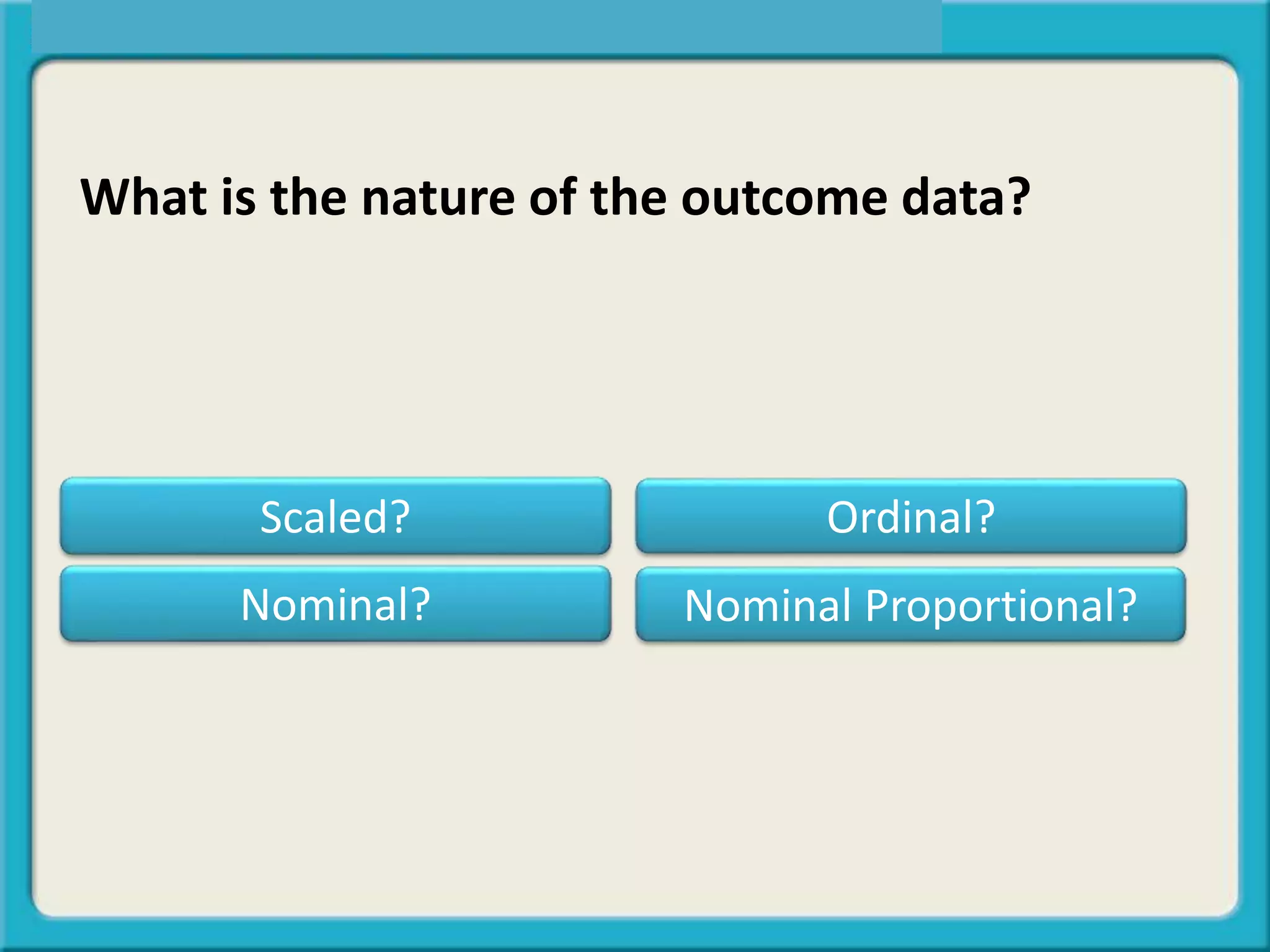
What is the nature of the outcome data?
Scaled? Ordinal?
Nominal Proportional?Nominal?

Nature of the data practice

  • 1.
    What is thenature of the outcome data? Scaled? Ordinal? Nominal Proportional?Nominal?
  • 2.
    What is thenature of the outcome data? Note: By outcome data we mean, the data that is being influenced by something. For example, “Do humanities or science professors drive faster?” The outcome data is not professors but speed.
  • 3.
    Scaled data providesexact amounts. Central Tendency, Spread, or Symmetry? 12.5 feet60 degrees
  • 4.
    Scaled data providesexact amounts. Central Tendency, Spread, or Symmetry? 80 Miles per hour 12.5 feet60 degrees 1st Place 2nd Place 3rd Place Ordinal or ranked data provides comparative amounts.
  • 5.
    Scaled data providesexact amounts. Central Tendency, Spread, or Symmetry? 80 Miles per hour 12.5 feet60 degrees 1st Place 2nd Place 3rd Place Ordinal or ranked data provides comparative amounts. Nominal data names or puts values in categories. Republican or DemocratFor or Against Mexican, Canadian, or American
  • 6.
    Scaled data providesexact amounts. Central Tendency, Spread, or Symmetry? 80 Miles per hour 12.5 feet60 degrees 1st Place 2nd Place 3rd Place Ordinal or ranked data provides comparative amounts. Nominal data names or puts values in categories. Republican or DemocratFor or Against Mexican, Canadian, or American Nominal proportional data are simply percentages. Republican 45% or Democrat 55%
  • 7.
  • 8.
    Scaled data providesexact amounts. Central Tendency, Spread, or Symmetry? 80 Miles per hour 12.5 feet60 degrees Ordinal or ranked data provides comparative amounts. 1st Place 2nd Place 3rd Place Nominal data names or puts values in categories. Republican or DemocratFor or Against Mexican, Canadian, or American Nominal proportional data are simply percentages. Republican 45% or Democrat 55%
  • 9.
  • 10.
    Determine the typeof data in each question that follows:
  • 11.
    Does product Aor B have the highest profit margin in terms of $$? Scaled? Ordinal? Nominal Proportional?Nominal?
  • 12.
    Does product Aor B have the highest profit margin in terms of $$? Scaled? Ordinal? Nominal Proportional?Nominal?
  • 13.
    Does product Aor B have the highest profit margin in terms of $$? Scaled? Ordinal? Nominal Proportional?Nominal?
  • 14.
    Does product Aor B have the highest profit margin in terms of $$? Scaled? Ordinal? Nominal Proportional?Nominal? Note – even though product A and B are categories and thus nominal, the focus is on what we call the outcome which in this case is $$.
  • 15.
    Does product Aor B have the highest profit margin in terms of $$? Scaled data is data that gives you exact amounts. 80 Miles per hour 12.5 feet 60 degrees Scaled? Ordinal? Nominal Proportional?Nominal?
  • 16.
  • 17.
    Does where yougrow up influence your religious affiliation? Scaled? Ordinal? Nominal Proportional?Nominal?
  • 18.
    Does where yougrow up influence your religious affiliation? Scaled? Ordinal? Nominal Proportional?Nominal?
  • 19.
    Does where yougrow up influence your religious affiliation? Scaled? Ordinal? Nominal Proportional?Nominal?
  • 20.
    Does where yougrow up influence your religious affiliation? Nominal data is categorical. Republican or DemocratFor or Against Mexican, Canadian, or American Scaled? Ordinal? Nominal Proportional?Nominal?
  • 21.
  • 22.
    Which school rankshigher in terms of overall ACT scores? Scaled? Ordinal? Nominal Proportional?Nominal?
  • 23.
    Which school rankshigher in terms of overall ACT scores? Scaled? Ordinal? Nominal Proportional?Nominal?
  • 24.
    Which school rankshigher in terms of overall ACT scores? Scaled? Ordinal? Nominal Proportional?Nominal?
  • 25.
    Which school rankshigher in terms of overall ACT scores? Ranked data is data that gives you comparative amounts. 1st Place 2nd Place 3rd Place Scaled? Ordinal? Nominal Proportional?Nominal?
  • 26.
  • 27.
    Do those enrolledin a test prep course have higher exam percentages than those not enrolled? Scaled? Ordinal? Nominal Proportional?Nominal?
  • 28.
    Do those enrolledin a test prep course have higher exam percentages than those not enrolled? Scaled? Ordinal? Nominal Proportional?Nominal?
  • 29.
    Do those enrolledin a test prep course have higher exam percentages than those not enrolled? Scaled? Ordinal? Nominal Proportional?Nominal?
  • 30.
    Do those enrolledin a test prep course have higher exam percentages than those not enrolled? Scaled? Ordinal? Nominal Proportional?Nominal? Nominal proportional data are simply percentages. Republican 45% or Democrat 55%
  • 31.
  • 32.
    Important Note There aretwo types of inferential statistics: Parametric and non-parametric.
  • 33.
    Important Note Parametric statisticsunder (the difference category) are those statistics that use scaled data. Because scaled data can use the mean in their calculations, parametric tests use the mean.
  • 34.
    Important Note Non-Parametric statisticsunder the difference category are those statistics that use ordinal data or nominal proportional data (%) Because these data types cannot use the mean in their calculations, non-parametric tests use the median.
  • 35.
    In this courseyou will not learn how to use non- parametric tests under the difference category.
  • 36.
    But, you willlearn the parametric tests under the difference category.
  • 37.
    But, you willlearn the parametric tests under the difference category. Mean Median Mode Range Stdev IQR Single t Ind t Paired t ANOVA ANCOVA F-ANOV RM Split Pearson Partial Point-B Phi Spearmn Kendall S-Linear M-Linear Chi-Ind Chi-Fit
  • 38.
    But, you willlearn the parametric tests under the difference category. Mean Median Mode Range Stdev IQR Single t Ind t Paired t ANOVA ANCOVA F-ANOV RM Split Pearson Partial Point-B Phi Spearmn Kendall S-Linear M-Linear Chi-Ind Chi-Fit
  • 39.
    What is thenature of the outcome data? Scaled? Ordinal? Nominal Proportional?Nominal?

Editor's Notes

  • #4 Does where you grow up influence your religious affiliation?
  • #5 Does where you grow up influence your religious affiliation?
  • #6 Does where you grow up influence your religious affiliation?
  • #7 Does where you grow up influence your religious affiliation?
  • #9 Does where you grow up influence your religious affiliation?