MODEL SPECIFICATION FOR
MULTIPLE REGRESSION
Ryan Herzog, Ph.D.
Gonzaga University
ECON 355 – Regression Analysis
MEASURES OF FIT
• R-squared
• Standard Error of the Regression
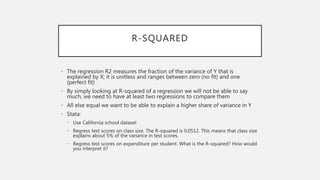
R-SQUARED
• The regression R2 measures the fraction of the variance of Y that is
explained by X; it is unitless and ranges between zero (no fit) and one
(perfect fit)
• By simply looking at R-squared of a regression we will not be able to say
much, we need to have at least two regressions to compare them
• All else equal we want to be able to explain a higher share of variance in Y
• Stata:
• Use California school dataset
• Regress test scores on class size. The R-squared is 0.0512. This means that class size
explains about 5% of the variance in test scores.
• Regress test scores on expenditure per student. What is the R-squared? How would
you interpret it?
INTERPRETING R-SQUARED
• An increase in R-squared does not necessarily mean that an added variable
is statistically significant
• A high R-squared does not mean that the regressors are a true cause of the
dependent variable
• A high R-squared does not mean that the coefficients on the regressors are
true
• A low R-squared does not mean that the coefficients on the regressors are
wrong
• A high R-squared does not necessarily mean that you have the most
appropriate set of regressors, nor does a low R-squared necessarily mean
that you have an inappropriate set of regressors.
R-SQUARED RULES
• Same dependent variable
• Same number of independent variables
• Stata:
• generate ltestscr=ln(testscr)
Generate a table with the regressions below (use outreg)
• Regress test score on class size and expenditure per student
• Regress natural log of test score on class size
• Regress test score on class size and average district income
• Regress expenditure per student on average district income
• Regress natural log of test score on average district income
• Regress natural log of test score on class size and expenditure per student
STANDARD ERROR OF THE REGRESSION
• The SER is a measure of the spread of the observations around the regression line
measured in the units of the dependent variable
• SER is an estimator of the standard deviation of the regression error 𝑢𝑖
• All else equal we want to have a smaller spread of the observations around the
regression line
• In Stata SER is called root MSE (mean squared error)
• In the regression of class size on test score the SER is about 18.6. This means that the
standard deviation of the regression residuals around the regression line is 18.6 points.
• We can use SER to compare models
• What are the SERs for the rest of the regressions you have run? What does that mean?
CAUSAL EFFECTS AND IDEALIZED
EXPERIMENTS
• Most of our questions concern causal relationships among variables, i.e.
does lower class size lead to higher test scores?
• Causality means that a specific action leads to a specific measurable
consequence
• The best way to measure a causal effect is by conducting an experiment
• In a randomized controlled experiment there is both a control group and a
treatment group. Assignment to a group happens randomly
• We would like to be able to show that the only systematic reason for
differences in outcomes between the treatment and control groups is the
treatment itself
• In practice, it is not possible to perform ideal experiment. This however, gives
us a benchmark.
NONRANDOM SAMPLE EXAMPLE - 1
• In 1936 the Literary Gazette polled a “random” sample of households chosen
from telephone records and automobile registration
• In 1936 many households did not have cars or telephones, and those that
did tended to be richer – and were also more likely to be Republican
• The results of the poll indicated the Landon (a republican presidential
candidate) would defeat an incumbent (Roosevelt) by a landslide – 57% to
43% in the 1936 election
• Roosevelt ended up winning by 59% to 41%
• Do you think surveys conducted using social media might have a similar
problem with bias?
NONRANDOM SAMPLE EXAMPLE - 2
• Some mutual funds simply track the market, some are actively managed by full-time
professionals.
• Do the latter mutual funds outperform the former?
• One way to answer the question is to use historical data on funds currently available
for purchase, however this means that the most poorly underperforming funds would
not be represented.
• The sample is selected based on the value of the dependent variable, returns, because
funds with the lowest returns are eliminated
• The mean return of all funds would then be lower than the mean return of those still in
existence. This is also called a survivorship bias.
• When corrected for survivorship bias it turns out actively managed funds do not
outperform the market
NON-RANDOM SAMPLE EXAMPLE 3
• Does the class size affect the test scores with only districts where
average class size is above 20 students included?
• What is the average height of a GU student measured outside of a
basketball locker room?

Topic 6 (model specification)

  • 1.
    MODEL SPECIFICATION FOR MULTIPLEREGRESSION Ryan Herzog, Ph.D. Gonzaga University ECON 355 – Regression Analysis
  • 2.
    MEASURES OF FIT •R-squared • Standard Error of the Regression
  • 3.
    R-SQUARED • The regressionR2 measures the fraction of the variance of Y that is explained by X; it is unitless and ranges between zero (no fit) and one (perfect fit) • By simply looking at R-squared of a regression we will not be able to say much, we need to have at least two regressions to compare them • All else equal we want to be able to explain a higher share of variance in Y • Stata: • Use California school dataset • Regress test scores on class size. The R-squared is 0.0512. This means that class size explains about 5% of the variance in test scores. • Regress test scores on expenditure per student. What is the R-squared? How would you interpret it?
  • 4.
    INTERPRETING R-SQUARED • Anincrease in R-squared does not necessarily mean that an added variable is statistically significant • A high R-squared does not mean that the regressors are a true cause of the dependent variable • A high R-squared does not mean that the coefficients on the regressors are true • A low R-squared does not mean that the coefficients on the regressors are wrong • A high R-squared does not necessarily mean that you have the most appropriate set of regressors, nor does a low R-squared necessarily mean that you have an inappropriate set of regressors.
  • 5.
    R-SQUARED RULES • Samedependent variable • Same number of independent variables • Stata: • generate ltestscr=ln(testscr) Generate a table with the regressions below (use outreg) • Regress test score on class size and expenditure per student • Regress natural log of test score on class size • Regress test score on class size and average district income • Regress expenditure per student on average district income • Regress natural log of test score on average district income • Regress natural log of test score on class size and expenditure per student
  • 6.
    STANDARD ERROR OFTHE REGRESSION • The SER is a measure of the spread of the observations around the regression line measured in the units of the dependent variable • SER is an estimator of the standard deviation of the regression error 𝑢𝑖 • All else equal we want to have a smaller spread of the observations around the regression line • In Stata SER is called root MSE (mean squared error) • In the regression of class size on test score the SER is about 18.6. This means that the standard deviation of the regression residuals around the regression line is 18.6 points. • We can use SER to compare models • What are the SERs for the rest of the regressions you have run? What does that mean?
  • 7.
    CAUSAL EFFECTS ANDIDEALIZED EXPERIMENTS • Most of our questions concern causal relationships among variables, i.e. does lower class size lead to higher test scores? • Causality means that a specific action leads to a specific measurable consequence • The best way to measure a causal effect is by conducting an experiment • In a randomized controlled experiment there is both a control group and a treatment group. Assignment to a group happens randomly • We would like to be able to show that the only systematic reason for differences in outcomes between the treatment and control groups is the treatment itself • In practice, it is not possible to perform ideal experiment. This however, gives us a benchmark.
  • 8.
    NONRANDOM SAMPLE EXAMPLE- 1 • In 1936 the Literary Gazette polled a “random” sample of households chosen from telephone records and automobile registration • In 1936 many households did not have cars or telephones, and those that did tended to be richer – and were also more likely to be Republican • The results of the poll indicated the Landon (a republican presidential candidate) would defeat an incumbent (Roosevelt) by a landslide – 57% to 43% in the 1936 election • Roosevelt ended up winning by 59% to 41% • Do you think surveys conducted using social media might have a similar problem with bias?
  • 9.
    NONRANDOM SAMPLE EXAMPLE- 2 • Some mutual funds simply track the market, some are actively managed by full-time professionals. • Do the latter mutual funds outperform the former? • One way to answer the question is to use historical data on funds currently available for purchase, however this means that the most poorly underperforming funds would not be represented. • The sample is selected based on the value of the dependent variable, returns, because funds with the lowest returns are eliminated • The mean return of all funds would then be lower than the mean return of those still in existence. This is also called a survivorship bias. • When corrected for survivorship bias it turns out actively managed funds do not outperform the market
  • 10.
    NON-RANDOM SAMPLE EXAMPLE3 • Does the class size affect the test scores with only districts where average class size is above 20 students included? • What is the average height of a GU student measured outside of a basketball locker room?