THE THEORY OF
PRIVATIZATION
Prof.Dr.Coskun Can Aktan
Dokuz Eylul University
Faculty of Economics & Management
&
Social Sciences Research Society
http://www.sobiad.org
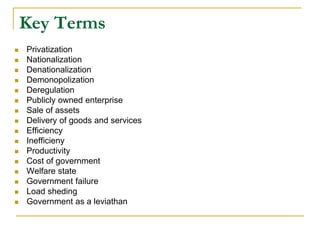
Key Terms
 Privatization
 Nationalization
 Denationalization
 Demonopolization
 Deregulation
 Publicly owned enterprise
 Sale of assets
 Delivery of goods and services
 Efficiency
 Inefficieny
 Productivity
 Cost of government
 Welfare state
 Government failure
 Load sheding
 Government as a leviathan
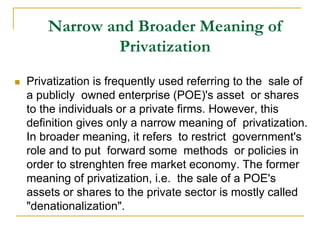
Narrow and Broader Meaning of
Privatization
 Privatization is frequently used referring to the sale of
a publicly owned enterprise (POE)'s asset or shares
to the individuals or a private firms. However, this
definition gives only a narrow meaning of privatization.
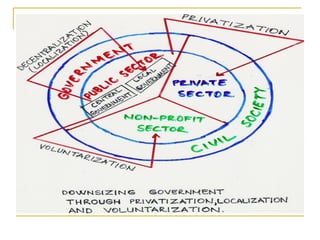
In broader meaning, it refers to restrict government's
role and to put forward some methods or policies in
order to strenghten free market economy. The former
meaning of privatization, i.e. the sale of a POE's
assets or shares to the private sector is mostly called
"denationalization".
Narrow Meaning of Privatization:
Denationalization
 As noted already, denationalization refers to the sale of assets or
shares of a publicly owned enterprises to the private sector.
 According to the definition given above, when a small part of
shares/assets are sold to the private sector, it can be called as
"denationalization".
 However, it is more appropriate to define denationalization as
transferring at least 51 percent shares of a POE to the private
sector.
 In this case, transfer of ownership (sale of shares) results in
transfer of management and operation as well. However, full
denationalization requires that all shares and assets of a POE
must be sold to the private sector.
Problems of Denationalization Process
1.Timing and Planning of the Denationalization
Process
2.Priority Problem
3.Other Problems
Timing and Planning of the
Denationalization Process
a. Promotion of the denationalization program
and strategy to the public
b. Preliminary studies
c. Legal framework
d. Implementing the program qradually
Priority Problem
 Which publicly owned enterprises should
be privatized first? In other words, which
public economic enterprise's stocks
should be offered for sale to the public
first
Other Problems
►Appraising the value of the assets of the
publicly owned enterprise subject to sale
is not an easy task to do.
►The important problems are how the
value of equity stocks will be determined.
THE MAJOR BARRIERS TO IMPLEMENT
DENATIONALIZATION SUCCESSFULLY IN
DEVELOPING COUNTRIES
►Political Instability and Uncertainty: It is a fact that many
developing countries suffer instability and uncertainty in
politics.
►Economic Instability and Uncertainty: Bad politics puts the
economy in a worse situation even though the
implemented economic policy is correct. Economists
increasingly believe that the politician are the major
source of economic problems.
►Weak and Underdeveloped Capital Markets: Capital
markets in developing countries either are not developed
or non-existent. It is quite difficult to sell equity stocks of
POEs in domestic capital market in developing countries.
This is because potential buyers are very few.
Broad Meaning of Privatization
 Denationalization is only one form of privatization. In
broad meaning, privatization refers to the transfer of
functions previously performed exclusively by the public
sector, to the private sector.
 In other words, privatization is an umbrella term, which
encompasses all methods or policies implemented to
increase the role of market forces within the national
economy. In this context, the concept of privatization
covers several arrangements to deliver goods and
services by private sector
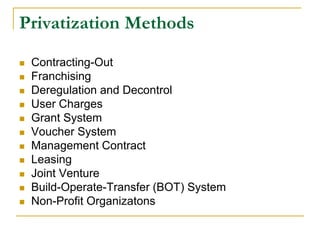
Privatization Methods
 Contracting-Out
 Franchising
 Deregulation and Decontrol
 User Charges
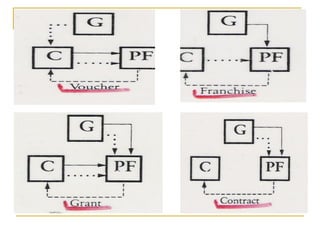
 Grant System
 Voucher System
 Management Contract
 Leasing
 Joint Venture
 Build-Operate-Transfer (BOT) System
 Non-Profit Organizatons
Contracting-Out
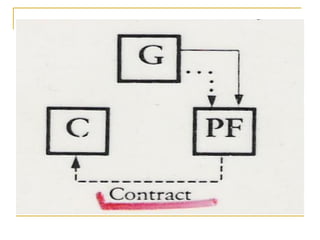
 Under this arrangement, the government contracts out with
the for-profit as well as not-for-profit organizations for the
delivery of goods and services. In other words, the
government purchases services from a private firm or a
non-profit organization.
 Contracting- out is common especially in such services as
public works and transportation, public safety services,
health and human services, parks and recreations services
etc.
 Especially municipal governments are interested in
contracting such goods and services with private firms,
inreasingly.At the local level, refuse collection and cleaning
are very common practices of contracting-out in many
countries.
Advantages of the contracting-out system
 Contracting-out is efficient and effective, because it fosters and
initiates competition.
 Contracting-out also provides better management than the
public management. Because decision making under
contracting-out is directly related to the costs and benefits.
 Contracting-out would help to limit the size of government at
least in terms of the number of employees.
 Contracting-out can help to reduce dependence on a
government monopoly which causes X-inefficiencies and
ineffectiveness in services.
 Under a contracting-out method, contractors can be penalized
if their service is of poor quality and unsatisfactory.
 Contracting-out is more flexible in terms of responding to the
needs of citizens.
Disadvantages of the contracting-out
system.
 Corruption may be widespread in the process
awarding contracts to the individuals or private firms.
 Contracting may limit the flexibility of government in
response to emergencies because contractors are
liable to default and go bankrupt in their activities.
 Competitive tendering is not costless; there are
costs to the state authority decreases monitoring
and enforcing contracts.
 Contractors may hire inexperienced transient
personnel at low wages and this increases the
quality of the service.
 Contracting-out involves laying off public employees
Franchising
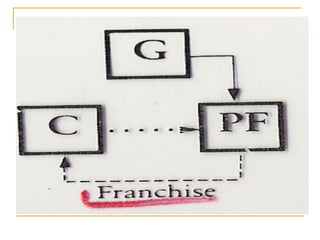
 Under a franchise agreement, the government
gives a special monopoly privilege to a private firm
to produce and supply some part of a particular
service.
 The government either makes a contract with a
single private firm or several firms to provide the
service. The former is an "exclusive franchise" and
the latter is called "multiple franchise". It should be
pointed out that a franchise contract usually
involves a price resolution right of government.
Deregulation and Decontrol
 Deregulation and decontrol are two important policies to
strenghten the free market economy.The former means
termination of all kind of "public regulations" within various
sectors or industries. The latter explains that all type of " public
controls" be abolished.
 Public regulations and controls would be either "legal-
administrative" or "economic". Some examples for legal and
administrative regulations and controls are: traffic regulation,
taxation, conscription etc.
 Economic regulations include such practices carried out by the
government as awarding occupational licensure, patent,
franchise, tariffs and quotas for international trade etc.
 All kinds of direct intervention in the natural functioning of
supply and demand, such as, price, rent, interest, wage control
etc. are aslo examples for " economic" controls within the
national economy.
User Charges
 There are some other types of public goods
and services, whose benefits can easily be
divided and whose users can be excluded from
its comsumption. Higher education, health
services, cable TV, electric power and mass
transit are the main examples. These types of
goods and services can be either provided free
of charge and financed by taxes or by the
imposition of a fee or user charge to the
individuals who receive benefits.
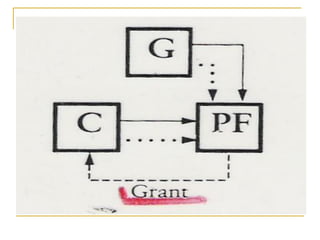
Grant System
 Grants or subsidies are financial or in-kind
contributions to individuals or private firms by
government. In other words, grants are
awarded to encourage the production of
particular classes or producers. The grant may
be in the form of a cash subsidy, tax incentives,
low cost laons and loan guarantees
Major types of grants:
1. Grant in the form of Cash Subsidy
2. Grant in the form of Direct Loans
3. Grant in the form of Loan Guarantees
4. Grant in the form of Tax Incentives
5.Accelerated Depreciation Range (ADR) System
6.Tax Deductions
7.Tax Exemptions
8. Grant in the form of Awarding
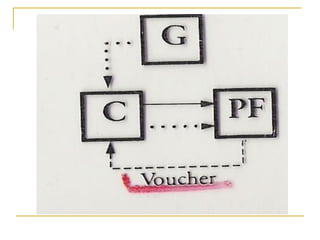
Voucher System
 The voucher system is designed
to encourage the consumption of
particular goods and services by
a particular class of consumers.
The Types of Voucher System
 Tuition Voucher
 Medicare/Medicaid Voucher
 Child Care Voucher
 Housing Voucher
 Transportation Voucher
 Food Voucher
 Clothing Voucher
Management Contract
 Government may sometimes retain full ownership of public
economic enterprises and/or other public facilities, but transfer its
management to a private firm.
 Management usually works as follows :
 Government retains full ownership of the public enterprise and/or
public facility.
 Government provides the necessary fund to manager to run the
enterprise and/or facility.
 The manager provides an integrated package of managerial skills
necessary to develope, operate or rehabilitate the public enterprise
and/or facilities.
 Manager sometimes owns some equity stocks of the public
economic enterprises. This motivates manager run the PEE more
effectively.
Leasing
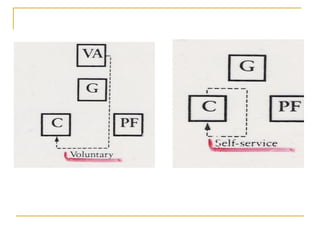
 Another method of privatization is called "leasing",
which is similar to the franchising and contracting-out
method in the sense that both the management and
operation are transferred to the private sector.
 However, leasing is a different arrangement from
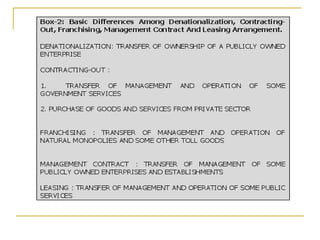
franchising and contracting-out. Box-2 show the basic
differences among denationalization, contracting-out,
franchising, management contract and leasing
arrangement.
Basic Differences Among
Denationalization, Contracting-Out,
Franchising, Management Contract
And Leasing Arrangement.
DENATIONALIZATION
 TRANSFER OF OWNERSHIP OF A PUBLICLY
OWNED ENTERPRISE
 Partial denationalization without management
transfer: Up to 50 percent of the shares/assets of a
POE are sold.
 Partial denationalization with the management
transfer: More than 50 percent of the shares/assets
–but not the whole- are sold to private firm.
 Full denationalization: All the shares/assets of a
POE are sold. Management and operation
automatically passes to the private firm.
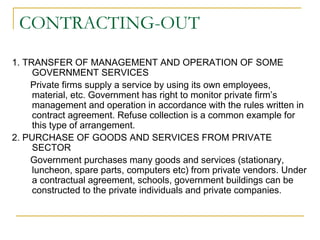
CONTRACTING-OUT
1. TRANSFER OF MANAGEMENT AND OPERATION OF SOME
GOVERNMENT SERVICES
Private firms supply a service by using its own employees,
material, etc. Government has right to monitor private firm’s
management and operation in accordance with the rules written in
contract agreement. Refuse collection is a common example for
this type of arrangement.
2. PURCHASE OF GOODS AND SERVICES FROM PRIVATE
SECTOR
Government purchases many goods and services (stationary,
luncheon, spare parts, computers etc) from private vendors. Under
a contractual agreement, schools, government buildings can be
constructed to the private individuals and private companies.
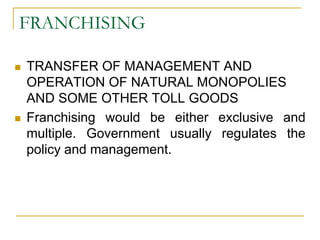
FRANCHISING
 TRANSFER OF MANAGEMENT AND
OPERATION OF NATURAL MONOPOLIES
AND SOME OTHER TOLL GOODS
 Franchising would be either exclusive and
multiple. Government usually regulates the
policy and management.
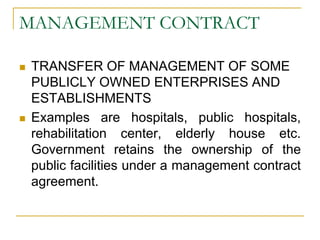
MANAGEMENT CONTRACT
 TRANSFER OF MANAGEMENT OF SOME
PUBLICLY OWNED ENTERPRISES AND
ESTABLISHMENTS
 Examples are hospitals, public hospitals,
rehabilitation center, elderly house etc.
Government retains the ownership of the
public facilities under a management contract
agreement.
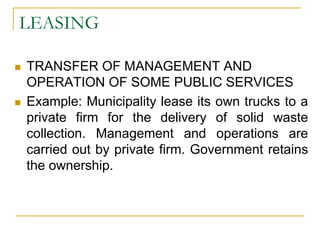
LEASING
 TRANSFER OF MANAGEMENT AND
OPERATION OF SOME PUBLIC SERVICES
 Example: Municipality lease its own trucks to a
private firm for the delivery of solid waste
collection. Management and operations are
carried out by private firm. Government retains
the ownership.
Joint Venture
 Joint venture is a partnership of two or more firms.
 Joint venture firms, that is, partners agree to a
common business target and to share accruing
profits, losses and any other risks.
 Joint venture can be established in various fields
such as; general trade, commodity exchance,
technology development and exchange, consultancy
services, training, product development, oil, gas and
mineral exploration, international merketing,
construction etc.
Build-Operate-Transfer (BOT) System
 The system is quite simple and seeks to attract
foreign capital.
 Direct foreign investments are encouraged to build
infrastructure facilities, petroleum exploration
stations, entertainment centers, recreation facilities
etc within the developing or host country.
 Upon completion of construction, the foreign private
firm has the right to operate the facilities for a certain
period of time agreed upon via contract.
 At the end of the contract, the facilities and
establishments are transferred to the government.
Non-Profit Organization
 A non-profit firm is an organization that is barred
from distributing its net earnings, if any, to
individuals who exercise control over it, such as
members, officers, directors of trustees.
 Non-profit organizations -donative or commercial-
generally provide merit and club goods such as
rehabilitation and sanitation centers, elderly
housing, drug-alcohol prevention and treatment
centers, cultural activities (museums, private
libraries, art galleries, symphony orchestra, theaters,
etc), hospitals, environmental protection centers,
blood banks, child-care, nursing homes etc.
THE OBJECTIVES OF
PRIVATIZATION
 Greater Efficiency
 Revealing the True and Full Cost of the Service
Provided
 Promotion of Technological Advancement
 Development of Capital Markets
 Broadening the Wealth and Achieving Widespread
Private Ownership in Society
 Curbing Inflation
 Raising Extra-Revenues for the Government
 Eliminating Hidden Unemployment and Reducing
the Power of Public Employee Unions

The Theory Of Privatization

  • 1.
    THE THEORY OF PRIVATIZATION Prof.Dr.CoskunCan Aktan Dokuz Eylul University Faculty of Economics & Management & Social Sciences Research Society http://www.sobiad.org
  • 2.
    Key Terms  Privatization Nationalization  Denationalization  Demonopolization  Deregulation  Publicly owned enterprise  Sale of assets  Delivery of goods and services  Efficiency  Inefficieny  Productivity  Cost of government  Welfare state  Government failure  Load sheding  Government as a leviathan
  • 3.
    Narrow and BroaderMeaning of Privatization  Privatization is frequently used referring to the sale of a publicly owned enterprise (POE)'s asset or shares to the individuals or a private firms. However, this definition gives only a narrow meaning of privatization. In broader meaning, it refers to restrict government's role and to put forward some methods or policies in order to strenghten free market economy. The former meaning of privatization, i.e. the sale of a POE's assets or shares to the private sector is mostly called "denationalization".
  • 4.
    Narrow Meaning ofPrivatization: Denationalization  As noted already, denationalization refers to the sale of assets or shares of a publicly owned enterprises to the private sector.  According to the definition given above, when a small part of shares/assets are sold to the private sector, it can be called as "denationalization".  However, it is more appropriate to define denationalization as transferring at least 51 percent shares of a POE to the private sector.  In this case, transfer of ownership (sale of shares) results in transfer of management and operation as well. However, full denationalization requires that all shares and assets of a POE must be sold to the private sector.
  • 6.
    Problems of DenationalizationProcess 1.Timing and Planning of the Denationalization Process 2.Priority Problem 3.Other Problems
  • 7.
    Timing and Planningof the Denationalization Process a. Promotion of the denationalization program and strategy to the public b. Preliminary studies c. Legal framework d. Implementing the program qradually
  • 8.
    Priority Problem  Whichpublicly owned enterprises should be privatized first? In other words, which public economic enterprise's stocks should be offered for sale to the public first
  • 9.
    Other Problems ►Appraising thevalue of the assets of the publicly owned enterprise subject to sale is not an easy task to do. ►The important problems are how the value of equity stocks will be determined.
  • 10.
    THE MAJOR BARRIERSTO IMPLEMENT DENATIONALIZATION SUCCESSFULLY IN DEVELOPING COUNTRIES ►Political Instability and Uncertainty: It is a fact that many developing countries suffer instability and uncertainty in politics. ►Economic Instability and Uncertainty: Bad politics puts the economy in a worse situation even though the implemented economic policy is correct. Economists increasingly believe that the politician are the major source of economic problems. ►Weak and Underdeveloped Capital Markets: Capital markets in developing countries either are not developed or non-existent. It is quite difficult to sell equity stocks of POEs in domestic capital market in developing countries. This is because potential buyers are very few.
  • 11.
    Broad Meaning ofPrivatization  Denationalization is only one form of privatization. In broad meaning, privatization refers to the transfer of functions previously performed exclusively by the public sector, to the private sector.  In other words, privatization is an umbrella term, which encompasses all methods or policies implemented to increase the role of market forces within the national economy. In this context, the concept of privatization covers several arrangements to deliver goods and services by private sector
  • 13.
    Privatization Methods  Contracting-Out Franchising  Deregulation and Decontrol  User Charges  Grant System  Voucher System  Management Contract  Leasing  Joint Venture  Build-Operate-Transfer (BOT) System  Non-Profit Organizatons
  • 17.
    Contracting-Out  Under thisarrangement, the government contracts out with the for-profit as well as not-for-profit organizations for the delivery of goods and services. In other words, the government purchases services from a private firm or a non-profit organization.  Contracting- out is common especially in such services as public works and transportation, public safety services, health and human services, parks and recreations services etc.  Especially municipal governments are interested in contracting such goods and services with private firms, inreasingly.At the local level, refuse collection and cleaning are very common practices of contracting-out in many countries.
  • 19.
    Advantages of thecontracting-out system  Contracting-out is efficient and effective, because it fosters and initiates competition.  Contracting-out also provides better management than the public management. Because decision making under contracting-out is directly related to the costs and benefits.  Contracting-out would help to limit the size of government at least in terms of the number of employees.  Contracting-out can help to reduce dependence on a government monopoly which causes X-inefficiencies and ineffectiveness in services.  Under a contracting-out method, contractors can be penalized if their service is of poor quality and unsatisfactory.  Contracting-out is more flexible in terms of responding to the needs of citizens.
  • 20.
    Disadvantages of thecontracting-out system.  Corruption may be widespread in the process awarding contracts to the individuals or private firms.  Contracting may limit the flexibility of government in response to emergencies because contractors are liable to default and go bankrupt in their activities.  Competitive tendering is not costless; there are costs to the state authority decreases monitoring and enforcing contracts.  Contractors may hire inexperienced transient personnel at low wages and this increases the quality of the service.  Contracting-out involves laying off public employees
  • 21.
    Franchising  Under afranchise agreement, the government gives a special monopoly privilege to a private firm to produce and supply some part of a particular service.  The government either makes a contract with a single private firm or several firms to provide the service. The former is an "exclusive franchise" and the latter is called "multiple franchise". It should be pointed out that a franchise contract usually involves a price resolution right of government.
  • 23.
    Deregulation and Decontrol Deregulation and decontrol are two important policies to strenghten the free market economy.The former means termination of all kind of "public regulations" within various sectors or industries. The latter explains that all type of " public controls" be abolished.  Public regulations and controls would be either "legal- administrative" or "economic". Some examples for legal and administrative regulations and controls are: traffic regulation, taxation, conscription etc.  Economic regulations include such practices carried out by the government as awarding occupational licensure, patent, franchise, tariffs and quotas for international trade etc.  All kinds of direct intervention in the natural functioning of supply and demand, such as, price, rent, interest, wage control etc. are aslo examples for " economic" controls within the national economy.
  • 24.
    User Charges  Thereare some other types of public goods and services, whose benefits can easily be divided and whose users can be excluded from its comsumption. Higher education, health services, cable TV, electric power and mass transit are the main examples. These types of goods and services can be either provided free of charge and financed by taxes or by the imposition of a fee or user charge to the individuals who receive benefits.
  • 25.
    Grant System  Grantsor subsidies are financial or in-kind contributions to individuals or private firms by government. In other words, grants are awarded to encourage the production of particular classes or producers. The grant may be in the form of a cash subsidy, tax incentives, low cost laons and loan guarantees
  • 27.
    Major types ofgrants: 1. Grant in the form of Cash Subsidy 2. Grant in the form of Direct Loans 3. Grant in the form of Loan Guarantees 4. Grant in the form of Tax Incentives 5.Accelerated Depreciation Range (ADR) System 6.Tax Deductions 7.Tax Exemptions 8. Grant in the form of Awarding
  • 28.
    Voucher System  Thevoucher system is designed to encourage the consumption of particular goods and services by a particular class of consumers.
  • 30.
    The Types ofVoucher System  Tuition Voucher  Medicare/Medicaid Voucher  Child Care Voucher  Housing Voucher  Transportation Voucher  Food Voucher  Clothing Voucher
  • 31.
    Management Contract  Governmentmay sometimes retain full ownership of public economic enterprises and/or other public facilities, but transfer its management to a private firm.  Management usually works as follows :  Government retains full ownership of the public enterprise and/or public facility.  Government provides the necessary fund to manager to run the enterprise and/or facility.  The manager provides an integrated package of managerial skills necessary to develope, operate or rehabilitate the public enterprise and/or facilities.  Manager sometimes owns some equity stocks of the public economic enterprises. This motivates manager run the PEE more effectively.
  • 32.
    Leasing  Another methodof privatization is called "leasing", which is similar to the franchising and contracting-out method in the sense that both the management and operation are transferred to the private sector.  However, leasing is a different arrangement from franchising and contracting-out. Box-2 show the basic differences among denationalization, contracting-out, franchising, management contract and leasing arrangement.
  • 34.
    Basic Differences Among Denationalization,Contracting-Out, Franchising, Management Contract And Leasing Arrangement.
  • 35.
    DENATIONALIZATION  TRANSFER OFOWNERSHIP OF A PUBLICLY OWNED ENTERPRISE  Partial denationalization without management transfer: Up to 50 percent of the shares/assets of a POE are sold.  Partial denationalization with the management transfer: More than 50 percent of the shares/assets –but not the whole- are sold to private firm.  Full denationalization: All the shares/assets of a POE are sold. Management and operation automatically passes to the private firm.
  • 36.
    CONTRACTING-OUT 1. TRANSFER OFMANAGEMENT AND OPERATION OF SOME GOVERNMENT SERVICES Private firms supply a service by using its own employees, material, etc. Government has right to monitor private firm’s management and operation in accordance with the rules written in contract agreement. Refuse collection is a common example for this type of arrangement. 2. PURCHASE OF GOODS AND SERVICES FROM PRIVATE SECTOR Government purchases many goods and services (stationary, luncheon, spare parts, computers etc) from private vendors. Under a contractual agreement, schools, government buildings can be constructed to the private individuals and private companies.
  • 37.
    FRANCHISING  TRANSFER OFMANAGEMENT AND OPERATION OF NATURAL MONOPOLIES AND SOME OTHER TOLL GOODS  Franchising would be either exclusive and multiple. Government usually regulates the policy and management.
  • 38.
    MANAGEMENT CONTRACT  TRANSFEROF MANAGEMENT OF SOME PUBLICLY OWNED ENTERPRISES AND ESTABLISHMENTS  Examples are hospitals, public hospitals, rehabilitation center, elderly house etc. Government retains the ownership of the public facilities under a management contract agreement.
  • 39.
    LEASING  TRANSFER OFMANAGEMENT AND OPERATION OF SOME PUBLIC SERVICES  Example: Municipality lease its own trucks to a private firm for the delivery of solid waste collection. Management and operations are carried out by private firm. Government retains the ownership.
  • 40.
    Joint Venture  Jointventure is a partnership of two or more firms.  Joint venture firms, that is, partners agree to a common business target and to share accruing profits, losses and any other risks.  Joint venture can be established in various fields such as; general trade, commodity exchance, technology development and exchange, consultancy services, training, product development, oil, gas and mineral exploration, international merketing, construction etc.
  • 41.
    Build-Operate-Transfer (BOT) System The system is quite simple and seeks to attract foreign capital.  Direct foreign investments are encouraged to build infrastructure facilities, petroleum exploration stations, entertainment centers, recreation facilities etc within the developing or host country.  Upon completion of construction, the foreign private firm has the right to operate the facilities for a certain period of time agreed upon via contract.  At the end of the contract, the facilities and establishments are transferred to the government.
  • 42.
    Non-Profit Organization  Anon-profit firm is an organization that is barred from distributing its net earnings, if any, to individuals who exercise control over it, such as members, officers, directors of trustees.  Non-profit organizations -donative or commercial- generally provide merit and club goods such as rehabilitation and sanitation centers, elderly housing, drug-alcohol prevention and treatment centers, cultural activities (museums, private libraries, art galleries, symphony orchestra, theaters, etc), hospitals, environmental protection centers, blood banks, child-care, nursing homes etc.
  • 44.
    THE OBJECTIVES OF PRIVATIZATION Greater Efficiency  Revealing the True and Full Cost of the Service Provided  Promotion of Technological Advancement  Development of Capital Markets  Broadening the Wealth and Achieving Widespread Private Ownership in Society  Curbing Inflation  Raising Extra-Revenues for the Government  Eliminating Hidden Unemployment and Reducing the Power of Public Employee Unions