PRIVATISATION
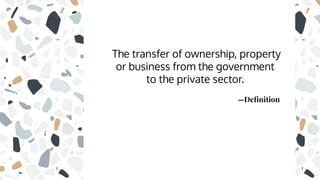
—Definition
The transfer of ownership, property
or business from the government
to the private sector.
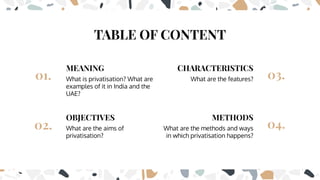
TABLE OF CONTENT
CHARACTERISTICS
03.
METHODS
04.
MEANING
01.
OBJECTIVES
02.
What is privatisation? What are
examples of it in India and the
UAE?
What are the aims of
privatisation?
What are the features?
What are the methods and ways
in which privatisation happens?
TABLE OF CONTENT
ADVANTAGES
05.
What are the pros of
privatisation? How does it help
us?
DISADVANTAGES
06.
What are the cons of privatisation?
MEANING
01.
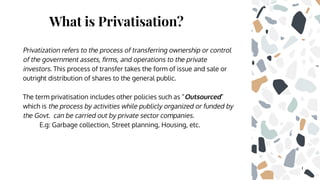
What is Privatisation?
Privatization refers to the process of transferring ownership or control
of the government assets, firms, and operations to the private
investors. This process of transfer takes the form of issue and sale or
outright distribution of shares to the general public.
The term privatisation includes other policies such as “Outsourced”
which is the process by activities while publicly organized or funded by
the Govt. can be carried out by private sector companies.
E.g: Garbage collection, Street planning, Housing, etc.
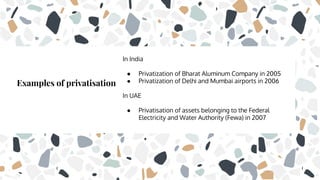
Examples of privatisation
In India
● Privatization of Bharat Aluminum Company in 2005
● Privatization of Delhi and Mumbai airports in 2006
In UAE
● Privatisation of assets belonging to the Federal
Electricity and Water Authority (Fewa) in 2007
Let us look at the why of privatisation.
OBJECTIVES
02.
IMPROVED EFFICIENCY
Government enterprises are mostly affected
by political motives rather than economic
well-being. It hinders the efficiency of public
sector companies and prevents growth.
Privatisation prevents this.They are more
concerned with promoting development and
efficiency inside a business in order to
increase revenue.
INCREASED COMPETITION
Often privatisation of state-owned
organisations occurs alongside
deregulation – i.e. policies to allow more
firms to enter the industry and increase the
competitiveness of the market.
It is this increase in competition that can be
the greatest motivation to improvements in
efficiency.
For example, there is now more competitio
in the distribution of gas and electricity.
Promotes Market Dynamism
Privatization releases the economy from state
control. Due to a lack of government
interference, the market becomes more
dynamic and follows basic economic values of
demand and supply.
Consumer response to a more dynamic and
naturally run market is greater and generates
higher revenue.
Revenue from the Sale of a Company
A primary objective of privatization is a one-tim
revenue generation for the government.
Several governments have previously resorted
to privatization when facing a financial crisis.
Let us look at the features of privatisation.
CHARACTERISTICS
03.
Transfer of Ownership
In privatization, ownership of a company,
undertaking or property is transferred to
the private sector.
Lack of Government Interference
Privatization reduces indulgence and
interference of the state in the activities of a
company.
Economic Democracy
Privatization weakens state monopoly and
allows private companies to participate in
economic activities more democratically.
There are 5 main methods of privatisation.
METHODS
04.
Public auctions are held with the motive of raising the
highest amount for a government-owned property. Shares of
a public company or long-term assets can be auctioned
through this route.
PUBLIC AUCTION
SALE OF SHARES
Equity shares of a public sector company or undertaking can be
sold through stock exchanges for privatization. The state hands
over complete authority of an organization’s economic activities
through a public sale of shares.
DIRECT NEGOTIATIONS
When the government enters into dealings with
specific private bodies for carrying out the
privatization of state-owned property, it is called
‘direct negotiation’.
Direct negotiations are potentially more
beneficial for participating bodies as both the
seller and purchaser are present and agree on
necessary and advantageous conditions.
PUBLIC TENDER
It refers to a contract issued to attract offers
from interested procurers. A tender is
essentially like an auction where the bidder
with the most profitable offer obtain it.
The process that follows public tender for the
privatization of government property is
similar to direct negotiations. Except in direct
negotiations, there are already selected
purchasers who can participate in the
dealing. In a public auction, there are no such
provisions.
LEASE
WITH A
RIGHT TO
PURCHASE
Under this method, a private company only assumes
possession and usage of a state-run company or
undertaking by meeting certain criteria. The private company
can later choose to exercise the option to convert the lease
of a property to ownership by paying the necessary sum and
following certain stipulations.
It can also be said that the public company
is being “rent” by the private company.
Let’s look at the pros of privatisation
ADVANTAGES
05.
Improved Performance
Private companies are profit-incentivized rather than
politically motivated. Privatization, therefore, allows
companies to become more efficient by eliminating
unnecessary elements within an organization like
overwhelming bureaucracy & red tape.
Moreover, private companies assess their employees based
on their performance and adequately incentivize better
performance. This factor encourages overall performance in
an organization.
Bureaucracy-
A system of govt in
which most decisions are
made by state officials
rather than elected
representatives.
Red tape-
Excessively
complicated
administrative process.
Incentivize-
Motivate or encourage
to do something.
Better Customer service
As private companies are profit-driven and function in a competitive
market, their primary focus rests on efficient customer service.
State-run companies lack this feature as they face no competition
and are not financially motivated.
Furthermore, customer service is enhanced in privatization due to the
elimination of unnecessary bureaucratic hassle.
Improved management
Privatization enhances management of a company. As
managers of a privately-owned organization are accountable to
the company’s owners, it becomes their responsibility to ensure
efficient management.
This factor of accountability is less intense in public sector
companies which results in poor and inefficient operations that
may ultimately harm the economy.
06.DISADVANTAGES
Issues of Regulating Monopolies
The private sector can manipulate their monopoly and
neglect social costs. Privatization of certain state
industries such as water and electricity regulators may
create only single monopolies.
Monopoly
A person or group having
complete control over something
Public Interest
The profit motive should not be the primary objective for
the industry which performs an important public service,
e.g. health care, education, and public transport.
According to the researchers, the private sector in India
has grown independently without any major regulation; In
the hands of Private health sector, some private
practitioners are not even registered doctors and are
referred to as quacks.
Accountability
The public does not have any control or
administration of private companies. Privatization has
a bad effect on accountability because Investors
retain full authority to do anything.
CREDITS: This presentation template was created
by Slidesgo, including icons by Flaticon, and
infographics & images by Freepik
THANK YOU!!
Please keep this slide for attribution

Privatisation -bst.pdf

  • 1.
  • 2.
    —Definition The transfer ofownership, property or business from the government to the private sector.
  • 3.
    TABLE OF CONTENT CHARACTERISTICS 03. METHODS 04. MEANING 01. OBJECTIVES 02. Whatis privatisation? What are examples of it in India and the UAE? What are the aims of privatisation? What are the features? What are the methods and ways in which privatisation happens?
  • 4.
    TABLE OF CONTENT ADVANTAGES 05. Whatare the pros of privatisation? How does it help us? DISADVANTAGES 06. What are the cons of privatisation?
  • 5.
  • 6.
    What is Privatisation? Privatizationrefers to the process of transferring ownership or control of the government assets, firms, and operations to the private investors. This process of transfer takes the form of issue and sale or outright distribution of shares to the general public. The term privatisation includes other policies such as “Outsourced” which is the process by activities while publicly organized or funded by the Govt. can be carried out by private sector companies. E.g: Garbage collection, Street planning, Housing, etc.
  • 7.
    Examples of privatisation InIndia ● Privatization of Bharat Aluminum Company in 2005 ● Privatization of Delhi and Mumbai airports in 2006 In UAE ● Privatisation of assets belonging to the Federal Electricity and Water Authority (Fewa) in 2007
  • 8.
    Let us lookat the why of privatisation. OBJECTIVES 02.
  • 9.
    IMPROVED EFFICIENCY Government enterprisesare mostly affected by political motives rather than economic well-being. It hinders the efficiency of public sector companies and prevents growth. Privatisation prevents this.They are more concerned with promoting development and efficiency inside a business in order to increase revenue. INCREASED COMPETITION Often privatisation of state-owned organisations occurs alongside deregulation – i.e. policies to allow more firms to enter the industry and increase the competitiveness of the market. It is this increase in competition that can be the greatest motivation to improvements in efficiency. For example, there is now more competitio in the distribution of gas and electricity.
  • 10.
    Promotes Market Dynamism Privatizationreleases the economy from state control. Due to a lack of government interference, the market becomes more dynamic and follows basic economic values of demand and supply. Consumer response to a more dynamic and naturally run market is greater and generates higher revenue. Revenue from the Sale of a Company A primary objective of privatization is a one-tim revenue generation for the government. Several governments have previously resorted to privatization when facing a financial crisis.
  • 11.
    Let us lookat the features of privatisation. CHARACTERISTICS 03.
  • 12.
    Transfer of Ownership Inprivatization, ownership of a company, undertaking or property is transferred to the private sector. Lack of Government Interference Privatization reduces indulgence and interference of the state in the activities of a company. Economic Democracy Privatization weakens state monopoly and allows private companies to participate in economic activities more democratically.
  • 13.
    There are 5main methods of privatisation. METHODS 04.
  • 14.
    Public auctions areheld with the motive of raising the highest amount for a government-owned property. Shares of a public company or long-term assets can be auctioned through this route. PUBLIC AUCTION SALE OF SHARES Equity shares of a public sector company or undertaking can be sold through stock exchanges for privatization. The state hands over complete authority of an organization’s economic activities through a public sale of shares.
  • 15.
    DIRECT NEGOTIATIONS When thegovernment enters into dealings with specific private bodies for carrying out the privatization of state-owned property, it is called ‘direct negotiation’. Direct negotiations are potentially more beneficial for participating bodies as both the seller and purchaser are present and agree on necessary and advantageous conditions. PUBLIC TENDER It refers to a contract issued to attract offers from interested procurers. A tender is essentially like an auction where the bidder with the most profitable offer obtain it. The process that follows public tender for the privatization of government property is similar to direct negotiations. Except in direct negotiations, there are already selected purchasers who can participate in the dealing. In a public auction, there are no such provisions.
  • 16.
    LEASE WITH A RIGHT TO PURCHASE Underthis method, a private company only assumes possession and usage of a state-run company or undertaking by meeting certain criteria. The private company can later choose to exercise the option to convert the lease of a property to ownership by paying the necessary sum and following certain stipulations. It can also be said that the public company is being “rent” by the private company.
  • 17.
    Let’s look atthe pros of privatisation ADVANTAGES 05.
  • 18.
    Improved Performance Private companiesare profit-incentivized rather than politically motivated. Privatization, therefore, allows companies to become more efficient by eliminating unnecessary elements within an organization like overwhelming bureaucracy & red tape. Moreover, private companies assess their employees based on their performance and adequately incentivize better performance. This factor encourages overall performance in an organization. Bureaucracy- A system of govt in which most decisions are made by state officials rather than elected representatives. Red tape- Excessively complicated administrative process. Incentivize- Motivate or encourage to do something.
  • 19.
    Better Customer service Asprivate companies are profit-driven and function in a competitive market, their primary focus rests on efficient customer service. State-run companies lack this feature as they face no competition and are not financially motivated. Furthermore, customer service is enhanced in privatization due to the elimination of unnecessary bureaucratic hassle.
  • 20.
    Improved management Privatization enhancesmanagement of a company. As managers of a privately-owned organization are accountable to the company’s owners, it becomes their responsibility to ensure efficient management. This factor of accountability is less intense in public sector companies which results in poor and inefficient operations that may ultimately harm the economy.
  • 21.
  • 22.
    Issues of RegulatingMonopolies The private sector can manipulate their monopoly and neglect social costs. Privatization of certain state industries such as water and electricity regulators may create only single monopolies. Monopoly A person or group having complete control over something
  • 23.
    Public Interest The profitmotive should not be the primary objective for the industry which performs an important public service, e.g. health care, education, and public transport. According to the researchers, the private sector in India has grown independently without any major regulation; In the hands of Private health sector, some private practitioners are not even registered doctors and are referred to as quacks.
  • 24.
    Accountability The public doesnot have any control or administration of private companies. Privatization has a bad effect on accountability because Investors retain full authority to do anything.
  • 25.
    CREDITS: This presentationtemplate was created by Slidesgo, including icons by Flaticon, and infographics & images by Freepik THANK YOU!! Please keep this slide for attribution