GLOBALIZATION AND PRIVATISATION
Presented by: Jaisha K J & Gayathri Jayasankar
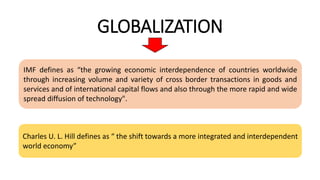
GLOBALIZATION
IMF defines as “the growing economic interdependence of countries worldwide
through increasing volume and variety of cross border transactions in goods and
services and of international capital flows and also through the more rapid and wide
spread diffusion of technology".
Charles U. L. Hill defines as “ the shift towards a more integrated and interdependent
world economy”
FOUR PARAMETERS OF GLOBALIZATION
Reduction of trade barriers – so as to promote free flow of goods and services
Creation of environment in which free flow of capital can take place
Creation of environment permitting free flow of technology
Creation of environment in which free movement of labour can take place
FEATURES OF GLOBALIZATION
Business expands through out the world
Goods/services are bought/sold to/from any country in the world
Erasing the difference between domestic and international markets
Products are planned and developed keeping in mind the markets of entire world
Manufacturing and distribution can be done at any part of the world based on feasibility
and viability
Outsourcing of goods and services can be done
PROCESS OF GLOBALIZATION
Stage
1
• Domestic company exports to foreign countries through dealers and distributions of home
country
Stage
2
• Domestic company exports to foreign countries directly on its own
Stage
3
• Domestic company becomes an international company by establishing production and
marketing operations in various foreign countries
Stage
4
• The company replicates a foreign company in the foreign country by having all the
facilities likes R&D, HR etc.,
Stage
5
• The company becomes a true foreign company by serving the needs of the foreign
customers just like the host country’s company serves
ESSENTIAL CONDITIONS
Liberalising the rules and
regulation of control
Removal of Quotas and Tariffs
Providing freedom to the
business and industry
Providing infrastructural facilities
Developing money and capital
markets
Providing administrative and
governmental support
Encouraging research and
development
Removal of bureaucratic hurdles
COMPONENTS OF GLOBALIZATION
Globalization of
Markets
Globalization of
Production
Globalization of
Technology
Globalization of
Investment
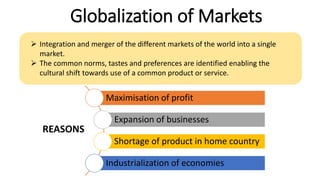
Globalization of Markets
 Integration and merger of the different markets of the world into a single
market.
 The common norms, tastes and preferences are identified enabling the
cultural shift towards use of a common product or service.
Maximisation of profit
Expansion of businesses
Shortage of product in home country
Industrialization of economies
REASONS
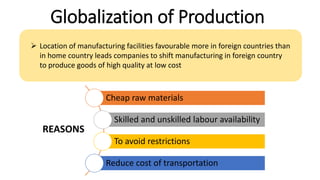
Globalization of Production
 Location of manufacturing facilities favourable more in foreign countries than
in home country leads companies to shift manufacturing in foreign country
to produce goods of high quality at low cost
Cheap raw materials
Skilled and unskilled labour availability
To avoid restrictions
Reduce cost of transportation
REASONS
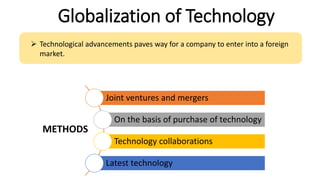
Globalization of Technology
 Technological advancements paves way for a company to enter into a foreign
market.
Joint ventures and mergers
On the basis of purchase of technology
Technology collaborations
Latest technology
METHODS
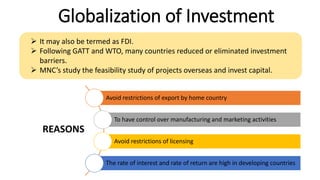
Globalization of Investment
 It may also be termed as FDI.
 Following GATT and WTO, many countries reduced or eliminated investment
barriers.
 MNC’s study the feasibility study of projects overseas and invest capital.
Avoid restrictions of export by home country
To have control over manufacturing and marketing activities
Avoid restrictions of licensing
The rate of interest and rate of return are high in developing countries
REASONS
ADVANTAGES OF GLOBALIZATION
Helps in free flow of capital
Helps in free flow of technology from developed to developing countries
Improves standard of living of people
Makes available high quality goods at low prices
Helps in spreading production facilities
Increases employment opportunities and decreases cultural differences
DISADVANTAGES OF GLOBALIZATION
Intense competition
Harder for small business to establish
Causes decline in demand of domestic products
Widens the gap between rich and poor
Developed countries exploit the resources of developing countries
Exploitation of workers in developing countries
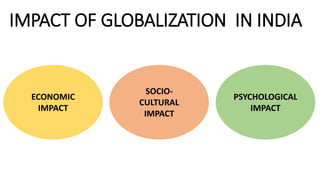
IMPACT OF GLOBALIZATION IN INDIA
ECONOMIC
IMPACT
SOCIO-
CULTURAL
IMPACT
PSYCHOLOGICAL
IMPACT
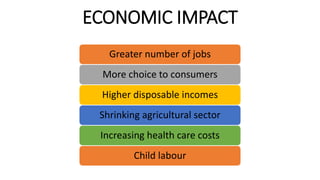
ECONOMIC IMPACT
Greater number of jobs
More choice to consumers
Higher disposable incomes
Shrinking agricultural sector
Increasing health care costs
Child labour
SOCIO-CULTURAL IMPACT
Access to education
Growth of cities
Indian cuisine
Clothing
Nuclear Families
Old Age Vulnerability
Pervasive Media
McDonaldization
Walmartization
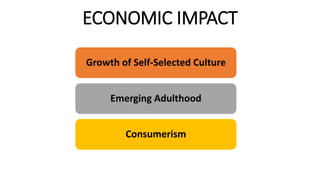
ECONOMIC IMPACT
Growth of Self-Selected Culture
Emerging Adulthood
Consumerism
Meaning
Privatization can refer to the act of transferring ownership of specified property or
business operations from a government organization to a privately owned entity.
It also means the withdrawal of the state from an industry or sector partially or fully.
Privatization is opening up of an industry that has been reserved for public sector to
the private sector.
Why privatisation
Ineffective and widespread inefficiency on management; With a view to provide
opportunities for more and more unemployed youths, more number of people, than
required, were recruited and therefore, many PSUs are over-staffed resulting in
lower labour productivity, bad industrial relations, etc
Entry of private sector industries into the areas exclusive reserved for the state
sector or which are considered exclusive monopolies of state.
Limiting the scope of the public sector or no more diversification of existing public
sector understandings.
To increase efficiency and competitive power of the enterprise
Objectives of privatisation
To strengthen industrial management
Distributing ownership more widely in the population at large
To achieve rapid industrial development of the country
To make optimum use of resources
To reduce the administrative burden on the state
Forms of privatisation
Complete privatization is the outright sale of government assets to the
private sector. This type of privatization not only confers assets but also
related responsibilities of ownership to the private sector. Government run
industries and assets have generally been completely privatized through
one of three main ways.
1. share issue privatization- The government sells shares of the
government run company which can then be traded on various stock
markets.
2. asset sale privatization- In this method, the whole firm or asset is sold
to an investor. This is usually done by auction.
3. voucher privatization- in which shares of ownership are distributed to
all citizens for free or for a very low price
Complete Privatization
The privatization of operations is the turning over of managerial and
operational responsibilities of publicly owned facilities to private sector
firms. This kind of privatization is often seen with the running of sports
and concert venues.
Franchising is the awarding of exclusive rights to perform services within
a specific geographic area to a private firm by a governmental unit.
Contracting out
The private sector firm is paid directly by the government for their
services. The government finances these services through the taxes of
the collection of user fees. This type of arrangement is commonly used
for the collection and disposal of solid waste.
Privatization of Operations
Franchising
Contracting out
Advantages of privatisation
Privatization is most of the time associated with improved efficiency due to the
profit incentive. Private companies will ensure they improve their operational
efficiency in order to reduce their costs and improve on profits.
Privatization reduces the government’s political interference. The government
sometimes seems incapable of making hard decisions especially when they impact
their political footing such as layoffs and pay cuts which are bound to attract
negative publicity.
Privatization urges improvements in the company through competition. When a
state owned entity is privatized it loses its government protection and is forced to
adapt to the market by providing better services or products in order to survive and
thrive.
Privatization of certain state entities such as water and electricity authorities may
just create single monopolies. These may eventually seek to increase prices at the
detriment of the consumer with no controls.
The government loses dividends after privatization as seen with most successful
companies that are developed through privatization. These dividends are instead
channelled to wealthy individuals.
Disadvantages of privatisation
Impact of privatisation
Positive impact
• It frees the resources for a more productive utilisation.
• State owned enterprises generally are outdone by the private
enterprises competitively. When compared the latter, it shows better
results in terms of profits and efficiency and productivity. Therefore,
privatization can provide the necessary push to the underperforming
PSUs.
• Privatization brings about fundamental structural changes in the
competitive sectors.
• Privatization leads to implementation of the global best practices
along with management and motivation of the best human talent to
foster sustainable competitive advantage and improvised
management of resources.
• Privatization has a positive impact on the financial growth of the
sector which was previously state dominated by way of decreasing
the deficits and debts.
• Private concerns tend to be profit oriented and transparent in their
functioning as private owners are always oriented towards making
profits.
• Since the system becomes more transparent all fundamental
corruption are minimised and owners have a free reign and incentive
for profit maximisation so they tend to get rid of all free loaders and
vices that are inherent in government functions.
Negative impact
• Ignorance of the actual mission
• lack of clearness in private sector and stakeholders do not get the
complete information about the functionality of the enterprise
• Less importance to social matters
THANK YOU

Globalisation and privatisation

  • 1.
    GLOBALIZATION AND PRIVATISATION Presentedby: Jaisha K J & Gayathri Jayasankar
  • 2.
    GLOBALIZATION IMF defines as“the growing economic interdependence of countries worldwide through increasing volume and variety of cross border transactions in goods and services and of international capital flows and also through the more rapid and wide spread diffusion of technology". Charles U. L. Hill defines as “ the shift towards a more integrated and interdependent world economy”
  • 3.
    FOUR PARAMETERS OFGLOBALIZATION Reduction of trade barriers – so as to promote free flow of goods and services Creation of environment in which free flow of capital can take place Creation of environment permitting free flow of technology Creation of environment in which free movement of labour can take place
  • 4.
    FEATURES OF GLOBALIZATION Businessexpands through out the world Goods/services are bought/sold to/from any country in the world Erasing the difference between domestic and international markets Products are planned and developed keeping in mind the markets of entire world Manufacturing and distribution can be done at any part of the world based on feasibility and viability Outsourcing of goods and services can be done
  • 5.
    PROCESS OF GLOBALIZATION Stage 1 •Domestic company exports to foreign countries through dealers and distributions of home country Stage 2 • Domestic company exports to foreign countries directly on its own Stage 3 • Domestic company becomes an international company by establishing production and marketing operations in various foreign countries Stage 4 • The company replicates a foreign company in the foreign country by having all the facilities likes R&D, HR etc., Stage 5 • The company becomes a true foreign company by serving the needs of the foreign customers just like the host country’s company serves
  • 6.
    ESSENTIAL CONDITIONS Liberalising therules and regulation of control Removal of Quotas and Tariffs Providing freedom to the business and industry Providing infrastructural facilities Developing money and capital markets Providing administrative and governmental support Encouraging research and development Removal of bureaucratic hurdles
  • 7.
    COMPONENTS OF GLOBALIZATION Globalizationof Markets Globalization of Production Globalization of Technology Globalization of Investment
  • 8.
    Globalization of Markets Integration and merger of the different markets of the world into a single market.  The common norms, tastes and preferences are identified enabling the cultural shift towards use of a common product or service. Maximisation of profit Expansion of businesses Shortage of product in home country Industrialization of economies REASONS
  • 9.
    Globalization of Production Location of manufacturing facilities favourable more in foreign countries than in home country leads companies to shift manufacturing in foreign country to produce goods of high quality at low cost Cheap raw materials Skilled and unskilled labour availability To avoid restrictions Reduce cost of transportation REASONS
  • 10.
    Globalization of Technology Technological advancements paves way for a company to enter into a foreign market. Joint ventures and mergers On the basis of purchase of technology Technology collaborations Latest technology METHODS
  • 11.
    Globalization of Investment It may also be termed as FDI.  Following GATT and WTO, many countries reduced or eliminated investment barriers.  MNC’s study the feasibility study of projects overseas and invest capital. Avoid restrictions of export by home country To have control over manufacturing and marketing activities Avoid restrictions of licensing The rate of interest and rate of return are high in developing countries REASONS
  • 12.
    ADVANTAGES OF GLOBALIZATION Helpsin free flow of capital Helps in free flow of technology from developed to developing countries Improves standard of living of people Makes available high quality goods at low prices Helps in spreading production facilities Increases employment opportunities and decreases cultural differences
  • 13.
    DISADVANTAGES OF GLOBALIZATION Intensecompetition Harder for small business to establish Causes decline in demand of domestic products Widens the gap between rich and poor Developed countries exploit the resources of developing countries Exploitation of workers in developing countries
  • 14.
    IMPACT OF GLOBALIZATIONIN INDIA ECONOMIC IMPACT SOCIO- CULTURAL IMPACT PSYCHOLOGICAL IMPACT
  • 15.
    ECONOMIC IMPACT Greater numberof jobs More choice to consumers Higher disposable incomes Shrinking agricultural sector Increasing health care costs Child labour
  • 16.
    SOCIO-CULTURAL IMPACT Access toeducation Growth of cities Indian cuisine Clothing Nuclear Families Old Age Vulnerability Pervasive Media McDonaldization Walmartization
  • 17.
    ECONOMIC IMPACT Growth ofSelf-Selected Culture Emerging Adulthood Consumerism
  • 19.
    Meaning Privatization can referto the act of transferring ownership of specified property or business operations from a government organization to a privately owned entity. It also means the withdrawal of the state from an industry or sector partially or fully. Privatization is opening up of an industry that has been reserved for public sector to the private sector.
  • 20.
    Why privatisation Ineffective andwidespread inefficiency on management; With a view to provide opportunities for more and more unemployed youths, more number of people, than required, were recruited and therefore, many PSUs are over-staffed resulting in lower labour productivity, bad industrial relations, etc Entry of private sector industries into the areas exclusive reserved for the state sector or which are considered exclusive monopolies of state. Limiting the scope of the public sector or no more diversification of existing public sector understandings.
  • 21.
    To increase efficiencyand competitive power of the enterprise Objectives of privatisation To strengthen industrial management Distributing ownership more widely in the population at large To achieve rapid industrial development of the country To make optimum use of resources To reduce the administrative burden on the state
  • 22.
    Forms of privatisation Completeprivatization is the outright sale of government assets to the private sector. This type of privatization not only confers assets but also related responsibilities of ownership to the private sector. Government run industries and assets have generally been completely privatized through one of three main ways. 1. share issue privatization- The government sells shares of the government run company which can then be traded on various stock markets. 2. asset sale privatization- In this method, the whole firm or asset is sold to an investor. This is usually done by auction. 3. voucher privatization- in which shares of ownership are distributed to all citizens for free or for a very low price Complete Privatization
  • 23.
    The privatization ofoperations is the turning over of managerial and operational responsibilities of publicly owned facilities to private sector firms. This kind of privatization is often seen with the running of sports and concert venues. Franchising is the awarding of exclusive rights to perform services within a specific geographic area to a private firm by a governmental unit. Contracting out The private sector firm is paid directly by the government for their services. The government finances these services through the taxes of the collection of user fees. This type of arrangement is commonly used for the collection and disposal of solid waste. Privatization of Operations Franchising Contracting out
  • 24.
    Advantages of privatisation Privatizationis most of the time associated with improved efficiency due to the profit incentive. Private companies will ensure they improve their operational efficiency in order to reduce their costs and improve on profits. Privatization reduces the government’s political interference. The government sometimes seems incapable of making hard decisions especially when they impact their political footing such as layoffs and pay cuts which are bound to attract negative publicity. Privatization urges improvements in the company through competition. When a state owned entity is privatized it loses its government protection and is forced to adapt to the market by providing better services or products in order to survive and thrive.
  • 25.
    Privatization of certainstate entities such as water and electricity authorities may just create single monopolies. These may eventually seek to increase prices at the detriment of the consumer with no controls. The government loses dividends after privatization as seen with most successful companies that are developed through privatization. These dividends are instead channelled to wealthy individuals. Disadvantages of privatisation
  • 26.
    Impact of privatisation Positiveimpact • It frees the resources for a more productive utilisation. • State owned enterprises generally are outdone by the private enterprises competitively. When compared the latter, it shows better results in terms of profits and efficiency and productivity. Therefore, privatization can provide the necessary push to the underperforming PSUs. • Privatization brings about fundamental structural changes in the competitive sectors. • Privatization leads to implementation of the global best practices along with management and motivation of the best human talent to foster sustainable competitive advantage and improvised management of resources.
  • 27.
    • Privatization hasa positive impact on the financial growth of the sector which was previously state dominated by way of decreasing the deficits and debts. • Private concerns tend to be profit oriented and transparent in their functioning as private owners are always oriented towards making profits. • Since the system becomes more transparent all fundamental corruption are minimised and owners have a free reign and incentive for profit maximisation so they tend to get rid of all free loaders and vices that are inherent in government functions.
  • 28.
    Negative impact • Ignoranceof the actual mission • lack of clearness in private sector and stakeholders do not get the complete information about the functionality of the enterprise • Less importance to social matters
  • 29.