FIVE YEAR PLANS
First five year plan (1951-1956)
Aim
• To fight against the diseases, malnutirion and
unhealthy environment
• To build health services for rural population
and for mothers
First five year plan (1951-1956)
Priorities
o Safe water supply and basic sanitation
o Control of malaria
o Health care for rural population
o Health services for mother and children.
o Education and training and health education
o Self sufficiency in drugs and equipments.
o Family planning and population control
First five year plan (1951-1956)
• Health outlay
Rs. 140 crores
First five year plan (1951-1956)
Major developments
Health programmes
• The BCG vaccination programmes-1951
• Community development programme-1953
• National malaria control programme-1953
• The National family planning programme-1953
First five year plan (1951-1956)
Major developments
Health programmes
• The National leprosy control programme-1954
• The National water supply and safe sanitation
programme-1954
• The National filaria Control programme-1955
First five year plan (1951-1956)
Major developments
Acts
• Prevention of food adulteration act in 1954.
• Hindu Marriage act recommended the
minimum marriage age of 18 years for boys
and 15 for girls.,1955
First five year plan (1951-1956)
Major developments
Committees
Shetty committee
• Constituted on 19th May 1954
• to survey the existing facilities for nursing services.

• To assess the minimum requirements of nurses in the country
• To make recommendations to overcome shortage of nurses and
improve service conditions.
First five year plan (1951-1956)
Major developments
Others
• The Central council of health,1952
• The Central social welfare board, 1954
• VDRL antigen centre at Kolkata,1954
• A filaria training centre at Ernakulam,1955
• The Central Leprosy Teaching and Research Institute,1955.
• National TB sample survey
THE SECOND FIVE YEAR
PLAN(1956-1961)
THE SECOND FIVE YEAR PLAN(1956-1961)
Aim
• To expand existing health
services to bring them within
the reach of all people so as to
promote progressive
improvement of Nation’s
Health.
THE SECOND FIVE YEAR PLAN(1956-1961)
Priorities
• Establishment of institutional facilities
for rural as well as for urban
population.
• Development of technical manpower.
• Control of communicable diseases.
• Water supply and sanitation.
• Family planning and other supporting
programmes.
THE SECOND FIVE YEAR PLAN(1956-1961
Health outlay
• Rs.225 crores
THE SECOND FIVE YEAR PLAN(1956-1961
Major developments
Health programmes
• National Malaria control
programme was converted into
National Malaria Eradication
programme, 1958
THE SECOND FIVE YEAR PLAN(1956-1961
Major developments
Health committees
• The Leprosy advisory committee
• The Mudaliar Committee
• National Nutrition Advisory
committee,1960
• The School health committee,1960
THE SECOND FIVE YEAR PLAN(1956-1961
Major developments
Act
• Draft Model of public health
act was prepared and
published,1956
• The Immoral traffic act, 1956
THE SECOND FIVE YEAR PLAN(1956-1961)
Major developments
Others
• Director, Family planning was appointed at
the centre,1956
• The Demographic Training and research
Centre was established at Mumbai, 1956
• The Central health education buraeu,1956
• The tuberculosis chemotherapy centres, at
Madras;1956
THE SECOND FIVE YEAR PLAN(1956-1961)
Major developments
Others
• The demographic research centers,
Delhi, Kolkata and Madras,1957
• The National tuberculosis survey, 1958
• Panchayat Raj,1959
• The National Institute of Tuberculosis
at Bangalore,1959
THE THIRD FIVE YEAR
PLAN(1961-1966)
THE THIRD FIVE YEAR PLAN(1961-1966)
AIM
• To remove shortages and
deficiencies which were
observed at the end of the
second five year plan
THE THIRD FIVE YEAR PLAN(1961-1966)
Priority areas
• Safe water supply in villages
and sanitation especially in
urban areas.
• Expansion of institutional
facilities to promote
accessibility in rural areas.
THE THIRD FIVE YEAR PLAN(1961-1966)
Priority areas
• Eradication of Malaria and small pox
and control of various communicable
diseases.
• Family planning and other supporting
services
• Development of manpower.
THE THIRD FIVE YEAR PLAN(1961-1966)
Health outlay
Rs. 342 crores
THE THIRD FIVE YEAR PLAN(1961-1966)
Major developments
Health programmes
• The national small pox eradication
programme and the National Goitre
Control programme,1962
• The School health programme,1962.
• The District Tuberculosis
Programme,1962
THE THIRD FIVE YEAR PLAN(1961-1966)
Major developments
Health programmes
• The Applied Nutrition
programme, 1963
• The postpartum Family
planning programme, 1966
THE THIRD FIVE YEAR PLAN(1961-1966)
Major developments
Committees
• Mudaliar committee report
submitted,1961
• Chadah committee,1963
• Mukherji committee,1965
• Mukherji committee,1966
• A medical education Committee to
study various aspects of medical
education,1968
THE THIRD FIVE YEAR PLAN(1961-1966)
Major developments
Bill
• A bill on registration of
births and deaths was passed
by the parliament,1968
THE THIRD FIVE YEAR PLAN(1961-1966)
• Major developments
• Others
• The central Bureau of Health
Intelligence,1961
• The central family planning
institute,Delhi,1962
• National Institute of Communicable
diseases,1963
THE THIRD FIVE YEAR PLAN(1961-1966)
• Major developments
• Others
• The Contributory Health service scheme was
changed into Central Government health
Scheme,1963
• A separate department of Family planning was
set up in Union Ministry of health,1966
THE FOURTH FIVE YEAR PLAN(1969-1974)
AIM
• To strengthen Primary health centre network in
the rural areas for undertaking preventive,
curative and family planning services and to
take over the maintenance phase of
communicable diseases
THE FOURTH FIVE YEAR PLAN(1969-1974)
Priorities
• Family planning programme
• Strengthening primary health centres
• Strengthening subdivisional and district hospitals to provide
effective referral transport to Primary health centres.
• Intensification of control programmes.
• Expansion of medical and nursing education training of
paramedical personnel to minimum technical manpower
requirements.
THE FOURTH FIVE YEAR PLAN(1969-
1974)
• Health outlay
• Rs.16,774 crores
THE FOURTH FIVE YEAR PLAN(1969-1974)
The major developments
Health programmes
• All India hospital family planning programme
was launched,1970
• The National programme of Minimum needs
programme,1973
THE FOURTH FIVE YEAR PLAN(1969-1974)
The major developments
Health committees
• The report of Medical education
committee,1969
• Kartar Singh Committee,1973
THE FOURTH FIVE YEAR PLAN(1969-1974)
The major developments
Health acts
• The central Births and deaths registration act
,1969
• MTP act,1972
THE FOURTH FIVE YEAR PLAN(1969-1974)
The major developments
Others
• The population council of India,1970
• The Demographic training and research institute was
changed into International Institute for population
studies,1970
• The family pension scheme,1971
• The national nutrition monitoring bureau,1972
THE FIFTH FIVE YEAR PLAN
(1974-79)
THE FIFTH FIVE YEAR PLAN
(1974-79)
Aim
To provide minimum level of well integrated health,
MCH, FP, Nutrition and immunization services to all
the people with special reference to vulnerable groups
especially children, pregnant women and nursing
mothers through a network of infrastructure in all
blocks and well structured referral system
THE FIFTH FIVE YEAR PLAN
(1974-79)
Priorities
• Increasing accessibility of health services in rural areas.
• Correcting regional imbalance
• Further development of referral services by removing
deficiencies in district and sub division hospitals
THE FIFTH FIVE YEAR PLAN
(1974-79)
• Priorities
• Integration of health, family planning and nutrition
• Intensification of the control and eradication of
communicable diseases especially Malaria and small pox.
• Qualitative improvement in the education and training of
health personnel.
THE FIFTH FIVE YEAR PLAN
(1974-79)
Health outlay
• Rs 37,382 crores
THE FIFTH FIVE YEAR PLAN
(1974-79)
The major developments
Health programmes
• ICDS scheme,1975
• Revised modified plan of malaria
eradication,1977
THE FIFTH FIVE YEAR PLAN
(1974-79)
Health committees
• Shrivastav Committee,1975
THE FIFTH FIVE YEAR PLAN
(1974-79)
Health acts
• The water( prevention and control of pollution ) act 1974
• The ESI act amended,1975
• The Cigarette regulation act, 1975
• Indian factory act,1976 amended
• The prevention of food adulteration act came into
force,1976
• The Child Marriage restraint Bill,1978
THE FIFTH FIVE YEAR PLAN
(1974-79)
Other developments
• UN declared 1974 as World population year.
• India became small pox free on 5th july,1975
• Children’s welfare board,1975
• New population policy,1976
THE FIFTH FIVE YEAR PLAN
(1974-79)
Other developments
• Rural health scheme,1977
• The 42nd amendment of the Constitution
population control and family planning,1977
• Alma Ata declared primary health care strategy to
achieve goal of health for all by the year 2000, in
1978
SIXTH FIVE YEAR PLAN
(1980-1985)
SIXTH FIVE YEAR PLAN (1980-1985)
AIM
• To workout alternative strategy and plan of
action for Primary Health Care as part of
National health system which is accessible to
all sections of society
SIXTH FIVE YEAR PLAN (1980-1985)
Priorities
• Rural health services
• Control of communicable diseases.
• Development of rural and urban hospitals/ dispensaries
• Improvement in medical education and training
• Medical research
SIXTH FIVE YEAR PLAN (1980-1985)
• Priorities
• Drug control and prevention of food adulteration
• Population control and family welfare including
MCH
• Water supply and sanitation
• Nutrition
SIXTH FIVE YEAR PLAN (1980-1985)
Health outlay
• Rs.1821.05 crores
SIXTH FIVE YEAR PLAN (1980-1985)
• Major developments
• Health programmes
• The 20 point programme was announced,1982
• National leprosy control programme was changed
to National leprosy eradication programme,1983.
• National Guinea worm was started,1983.
SIXTH FIVE YEAR PLAN (1980-1985)
Major developments
Health acts
• The Air Prevention and Control of Pollution
act,1981
• The workmen Compensation act 1984 came
into force,1984.
SIXTH FIVE YEAR PLAN (1980-1985)
• Major developments
• WHO declared eradication of small pox from the world,1980
• The Working group on health was constituted by the planning
commission under the chairmanship of health secretary,1980
• The 1981 Census was undertaken.
• National Health policy,1983
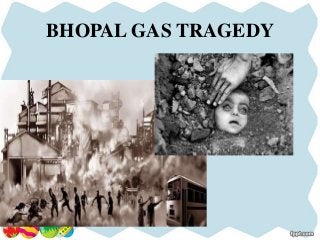
• Bhopal gas tragedy,1984
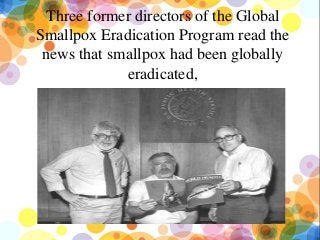
Three former directors of the Global
Smallpox Eradication Program read the
news that smallpox had been globally
eradicated,
BHOPAL GAS TRAGEDY
THE SEVENTH FIVE YEAR PLAN
(1985-1990)
THE SEVENTH FIVE YEAR PLAN
(1985-1990)
AIM
• To plan and provide primary health care and
medical services to all with special consideration
of vulnerable groups and those who are living in
the tribal, hilly areas and remote rural areas so as
to achieve the goal of Health for all by 2000AD
THE SEVENTH FIVE YEAR PLAN
(1985-1990)
THE PRIORITIES
• Health services in Rural, hilly and tribal areas
• Medical education and training
• Control of emerging health problems
• MCH and family welfare
• Medical research
• Safe water supply and sanitation
• Standardization, integration and application of Indian
Systems of medicine
THE SEVENTH FIVE YEAR PLAN
(1985-1990)
MAJOR DEVELOPMENTS
Health Programmes
• Universal Immunization programme,1985
• The 20 point programme was modified and
launched new 20 point programme,1986
• National Diabetes control programme,1987
• The national AIDS control programme,1987
• The National ARI programme,1989
THE SEVENTH FIVE YEAR PLAN
(1985-1990)
MAJOR DEVELOPMENTS
Health committees
• High power committee on nursing and nursing
profession
The objective of the committee were to
• To review the role, function, status, preparation
of nursing professionals, nursing services and
other issues related to the development of
profession
THE SEVENTH FIVE YEAR PLAN
(1985-1990)
MAJOR DEVELOPMENTS
Health acts
• Juvenile Justice act,1986
• The factories ( amendment) act,1987
• The ESI (amendment) act,1991
THE SEVENTH FIVE YEAR PLAN
(1985-1990)
MAJOR DEVELOPMENTS
Other developments
• A separate department of women and child
development was established by the
Ministry of Human resource
Development,1985
• The 1991 census was conducted.
THE EIGHTH FIVE YEAR
PLAN(1992-1997)
THE EIGHTH FIVE YEAR PLAN(1992-1997)
AIM
• To continue reorganization and strengthening
of health infrastructure and medical services
accessible to all.
THE EIGHTH FIVE YEAR PLAN(1992-1997)
The priorities
• Developing health infrastructure
• Medical education and training
• Control of communicable diseases
• Strengthening of health services
THE EIGHTH FIVE YEAR PLAN(1992-1997)
The priorities
• Medical research
• Universal immunization
• MCH and family welfare
• Safe water supply and sanitation
THE EIGHTH FIVE YEAR PLAN(1992-1997)
Major developments
Health Programmes
• CSSM,1992
• RNTCP,1993
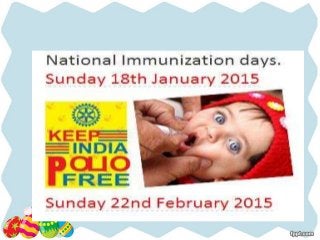
• The first pulse polio immunization programme for
children under 3 years,1994
• ICDS programme was changed into Integrated mother
and child development scheme,1995
THE EIGHTH FIVE YEAR PLAN(1992-
1997)
Major developments
Health acts
• The infant milk substitute, feeding bottle, and Infant foods(
regulation of production, supply and distribution Act, 1952
• The Panchayat raj act came into operation,1994
• Transplantation of Human organs act ,1995
• Prenatal diagnostic technique act( regulation and prevention
of misuse act, 1994
THE EIGHTH FIVE YEAR PLAN(1992-
1997)
Major developments
Health Committee
• Expert committee on Malaria submitted
report,1995
THE EIGHTH FIVE YEAR PLAN(1992-1997)
Major developments
Other developments
• Out break of plague epidemic,1994
• Post basic three year BSc Nursing programme
was launched by IGNOU
THE NINTH FIVE YEAR PLAN
(1997-2002)
THE NINTH FIVE YEAR PLAN
(1997-2002)
• AIM
Reorganization and
strengthening of infrastructure
so as to provide primary health
care services accessible to all
THE NINTH FIVE YEAR PLAN
(1997-2002)
The objectives
• To tackle both communicable and non
communicable diseases effectively
• To further intensify the efforts to improve the
health status of the population by optimising
quality of care and coverage
THE NINTH FIVE YEAR PLAN
(1997-2002)
Priorities
• Control of communicable and non communicable diseases
• Efficient primary health care system
• Strengthening of existing infrastructure
• Improvement of refferal linkages
• Development of human resources
THE NINTH FIVE YEAR PLAN
(1997-2002)
• Priorities
• Strengthening of existing national programmes
• Disaster and emergency management
• Strengthening of health research
• Involvement of practitioners from indigeneous systems of
medicine
• Inter sector coordination
THE NINTH FIVE YEAR PLAN
(1997-2002)
MAJOR DEVELOPMENTS
Health programmes
• RCH was launched
• National Malaria Eradication programme was renamed
into National Antimalarial programme in 1999
• Phase II NACP
THE NINTH FIVE YEAR PLAN
(1997-2002)
MAJOR DEVELOPMENTS
Other developments
• National population policy,2000
• National health policy,2002
• National AIDS prevention and Control policy,2002
• National Family Health survey 2 1998-1999
• Census 2011
THE TENTH FIVE YEAR PLAN
(2002-2007)
THE TENTH FIVE YEAR PLAN
(2002-2007)
Objectives
• Attain 8% GDP growth per year.
• Reduction of poverty ratio by 5 percentage points by2007
• Providing gainful and high-quality employment at least to
the addition to the labor force;
• All childrenin India in school by 2003; all children to
complete5 years of schooling by 2007
THE TENTH FIVE YEAR PLAN
(2002-2007)
Objectives
• Reduction in gender gaps in literacy and wage rates by at
least 50% by 2007
• Reduction in the decadal rate of population growth between
2 001 and 2011to 16.2%
• Increase in Literacy Rates to75percent within the Tenth Plan
period(2002 to 2007)
THE TENTH FIVE YEAR PLAN
(2002-2007)
MAJOR DEVELOPMENTS
Health programmes
• National Vector Borne Disease Control Programme in 2002
• Vandemataram Schedule launched in 2004.
• Revised Programme of Nutritional support to primary
education(Mid-day meal scheme launched)in 2004
• Integrated Disease Surveillance project launched in 2004
• RCH II launched in 2005.
THE TENTH FIVE YEAR PLAN
(2002-2007)
MAJOR DEVELOPMENTS
Health programmes
• Janani Suraksha Yojana launched in 2005.
• National Rural Health Mission launched in 2005.
• RNTCP covers whole country since March 2006.
• IMNCI was launched in 16 states in 2006.
• India achieved leprosy elimination target in 2005.
THE TENTH FIVE YEAR PLAN
(2002-2007)
MAJOR DEVELOPMENTS
Health acts
• 2003: Parliament approves the Cigarettes and
other Tobacco Products Act.
THE TENTH FIVE YEAR PLAN
(2002-2007)
MAJOR DEVELOPMENTS
Other developments
• 2004:Low osmolarity oral rehydration salt replaces the
existing formula.
• Nationa l guidelines on Infant and Young Child Feeding
formulated.
2005: Indian Public Health Standards for CHCs formulated.
• National Plan of Action for Children 2005 formulated.
THE TENTH FIVE YEAR PLAN
(2002-2007)
MAJOR DEVELOPMENTS
Other developments
• 2006: WHO releases new pediatric growth chart based on breast fed
children.
• Ban on child labour as domestic servant.
• National Family Health Survey III conducted.
• Ministry of women and Children development carved out of the Ministry
of human resources and development.
• 2007: Indian Public Health Standards for PHC and Sub-centers formulated.
• Maintenance and welfare of parents and senior citizen bill 2007 passed.
ELEVENTH FIVE YEAR PLAN
(2007-2012)
ELEVENTH FIVE YEAR PLAN
(2007-2012)
Goals
• Reducing maternal mortality ratio to 1 per 1000 live births.
• Reducing infant mortality rate to 28 per 1000 live births.
• Reducing TFR to 2.1
• Provide clean drinking water for all by 2009.
• Reducing malnutrition among children of age group 0-3 to half its present
level.
• Reducing anemia among girls and women by 50%
• Raising the sex ratio for age group 0-6 to 935 by 2011 -2012 and 950 by
2016-2017.
ELEVENTH FIVE YEAR PLAN
(2007-2012)
The thrust areas
• Improving health equity.
• Adopting a system centric approach rather than a disease
centric approach
• Increasing survival
• Taking full advantage of local enterprise for solving local
health problems.
• Preventing indebtedness due to expenditure on health
protecting the poor from health expenditures
ELEVENTH FIVE YEAR PLAN
(2007-2012)
• Decentralizing governance
• Establishing e health
• Improving access to and utilization of essential and quality health
care.
• Increasing focus on health human resource
• Focusing on excluded/neglected cases.
• Enhancing efforts at disease reduction
• Providing focus to health system and biomedical research.
THE TWELFTH FIVE YEAR
PLAN
(2012-2017)
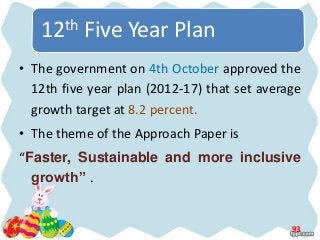
• The government on 4th October approved the
12th five year plan (2012-17) that set average
growth target at 8.2 percent.
• The theme of the Approach Paper is
“Faster, Sustainable and more inclusive
growth” .
15-05-2013 93
12th Five Year Plan
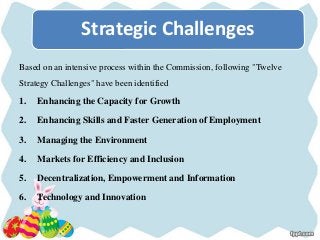
Based on an intensive process within the Commission, following "Twelve
Strategy Challenges" have been identified
1. Enhancing the Capacity for Growth
2. Enhancing Skills and Faster Generation of Employment
3. Managing the Environment
4. Markets for Efficiency and Inclusion
5. Decentralization, Empowerment and Information
6. Technology and Innovation
Strategic Challenges
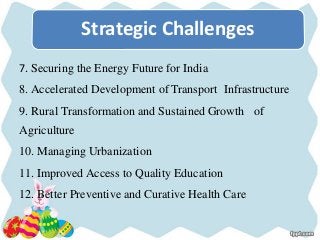
7. Securing the Energy Future for India
8. Accelerated Development of Transport Infrastructure
9. Rural Transformation and Sustained Growth of
Agriculture
10. Managing Urbanization
11. Improved Access to Quality Education
12. Better Preventive and Curative Health Care
Strategic Challenges
12th Five Year Plan :
Sectors
Agriculture
• Target at least 4% growth for agriculture.
• Cereals are on target for 1.5 to 2% growth.
• Technology must focus on land productivity and water
use efficiency.
• Farmers need better functioning markets for both outputs
and inputs. Also, better rural infrastructure, including
storage and food processing
Industry
• Investment and capacity additions are critical
for sustained industrial growth.
• Need to grow at 11-12% per year to create 2
million additional jobs per year.
• Indian industry must develop greater domestic
value addition.
• Better consultation and co-ordination in
industrial policy making
Education
and Skill
Development
• Must aim at universalisation of secondary education by 2017
• Must aim at raising the Gross Enrolment Ratio (GER) in
Higher Education to 20 percent by 2017 and 25 percent by
2022
• Must focus on quality of education. Must invest in faculty
development and teachers’ training
• Must aim at significant reduction in social, gender
and regional gaps in education.
• Research and innovation in higher education must
be encouraged with cross-linkages between
institutions and industry
Education
and Skill
Development
Health
• Better health is not only about curative care, but about better
prevention, Clean drinking water, sanitation and better nutrition,
childcare, etc. Convergence of schemes across Ministries is
needed.
• Desperate shortage of medical personnel. Need targeted
approach to increase seats in medical colleges, nursing colleges
and other licensed health professionals
• Health insurance cover should be expanded to all disadvantaged
groups
• Focus on women and children;
Energy
• Commercial energy demand will increase at 7%
p.a. if GDP grows at 9%. This will require a major
supply side response and also demand
management
• Energy pricing is a major issue. Petroleum and
Coal prices are significantly below world prices
and world prices are unlikely to soften.
THE TWELFTH FIVE YEAR PLAN
(2012-2017)
Goals
• Reduction of IMR to 25 per 1000 live births.
• Reduction of MMR to 100 per 1 lakh live births
• Reduction of TFR to 2.1
• Prevention and reduction of under nutrition in children
under 3 years to half of NFHS 3 levels
• Prevention And reduction of anemia among women aged
15-45 years to 28%
THE TWELFTH FIVE YEAR PLAN
(2012-2017)
Goals
• Raising child sex ratio in 0-6 years age group from
914 to 950.
• Prevention and reduction of burden of communicable
and non communicable diseases and injuries.
• Reduction of poor households out pocket expenditure
THE TWELFTH FIVE YEAR PLAN
(2012-2017)
Activities proposed for the 12th five year plan by the working group
• Health infrastructure
• Health human resource
• Reproductive child health programme
• Drugs procurement and logistics
• Programme management
• Community processes
• National urban health mission
Five year plans

Five year plans

  • 1.
  • 2.
    First five yearplan (1951-1956) Aim • To fight against the diseases, malnutirion and unhealthy environment • To build health services for rural population and for mothers
  • 3.
    First five yearplan (1951-1956) Priorities o Safe water supply and basic sanitation o Control of malaria o Health care for rural population o Health services for mother and children. o Education and training and health education o Self sufficiency in drugs and equipments. o Family planning and population control
  • 4.
    First five yearplan (1951-1956) • Health outlay Rs. 140 crores
  • 5.
    First five yearplan (1951-1956) Major developments Health programmes • The BCG vaccination programmes-1951 • Community development programme-1953 • National malaria control programme-1953 • The National family planning programme-1953
  • 6.
    First five yearplan (1951-1956) Major developments Health programmes • The National leprosy control programme-1954 • The National water supply and safe sanitation programme-1954 • The National filaria Control programme-1955
  • 7.
    First five yearplan (1951-1956) Major developments Acts • Prevention of food adulteration act in 1954. • Hindu Marriage act recommended the minimum marriage age of 18 years for boys and 15 for girls.,1955
  • 8.
    First five yearplan (1951-1956) Major developments Committees Shetty committee • Constituted on 19th May 1954 • to survey the existing facilities for nursing services. • To assess the minimum requirements of nurses in the country • To make recommendations to overcome shortage of nurses and improve service conditions.
  • 9.
    First five yearplan (1951-1956) Major developments Others • The Central council of health,1952 • The Central social welfare board, 1954 • VDRL antigen centre at Kolkata,1954 • A filaria training centre at Ernakulam,1955 • The Central Leprosy Teaching and Research Institute,1955. • National TB sample survey
  • 10.
    THE SECOND FIVEYEAR PLAN(1956-1961)
  • 11.
    THE SECOND FIVEYEAR PLAN(1956-1961) Aim • To expand existing health services to bring them within the reach of all people so as to promote progressive improvement of Nation’s Health.
  • 12.
    THE SECOND FIVEYEAR PLAN(1956-1961) Priorities • Establishment of institutional facilities for rural as well as for urban population. • Development of technical manpower. • Control of communicable diseases. • Water supply and sanitation. • Family planning and other supporting programmes.
  • 13.
    THE SECOND FIVEYEAR PLAN(1956-1961 Health outlay • Rs.225 crores
  • 14.
    THE SECOND FIVEYEAR PLAN(1956-1961 Major developments Health programmes • National Malaria control programme was converted into National Malaria Eradication programme, 1958
  • 15.
    THE SECOND FIVEYEAR PLAN(1956-1961 Major developments Health committees • The Leprosy advisory committee • The Mudaliar Committee • National Nutrition Advisory committee,1960 • The School health committee,1960
  • 16.
    THE SECOND FIVEYEAR PLAN(1956-1961 Major developments Act • Draft Model of public health act was prepared and published,1956 • The Immoral traffic act, 1956
  • 17.
    THE SECOND FIVEYEAR PLAN(1956-1961) Major developments Others • Director, Family planning was appointed at the centre,1956 • The Demographic Training and research Centre was established at Mumbai, 1956 • The Central health education buraeu,1956 • The tuberculosis chemotherapy centres, at Madras;1956
  • 18.
    THE SECOND FIVEYEAR PLAN(1956-1961) Major developments Others • The demographic research centers, Delhi, Kolkata and Madras,1957 • The National tuberculosis survey, 1958 • Panchayat Raj,1959 • The National Institute of Tuberculosis at Bangalore,1959
  • 19.
    THE THIRD FIVEYEAR PLAN(1961-1966)
  • 20.
    THE THIRD FIVEYEAR PLAN(1961-1966) AIM • To remove shortages and deficiencies which were observed at the end of the second five year plan
  • 21.
    THE THIRD FIVEYEAR PLAN(1961-1966) Priority areas • Safe water supply in villages and sanitation especially in urban areas. • Expansion of institutional facilities to promote accessibility in rural areas.
  • 22.
    THE THIRD FIVEYEAR PLAN(1961-1966) Priority areas • Eradication of Malaria and small pox and control of various communicable diseases. • Family planning and other supporting services • Development of manpower.
  • 23.
    THE THIRD FIVEYEAR PLAN(1961-1966) Health outlay Rs. 342 crores
  • 24.
    THE THIRD FIVEYEAR PLAN(1961-1966) Major developments Health programmes • The national small pox eradication programme and the National Goitre Control programme,1962 • The School health programme,1962. • The District Tuberculosis Programme,1962
  • 25.
    THE THIRD FIVEYEAR PLAN(1961-1966) Major developments Health programmes • The Applied Nutrition programme, 1963 • The postpartum Family planning programme, 1966
  • 26.
    THE THIRD FIVEYEAR PLAN(1961-1966) Major developments Committees • Mudaliar committee report submitted,1961 • Chadah committee,1963 • Mukherji committee,1965 • Mukherji committee,1966 • A medical education Committee to study various aspects of medical education,1968
  • 27.
    THE THIRD FIVEYEAR PLAN(1961-1966) Major developments Bill • A bill on registration of births and deaths was passed by the parliament,1968
  • 28.
    THE THIRD FIVEYEAR PLAN(1961-1966) • Major developments • Others • The central Bureau of Health Intelligence,1961 • The central family planning institute,Delhi,1962 • National Institute of Communicable diseases,1963
  • 29.
    THE THIRD FIVEYEAR PLAN(1961-1966) • Major developments • Others • The Contributory Health service scheme was changed into Central Government health Scheme,1963 • A separate department of Family planning was set up in Union Ministry of health,1966
  • 30.
    THE FOURTH FIVEYEAR PLAN(1969-1974) AIM • To strengthen Primary health centre network in the rural areas for undertaking preventive, curative and family planning services and to take over the maintenance phase of communicable diseases
  • 31.
    THE FOURTH FIVEYEAR PLAN(1969-1974) Priorities • Family planning programme • Strengthening primary health centres • Strengthening subdivisional and district hospitals to provide effective referral transport to Primary health centres. • Intensification of control programmes. • Expansion of medical and nursing education training of paramedical personnel to minimum technical manpower requirements.
  • 32.
    THE FOURTH FIVEYEAR PLAN(1969- 1974) • Health outlay • Rs.16,774 crores
  • 33.
    THE FOURTH FIVEYEAR PLAN(1969-1974) The major developments Health programmes • All India hospital family planning programme was launched,1970 • The National programme of Minimum needs programme,1973
  • 34.
    THE FOURTH FIVEYEAR PLAN(1969-1974) The major developments Health committees • The report of Medical education committee,1969 • Kartar Singh Committee,1973
  • 35.
    THE FOURTH FIVEYEAR PLAN(1969-1974) The major developments Health acts • The central Births and deaths registration act ,1969 • MTP act,1972
  • 36.
    THE FOURTH FIVEYEAR PLAN(1969-1974) The major developments Others • The population council of India,1970 • The Demographic training and research institute was changed into International Institute for population studies,1970 • The family pension scheme,1971 • The national nutrition monitoring bureau,1972
  • 37.
    THE FIFTH FIVEYEAR PLAN (1974-79)
  • 38.
    THE FIFTH FIVEYEAR PLAN (1974-79) Aim To provide minimum level of well integrated health, MCH, FP, Nutrition and immunization services to all the people with special reference to vulnerable groups especially children, pregnant women and nursing mothers through a network of infrastructure in all blocks and well structured referral system
  • 39.
    THE FIFTH FIVEYEAR PLAN (1974-79) Priorities • Increasing accessibility of health services in rural areas. • Correcting regional imbalance • Further development of referral services by removing deficiencies in district and sub division hospitals
  • 40.
    THE FIFTH FIVEYEAR PLAN (1974-79) • Priorities • Integration of health, family planning and nutrition • Intensification of the control and eradication of communicable diseases especially Malaria and small pox. • Qualitative improvement in the education and training of health personnel.
  • 41.
    THE FIFTH FIVEYEAR PLAN (1974-79) Health outlay • Rs 37,382 crores
  • 42.
    THE FIFTH FIVEYEAR PLAN (1974-79) The major developments Health programmes • ICDS scheme,1975 • Revised modified plan of malaria eradication,1977
  • 43.
    THE FIFTH FIVEYEAR PLAN (1974-79) Health committees • Shrivastav Committee,1975
  • 44.
    THE FIFTH FIVEYEAR PLAN (1974-79) Health acts • The water( prevention and control of pollution ) act 1974 • The ESI act amended,1975 • The Cigarette regulation act, 1975 • Indian factory act,1976 amended • The prevention of food adulteration act came into force,1976 • The Child Marriage restraint Bill,1978
  • 45.
    THE FIFTH FIVEYEAR PLAN (1974-79) Other developments • UN declared 1974 as World population year. • India became small pox free on 5th july,1975 • Children’s welfare board,1975 • New population policy,1976
  • 46.
    THE FIFTH FIVEYEAR PLAN (1974-79) Other developments • Rural health scheme,1977 • The 42nd amendment of the Constitution population control and family planning,1977 • Alma Ata declared primary health care strategy to achieve goal of health for all by the year 2000, in 1978
  • 47.
    SIXTH FIVE YEARPLAN (1980-1985)
  • 48.
    SIXTH FIVE YEARPLAN (1980-1985) AIM • To workout alternative strategy and plan of action for Primary Health Care as part of National health system which is accessible to all sections of society
  • 49.
    SIXTH FIVE YEARPLAN (1980-1985) Priorities • Rural health services • Control of communicable diseases. • Development of rural and urban hospitals/ dispensaries • Improvement in medical education and training • Medical research
  • 50.
    SIXTH FIVE YEARPLAN (1980-1985) • Priorities • Drug control and prevention of food adulteration • Population control and family welfare including MCH • Water supply and sanitation • Nutrition
  • 51.
    SIXTH FIVE YEARPLAN (1980-1985) Health outlay • Rs.1821.05 crores
  • 52.
    SIXTH FIVE YEARPLAN (1980-1985) • Major developments • Health programmes • The 20 point programme was announced,1982 • National leprosy control programme was changed to National leprosy eradication programme,1983. • National Guinea worm was started,1983.
  • 53.
    SIXTH FIVE YEARPLAN (1980-1985) Major developments Health acts • The Air Prevention and Control of Pollution act,1981 • The workmen Compensation act 1984 came into force,1984.
  • 54.
    SIXTH FIVE YEARPLAN (1980-1985) • Major developments • WHO declared eradication of small pox from the world,1980 • The Working group on health was constituted by the planning commission under the chairmanship of health secretary,1980 • The 1981 Census was undertaken. • National Health policy,1983 • Bhopal gas tragedy,1984
  • 55.
    Three former directorsof the Global Smallpox Eradication Program read the news that smallpox had been globally eradicated,
  • 56.
  • 57.
    THE SEVENTH FIVEYEAR PLAN (1985-1990)
  • 58.
    THE SEVENTH FIVEYEAR PLAN (1985-1990) AIM • To plan and provide primary health care and medical services to all with special consideration of vulnerable groups and those who are living in the tribal, hilly areas and remote rural areas so as to achieve the goal of Health for all by 2000AD
  • 59.
    THE SEVENTH FIVEYEAR PLAN (1985-1990) THE PRIORITIES • Health services in Rural, hilly and tribal areas • Medical education and training • Control of emerging health problems • MCH and family welfare • Medical research • Safe water supply and sanitation • Standardization, integration and application of Indian Systems of medicine
  • 60.
    THE SEVENTH FIVEYEAR PLAN (1985-1990) MAJOR DEVELOPMENTS Health Programmes • Universal Immunization programme,1985 • The 20 point programme was modified and launched new 20 point programme,1986 • National Diabetes control programme,1987 • The national AIDS control programme,1987 • The National ARI programme,1989
  • 61.
    THE SEVENTH FIVEYEAR PLAN (1985-1990) MAJOR DEVELOPMENTS Health committees • High power committee on nursing and nursing profession The objective of the committee were to • To review the role, function, status, preparation of nursing professionals, nursing services and other issues related to the development of profession
  • 62.
    THE SEVENTH FIVEYEAR PLAN (1985-1990) MAJOR DEVELOPMENTS Health acts • Juvenile Justice act,1986 • The factories ( amendment) act,1987 • The ESI (amendment) act,1991
  • 63.
    THE SEVENTH FIVEYEAR PLAN (1985-1990) MAJOR DEVELOPMENTS Other developments • A separate department of women and child development was established by the Ministry of Human resource Development,1985 • The 1991 census was conducted.
  • 64.
    THE EIGHTH FIVEYEAR PLAN(1992-1997)
  • 65.
    THE EIGHTH FIVEYEAR PLAN(1992-1997) AIM • To continue reorganization and strengthening of health infrastructure and medical services accessible to all.
  • 66.
    THE EIGHTH FIVEYEAR PLAN(1992-1997) The priorities • Developing health infrastructure • Medical education and training • Control of communicable diseases • Strengthening of health services
  • 67.
    THE EIGHTH FIVEYEAR PLAN(1992-1997) The priorities • Medical research • Universal immunization • MCH and family welfare • Safe water supply and sanitation
  • 68.
    THE EIGHTH FIVEYEAR PLAN(1992-1997) Major developments Health Programmes • CSSM,1992 • RNTCP,1993 • The first pulse polio immunization programme for children under 3 years,1994 • ICDS programme was changed into Integrated mother and child development scheme,1995
  • 70.
    THE EIGHTH FIVEYEAR PLAN(1992- 1997) Major developments Health acts • The infant milk substitute, feeding bottle, and Infant foods( regulation of production, supply and distribution Act, 1952 • The Panchayat raj act came into operation,1994 • Transplantation of Human organs act ,1995 • Prenatal diagnostic technique act( regulation and prevention of misuse act, 1994
  • 71.
    THE EIGHTH FIVEYEAR PLAN(1992- 1997) Major developments Health Committee • Expert committee on Malaria submitted report,1995
  • 72.
    THE EIGHTH FIVEYEAR PLAN(1992-1997) Major developments Other developments • Out break of plague epidemic,1994 • Post basic three year BSc Nursing programme was launched by IGNOU
  • 73.
    THE NINTH FIVEYEAR PLAN (1997-2002)
  • 74.
    THE NINTH FIVEYEAR PLAN (1997-2002) • AIM Reorganization and strengthening of infrastructure so as to provide primary health care services accessible to all
  • 75.
    THE NINTH FIVEYEAR PLAN (1997-2002) The objectives • To tackle both communicable and non communicable diseases effectively • To further intensify the efforts to improve the health status of the population by optimising quality of care and coverage
  • 76.
    THE NINTH FIVEYEAR PLAN (1997-2002) Priorities • Control of communicable and non communicable diseases • Efficient primary health care system • Strengthening of existing infrastructure • Improvement of refferal linkages • Development of human resources
  • 77.
    THE NINTH FIVEYEAR PLAN (1997-2002) • Priorities • Strengthening of existing national programmes • Disaster and emergency management • Strengthening of health research • Involvement of practitioners from indigeneous systems of medicine • Inter sector coordination
  • 78.
    THE NINTH FIVEYEAR PLAN (1997-2002) MAJOR DEVELOPMENTS Health programmes • RCH was launched • National Malaria Eradication programme was renamed into National Antimalarial programme in 1999 • Phase II NACP
  • 79.
    THE NINTH FIVEYEAR PLAN (1997-2002) MAJOR DEVELOPMENTS Other developments • National population policy,2000 • National health policy,2002 • National AIDS prevention and Control policy,2002 • National Family Health survey 2 1998-1999 • Census 2011
  • 80.
    THE TENTH FIVEYEAR PLAN (2002-2007)
  • 81.
    THE TENTH FIVEYEAR PLAN (2002-2007) Objectives • Attain 8% GDP growth per year. • Reduction of poverty ratio by 5 percentage points by2007 • Providing gainful and high-quality employment at least to the addition to the labor force; • All childrenin India in school by 2003; all children to complete5 years of schooling by 2007
  • 82.
    THE TENTH FIVEYEAR PLAN (2002-2007) Objectives • Reduction in gender gaps in literacy and wage rates by at least 50% by 2007 • Reduction in the decadal rate of population growth between 2 001 and 2011to 16.2% • Increase in Literacy Rates to75percent within the Tenth Plan period(2002 to 2007)
  • 83.
    THE TENTH FIVEYEAR PLAN (2002-2007) MAJOR DEVELOPMENTS Health programmes • National Vector Borne Disease Control Programme in 2002 • Vandemataram Schedule launched in 2004. • Revised Programme of Nutritional support to primary education(Mid-day meal scheme launched)in 2004 • Integrated Disease Surveillance project launched in 2004 • RCH II launched in 2005.
  • 84.
    THE TENTH FIVEYEAR PLAN (2002-2007) MAJOR DEVELOPMENTS Health programmes • Janani Suraksha Yojana launched in 2005. • National Rural Health Mission launched in 2005. • RNTCP covers whole country since March 2006. • IMNCI was launched in 16 states in 2006. • India achieved leprosy elimination target in 2005.
  • 85.
    THE TENTH FIVEYEAR PLAN (2002-2007) MAJOR DEVELOPMENTS Health acts • 2003: Parliament approves the Cigarettes and other Tobacco Products Act.
  • 86.
    THE TENTH FIVEYEAR PLAN (2002-2007) MAJOR DEVELOPMENTS Other developments • 2004:Low osmolarity oral rehydration salt replaces the existing formula. • Nationa l guidelines on Infant and Young Child Feeding formulated. 2005: Indian Public Health Standards for CHCs formulated. • National Plan of Action for Children 2005 formulated.
  • 87.
    THE TENTH FIVEYEAR PLAN (2002-2007) MAJOR DEVELOPMENTS Other developments • 2006: WHO releases new pediatric growth chart based on breast fed children. • Ban on child labour as domestic servant. • National Family Health Survey III conducted. • Ministry of women and Children development carved out of the Ministry of human resources and development. • 2007: Indian Public Health Standards for PHC and Sub-centers formulated. • Maintenance and welfare of parents and senior citizen bill 2007 passed.
  • 88.
    ELEVENTH FIVE YEARPLAN (2007-2012)
  • 89.
    ELEVENTH FIVE YEARPLAN (2007-2012) Goals • Reducing maternal mortality ratio to 1 per 1000 live births. • Reducing infant mortality rate to 28 per 1000 live births. • Reducing TFR to 2.1 • Provide clean drinking water for all by 2009. • Reducing malnutrition among children of age group 0-3 to half its present level. • Reducing anemia among girls and women by 50% • Raising the sex ratio for age group 0-6 to 935 by 2011 -2012 and 950 by 2016-2017.
  • 90.
    ELEVENTH FIVE YEARPLAN (2007-2012) The thrust areas • Improving health equity. • Adopting a system centric approach rather than a disease centric approach • Increasing survival • Taking full advantage of local enterprise for solving local health problems. • Preventing indebtedness due to expenditure on health protecting the poor from health expenditures
  • 91.
    ELEVENTH FIVE YEARPLAN (2007-2012) • Decentralizing governance • Establishing e health • Improving access to and utilization of essential and quality health care. • Increasing focus on health human resource • Focusing on excluded/neglected cases. • Enhancing efforts at disease reduction • Providing focus to health system and biomedical research.
  • 92.
    THE TWELFTH FIVEYEAR PLAN (2012-2017)
  • 93.
    • The governmenton 4th October approved the 12th five year plan (2012-17) that set average growth target at 8.2 percent. • The theme of the Approach Paper is “Faster, Sustainable and more inclusive growth” . 15-05-2013 93 12th Five Year Plan
  • 94.
    Based on anintensive process within the Commission, following "Twelve Strategy Challenges" have been identified 1. Enhancing the Capacity for Growth 2. Enhancing Skills and Faster Generation of Employment 3. Managing the Environment 4. Markets for Efficiency and Inclusion 5. Decentralization, Empowerment and Information 6. Technology and Innovation Strategic Challenges
  • 95.
    7. Securing theEnergy Future for India 8. Accelerated Development of Transport Infrastructure 9. Rural Transformation and Sustained Growth of Agriculture 10. Managing Urbanization 11. Improved Access to Quality Education 12. Better Preventive and Curative Health Care Strategic Challenges
  • 96.
    12th Five YearPlan : Sectors
  • 97.
    Agriculture • Target atleast 4% growth for agriculture. • Cereals are on target for 1.5 to 2% growth. • Technology must focus on land productivity and water use efficiency. • Farmers need better functioning markets for both outputs and inputs. Also, better rural infrastructure, including storage and food processing
  • 98.
    Industry • Investment andcapacity additions are critical for sustained industrial growth. • Need to grow at 11-12% per year to create 2 million additional jobs per year. • Indian industry must develop greater domestic value addition. • Better consultation and co-ordination in industrial policy making
  • 99.
    Education and Skill Development • Mustaim at universalisation of secondary education by 2017 • Must aim at raising the Gross Enrolment Ratio (GER) in Higher Education to 20 percent by 2017 and 25 percent by 2022 • Must focus on quality of education. Must invest in faculty development and teachers’ training
  • 100.
    • Must aimat significant reduction in social, gender and regional gaps in education. • Research and innovation in higher education must be encouraged with cross-linkages between institutions and industry Education and Skill Development
  • 101.
    Health • Better healthis not only about curative care, but about better prevention, Clean drinking water, sanitation and better nutrition, childcare, etc. Convergence of schemes across Ministries is needed. • Desperate shortage of medical personnel. Need targeted approach to increase seats in medical colleges, nursing colleges and other licensed health professionals • Health insurance cover should be expanded to all disadvantaged groups • Focus on women and children;
  • 102.
    Energy • Commercial energydemand will increase at 7% p.a. if GDP grows at 9%. This will require a major supply side response and also demand management • Energy pricing is a major issue. Petroleum and Coal prices are significantly below world prices and world prices are unlikely to soften.
  • 103.
    THE TWELFTH FIVEYEAR PLAN (2012-2017) Goals • Reduction of IMR to 25 per 1000 live births. • Reduction of MMR to 100 per 1 lakh live births • Reduction of TFR to 2.1 • Prevention and reduction of under nutrition in children under 3 years to half of NFHS 3 levels • Prevention And reduction of anemia among women aged 15-45 years to 28%
  • 104.
    THE TWELFTH FIVEYEAR PLAN (2012-2017) Goals • Raising child sex ratio in 0-6 years age group from 914 to 950. • Prevention and reduction of burden of communicable and non communicable diseases and injuries. • Reduction of poor households out pocket expenditure
  • 105.
    THE TWELFTH FIVEYEAR PLAN (2012-2017) Activities proposed for the 12th five year plan by the working group • Health infrastructure • Health human resource • Reproductive child health programme • Drugs procurement and logistics • Programme management • Community processes • National urban health mission