COMMUNITY GERIATRICS
Geriatrics
Geriatrics or geriatric medicine is a sub-
specialty of internal medicine and family
medicine that focuses on health care
of elderly people.
Geriatric nursing
Geriatric nursing: - Nursing care of the aged
patient given in the home, the hospital, or
special institutions such as nursing homes,
psychiatric institutions, etc.
GERONTOLOGY
Gerontology
The scientific study of the biological,
psychological, and sociological phenomena
associated with old age and aging.
The objectives of geriatric care
• Maintenance of health function
• Detection of diseases at early stages
• Prevention of deterioration of any existing
problem
GENERAL PRINCIPLES OF GERIATRIC
CARE
1. Consider individuality. Consult his preferences.
2. Be patient, kind and sympathetic. Communicate effectively,
demonstrate respect.
3. Encourage independence and encourage him to make his
choices and decisions.
4. Assist elderly to achieve emotional stability.
5. Stimulate mental acuity and sensory input and physical activity
to uplift their self esteem, self concept and confidence.
GENERAL PRINCIPLES OF
GERIATRIC CARE
6. Make elderly stay in home interesting and lively
7. Provide diversion /occupational therapy.
8. Maintain privacy
9. Handle them gently.
10. Make them comfortable by providing comfortable
bed, bed linen etc. keep bed dry, smooth and
unwrinkled.
GENERAL PRINCIPLES OF
GERIATRIC CARE
11. Encourage them to maintain body hygiene, thus
regulate body temperature.
12. Assist them to take care of visual, auditory and
dental aid.
13. Protect from injuries, falls and accidents etc.
14. Ensure adequate nutrition.
15. Facilitate elimination. Encourage them to maintain
external genitalia hygiene.
GENERAL PRINCIPLES OF GERIATRIC
CARE
16. Encourage them to do active range of motion exercises.
Maintain body alignment and posture. Encourage mobility.
17. Help elderly to establish good sleep patterns.
18 . Caution elderly about the use of drugs.
19 . Have them physically examined annually and whenever
needed.
20. Observe any psychophysical changes which alter their body
image and behaviour.
Principles guiding the
Gerontological Nursing Practice
• Aging is a natural process common to all living organisms.
• Various factors influence the aging process.
• Unique data and knowledge are used in applying the nursing
process to older population.
• Older adults share similar self-care and human needs with all
other human beings.
• Gerontological nursing strives to help older adults achieve
wholeness by reaching optimum levels of physical,
psychological, social and spiritual health.
Factors affecting
aging
• Hereditary factors
• Environmental factors
Abiotic factors
Biotic factors
Socioeconomic factors
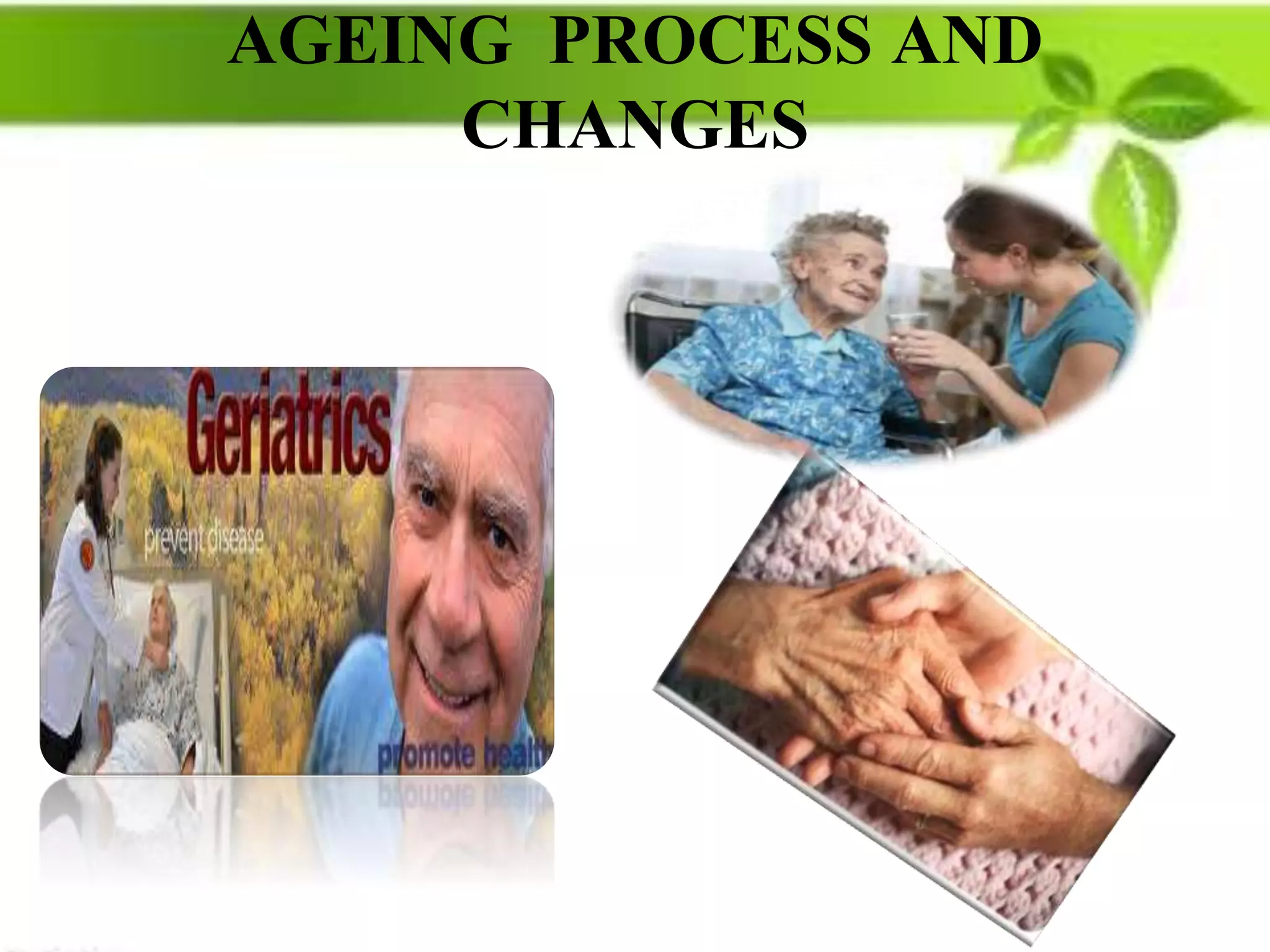
AGEING PROCESS AND
CHANGES
SENSORY SYSTEM
VISION
• Decreased visual acuity
• Decreased peripheral vision
• Decreased dark adaptation
• Elevated minimal threshold of light perception
• Presbyopia
SENSORY SYSTEM
VISION
• Decreased colour discrimination
• Increased sensitivity to glare
• Decreased depth sensation
• Decreased tears
VISION
ASSESSMENT FINDINGS
• Arcus senilis
• Cataracts
• Macular degeneration
• Glaucoma
• Smaller pupil size
• Dry, red eyes
• Vitreous floaters
HEARING
• Hearing loss-
• Usual progression from high tone or high frequency loss
to a general loss of both high and low tones.
• Consonants are not heard well.
• Hearing loss increases with age and greater in men.
• Increase in the sound threshold.
• Decreased speech discrimination.
• Cerumen impaction
HEARING
Assessment findings
• Increased volume of patients own voice.
• Turning of head toward speaker.
• Request of a speaker to repeat.
• Inappropriate answers
• The person may withdraw, demonstrate short attention
span and become frustrated, angry and depressed.
• Lack of response to a loud noise.
SMELL
Characteristics
• Changes in smell due to nasal sinus disease
preventing odours from reaching smell receptors
• Decreased discrimination of odours.
• Decreased more in men than women.
Assessment findings
• Inability to notice unpleasant odours
• Decreased appetite.
TASTE
Characteristics
• Taste buds decreases with age especially in men.
• Taste buds lost from the front to the back.
Assessment findings
• Complaints of food has no taste.
• Excessive use of sugar and salt.
• Inability to identify the foods.
• Decrease in appetite and weight loss.
• Decrease pleasure from food.
NERVOUS SYSTEM
Characteristics
• Gradual loss in the number of neurons with age and
no change in the neurotransmitter level.
• Brain tissue atrophy
• Decreased muscle tone, motor speed, and nerve
conduction velocity.
• Decrease in gait speed, decreased step length, stride
length, and arm swing.
NERVOUS SYSTEM
Assessment findings
• Decreased position and vibration sense
• Diminished reflexes, possible absent ankle jerks.
• Complaints of fall and impaired balance.
• Wide based gait with decreased arm swing.
CARDIO VASCULAR SYSTEM
Characteristics
• Valves of the heart become thick and rigid as a result of
sclerosis and fibrosis.
• Blood vessels become thick and rigid, resulting in
elevated blood pressure.
• Maximum heart rate and aerobic capacity decreases with
age.
• Decline in maximum oxygen consumption.
• Decreased baroreceptor sensitivity.
CARDIO VASCULAR SYSTEM
Assessment findings
• Normal blood pressure or below,
• Pre hypertension
• Stage I hypertension
• Stage II hypertension
• Prolonged tachycardia may occur following the stress.
RESPIRATORY SYSTEM
Characteristics
• Weakening of intercostal respiratory muscles and the
elastic recoil of the chest wall diminishes.
• Residual volume and functional residual capacity
increase.
• Partial pressure of oxygen decreases
• Decrease in mucus transport or ciliary system, therefore
reduced clearance of mucus and foreign bodies.
RESPIRATORY SYSTEM
Assessment findings
• Prolonged cough, inability to raise secretions.
• Increased frequency of respiratory infections.
GENITO URINARY SYSTEM
Female
• Thinning of the vaginal wall,
• Narrowing of vagina in size and loss of elasticity
• Decreased vaginal secretions resulting in vaginal dryness,
itching and decreased acidity
• Involution of the uterus and ovaries
• Decreased pubococcygeal muscle tone resulting in
relaxed vagina and perineum,
GENITO URINARY SYSTEM
Males
• Penis and testes decrease in size, and levels of
androgens diminishes
• Erectile dysfunction
GENITO URINARY SYSTEM
Assessment findings
• Vaginal dryness, painful intercourse.
• Atrophic vaginitis
• Urinary incontinence, BPH and prostatic
cancer
MUSCULOSKELETAL SYSTEM
Characteristics
• Declining muscle mass
• Decreased bone density, more in women.
• Decreased thickness and resiliency of
cartilage
• Bone resorption exceeds bone formation,
resulting in decline of bone density.
• Injuries to the cartilage
MUSCULOSKELETAL SYSTEM
• With age, the receptors in the joints and muscles loss
their ability to function, so there is a change in
balance.
• Walking with shorter step length, less leg lift, a wider
base, and tendency to lean forward
• With age less ability to stop a fall from occurring
MUSCULO SKELETAL
Assessment findings
• Muscle atrophy
• Increased incidence of fractures.
• Joint stiffness.
• Decreased bone density
• Alteration in posture, ability to transfer, and gait
• Complaint of dizziness.
INTEGUMENTARY SYSTEM
Characteristics
• Thinning of three layers of skin and decreased ability
to function as a barrier.
• Fewer melanocyte and decrease tanning.
• Less efficient thermoregulation because fewer sweat
glands.
• Drier skin because of decreased number of sebaceous
glands.
INTEGUMENTARY SYSTEM
• Reduced sensory output and decreased
elasticity.
• More prone to heat stress
• Hypothermia
ENDOCRINE SYSTEM
Characteristics
• Decreased secretion of trophic hormones from pituitary gland.
• Blunted growth hormone release during the times of stress.
• Elevated vasopressin and exaggerated response to osmotic
challenge.
• Elevated levels of FSH and LH because of reduced end organ
response.
• Normal insulin secretion at rest and an age related decrease in
secretion in response to glucose overload.
HEMATOPOETIC SYSTEM
Characteristics
• Bone marrow cellularity is decreased during
older life
• Declining marrow activity.
IMMUNOLOGIC SYSTEM
Characteristics
• The function of T lymphocyte, such as cell mediated
immunity, declines with age due to involution and
atrophy of thymus gland.
• Decreased T cell helper activity, increased T cell
suppressor activity.
• Declined B cell function as a result of T cell changes.
IMMUNOLOGIC SYSTEM
Assessment findings
• More frequent infections.
• Increased incidence of many types of cancers.
THEORIES OF AGEING
Disengagement Theory
• Refers to an inevitable
process in which many of the
relationships between a
person and other members of
society are severed.
ACTIVITY THEORY
• Activity theory emphasizes
the importance of ongoing
social activity.
• This theory suggests that a
person's self-concept is
related to the roles held by
that person
Erikson’s theory
EXCHANGE THEORY
The exchange theory
simply states that people
should end the relationship
with another person if
nothing can be gained or
exchanged from that
person.
Jung’s theory
• As individuals age, they go through a re
evaluation stage at midlife then they begin to
question whether the decisions and the choices
they have made were the right choices for
them
CONTINUITY THEORY
• In later life, adults tend to use continuity as an
adaptive strategy to deal with changes that
occur during normal aging.
Error & Fidelity Theory
• Accumulation of errors in the synthesis of
cellular DNA and RNA, the basic building
blocks of the cell.
CROSS LINK THEORY
• It explains aging in terms of the accumulation
of errors by cross- linking, or the stiffening of
proteins in the cell. Proteins link with glucose
and other sugars in the presence of oxygen and
become stiff and thick.
FREE RADICAL THEORY
• Free radicals are natural by products of
cellular activity and are always present to
some extent. With ageing, the damage caused
by free radicals occurs faster than the cells can
repair themselves, and cell death occurs.
Glycation Theory
• Glycation is the nonenzymic reaction between
glucose & tissue protein.
• The negative effects of this process on proteins
may be a major contributor to age changes.
Programmed Cellular Aging
Theory
• Suggests that aging may be a result of an
impairment of the cell in translating necessary
RNAs as a result of increased turnoffs of
DNA.
AUTOIMMUNE THEORY
• As the body ages the immune system is less
able to deal with foreign organisms &
increasingly make mistakes by identifying
ones own tissues as foreign.
Neuroendocrine Control Theory
The age related changes in
response to hormones may be
the result of changes in the
receptors for hormones rather
than changes in the activity
of the endocrine hormones
themselves.
Psychological Problems in older populations
• Depression
• Dementia
• Delirium
• Alcohol and substance abuse
GERIATRIC HEALTH
ASSESSMENT
HEALTH ASSESSMMENT
• THE HEALTH HISTORY
• PHYSICAL ASSESSMENT
• COMPREHENSIVE ASSESSMENT
• FUNCTIONAL ASSESSMENT
• MENTAL STATUS ASSESSMENT
• ASSESSMENT OF SOCIAL SUPPORTS
• ENVIRONMENTAL AND SAFETY ASSESSMENT
• INTEGRATED ASSESSMENT
COMPREHENSIVE ASSESSMENT
• F- Fluids
• A-Aeration
• N- Nutrition
• C- Communication
• A-Activity
• P- Pain
• E- Elimination
• S- Socialization and Social skills
FUNCTIONAL ASSESSMENT
MENTAL STATUS ASSESSMENT
COGNITIVE MEASURES
• Mini mental status examination
• Clock drawing test
• The Mini – Cog
MOOD MEASURES
Geriatric depression scale
INTEGRATED ASSESSMENT
• Social resources
• Economic resources
• Mental health
• Physical health
• Activities of daily living
BENEFITS GIVEN TO OLD AGE
PEOPLE IN INDIA
Indira Gandhi National Old Age Pension
Scheme
• Objective - To disburse pension to the
destitute old age persons.
• Assistance provided 400/-per month
• Beneficiary
• Beyond 65 years of age, belonging to
BPL. And 60 years above for persons
affected by leprosy, blindness,
insanity, paralysis and loss of limb.
Helpage India
• It is a secular, nonprofit,
largest voluntary
organization which was
set up in 1978.
National Policy On Older Persons
• Formed in January1999 under Ministry of
social justice and empowerment.
• The goal of the national policy is the well
being of older persons..
• Annapurna scheme
Free food grains upto 10 kg per month are
provided to destitute older persons above 65
years of age who are eligible for pension but
not receiving it.
• Ministry of Health and Family Welfare
provides separate queues to senior citizens in
the hospitals.
Ministry of Railways
• Concessions to senior citizens are
hiked from 30 to 40 percent for men
above 60 years and for women above
58 years for booking and cancellation
of railway tickets.
• Ministry of Civil Aviation
• Fifty percent discount on basic fare for all
domestic flights in Economy class for above
65 years of age.
• Ministry of Road Transport and Highways
• The benefit is given after 65 years of age for
both men and women.
• Department of post office A new scheme
called Senior Citizen Saving scheme has been
notified.
CARE OF AGED
Primary
prevention
Secondary
prevention
Tertiary
prevention
Primary prevention
• Control of BP, weight and diabetes
• Avoid smoking and alcohol
• Regular, moderate physical exercise
• Avoidance of drug abuse and self medication
• Well balanced diet with plenty of vegetables
and fruits, low in saturated fats, refined sugars
and fast foods.
Primary prevention
• Cultivation of interest in reading, listening to music and
other recreational activities.
• Avoid plenty of fluid intake
• Periodical screening for blood pressure, vision and
hearing
• Plan for future financial, housing security.
• Yoga exercises and meditation
• Immunization against influenza, pneumonia, tetanus,
hepatitis B
Secondary prevention
• Educate about danger signals of disease.
• Educate woman about BSE
• Pap smear examination for menopause women.
Tertiary prevention
• Cataract surgery, provision of spectacles
• Hearing aids, artificial limbs, prosthesis.
• Physiotherapy, vocational therapy, psychological and
social therapy depending upon the functional
capacities.
• Deaddiction counseling
• Establishment of old age homes and old age clubs
• Establishment of geriatric clinics
RESPONSIBILITIES OF COMMUNITY
HEALTH NURSE
• Health assessment
• Arranging and promoting nutrition
• Promoting activity and exercise
• Preventive care of elderly
• Providing psychological support
FUNCTIONS OF A GERONTOLOGICAL
NURSE
• G (Guiding)
• E ( Eliminating)
• R ( Respecting)
• O (Observing)
• N ( Noticing)
• T (Teaching)
• O (Opening Channels)
• L ( Listening)
FUNCTIONS OF A GERONTOLOGICAL
NURSE
• O( Offering)
• G( Generating)
• I( Implementing)
• C(Co ordinating)
• A(Assessing)
• L(Linking)
FUNCTIONS OF A GERONTOLOGICAL
NURSE
• N(Nurturing)
• U( Understanding)
• R( Recognizing)
• S(Supporting)
• E(Education and encouraging)
THANK YOU

Geriatric care

  • 1.
  • 2.
    Geriatrics Geriatrics or geriatricmedicine is a sub- specialty of internal medicine and family medicine that focuses on health care of elderly people.
  • 3.
    Geriatric nursing Geriatric nursing:- Nursing care of the aged patient given in the home, the hospital, or special institutions such as nursing homes, psychiatric institutions, etc.
  • 4.
    GERONTOLOGY Gerontology The scientific studyof the biological, psychological, and sociological phenomena associated with old age and aging.
  • 5.
    The objectives ofgeriatric care • Maintenance of health function • Detection of diseases at early stages • Prevention of deterioration of any existing problem
  • 6.
    GENERAL PRINCIPLES OFGERIATRIC CARE 1. Consider individuality. Consult his preferences. 2. Be patient, kind and sympathetic. Communicate effectively, demonstrate respect. 3. Encourage independence and encourage him to make his choices and decisions. 4. Assist elderly to achieve emotional stability. 5. Stimulate mental acuity and sensory input and physical activity to uplift their self esteem, self concept and confidence.
  • 7.
    GENERAL PRINCIPLES OF GERIATRICCARE 6. Make elderly stay in home interesting and lively 7. Provide diversion /occupational therapy. 8. Maintain privacy 9. Handle them gently. 10. Make them comfortable by providing comfortable bed, bed linen etc. keep bed dry, smooth and unwrinkled.
  • 8.
    GENERAL PRINCIPLES OF GERIATRICCARE 11. Encourage them to maintain body hygiene, thus regulate body temperature. 12. Assist them to take care of visual, auditory and dental aid. 13. Protect from injuries, falls and accidents etc. 14. Ensure adequate nutrition. 15. Facilitate elimination. Encourage them to maintain external genitalia hygiene.
  • 9.
    GENERAL PRINCIPLES OFGERIATRIC CARE 16. Encourage them to do active range of motion exercises. Maintain body alignment and posture. Encourage mobility. 17. Help elderly to establish good sleep patterns. 18 . Caution elderly about the use of drugs. 19 . Have them physically examined annually and whenever needed. 20. Observe any psychophysical changes which alter their body image and behaviour.
  • 10.
    Principles guiding the GerontologicalNursing Practice • Aging is a natural process common to all living organisms. • Various factors influence the aging process. • Unique data and knowledge are used in applying the nursing process to older population. • Older adults share similar self-care and human needs with all other human beings. • Gerontological nursing strives to help older adults achieve wholeness by reaching optimum levels of physical, psychological, social and spiritual health.
  • 11.
    Factors affecting aging • Hereditaryfactors • Environmental factors Abiotic factors Biotic factors Socioeconomic factors
  • 12.
  • 13.
    SENSORY SYSTEM VISION • Decreasedvisual acuity • Decreased peripheral vision • Decreased dark adaptation • Elevated minimal threshold of light perception • Presbyopia
  • 14.
    SENSORY SYSTEM VISION • Decreasedcolour discrimination • Increased sensitivity to glare • Decreased depth sensation • Decreased tears
  • 15.
    VISION ASSESSMENT FINDINGS • Arcussenilis • Cataracts • Macular degeneration • Glaucoma • Smaller pupil size • Dry, red eyes • Vitreous floaters
  • 16.
    HEARING • Hearing loss- •Usual progression from high tone or high frequency loss to a general loss of both high and low tones. • Consonants are not heard well. • Hearing loss increases with age and greater in men. • Increase in the sound threshold. • Decreased speech discrimination. • Cerumen impaction
  • 17.
    HEARING Assessment findings • Increasedvolume of patients own voice. • Turning of head toward speaker. • Request of a speaker to repeat. • Inappropriate answers • The person may withdraw, demonstrate short attention span and become frustrated, angry and depressed. • Lack of response to a loud noise.
  • 18.
    SMELL Characteristics • Changes insmell due to nasal sinus disease preventing odours from reaching smell receptors • Decreased discrimination of odours. • Decreased more in men than women. Assessment findings • Inability to notice unpleasant odours • Decreased appetite.
  • 19.
    TASTE Characteristics • Taste budsdecreases with age especially in men. • Taste buds lost from the front to the back. Assessment findings • Complaints of food has no taste. • Excessive use of sugar and salt. • Inability to identify the foods. • Decrease in appetite and weight loss. • Decrease pleasure from food.
  • 20.
    NERVOUS SYSTEM Characteristics • Gradualloss in the number of neurons with age and no change in the neurotransmitter level. • Brain tissue atrophy • Decreased muscle tone, motor speed, and nerve conduction velocity. • Decrease in gait speed, decreased step length, stride length, and arm swing.
  • 21.
    NERVOUS SYSTEM Assessment findings •Decreased position and vibration sense • Diminished reflexes, possible absent ankle jerks. • Complaints of fall and impaired balance. • Wide based gait with decreased arm swing.
  • 22.
    CARDIO VASCULAR SYSTEM Characteristics •Valves of the heart become thick and rigid as a result of sclerosis and fibrosis. • Blood vessels become thick and rigid, resulting in elevated blood pressure. • Maximum heart rate and aerobic capacity decreases with age. • Decline in maximum oxygen consumption. • Decreased baroreceptor sensitivity.
  • 23.
    CARDIO VASCULAR SYSTEM Assessmentfindings • Normal blood pressure or below, • Pre hypertension • Stage I hypertension • Stage II hypertension • Prolonged tachycardia may occur following the stress.
  • 24.
    RESPIRATORY SYSTEM Characteristics • Weakeningof intercostal respiratory muscles and the elastic recoil of the chest wall diminishes. • Residual volume and functional residual capacity increase. • Partial pressure of oxygen decreases • Decrease in mucus transport or ciliary system, therefore reduced clearance of mucus and foreign bodies.
  • 25.
    RESPIRATORY SYSTEM Assessment findings •Prolonged cough, inability to raise secretions. • Increased frequency of respiratory infections.
  • 26.
    GENITO URINARY SYSTEM Female •Thinning of the vaginal wall, • Narrowing of vagina in size and loss of elasticity • Decreased vaginal secretions resulting in vaginal dryness, itching and decreased acidity • Involution of the uterus and ovaries • Decreased pubococcygeal muscle tone resulting in relaxed vagina and perineum,
  • 27.
    GENITO URINARY SYSTEM Males •Penis and testes decrease in size, and levels of androgens diminishes • Erectile dysfunction
  • 28.
    GENITO URINARY SYSTEM Assessmentfindings • Vaginal dryness, painful intercourse. • Atrophic vaginitis • Urinary incontinence, BPH and prostatic cancer
  • 29.
    MUSCULOSKELETAL SYSTEM Characteristics • Decliningmuscle mass • Decreased bone density, more in women. • Decreased thickness and resiliency of cartilage • Bone resorption exceeds bone formation, resulting in decline of bone density. • Injuries to the cartilage
  • 30.
    MUSCULOSKELETAL SYSTEM • Withage, the receptors in the joints and muscles loss their ability to function, so there is a change in balance. • Walking with shorter step length, less leg lift, a wider base, and tendency to lean forward • With age less ability to stop a fall from occurring
  • 31.
    MUSCULO SKELETAL Assessment findings •Muscle atrophy • Increased incidence of fractures. • Joint stiffness. • Decreased bone density • Alteration in posture, ability to transfer, and gait • Complaint of dizziness.
  • 32.
    INTEGUMENTARY SYSTEM Characteristics • Thinningof three layers of skin and decreased ability to function as a barrier. • Fewer melanocyte and decrease tanning. • Less efficient thermoregulation because fewer sweat glands. • Drier skin because of decreased number of sebaceous glands.
  • 33.
    INTEGUMENTARY SYSTEM • Reducedsensory output and decreased elasticity. • More prone to heat stress • Hypothermia
  • 34.
    ENDOCRINE SYSTEM Characteristics • Decreasedsecretion of trophic hormones from pituitary gland. • Blunted growth hormone release during the times of stress. • Elevated vasopressin and exaggerated response to osmotic challenge. • Elevated levels of FSH and LH because of reduced end organ response. • Normal insulin secretion at rest and an age related decrease in secretion in response to glucose overload.
  • 35.
    HEMATOPOETIC SYSTEM Characteristics • Bonemarrow cellularity is decreased during older life • Declining marrow activity.
  • 36.
    IMMUNOLOGIC SYSTEM Characteristics • Thefunction of T lymphocyte, such as cell mediated immunity, declines with age due to involution and atrophy of thymus gland. • Decreased T cell helper activity, increased T cell suppressor activity. • Declined B cell function as a result of T cell changes.
  • 37.
    IMMUNOLOGIC SYSTEM Assessment findings •More frequent infections. • Increased incidence of many types of cancers.
  • 38.
  • 39.
    Disengagement Theory • Refersto an inevitable process in which many of the relationships between a person and other members of society are severed.
  • 41.
    ACTIVITY THEORY • Activitytheory emphasizes the importance of ongoing social activity. • This theory suggests that a person's self-concept is related to the roles held by that person
  • 42.
  • 43.
    EXCHANGE THEORY The exchangetheory simply states that people should end the relationship with another person if nothing can be gained or exchanged from that person.
  • 44.
    Jung’s theory • Asindividuals age, they go through a re evaluation stage at midlife then they begin to question whether the decisions and the choices they have made were the right choices for them
  • 46.
    CONTINUITY THEORY • Inlater life, adults tend to use continuity as an adaptive strategy to deal with changes that occur during normal aging.
  • 49.
    Error & FidelityTheory • Accumulation of errors in the synthesis of cellular DNA and RNA, the basic building blocks of the cell.
  • 51.
    CROSS LINK THEORY •It explains aging in terms of the accumulation of errors by cross- linking, or the stiffening of proteins in the cell. Proteins link with glucose and other sugars in the presence of oxygen and become stiff and thick.
  • 52.
    FREE RADICAL THEORY •Free radicals are natural by products of cellular activity and are always present to some extent. With ageing, the damage caused by free radicals occurs faster than the cells can repair themselves, and cell death occurs.
  • 55.
    Glycation Theory • Glycationis the nonenzymic reaction between glucose & tissue protein. • The negative effects of this process on proteins may be a major contributor to age changes.
  • 57.
    Programmed Cellular Aging Theory •Suggests that aging may be a result of an impairment of the cell in translating necessary RNAs as a result of increased turnoffs of DNA.
  • 58.
    AUTOIMMUNE THEORY • Asthe body ages the immune system is less able to deal with foreign organisms & increasingly make mistakes by identifying ones own tissues as foreign.
  • 59.
    Neuroendocrine Control Theory Theage related changes in response to hormones may be the result of changes in the receptors for hormones rather than changes in the activity of the endocrine hormones themselves.
  • 60.
    Psychological Problems inolder populations • Depression • Dementia • Delirium • Alcohol and substance abuse
  • 61.
  • 62.
    HEALTH ASSESSMMENT • THEHEALTH HISTORY • PHYSICAL ASSESSMENT • COMPREHENSIVE ASSESSMENT • FUNCTIONAL ASSESSMENT • MENTAL STATUS ASSESSMENT • ASSESSMENT OF SOCIAL SUPPORTS • ENVIRONMENTAL AND SAFETY ASSESSMENT • INTEGRATED ASSESSMENT
  • 63.
    COMPREHENSIVE ASSESSMENT • F-Fluids • A-Aeration • N- Nutrition • C- Communication • A-Activity • P- Pain • E- Elimination • S- Socialization and Social skills
  • 64.
  • 65.
    MENTAL STATUS ASSESSMENT COGNITIVEMEASURES • Mini mental status examination • Clock drawing test • The Mini – Cog MOOD MEASURES Geriatric depression scale
  • 66.
    INTEGRATED ASSESSMENT • Socialresources • Economic resources • Mental health • Physical health • Activities of daily living
  • 67.
    BENEFITS GIVEN TOOLD AGE PEOPLE IN INDIA
  • 68.
    Indira Gandhi NationalOld Age Pension Scheme • Objective - To disburse pension to the destitute old age persons. • Assistance provided 400/-per month • Beneficiary • Beyond 65 years of age, belonging to BPL. And 60 years above for persons affected by leprosy, blindness, insanity, paralysis and loss of limb.
  • 69.
    Helpage India • Itis a secular, nonprofit, largest voluntary organization which was set up in 1978.
  • 70.
    National Policy OnOlder Persons • Formed in January1999 under Ministry of social justice and empowerment. • The goal of the national policy is the well being of older persons..
  • 71.
    • Annapurna scheme Freefood grains upto 10 kg per month are provided to destitute older persons above 65 years of age who are eligible for pension but not receiving it.
  • 72.
    • Ministry ofHealth and Family Welfare provides separate queues to senior citizens in the hospitals.
  • 73.
    Ministry of Railways •Concessions to senior citizens are hiked from 30 to 40 percent for men above 60 years and for women above 58 years for booking and cancellation of railway tickets.
  • 74.
    • Ministry ofCivil Aviation • Fifty percent discount on basic fare for all domestic flights in Economy class for above 65 years of age.
  • 75.
    • Ministry ofRoad Transport and Highways • The benefit is given after 65 years of age for both men and women.
  • 76.
    • Department ofpost office A new scheme called Senior Citizen Saving scheme has been notified.
  • 77.
  • 78.
    Primary prevention • Controlof BP, weight and diabetes • Avoid smoking and alcohol • Regular, moderate physical exercise • Avoidance of drug abuse and self medication • Well balanced diet with plenty of vegetables and fruits, low in saturated fats, refined sugars and fast foods.
  • 79.
    Primary prevention • Cultivationof interest in reading, listening to music and other recreational activities. • Avoid plenty of fluid intake • Periodical screening for blood pressure, vision and hearing • Plan for future financial, housing security. • Yoga exercises and meditation • Immunization against influenza, pneumonia, tetanus, hepatitis B
  • 80.
    Secondary prevention • Educateabout danger signals of disease. • Educate woman about BSE • Pap smear examination for menopause women.
  • 81.
    Tertiary prevention • Cataractsurgery, provision of spectacles • Hearing aids, artificial limbs, prosthesis. • Physiotherapy, vocational therapy, psychological and social therapy depending upon the functional capacities. • Deaddiction counseling • Establishment of old age homes and old age clubs • Establishment of geriatric clinics
  • 82.
    RESPONSIBILITIES OF COMMUNITY HEALTHNURSE • Health assessment • Arranging and promoting nutrition • Promoting activity and exercise • Preventive care of elderly • Providing psychological support
  • 83.
    FUNCTIONS OF AGERONTOLOGICAL NURSE • G (Guiding) • E ( Eliminating) • R ( Respecting) • O (Observing) • N ( Noticing) • T (Teaching) • O (Opening Channels) • L ( Listening)
  • 84.
    FUNCTIONS OF AGERONTOLOGICAL NURSE • O( Offering) • G( Generating) • I( Implementing) • C(Co ordinating) • A(Assessing) • L(Linking)
  • 85.
    FUNCTIONS OF AGERONTOLOGICAL NURSE • N(Nurturing) • U( Understanding) • R( Recognizing) • S(Supporting) • E(Education and encouraging)
  • 87.