Community Nutrition
programs in India
Presented by : Muzzammil Arif
University of Lahore
Contents:
■ Integrated Child Development Services Scheme
■ Special Nutrition Programme (SNP)
■ National Nutritional Anemia Prophylaxis
Programme
■ National Iodine Deficiency Disorders Control
Programme
■ National Goitre Control Programme
■ Mid Day meal programme
■ Applied Nutrition Programme
Integrated Child Development
Services Scheme (ICDSS)
■ Launched on 2nd October 1975. One
of the world’s largest and most unique
programmes for early childhood
development.
■ India’s response to the challenge of
Providing pre-school education on one
hand and, breaking the vicious cycle
of malnutrition, morbidity, reduced
learning capacity and mortality
Objectives:
■ To improve the nutritional and health status of children
in the age group 0-6 years
■ To lay the foundation for proper psychological, physical
and social development of the child
■ To reduce the incidence of mortality, morbidity,
malnutrition and school drop out;
■ To regulate effective coordination of policy and
programme implementation amongst various
departments to promote child development
■ To enhance the capability of the mother through proper
nutrition education for taking care of the normal health
and nutritional needs and health of the child
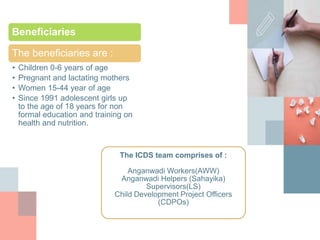
The ICDS team comprises of :
Anganwadi Workers(AWW)
Anganwadi Helpers (Sahayika)
Supervisors(LS)
Child Development Project Officers
(CDPOs)
Beneficiaries
The beneficiaries are :
• Children 0-6 years of age
• Pregnant and lactating mothers
• Women 15-44 year of age
• Since 1991 adolescent girls up
to the age of 18 years for non
formal education and training on
health and nutrition.
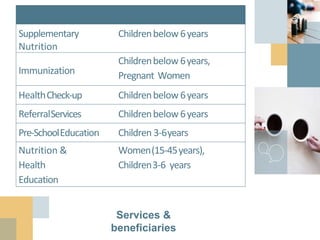
Services &
beneficiaries
Services TargetGroup
Supplementary
Nutrition
Childrenbelow 6years
Immunization
Childrenbelow 6years,
Pregnant Women
HealthCheck-up Childrenbelow 6years
ReferralServices Childrenbelow 6years
Pre-SchoolEducation Children 3-6years
Nutrition &
Health
Education
Women(15-45years),
Children3-6 years
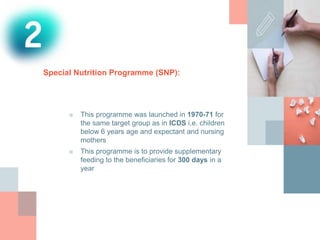
Special Nutrition Programme (SNP):
■ This programme was launched in 1970-71 for
the same target group as in ICDS i.e. children
below 6 years age and expectant and nursing
mothers
■ This programme is to provide supplementary
feeding to the beneficiaries for 300 days in a
year
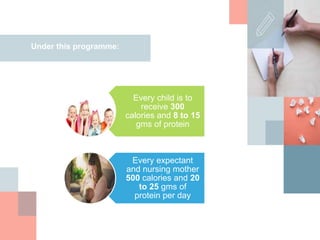
Under this programme:
Every child is to
receive 300
calories and 8 to 15
gms of protein
Every expectant
and nursing mother
500 calories and 20
to 25 gms of
protein per day
Objectives
The objectives of
the programme is to
improve the, nutritional of
preschool children,
pregnant and lactating
mothers of poor socio-
economic groups in urban
slums, tribal areas and
drought prone rural areas.
Balwadi Nutrition Programme:
■ Bal (children) wadi (home or centre)
■ The Balwadi Nutrition Programme (BNP) was started in
1970-71. It is operated through Balwadis and day-care
centers which are being run by the five national
voluntary organizations.
■ There are about five thousand Balwadis implementing
the programme. It is a non-expanding and non-plan
activity of the government of India.
■ A total number of 5641 Balwadi centers are
presently being run by the five organizations.
About 229 thousand children in the age group
3-5 years are covered under the programme.
Objectives :
The programme aims to
supply about one-third of the
calorie and half of the protein
requirements of the pre-school
child as measure to improve
nutritional and health status.
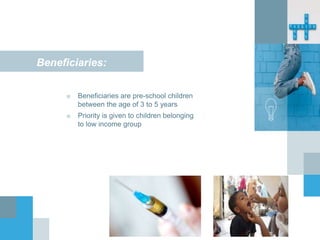
Beneficiaries:
■ Beneficiaries are pre-school children
between the age of 3 to 5 years
■ Priority is given to children belonging
to low income group
• The programme was launched in 1970 by the
ministry of health and family welfare.
• one objective to reduce the disease and
preventing blindness due to Vitamin A deficiency. It
was started with seven states with severe
problems later it was extended country.
Vitamin A Prophylaxis Programme :
■ The main objective was to decrease
the commonness of Vitamin A
deficiency from current 0.6% to ≤
0.5%.
■ The Main strategy was given to
provide health and nutrition education
to encourage colostrums feeding,
exclusive breastfeeding for the first six
months, the introduction of
complementary feeding thereafter and
adequate intake of Vitamin A rich
foods.
Objectives
Under this programme
Children aged 6 months to 6 years
were to be administered a mega dose
of vitamin A at 6 monthly intervals.
To prioritize Vitamin A administration,
the programme was revised to give 5
mega doses at 6 months intervals to
children 9 months to 3 years of age..
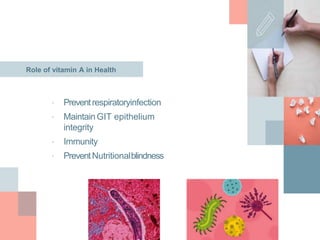
Role of vitamin A in Health
• Preventrespiratoryinfection
• MaintainGIT epithelium
integrity
• Immunity
• PreventNutritionalblindness
Prophylaxis against Nutritional Anemia :
• Initiated in1970
• Over 50%pregnant womansufferfrom anemia
• CausesLBWand perinatalmortality,maternal death
• Objectives:
• Assess prevalence,Give treatment, Monitoring,Education
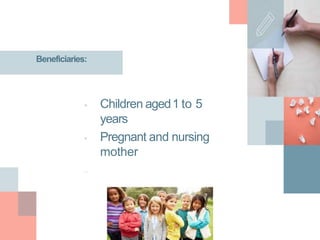
Beneficiaries:
 Children aged1 to 5
years
 Pregnant and nursing
mother
– Femaleacceptor of
terminal method of
family planning and
IUDS
Dosage of tablets:
Pregnantwomen:
• 100mgFe& 0.5mgfolic acid
Children6to 60months:
• 20mgFe& 0.1mg folic acid
• Shouldbegiven100days
• Adolescentgirls:100mgFe& 0.5mgfolic
acid
• Children between 1 to5years
– Screeningtest for anemiadoneat 6mo,
1,2years
National Goitre Control Programme:
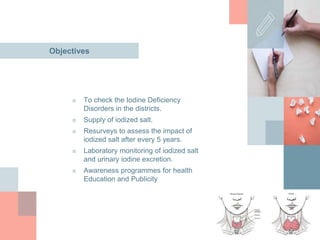
■ The Government of India launched a 100%
centrally assisted National Goitre Control
Programme (NGCP) in 1962.
■ In August 1992 the National Goitre Control
Programme (NGCP) was renamed as National
Iodine Deficiency Disorders Control
Programme
■ (NIDDCP) with a view of wide spectrum of
Iodine Deficiency Disorders like mental and
physical retardation, stillbirths, abortions etc.
The programme is being implemented in all the
States for entire population.
Objectives
■ To check the Iodine Deficiency
Disorders in the districts.
■ Supply of iodized salt.
■ Resurveys to assess the impact of
iodized salt after every 5 years.
■ Laboratory monitoring of iodized salt
and urinary iodine excretion.
■ Awareness programmes for health
Education and Publicity
Mid-Day Meal Programme:
■ The Mid-day Meal Scheme first
started in Tamilnadu. It is also known
as School Lunch Programme. This
programme was launched by Ministry
of Education in 1961.
Objectives
The aim of this scheme involves
■ The provision of free to school-
children on all working days
■ Protecting children from classroom
hunger;
■ Increasing school enrolment and
attendance
■ Improved socialisation among children
belonging to all castes
■ Addressing malnutrition, and social
empowerment through provision of
employment to women, reduce school
drops outs, and improve the
attendance.
References:
■ http://www.fao.org/3/x0172e/x0172e08.htm
■ Kapil, U., Chaturvedi, S. and Nayar, D. (1992)
‘National nutrition supplementation programmes.’,
Indian pediatrics, 29(12), pp. 1601–1613.
■ Maurya, N. K. and Kushwaha, R. (2018) ‘National
Nutrition Programmes in India Chapter - 2 National
Nutrition Programmes in India Authors Institute of
Home Science , Bundelkhand University , Jhansi ,
Uttar Pradesh , India Centre of Food Technology
University of Allahabad , Assistant Professor ’, (June
2019).
Community nutrition programs in india

Community nutrition programs in india

  • 1.
    Community Nutrition programs inIndia Presented by : Muzzammil Arif University of Lahore
  • 2.
    Contents: ■ Integrated ChildDevelopment Services Scheme ■ Special Nutrition Programme (SNP) ■ National Nutritional Anemia Prophylaxis Programme ■ National Iodine Deficiency Disorders Control Programme ■ National Goitre Control Programme ■ Mid Day meal programme ■ Applied Nutrition Programme
  • 3.
    Integrated Child Development ServicesScheme (ICDSS) ■ Launched on 2nd October 1975. One of the world’s largest and most unique programmes for early childhood development. ■ India’s response to the challenge of Providing pre-school education on one hand and, breaking the vicious cycle of malnutrition, morbidity, reduced learning capacity and mortality
  • 4.
    Objectives: ■ To improvethe nutritional and health status of children in the age group 0-6 years ■ To lay the foundation for proper psychological, physical and social development of the child ■ To reduce the incidence of mortality, morbidity, malnutrition and school drop out; ■ To regulate effective coordination of policy and programme implementation amongst various departments to promote child development ■ To enhance the capability of the mother through proper nutrition education for taking care of the normal health and nutritional needs and health of the child
  • 5.
    The ICDS teamcomprises of : Anganwadi Workers(AWW) Anganwadi Helpers (Sahayika) Supervisors(LS) Child Development Project Officers (CDPOs) Beneficiaries The beneficiaries are : • Children 0-6 years of age • Pregnant and lactating mothers • Women 15-44 year of age • Since 1991 adolescent girls up to the age of 18 years for non formal education and training on health and nutrition.
  • 6.
    Services & beneficiaries Services TargetGroup Supplementary Nutrition Childrenbelow6years Immunization Childrenbelow 6years, Pregnant Women HealthCheck-up Childrenbelow 6years ReferralServices Childrenbelow 6years Pre-SchoolEducation Children 3-6years Nutrition & Health Education Women(15-45years), Children3-6 years
  • 7.
    Special Nutrition Programme(SNP): ■ This programme was launched in 1970-71 for the same target group as in ICDS i.e. children below 6 years age and expectant and nursing mothers ■ This programme is to provide supplementary feeding to the beneficiaries for 300 days in a year
  • 8.
    Under this programme: Everychild is to receive 300 calories and 8 to 15 gms of protein Every expectant and nursing mother 500 calories and 20 to 25 gms of protein per day
  • 9.
    Objectives The objectives of theprogramme is to improve the, nutritional of preschool children, pregnant and lactating mothers of poor socio- economic groups in urban slums, tribal areas and drought prone rural areas.
  • 10.
    Balwadi Nutrition Programme: ■Bal (children) wadi (home or centre) ■ The Balwadi Nutrition Programme (BNP) was started in 1970-71. It is operated through Balwadis and day-care centers which are being run by the five national voluntary organizations. ■ There are about five thousand Balwadis implementing the programme. It is a non-expanding and non-plan activity of the government of India.
  • 11.
    ■ A totalnumber of 5641 Balwadi centers are presently being run by the five organizations. About 229 thousand children in the age group 3-5 years are covered under the programme.
  • 12.
    Objectives : The programmeaims to supply about one-third of the calorie and half of the protein requirements of the pre-school child as measure to improve nutritional and health status.
  • 13.
    Beneficiaries: ■ Beneficiaries arepre-school children between the age of 3 to 5 years ■ Priority is given to children belonging to low income group
  • 14.
    • The programmewas launched in 1970 by the ministry of health and family welfare. • one objective to reduce the disease and preventing blindness due to Vitamin A deficiency. It was started with seven states with severe problems later it was extended country. Vitamin A Prophylaxis Programme :
  • 15.
    ■ The mainobjective was to decrease the commonness of Vitamin A deficiency from current 0.6% to ≤ 0.5%. ■ The Main strategy was given to provide health and nutrition education to encourage colostrums feeding, exclusive breastfeeding for the first six months, the introduction of complementary feeding thereafter and adequate intake of Vitamin A rich foods. Objectives
  • 16.
    Under this programme Childrenaged 6 months to 6 years were to be administered a mega dose of vitamin A at 6 monthly intervals. To prioritize Vitamin A administration, the programme was revised to give 5 mega doses at 6 months intervals to children 9 months to 3 years of age..
  • 17.
    Role of vitaminA in Health • Preventrespiratoryinfection • MaintainGIT epithelium integrity • Immunity • PreventNutritionalblindness
  • 18.
    Prophylaxis against NutritionalAnemia : • Initiated in1970 • Over 50%pregnant womansufferfrom anemia • CausesLBWand perinatalmortality,maternal death • Objectives: • Assess prevalence,Give treatment, Monitoring,Education
  • 19.
    Beneficiaries:  Children aged1to 5 years  Pregnant and nursing mother – Femaleacceptor of terminal method of family planning and IUDS
  • 20.
    Dosage of tablets: Pregnantwomen: •100mgFe& 0.5mgfolic acid Children6to 60months: • 20mgFe& 0.1mg folic acid • Shouldbegiven100days • Adolescentgirls:100mgFe& 0.5mgfolic acid • Children between 1 to5years – Screeningtest for anemiadoneat 6mo, 1,2years
  • 21.
    National Goitre ControlProgramme: ■ The Government of India launched a 100% centrally assisted National Goitre Control Programme (NGCP) in 1962. ■ In August 1992 the National Goitre Control Programme (NGCP) was renamed as National Iodine Deficiency Disorders Control Programme ■ (NIDDCP) with a view of wide spectrum of Iodine Deficiency Disorders like mental and physical retardation, stillbirths, abortions etc. The programme is being implemented in all the States for entire population.
  • 22.
    Objectives ■ To checkthe Iodine Deficiency Disorders in the districts. ■ Supply of iodized salt. ■ Resurveys to assess the impact of iodized salt after every 5 years. ■ Laboratory monitoring of iodized salt and urinary iodine excretion. ■ Awareness programmes for health Education and Publicity
  • 23.
    Mid-Day Meal Programme: ■The Mid-day Meal Scheme first started in Tamilnadu. It is also known as School Lunch Programme. This programme was launched by Ministry of Education in 1961.
  • 24.
    Objectives The aim ofthis scheme involves ■ The provision of free to school- children on all working days ■ Protecting children from classroom hunger; ■ Increasing school enrolment and attendance ■ Improved socialisation among children belonging to all castes ■ Addressing malnutrition, and social empowerment through provision of employment to women, reduce school drops outs, and improve the attendance.
  • 25.
    References: ■ http://www.fao.org/3/x0172e/x0172e08.htm ■ Kapil,U., Chaturvedi, S. and Nayar, D. (1992) ‘National nutrition supplementation programmes.’, Indian pediatrics, 29(12), pp. 1601–1613. ■ Maurya, N. K. and Kushwaha, R. (2018) ‘National Nutrition Programmes in India Chapter - 2 National Nutrition Programmes in India Authors Institute of Home Science , Bundelkhand University , Jhansi , Uttar Pradesh , India Centre of Food Technology University of Allahabad , Assistant Professor ’, (June 2019).

Editor's Notes

  • #11 namely, Indian Council for Child Welfare, Harijan (Scheduled Castes) Sevak (Service) Sangh (Board), Bhartiya (Indian) Adimjati (Scheduled Tribe) Sevak Sangh and Kasturba (wife of Mahatma Gandhi) National Memorial Trust.
  • #22 The Government of India launched a 100% centrally assisted National Goitre Control Programme (NGCP) in 1962. In August 1992 the National Goitre Control Programme (NGCP) was renamed as National Iodine Deficiency Disorders Control Programme (NIDDCP) with a view of wide spectrum of Iodine Deficiency Disorders like mental and physical retardation, deaf-mutism, cretinism, stillbirths, abortions etc. The programme is being implemented in all the States/UTs for entire population.