NATIONAL NUTRITIONAL PROGRAMMES
Presented by,
Roll no. 61 & 109
INTRODUCTION
 Nutrition may be defined as the science of food and its
relationship to health which helps in body growth,
development and maintenance.
 The Government of India have initiated several large scale
supplementary feeding programmes, and programmes aimed
at overcoming specific deficiency diseases through various
Ministries to combat malnutrition.
NUTRITIONAL CELL
 It is in the Directorate General of Health Services and provides
technical advice in all matters related to the nutrition.
 These include policy decision, programme planning,
implementation and evaluation; training content for different
levels of medical, nursing and paramedical personnel, standards
and labels for foods, proposals, project evaluation, hospital diet
etc.
 It is working on creating awareness through dissemination of
various types of IEC materials.
 Coordinates with State Nutrition Division which conduct diet and
nutrition surveys, imparting training of health personnel who are
involved in the programmes.
 Appraisal of several research projects on subjects such as
fluorosis, arsenic toxicity, maternal micro nutrient status, street
food management, were taken up.
VITAMIN A
PROPHYLAXIS PROGRAMME
VITAMIN A PROPHYLAXIS PROGRAMME
 Launched by- Ministry of Health and Family Welfare
 Launched in - 1970
 Beneficiaries- all pregnant and lactating women and children under
5 years of age
Vitamin A is an important for maintaining normal growth, regulating
cellular proliferation and differentiation, controlling development, and
maintaining visual and reproductive functions.
OBJECTIVES
 Promoting consumption of vitamin A rich food.
 Creating awareness of preventingVitamin A deficiency.
Treatment of children with xerophthalmia.
Treatment of children having measles’
PROPHYLAXIS
AGAINST
NUTRITIONA ANEMIA
PROPHYLAXIS AGAINST NUTRITIONAL
ANEMIA
 Prevalence of nutritional anemia in India
 65% - infant and toddlers
 60% - (1-6 ) years of age
 88% - adolescent girls
 (3.3% has hemoglobin <7 gm./dl; severe anemia)
 85% - pregnant women (9.9% having severe anemia)
 Higher in lactating women as compared to pregnancy.
 The commonest is iron deficiency anemia
Launched in - 1970 during the fourth Five Year Plan
 Beneficiaries - the expected and nursing mothers,acceptors
of family planning and children.
 Dosage : Adults - one tablet of iron and folic acid (100 mg
elementary iron and 0.5 mg of folic acid.)for 100 days.
 Children - (1-5 years)- one tablet of iron (20 mg elementary
iron ,60 mg of ferrous sulphate and 0.1 mg of folic acid)
daily for a period of 100 days.
 Taken by Maternal and Child Health (MCH), Division of
MoHFW,Now it is part of RCH programme.
 Iron fortification of common salt has also been developed .
WEEKLY IRON FOLIC ACID SUPPLEMENTATION:
 Launched by -Ministry of Health and Family Welfare
 Goal - meet the high prevalence and incidence of anaemia
amongst adolescent girls and boys.
 Long term goal is to break the intergenerational cycle of anaemia,
 Short term benefits is of a nutritionally improved human capital.
 Implementation - By supervised weekly ingestion of IFA
supplementation and biannual helminthic control.
IODINE DEFICIENCY DISORDERS
CONTROL PROGRAMME
IODINE DEFICIENCY DISORDERS
CONTROL PROGRAMME
 Launched by -Government of India
 Launched in - 1962
 Objective -
i. Identification of the goitre in endemic areas
ii. Supply iodized salt in place of common salt
iii. Assess the impact of goitre control measures over time.
 A major national programme was mounted in 1986 to replace the
entire edible salt by iodide salt, in a phase - the IDD Control
manner by 1992 .
 Ban of non iodised salt under PFA act (1954).
SPECIAL NUTRITION
PROGRAMME
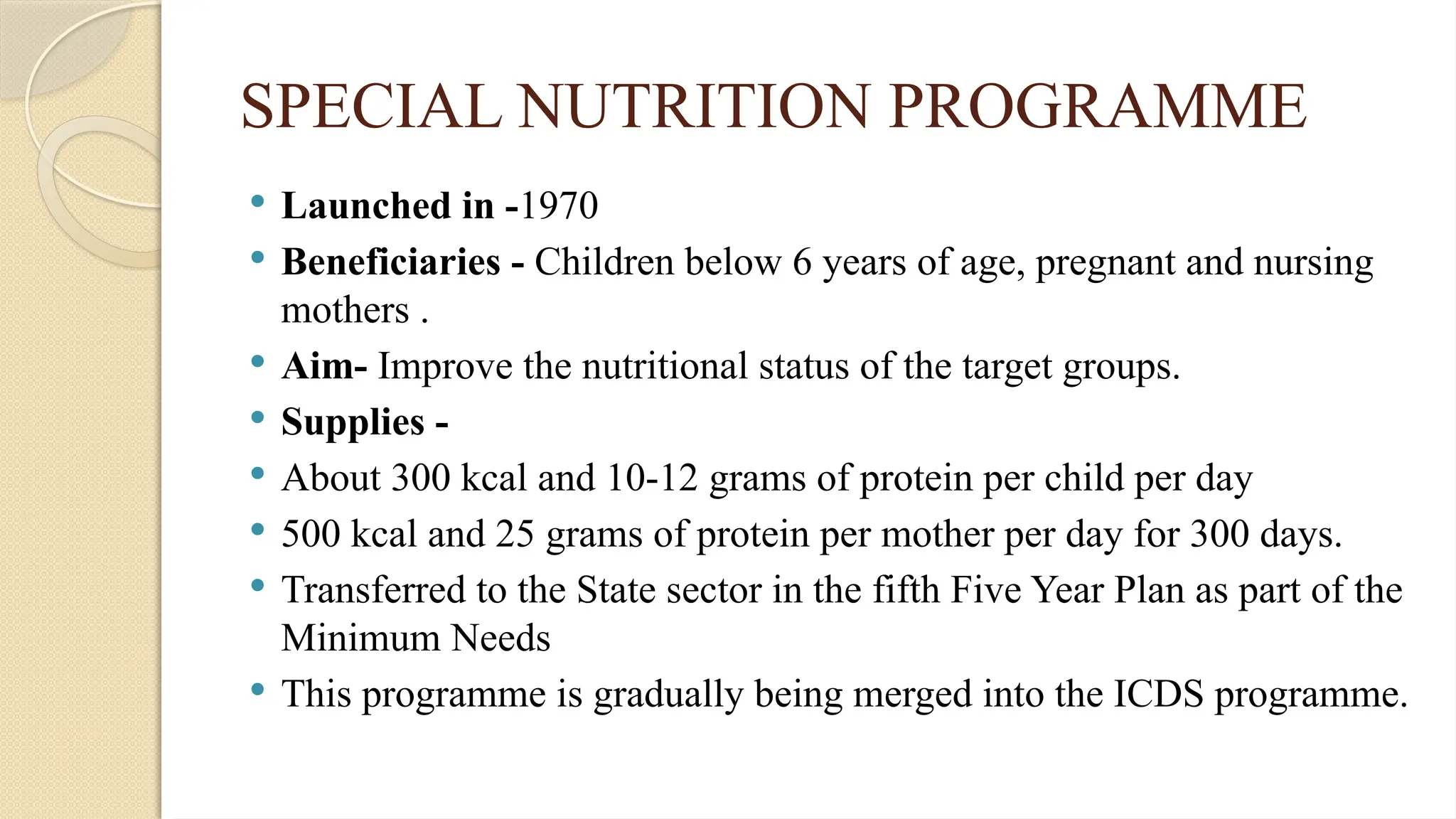
SPECIAL NUTRITION PROGRAMME
 Launched in -1970
 Beneficiaries - Children below 6 years of age, pregnant and nursing
mothers .
 Aim- Improve the nutritional status of the target groups.
 Supplies -
 About 300 kcal and 10-12 grams of protein per child per day
 500 kcal and 25 grams of protein per mother per day for 300 days.
 Transferred to the State sector in the fifth Five Year Plan as part of the
Minimum Needs
 This programme is gradually being merged into the ICDS programme.
BALWADI NUTRITION
PROGRAMME
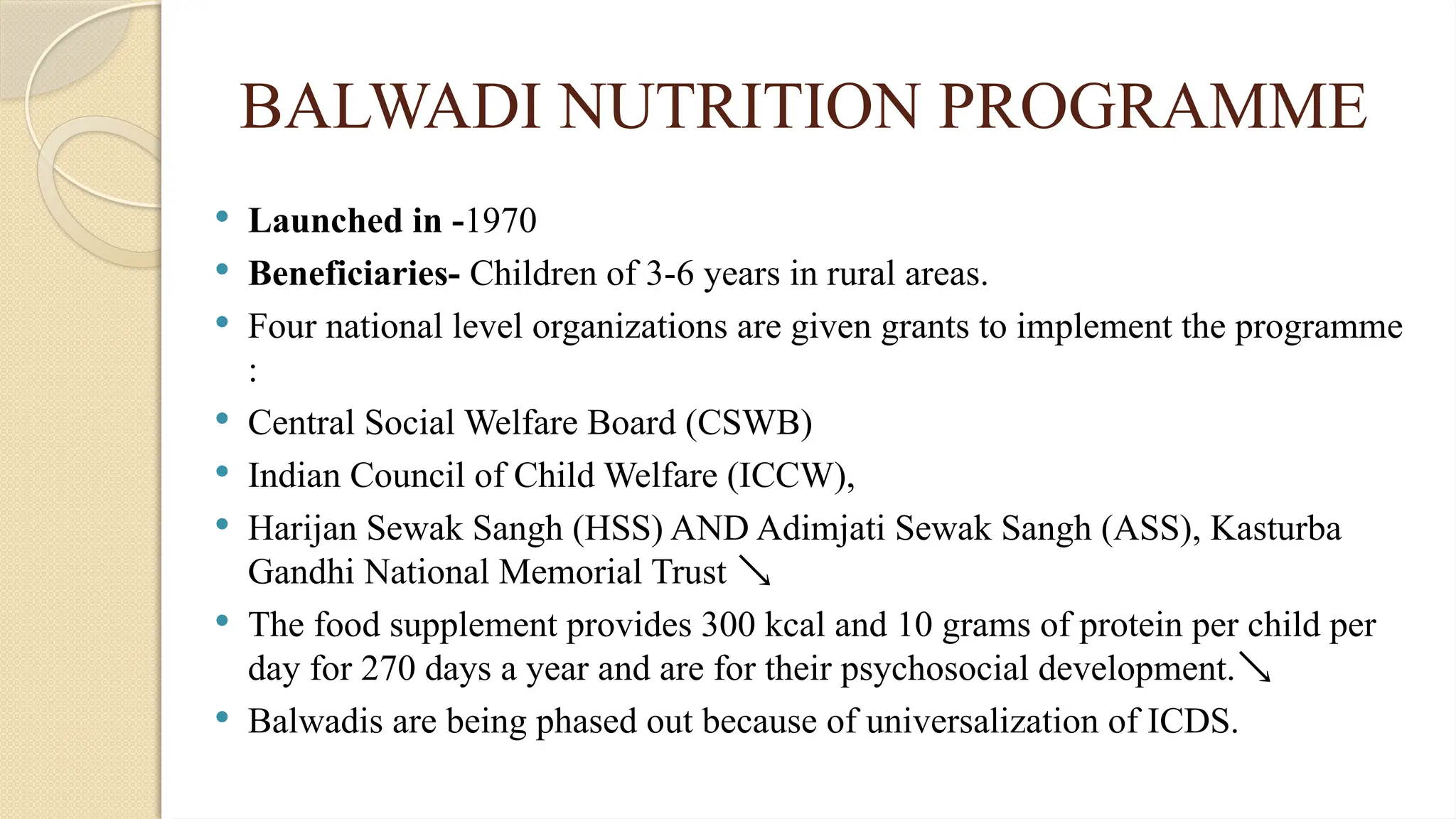
BALWADI NUTRITION PROGRAMME
 Launched in -1970
 Beneficiaries- Children of 3-6 years in rural areas.
 Four national level organizations are given grants to implement the programme
:
 Central Social Welfare Board (CSWB)
 Indian Council of Child Welfare (ICCW),
 Harijan Sewak Sangh (HSS) AND Adimjati Sewak Sangh (ASS), Kasturba
Gandhi National Memorial Trust 
 The food supplement provides 300 kcal and 10 grams of protein per child per
day for 270 days a year and are for their psychosocial development.
 Balwadis are being phased out because of universalization of ICDS.
MID-DAY MEAL
PROGRAMME
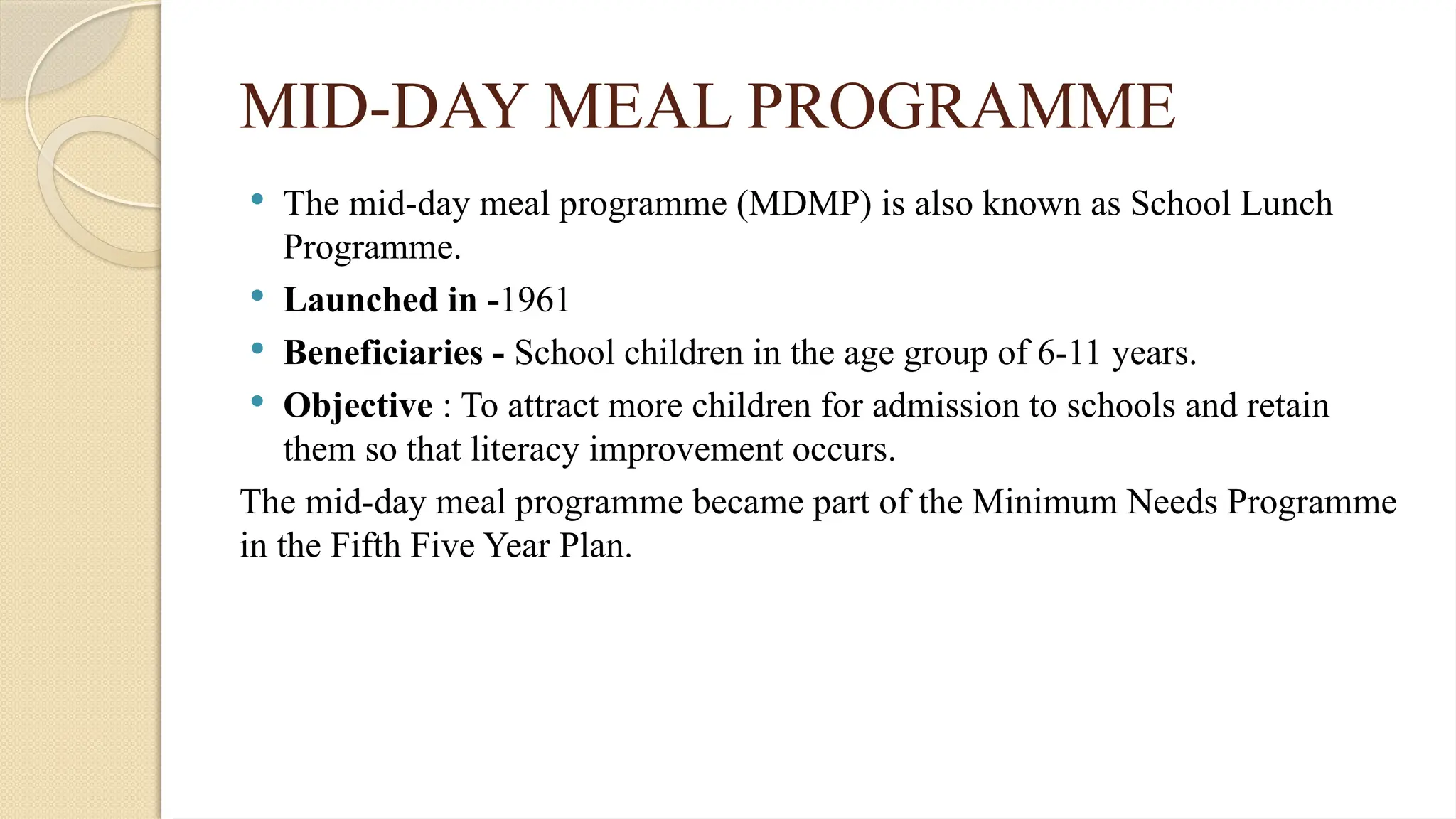
MID-DAY MEAL PROGRAMME
 The mid-day meal programme (MDMP) is also known as School Lunch
Programme.
 Launched in -1961
 Beneficiaries - School children in the age group of 6-11 years.
 Objective : To attract more children for admission to schools and retain
them so that literacy improvement occurs.
The mid-day meal programme became part of the Minimum Needs Programme
in the Fifth Five Year Plan.
Principles of Mid day meal :
(a)the meal should be a supplement and not a substitute to the home diet.
(b) the meal should supply at least one-third of the total energy requirement, and half of
the protein need i.e. about 300 kcal and 8-12 gms of protein per/day/student. This is
provided for 200 days in a year.
(c) the cost of the meal should be reasonably low.
(d) the meal should be such that it can be prepared easily in schools.
(e) planning nutritious menu using locally available food stuffs, food, hygiene, food
habits etc.
The important goals to be accomplished are:
a. reorientation of eating habits;
b. incorporating nutrition education into the curriculum;
c. encouraging the use of local commodities;
d. improving school attendance as we to educational performance of the pupils.

MID-DAY MEAL SCHEME
Also known as National Programme of Nutritional Support to Primary Education.
Launched on - 5th August 1995 and revised in 2004.
Objective -Universalization of primary education by increasing enrolment, retention and
attendance and simultaneously impacting on nutrition of students in primary classes.
It was implemented in 2,408 blocks in the first year and covered the whole country in a
phased manner by 1997-98.
 The programme originally covered children of primary stage (classes I to V) extended
in Oct. 2002.
 The central assistance - free supply of food grain from nearest Food Corporation of
India godown at the rate of 100 g. per student per day and subsidy for transport of food
grain.
 To achieve the objective, a cooked mid-day meal with minimum 300 Calories and 8 to
12 grammes of protein content will be provided to all the children in class I to V.
Some suggesstions:
a)Food grains stored away from moisture, to avoid infestation.
b)Use whole wheat or broken wheat (dalia) .
c)'Single Dish Meals' using broken wheat or rice and incorporating some
amount of a pulse or soyabeans, a seasonal vegetable/green leafy
vegetable, and some amount of edible oil will save both time and fuel.
d)Cereal pulse combination is necessary to have good quality protein. The
cereal pulse ratio could range from 3:1 to 5:1.
e)Sprouted pulses have more nutrients and should be incorporated in
single dish meals.
f) Leafy vegetables should be washed before cutting and should not be subjected to washing
after cutting.
g)Soaking of rice, dal, bengal gram etc. reduces cooking time.
h)Wash the grains thoroughly and soak in just sufficient amount of water required for cooking.
i)Rice water if left after cooking should be mixed with dal if these are cooked separately and
should never be thrown away. Fermentation improves nutritive value. Preparation of idli,
dosa, dhokla etc. may be encouraged.
j)Cooking must be done with the lid on to avoid loss of nutrients. Over cooking should be
avoided.
k)Reheating of oil used for frying is harmful and should be avoided.
l)Leafy tops of carrots, radish, turnips etc. should not be thrown but utilized in preparing mid-
day meals.
m)Only 'iodized salt" should be used for cooking mid-day meals.
POSHAN ABHIYAN
POSHAN ABHIYAN (Prime Minister’s Overarching
Scheme for Holistic Nutrition)
 Launched by -Government of India
 Launche on - 8 march 2018 for a period of three years in all 36 states/UTs.
 It was earlier known as national nutrition mission.
 Goals -Improvement in nutritional status of children from 0-6 years, adolescent girls,
pregnant women and lactating mothers with fixed targets.
 It ensures convergence of various programmes i,e anganwadi services, Pradhan Mantri
Matru Vandana Yojana; Janani Suraksha Yojana; National Health Mission; Swachh Bharat
Mission of Ministry
 Month of September 2018 was celebrated as Rashtriya POSHAN Maah.
 The activities in POSHAN Maah focussed on Social Behavioural Change and
Communication (SBCC). The broad themes were: antenatal care, optimal breastfeeding
(early and exclusive), complementary feeding, anaemia, growth monitoring, girls’ -
education, diet, right age of marriage, hygiene and sanitation, eating healthy - food
fortification.
Objectives and targets are as follows :
1.Prevent and reduce stunting in children (0-6 years) by 6 percent.
2. Prevent and reduce under nutrition and underweight prevalence in
children(0-6 years) by 6 percent.
3. Reduce the prevalence of anaemia among children (6-59 months)
by 9 percent.
4. Reduce the prevalence of anaemia among girls and women in the
age group (15-49 years) by 9 percent.
5. Reduce low birth weight by 6 percent.
Presentationon. National nutrition programme.pptx

Presentationon. National nutrition programme.pptx

  • 1.
  • 2.
    INTRODUCTION  Nutrition maybe defined as the science of food and its relationship to health which helps in body growth, development and maintenance.  The Government of India have initiated several large scale supplementary feeding programmes, and programmes aimed at overcoming specific deficiency diseases through various Ministries to combat malnutrition.
  • 3.
    NUTRITIONAL CELL  Itis in the Directorate General of Health Services and provides technical advice in all matters related to the nutrition.  These include policy decision, programme planning, implementation and evaluation; training content for different levels of medical, nursing and paramedical personnel, standards and labels for foods, proposals, project evaluation, hospital diet etc.
  • 4.
     It isworking on creating awareness through dissemination of various types of IEC materials.  Coordinates with State Nutrition Division which conduct diet and nutrition surveys, imparting training of health personnel who are involved in the programmes.  Appraisal of several research projects on subjects such as fluorosis, arsenic toxicity, maternal micro nutrient status, street food management, were taken up.
  • 6.
  • 7.
    VITAMIN A PROPHYLAXISPROGRAMME  Launched by- Ministry of Health and Family Welfare  Launched in - 1970  Beneficiaries- all pregnant and lactating women and children under 5 years of age Vitamin A is an important for maintaining normal growth, regulating cellular proliferation and differentiation, controlling development, and maintaining visual and reproductive functions.
  • 8.
    OBJECTIVES  Promoting consumptionof vitamin A rich food.  Creating awareness of preventingVitamin A deficiency. Treatment of children with xerophthalmia. Treatment of children having measles’
  • 9.
  • 10.
    PROPHYLAXIS AGAINST NUTRITIONAL ANEMIA Prevalence of nutritional anemia in India  65% - infant and toddlers  60% - (1-6 ) years of age  88% - adolescent girls  (3.3% has hemoglobin <7 gm./dl; severe anemia)  85% - pregnant women (9.9% having severe anemia)  Higher in lactating women as compared to pregnancy.  The commonest is iron deficiency anemia
  • 11.
    Launched in -1970 during the fourth Five Year Plan  Beneficiaries - the expected and nursing mothers,acceptors of family planning and children.  Dosage : Adults - one tablet of iron and folic acid (100 mg elementary iron and 0.5 mg of folic acid.)for 100 days.  Children - (1-5 years)- one tablet of iron (20 mg elementary iron ,60 mg of ferrous sulphate and 0.1 mg of folic acid) daily for a period of 100 days.  Taken by Maternal and Child Health (MCH), Division of MoHFW,Now it is part of RCH programme.  Iron fortification of common salt has also been developed .
  • 12.
    WEEKLY IRON FOLICACID SUPPLEMENTATION:  Launched by -Ministry of Health and Family Welfare  Goal - meet the high prevalence and incidence of anaemia amongst adolescent girls and boys.  Long term goal is to break the intergenerational cycle of anaemia,  Short term benefits is of a nutritionally improved human capital.  Implementation - By supervised weekly ingestion of IFA supplementation and biannual helminthic control.
  • 13.
  • 14.
    IODINE DEFICIENCY DISORDERS CONTROLPROGRAMME  Launched by -Government of India  Launched in - 1962  Objective - i. Identification of the goitre in endemic areas ii. Supply iodized salt in place of common salt iii. Assess the impact of goitre control measures over time.  A major national programme was mounted in 1986 to replace the entire edible salt by iodide salt, in a phase - the IDD Control manner by 1992 .  Ban of non iodised salt under PFA act (1954).
  • 15.
  • 16.
    SPECIAL NUTRITION PROGRAMME Launched in -1970  Beneficiaries - Children below 6 years of age, pregnant and nursing mothers .  Aim- Improve the nutritional status of the target groups.  Supplies -  About 300 kcal and 10-12 grams of protein per child per day  500 kcal and 25 grams of protein per mother per day for 300 days.  Transferred to the State sector in the fifth Five Year Plan as part of the Minimum Needs  This programme is gradually being merged into the ICDS programme.
  • 17.
  • 18.
    BALWADI NUTRITION PROGRAMME Launched in -1970  Beneficiaries- Children of 3-6 years in rural areas.  Four national level organizations are given grants to implement the programme :  Central Social Welfare Board (CSWB)  Indian Council of Child Welfare (ICCW),  Harijan Sewak Sangh (HSS) AND Adimjati Sewak Sangh (ASS), Kasturba Gandhi National Memorial Trust   The food supplement provides 300 kcal and 10 grams of protein per child per day for 270 days a year and are for their psychosocial development.  Balwadis are being phased out because of universalization of ICDS.
  • 19.
  • 20.
    MID-DAY MEAL PROGRAMME The mid-day meal programme (MDMP) is also known as School Lunch Programme.  Launched in -1961  Beneficiaries - School children in the age group of 6-11 years.  Objective : To attract more children for admission to schools and retain them so that literacy improvement occurs. The mid-day meal programme became part of the Minimum Needs Programme in the Fifth Five Year Plan.
  • 21.
    Principles of Midday meal : (a)the meal should be a supplement and not a substitute to the home diet. (b) the meal should supply at least one-third of the total energy requirement, and half of the protein need i.e. about 300 kcal and 8-12 gms of protein per/day/student. This is provided for 200 days in a year. (c) the cost of the meal should be reasonably low. (d) the meal should be such that it can be prepared easily in schools. (e) planning nutritious menu using locally available food stuffs, food, hygiene, food habits etc. The important goals to be accomplished are: a. reorientation of eating habits; b. incorporating nutrition education into the curriculum; c. encouraging the use of local commodities; d. improving school attendance as we to educational performance of the pupils. 
  • 23.
    MID-DAY MEAL SCHEME Alsoknown as National Programme of Nutritional Support to Primary Education. Launched on - 5th August 1995 and revised in 2004. Objective -Universalization of primary education by increasing enrolment, retention and attendance and simultaneously impacting on nutrition of students in primary classes. It was implemented in 2,408 blocks in the first year and covered the whole country in a phased manner by 1997-98.  The programme originally covered children of primary stage (classes I to V) extended in Oct. 2002.  The central assistance - free supply of food grain from nearest Food Corporation of India godown at the rate of 100 g. per student per day and subsidy for transport of food grain.  To achieve the objective, a cooked mid-day meal with minimum 300 Calories and 8 to 12 grammes of protein content will be provided to all the children in class I to V.
  • 24.
    Some suggesstions: a)Food grainsstored away from moisture, to avoid infestation. b)Use whole wheat or broken wheat (dalia) . c)'Single Dish Meals' using broken wheat or rice and incorporating some amount of a pulse or soyabeans, a seasonal vegetable/green leafy vegetable, and some amount of edible oil will save both time and fuel. d)Cereal pulse combination is necessary to have good quality protein. The cereal pulse ratio could range from 3:1 to 5:1. e)Sprouted pulses have more nutrients and should be incorporated in single dish meals.
  • 25.
    f) Leafy vegetablesshould be washed before cutting and should not be subjected to washing after cutting. g)Soaking of rice, dal, bengal gram etc. reduces cooking time. h)Wash the grains thoroughly and soak in just sufficient amount of water required for cooking. i)Rice water if left after cooking should be mixed with dal if these are cooked separately and should never be thrown away. Fermentation improves nutritive value. Preparation of idli, dosa, dhokla etc. may be encouraged. j)Cooking must be done with the lid on to avoid loss of nutrients. Over cooking should be avoided. k)Reheating of oil used for frying is harmful and should be avoided. l)Leafy tops of carrots, radish, turnips etc. should not be thrown but utilized in preparing mid- day meals. m)Only 'iodized salt" should be used for cooking mid-day meals.
  • 26.
  • 27.
    POSHAN ABHIYAN (PrimeMinister’s Overarching Scheme for Holistic Nutrition)  Launched by -Government of India  Launche on - 8 march 2018 for a period of three years in all 36 states/UTs.  It was earlier known as national nutrition mission.  Goals -Improvement in nutritional status of children from 0-6 years, adolescent girls, pregnant women and lactating mothers with fixed targets.  It ensures convergence of various programmes i,e anganwadi services, Pradhan Mantri Matru Vandana Yojana; Janani Suraksha Yojana; National Health Mission; Swachh Bharat Mission of Ministry  Month of September 2018 was celebrated as Rashtriya POSHAN Maah.  The activities in POSHAN Maah focussed on Social Behavioural Change and Communication (SBCC). The broad themes were: antenatal care, optimal breastfeeding (early and exclusive), complementary feeding, anaemia, growth monitoring, girls’ - education, diet, right age of marriage, hygiene and sanitation, eating healthy - food fortification.
  • 28.
    Objectives and targetsare as follows : 1.Prevent and reduce stunting in children (0-6 years) by 6 percent. 2. Prevent and reduce under nutrition and underweight prevalence in children(0-6 years) by 6 percent. 3. Reduce the prevalence of anaemia among children (6-59 months) by 9 percent. 4. Reduce the prevalence of anaemia among girls and women in the age group (15-49 years) by 9 percent. 5. Reduce low birth weight by 6 percent.