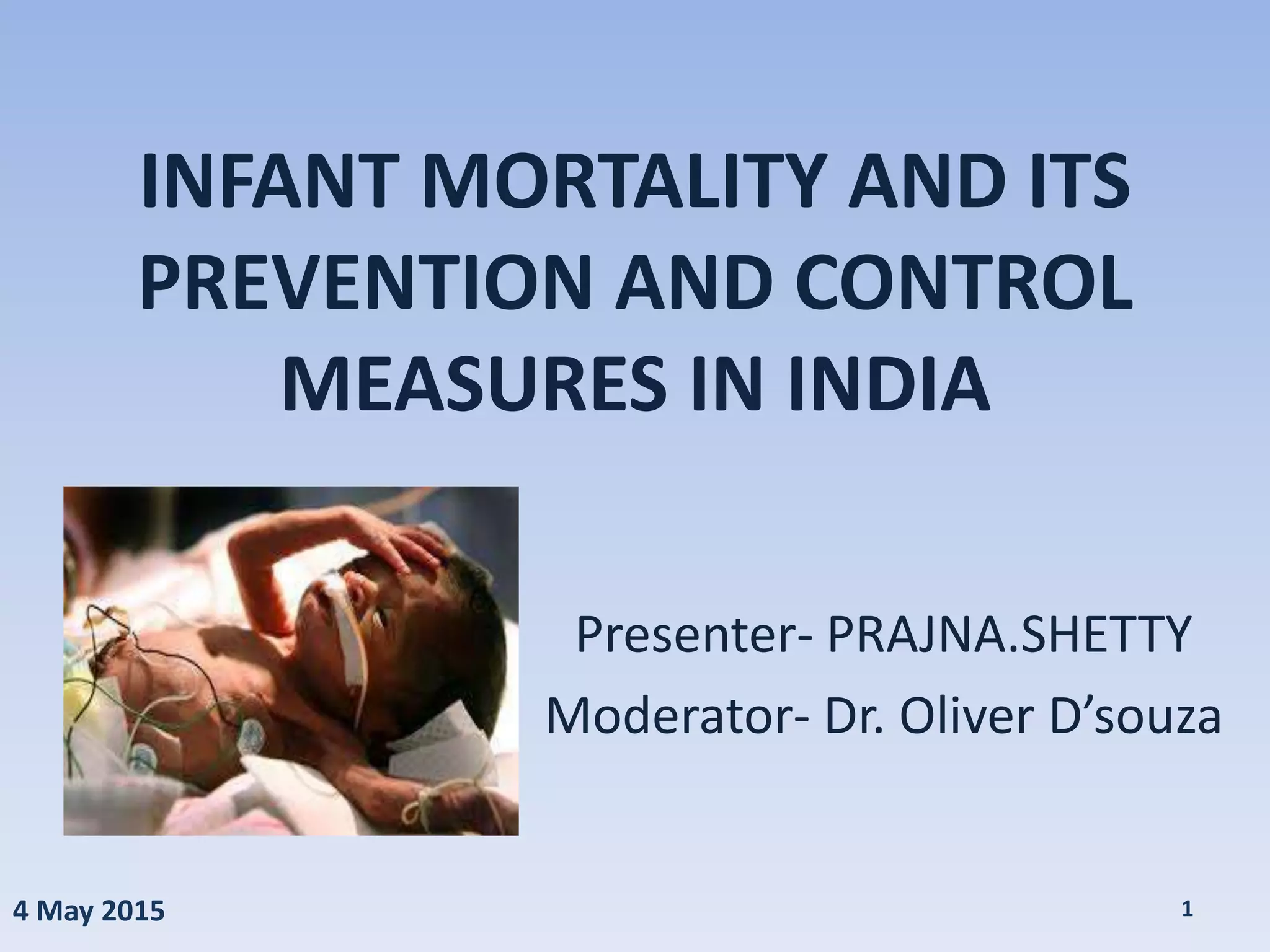
INFANT MORTALITY AND ITS
PREVENTION AND CONTROL
MEASURES IN INDIA
Presenter- PRAJNA.SHETTY
Moderator- Dr. Oliver D’souza
4 May 2015 1
INFANT MORTALITY RATE
- the ratio of infant deaths registered in a given
year to the total number of live births
registered in the same year; usually expressed
as a rate per 1000 live births.
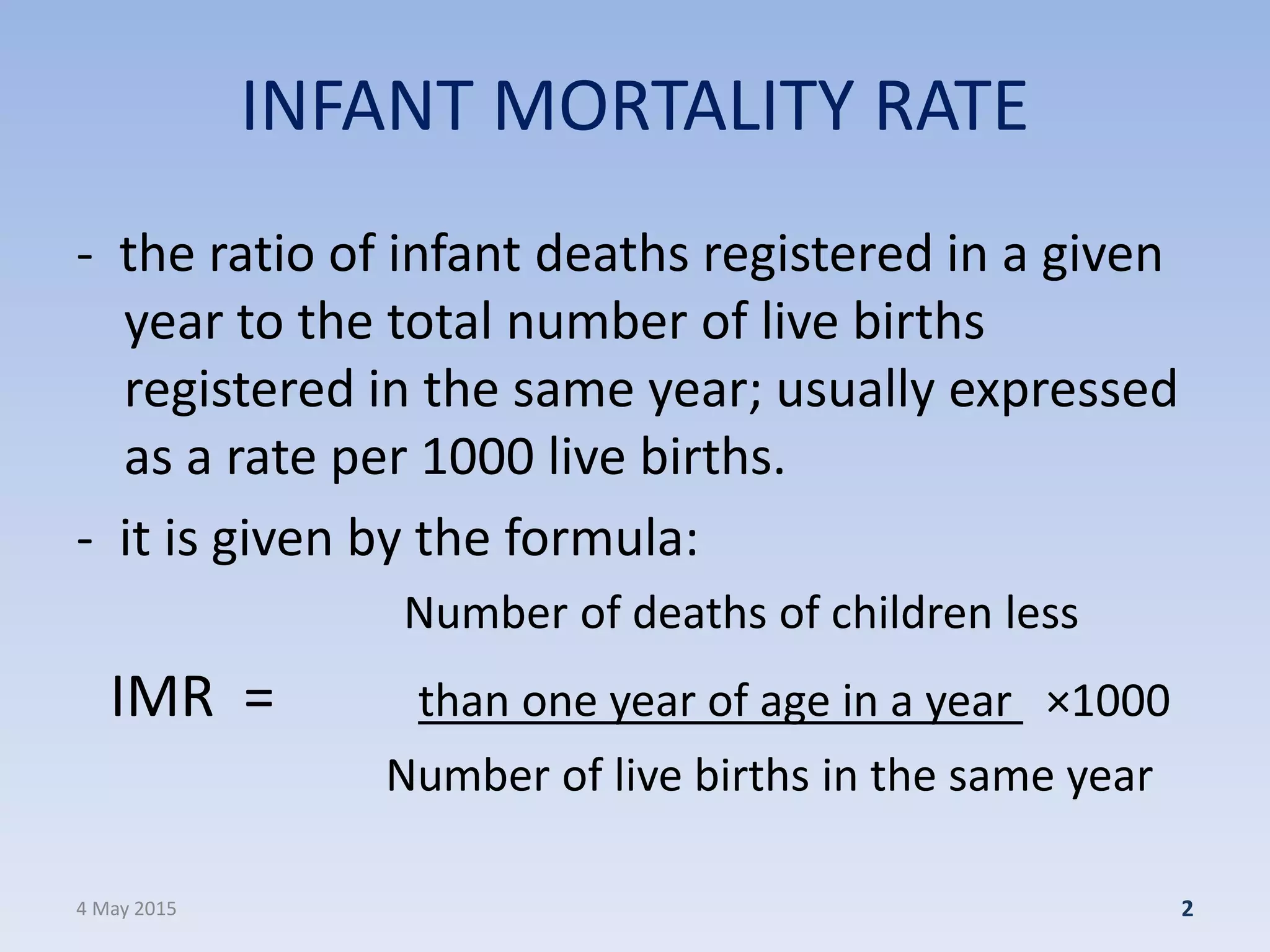
- it is given by the formula:
Number of deaths of children less
IMR = than one year of age in a year ×1000
Number of live births in the same year
4 May 2015 2
Infant mortality in India
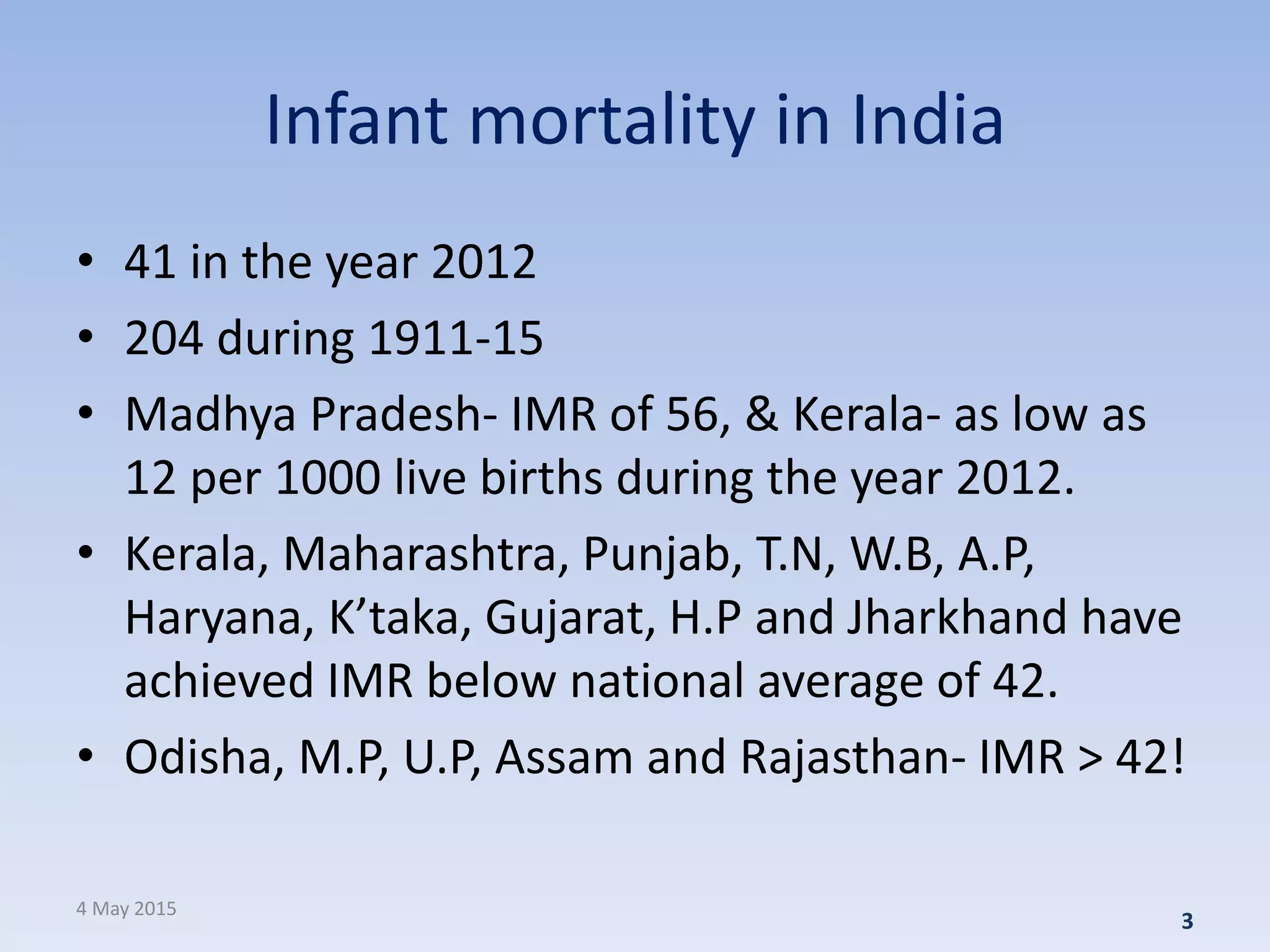
• 41 in the year 2012
• 204 during 1911-15
• Madhya Pradesh- IMR of 56, & Kerala- as low as
12 per 1000 live births during the year 2012.
• Kerala, Maharashtra, Punjab, T.N, W.B, A.P,
Haryana, K’taka, Gujarat, H.P and Jharkhand have
achieved IMR below national average of 42.
• Odisha, M.P, U.P, Assam and Rajasthan- IMR > 42!
4 May 2015
3
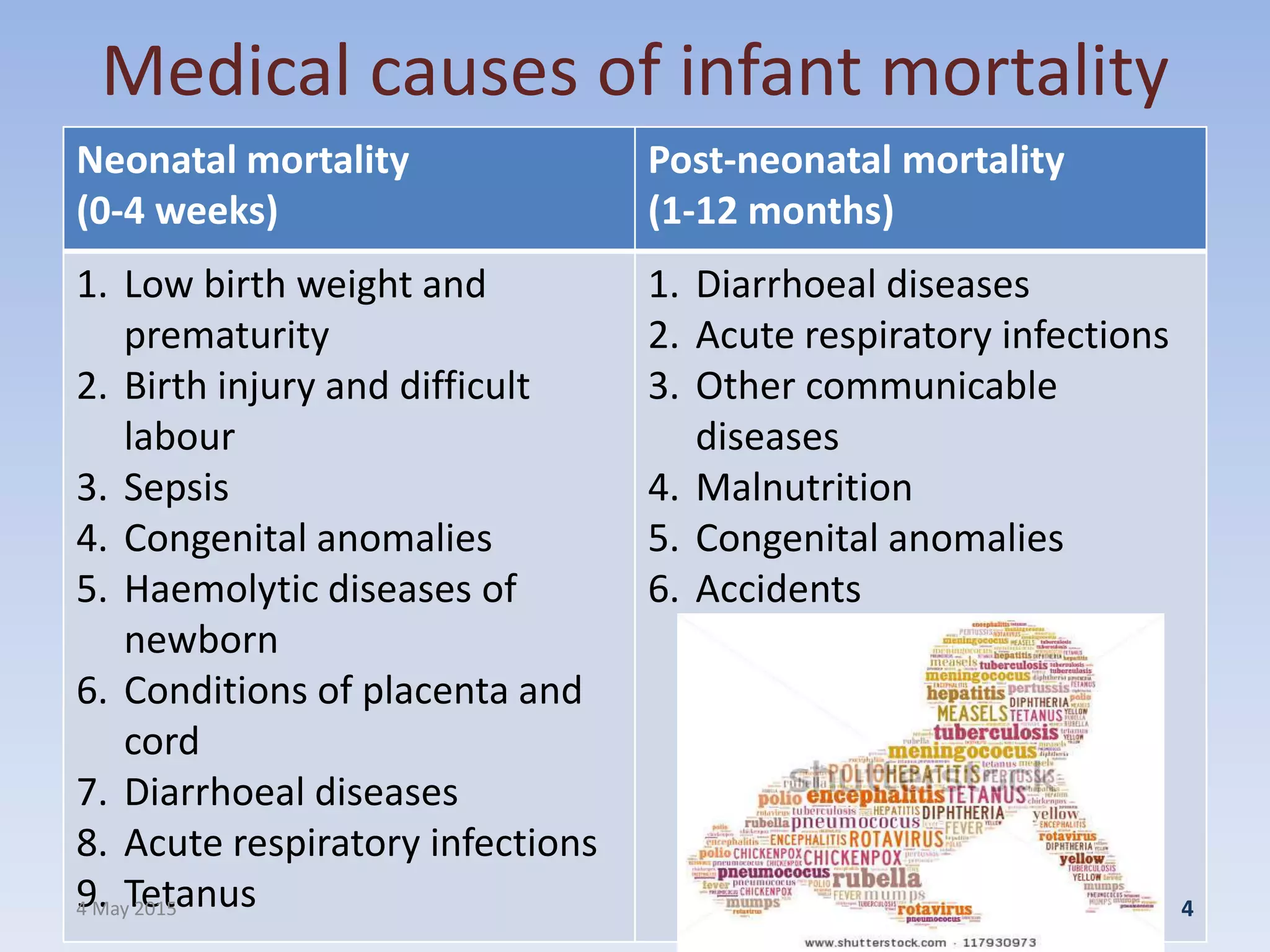
Medical causes of infant mortality
Neonatal mortality
(0-4 weeks)
Post-neonatal mortality
(1-12 months)
1. Low birth weight and
prematurity
2. Birth injury and difficult
labour
3. Sepsis
4. Congenital anomalies
5. Haemolytic diseases of
newborn
6. Conditions of placenta and
cord
7. Diarrhoeal diseases
8. Acute respiratory infections
9. Tetanus
1. Diarrhoeal diseases
2. Acute respiratory infections
3. Other communicable
diseases
4. Malnutrition
5. Congenital anomalies
6. Accidents
4 May 2015 4
Factors affecting Infant mortality
1. BIOLOGICAL FACTORS
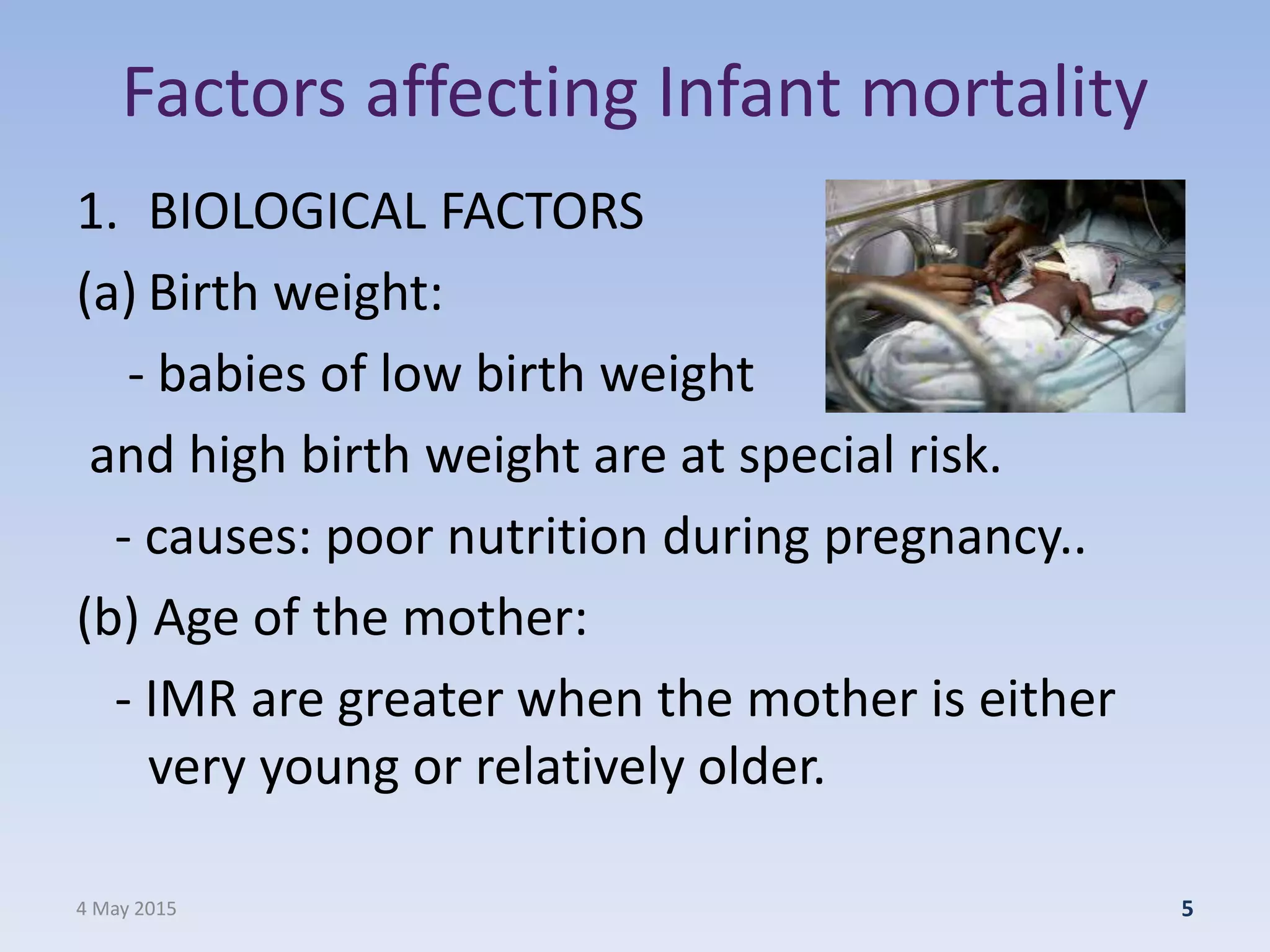
(a) Birth weight:
- babies of low birth weight
and high birth weight are at special risk.
- causes: poor nutrition during pregnancy..
(b) Age of the mother:
- IMR are greater when the mother is either
very young or relatively older.
4 May 2015 5
(c) Birth order
- the highest mortality is found among first
born, and the lowest among those born
second.
- The risk of infant mortality escalates after the
third birth.
- the fate of fifth and later children is always
worse than the fate of the 3rd child.
4 May 2015 6
(d) Birth spacing
- repeated pregnancies- malnutrition and
anaemia in the mother- predispose to LBW..
- prematurely weaned- PEM, diarrhoea and
dehydration.
(e) Multiple births
- Infants born in multiple births face a greater
risk of death than do those in single births due
to the greater frequency of low birth weight
among the former.
4 May 2015 7
(f) Family size
- the number of episodes of
infectious diarrhoea, prevalence of
malnutrition, and severe respiratory infections
have been found to increase with family size.
- fewer children-better maternal care, a better
share of family resources, less morbidity and
greatly decreased infant mortality.
4 May 2015 8
(g) High fertility
high fertility and high infant mortality go
together.
2. ECONOMIC FACTORS
The availability and quality of health care and
the nature of the child’s environment are
closely related to socio-economic status.
4 May 2015 9
3. CULTURAL AND SOCIAL
FACTORS
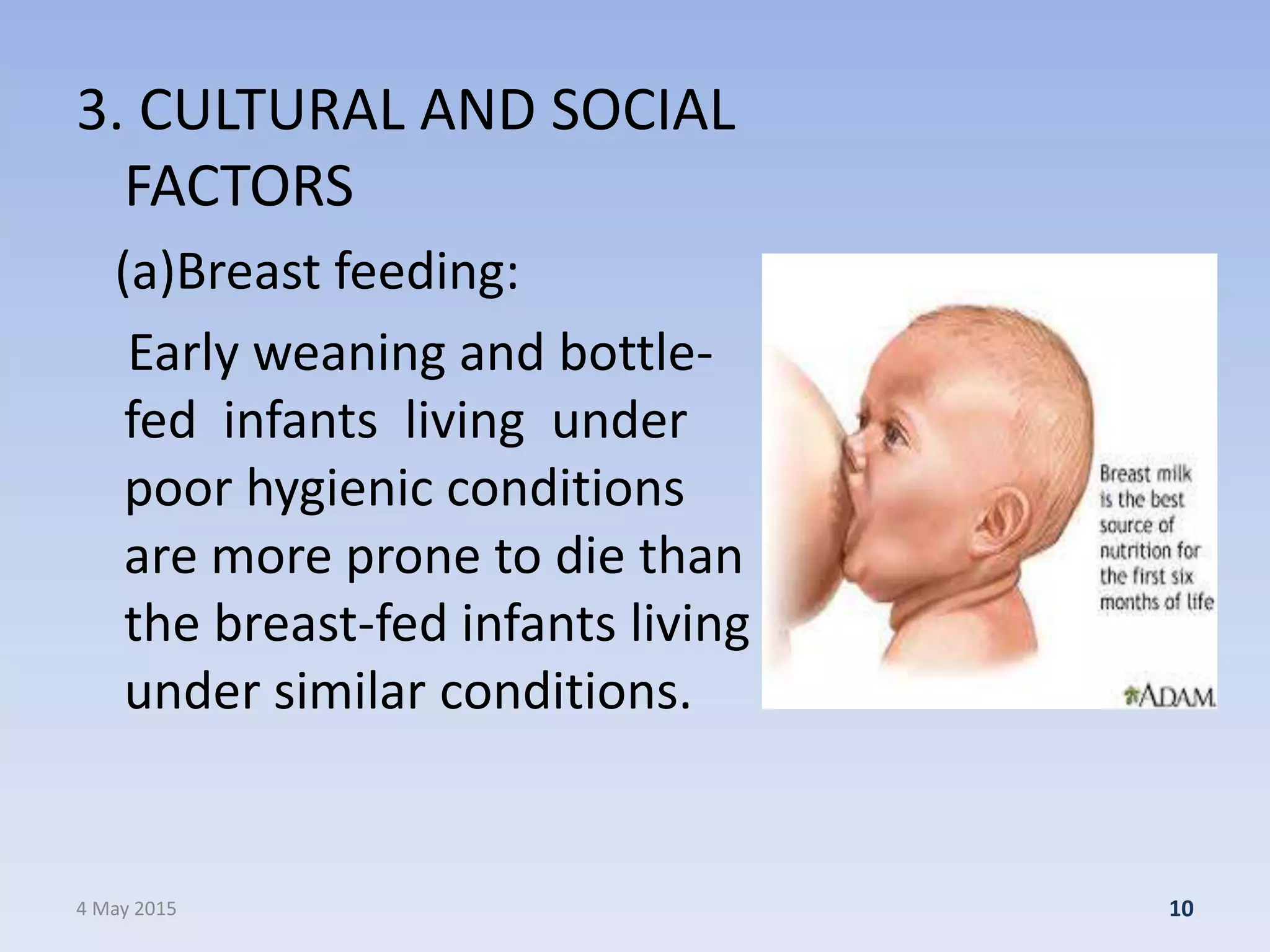
(a)Breast feeding:
Early weaning and bottle-
fed infants living under
poor hygienic conditions
are more prone to die than
the breast-fed infants living
under similar conditions.
4 May 2015 10
(b) Religion and caste
The differences are attributed to socio-
cultural patterns of living, involving age-old
habits, customs, traditions affecting
cleanliness, eating, clothing, child care and
almost every detail of daily living.
(c) Early marriages
..teen-age mother- greater risk of neonatal and
post-neonatal mortality.
4 May 2015 11
(d) Sex of the child
Statistics show that female infant
mortality is higher than the male infant
mortality.
(e) Quality of mothering
(f) Maternal education
Women with schooling tend to marry later,
delay child- bearing and are more likely to
practice family planning.
4 May 2015 12
(g) Quality of health care
Shortage of trained personnel like dais,
midwives and health visitors is another
determinant of high mortality in India.
According to estimates only 47% of the
deliveries are attended by trained birth
attendants.
(f) Broken families
(g) Illegitimacy
4 May 2015 13
(j) Brutal habits and customs
-depriving the baby of the first milk or
colostrum, frequent purgation, branding the
skin, application of cow-dung to the cut end of
umbilical cord, faulty feeding practices and
early weaning.
(k) The indigenous dai
..untrained midwife- unhygienic delivery.
(l) Bad environmental sanitation
4 May 2015 14
Preventive and social measures
1. Prenatal nutrition
- improve the state of maternal nutrition..
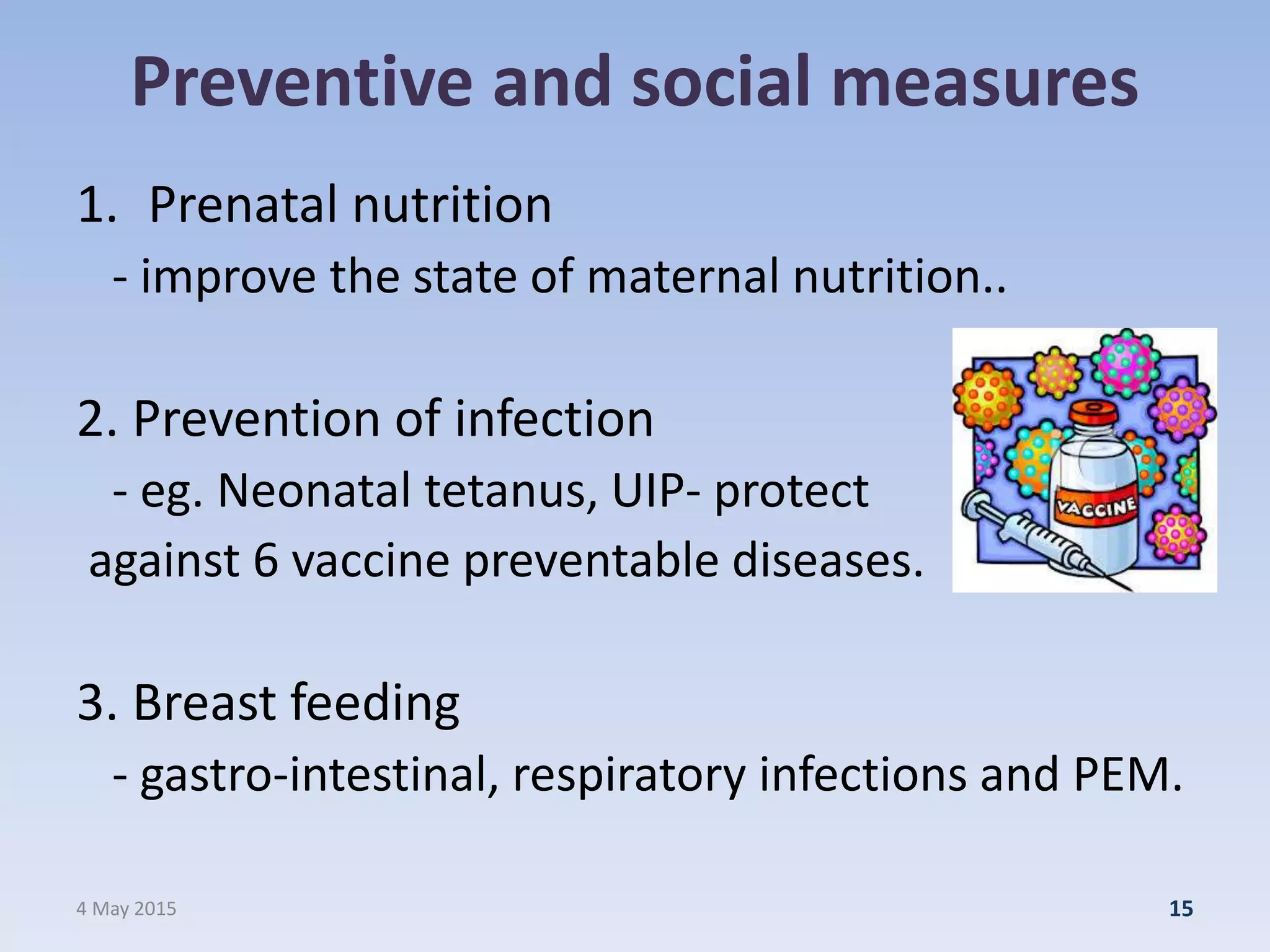
2. Prevention of infection
- eg. Neonatal tetanus, UIP- protect
against 6 vaccine preventable diseases.
3. Breast feeding
- gastro-intestinal, respiratory infections and PEM.
4 May 2015 15
4. Growth monitoring
- all infants should be weighed periodically and
their growth charts maintained.
- these charts help to identify children at risk
of malnutrition early.
5. Family planning
- smaller sibship and longer spacing between
pregnancies are associated with improved
infant and child survival.
4 May 2015 16
6. Sanitation
- poor sanitation and environmental
conditions exposes the infant to various
infections.
7. Provision of primary health care
- all those involved in maternity care
( obstetrician-local dai) should collaborate and
work together as a team.
4 May 2015 17
- Prenatal care must be improved with a view
to detecting mothers with “high-risk factors”,
and those with prenatal conditions associated
with high- risk are hospitalised and treated.
- “Special care baby units” : for babies weighing
less than 2000g.
- Proper referral services.
4 May 2015 18
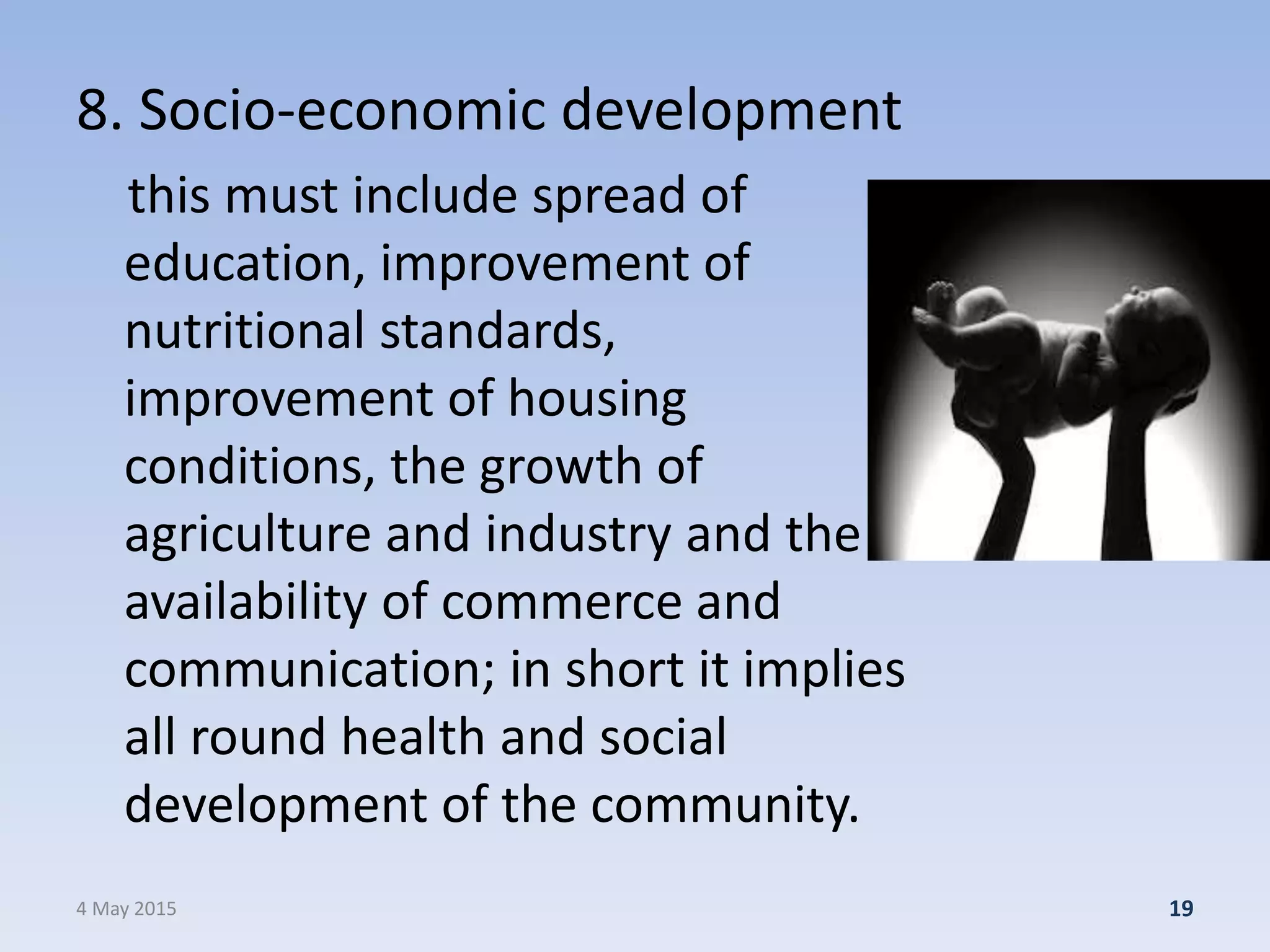
8. Socio-economic development
this must include spread of
education, improvement of
nutritional standards,
improvement of housing
conditions, the growth of
agriculture and industry and the
availability of commerce and
communication; in short it implies
all round health and social
development of the community.
4 May 2015 19
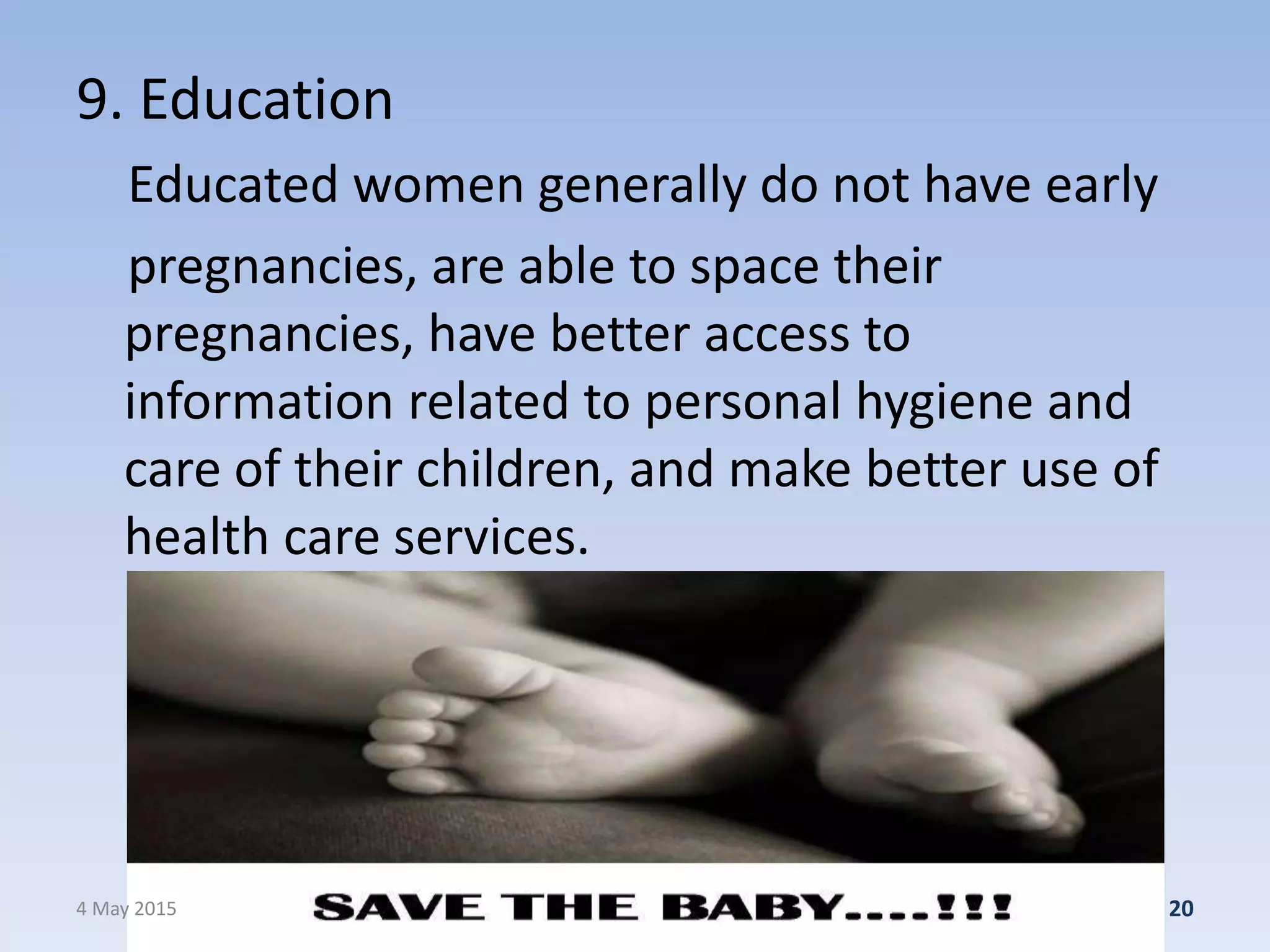
9. Education
Educated women generally do not have early
pregnancies, are able to space their
pregnancies, have better access to
information related to personal hygiene and
care of their children, and make better use of
health care services.
4 May 2015 20
4 May 2015 21

Imr

  • 1.
    INFANT MORTALITY ANDITS PREVENTION AND CONTROL MEASURES IN INDIA Presenter- PRAJNA.SHETTY Moderator- Dr. Oliver D’souza 4 May 2015 1
  • 2.
    INFANT MORTALITY RATE -the ratio of infant deaths registered in a given year to the total number of live births registered in the same year; usually expressed as a rate per 1000 live births. - it is given by the formula: Number of deaths of children less IMR = than one year of age in a year ×1000 Number of live births in the same year 4 May 2015 2
  • 3.
    Infant mortality inIndia • 41 in the year 2012 • 204 during 1911-15 • Madhya Pradesh- IMR of 56, & Kerala- as low as 12 per 1000 live births during the year 2012. • Kerala, Maharashtra, Punjab, T.N, W.B, A.P, Haryana, K’taka, Gujarat, H.P and Jharkhand have achieved IMR below national average of 42. • Odisha, M.P, U.P, Assam and Rajasthan- IMR > 42! 4 May 2015 3
  • 4.
    Medical causes ofinfant mortality Neonatal mortality (0-4 weeks) Post-neonatal mortality (1-12 months) 1. Low birth weight and prematurity 2. Birth injury and difficult labour 3. Sepsis 4. Congenital anomalies 5. Haemolytic diseases of newborn 6. Conditions of placenta and cord 7. Diarrhoeal diseases 8. Acute respiratory infections 9. Tetanus 1. Diarrhoeal diseases 2. Acute respiratory infections 3. Other communicable diseases 4. Malnutrition 5. Congenital anomalies 6. Accidents 4 May 2015 4
  • 5.
    Factors affecting Infantmortality 1. BIOLOGICAL FACTORS (a) Birth weight: - babies of low birth weight and high birth weight are at special risk. - causes: poor nutrition during pregnancy.. (b) Age of the mother: - IMR are greater when the mother is either very young or relatively older. 4 May 2015 5
  • 6.
    (c) Birth order -the highest mortality is found among first born, and the lowest among those born second. - The risk of infant mortality escalates after the third birth. - the fate of fifth and later children is always worse than the fate of the 3rd child. 4 May 2015 6
  • 7.
    (d) Birth spacing -repeated pregnancies- malnutrition and anaemia in the mother- predispose to LBW.. - prematurely weaned- PEM, diarrhoea and dehydration. (e) Multiple births - Infants born in multiple births face a greater risk of death than do those in single births due to the greater frequency of low birth weight among the former. 4 May 2015 7
  • 8.
    (f) Family size -the number of episodes of infectious diarrhoea, prevalence of malnutrition, and severe respiratory infections have been found to increase with family size. - fewer children-better maternal care, a better share of family resources, less morbidity and greatly decreased infant mortality. 4 May 2015 8
  • 9.
    (g) High fertility highfertility and high infant mortality go together. 2. ECONOMIC FACTORS The availability and quality of health care and the nature of the child’s environment are closely related to socio-economic status. 4 May 2015 9
  • 10.
    3. CULTURAL ANDSOCIAL FACTORS (a)Breast feeding: Early weaning and bottle- fed infants living under poor hygienic conditions are more prone to die than the breast-fed infants living under similar conditions. 4 May 2015 10
  • 11.
    (b) Religion andcaste The differences are attributed to socio- cultural patterns of living, involving age-old habits, customs, traditions affecting cleanliness, eating, clothing, child care and almost every detail of daily living. (c) Early marriages ..teen-age mother- greater risk of neonatal and post-neonatal mortality. 4 May 2015 11
  • 12.
    (d) Sex ofthe child Statistics show that female infant mortality is higher than the male infant mortality. (e) Quality of mothering (f) Maternal education Women with schooling tend to marry later, delay child- bearing and are more likely to practice family planning. 4 May 2015 12
  • 13.
    (g) Quality ofhealth care Shortage of trained personnel like dais, midwives and health visitors is another determinant of high mortality in India. According to estimates only 47% of the deliveries are attended by trained birth attendants. (f) Broken families (g) Illegitimacy 4 May 2015 13
  • 14.
    (j) Brutal habitsand customs -depriving the baby of the first milk or colostrum, frequent purgation, branding the skin, application of cow-dung to the cut end of umbilical cord, faulty feeding practices and early weaning. (k) The indigenous dai ..untrained midwife- unhygienic delivery. (l) Bad environmental sanitation 4 May 2015 14
  • 15.
    Preventive and socialmeasures 1. Prenatal nutrition - improve the state of maternal nutrition.. 2. Prevention of infection - eg. Neonatal tetanus, UIP- protect against 6 vaccine preventable diseases. 3. Breast feeding - gastro-intestinal, respiratory infections and PEM. 4 May 2015 15
  • 16.
    4. Growth monitoring -all infants should be weighed periodically and their growth charts maintained. - these charts help to identify children at risk of malnutrition early. 5. Family planning - smaller sibship and longer spacing between pregnancies are associated with improved infant and child survival. 4 May 2015 16
  • 17.
    6. Sanitation - poorsanitation and environmental conditions exposes the infant to various infections. 7. Provision of primary health care - all those involved in maternity care ( obstetrician-local dai) should collaborate and work together as a team. 4 May 2015 17
  • 18.
    - Prenatal caremust be improved with a view to detecting mothers with “high-risk factors”, and those with prenatal conditions associated with high- risk are hospitalised and treated. - “Special care baby units” : for babies weighing less than 2000g. - Proper referral services. 4 May 2015 18
  • 19.
    8. Socio-economic development thismust include spread of education, improvement of nutritional standards, improvement of housing conditions, the growth of agriculture and industry and the availability of commerce and communication; in short it implies all round health and social development of the community. 4 May 2015 19
  • 20.
    9. Education Educated womengenerally do not have early pregnancies, are able to space their pregnancies, have better access to information related to personal hygiene and care of their children, and make better use of health care services. 4 May 2015 20
  • 21.