BLENDED LEARNING:
                          REDEFINING THE SPACE


                                        Professor Mike Keppell
                              Director, The Flexible Learning Institute &
                                    Professor of Higher Education
                                       Charles Sturt University

                                                   1
Thursday, 30 September 2010                                                 1
OVERVIEW

                 Assumptions
                 Principles
                 Conceptualising the space
                 of this presentation
                 What is blended learning?
                 Dimensions of blended
                 learning
                 Space
                 Multi-dimensional nature
                 of blended learning
                                             2
Thursday, 30 September 2010                      2
ASSUMPTIONS
              Universities value and seek to enhance the skills
              essential for lifelong and life wide learning,
              developing graduates who will continue to develop
              intellectually, professionally and socially beyond the
              bounds of formal education.

              Universities believe that programs, services and teaching
              methods should be responsive to the diverse
              cultural, social and academic needs of
              students, enabling them to adapt to the demands of
              university education and providing them with the
              cultural capital for life success.
                                         3
Thursday, 30 September 2010                                               3
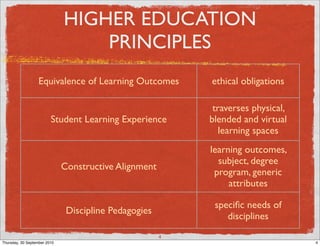
HIGHER EDUCATION
                                  PRINCIPLES
                   Equivalence of Learning Outcomes        ethical obligations

                                                            traverses physical,
                         Student Learning Experience       blended and virtual
                                                              learning spaces
                                                           learning outcomes,
                                                             subject, degree
                              Constructive Alignment
                                                            program, generic
                                                                attributes

                                                            specific needs of
                               Discipline Pedagogies
                                                               disciplines
                                                       4
Thursday, 30 September 2010                                                       4
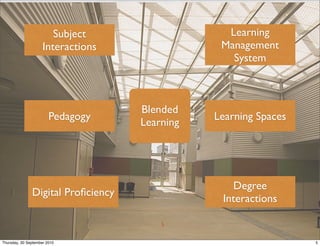
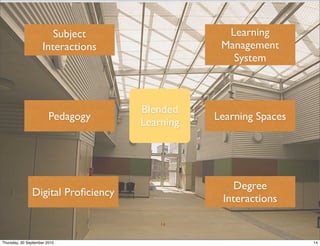
Subject                  Learning
                     Interactions               Management
                                                  System


                                    Blended
                        Pedagogy               Learning Spaces
                                    Learning


                                                  Degree
               Digital Proficiency
                                                Interactions

                                        5


Thursday, 30 September 2010                                      5
PERSPECTIVES ON BLENDED
                      LEARNING


                 Blended learning means that you need to look at the
                 cohort, and the resources, the lesson, curriculum and put it
                 all together. It requires a change of language. I see it as
                 using technology for enhancing learning and it allows you
                 to cater more for differences, for the different needs of the
                 student body (Teaching Fellow, 2008).


                                              6
Thursday, 30 September 2010                                                      6
PERSPECTIVES ON BLENDED
                      LEARNING
                 The reason I’m a bit cynical about it (blended learning) is
                 that I think it’s a matter of good teaching that you do...
                 anyway. It’s a bit of a jargon word, I think, but I can
                 understand the need to have it for the increased range of
                 technologies (Teaching Fellow, 2008).

                 … It’s very, very hard to get people who come on campus to
                 want to do something that’s not face-to-face and it’s very
                 hard to get people who want to be totally flexible and do
                 something at two o’clock in the morning by themselves to
                 actually want to engage with other people (Teaching Fellow,
                 2008).
                                               7
Thursday, 30 September 2010                                                    7
BALANCE


                              8
Thursday, 30 September 2010       8
FLEXIBLE LEARNING

                 “Flexible learning” provides opportunities to
                 improve the student learning experience through
                 flexibility in time, pace, place (physical, virtual, on-
                 campus, off-campus), mode of study (print-based,
                 face-to-face, blended, online), teaching approach
                 (collaborative, independent), forms of assessment
                 and staffing. It may utilise a wide range of media,
                 environments, learning spaces and technologies for
                 learning and teaching.

                                           9
Thursday, 30 September 2010                                                9
BLENDED & FLEXIBLE
                                  LEARNING


                 “Blended and flexible learning” is a design
                 approach that examines the relationships between
                 flexible learning opportunities, in order to optimise
                 student engagement and equivalence in learning
                 outcomes regardless of mode of study (Keppell,
                 2010, p. 3).


                                          10
Thursday, 30 September 2010                                             10
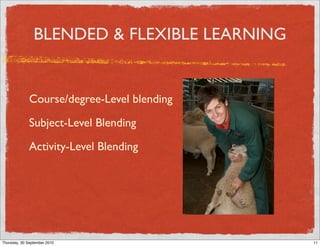
BLENDED & FLEXIBLE LEARNING


              Course/degree-Level blending

              Subject-Level Blending

              Activity-Level Blending


                                        11
Thursday, 30 September 2010                   11
PARADIGMS OF BLENDED
                           LEARNING
           Enabling blends
           Access and equity

           Enhancing blends
           Incremental changes to
           the pedagogy

           Transforming blends
           Transformation of the pedagogy


                                    12
Thursday, 30 September 2010                 12
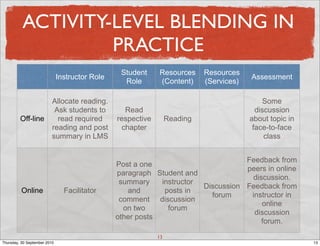
ACTIVITY-LEVEL BLENDING IN
                   PRACTICE
                                                 Student     Resources      Resources
                              Instructor Role                                            Assessment
                                                  Role       (Content)      (Services)

                          Allocate reading.                                                  Some
                           Ask students to        Read                                     discussion
         Off-line           read required       respective        Reading                about topic in
                          reading and post       chapter                                  face-to-face
                          summary in LMS                                                      class


                                                                                  Feedback from
                                                Post a one
                                                                                  peers in online
                                                paragraph Student and
                                                                                   discussion.
                                                 summary    instructor
                                                                       Discussion Feedback from
          Online                Facilitator        and       posts in
                                                                         forum     instructor in
                                                 comment discussion
                                                                                      online
                                                  on two      forum
                                                                                    discussion
                                                other posts
                                                                                      forum.

                                                             13
Thursday, 30 September 2010                                                                               13
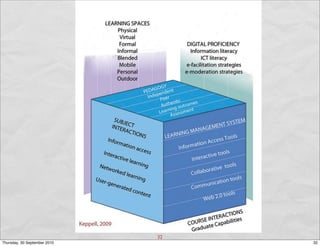
Subject                  Learning
                     Interactions               Management
                                                  System


                                    Blended
                        Pedagogy               Learning Spaces
                                    Learning


                                                  Degree
               Digital Proficiency
                                                Interactions

                                        14


Thursday, 30 September 2010                                      14
SUBJECT & DEGREE
                               INTERACTIONS

                 Information access (degree and subject expectations)

                 Interactive learning (learner-to-content interactions)

                 Networked learning (learner-to-learner; learner-to-
                 teacher interactions)

                 Student-generated content (learner-as-designers;
                 assessment-as-learning interactions)

                 (Herrington & Oliver 2001).
                                           15
Thursday, 30 September 2010                                               15
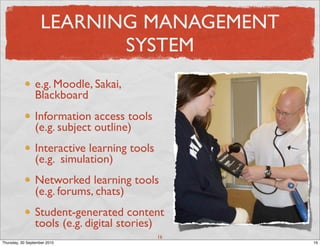
LEARNING MANAGEMENT
                           SYSTEM
                 e.g. Moodle, Sakai,
                 Blackboard
                 Information access tools
                 (e.g. subject outline)
                 Interactive learning tools
                 (e.g. simulation)
                 Networked learning tools
                 (e.g. forums, chats)
                 Student-generated content
                 tools (e.g. digital stories)
                                              16
Thursday, 30 September 2010                        16
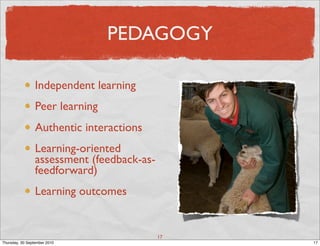
PEDAGOGY

                 Independent learning
                 Peer learning
                 Authentic interactions
                 Learning-oriented
                 assessment (feedback-as-
                 feedforward)
                 Learning outcomes


                                            17
Thursday, 30 September 2010                      17
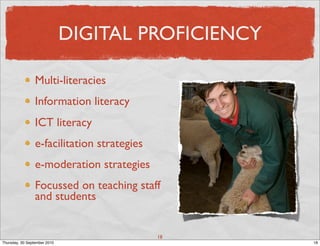
DIGITAL PROFICIENCY

                 Multi-literacies
                 Information literacy
                 ICT literacy
                 e-facilitation strategies
                 e-moderation strategies
                 Focussed on teaching staff
                 and students


                                             18
Thursday, 30 September 2010                         18
LEARNING SPACES
                                     19
Thursday, 30 September 2010                     19
LEARNING SPACES

                   Physical, blended or virtual ‘areas’ that enhance
                   learning

                   Physical, blended or virtual ‘areas’ that motivate
                   learners

                   Spaces where both teachers and students optimize
                   the perceived and actual affordances of the
                   space

                   Spaces that promote authentic learning
                   interactions
                                           20
Thursday, 30 September 2010                                             20
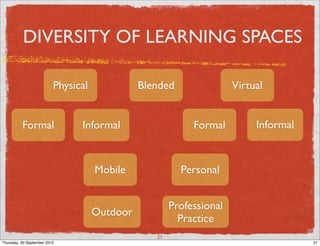
DIVERSITY OF LEARNING SPACES

                          Physical             Blended                Virtual


          Formal                Informal                    Formal         Informal


                                     Mobile              Personal


                                                       Professional
                                     Outdoor
                                                         Practice
                                                  21
Thursday, 30 September 2010                                                           21
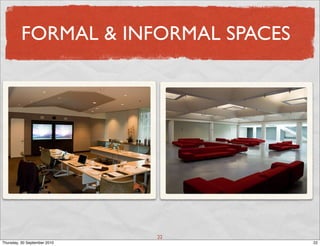
FORMAL & INFORMAL SPACES


                              22
Thursday, 30 September 2010         22
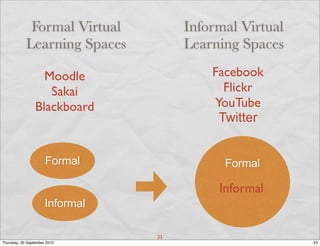
Formal Virtual           Informal Virtual
            Learning Spaces           Learning Spaces

                   Moodle                 Facebook
                    Sakai                   Flickr
                 Blackboard               YouTube
                                           Twitter


                      Formal                Formal
                                               I
                                           Informal
                      Informal

                                 23
Thursday, 30 September 2010                              23
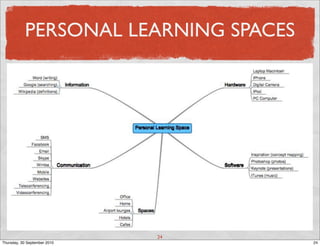
PERSONAL LEARNING SPACES


                              24
Thursday, 30 September 2010           24
25
Thursday, 30 September 2010        25
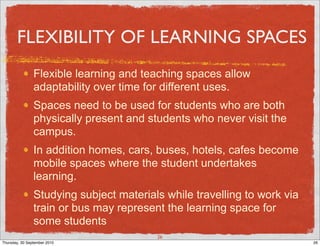
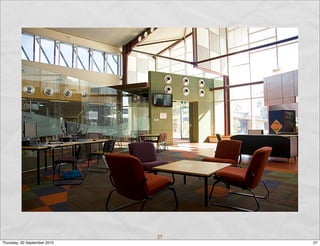
FLEXIBILITY OF LEARNING SPACES
                Flexible learning and teaching spaces allow
                adaptability over time for different uses.
                Spaces need to be used for students who are both
                physically present and students who never visit the
                campus.
                In addition homes, cars, buses, hotels, cafes become
                mobile spaces where the student undertakes
                learning.
                Studying subject materials while travelling to work via
                train or bus may represent the learning space for
                some students
                                         26
Thursday, 30 September 2010                                               26
27
Thursday, 30 September 2010        27
28
Thursday, 30 September 2010        28
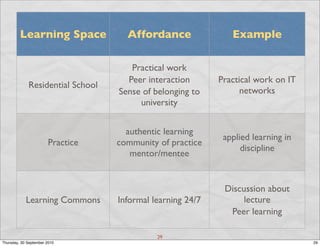
Learning Space             Affordance                Example

                                     Practical work
                                    Peer interaction       Practical work on IT
             Residential School
                                  Sense of belonging to          networks
                                       university


                                    authentic learning
                                                            applied learning in
                       Practice   community of practice
                                                                 discipline
                                     mentor/mentee


                                                            Discussion about
            Learning Commons      Informal learning 24/7         lecture
                                                             Peer learning

                                            29
Thursday, 30 September 2010                                                       29
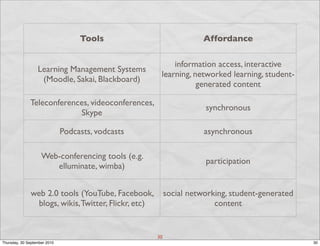
Tools                              Affordance

                                                           information access, interactive
                  Learning Management Systems
                                                       learning, networked learning, student-
                   (Moodle, Sakai, Blackboard)
                                                                  generated content

              Teleconferences, videoconferences,
                                                                      synchronous
                           Skype

                              Podcasts, vodcasts                      asynchronous

                    Web-conferencing tools (e.g.
                                                                      participation
                       elluminate, wimba)


              web 2.0 tools (YouTube, Facebook,            social networking, student-generated
                blogs, wikis, Twitter, Flickr, etc)                      content


                                                      30
Thursday, 30 September 2010                                                                       30
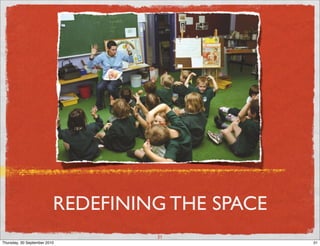
REDEFINING THE SPACE
                                   31
Thursday, 30 September 2010                      31
32
Thursday, 30 September 2010        32
http://www.csu.edu.au/division/landt/flexible-learning/

                              http://www.ascilite.org.au/
                                            33
Thursday, 30 September 2010                                        33
34
Thursday, 30 September 2010        34

National Learning and Teaching Forum - Redefining Blended Learning

  • 1.
    BLENDED LEARNING: REDEFINING THE SPACE Professor Mike Keppell Director, The Flexible Learning Institute & Professor of Higher Education Charles Sturt University 1 Thursday, 30 September 2010 1
  • 2.
    OVERVIEW Assumptions Principles Conceptualising the space of this presentation What is blended learning? Dimensions of blended learning Space Multi-dimensional nature of blended learning 2 Thursday, 30 September 2010 2
  • 3.
    ASSUMPTIONS Universities value and seek to enhance the skills essential for lifelong and life wide learning, developing graduates who will continue to develop intellectually, professionally and socially beyond the bounds of formal education. Universities believe that programs, services and teaching methods should be responsive to the diverse cultural, social and academic needs of students, enabling them to adapt to the demands of university education and providing them with the cultural capital for life success. 3 Thursday, 30 September 2010 3
  • 4.
    HIGHER EDUCATION PRINCIPLES Equivalence of Learning Outcomes ethical obligations traverses physical, Student Learning Experience blended and virtual learning spaces learning outcomes, subject, degree Constructive Alignment program, generic attributes specific needs of Discipline Pedagogies disciplines 4 Thursday, 30 September 2010 4
  • 5.
    Subject Learning Interactions Management System Blended Pedagogy Learning Spaces Learning Degree Digital Proficiency Interactions 5 Thursday, 30 September 2010 5
  • 6.
    PERSPECTIVES ON BLENDED LEARNING Blended learning means that you need to look at the cohort, and the resources, the lesson, curriculum and put it all together. It requires a change of language. I see it as using technology for enhancing learning and it allows you to cater more for differences, for the different needs of the student body (Teaching Fellow, 2008). 6 Thursday, 30 September 2010 6
  • 7.
    PERSPECTIVES ON BLENDED LEARNING The reason I’m a bit cynical about it (blended learning) is that I think it’s a matter of good teaching that you do... anyway. It’s a bit of a jargon word, I think, but I can understand the need to have it for the increased range of technologies (Teaching Fellow, 2008). … It’s very, very hard to get people who come on campus to want to do something that’s not face-to-face and it’s very hard to get people who want to be totally flexible and do something at two o’clock in the morning by themselves to actually want to engage with other people (Teaching Fellow, 2008). 7 Thursday, 30 September 2010 7
  • 8.
    BALANCE 8 Thursday, 30 September 2010 8
  • 9.
    FLEXIBLE LEARNING “Flexible learning” provides opportunities to improve the student learning experience through flexibility in time, pace, place (physical, virtual, on- campus, off-campus), mode of study (print-based, face-to-face, blended, online), teaching approach (collaborative, independent), forms of assessment and staffing. It may utilise a wide range of media, environments, learning spaces and technologies for learning and teaching. 9 Thursday, 30 September 2010 9
  • 10.
    BLENDED & FLEXIBLE LEARNING “Blended and flexible learning” is a design approach that examines the relationships between flexible learning opportunities, in order to optimise student engagement and equivalence in learning outcomes regardless of mode of study (Keppell, 2010, p. 3). 10 Thursday, 30 September 2010 10
  • 11.
    BLENDED & FLEXIBLELEARNING Course/degree-Level blending Subject-Level Blending Activity-Level Blending 11 Thursday, 30 September 2010 11
  • 12.
    PARADIGMS OF BLENDED LEARNING Enabling blends Access and equity Enhancing blends Incremental changes to the pedagogy Transforming blends Transformation of the pedagogy 12 Thursday, 30 September 2010 12
  • 13.
    ACTIVITY-LEVEL BLENDING IN PRACTICE Student Resources Resources Instructor Role Assessment Role (Content) (Services) Allocate reading. Some Ask students to Read discussion Off-line read required respective Reading about topic in reading and post chapter face-to-face summary in LMS class Feedback from Post a one peers in online paragraph Student and discussion. summary instructor Discussion Feedback from Online Facilitator and posts in forum instructor in comment discussion online on two forum discussion other posts forum. 13 Thursday, 30 September 2010 13
  • 14.
    Subject Learning Interactions Management System Blended Pedagogy Learning Spaces Learning Degree Digital Proficiency Interactions 14 Thursday, 30 September 2010 14
  • 15.
    SUBJECT & DEGREE INTERACTIONS Information access (degree and subject expectations) Interactive learning (learner-to-content interactions) Networked learning (learner-to-learner; learner-to- teacher interactions) Student-generated content (learner-as-designers; assessment-as-learning interactions) (Herrington & Oliver 2001). 15 Thursday, 30 September 2010 15
  • 16.
    LEARNING MANAGEMENT SYSTEM e.g. Moodle, Sakai, Blackboard Information access tools (e.g. subject outline) Interactive learning tools (e.g. simulation) Networked learning tools (e.g. forums, chats) Student-generated content tools (e.g. digital stories) 16 Thursday, 30 September 2010 16
  • 17.
    PEDAGOGY Independent learning Peer learning Authentic interactions Learning-oriented assessment (feedback-as- feedforward) Learning outcomes 17 Thursday, 30 September 2010 17
  • 18.
    DIGITAL PROFICIENCY Multi-literacies Information literacy ICT literacy e-facilitation strategies e-moderation strategies Focussed on teaching staff and students 18 Thursday, 30 September 2010 18
  • 19.
    LEARNING SPACES 19 Thursday, 30 September 2010 19
  • 20.
    LEARNING SPACES Physical, blended or virtual ‘areas’ that enhance learning Physical, blended or virtual ‘areas’ that motivate learners Spaces where both teachers and students optimize the perceived and actual affordances of the space Spaces that promote authentic learning interactions 20 Thursday, 30 September 2010 20
  • 21.
    DIVERSITY OF LEARNINGSPACES Physical Blended Virtual Formal Informal Formal Informal Mobile Personal Professional Outdoor Practice 21 Thursday, 30 September 2010 21
  • 22.
    FORMAL & INFORMALSPACES 22 Thursday, 30 September 2010 22
  • 23.
    Formal Virtual Informal Virtual Learning Spaces Learning Spaces Moodle Facebook Sakai Flickr Blackboard YouTube Twitter Formal Formal I Informal Informal 23 Thursday, 30 September 2010 23
  • 24.
    PERSONAL LEARNING SPACES 24 Thursday, 30 September 2010 24
  • 25.
  • 26.
    FLEXIBILITY OF LEARNINGSPACES Flexible learning and teaching spaces allow adaptability over time for different uses. Spaces need to be used for students who are both physically present and students who never visit the campus. In addition homes, cars, buses, hotels, cafes become mobile spaces where the student undertakes learning. Studying subject materials while travelling to work via train or bus may represent the learning space for some students 26 Thursday, 30 September 2010 26
  • 27.
  • 28.
  • 29.
    Learning Space Affordance Example Practical work Peer interaction Practical work on IT Residential School Sense of belonging to networks university authentic learning applied learning in Practice community of practice discipline mentor/mentee Discussion about Learning Commons Informal learning 24/7 lecture Peer learning 29 Thursday, 30 September 2010 29
  • 30.
    Tools Affordance information access, interactive Learning Management Systems learning, networked learning, student- (Moodle, Sakai, Blackboard) generated content Teleconferences, videoconferences, synchronous Skype Podcasts, vodcasts asynchronous Web-conferencing tools (e.g. participation elluminate, wimba) web 2.0 tools (YouTube, Facebook, social networking, student-generated blogs, wikis, Twitter, Flickr, etc) content 30 Thursday, 30 September 2010 30
  • 31.
    REDEFINING THE SPACE 31 Thursday, 30 September 2010 31
  • 32.
  • 33.
    http://www.csu.edu.au/division/landt/flexible-learning/ http://www.ascilite.org.au/ 33 Thursday, 30 September 2010 33
  • 34.