
Teachers’ learning


                                                4.10.2012
                                               Niina Impiö


Learning and Educational Technology Research
Unit
Content

      • Teachers’ knowledge
      • Teachers’ collaboration
      • Teachers’ technological pedagogical
        content knowledge


                                               niina.impio@oulu.fi
Learning and Educational Technology Research
Unit
Changes at teachers’ work
•     There is ongoing pressure for developmental changes in education (e.g.
      educational innovations, technology-enhanced learning).

•     This require both changes in teachers’ ways of thinking about student
      learning and changes in their teaching practices.

•     There is a need for changes in knowledge, beliefs, emotions and teaching
      practices (Bakkenes, Vermunt & Wubbels, 2010).

•     These changes require continuous teacher professional development (e.g.
      Sahlberg & Boce, 2010).

•     Too often educational innovations have failed because they did not
      recognize the need for teacher learning (c.f Lieberman & Pointer
      Mace, 2008)


                                               niina.impio@oulu.fi
Learning and Educational Technology Research
Unit
• When there is need to change the pedagogy of the school, teachers are
  expected to adapt their way of teaching accordingly. They have to
      –    develop another vision on learning and teaching
      –    be motivated to learn about the new pedagogy
      –    understand what the innovation is good for
      –    develop skills to bring the innovation into practice
      –    form experiments with the new pedagogy in order to learn
      –    form part of a community of teachers who all are learning new things

       Teaching is highly demanding, high-performance profession in which
        teachers must rapidly make many decisions in a highly complex and time-
        pressured conditions
       We have to see teachers as the adaptive expertisers
           (e.g. Crawford, Schlager, Toyama, Riel & Vahey, 2005)


                                                niina.impio@oulu.fi
 Learning and Educational Technology Research
 Unit
Teachers’ Learning
 • In recent years, teacher learning has become an
   important topic in educational research.

 • How teachers learn at work?
          –    learning by experimenting
          –    learning in interaction
          –    using external sources
          –    consciously thinking about one’s own teaching practices

                                   (Kwakman 2003, Lohma & Woolf 2001, Van Eekelen et al. 2005)


                                               niina.impio@oulu.fi
Learning and Educational Technology Research
Unit
Teachers’ Learning
• Teachers’ conceptions of learning direct their teaching practices, it
  providing a pedagogical frame for teaching methods they use.

• Conceptions of learning relate closely to the concept of pedagogical
  content knowledge (PCK) (Shulman 1986; 1987)
        – Three components of knowledge

                Pedagogical knowledge (PK)
                Content Knowledge (CK)
                Pedagogical Content Knowledge (PCK)


                                               niina.impio@oulu.fi
Learning and Educational Technology Research
Unit
• Pedagogical knowledge (PK)
     – is teachers’ deep knowledge about the processes and practices or methods of
       teaching and learning
     – applies to understanding how students learn, general classroom management
       skills, lesson planning, and student assessment

     – A teacher with deep pedagogical knowledge undestands how students
       construct knowledge and acquire skills and how they develop habits of mind
       and positive dispositions towards learning. As such, pedagogical knowledge
       requires an understanding of cognitive, social, and developmental theories of
       learning and how they apply to students in the classroom.


                                                 niina.impio@oulu.fi
  Learning and Educational Technology Research
  Unit
• Content Knowledge (CK)
     – is teachers’ knowledge about the subject matter to be learned or taught
     – would include knowledge of concepts, theories, ideas, organizational
       frameworks, knowledge of evidence and proof, as well as established practices
       and approaches toward developing such knowledge

• Pedagogical Content Knowledge (PCK)
     – transformation of the subject matter for teaching
     – transformation occurs as the teacher interprets the subject matter, finds
       multiple ways to represent it, and adapts and tailors the instructional materials
       to alternative conceptions and students’ prior knowledge
     – covers the core business of teaching, learning, curriculum, assessment and
       reporting, such as the conditions that promote learning and the links among
       curriculumn, assessment, and pedagogy


                                                 niina.impio@oulu.fi
  Learning and Educational Technology Research
  Unit
• Collaboration and it’s impact on pedagogical practices is important for
  teachers’ professional development.
   (Barab & Squire, 2002; Barab, Makinster & Scheckler, 2003; Goddard, Hoy & Woolfolk Hoy,
   2004 Yuen, Law & Wong, 2003).


• Despite increased collaboration between teachers and between schools, it
  seems that teachers’ collaborative working culture still needs to be
  developed (e.g. Ilomäki, 2008).


                                                 niina.impio@oulu.fi
  Learning and Educational Technology Research
  Unit
COLLABORATIVE LEARNING
    (e.g. Dillenbourg, 1999; Roschelle & Teasley, 1995)


•    “a coordinated synchronous activity that is the result of continued
     attempt to construct and maintain a shared conception of a problem”
     (Roschelle & Teasley, 1995)

•    “is a situation in which two or more people learn or attempt to learn
     something together” (Dillenbourg, 1999)

•    Activities characterized as teachers collaboration
       –     Joint teaching and collaborative teaching methods
       –     Interaction between colleagues and others
       –     F2f and computer-mediated interaction
       –     Joint problem solving processes  pedagogical innovations


                                               niina.impio@oulu.fi
Learning and Educational Technology Research
Unit
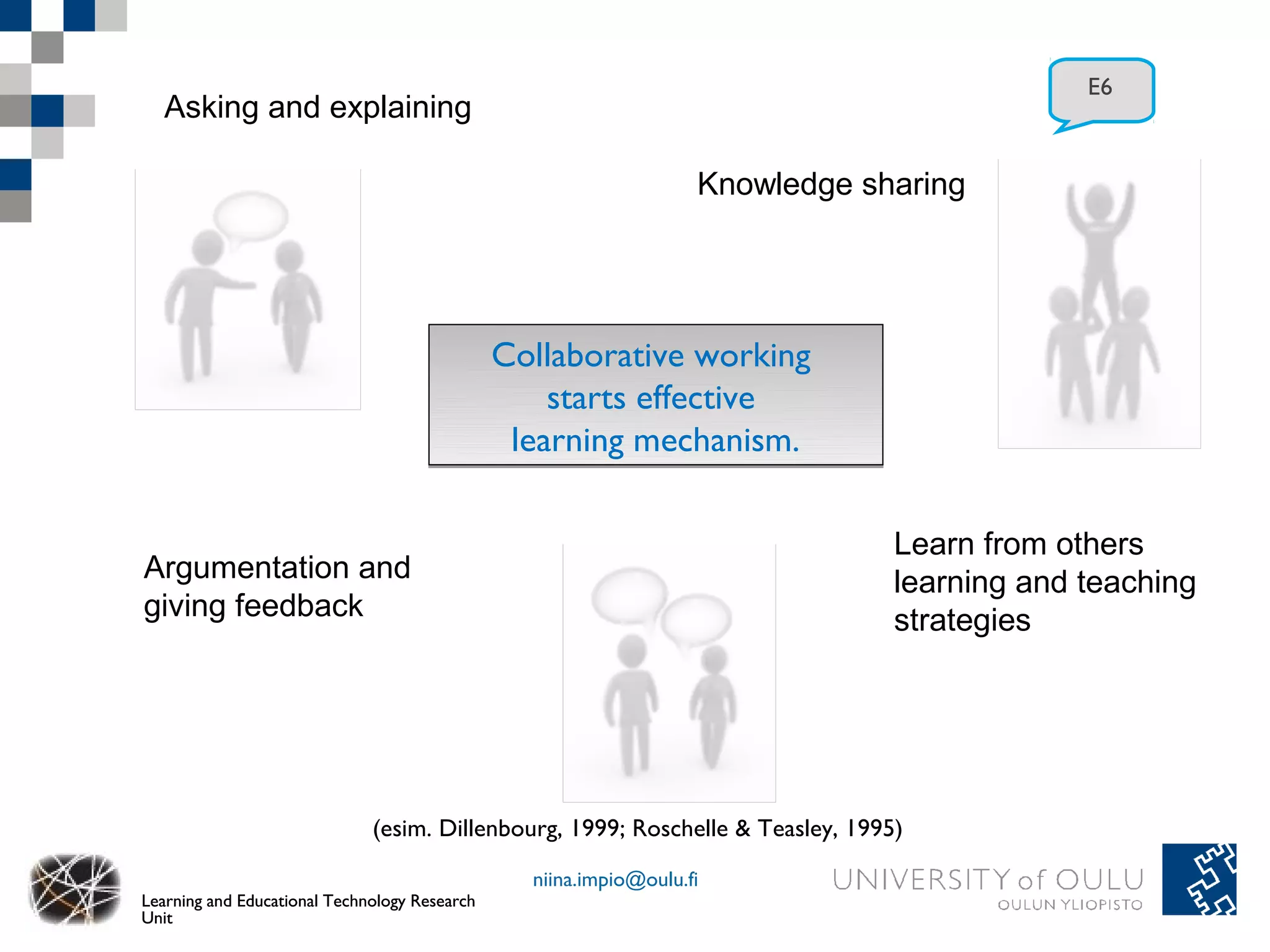
E6
  Asking and explaining

                                                                   Knowledge sharing


                                               Collaborative working
                                                   starts effective
                                                learning mechanism.

                                                                                 Learn from others
Argumentation and                                                                learning and teaching
giving feedback                                                                  strategies


                              (esim. Dillenbourg, 1999; Roschelle & Teasley, 1995)

                                                 niina.impio@oulu.fi
Learning and Educational Technology Research
Unit
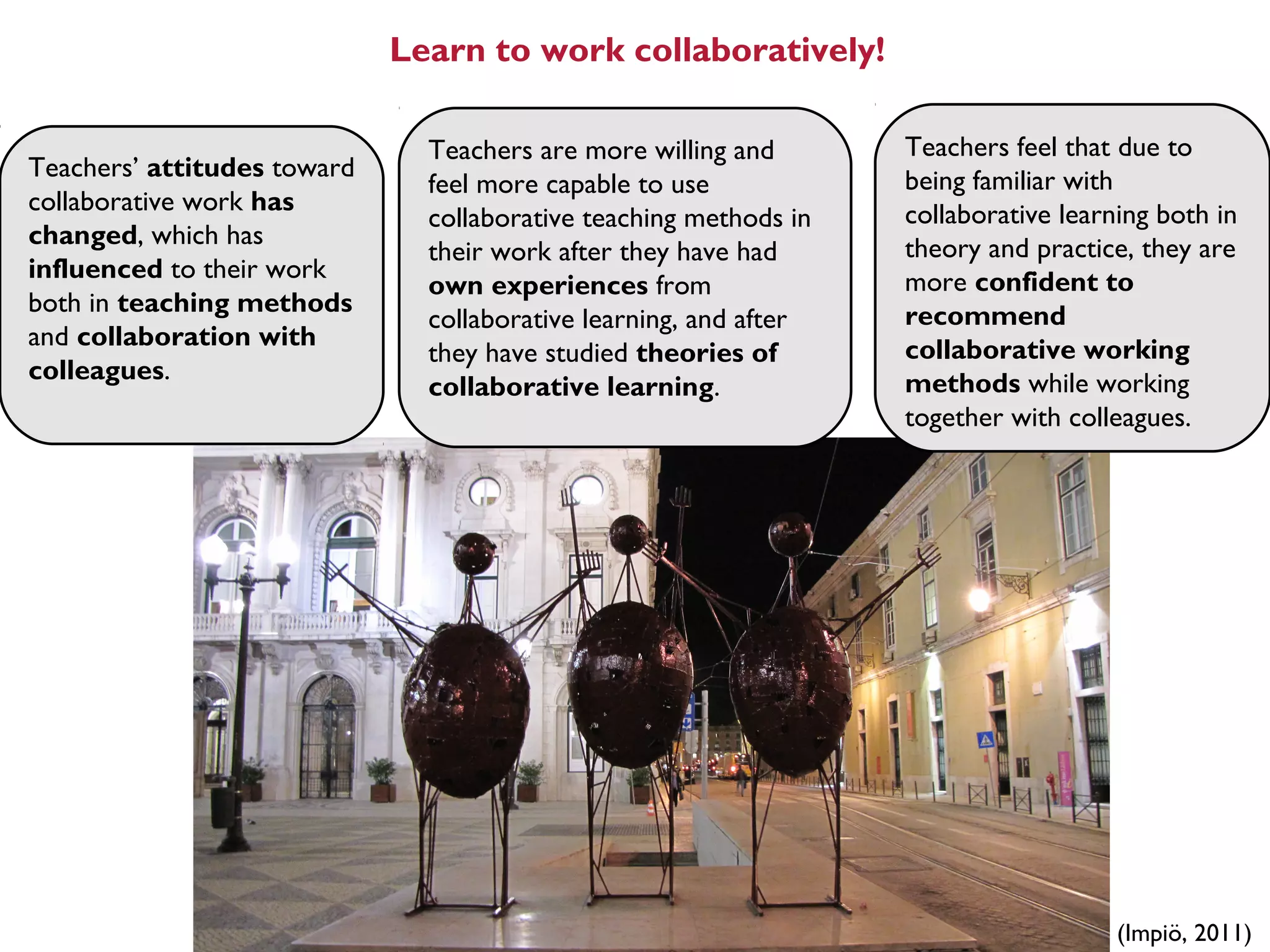
Learn to work collaboratively!

                               Teachers are more willing and       Teachers feel that due to
Teachers’ attitudes toward                                         being familiar with
                               feel more capable to use
collaborative work has                                             collaborative learning both in
                               collaborative teaching methods in
changed, which has                                                 theory and practice, they are
                               their work after they have had
influenced to their work                                           more confident to
                               own experiences from
both in teaching methods                                           recommend
                               collaborative learning, and after
and collaboration with                                             collaborative working
                               they have studied theories of
colleagues.                                                        methods while working
                               collaborative learning.
                                                                   together with colleagues.


                                                                                      (Impiö, 2011)
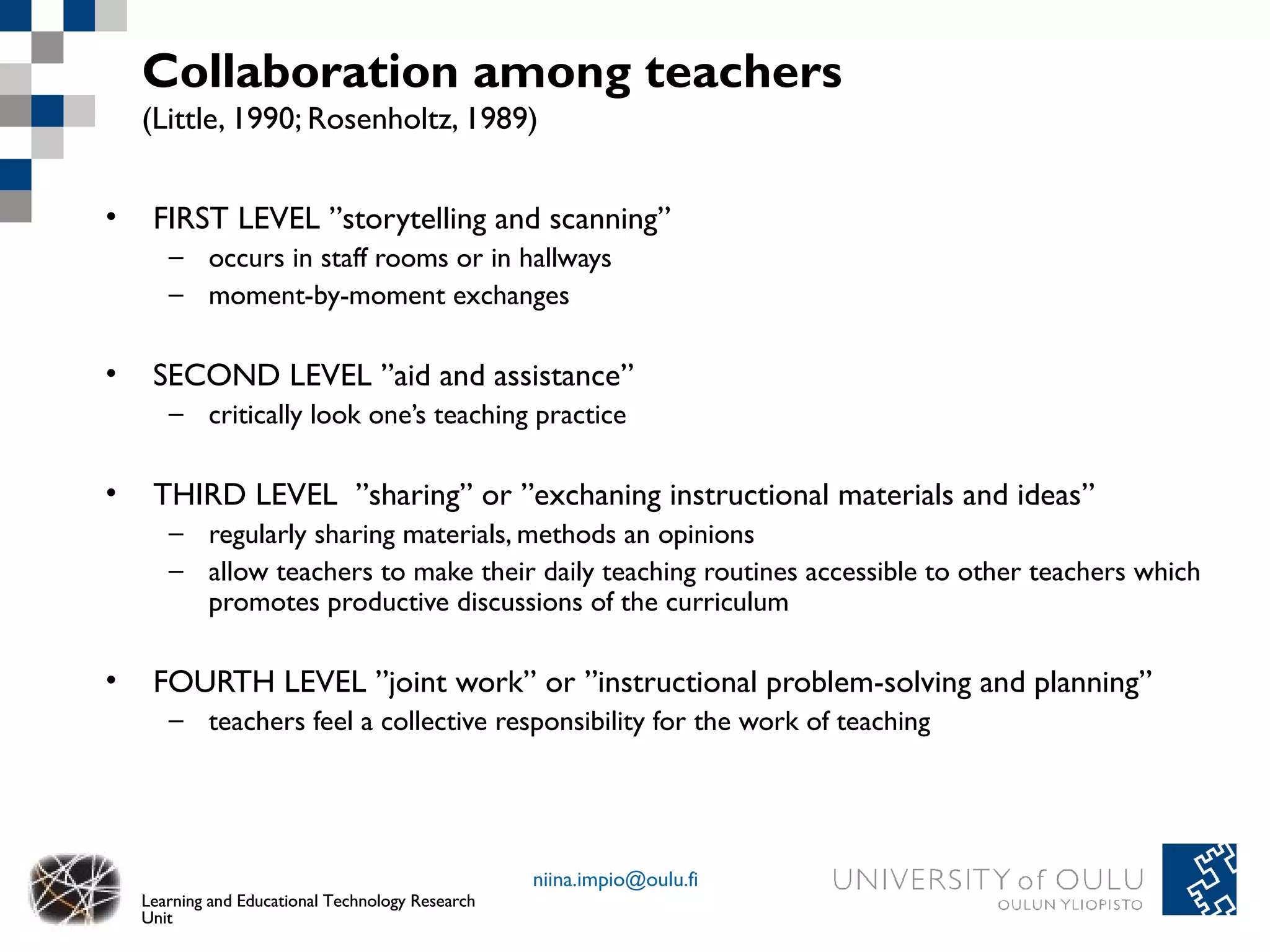
Collaboration among teachers
    (Little, 1990; Rosenholtz, 1989)


•    FIRST LEVEL ”storytelling and scanning”
       – occurs in staff rooms or in hallways
       – moment-by-moment exchanges

•    SECOND LEVEL ”aid and assistance”
       – critically look one’s teaching practice

•    THIRD LEVEL ”sharing” or ”exchaning instructional materials and ideas”
       – regularly sharing materials, methods an opinions
       – allow teachers to make their daily teaching routines accessible to other teachers which
         promotes productive discussions of the curriculum

•    FOURTH LEVEL ”joint work” or ”instructional problem-solving and planning”
       – teachers feel a collective responsibility for the work of teaching


                                                   niina.impio@oulu.fi
    Learning and Educational Technology Research
    Unit
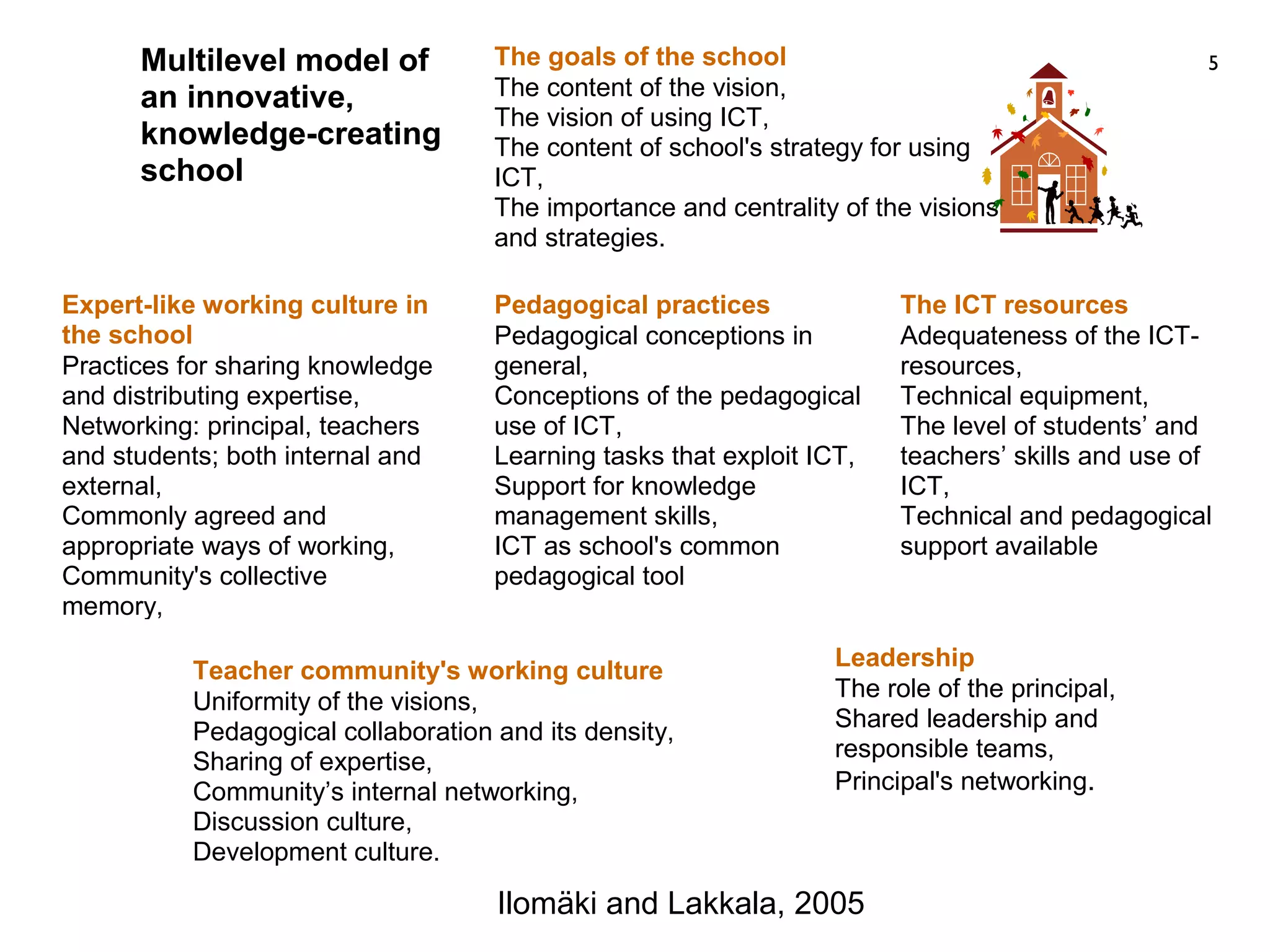
Multilevel model of           The goals of the school                                      5
      an innovative,                The content of the vision,
                                    The vision of using ICT,
      knowledge-creating            The content of school's strategy for using
      school                        ICT,
                                    The importance and centrality of the visions
                                    and strategies.

Expert-like working culture in      Pedagogical practices              The ICT resources
the school                          Pedagogical conceptions in         Adequateness of the ICT-
Practices for sharing knowledge     general,                           resources,
and distributing expertise,         Conceptions of the pedagogical     Technical equipment,
Networking: principal, teachers     use of ICT,                        The level of students’ and
and students; both internal and     Learning tasks that exploit ICT,   teachers’ skills and use of
external,                           Support for knowledge              ICT,
Commonly agreed and                 management skills,                 Technical and pedagogical
appropriate ways of working,        ICT as school's common             support available
Community's collective              pedagogical tool
memory,
common development projects.
                                                                 Leadership
          Teacher community's working culture
                                                                 The role of the principal,
          Uniformity of the visions,
          Pedagogical collaboration and its density,             Shared leadership and
          Sharing of expertise,                                  responsible teams,
          Community’s internal networking,                       Principal's networking.
          Discussion culture,
          Development culture.

                                    Ilomäki and Lakkala, 2005
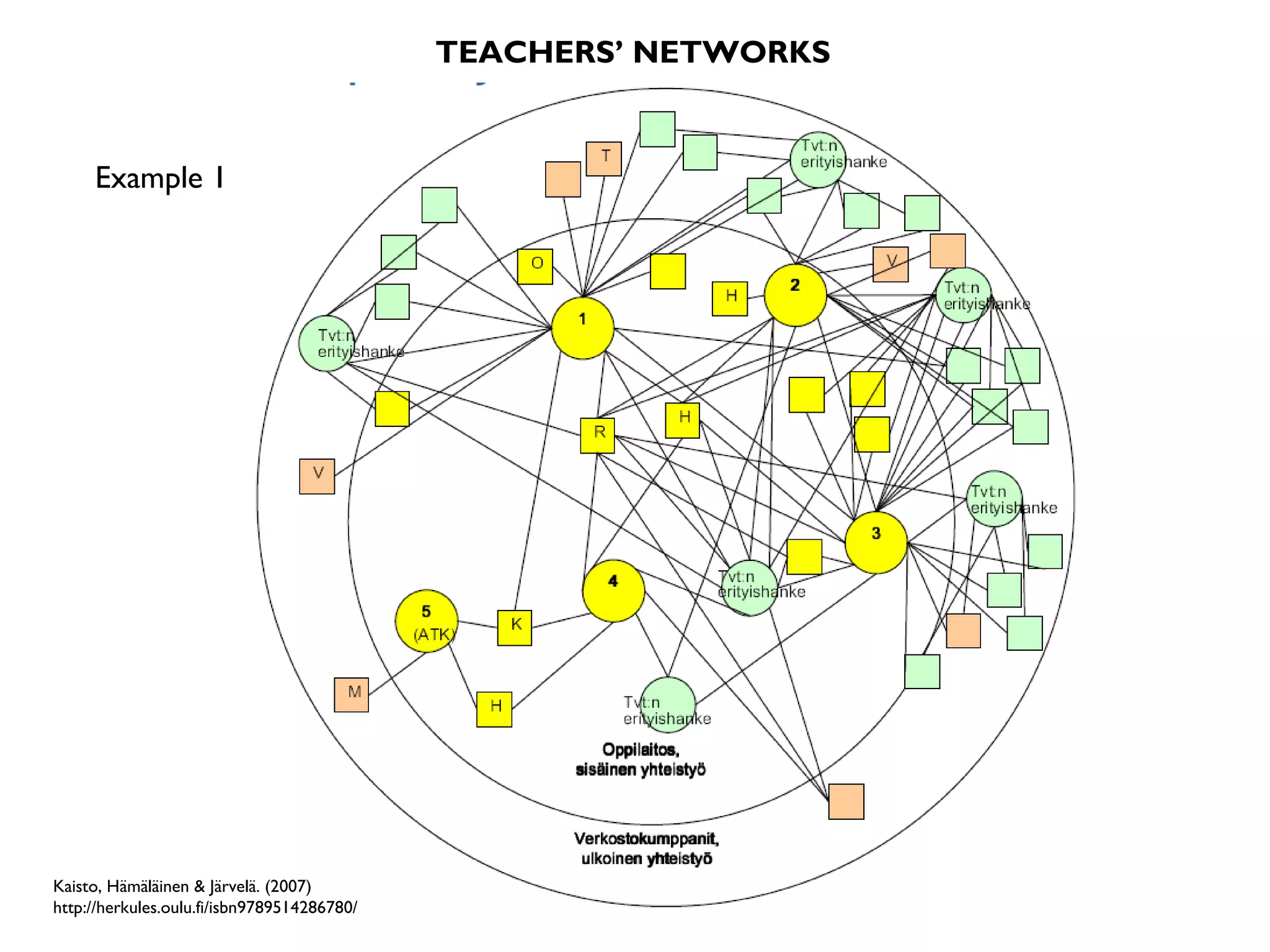
TEACHERS’ NETWORKS


     Example 1


Kaisto, Hämäläinen & Järvelä. (2007)
http://herkules.oulu.fi/isbn9789514286780/
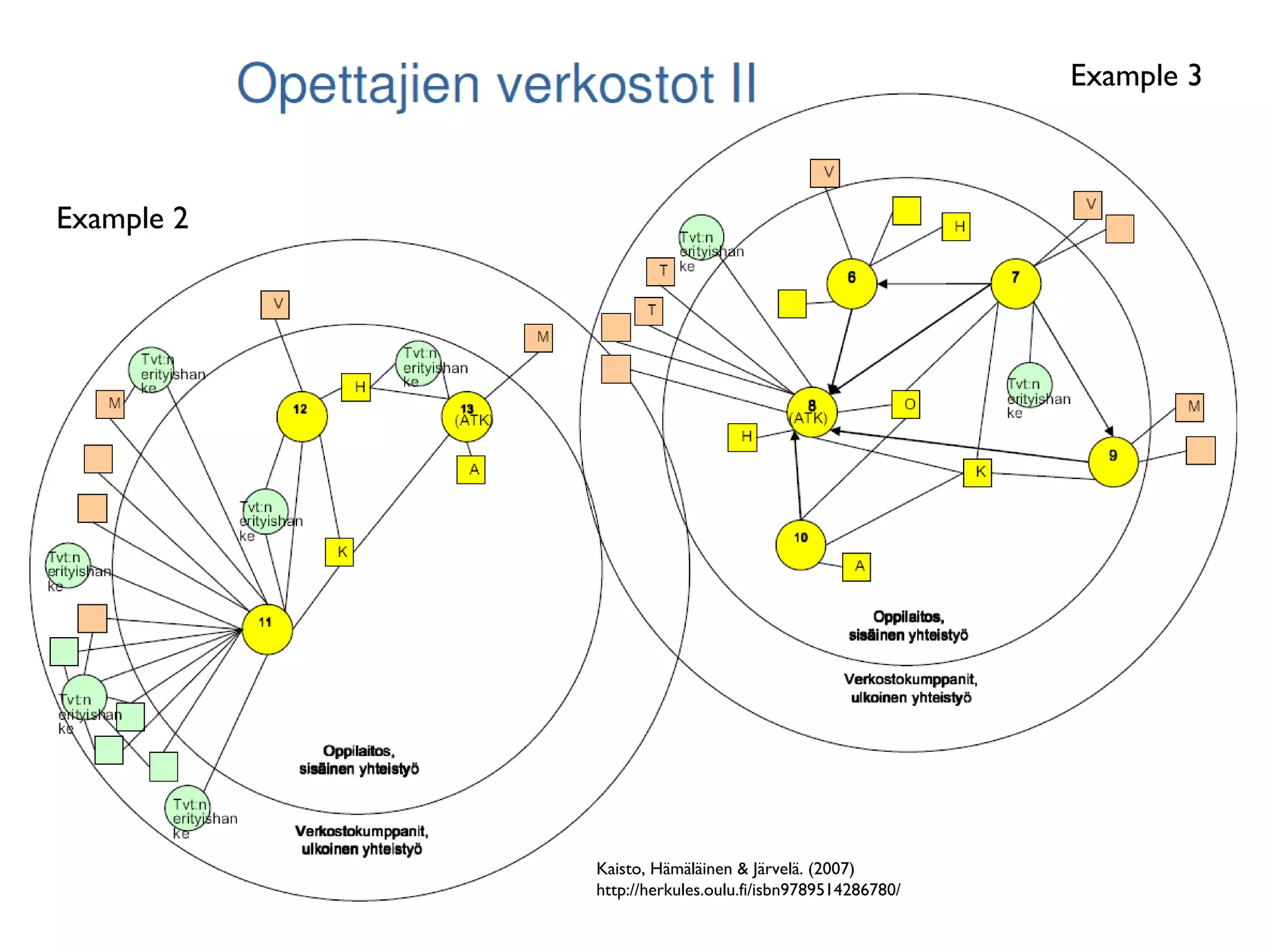
Example 3


Example 2


            Kaisto, Hämäläinen & Järvelä. (2007)
            http://herkules.oulu.fi/isbn9789514286780/
Technology has increased
                    networking and
                  collaboration among
                        teachers
                                               E4       E5


LET.OULU.FI                       niina.impio@oulu.fi
Learning and Educational Technology Research
Unit
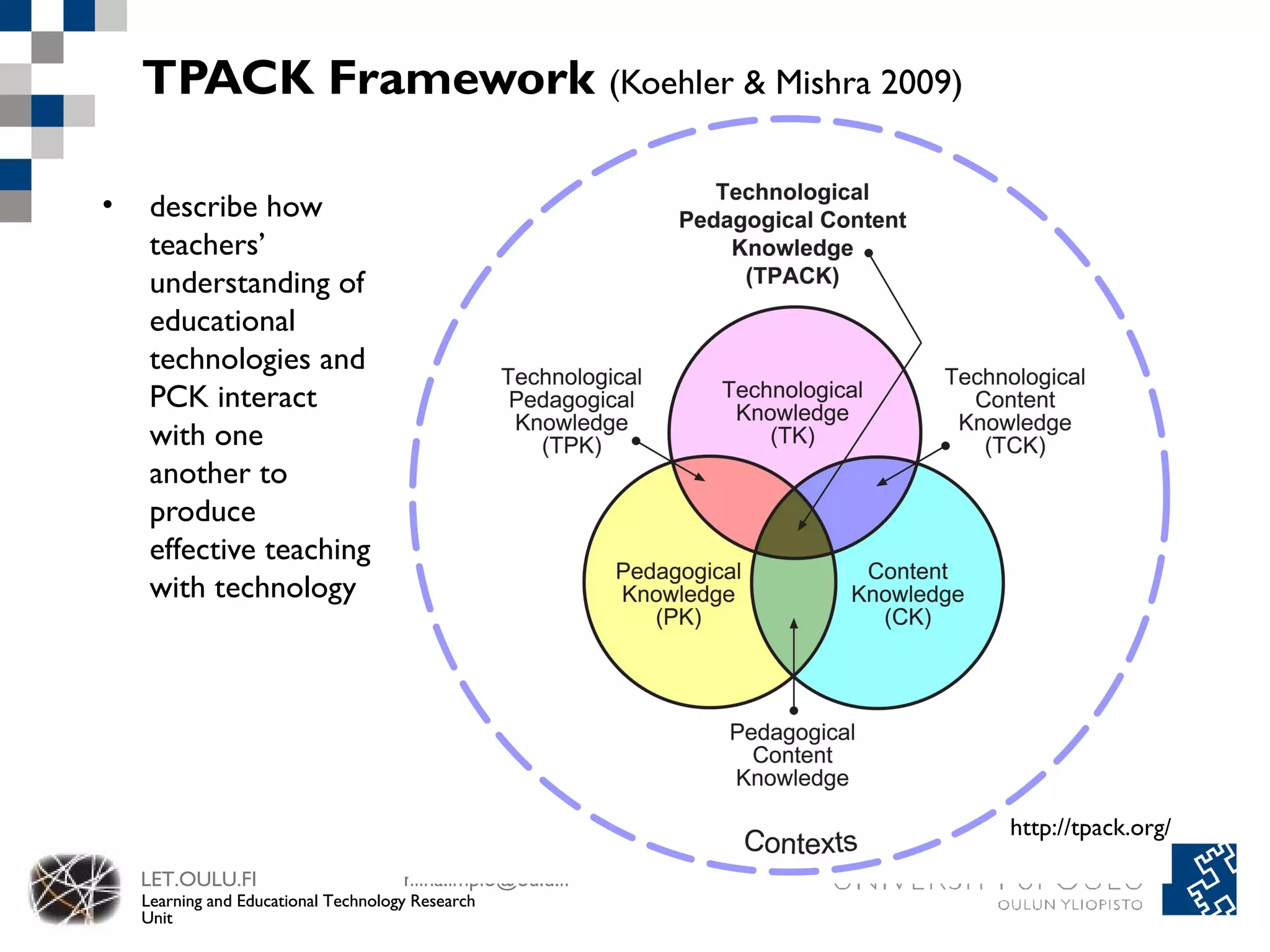
TPACK Framework (Koehler & Mishra 2009)

•    describe how
     teachers’
     understanding of
     educational
     technologies and
     PCK interact
     with one
     another to
     produce
     effective teaching
     with technology


                                                            http://tpack.org/

    LET.OULU.FI                       niina.impio@oulu.fi
    Learning and Educational Technology Research
    Unit
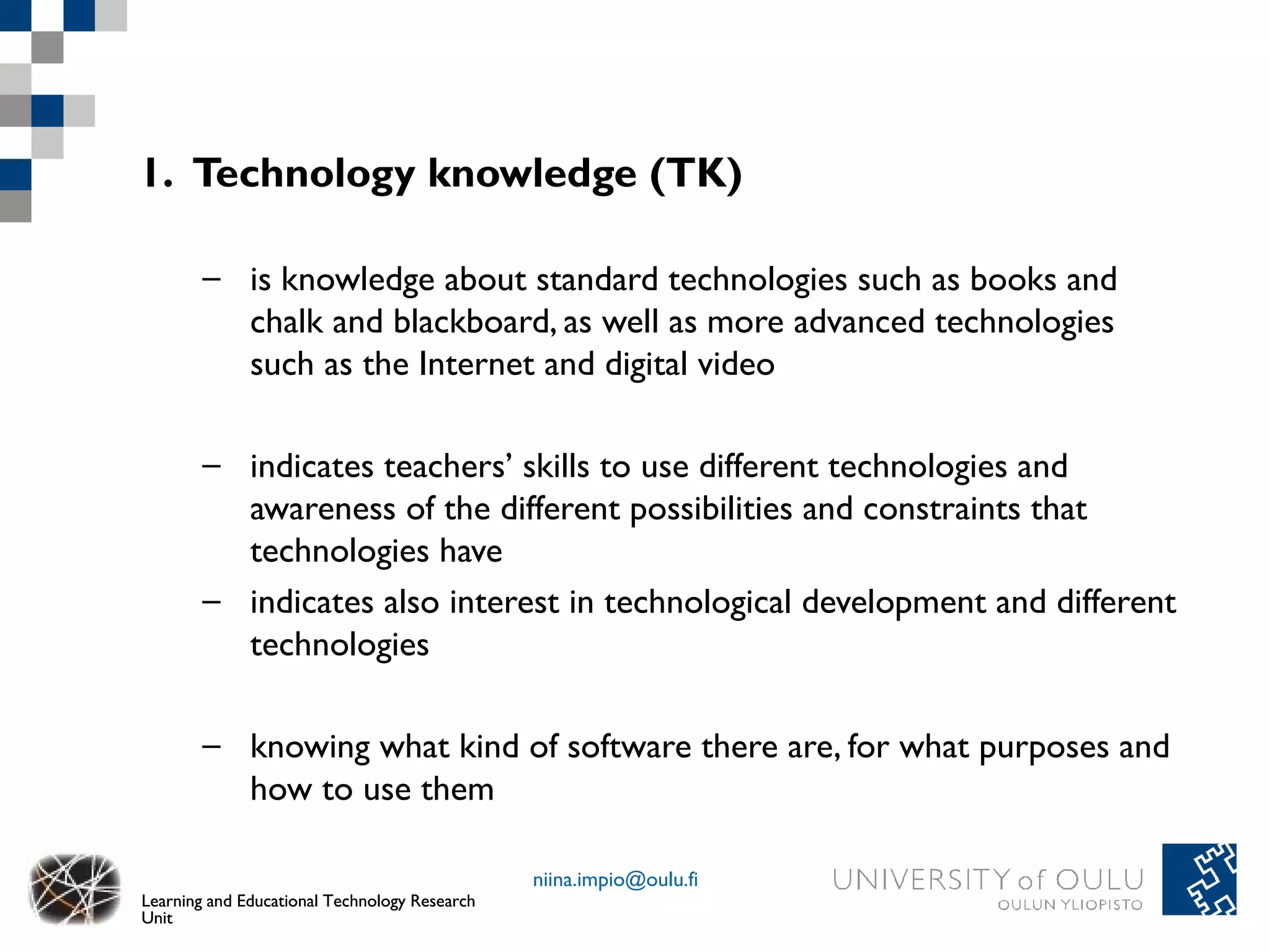
1. Technology knowledge (TK)

        – is knowledge about standard technologies such as books and
          chalk and blackboard, as well as more advanced technologies
          such as the Internet and digital video

        – indicates teachers’ skills to use different technologies and
          awareness of the different possibilities and constraints that
          technologies have
        – indicates also interest in technological development and different
          technologies

        – knowing what kind of software there are, for what purposes and
          how to use them

                                               niina.impio@oulu.fi
Learning and Educational Technology Research
Unit
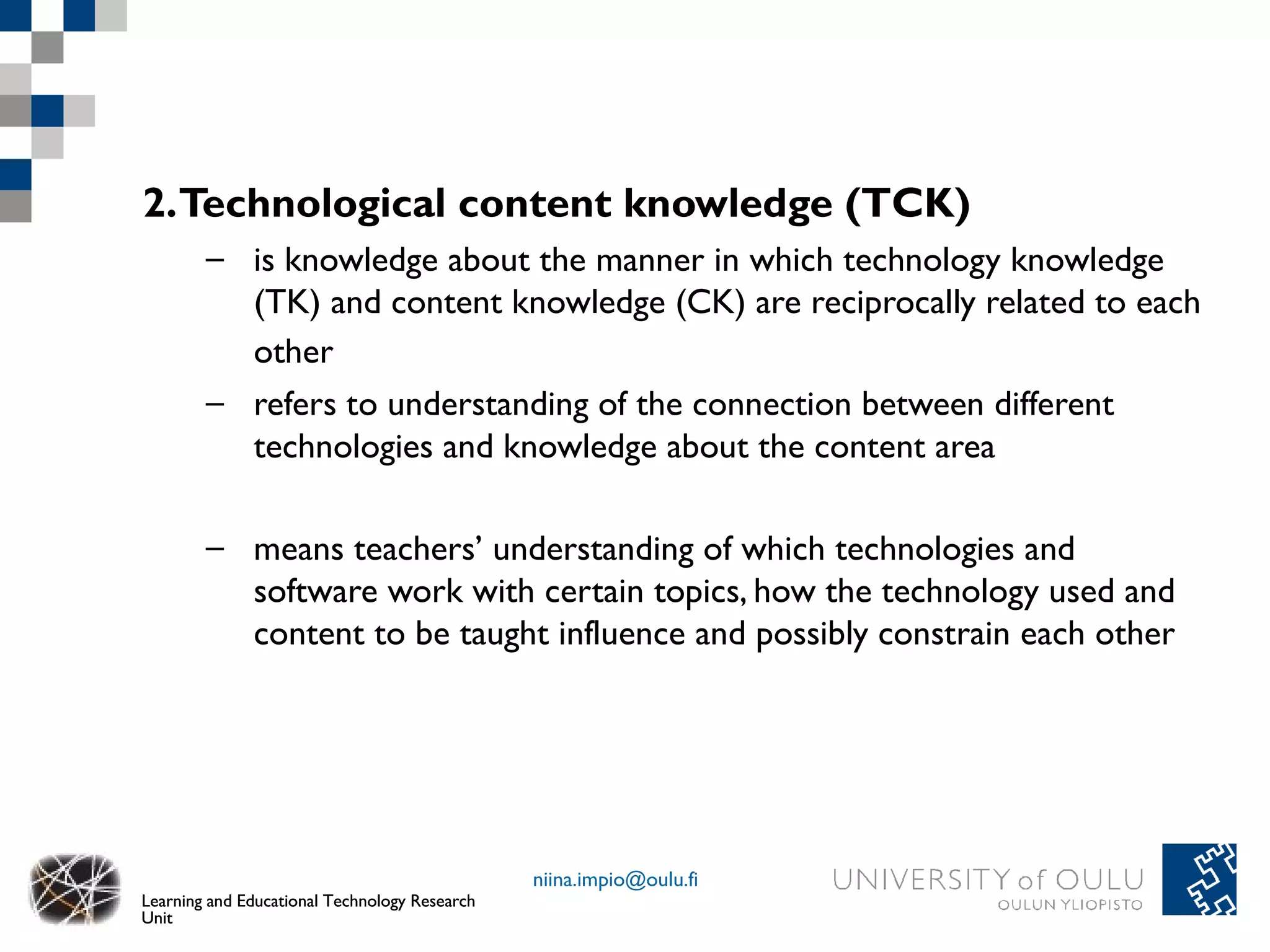
2.Technological content knowledge (TCK)
        – is knowledge about the manner in which technology knowledge
          (TK) and content knowledge (CK) are reciprocally related to each
          other
        – refers to understanding of the connection between different
          technologies and knowledge about the content area

        – means teachers’ understanding of which technologies and
          software work with certain topics, how the technology used and
          content to be taught influence and possibly constrain each other


                                               niina.impio@oulu.fi
Learning and Educational Technology Research
Unit
3.Technological pedagogical knowledge
      – an understanding of various technologies as they are used in teaching and
        learning settings, and conversely, knowing how teaching might change as the
        result of using technologies
      – means understanding how teaching and learning changes when introducing and
        using different technologies
      – refers to understanding of the benefits and constrains of different technologies
        when using them in teaching, indicating deep understanding of the
        characteristics of technologies available.

• This area of knowledge is important when we consider software used in
  teaching. Software such as social software or office tools is rarely designed
  specifically for teaching. This leaves the teacher to decide and apply them
  in teaching based on his or her judgment on the benefits of different tools
  for learning (Valtonen, 2011).


                                                niina.impio@oulu.fi
 Learning and Educational Technology Research
 Unit
LET.OULU.FI                       niina.impio@oulu.fi
Learning and Educational Technology Research
Unit
THANK YOU!


                                         Niina Impiö
                                    (niina.impio@oulu.fi)


                                               niina.impio@oulu.fi
Learning and Educational Technology Research
Unit
References
•    Fullan, M. (2002). The Role of Leadership in the Promotion of Knowledge Management in Schools. Teachers
     and Teaching: theory and practice, 8(3/4), 411-419.
•    Hargreaves, A. (1994). Changing Teachers, Changing Times:Teachers Work and Culture in the Postmodern Age.
     London, Cassell.
•    Hargreaves, D. (1999). The knowledge-creating school. British Journal of Educational Studies, 47(2), 122-144.
•    Ilomäki, L., & Lakkala, M. (2005, August). A framework for investigating school development through ICT. A
     paper presented at the 11th Biennial Conference for Research on Learning and Instruction (EARLI), Nicosia,
     Cyprus.
•    Koehler, M., & Mishra, P. (2005). What happens when teachers design educational technology? The
     development of technological pedagogical content knowledge. Journal of Educational Computing Research, 32
     (2), 131-152.
•    Koehler, M., & Mishra, P. (2009). What is technological pedagogical content knowledge? Contemporary Issues in
     Technology and Teacher Education, 9(1), 60-70. Retrieved from:
     http://www.citejournal.org/vol9/iss1/general/article1.cfm
•    Mishra, P., & Koehler, M.J. (2006). Technological pedagogical content knowledge: A framework for integrating
     technology in teacher knowledge. Teachers College Record, 108(6), 1017-1054.
•    Shulman, L. (1986). Those who understand: Knowledge growth in teaching. Educational Researcher, 15(2), 4-
     14.
•    Shulman, L. (1987). Knowledge and teaching: Foundations of the new reform. Harward Educational Review,
     57(1), 1-21.


                                                   niina.impio@oulu.fi
    Learning and Educational Technology Research
    Unit
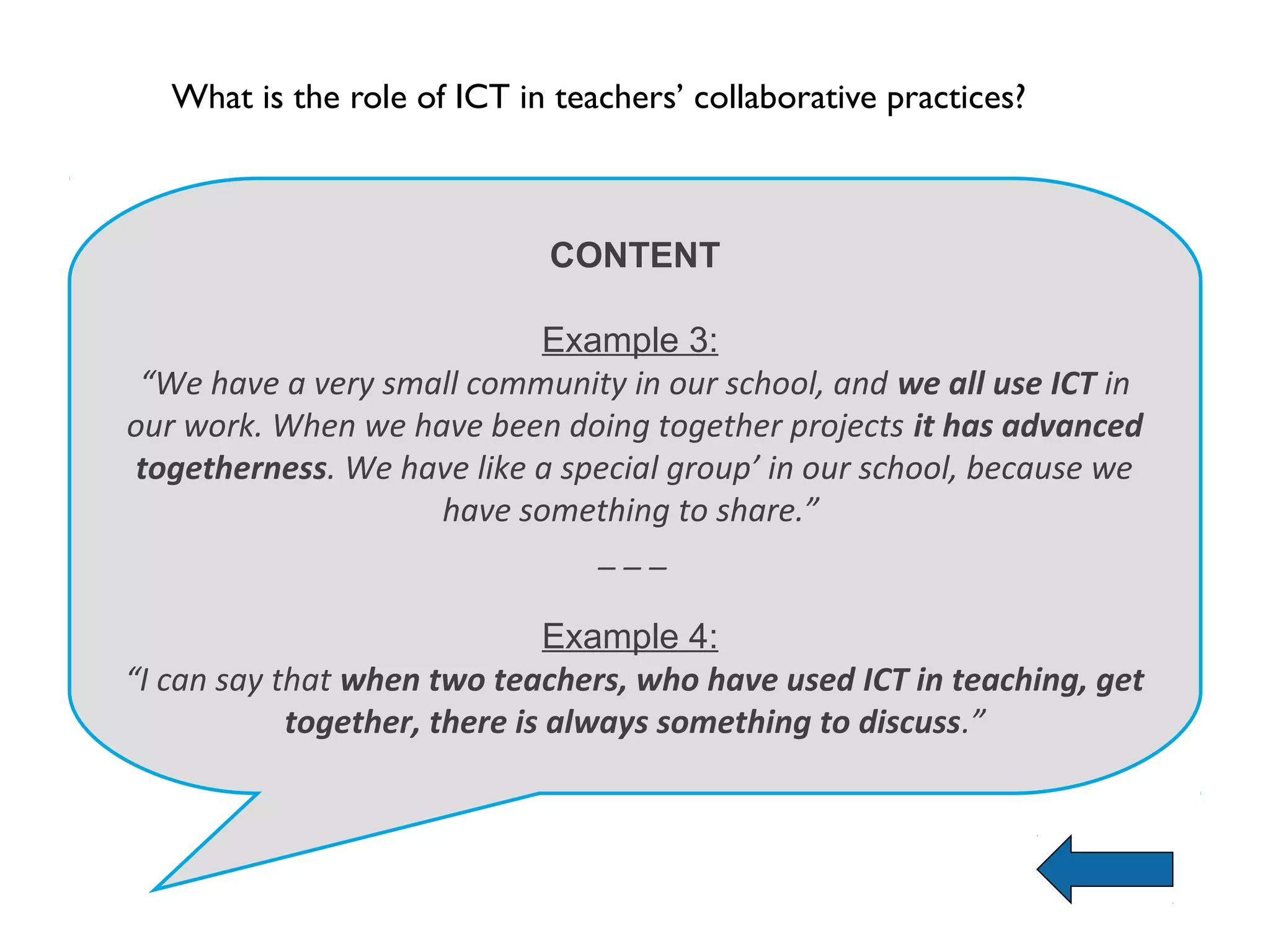
What is the role of ICT in teachers’ collaborative practices?


                             CONTENT

                           Example 3:
 “We have a very small community in our school, and we all use ICT in
our work. When we have been doing together projects it has advanced
togetherness. We have like a special group’ in our school, because we
                    have something to share.”
                               ___

                               Example 4:
“I can say that when two teachers, who have used ICT in teaching, get
            together, there is always something to discuss.”
What is the role of ICT in teachers’
          collaborative practices?


                              TOOL

                             Example 5:
“We got Reissuvihko (management system for register e.g. absences,
  schedules and homeworks) last autumn. [...] it has been incredibly
  good, a huge step in promoting collaboration between home and
 school, and unexpectedly also, and may be more, inside our school,
 promoting communication between workmates. […] Unexpectedly
  this same application has increased information sharing between
                       children and teachers.”
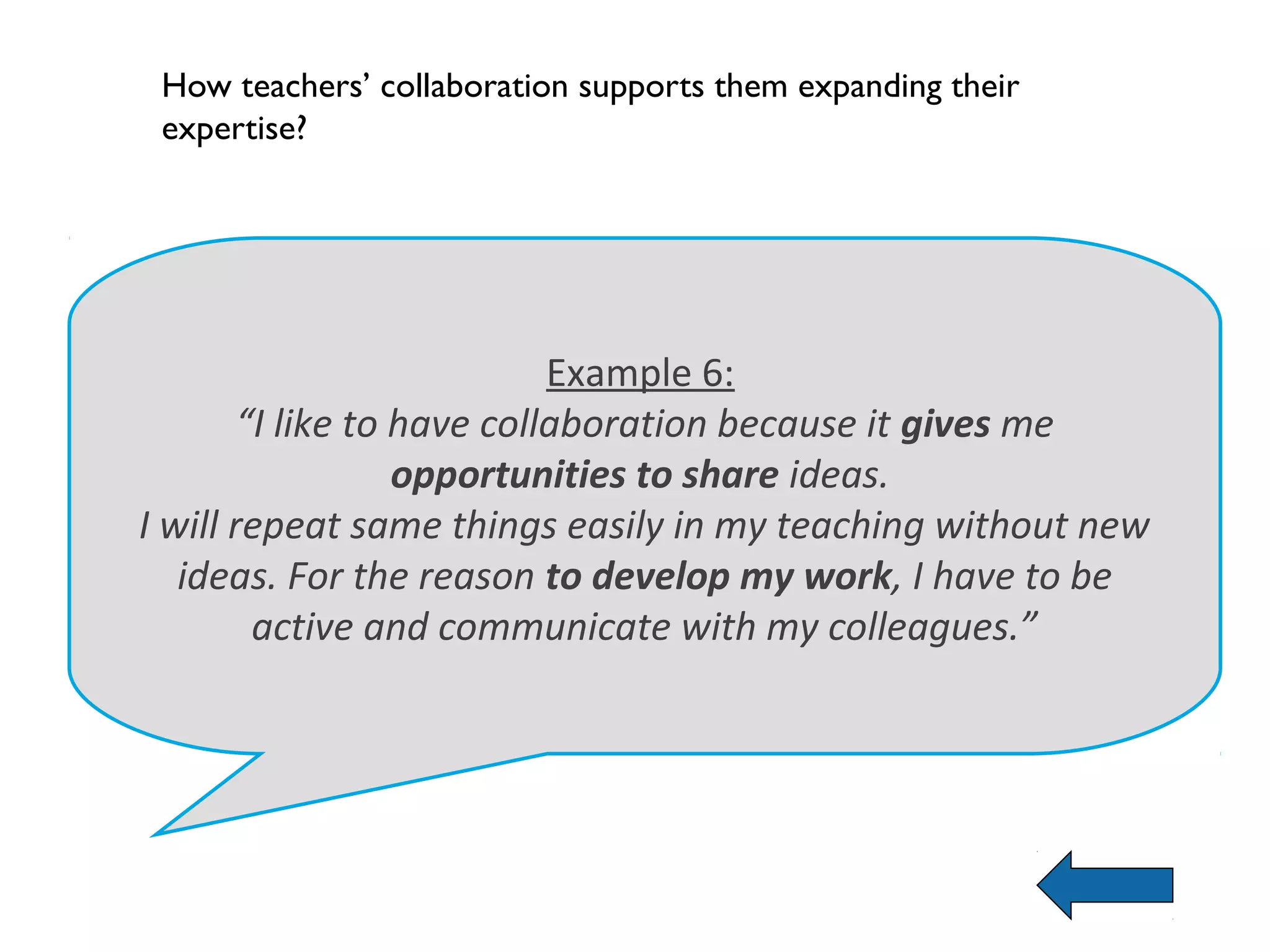
How teachers’ collaboration supports them expanding their
 expertise?


                            Example 6:
        “I like to have collaboration because it gives me
                   opportunities to share ideas.
I will repeat same things easily in my teaching without new
   ideas. For the reason to develop my work, I have to be
         active and communicate with my colleagues.”

Teachers learning 2012

  • 1.
    Teachers’ learning 4.10.2012 Niina Impiö Learning and Educational Technology Research Unit
  • 2.
    Content • Teachers’ knowledge • Teachers’ collaboration • Teachers’ technological pedagogical content knowledge niina.impio@oulu.fi Learning and Educational Technology Research Unit
  • 3.
    Changes at teachers’work • There is ongoing pressure for developmental changes in education (e.g. educational innovations, technology-enhanced learning). • This require both changes in teachers’ ways of thinking about student learning and changes in their teaching practices. • There is a need for changes in knowledge, beliefs, emotions and teaching practices (Bakkenes, Vermunt & Wubbels, 2010). • These changes require continuous teacher professional development (e.g. Sahlberg & Boce, 2010). • Too often educational innovations have failed because they did not recognize the need for teacher learning (c.f Lieberman & Pointer Mace, 2008) niina.impio@oulu.fi Learning and Educational Technology Research Unit
  • 4.
    • When thereis need to change the pedagogy of the school, teachers are expected to adapt their way of teaching accordingly. They have to – develop another vision on learning and teaching – be motivated to learn about the new pedagogy – understand what the innovation is good for – develop skills to bring the innovation into practice – form experiments with the new pedagogy in order to learn – form part of a community of teachers who all are learning new things  Teaching is highly demanding, high-performance profession in which teachers must rapidly make many decisions in a highly complex and time- pressured conditions  We have to see teachers as the adaptive expertisers (e.g. Crawford, Schlager, Toyama, Riel & Vahey, 2005) niina.impio@oulu.fi Learning and Educational Technology Research Unit
  • 5.
    Teachers’ Learning •In recent years, teacher learning has become an important topic in educational research. • How teachers learn at work? – learning by experimenting – learning in interaction – using external sources – consciously thinking about one’s own teaching practices (Kwakman 2003, Lohma & Woolf 2001, Van Eekelen et al. 2005) niina.impio@oulu.fi Learning and Educational Technology Research Unit
  • 6.
    Teachers’ Learning • Teachers’conceptions of learning direct their teaching practices, it providing a pedagogical frame for teaching methods they use. • Conceptions of learning relate closely to the concept of pedagogical content knowledge (PCK) (Shulman 1986; 1987) – Three components of knowledge Pedagogical knowledge (PK) Content Knowledge (CK) Pedagogical Content Knowledge (PCK) niina.impio@oulu.fi Learning and Educational Technology Research Unit
  • 7.
    • Pedagogical knowledge(PK) – is teachers’ deep knowledge about the processes and practices or methods of teaching and learning – applies to understanding how students learn, general classroom management skills, lesson planning, and student assessment – A teacher with deep pedagogical knowledge undestands how students construct knowledge and acquire skills and how they develop habits of mind and positive dispositions towards learning. As such, pedagogical knowledge requires an understanding of cognitive, social, and developmental theories of learning and how they apply to students in the classroom. niina.impio@oulu.fi Learning and Educational Technology Research Unit
  • 8.
    • Content Knowledge(CK) – is teachers’ knowledge about the subject matter to be learned or taught – would include knowledge of concepts, theories, ideas, organizational frameworks, knowledge of evidence and proof, as well as established practices and approaches toward developing such knowledge • Pedagogical Content Knowledge (PCK) – transformation of the subject matter for teaching – transformation occurs as the teacher interprets the subject matter, finds multiple ways to represent it, and adapts and tailors the instructional materials to alternative conceptions and students’ prior knowledge – covers the core business of teaching, learning, curriculum, assessment and reporting, such as the conditions that promote learning and the links among curriculumn, assessment, and pedagogy niina.impio@oulu.fi Learning and Educational Technology Research Unit
  • 9.
    • Collaboration andit’s impact on pedagogical practices is important for teachers’ professional development. (Barab & Squire, 2002; Barab, Makinster & Scheckler, 2003; Goddard, Hoy & Woolfolk Hoy, 2004 Yuen, Law & Wong, 2003). • Despite increased collaboration between teachers and between schools, it seems that teachers’ collaborative working culture still needs to be developed (e.g. Ilomäki, 2008). niina.impio@oulu.fi Learning and Educational Technology Research Unit
  • 10.
    COLLABORATIVE LEARNING (e.g. Dillenbourg, 1999; Roschelle & Teasley, 1995) • “a coordinated synchronous activity that is the result of continued attempt to construct and maintain a shared conception of a problem” (Roschelle & Teasley, 1995) • “is a situation in which two or more people learn or attempt to learn something together” (Dillenbourg, 1999) • Activities characterized as teachers collaboration – Joint teaching and collaborative teaching methods – Interaction between colleagues and others – F2f and computer-mediated interaction – Joint problem solving processes  pedagogical innovations niina.impio@oulu.fi Learning and Educational Technology Research Unit
  • 11.
    E6 Askingand explaining Knowledge sharing Collaborative working starts effective learning mechanism. Learn from others Argumentation and learning and teaching giving feedback strategies (esim. Dillenbourg, 1999; Roschelle & Teasley, 1995) niina.impio@oulu.fi Learning and Educational Technology Research Unit
  • 12.
    Learn to workcollaboratively! Teachers are more willing and Teachers feel that due to Teachers’ attitudes toward being familiar with feel more capable to use collaborative work has collaborative learning both in collaborative teaching methods in changed, which has theory and practice, they are their work after they have had influenced to their work more confident to own experiences from both in teaching methods recommend collaborative learning, and after and collaboration with collaborative working they have studied theories of colleagues. methods while working collaborative learning. together with colleagues. (Impiö, 2011)
  • 13.
    Collaboration among teachers (Little, 1990; Rosenholtz, 1989) • FIRST LEVEL ”storytelling and scanning” – occurs in staff rooms or in hallways – moment-by-moment exchanges • SECOND LEVEL ”aid and assistance” – critically look one’s teaching practice • THIRD LEVEL ”sharing” or ”exchaning instructional materials and ideas” – regularly sharing materials, methods an opinions – allow teachers to make their daily teaching routines accessible to other teachers which promotes productive discussions of the curriculum • FOURTH LEVEL ”joint work” or ”instructional problem-solving and planning” – teachers feel a collective responsibility for the work of teaching niina.impio@oulu.fi Learning and Educational Technology Research Unit
  • 14.
    Multilevel model of The goals of the school 5 an innovative, The content of the vision, The vision of using ICT, knowledge-creating The content of school's strategy for using school ICT, The importance and centrality of the visions and strategies. Expert-like working culture in Pedagogical practices The ICT resources the school Pedagogical conceptions in Adequateness of the ICT- Practices for sharing knowledge general, resources, and distributing expertise, Conceptions of the pedagogical Technical equipment, Networking: principal, teachers use of ICT, The level of students’ and and students; both internal and Learning tasks that exploit ICT, teachers’ skills and use of external, Support for knowledge ICT, Commonly agreed and management skills, Technical and pedagogical appropriate ways of working, ICT as school's common support available Community's collective pedagogical tool memory, common development projects. Leadership Teacher community's working culture The role of the principal, Uniformity of the visions, Pedagogical collaboration and its density, Shared leadership and Sharing of expertise, responsible teams, Community’s internal networking, Principal's networking. Discussion culture, Development culture. Ilomäki and Lakkala, 2005
  • 15.
    TEACHERS’ NETWORKS Example 1 Kaisto, Hämäläinen & Järvelä. (2007) http://herkules.oulu.fi/isbn9789514286780/
  • 16.
    Example 3 Example 2 Kaisto, Hämäläinen & Järvelä. (2007) http://herkules.oulu.fi/isbn9789514286780/
  • 17.
    Technology has increased networking and collaboration among teachers E4 E5 LET.OULU.FI niina.impio@oulu.fi Learning and Educational Technology Research Unit
  • 18.
    TPACK Framework (Koehler& Mishra 2009) • describe how teachers’ understanding of educational technologies and PCK interact with one another to produce effective teaching with technology http://tpack.org/ LET.OULU.FI niina.impio@oulu.fi Learning and Educational Technology Research Unit
  • 19.
    1. Technology knowledge(TK) – is knowledge about standard technologies such as books and chalk and blackboard, as well as more advanced technologies such as the Internet and digital video – indicates teachers’ skills to use different technologies and awareness of the different possibilities and constraints that technologies have – indicates also interest in technological development and different technologies – knowing what kind of software there are, for what purposes and how to use them niina.impio@oulu.fi Learning and Educational Technology Research Unit
  • 20.
    2.Technological content knowledge(TCK) – is knowledge about the manner in which technology knowledge (TK) and content knowledge (CK) are reciprocally related to each other – refers to understanding of the connection between different technologies and knowledge about the content area – means teachers’ understanding of which technologies and software work with certain topics, how the technology used and content to be taught influence and possibly constrain each other niina.impio@oulu.fi Learning and Educational Technology Research Unit
  • 21.
    3.Technological pedagogical knowledge – an understanding of various technologies as they are used in teaching and learning settings, and conversely, knowing how teaching might change as the result of using technologies – means understanding how teaching and learning changes when introducing and using different technologies – refers to understanding of the benefits and constrains of different technologies when using them in teaching, indicating deep understanding of the characteristics of technologies available. • This area of knowledge is important when we consider software used in teaching. Software such as social software or office tools is rarely designed specifically for teaching. This leaves the teacher to decide and apply them in teaching based on his or her judgment on the benefits of different tools for learning (Valtonen, 2011). niina.impio@oulu.fi Learning and Educational Technology Research Unit
  • 22.
    LET.OULU.FI niina.impio@oulu.fi Learning and Educational Technology Research Unit
  • 23.
    THANK YOU! Niina Impiö (niina.impio@oulu.fi) niina.impio@oulu.fi Learning and Educational Technology Research Unit
  • 24.
    References • Fullan, M. (2002). The Role of Leadership in the Promotion of Knowledge Management in Schools. Teachers and Teaching: theory and practice, 8(3/4), 411-419. • Hargreaves, A. (1994). Changing Teachers, Changing Times:Teachers Work and Culture in the Postmodern Age. London, Cassell. • Hargreaves, D. (1999). The knowledge-creating school. British Journal of Educational Studies, 47(2), 122-144. • Ilomäki, L., & Lakkala, M. (2005, August). A framework for investigating school development through ICT. A paper presented at the 11th Biennial Conference for Research on Learning and Instruction (EARLI), Nicosia, Cyprus. • Koehler, M., & Mishra, P. (2005). What happens when teachers design educational technology? The development of technological pedagogical content knowledge. Journal of Educational Computing Research, 32 (2), 131-152. • Koehler, M., & Mishra, P. (2009). What is technological pedagogical content knowledge? Contemporary Issues in Technology and Teacher Education, 9(1), 60-70. Retrieved from: http://www.citejournal.org/vol9/iss1/general/article1.cfm • Mishra, P., & Koehler, M.J. (2006). Technological pedagogical content knowledge: A framework for integrating technology in teacher knowledge. Teachers College Record, 108(6), 1017-1054. • Shulman, L. (1986). Those who understand: Knowledge growth in teaching. Educational Researcher, 15(2), 4- 14. • Shulman, L. (1987). Knowledge and teaching: Foundations of the new reform. Harward Educational Review, 57(1), 1-21. niina.impio@oulu.fi Learning and Educational Technology Research Unit
  • 25.
    What is therole of ICT in teachers’ collaborative practices? CONTENT Example 3: “We have a very small community in our school, and we all use ICT in our work. When we have been doing together projects it has advanced togetherness. We have like a special group’ in our school, because we have something to share.” ___ Example 4: “I can say that when two teachers, who have used ICT in teaching, get together, there is always something to discuss.”
  • 26.
    What is therole of ICT in teachers’ collaborative practices? TOOL Example 5: “We got Reissuvihko (management system for register e.g. absences, schedules and homeworks) last autumn. [...] it has been incredibly good, a huge step in promoting collaboration between home and school, and unexpectedly also, and may be more, inside our school, promoting communication between workmates. […] Unexpectedly this same application has increased information sharing between children and teachers.”
  • 27.
    How teachers’ collaborationsupports them expanding their expertise? Example 6: “I like to have collaboration because it gives me opportunities to share ideas. I will repeat same things easily in my teaching without new ideas. For the reason to develop my work, I have to be active and communicate with my colleagues.”

Editor's Notes

  • #4 In recent years, teachers’ ways of working have developed from being independent experts to active members of collaborative knowledge sharing. Studies focusing on teachers’ professional development have emphasized the importance of collaboration and it’s impact on pedagogical practices. Teachers who have an important role in a school’s community are more likely to use collaborative instructional strategies in their classrooms . TÄHÄN JOTAKIN KOKOAVAA!
  • #19 Pedagogical content knowledge has been developed further to include a view of using ICT in teaching, resulting in the concept of technological pedagogical content knowledge (TPCK) (Mishra & Koehler, 2006; Koehler & Mishra, 2009).