Channing Shattuck
NATION
REPORT
No butts about it, the Argentina people are a vibrant
culture – as enthusiastic and proud of their country as
any other nation. Most Argentineans originated from
Italy and Spain with smaller percentages ranging from
other European nations and onwards. It would be safe
to say that Argentina is a nation largely made up of
immigrants.
PEOPLE
The religion most practiced in Argentina is Roman
Catholicism. The official language that is spoken is
Spanish, yet Argentinian Spanish is different from
original Spanish. According to kwintessential.com,
Argentinian Spanish sounds much more like Italian than
Spanish from Spain.
PEOPLE
The culture of Argentina is strongly
borrowed from the various immigrants that populated it.
The culture is based mainly off a Spanish heritage, with
strong Catholic ties. There is also a name that is given to
the populace, a “guacho”, meaning a person from
Southern America with Indian and Spanish decent. The
main language of the land is Spanish. There is a strong
fascination from the culture with soccer (better known
as futbol in the country).
CULTURE
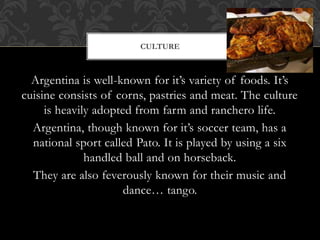
Argentina is well-known for it’s variety of foods. It’s
cuisine consists of corns, pastries and meat. The culture
is heavily adopted from farm and ranchero life.
Argentina, though known for it’s soccer team, has a
national sport called Pato. It is played by using a six
handled ball and on horseback.
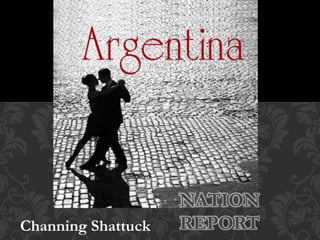
They are also feverously known for their music and
dance… tango.
CULTURE
Argentina shares borders with Bolivia, Paraguay, Brazil,
Uruguay, and Chile. The capital of Argentina is the
beautiful riverside city of Buenos Aires. Buenos Aires
has remained the heart of the country, being the hotspot
for economic, political and social life. Some of the main
industries of Argentina include meat-packing,
flourmilling, metalcrafting, electrical equipment,
chemicals, drugs, leather goods, and textiles because of
the prime location and the resources available.
GEOGRAPHY
Argentina has a current population of about 39,144,753
people. The ethnicity that majorly makes up the
population is Hispanic white, mostly originating from
Spain and Italy. The percentage of them? 98%!
The climate of Argentina is mostly temperate, being
described as arid in the southeast and subantartic in the
south west, according to kwintessential.com.
GEOGRAPHY
Argentina has several stages of history. The first is
known as the Precolumbian time. After that (1500’s to
1800) was known as the colonial period. Next is post-
colonial, then lastly is the modern Argentina, being from
the late 1800’s to now.
HISTORY
Where things started happening was the colonial period,
basically this is when the Spaniards arrived. With the
arrival of the Spanish came their form of government,
known as Viceroyalty. Wars for independence would rage
during the time of the post colonial age, and the result
was a new united nation. Modern Argentina boomed
from improvements in agriculture, foreign investment,
and new railroads and ports. Masses of immigration
poured in from Europe.
HISTORY
http://en.wikipedia.org/wiki/Argentinian#Architecture.2C_painting_and_scu
lpture
http://www.kwintessential.co.uk/resources/global-etiquette/argentina.html
http://www.mibuenosairesquerido.com/wArgentina3.htm
https://www.cia.gov/library/publications/the-world-factbook/geos/ar.html

Nation report

  • 1.
  • 2.
    No butts aboutit, the Argentina people are a vibrant culture – as enthusiastic and proud of their country as any other nation. Most Argentineans originated from Italy and Spain with smaller percentages ranging from other European nations and onwards. It would be safe to say that Argentina is a nation largely made up of immigrants. PEOPLE
  • 3.
    The religion mostpracticed in Argentina is Roman Catholicism. The official language that is spoken is Spanish, yet Argentinian Spanish is different from original Spanish. According to kwintessential.com, Argentinian Spanish sounds much more like Italian than Spanish from Spain. PEOPLE
  • 4.
    The culture ofArgentina is strongly borrowed from the various immigrants that populated it. The culture is based mainly off a Spanish heritage, with strong Catholic ties. There is also a name that is given to the populace, a “guacho”, meaning a person from Southern America with Indian and Spanish decent. The main language of the land is Spanish. There is a strong fascination from the culture with soccer (better known as futbol in the country). CULTURE
  • 5.
    Argentina is well-knownfor it’s variety of foods. It’s cuisine consists of corns, pastries and meat. The culture is heavily adopted from farm and ranchero life. Argentina, though known for it’s soccer team, has a national sport called Pato. It is played by using a six handled ball and on horseback. They are also feverously known for their music and dance… tango. CULTURE
  • 6.
    Argentina shares borderswith Bolivia, Paraguay, Brazil, Uruguay, and Chile. The capital of Argentina is the beautiful riverside city of Buenos Aires. Buenos Aires has remained the heart of the country, being the hotspot for economic, political and social life. Some of the main industries of Argentina include meat-packing, flourmilling, metalcrafting, electrical equipment, chemicals, drugs, leather goods, and textiles because of the prime location and the resources available. GEOGRAPHY
  • 7.
    Argentina has acurrent population of about 39,144,753 people. The ethnicity that majorly makes up the population is Hispanic white, mostly originating from Spain and Italy. The percentage of them? 98%! The climate of Argentina is mostly temperate, being described as arid in the southeast and subantartic in the south west, according to kwintessential.com. GEOGRAPHY
  • 8.
    Argentina has severalstages of history. The first is known as the Precolumbian time. After that (1500’s to 1800) was known as the colonial period. Next is post- colonial, then lastly is the modern Argentina, being from the late 1800’s to now. HISTORY
  • 9.
    Where things startedhappening was the colonial period, basically this is when the Spaniards arrived. With the arrival of the Spanish came their form of government, known as Viceroyalty. Wars for independence would rage during the time of the post colonial age, and the result was a new united nation. Modern Argentina boomed from improvements in agriculture, foreign investment, and new railroads and ports. Masses of immigration poured in from Europe. HISTORY
  • 10.