Argentina: Part 1Jean Lowry50587
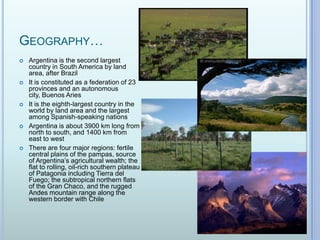
Geography…Argentina is the second largest country in South America by land area, after BrazilIt is constituted as a federation of 23 provinces and an autonomous city, Buenos AriesIt is the eighth-largest country in the world by land area and the largest among Spanish-speaking nationsArgentina is about 3900 km long from north to south, and 1400 km from east to westThere are four major regions: fertile central plains of the pampas, source of Argentina’s agricultural wealth; the flat to rolling, oil-rich southern plateau of Patagonia including Tierra del Fuego; the subtropical northern flats of the Gran Chaco, and the rugged Andes mountain range along the western border with Chile
Geography… Cont’dThe highest point above sea level is in Mendoza province at Cerro Aconcagua, also the highest point in the Southern and Western HemisphereThe lowest point is Laguna del Carbon in Santa Cruz provinceThe geographic center of the country is in south-central La Pampa provinceThe major rivers are Paraná(the largest), the Pilcomayo, Paraguay, Bermejo, Colorado, Rio Negro, Salado and UruguayThe Paraná and the Uruguay join to form the Rio de la Plata estuary, before reaching the AtlanticRegionally important rivers are the Atuel and Mendoza in the homonymous province, the Chubut in Patagonia, the Rio Grande in Jujuy and the San Francisco River in Salta
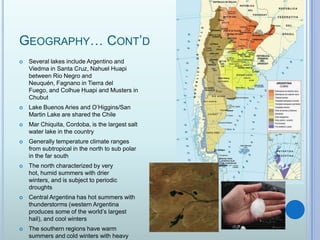
Geography… Cont’dSeveral lakes include Argentino and Viedma in Santa Cruz, Nahuel Huapi between Rio Negro and Neuquén, Fagnano in Tierra del Fuego, and Colhue Huapi and Musters in ChubutLake Buenos Aries and O’Higgins/San Martin Lake are shared the ChileMar Chiquita, Cordoba, is the largest salt water lake in the countryGenerally temperature climate ranges from subtropical in the north to sub polar in the far southThe north characterized by very hot, humid summers with drier winters, and is subject to periodic droughtsCentral Argentina has hot summers with thunderstorms (western Argentina produces some of the world’s largest hail), and cool wintersThe southern regions have warm summers and cold winters with heavy snowfall, especially in mountainous zones
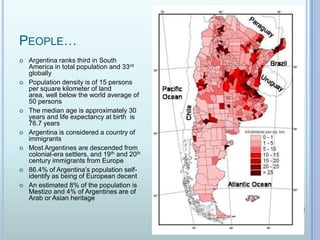
People…Argentina ranks third in South America in total population and 33rd globallyPopulation density is of 15 persons per square kilometer of land area, well below the world average of 50 personsThe median age is approximately 30 years and life expectancy at birth  is 76.7 yearsArgentina is considered a country of immigrantsMost Argentines are descended from colonial-era settlers, and 19th and 20th century immigrants from Europe86.4% of Argentina’s population self-identify as being of European decentAn estimated 8% of the population is Mestizo and 4% of Argentines are of Arab or Asian heritage
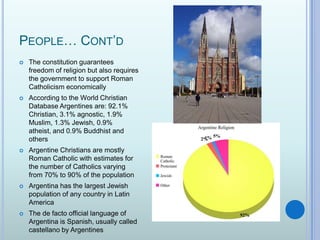
People… Cont’dThe constitution guarantees freedom of religion but also requires the government to support Roman Catholicism economicallyAccording to the World Christian Database Argentines are: 92.1% Christian, 3.1% agnostic, 1.9% Muslim, 1.3% Jewish, 0.9% atheist, and 0.9% Buddhist and othersArgentine Christians are mostly Roman Catholic with estimates for the number of Catholics varying from 70% to 90% of the populationArgentina has the largest Jewish population of any country in Latin AmericaThe de facto official language of Argentina is Spanish, usually called castellano by Argentines
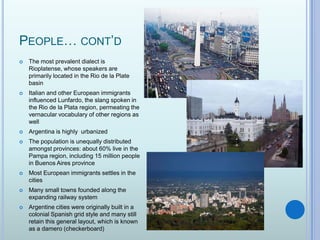
People… cont’dThe most prevalent dialect is Rioplatense, whose speakers are primarily located in the Rio de la Plate basinItalian and other European immigrants influenced Lunfardo, the slang spoken in the Rio de la Plata region, permeating the vernacular vocabulary of other regions as wellArgentina is highly  urbanizedThe population is unequally distributed amongst provinces: about 60% live in the Pampa region, including 15 million people in Buenos Aires provinceMost European immigrants settles in the citiesMany small towns founded along the expanding railway systemArgentine cities were originally built in a colonial Spanish grid style and many still retain this general layout, which is known as a damero (checkerboard)
History…The earliest evidence of humans in Argentina dates from 11,000 BC and was found in PatagoniaEuropean explorers arrived in 1516; Spain established the Viceroyalty of Peru in 1542, encompassing all its holdings in South AmericaTheir first settlement in modern Argentina was the Fort of Sancti Spiritu established in 1527 next to the  Paraná RiverBuenos Aires, a permanent colony, was established in 1536 but was destroyed by nativesThe area which encompassed much of the territory that would later become Argentina was largely a territory of  Spanish immigrants and their descendants (known as  criollos),  mestizos, native cultures, and descendants of African slavesWar for independence ensued in the former Viceroyalty, its regions divided between patriots and royalists
History… Cont’dThe cities of present-day Argentina would align with the independents after 1811, the other regions would follow differing paths: Paraguay secede, declaring its independence from Spain 1811 and from Argentina in 1842Upper Peru was disputed with the royalists from Peru until it declared independence as Bolivia in 1824Internal conflicts would cause political instability within the patriotsIn 1813 an Assembly convened to declare independence but it could not do so due to political disputesThe military campaign became the responsibility of Jose de San Martin, who led an army across the Andes in 1817 and defeated the Chilean royalistsA new constitution was enacted in 1826, during the War with Brazil, when Bernardino Rivadavia was elected the first President of ArgentinaThis constitution was soon rejected by the provinces, due to its Centralist bias, and Rivadavia resigned shortly after; The provinces then reorganized themselves as the Argentine Confederation, a loose confederation of provinces that lacked a common head of state
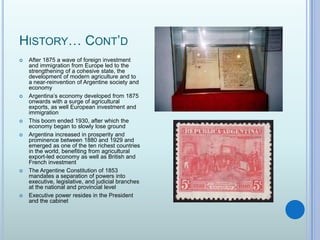
History… Cont’dAfter 1875 a wave of foreign investment and immigration from Europe led to the strengthening of a cohesive state, the development of modern agriculture and to a near-reinvention of Argentine society and economyArgentina’s economy developed from 1875 onwards with a surge of agricultural exports, as well European investment and immigrationThis boom ended 1930, after which the economy began to slowly lose groundArgentina increased in prosperity and prominence between 1880 and 1929 and emerged as one of the ten richest countries in the world, benefiting from agricultural export-led economy as well as British and French investmentThe Argentine Constitution of 1853 mandates a separation of powers into executive, legislative, and judicial branches at the national and provincial levelExecutive power resides in the President and the cabinet
Sources…"Argentina." Wikipedia, the Free Encyclopedia. Web. 25 July 2011. <http://en.wikipedia.org/wiki/Argentina>.

Argentina

  • 1.
  • 2.
    Geography…Argentina is thesecond largest country in South America by land area, after BrazilIt is constituted as a federation of 23 provinces and an autonomous city, Buenos AriesIt is the eighth-largest country in the world by land area and the largest among Spanish-speaking nationsArgentina is about 3900 km long from north to south, and 1400 km from east to westThere are four major regions: fertile central plains of the pampas, source of Argentina’s agricultural wealth; the flat to rolling, oil-rich southern plateau of Patagonia including Tierra del Fuego; the subtropical northern flats of the Gran Chaco, and the rugged Andes mountain range along the western border with Chile
  • 3.
    Geography… Cont’dThe highestpoint above sea level is in Mendoza province at Cerro Aconcagua, also the highest point in the Southern and Western HemisphereThe lowest point is Laguna del Carbon in Santa Cruz provinceThe geographic center of the country is in south-central La Pampa provinceThe major rivers are Paraná(the largest), the Pilcomayo, Paraguay, Bermejo, Colorado, Rio Negro, Salado and UruguayThe Paraná and the Uruguay join to form the Rio de la Plata estuary, before reaching the AtlanticRegionally important rivers are the Atuel and Mendoza in the homonymous province, the Chubut in Patagonia, the Rio Grande in Jujuy and the San Francisco River in Salta
  • 4.
    Geography… Cont’dSeveral lakesinclude Argentino and Viedma in Santa Cruz, Nahuel Huapi between Rio Negro and Neuquén, Fagnano in Tierra del Fuego, and Colhue Huapi and Musters in ChubutLake Buenos Aries and O’Higgins/San Martin Lake are shared the ChileMar Chiquita, Cordoba, is the largest salt water lake in the countryGenerally temperature climate ranges from subtropical in the north to sub polar in the far southThe north characterized by very hot, humid summers with drier winters, and is subject to periodic droughtsCentral Argentina has hot summers with thunderstorms (western Argentina produces some of the world’s largest hail), and cool wintersThe southern regions have warm summers and cold winters with heavy snowfall, especially in mountainous zones
  • 5.
    People…Argentina ranks thirdin South America in total population and 33rd globallyPopulation density is of 15 persons per square kilometer of land area, well below the world average of 50 personsThe median age is approximately 30 years and life expectancy at birth is 76.7 yearsArgentina is considered a country of immigrantsMost Argentines are descended from colonial-era settlers, and 19th and 20th century immigrants from Europe86.4% of Argentina’s population self-identify as being of European decentAn estimated 8% of the population is Mestizo and 4% of Argentines are of Arab or Asian heritage
  • 6.
    People… Cont’dThe constitutionguarantees freedom of religion but also requires the government to support Roman Catholicism economicallyAccording to the World Christian Database Argentines are: 92.1% Christian, 3.1% agnostic, 1.9% Muslim, 1.3% Jewish, 0.9% atheist, and 0.9% Buddhist and othersArgentine Christians are mostly Roman Catholic with estimates for the number of Catholics varying from 70% to 90% of the populationArgentina has the largest Jewish population of any country in Latin AmericaThe de facto official language of Argentina is Spanish, usually called castellano by Argentines
  • 7.
    People… cont’dThe mostprevalent dialect is Rioplatense, whose speakers are primarily located in the Rio de la Plate basinItalian and other European immigrants influenced Lunfardo, the slang spoken in the Rio de la Plata region, permeating the vernacular vocabulary of other regions as wellArgentina is highly urbanizedThe population is unequally distributed amongst provinces: about 60% live in the Pampa region, including 15 million people in Buenos Aires provinceMost European immigrants settles in the citiesMany small towns founded along the expanding railway systemArgentine cities were originally built in a colonial Spanish grid style and many still retain this general layout, which is known as a damero (checkerboard)
  • 8.
    History…The earliest evidenceof humans in Argentina dates from 11,000 BC and was found in PatagoniaEuropean explorers arrived in 1516; Spain established the Viceroyalty of Peru in 1542, encompassing all its holdings in South AmericaTheir first settlement in modern Argentina was the Fort of Sancti Spiritu established in 1527 next to the Paraná RiverBuenos Aires, a permanent colony, was established in 1536 but was destroyed by nativesThe area which encompassed much of the territory that would later become Argentina was largely a territory of Spanish immigrants and their descendants (known as criollos), mestizos, native cultures, and descendants of African slavesWar for independence ensued in the former Viceroyalty, its regions divided between patriots and royalists
  • 9.
    History… Cont’dThe citiesof present-day Argentina would align with the independents after 1811, the other regions would follow differing paths: Paraguay secede, declaring its independence from Spain 1811 and from Argentina in 1842Upper Peru was disputed with the royalists from Peru until it declared independence as Bolivia in 1824Internal conflicts would cause political instability within the patriotsIn 1813 an Assembly convened to declare independence but it could not do so due to political disputesThe military campaign became the responsibility of Jose de San Martin, who led an army across the Andes in 1817 and defeated the Chilean royalistsA new constitution was enacted in 1826, during the War with Brazil, when Bernardino Rivadavia was elected the first President of ArgentinaThis constitution was soon rejected by the provinces, due to its Centralist bias, and Rivadavia resigned shortly after; The provinces then reorganized themselves as the Argentine Confederation, a loose confederation of provinces that lacked a common head of state
  • 10.
    History… Cont’dAfter 1875a wave of foreign investment and immigration from Europe led to the strengthening of a cohesive state, the development of modern agriculture and to a near-reinvention of Argentine society and economyArgentina’s economy developed from 1875 onwards with a surge of agricultural exports, as well European investment and immigrationThis boom ended 1930, after which the economy began to slowly lose groundArgentina increased in prosperity and prominence between 1880 and 1929 and emerged as one of the ten richest countries in the world, benefiting from agricultural export-led economy as well as British and French investmentThe Argentine Constitution of 1853 mandates a separation of powers into executive, legislative, and judicial branches at the national and provincial levelExecutive power resides in the President and the cabinet
  • 11.
    Sources…"Argentina." Wikipedia, the FreeEncyclopedia. Web. 25 July 2011. <http://en.wikipedia.org/wiki/Argentina>.