Country Report Part. 1By: Twyla Gollery
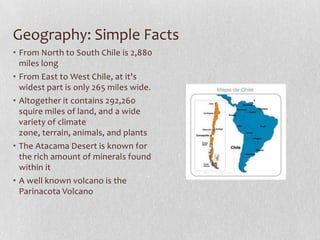
Geography: Simple FactsFrom North to South Chile is 2,880 miles longFrom East to West Chile, at it's widest part is only 265 miles wide.Altogether it contains 292,260 squire miles of land, and a wide variety of climate zone, terrain, animals, and plantsThe Atacama Desert is known for the rich amount of minerals found within itA well known volcano is the Parinacota Volcano
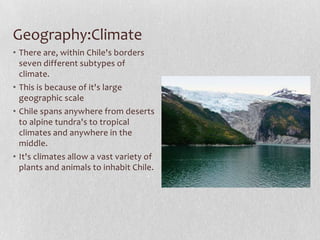
Geography:ClimateThere are, within Chile's borders seven different subtypes of climate.This is because of it's large geographic scaleChile spans anywhere from deserts to alpine tundra's to tropical climates and anywhere in the middle.It's climates allow a vast variety of plants and animals to inhabit Chile.
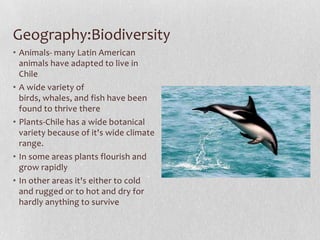
Geography:BiodiversityAnimals- many Latin American animals have adapted to live in ChileA wide variety of birds, whales, and fish have been found to thrive therePlants-Chile has a wide botanical variety because of it's wide climate range. In some areas plants flourish and grow rapidlyIn other areas it's either to cold and rugged or to hot and dry for hardly anything to survive
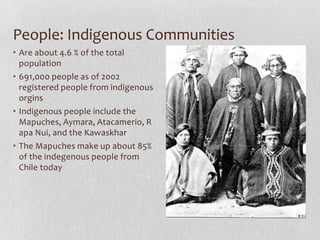
People: Indigenous CommunitiesAre about 4.6 % of the total population691,000 people as of 2002 registered people from indigenous orginsIndigenous people include the Mapuches, Aymara, Atacamerio, Rapa Nui, and the KawaskharThe Mapuches make up about 85% of the indegenous people from Chile today
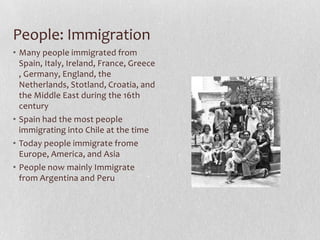
People: ImmigrationMany people immigrated from Spain, Italy, Ireland, France, Greece, Germany, England, the Netherlands, Stotland, Croatia, and the Middle East during the 16th centurySpain had the most people immigrating into Chile at the timeToday people immigrate frome Europe, America, and AsiaPeople now mainly Immigrate from Argentina and Peru 
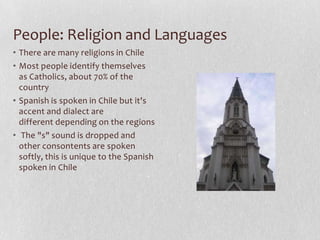
People: Religion and LanguagesThere are many religions in ChileMost people identify themselves as Catholics, about 70% of the countrySpanish is spoken in Chile but it's accent and dialect are different depending on the regions The "s" sound is dropped and other consontents are spoken softly, this is unique to the Spanish spoken in Chile
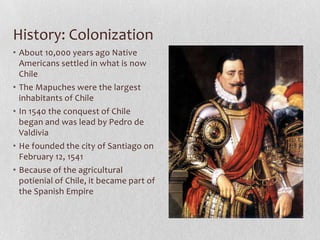
History: ColonizationAbout 10,000 years ago Native Americans settled in what is now ChileThe Mapuches were the largest inhabitants of Chile In 1540 the conquest of Chile began and was lead by Pedro de ValdiviaHe founded the city of Santiago on February 12, 1541Because of the agricultural potienial of Chile, it became part of the Spanish Empire
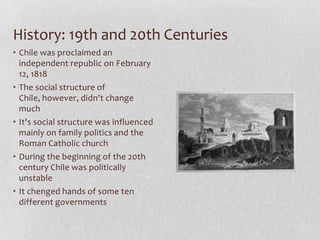
History: 19th and 20th CenturiesChile was proclaimed an independent republic on February 12, 1818 The social structure of Chile, however, didn't change muchIt's social structure was influenced mainly on family politics and the Roman Catholic churchDuring the beginning of the 20th century Chile was politically unstableIt chenged hands of some ten different governments
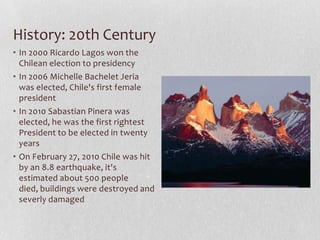
History: 20th CenturyIn 2000 Ricardo Lagos won the Chilean election to presidencyIn 2006 Michelle Bachelet Jeria was elected, Chile's first female presidentIn 2010 Sabastian Pinera was elected, he was the first rightest President to be elected in twenty yearsOn February 27, 2010 Chile was hit by an 8.8 earthquake, it's estimated about 500 people died, buildings were destroyed and severly damaged
Sources:                    Wikipedia-Chile

Country report

  • 1.
  • 2.
    Geography: Simple FactsFromNorth to South Chile is 2,880 miles longFrom East to West Chile, at it's widest part is only 265 miles wide.Altogether it contains 292,260 squire miles of land, and a wide variety of climate zone, terrain, animals, and plantsThe Atacama Desert is known for the rich amount of minerals found within itA well known volcano is the Parinacota Volcano
  • 3.
    Geography:ClimateThere are, withinChile's borders seven different subtypes of climate.This is because of it's large geographic scaleChile spans anywhere from deserts to alpine tundra's to tropical climates and anywhere in the middle.It's climates allow a vast variety of plants and animals to inhabit Chile.
  • 4.
    Geography:BiodiversityAnimals- many LatinAmerican animals have adapted to live in ChileA wide variety of birds, whales, and fish have been found to thrive therePlants-Chile has a wide botanical variety because of it's wide climate range. In some areas plants flourish and grow rapidlyIn other areas it's either to cold and rugged or to hot and dry for hardly anything to survive
  • 5.
    People: Indigenous CommunitiesAreabout 4.6 % of the total population691,000 people as of 2002 registered people from indigenous orginsIndigenous people include the Mapuches, Aymara, Atacamerio, Rapa Nui, and the KawaskharThe Mapuches make up about 85% of the indegenous people from Chile today
  • 6.
    People: ImmigrationMany peopleimmigrated from Spain, Italy, Ireland, France, Greece, Germany, England, the Netherlands, Stotland, Croatia, and the Middle East during the 16th centurySpain had the most people immigrating into Chile at the timeToday people immigrate frome Europe, America, and AsiaPeople now mainly Immigrate from Argentina and Peru 
  • 7.
    People: Religion andLanguagesThere are many religions in ChileMost people identify themselves as Catholics, about 70% of the countrySpanish is spoken in Chile but it's accent and dialect are different depending on the regions The "s" sound is dropped and other consontents are spoken softly, this is unique to the Spanish spoken in Chile
  • 8.
    History: ColonizationAbout 10,000years ago Native Americans settled in what is now ChileThe Mapuches were the largest inhabitants of Chile In 1540 the conquest of Chile began and was lead by Pedro de ValdiviaHe founded the city of Santiago on February 12, 1541Because of the agricultural potienial of Chile, it became part of the Spanish Empire
  • 9.
    History: 19th and20th CenturiesChile was proclaimed an independent republic on February 12, 1818 The social structure of Chile, however, didn't change muchIt's social structure was influenced mainly on family politics and the Roman Catholic churchDuring the beginning of the 20th century Chile was politically unstableIt chenged hands of some ten different governments
  • 10.
    History: 20th CenturyIn2000 Ricardo Lagos won the Chilean election to presidencyIn 2006 Michelle Bachelet Jeria was elected, Chile's first female presidentIn 2010 Sabastian Pinera was elected, he was the first rightest President to be elected in twenty yearsOn February 27, 2010 Chile was hit by an 8.8 earthquake, it's estimated about 500 people died, buildings were destroyed and severly damaged
  • 11.