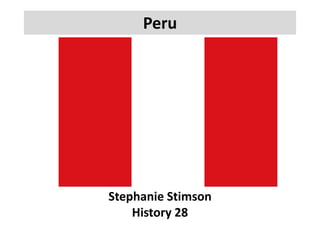
PeruStephanie StimsonHistory 28
History of PeruHistory goes back over 10,000 yearsEarly Peruvian culture thrived in one of the harshest environments in the world- the Andean highlandsThe Incan empire was once of the largest and most sophisticated in the world
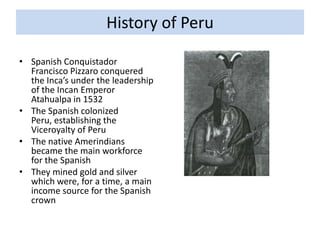
History of PeruSpanish Conquistador Francisco Pizzaro conquered the Inca’s under the leadership of the Incan Emperor Atahualpa in 1532The Spanish colonized Peru, establishing the Viceroyalty of PeruThe native Amerindians became the main workforce for the SpanishThey mined gold and silver which were, for a time, a main income source for the Spanish crown
 Independence Most of Latin America was fighting for independence while Peru remained loyal to the crownIt  wasn’t until the efforts of Simon Bolivar and Jose San Martin that Peruvians were able to overcome loyalists Independence was achieved but Peru struggled with political instabilityPeru had a period of stability under CastillaGuano became a primary export and helped improve the economy
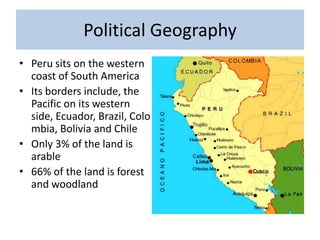
Political GeographyPeru sits on the western coast of South AmericaIts borders include, the Pacific on its western side, Ecuador, Brazil, Colombia, Bolivia and Chile Only 3% of the land is arable66% of the land is forest and woodland
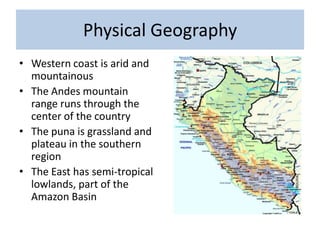
Physical GeographyWestern coast is arid and mountainousThe Andes mountain range runs through the center of the countryThe puna is grassland and plateau in the southern regionThe East has semi-tropical lowlands, part of the Amazon Basin
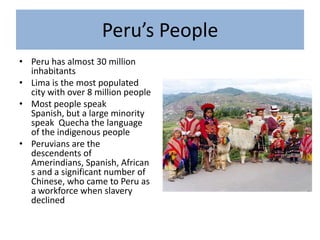
Peru’s PeoplePeru has almost 30 million inhabitantsLima is the most populated city with over 8 million peopleMost people speak Spanish, but a large minority speak  Quecha the language of the indigenous peoplePeruvians are the descendents of Amerindians, Spanish, Africans and a significant number of Chinese, who came to Peru as a workforce when slavery declined
Education and Health in PeruEducation HealthInfant mortality is 22/1000 live birthsLife expectancy Men 70 yearsWomen 74 yearsInfectious disease rate is high, there remains a lack of potable waterMany women die each year seeking illegal abortionsPre-primary for the first 6 yearsFree 6 years of primary educationSecondary education begins at age 1258% of children attend schoolLiteracy for males is 92%Literacy for females is 79%Peru has 27 national universities
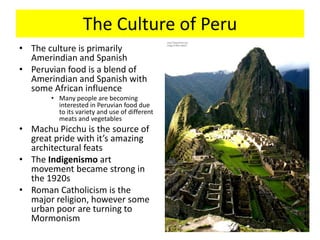
The Culture of PeruThe culture is primarily Amerindian and SpanishPeruvian food is a blend of Amerindian and Spanish with some African influenceMany people are becoming interested in Peruvian food due to its variety and use of different meats and vegetablesMachu Picchu is the source of great pride with it’s amazing architectural featsThe Indigenismo art movement became strong in the 1920sRoman Catholicism is the major religion, however some urban poor are turning to Mormonism
Sources for InformationHistorical, political and cultural informationhttp://en.wikipedia.org/wiki/PeruGeographical and economic informationhttp://lcweb2.loc.gov/frd/cs/ectoc.htmlImages of Peru	- http://www.google.com/imghp

Peru

  • 1.
  • 2.
    History of PeruHistorygoes back over 10,000 yearsEarly Peruvian culture thrived in one of the harshest environments in the world- the Andean highlandsThe Incan empire was once of the largest and most sophisticated in the world
  • 3.
    History of PeruSpanishConquistador Francisco Pizzaro conquered the Inca’s under the leadership of the Incan Emperor Atahualpa in 1532The Spanish colonized Peru, establishing the Viceroyalty of PeruThe native Amerindians became the main workforce for the SpanishThey mined gold and silver which were, for a time, a main income source for the Spanish crown
  • 4.
    Independence Mostof Latin America was fighting for independence while Peru remained loyal to the crownIt wasn’t until the efforts of Simon Bolivar and Jose San Martin that Peruvians were able to overcome loyalists Independence was achieved but Peru struggled with political instabilityPeru had a period of stability under CastillaGuano became a primary export and helped improve the economy
  • 5.
    Political GeographyPeru sitson the western coast of South AmericaIts borders include, the Pacific on its western side, Ecuador, Brazil, Colombia, Bolivia and Chile Only 3% of the land is arable66% of the land is forest and woodland
  • 6.
    Physical GeographyWestern coastis arid and mountainousThe Andes mountain range runs through the center of the countryThe puna is grassland and plateau in the southern regionThe East has semi-tropical lowlands, part of the Amazon Basin
  • 7.
    Peru’s PeoplePeru hasalmost 30 million inhabitantsLima is the most populated city with over 8 million peopleMost people speak Spanish, but a large minority speak Quecha the language of the indigenous peoplePeruvians are the descendents of Amerindians, Spanish, Africans and a significant number of Chinese, who came to Peru as a workforce when slavery declined
  • 8.
    Education and Healthin PeruEducation HealthInfant mortality is 22/1000 live birthsLife expectancy Men 70 yearsWomen 74 yearsInfectious disease rate is high, there remains a lack of potable waterMany women die each year seeking illegal abortionsPre-primary for the first 6 yearsFree 6 years of primary educationSecondary education begins at age 1258% of children attend schoolLiteracy for males is 92%Literacy for females is 79%Peru has 27 national universities
  • 9.
    The Culture ofPeruThe culture is primarily Amerindian and SpanishPeruvian food is a blend of Amerindian and Spanish with some African influenceMany people are becoming interested in Peruvian food due to its variety and use of different meats and vegetablesMachu Picchu is the source of great pride with it’s amazing architectural featsThe Indigenismo art movement became strong in the 1920sRoman Catholicism is the major religion, however some urban poor are turning to Mormonism
  • 10.
    Sources for InformationHistorical,political and cultural informationhttp://en.wikipedia.org/wiki/PeruGeographical and economic informationhttp://lcweb2.loc.gov/frd/cs/ectoc.htmlImages of Peru - http://www.google.com/imghp