
Introduction


 Argentina is a country in South America. Argentina is the world's
  eighth largest country, covering an area of 2.8 million square km.
  Argentina possesses some of the world's tallest mountains,
  expansive deserts, and impressive waterfalls, with the diversity of
  the land ranging from wild, remote areas .It’s Capital City is,
   Buenos Aires.

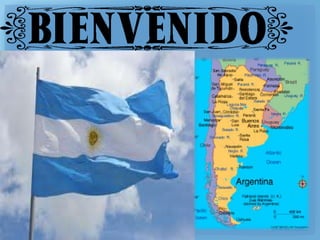
 Argentina is bordered by Chile to the west and south, Bolivia and
  Paraguay to the north, and Brazil and Uruguay to the northeast.
Contd…

 Total Area:1,068,302 (sq miles), 2,766,890 (sq kilometers)
 Land Area:1,056,642 (sq miles), 2,736,690 (sq kilometers)
 Water Area:11,660 (sq miles), 30,200 (sq kilometers)
 Land Boundaries:6,006 (miles), 9,665 (kilometers)
 Irrigated Land:5,985 (sq miles), 15,500 (sq kilometers)
 Coastline:1,926 (sq miles), 4,989 (sq kilometers)
 Natural Resources: fertile plains of the pampas, lead, zinc, tin,
  copper, iron ore, manganese, petroleum, uranium
 Literacy Rate Total Population:97.20%
 Independence:9 July 1816 (from Spain)
 National Holiday: Revolution Day, 25 May (1810)
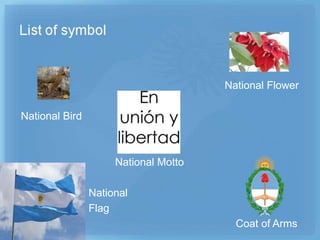
National Flower

National Bird


                     National Motto

                National
                Flag
                                        Coat of Arms
Factsheet

Argentina is a country with a vibrant, rich culture influenced by its
   diverse population and proud heritage. This unique culture stems
   from Argentina’s strong European ties mixed with indigenous people
   of South America.

   Official name – Argentine Republic
   Population – 40,913,584 aproxx
   Currency – Argentinean peso (ARS)
   Capital city – Buenos Aires
   GDP – purchasing power parity $575.6 billion
   GDP Per Capita – purchasing power parity $14,200
   Climate: mostly temperate; arid in southeast; sub Antarctic in southwest
History of the Country

 Human habitation of the Americans is accepted 30000 years ago.
  Ancestors Amerindians reached southern South America around
  10,000BC. One of the oldest and most impressive archaeological
  sites in Argentina is Cueva de las Manos in Patagonia where cave
  paintings, mostly of left hands, from 7370 BC.

 The Pampas was later inhabited by the Querandi, who were hunters
  and gatherers, and by the Guarani, who were agriculturalists. In the
  northwest, there were several indigenous groups, who practiced
  agriculture in the valleys of the eastern Andean foothills.

 The Spanish came in the mid 1500’s looking for silver. The country’s
  oldest permanent settlement is Santiago del Estero, which was
  founded in 1551.
Major Exports     Major Imports

Food              Food
Meat             Fuel
Manufacturing    Energy
 products

Export Partners
                  Import Partners
Brazil
                  USA
Chile
                  Germany
China
                  Italy
USA
                  Spain
Greetings And Address
 A standard handshake, with direct eye contact and a welcoming
  smile will suffice.

 Maintaining eye contact indicates interest.

 In general, Argentines prefer third-party introductions, so you
  should wait for your host or hostess to introduce you to others at a
  small gathering.

 When leaving, say good-bye to each person individually
Appointment and Punctuality
 Appointments are necessary and should be made 1 to 2 weeks in
  advance, preferably by e-mail or telephone.

 Avoid January and February, which are their vacation times; the
  middle weeks of July, and during the 2 weeks before and after
  Christmas.

 You should arrive on time for meetings, although the person you are
  meeting may not be punctual.
Contd…
 Do not immediately begin discussing business. Small talk helps
  establish a rapport.

 The person you are meeting with may accept telephone calls and
  attend to other business while you are there.

 Have all printed material available in both English and Spanish.

 Decisions are not reached at meetings. Meetings are for discussion
  and to exchange ideas
Business Etiquettes
 Argentines expect to deal with people of similar status.

 Hierarchy is important. Decisions are made at the top of the
  company.

 They prefer face-to-face meetings rather than by telephone or in
  writing, which are seen as impersonal.

 Avoid confrontation. Argentines do not like publicly admitting they
  are incorrect.
What to Wear..?


 Business attire is formal and conservative, yet stylish.

 Men should wear dark coloured , conservative business suits.

 Women should wear elegant business suits or dresses.
Business Card Etiquettes


 Business cards are given without formal ritual.

 Have one side of your business card translated into Spanish.

 Present your business card so the Spanish side faces the recipient.
Gift Giving Etiquettes
 If invited to dinner at an Argentine's home bring a small gift for the
  hostess.

 Since taxes on imported spirits are extremely high, a bottle of
  imported spirits is always well received.

 Do not give knives or scissors as they indicate a desire to sever the
  relationship.

 Gifts are opened immediately.
Challenges Faced By Indian’s while working with / in
    Argentina

       Religion

Understanding each others religion because of communication gap like in
India we follow dharmic religion which was originated from Indian
subcontinent, where as in Argentina 70% of the population are Roman
catholic religious festivals in the north-western provinces feature Catholic
icons in ancient Andean indigenous ceremonies.

       Language

Argentina 40 languages are spoken some are Quechua, German, Yiddish etc
but mostly used Spanish language. In India generally Hindi, Punjabi and
English language is spoken.
Culture


 In Argentina culture vary from geography to geography and full mixture of
  ethnic group where as in Indian culture, values and way of life differ from
  people to people.

 European styles all the architecture, cinema and galleries are abundant.
  Where as in India we are still maintaining our culture all the diverse
  culture such as Indian yoga and Indian cuisine have a profound impact
  around the world
Cuisine

 Indian’s have wide variety of regional cuisine native to India. Giving the
  range of diversity of soil type.
 Indian cuisine we use:-spices, herbs, vegetable and fruits. Most of the
  Indian food are influenced by the religious and cultural choices.
 Argentine cuisine may be described as:-combination of Italian and Spanish
  cousin.
 As the agricultural products are abundant in the country they consume
  meat item mostly like beef, pork, lamb etc and frequently fast food item.
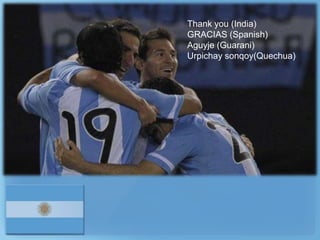
Thank you (India)
GRACIAS (Spanish)
Aguyje (Guarani)
Urpichay sonqoy(Quechua)

Bc argentina ppt(final)

  • 2.
    Introduction  Argentina isa country in South America. Argentina is the world's eighth largest country, covering an area of 2.8 million square km. Argentina possesses some of the world's tallest mountains, expansive deserts, and impressive waterfalls, with the diversity of the land ranging from wild, remote areas .It’s Capital City is, Buenos Aires.  Argentina is bordered by Chile to the west and south, Bolivia and Paraguay to the north, and Brazil and Uruguay to the northeast.
  • 3.
    Contd…  Total Area:1,068,302(sq miles), 2,766,890 (sq kilometers)  Land Area:1,056,642 (sq miles), 2,736,690 (sq kilometers)  Water Area:11,660 (sq miles), 30,200 (sq kilometers)  Land Boundaries:6,006 (miles), 9,665 (kilometers)  Irrigated Land:5,985 (sq miles), 15,500 (sq kilometers)  Coastline:1,926 (sq miles), 4,989 (sq kilometers)  Natural Resources: fertile plains of the pampas, lead, zinc, tin, copper, iron ore, manganese, petroleum, uranium  Literacy Rate Total Population:97.20%  Independence:9 July 1816 (from Spain)  National Holiday: Revolution Day, 25 May (1810)
  • 4.
    National Flower National Bird National Motto National Flag Coat of Arms
  • 5.
    Factsheet Argentina is acountry with a vibrant, rich culture influenced by its diverse population and proud heritage. This unique culture stems from Argentina’s strong European ties mixed with indigenous people of South America.  Official name – Argentine Republic  Population – 40,913,584 aproxx  Currency – Argentinean peso (ARS)  Capital city – Buenos Aires  GDP – purchasing power parity $575.6 billion  GDP Per Capita – purchasing power parity $14,200  Climate: mostly temperate; arid in southeast; sub Antarctic in southwest
  • 6.
    History of theCountry  Human habitation of the Americans is accepted 30000 years ago. Ancestors Amerindians reached southern South America around 10,000BC. One of the oldest and most impressive archaeological sites in Argentina is Cueva de las Manos in Patagonia where cave paintings, mostly of left hands, from 7370 BC.  The Pampas was later inhabited by the Querandi, who were hunters and gatherers, and by the Guarani, who were agriculturalists. In the northwest, there were several indigenous groups, who practiced agriculture in the valleys of the eastern Andean foothills.  The Spanish came in the mid 1500’s looking for silver. The country’s oldest permanent settlement is Santiago del Estero, which was founded in 1551.
  • 7.
    Major Exports Major Imports Food  Food Meat Fuel Manufacturing Energy products Export Partners Import Partners Brazil USA Chile Germany China Italy USA Spain
  • 8.
    Greetings And Address A standard handshake, with direct eye contact and a welcoming smile will suffice.  Maintaining eye contact indicates interest.  In general, Argentines prefer third-party introductions, so you should wait for your host or hostess to introduce you to others at a small gathering.  When leaving, say good-bye to each person individually
  • 9.
    Appointment and Punctuality Appointments are necessary and should be made 1 to 2 weeks in advance, preferably by e-mail or telephone.  Avoid January and February, which are their vacation times; the middle weeks of July, and during the 2 weeks before and after Christmas.  You should arrive on time for meetings, although the person you are meeting may not be punctual.
  • 10.
    Contd…  Do notimmediately begin discussing business. Small talk helps establish a rapport.  The person you are meeting with may accept telephone calls and attend to other business while you are there.  Have all printed material available in both English and Spanish.  Decisions are not reached at meetings. Meetings are for discussion and to exchange ideas
  • 11.
    Business Etiquettes  Argentinesexpect to deal with people of similar status.  Hierarchy is important. Decisions are made at the top of the company.  They prefer face-to-face meetings rather than by telephone or in writing, which are seen as impersonal.  Avoid confrontation. Argentines do not like publicly admitting they are incorrect.
  • 12.
    What to Wear..? Business attire is formal and conservative, yet stylish.  Men should wear dark coloured , conservative business suits.  Women should wear elegant business suits or dresses.
  • 13.
    Business Card Etiquettes Business cards are given without formal ritual.  Have one side of your business card translated into Spanish.  Present your business card so the Spanish side faces the recipient.
  • 14.
    Gift Giving Etiquettes If invited to dinner at an Argentine's home bring a small gift for the hostess.  Since taxes on imported spirits are extremely high, a bottle of imported spirits is always well received.  Do not give knives or scissors as they indicate a desire to sever the relationship.  Gifts are opened immediately.
  • 15.
    Challenges Faced ByIndian’s while working with / in Argentina  Religion Understanding each others religion because of communication gap like in India we follow dharmic religion which was originated from Indian subcontinent, where as in Argentina 70% of the population are Roman catholic religious festivals in the north-western provinces feature Catholic icons in ancient Andean indigenous ceremonies.  Language Argentina 40 languages are spoken some are Quechua, German, Yiddish etc but mostly used Spanish language. In India generally Hindi, Punjabi and English language is spoken.
  • 16.
    Culture  In Argentinaculture vary from geography to geography and full mixture of ethnic group where as in Indian culture, values and way of life differ from people to people.  European styles all the architecture, cinema and galleries are abundant. Where as in India we are still maintaining our culture all the diverse culture such as Indian yoga and Indian cuisine have a profound impact around the world
  • 17.
    Cuisine  Indian’s havewide variety of regional cuisine native to India. Giving the range of diversity of soil type.  Indian cuisine we use:-spices, herbs, vegetable and fruits. Most of the Indian food are influenced by the religious and cultural choices.  Argentine cuisine may be described as:-combination of Italian and Spanish cousin.  As the agricultural products are abundant in the country they consume meat item mostly like beef, pork, lamb etc and frequently fast food item.
  • 18.
    Thank you (India) GRACIAS(Spanish) Aguyje (Guarani) Urpichay sonqoy(Quechua)