ARGENTINA Immigration and Culture
PHASE ONE:  Spanish Colonial Period Spanish conquistadors arrived in late 1500s Early colonies were ruled from Peru Major cities of Salta, Jujuy, and Cordoba grew in the Northwest along the Silver Trail Buenos Aires was an important port city, but trade was forbidden with anyone but Spain Eventually Argentina ruled by the Viceroy of Rio de la Plata, separating it from Peru Most of the native population died or was sent to Peru to work in the mines.
Colonial Buildings in Salta Church of San Francisco Original house of legislature
Legacy of Spanish Colonial Period Spanish remains the official language 97% of the population is of European descent 92% of the country is Roman Catholic Lingering connection to the rest of the Latin American world through shared heritage
PHASE TWO:  European Immigration 1860-1930 Dominated by Spanish and Italian immigrants Contributed to the agricultural and industrial development Some settled in cities which created large urban centers such as Buenos Aires
Agriculture- Sugar Cane Fields, Jujuy
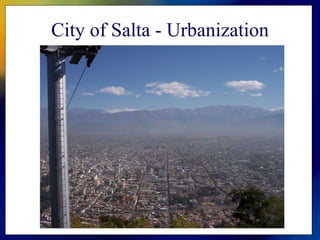
City of Salta - Urbanization
Legacy of European Immigration Argentina moves away from “typical” Latin American culture and develops a blend of traditions Architecture in Buenos Aires more similar to Europe than South America Argentina becomes “The Breadbasket of the World” for a time Creates a strong economic backbone for the country
PHASE THREE:  Modern Migration Economic collapse in the late 20 th   century left a shortage of workers Universal free education and health care are appealing to neighboring countries Many workers needed for factories and to follow crops through central and northern provinces
Bolivia Farmer’s Market, Jujuy
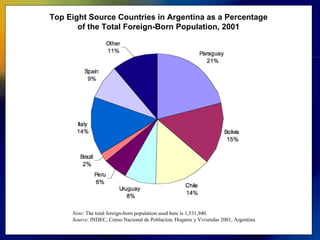
Top Eight Source Countries in Argentina as a Percentage of the Total Foreign-Born Population, 2001 Note : The total foreign-born population used here is 1,531,940.  Source : INDEC, Censo Nacional de Poblacíon, Hogares y Viviendas 2001, Argentina
Emerging legacy of migration Infusion of native culture into Argentina, which had lost most of its native roots during colonial period Government struggles to provide services for legal and illegal immigrants, straining the already over-stretched funds Growing dissatisfaction among the people and discrimination toward migrant families

Argentina's Immigrant History

  • 1.
  • 2.
    PHASE ONE: Spanish Colonial Period Spanish conquistadors arrived in late 1500s Early colonies were ruled from Peru Major cities of Salta, Jujuy, and Cordoba grew in the Northwest along the Silver Trail Buenos Aires was an important port city, but trade was forbidden with anyone but Spain Eventually Argentina ruled by the Viceroy of Rio de la Plata, separating it from Peru Most of the native population died or was sent to Peru to work in the mines.
  • 3.
    Colonial Buildings inSalta Church of San Francisco Original house of legislature
  • 4.
    Legacy of SpanishColonial Period Spanish remains the official language 97% of the population is of European descent 92% of the country is Roman Catholic Lingering connection to the rest of the Latin American world through shared heritage
  • 5.
    PHASE TWO: European Immigration 1860-1930 Dominated by Spanish and Italian immigrants Contributed to the agricultural and industrial development Some settled in cities which created large urban centers such as Buenos Aires
  • 6.
  • 7.
    City of Salta- Urbanization
  • 8.
    Legacy of EuropeanImmigration Argentina moves away from “typical” Latin American culture and develops a blend of traditions Architecture in Buenos Aires more similar to Europe than South America Argentina becomes “The Breadbasket of the World” for a time Creates a strong economic backbone for the country
  • 9.
    PHASE THREE: Modern Migration Economic collapse in the late 20 th century left a shortage of workers Universal free education and health care are appealing to neighboring countries Many workers needed for factories and to follow crops through central and northern provinces
  • 10.
  • 11.
    Top Eight SourceCountries in Argentina as a Percentage of the Total Foreign-Born Population, 2001 Note : The total foreign-born population used here is 1,531,940. Source : INDEC, Censo Nacional de Poblacíon, Hogares y Viviendas 2001, Argentina
  • 12.
    Emerging legacy ofmigration Infusion of native culture into Argentina, which had lost most of its native roots during colonial period Government struggles to provide services for legal and illegal immigrants, straining the already over-stretched funds Growing dissatisfaction among the people and discrimination toward migrant families