POPULATION :
ARGENTINA
DONE BY DEETH
ARGENTINA
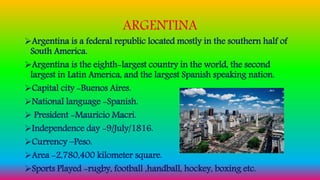
Argentina is a federal republic located mostly in the southern half of
South America.
Argentina is the eighth-largest country in the world, the second
largest in Latin America, and the largest Spanish speaking nation.
Capital city -Buenos Aires.
National language -Spanish.
 President -Mauricio Macri.
Independence day -9/July/1816.
Currency –Peso.
Area -2,780,400 kilometer square.
Sports Played -rugby, football ,handball, hockey, boxing etc.
MAP OF ARGENTINA
Flag – Currency Sol De Mayo -
(peso) -
Argentina's
famous
football President – Highest mountain in
player - (Mauricio Argentina ((Aconcagua) -
(Messi) Macri)
POPULATION
Currently Argentina has a population 46 million people (2018), 64%
being the age 15-65, 25.1% being under the age 15 and just 10.2%
being over the age of 65. Argentina is widely praised on being a
highly urbanized country; with only 1/10 living in rural states. the
population density is 15 people per square kilometer.
 Birth rate -17.75 births/1,000 population .
 Death rate -7.39 deaths/1,000 population.
 Life expectancy -77.14 years.
Positive factors of increase in population
Better tourist attractions.
Better way of life.
Chances of employment/jobs.
Better education.
Cheap transport.
Better medical care.
Better living conditions.
Better climate.
Cheap things.
CULTURE
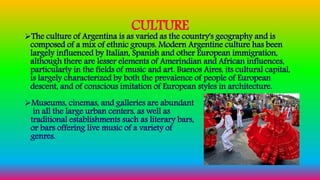
The culture of Argentina is as varied as the country's geography and is
composed of a mix of ethnic groups. Modern Argentine culture has been
largely influenced by Italian, Spanish and other European immigration,
although there are lesser elements of Amerindian and African influences,
particularly in the fields of music and art. Buenos Aires, its cultural capital,
is largely characterized by both the prevalence of people of European
descent, and of conscious imitation of European styles in architecture.
Museums, cinemas, and galleries are abundant
in all the large urban centers, as well as
traditional establishments such as literary bars,
or bars offering live music of a variety of
genres.
ATTRACTIONS IN ARGENTINA
CORDOBA MAR DEL PLATA
ATTRACTIONS
VALDES PENINSULA USHUAIA
TOP TEN TOURIST ATTRACTIONS IN
ARGENTINA
Population argentina

Population argentina

  • 1.
  • 2.
    ARGENTINA Argentina is afederal republic located mostly in the southern half of South America. Argentina is the eighth-largest country in the world, the second largest in Latin America, and the largest Spanish speaking nation. Capital city -Buenos Aires. National language -Spanish.  President -Mauricio Macri. Independence day -9/July/1816. Currency –Peso. Area -2,780,400 kilometer square. Sports Played -rugby, football ,handball, hockey, boxing etc.
  • 3.
  • 4.
    Flag – CurrencySol De Mayo - (peso) - Argentina's famous football President – Highest mountain in player - (Mauricio Argentina ((Aconcagua) - (Messi) Macri)
  • 5.
    POPULATION Currently Argentina hasa population 46 million people (2018), 64% being the age 15-65, 25.1% being under the age 15 and just 10.2% being over the age of 65. Argentina is widely praised on being a highly urbanized country; with only 1/10 living in rural states. the population density is 15 people per square kilometer.  Birth rate -17.75 births/1,000 population .  Death rate -7.39 deaths/1,000 population.  Life expectancy -77.14 years.
  • 6.
    Positive factors ofincrease in population Better tourist attractions. Better way of life. Chances of employment/jobs. Better education. Cheap transport. Better medical care. Better living conditions. Better climate. Cheap things.
  • 7.
    CULTURE The culture ofArgentina is as varied as the country's geography and is composed of a mix of ethnic groups. Modern Argentine culture has been largely influenced by Italian, Spanish and other European immigration, although there are lesser elements of Amerindian and African influences, particularly in the fields of music and art. Buenos Aires, its cultural capital, is largely characterized by both the prevalence of people of European descent, and of conscious imitation of European styles in architecture. Museums, cinemas, and galleries are abundant in all the large urban centers, as well as traditional establishments such as literary bars, or bars offering live music of a variety of genres.
  • 8.
  • 9.
  • 10.
    TOP TEN TOURISTATTRACTIONS IN ARGENTINA