
"Narrative and Gameplay
in Game Design"
Sherry Jones
Philosophy, Rhetoric, Game Studies
sherryjones.edtech@gmail.com
Twitter @autnes
Slides: http://bit.ly/narrativegame
Creative Commons Attribution-NonCommercial-NoDerivs 3.0 Unported License.
Watch Live Webcast to this
Presentation!
A Very Brief Introduction to
Game Studies
Game Studies is a complex, interdisciplinary
field that involves the study of game systems,
game structures, and gameplay through the
lenses of philosophy, psychology, sociology,
economics, semiotics, engineering, and others.
Narratology and Ludology are 2 dominant
schools of thought in the field, and a heated
debate between the schools have divided
digital game scholars.
What is Narratology?
Study of games as narrative structures:
"The term narratology had to be invented to
unify the works that scholars from different
disciplines were doing about narrative"
(Frasca, 1999)
Source: "Ludology Meets Narratology: Similitude and differences between (video)games and narrative"
http://www.ludology.org/articles/ludology.htm
What is Ludology?
Study of games as formal systems:
"We will propose the term ludology (from
ludus, the Latin word for "game"), to refer to
the yet non-existent 'discipline that studies
game and play activities."
(Frasca, 1999)
Source: "Ludology Meets Narratology: Similitude and differences between (video)games and narrative"
http://www.ludology.org/articles/ludology.htm
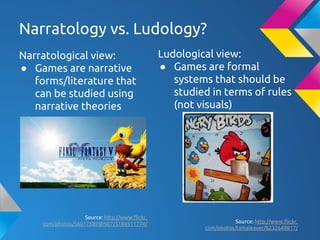
Narratology vs. Ludology?
Narratological view:
● Games are narrative
forms/literature that
can be studied using
narrative theories
Source: http://www.flickr.
com/photos/56017589@N07/5184511774/
Ludological view:
● Games are formal
systems that should be
studied in terms of rules
(not visuals)
Source: http://www.flickr.
com/photos/tamaleaver/8232648817/
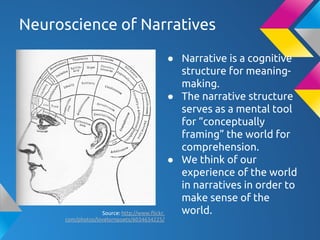
Neuroscience of Narratives
● Narrative is a cognitive
structure for meaning-
making.
● The narrative structure
serves as a mental tool
for “conceptually
framing” the world for
comprehension.
● We think of our
experience of the world
in narratives in order to
make sense of the
world.Source: http://www.flickr.
com/photos/lovelornpoets/6034634225/
Emotions of Narratives
"One interesting aspect of comprehension is
the evocation of emotions that occurs when
we read, hear, or watch a narrative."
"Emotions are an integral part of the narrative
experience and likely one of the main reasons
why stories appear to have such universal
appeal."
(Wallentin et. al., 2011)
Source: "Neuroscience of Narrative Emotion"
http://www.onfiction.ca/2011/10/research-bulletin-neuroscience-of.html
Psychology of Narratives
"How people react psychologically to narrated events is
influenced by the way in which events are framed by a
narrator and appeal to different values, knowledge, and
experiences of listeners."
(Damasio et. al., 2013)
Source: "Neurobiology of Narrative Framing"
http://narrative.ict.usc.edu/projects/neurobiology-of-narrative-framing/
"State-of-the-art neuro-imaging and cognitive
neuropsychology both uphold the idea that we create our
"selves" through narrative."
(Bickle and Keating, 2010)
Source: "Storytelling 2.0: When new narratives meet old brains"
http://www.newscientist.com/blogs/culturelab/2010/11/storytelling-20-when-new-narratives-meet-old-brains.html
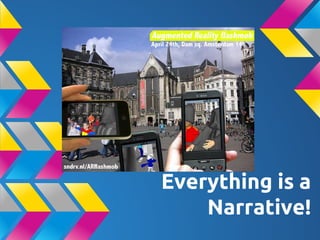
Everything is a
Narrative!
Argument Against "Everything is
a Narrative"
"Narratives may be fundamental to human thought, but
this does not mean that everything should be described in
narrative terms. And that something can be presented in
narrative form does not mean that it is narrative."
"Games and stories actually do not translate to each other
in the way that novels and movies do."
(Juul, 2001)
Source: "Games Telling Stories?"
http://www.gamestudies.org/0101/juul-gts/
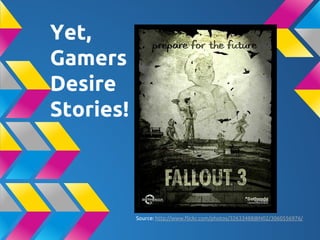
Yet,
Gamers
Desire
Stories!
Source: http://www.flickr.com/photos/32633488@N02/3060556976/
Abstract vs. Character Games
"The more abstract the game, the less the
need for a story to tie it all together."
"But once you add actual characters to the
game -- especially human characters -- there's
something hardwired in us that makes us want
a story to give context to the action. It's not
required by the game. But it's desired by the
player."
(Dean, 2005)
Source: "Ludology Meets Narratology: The Study of Video Games"
http://www.spyhunter007.com/ludology_meets_narratology_the_study_of_video_games.htm
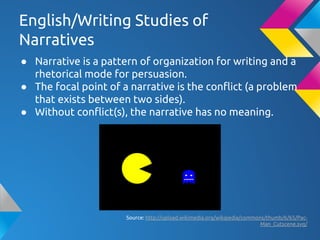
English/Writing Studies of
Narratives
● Narrative is a pattern of organization for writing and a
rhetorical mode for persuasion.
● The focal point of a narrative is the conflict (a problem
that exists between two sides).
● Without conflict(s), the narrative has no meaning.
Source: http://upload.wikimedia.org/wikipedia/commons/thumb/6/65/Pac-
Man_Cutscene.svg/
Meaning of Fictional Narratives
"In fiction, authors will create meaning by
introducing conflicts in the life of a character.
The way a character responds to these
conflicts is part of what gives a story
meaning."
(Layne and Lewis, 2009)
Source: "Plot, Theme, the Narrative Arc, and Narrative Patterns"
http://www.sandhills.edu/academic-departments/english/film/narrativearc.html
Elements of Narration
Elements of narration helps one understand a
narrative's meaning. They are like arrangeable
"Lego Blocks." Here are the basic elements:
● Setting - Time and Place
● Character - Those involved in the conflict
● Conflict - A problem between 2 sides
● Plot - Sequence of events
● Action (Rising/Falling) - To progress story
● Climax - When all actions culminate to peak
● Resolution - How conflict is being solved
● Conclusion - Is the conflict solved (or not)?
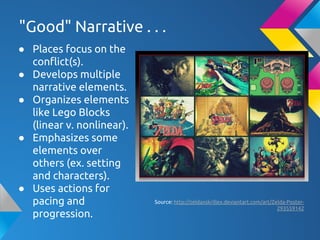
"Good" Narrative . . .
● Places focus on the
conflict(s).
● Develops multiple
narrative elements.
● Organizes elements
like Lego Blocks
(linear v. nonlinear).
● Emphasizes some
elements over
others (ex. setting
and characters).
● Uses actions for
pacing and
progression.
Source: http://zeldaxskrillex.deviantart.com/art/Zelda-Poster-
293559142
So, why is "conflict"
such a dominant
element in narrative
writing?
Philosophy of Language on
Conflict
According to Philosopher Jacques Derrida:
● We think in language, which sets limits on how we
think about the world.
● Inherent in language are polarities that make us think
about things in binaries (good vs. bad, beautiful vs.
ugly, high vs. low, etc.). We tend to assign higher value
to one concept over its opposing term.
Source: "Jacques Derrida: Duality, Hierarchy, Priority"
http://oregonstate.edu/instruct/phl201/modules/Philosophers/Derrida/derrida_duality.htm
We already think in
"conflictive terms" due to
thinking in language.
Of course, English/Writing
Studies show that “conflict” is
not the only element needed
to make engaging narratives.
Calls for Better Narrative Games
Logical Actions and Emotional Development?
"One of the weaknesses is a problem of verbs. Video
game verbs tend to be running, shooting, jumping...watch
a movie, and the verbs are different -- talking, asking,
pleading...video games are really good at the below-the-
neck verbs."
"We suck at tragedy. It's not really a thing for us. If we're
doing interactive Romeo and Juliet, what happens? Oh my
god, she died. Go back to the beginning. Go us. Not
everything has to be a tragedy, but it's unfortunate that
this is off-limits to us."
(Schell, 2013)
Source: "Jesse Schell's Search for the Shakespeare of Games" http://www.gamasutra.
com/view/news/189370/Jesse_Schells_search_for_the_Shakespeare_of_video_games.php
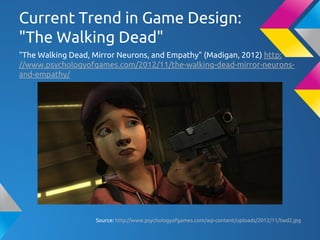
Current Trend in Game Design:
"The Walking Dead"
"The Walking Dead, Mirror Neurons, and Empathy" (Madigan, 2012) http:
//www.psychologyofgames.com/2012/11/the-walking-dead-mirror-neurons-
and-empathy/
Source: http://www.psychologyofgames.com/wp-content/uploads/2012/11/twd2.jpg
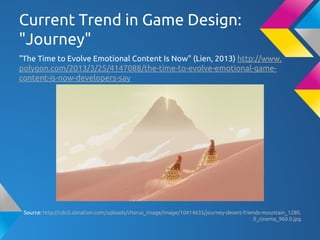
Current Trend in Game Design:
"Journey"
"The Time to Evolve Emotional Content Is Now" (Lien, 2013) http://www.
polygon.com/2013/3/25/4147088/the-time-to-evolve-emotional-game-
content-is-now-developers-say
Source: http://cdn3.sbnation.com/uploads/chorus_image/image/10414635/journey-desert-friends-mountain_1280.
0_cinema_960.0.jpg
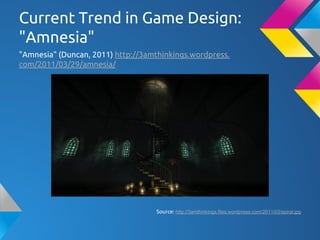
Current Trend in Game Design:
"Amnesia"
"Amnesia" (Duncan, 2011) http://3amthinkings.wordpress.
com/2011/03/29/amnesia/
Source: http://3amthinkings.files.wordpress.com/2011/03/spiral.jpg
Questions? Comments?
Gamer/Instructor
sherryjones.edtech@gmail.com
Twitter @autnes
Visual Bio
Access to Slideshow!: http://bit.ly/narrativegame

"Narrative and Gameplay in Game Design" by Sherry Jones (Apr. 4, 2013)

  • 1.
    "Narrative and Gameplay inGame Design" Sherry Jones Philosophy, Rhetoric, Game Studies sherryjones.edtech@gmail.com Twitter @autnes Slides: http://bit.ly/narrativegame Creative Commons Attribution-NonCommercial-NoDerivs 3.0 Unported License.
  • 2.
    Watch Live Webcastto this Presentation!
  • 3.
    A Very BriefIntroduction to Game Studies Game Studies is a complex, interdisciplinary field that involves the study of game systems, game structures, and gameplay through the lenses of philosophy, psychology, sociology, economics, semiotics, engineering, and others. Narratology and Ludology are 2 dominant schools of thought in the field, and a heated debate between the schools have divided digital game scholars.
  • 4.
    What is Narratology? Studyof games as narrative structures: "The term narratology had to be invented to unify the works that scholars from different disciplines were doing about narrative" (Frasca, 1999) Source: "Ludology Meets Narratology: Similitude and differences between (video)games and narrative" http://www.ludology.org/articles/ludology.htm
  • 5.
    What is Ludology? Studyof games as formal systems: "We will propose the term ludology (from ludus, the Latin word for "game"), to refer to the yet non-existent 'discipline that studies game and play activities." (Frasca, 1999) Source: "Ludology Meets Narratology: Similitude and differences between (video)games and narrative" http://www.ludology.org/articles/ludology.htm
  • 6.
    Narratology vs. Ludology? Narratologicalview: ● Games are narrative forms/literature that can be studied using narrative theories Source: http://www.flickr. com/photos/56017589@N07/5184511774/ Ludological view: ● Games are formal systems that should be studied in terms of rules (not visuals) Source: http://www.flickr. com/photos/tamaleaver/8232648817/
  • 7.
    Neuroscience of Narratives ●Narrative is a cognitive structure for meaning- making. ● The narrative structure serves as a mental tool for “conceptually framing” the world for comprehension. ● We think of our experience of the world in narratives in order to make sense of the world.Source: http://www.flickr. com/photos/lovelornpoets/6034634225/
  • 8.
    Emotions of Narratives "Oneinteresting aspect of comprehension is the evocation of emotions that occurs when we read, hear, or watch a narrative." "Emotions are an integral part of the narrative experience and likely one of the main reasons why stories appear to have such universal appeal." (Wallentin et. al., 2011) Source: "Neuroscience of Narrative Emotion" http://www.onfiction.ca/2011/10/research-bulletin-neuroscience-of.html
  • 9.
    Psychology of Narratives "Howpeople react psychologically to narrated events is influenced by the way in which events are framed by a narrator and appeal to different values, knowledge, and experiences of listeners." (Damasio et. al., 2013) Source: "Neurobiology of Narrative Framing" http://narrative.ict.usc.edu/projects/neurobiology-of-narrative-framing/ "State-of-the-art neuro-imaging and cognitive neuropsychology both uphold the idea that we create our "selves" through narrative." (Bickle and Keating, 2010) Source: "Storytelling 2.0: When new narratives meet old brains" http://www.newscientist.com/blogs/culturelab/2010/11/storytelling-20-when-new-narratives-meet-old-brains.html
  • 10.
  • 11.
    Argument Against "Everythingis a Narrative" "Narratives may be fundamental to human thought, but this does not mean that everything should be described in narrative terms. And that something can be presented in narrative form does not mean that it is narrative." "Games and stories actually do not translate to each other in the way that novels and movies do." (Juul, 2001) Source: "Games Telling Stories?" http://www.gamestudies.org/0101/juul-gts/
  • 12.
  • 13.
    Abstract vs. CharacterGames "The more abstract the game, the less the need for a story to tie it all together." "But once you add actual characters to the game -- especially human characters -- there's something hardwired in us that makes us want a story to give context to the action. It's not required by the game. But it's desired by the player." (Dean, 2005) Source: "Ludology Meets Narratology: The Study of Video Games" http://www.spyhunter007.com/ludology_meets_narratology_the_study_of_video_games.htm
  • 14.
    English/Writing Studies of Narratives ●Narrative is a pattern of organization for writing and a rhetorical mode for persuasion. ● The focal point of a narrative is the conflict (a problem that exists between two sides). ● Without conflict(s), the narrative has no meaning. Source: http://upload.wikimedia.org/wikipedia/commons/thumb/6/65/Pac- Man_Cutscene.svg/
  • 15.
    Meaning of FictionalNarratives "In fiction, authors will create meaning by introducing conflicts in the life of a character. The way a character responds to these conflicts is part of what gives a story meaning." (Layne and Lewis, 2009) Source: "Plot, Theme, the Narrative Arc, and Narrative Patterns" http://www.sandhills.edu/academic-departments/english/film/narrativearc.html
  • 16.
    Elements of Narration Elementsof narration helps one understand a narrative's meaning. They are like arrangeable "Lego Blocks." Here are the basic elements: ● Setting - Time and Place ● Character - Those involved in the conflict ● Conflict - A problem between 2 sides ● Plot - Sequence of events ● Action (Rising/Falling) - To progress story ● Climax - When all actions culminate to peak ● Resolution - How conflict is being solved ● Conclusion - Is the conflict solved (or not)?
  • 17.
    "Good" Narrative .. . ● Places focus on the conflict(s). ● Develops multiple narrative elements. ● Organizes elements like Lego Blocks (linear v. nonlinear). ● Emphasizes some elements over others (ex. setting and characters). ● Uses actions for pacing and progression. Source: http://zeldaxskrillex.deviantart.com/art/Zelda-Poster- 293559142
  • 18.
    So, why is"conflict" such a dominant element in narrative writing?
  • 19.
    Philosophy of Languageon Conflict According to Philosopher Jacques Derrida: ● We think in language, which sets limits on how we think about the world. ● Inherent in language are polarities that make us think about things in binaries (good vs. bad, beautiful vs. ugly, high vs. low, etc.). We tend to assign higher value to one concept over its opposing term. Source: "Jacques Derrida: Duality, Hierarchy, Priority" http://oregonstate.edu/instruct/phl201/modules/Philosophers/Derrida/derrida_duality.htm
  • 20.
    We already thinkin "conflictive terms" due to thinking in language. Of course, English/Writing Studies show that “conflict” is not the only element needed to make engaging narratives.
  • 21.
    Calls for BetterNarrative Games Logical Actions and Emotional Development? "One of the weaknesses is a problem of verbs. Video game verbs tend to be running, shooting, jumping...watch a movie, and the verbs are different -- talking, asking, pleading...video games are really good at the below-the- neck verbs." "We suck at tragedy. It's not really a thing for us. If we're doing interactive Romeo and Juliet, what happens? Oh my god, she died. Go back to the beginning. Go us. Not everything has to be a tragedy, but it's unfortunate that this is off-limits to us." (Schell, 2013) Source: "Jesse Schell's Search for the Shakespeare of Games" http://www.gamasutra. com/view/news/189370/Jesse_Schells_search_for_the_Shakespeare_of_video_games.php
  • 22.
    Current Trend inGame Design: "The Walking Dead" "The Walking Dead, Mirror Neurons, and Empathy" (Madigan, 2012) http: //www.psychologyofgames.com/2012/11/the-walking-dead-mirror-neurons- and-empathy/ Source: http://www.psychologyofgames.com/wp-content/uploads/2012/11/twd2.jpg
  • 23.
    Current Trend inGame Design: "Journey" "The Time to Evolve Emotional Content Is Now" (Lien, 2013) http://www. polygon.com/2013/3/25/4147088/the-time-to-evolve-emotional-game- content-is-now-developers-say Source: http://cdn3.sbnation.com/uploads/chorus_image/image/10414635/journey-desert-friends-mountain_1280. 0_cinema_960.0.jpg
  • 24.
    Current Trend inGame Design: "Amnesia" "Amnesia" (Duncan, 2011) http://3amthinkings.wordpress. com/2011/03/29/amnesia/ Source: http://3amthinkings.files.wordpress.com/2011/03/spiral.jpg
  • 25.