HOW TO HACK
CRYPTOGRAPHIC PROTOCOLS
WITH
FORMAL METHODS
Ofer Rivlin
1
2
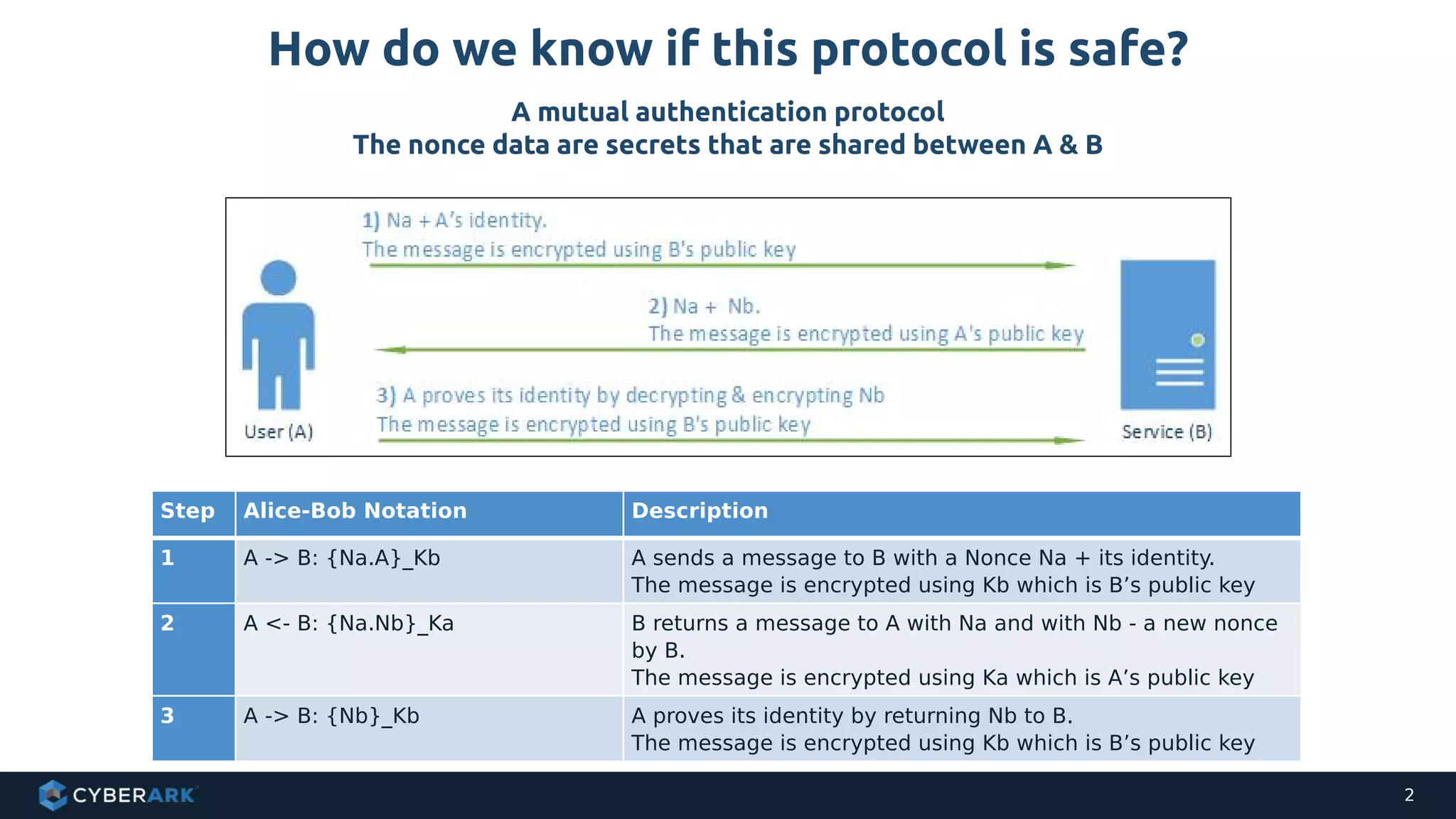
Step Alice-Bob Notation Description
1 A -> B: {Na.A}_Kb A sends a message to B with a Nonce Na + its identity.
The message is encrypted using Kb which is B’s public key
2 A <- B: {Na.Nb}_Ka B returns a message to A with Na and with Nb - a new nonce
by B.
The message is encrypted using Ka which is A’s public key
3 A -> B: {Nb}_Kb A proves its identity by returning Nb to B.
The message is encrypted using Kb which is B’s public key
A mutual authentication protocol
The nonce data are secrets that are shared between A & B
How do we know if this protocol is safe?
• Intro
• My background, scope, goals & subject of this presentation
• The problem
• The suggested solution
• A few words on Formal Methods & Model Checker
• Analysis tools demos
• Avispa & Tamarin Prover
• Advanced attacks/analysis
• Summary
AGENDA
3
4
INTRODUCTION
• Lead the product security at CyberArk
• 10 years of cybersecurity experience
• 10 years of experience as a software developer and architect
• 3 years of Formal Methods experience in development tools for Provable Software
• Passionate about cutting edge technology and cybersecurity!
MY BACKGROUND
5
• Ofer Rivlin
• ofer.rivlin@cyberark.com
• https://www.linkedin.com/in/ofer-rivlin/
• Twitter: @0xriv3r
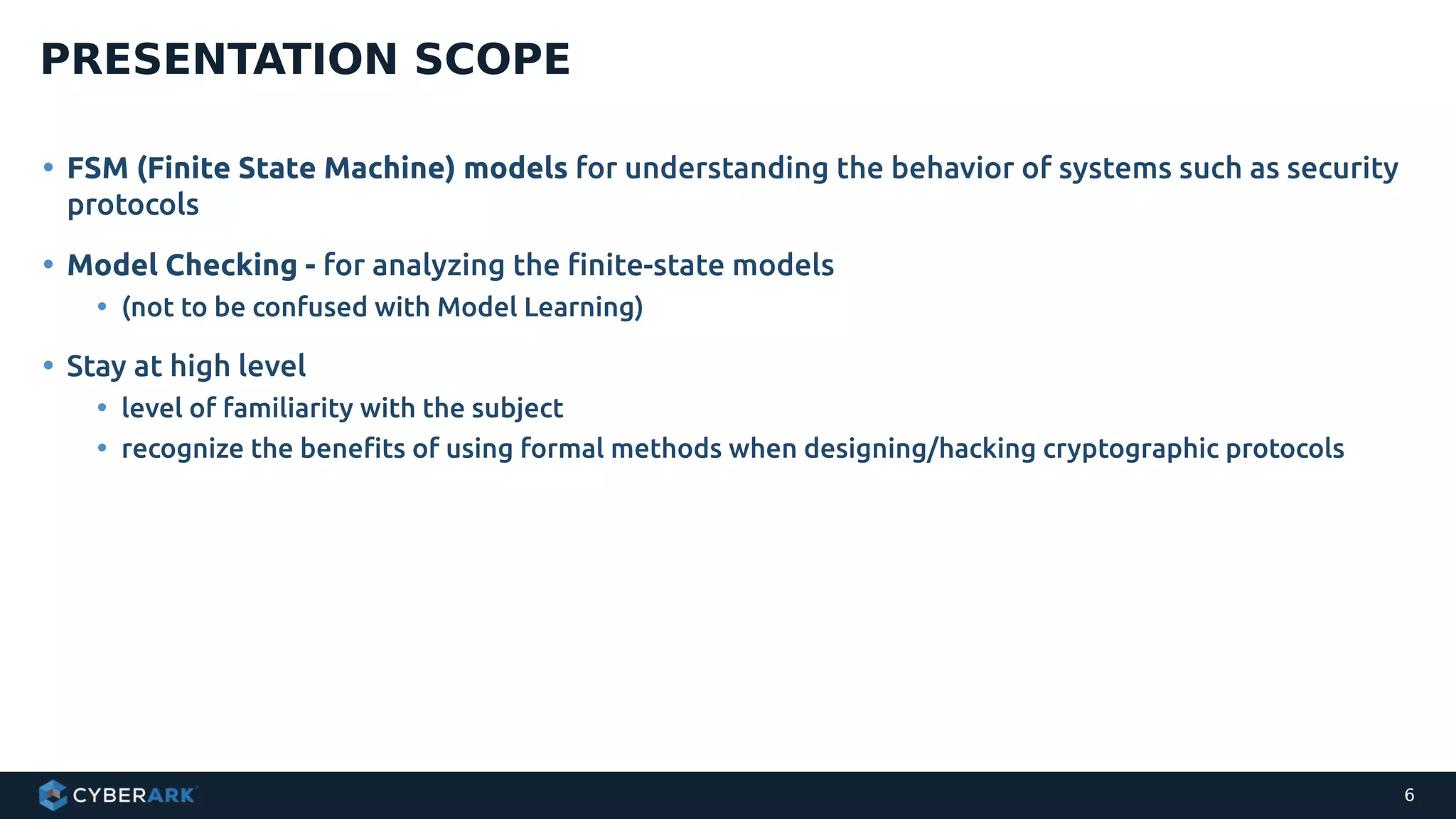
• FSM (Finite State Machine) models for understanding the behavior of systems such as security
protocols
• Model Checking - for analyzing the finite-state models
• (not to be confused with Model Learning)
• Stay at high level
• level of familiarity with the subject
• recognize the benefits of using formal methods when designing/hacking cryptographic protocols
PRESENTATION SCOPE
6
7
THE PROBLEM
8
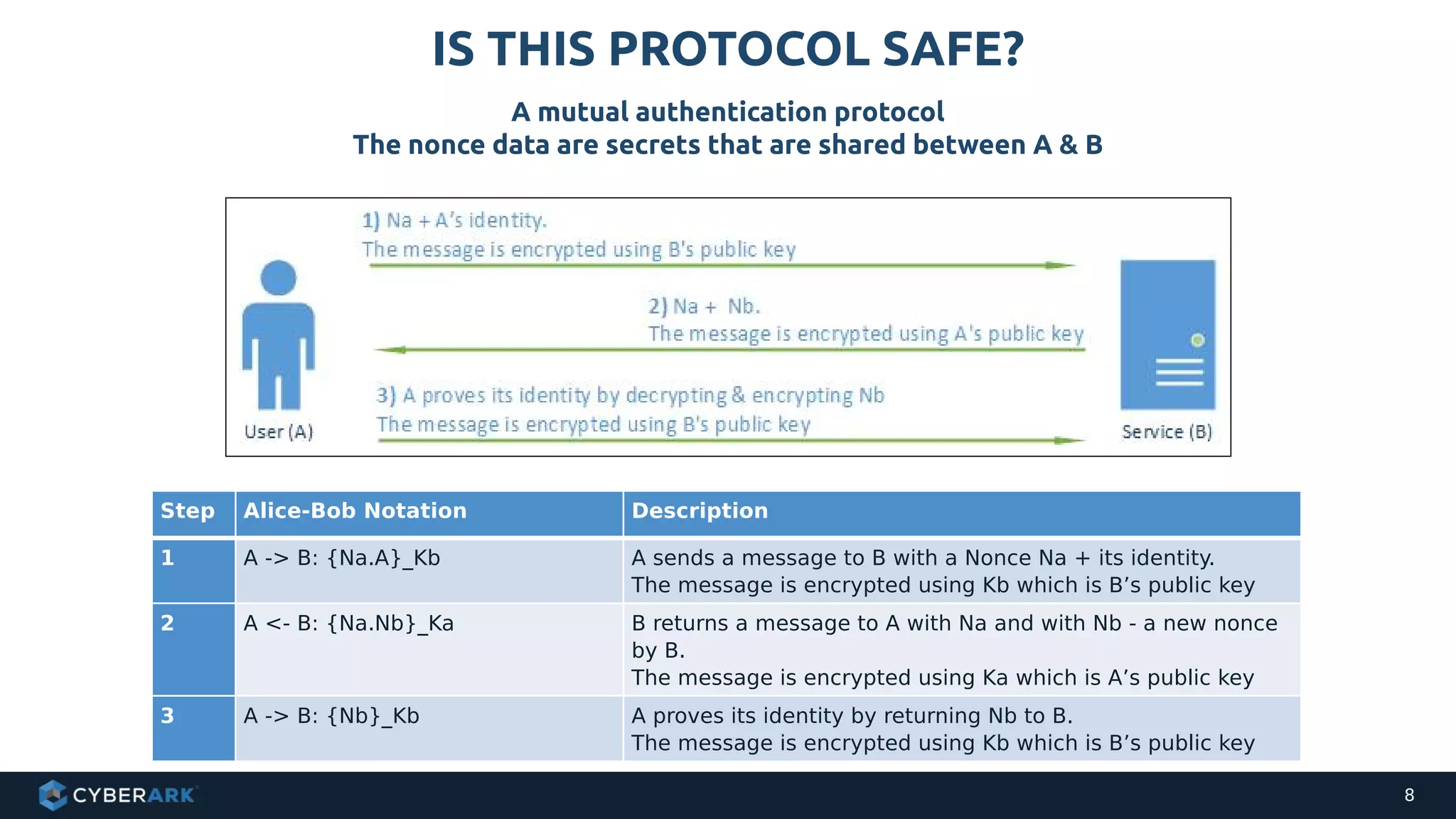
Step Alice-Bob Notation Description
1 A -> B: {Na.A}_Kb A sends a message to B with a Nonce Na + its identity.
The message is encrypted using Kb which is B’s public key
2 A <- B: {Na.Nb}_Ka B returns a message to A with Na and with Nb - a new nonce
by B.
The message is encrypted using Ka which is A’s public key
3 A -> B: {Nb}_Kb A proves its identity by returning Nb to B.
The message is encrypted using Kb which is B’s public key
A mutual authentication protocol
The nonce data are secrets that are shared between A & B
IS THIS PROTOCOL SAFE?
• the Needham-Schroeder (Roger Needham & Michael Schroeder) Public Key protocol (1978)
• Mutual authentication with public keys (using a trusted key server)
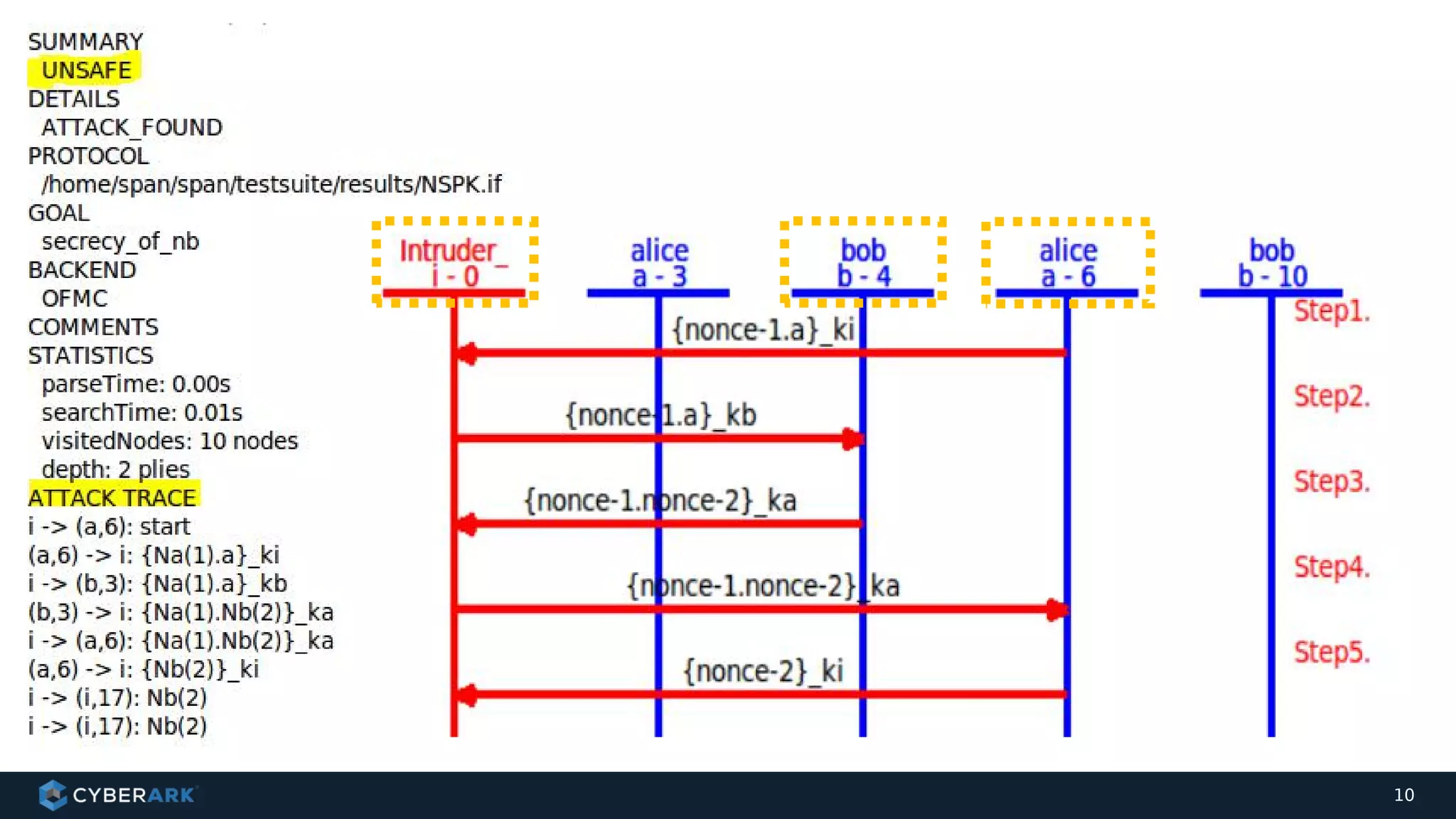
• The MITM attack was published by Gavin Lowe, by using a model checker in 1996 (Link), 18 years later!
THE NEEDHAM SCHROEDER PUBLIC KEY PROTOCOL
9
10
11
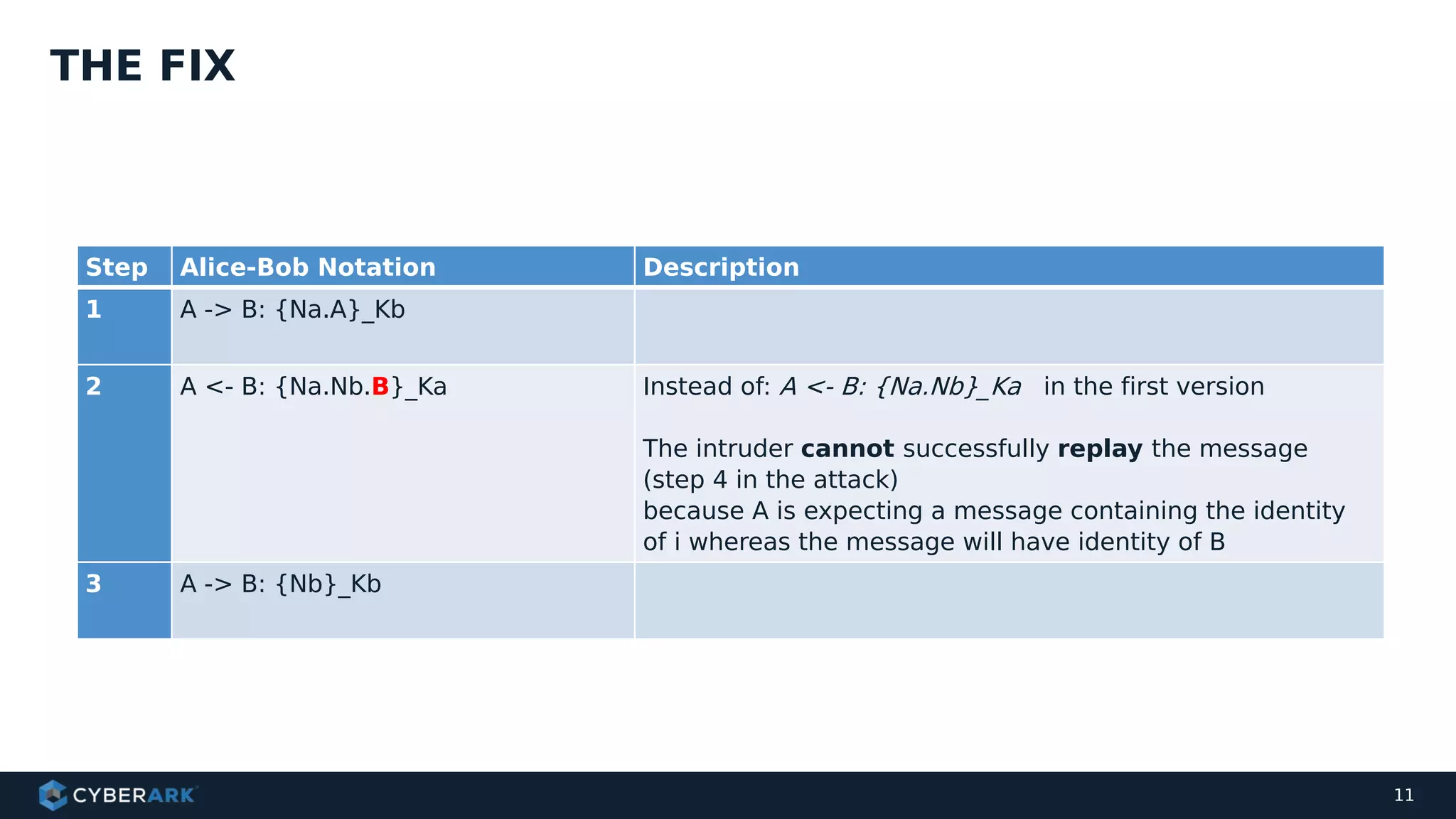
Step Alice-Bob Notation Description
1 A -> B: {Na.A}_Kb  
2 A <- B: {Na.Nb.B}_Ka Instead of: A <- B: {Na.Nb}_Ka in the first version
 
The intruder cannot successfully replay the message
(step 4 in the attack)
because A is expecting a message containing the identity
of i whereas the message will have identity of B
3 A -> B: {Nb}_Kb  
THE FIX
12
Roger Needham:
Cryptography protocols
are three line programs
that people still manage to get wrong
13
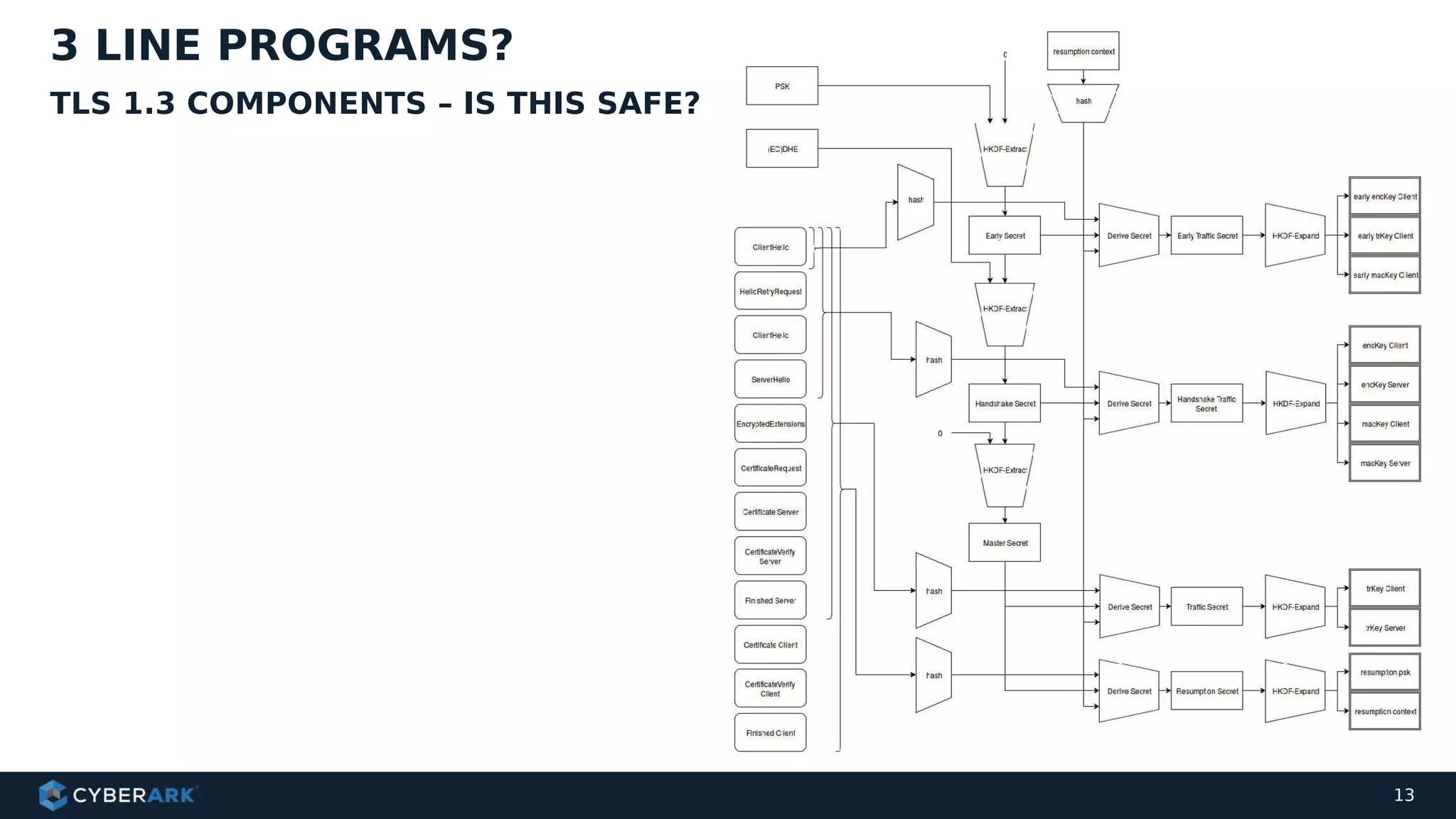
3 LINE PROGRAMS?
TLS 1.3 COMPONENTS – IS THIS SAFE?
14
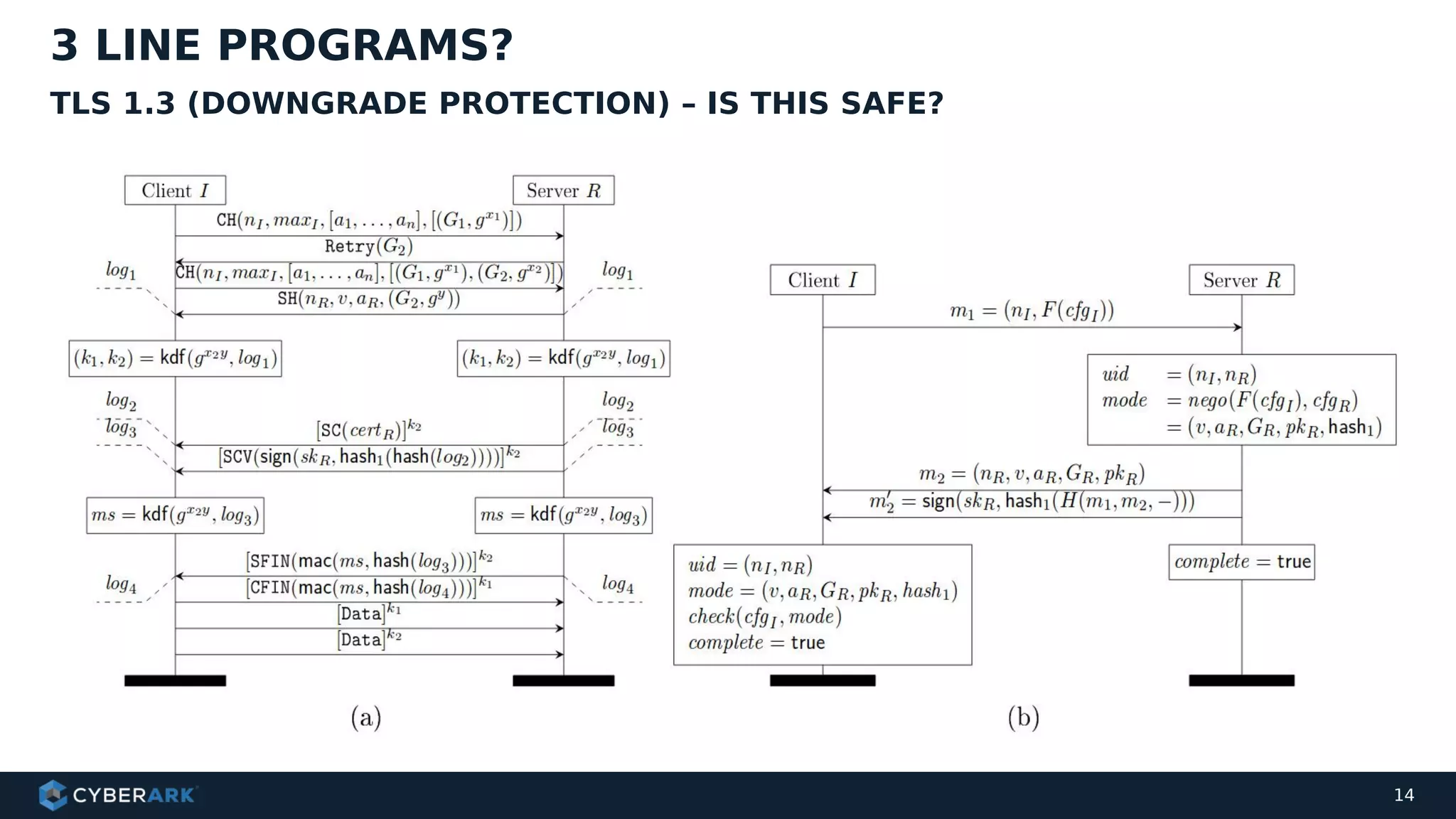
3 LINE PROGRAMS?
TLS 1.3 (DOWNGRADE PROTECTION) – IS THIS SAFE?
15
THE SOLUTION
Detect design vulnerabilities that can lead to logical
attacks
GOAL – TO PREVENT LOGICAL ATTACKS
16
17
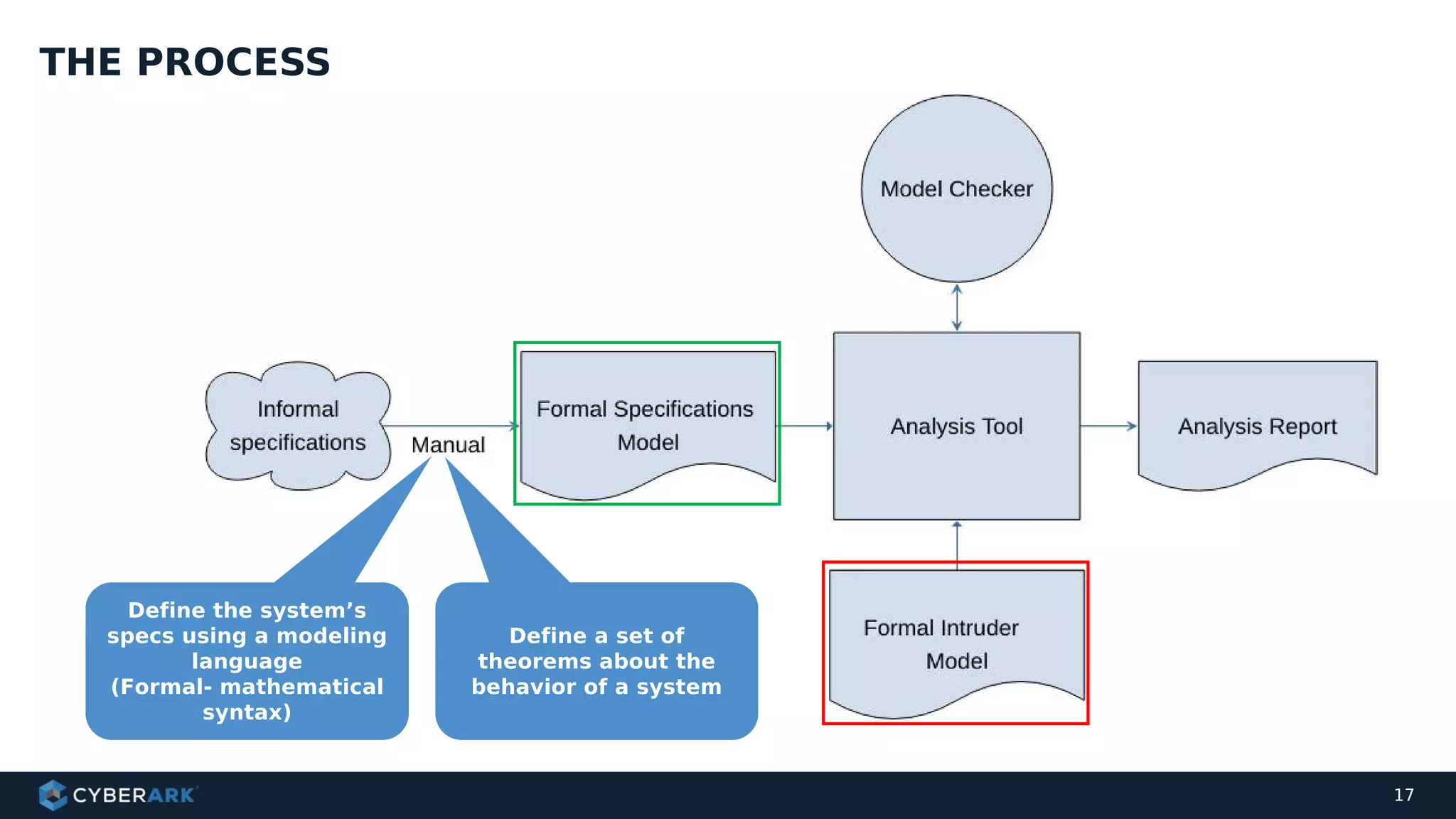
THE PROCESS
Define the system’s
specs using a modeling
language
(Formal- mathematical
syntax)
Define a set of
theorems about the
behavior of a system
18
FORMAL METHODS
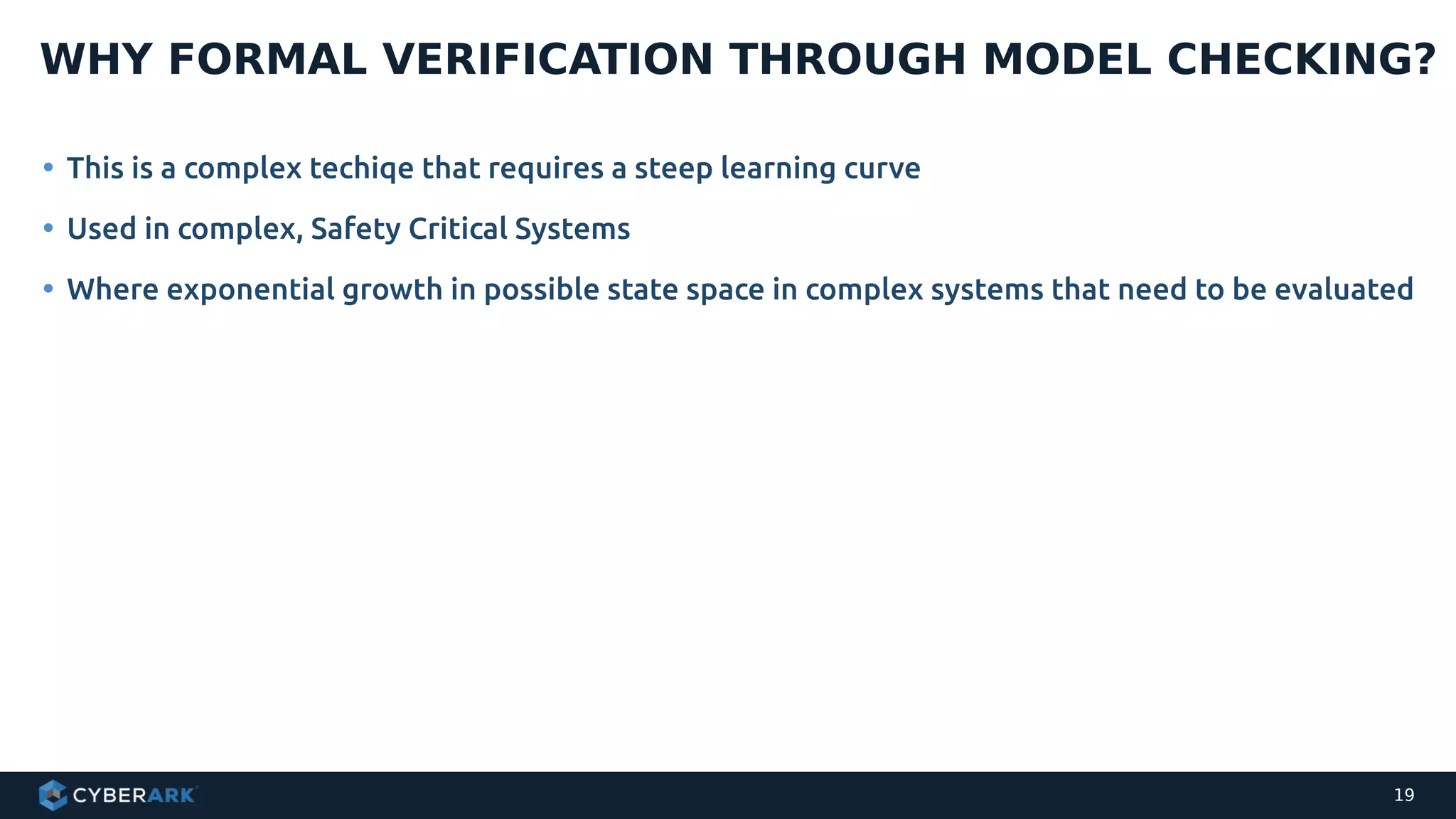
• This is a complex techiqe that requires a steep learning curve
• Used in complex, Safety Critical Systems
• Where exponential growth in possible state space in complex systems that need to be evaluated
WHY FORMAL VERIFICATION THROUGH MODEL CHECKING?
19
WHAT IS A MODEL CHECKER?
20
21
22
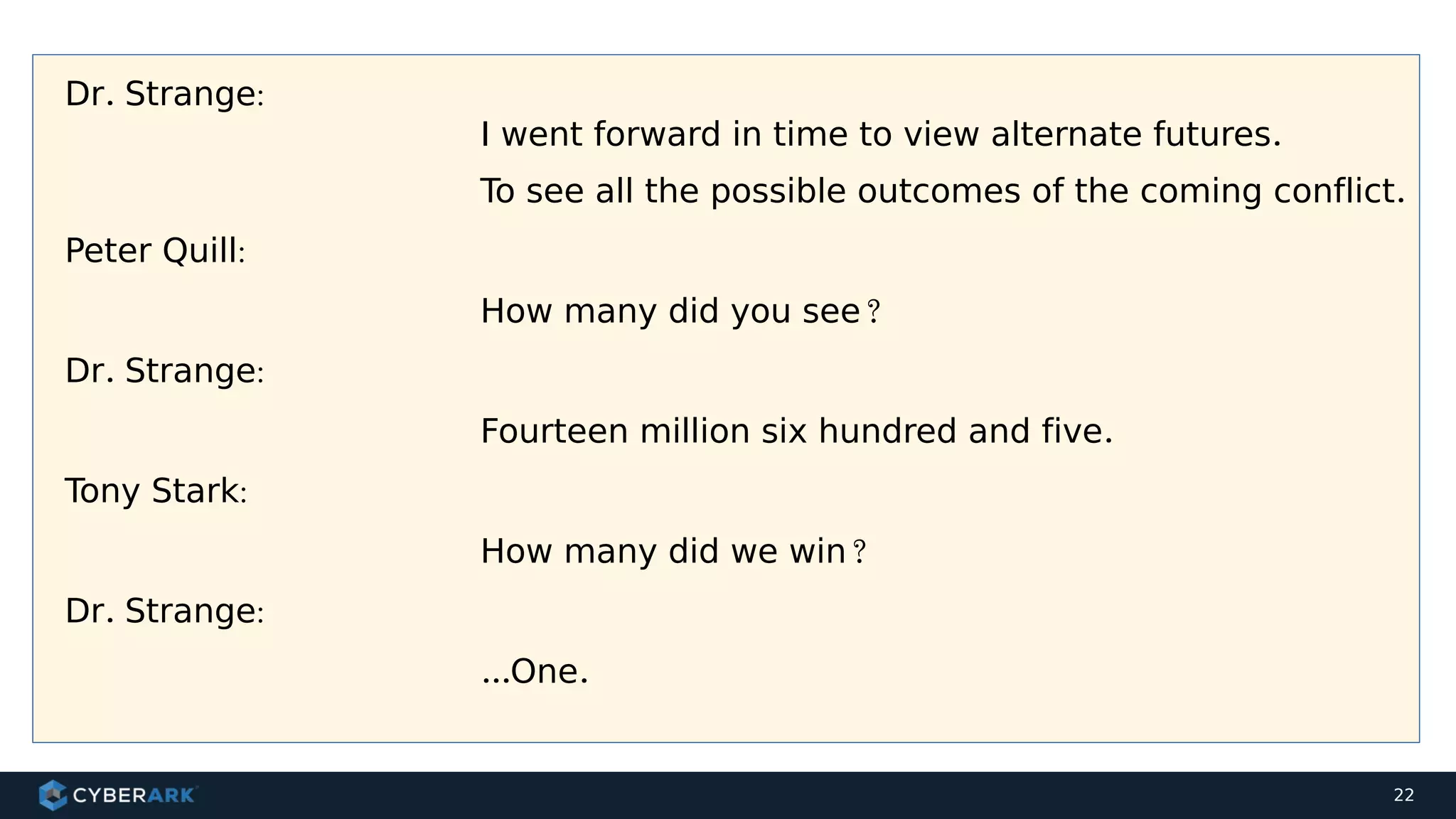
Dr. Strange:
I went forward in time to view alternate futures.
To see all the possible outcomes of the coming conflict.
Peter Quill:
How many did you see?
Dr. Strange:
Fourteen million six hundred and five.
Tony Stark:
How many did we win?
Dr. Strange:
...One.
23
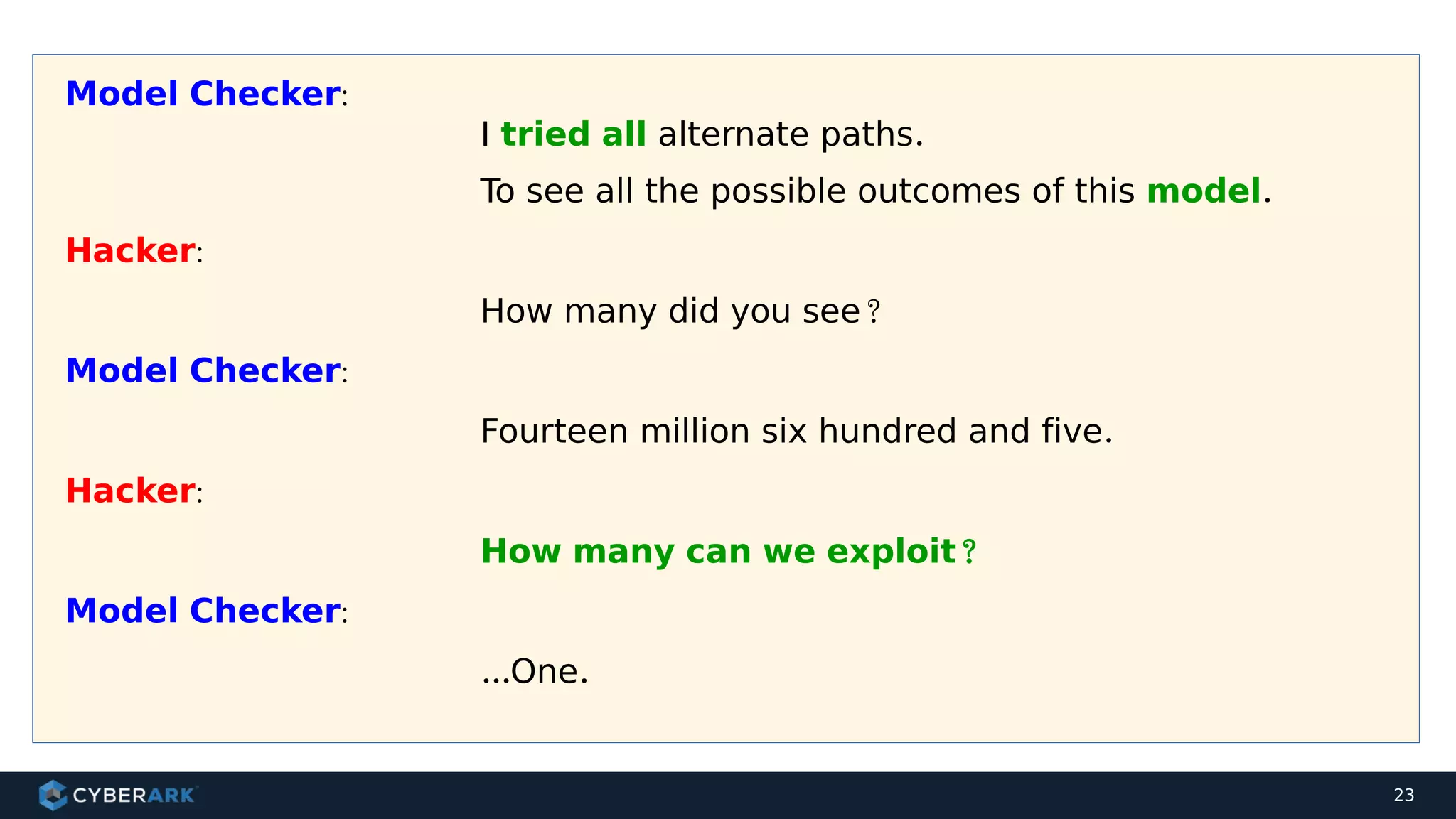
Model Checker:
I tried all alternate paths.
To see all the possible outcomes of this model.
Hacker:
How many did you see?
Model Checker:
Fourteen million six hundred and five.
Hacker:
How many can we exploit?
Model Checker:
...One.
24
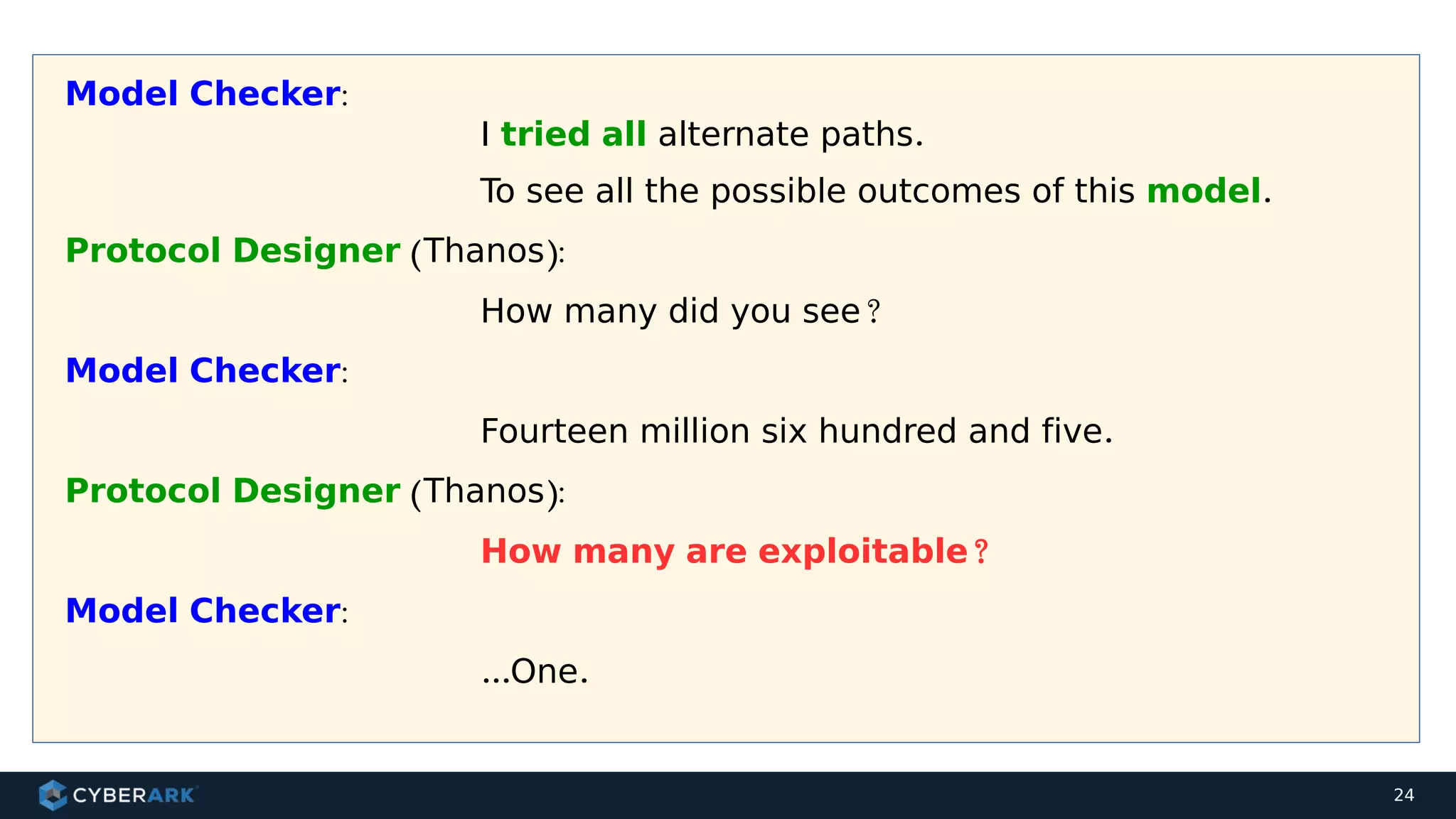
Model Checker:
I tried all alternate paths.
To see all the possible outcomes of this model.
Protocol Designer (Thanos):
How many did you see?
Model Checker:
Fourteen million six hundred and five.
Protocol Designer (Thanos):
How many are exploitable?
Model Checker:
...One.
• Coverage: exhaustive exploration of all possible behaviors
• Verify each behavior against the required theorems through mathematical proofs
• Can verify systems that are not finite space, using abstraction
• Provide a counter example, i.e. a Fault Trace
MODEL CHECKER GOALS
25
• Assumption: The intruder is an Insider!
• Intruder has full control over the network
• Intruder can play role(s) of (honest/normal) principals
• Knows all the public data of the network
• Possible actions:
• Start any number of parallel protocol sessions
• Intercept any message
• Generate new messages, using observed data and initial knowledge (e.g. public keys)
DOLEV-YAO INTRUDER MODEL
26
• Assumption: the cryptography is secure!
• Intruder cannot break cryptography
• Intruder cannot encrypt/decrypt messages if s/he doesn't have the key
• Intruder cannot guess a secret key or a nonce
* we check only the protocol’s logic
** we assume the cryptography, random, etc. are secure
DOLEV-YAO INTRUDER MODEL
27
28
ANALYSIS TOOLS
DEMOS
29
AVISPA
DEMO
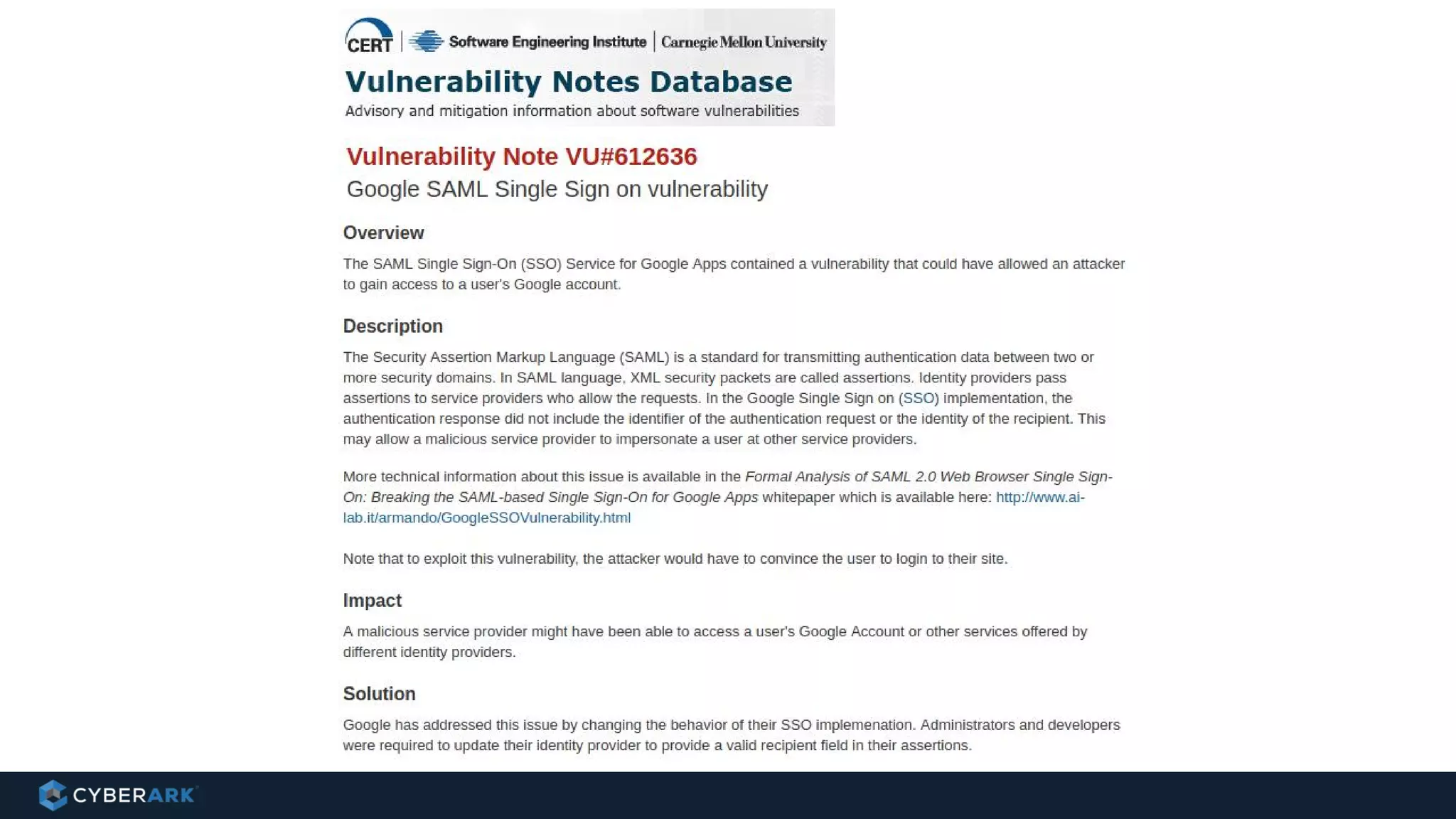
GOOGLE SAML SINGLE SIGN ON
VULNERABILITY
30
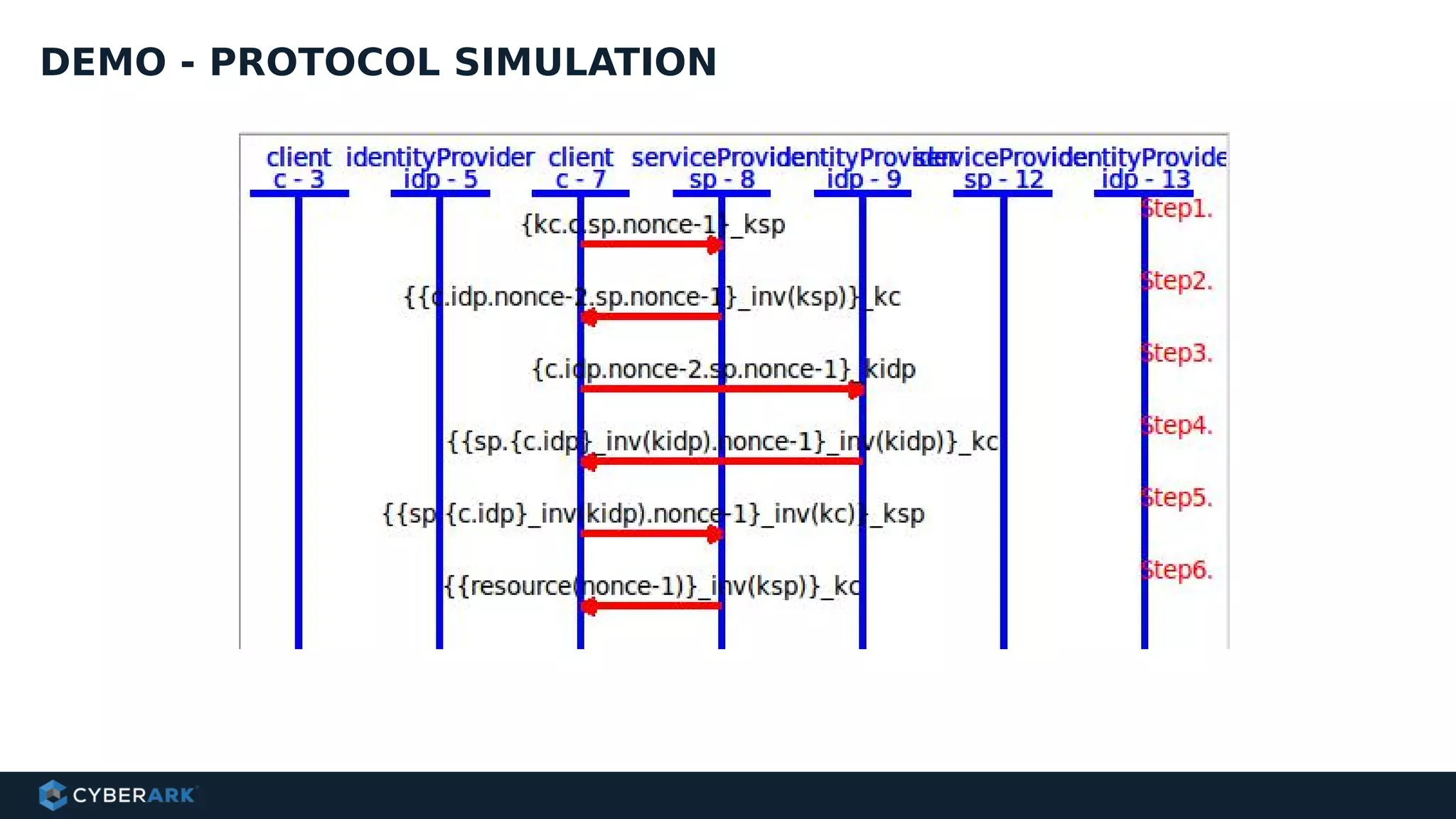
DEMO - PROTOCOL SIMULATION
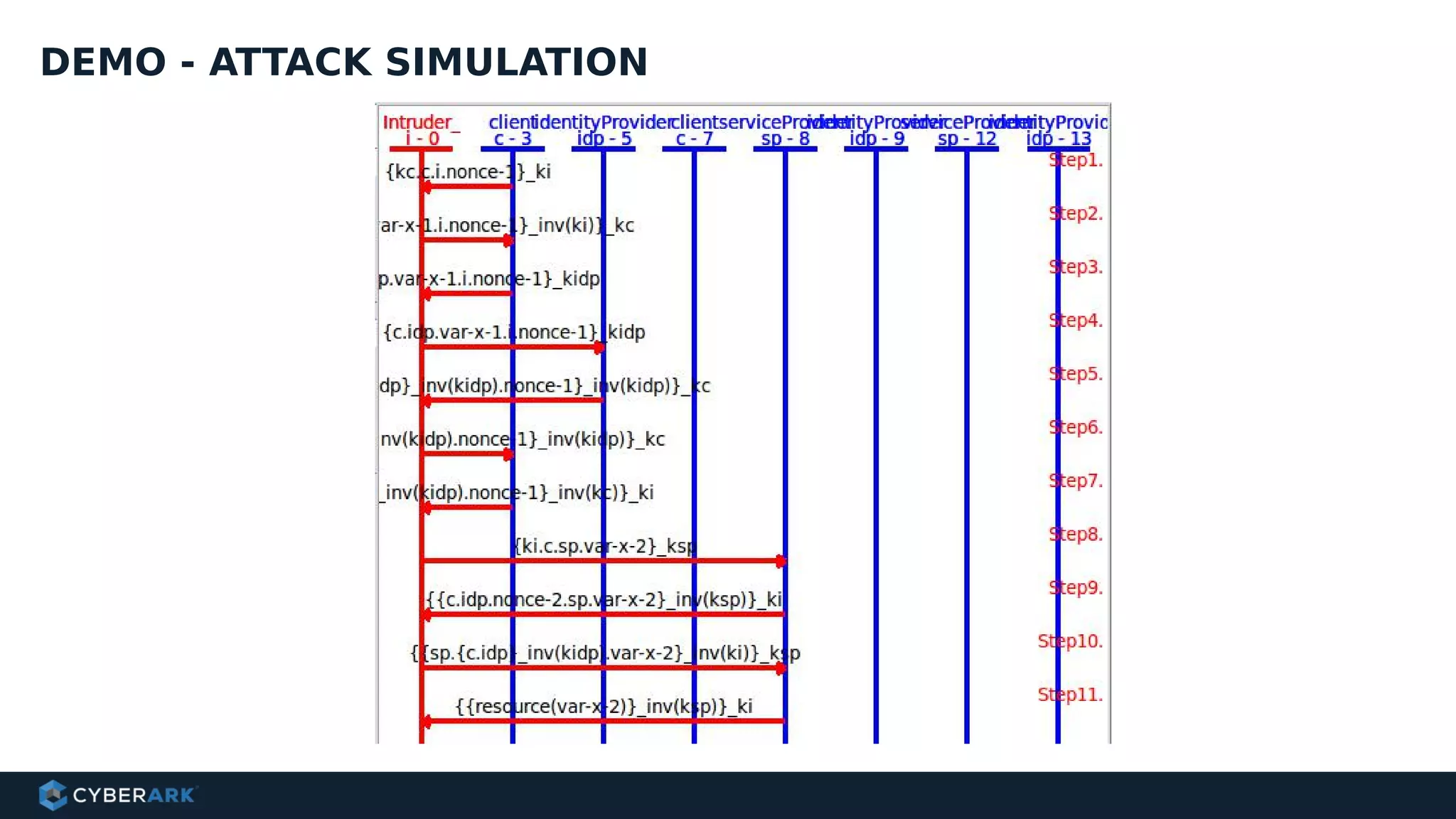
DEMO - ATTACK SIMULATION
34
TAMARIN PROVER
DEMO
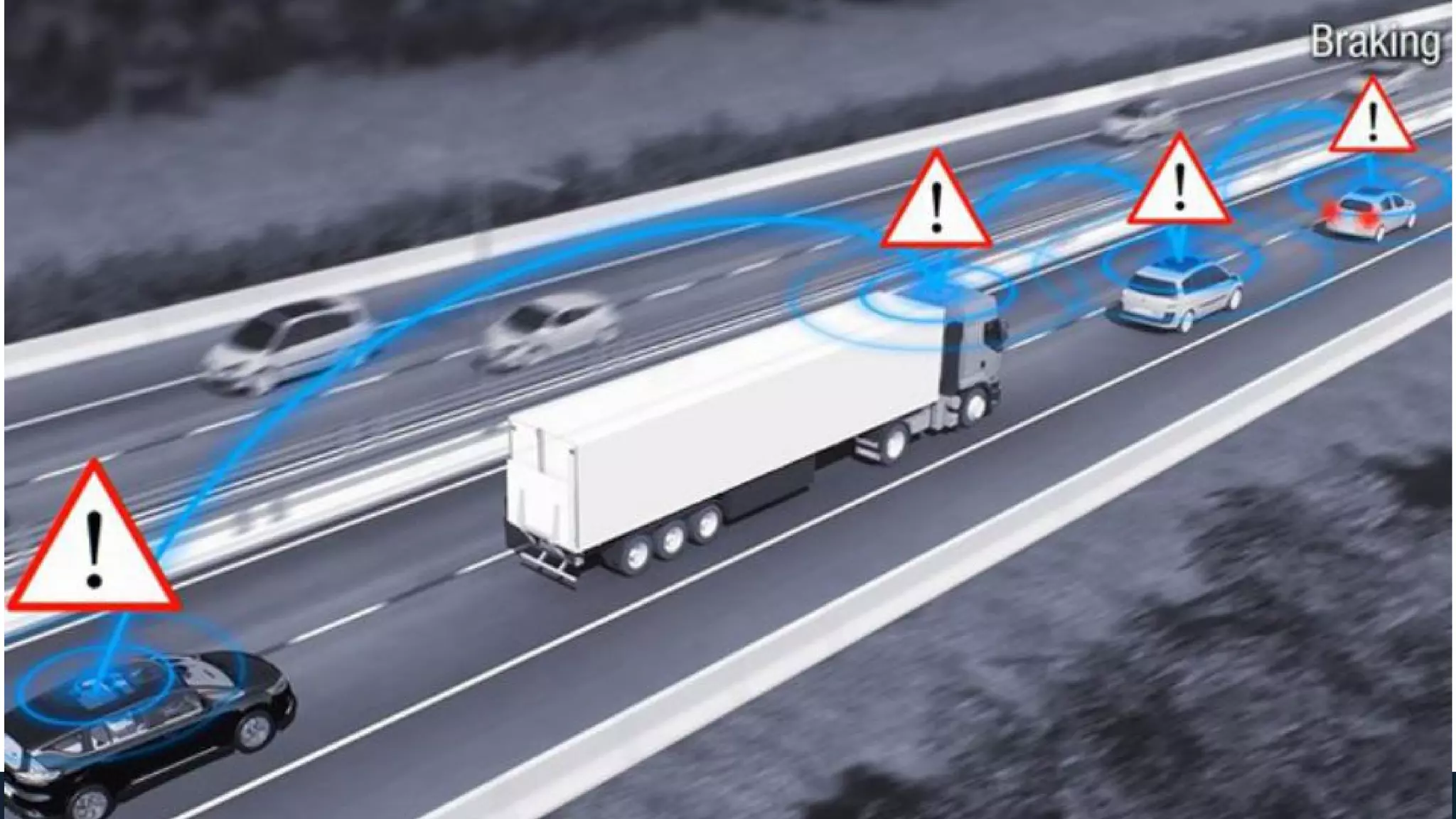
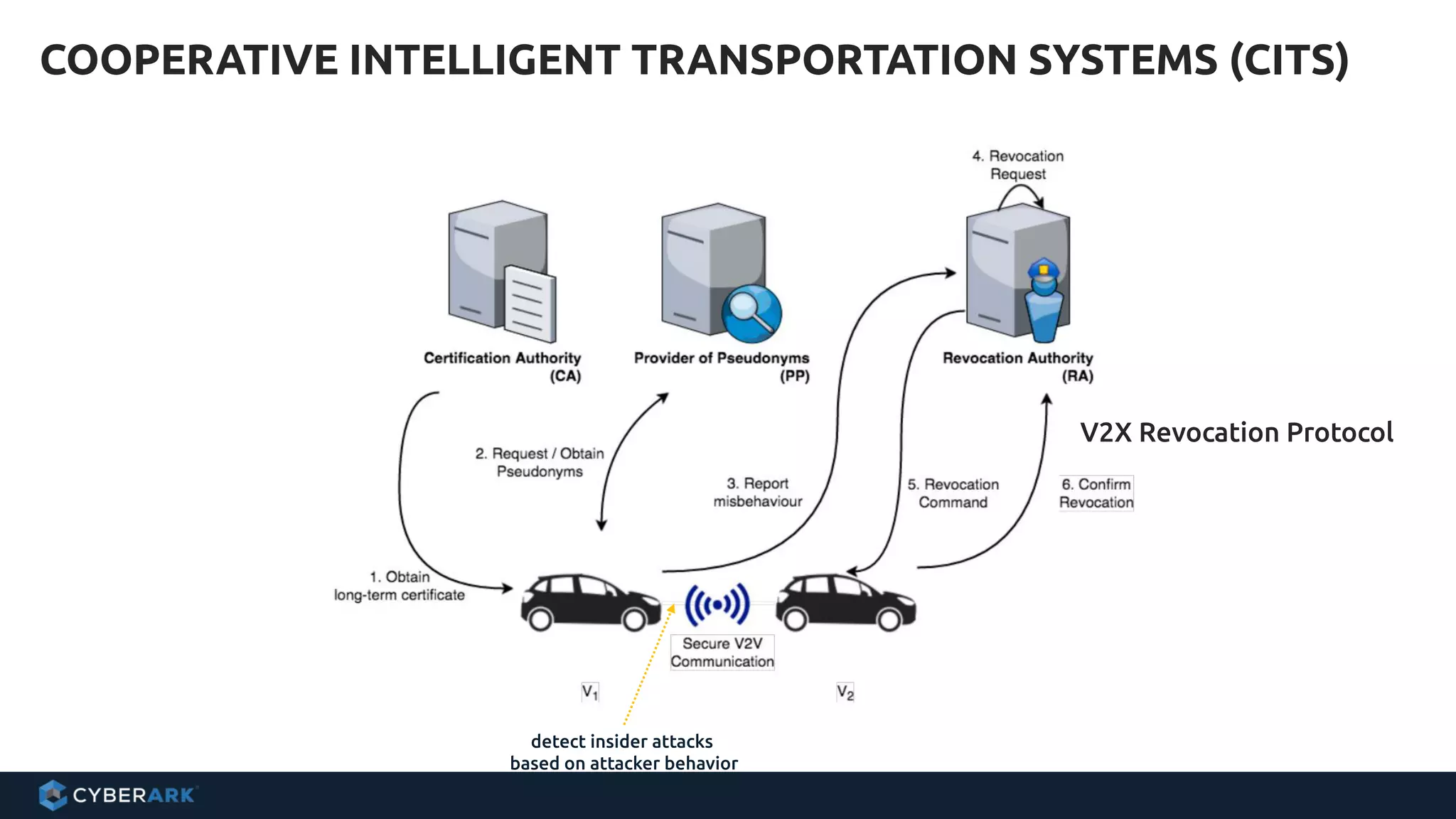
VANET/V2X REVOCATION PROTOCOL
35
COOPERATIVE INTELLIGENT TRANSPORTATION SYSTEMS (CITS)
detect insider attacks
based on attacker behavior
V2X Revocation Protocol
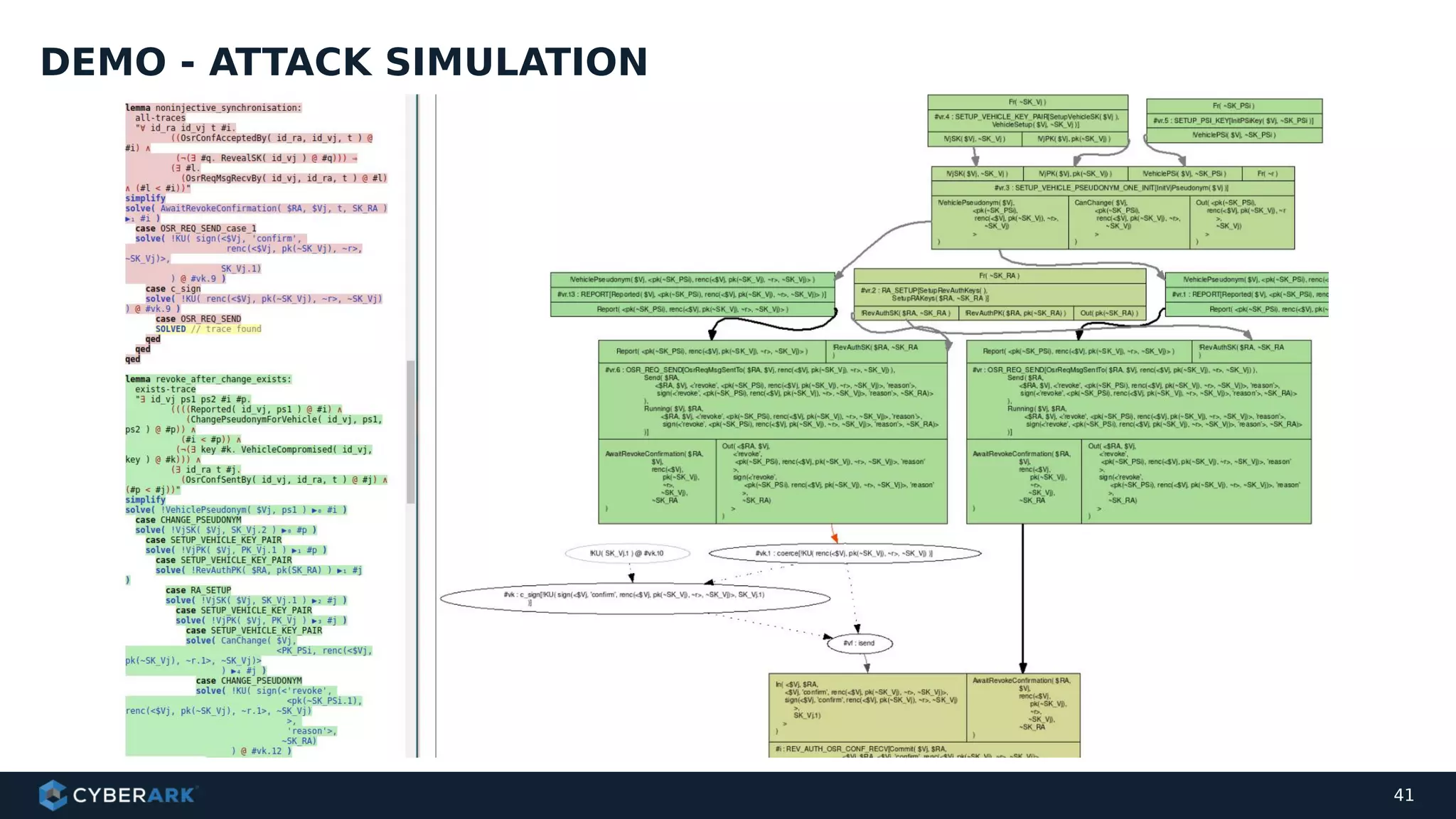
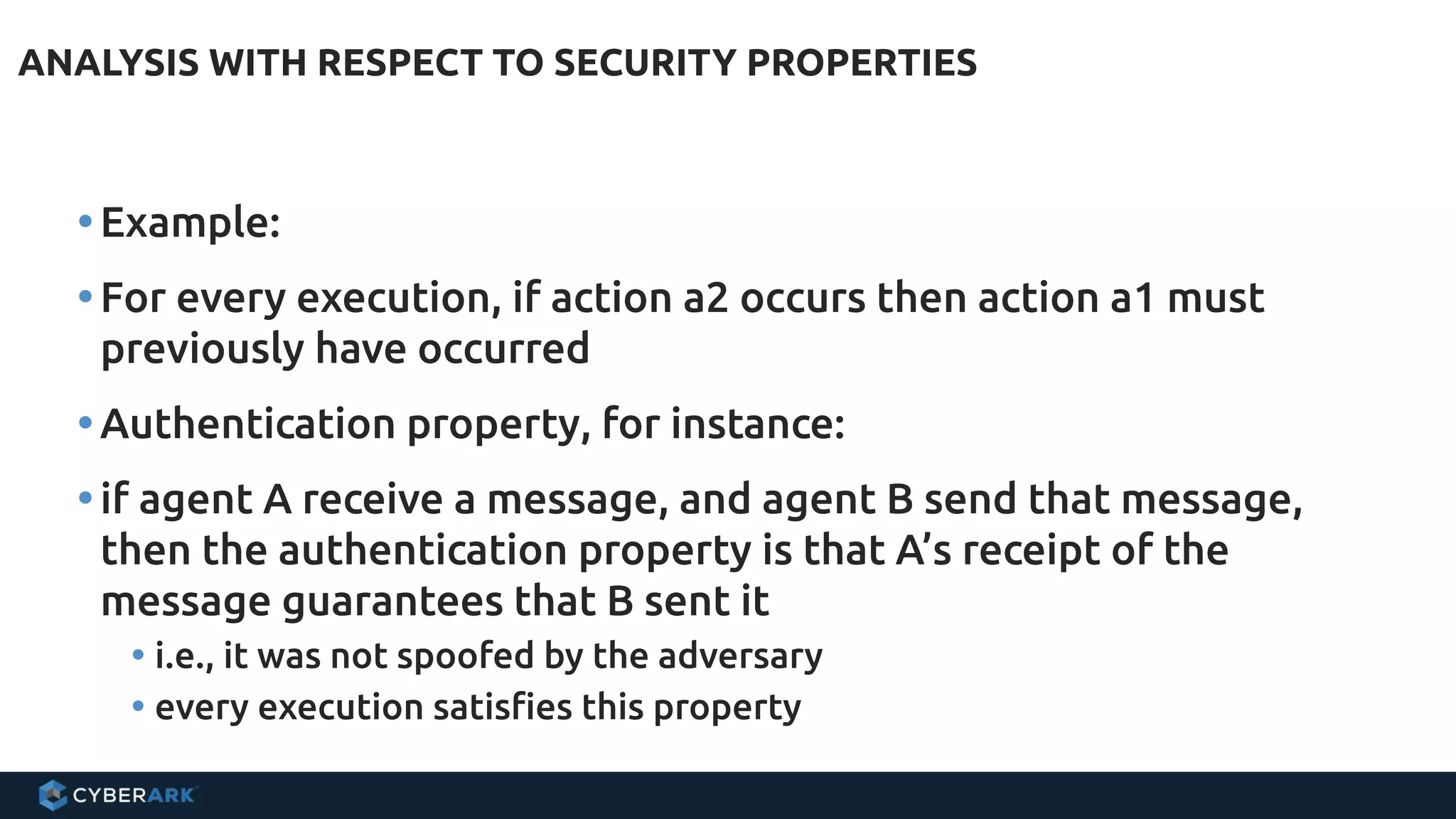
ANALYSIS WITH RESPECT TO SECURITY PROPERTIES
•Example:
•For every execution, if action a2 occurs then action a1 must
previously have occurred
•Authentication property, for instance:
•if agent A receive a message, and agent B send that message,
then the authentication property is that A’s receipt of the
message guarantees that B sent it
• i.e., it was not spoofed by the adversary
• every execution satisfies this property
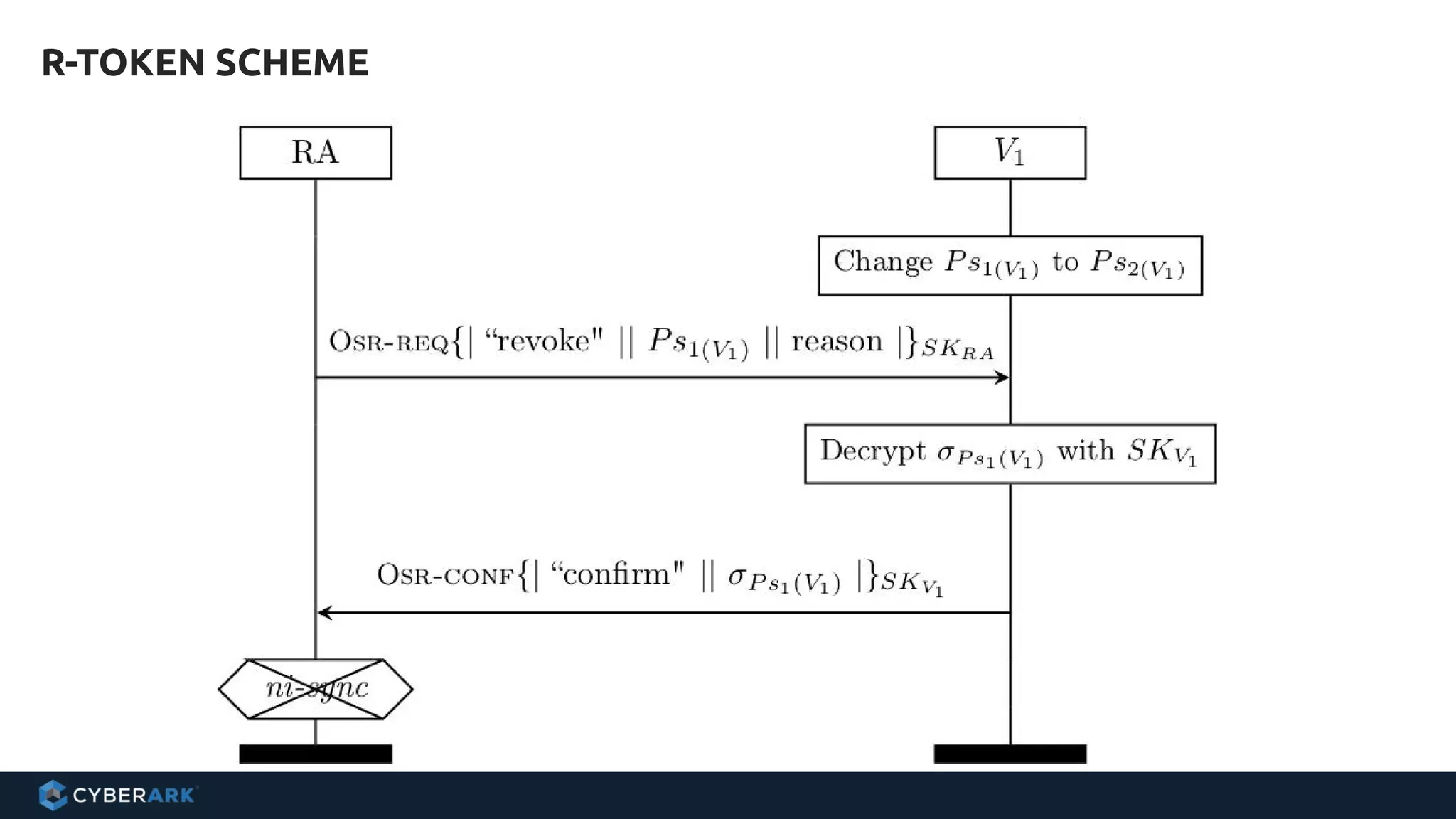
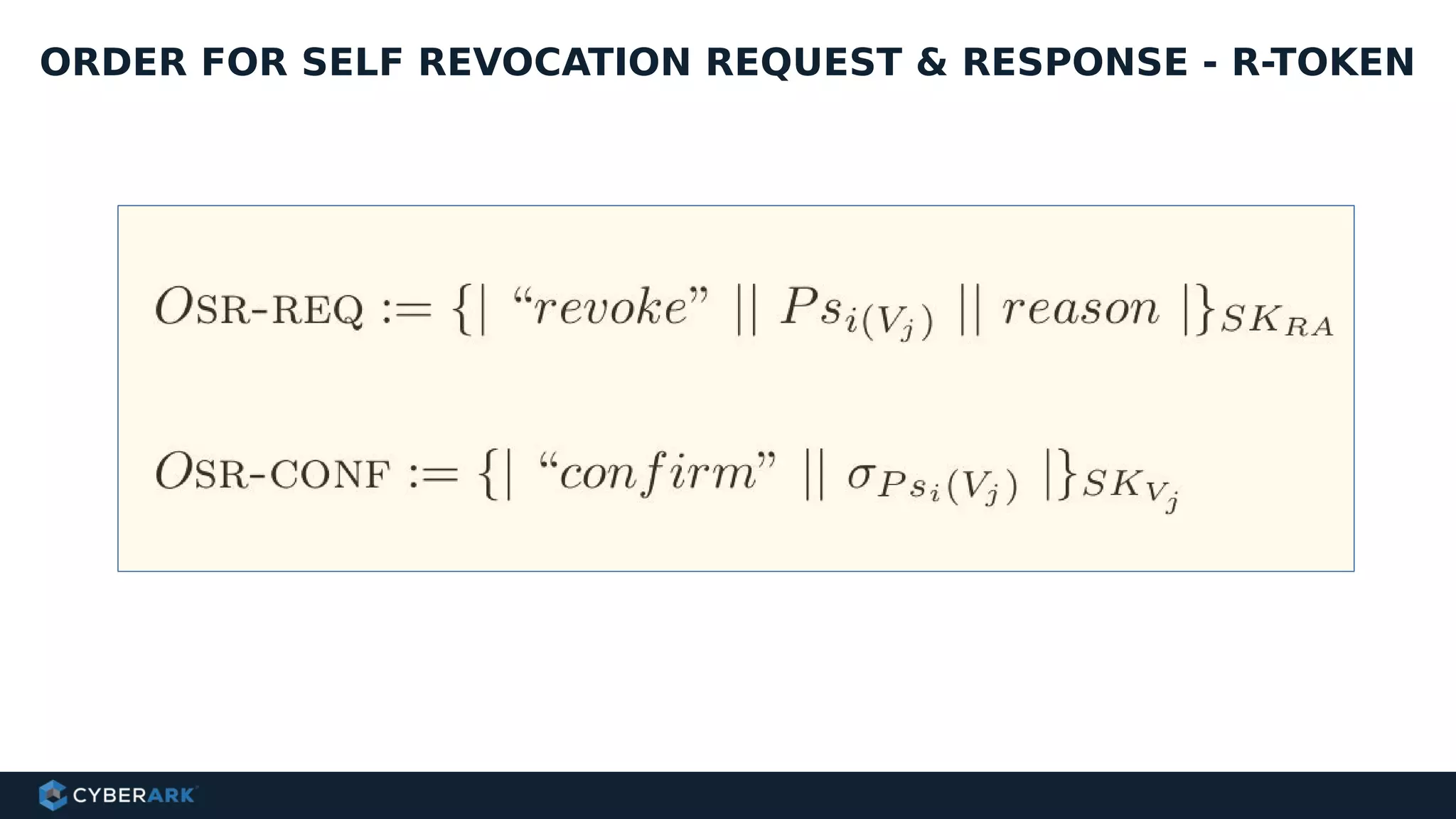
ORDER FOR SELF REVOCATION REQUEST & RESPONSE - R-TOKEN
R-TOKEN SCHEME
41
DEMO - ATTACK SIMULATION
42
ADVANCED ATTACKS/ANALYSIS
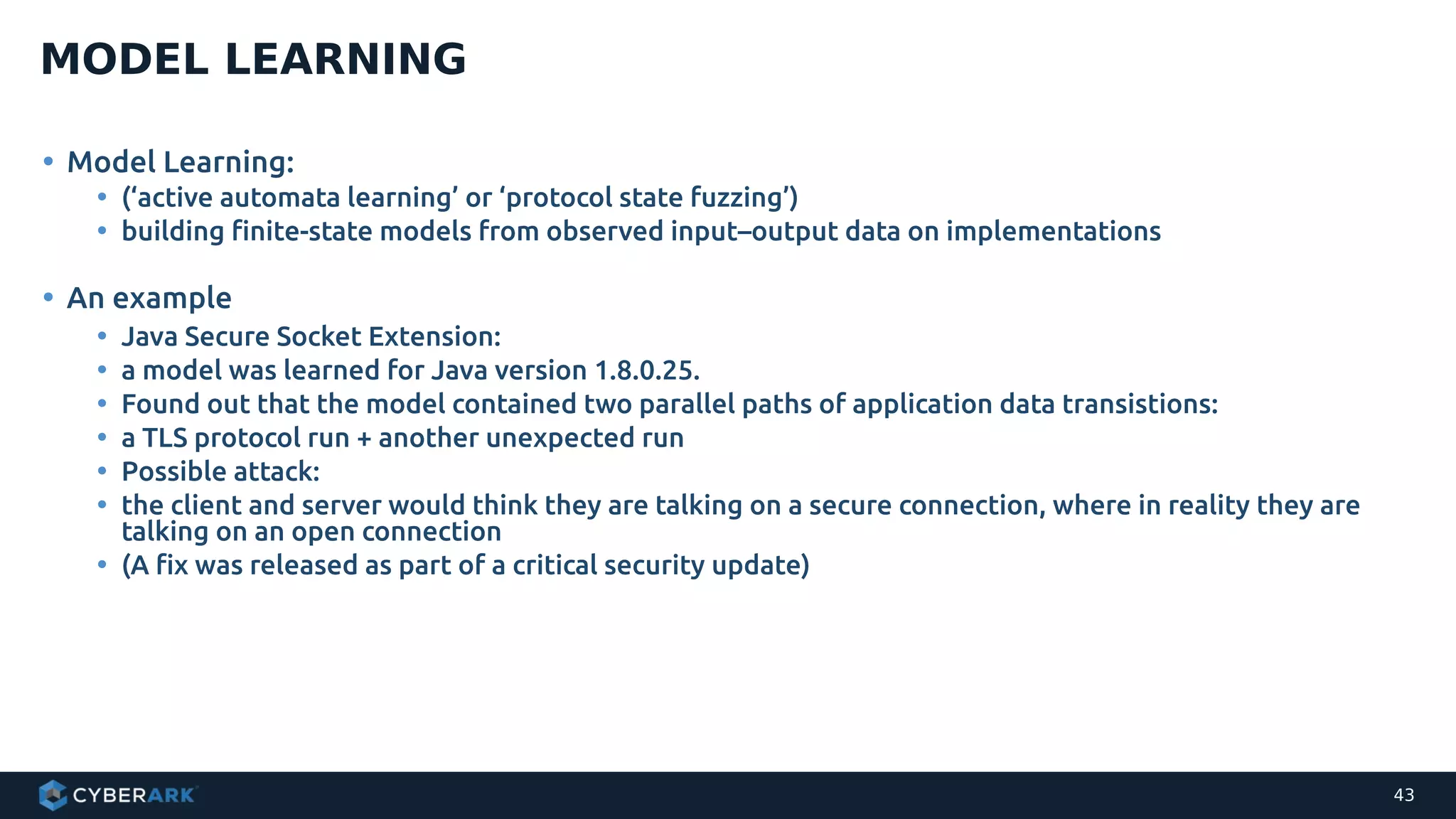
• Model Learning:
• (‘active automata learning’ or ‘protocol state fuzzing’)
• building finite-state models from observed input–output data on implementations
• An example
• Java Secure Socket Extension:
• a model was learned for Java version 1.8.0.25.
• Found out that the model contained two parallel paths of application data transistions:
• a TLS protocol run + another unexpected run
• Possible attack:
• the client and server would think they are talking on a secure connection, where in reality they are
talking on an open connection
• (A fix was released as part of a critical security update)
MODEL LEARNING
43
POSSIBLE CONNECTIONS
BETWEEN
MODEL LEARNING
&
MODEL CHECKING
44
45
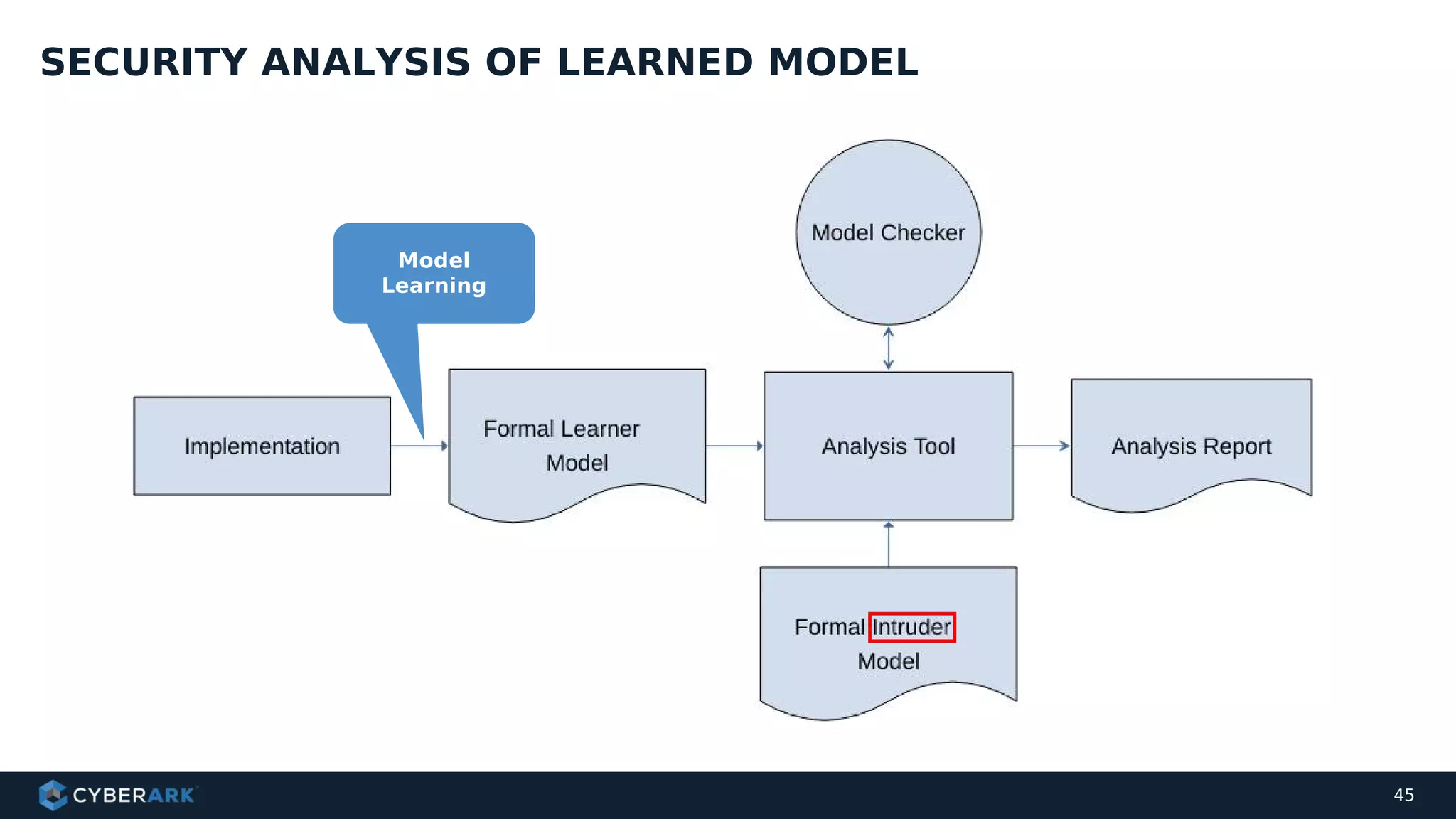
SECURITY ANALYSIS OF LEARNED MODEL
Model
Learning
46
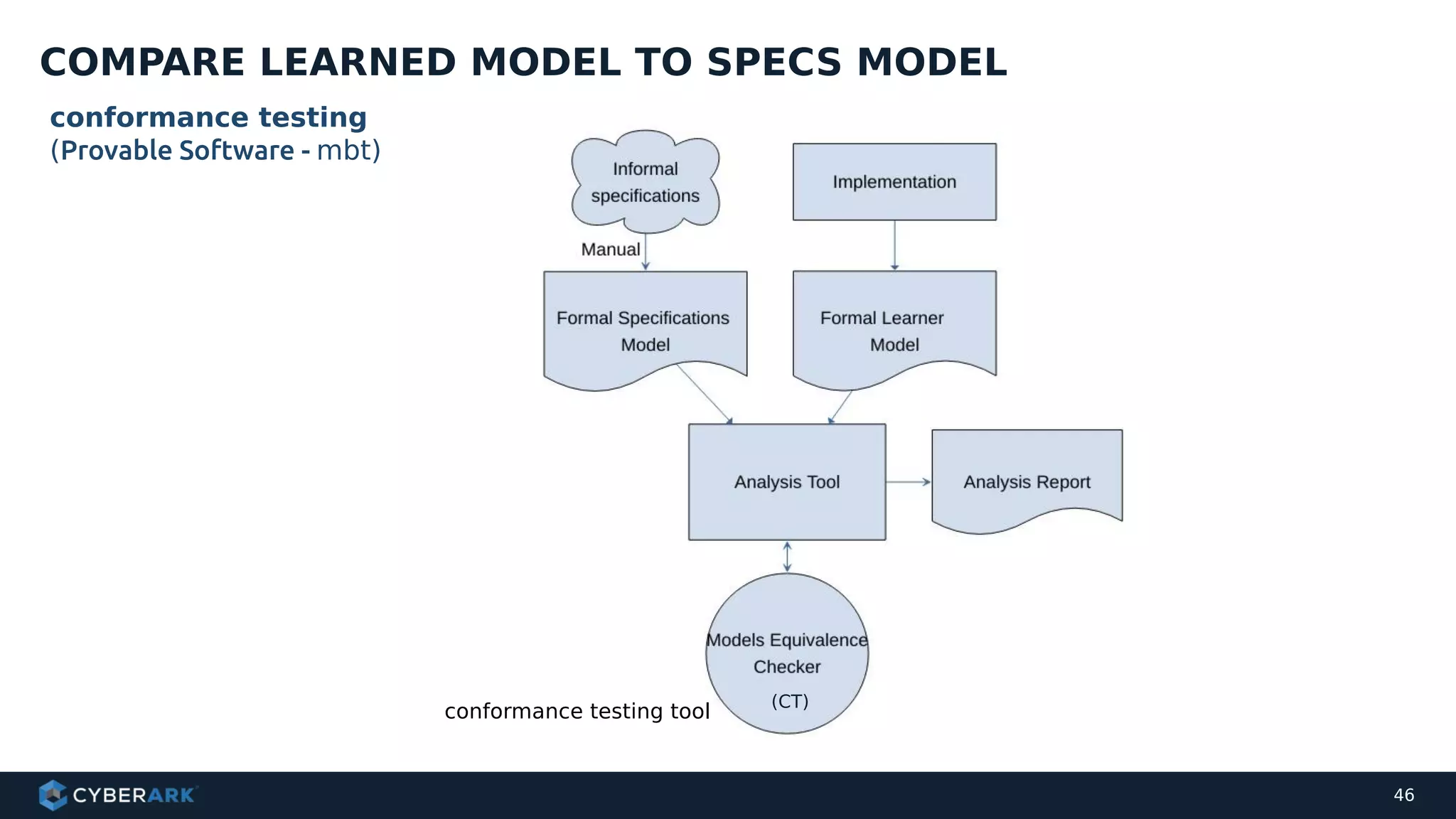
COMPARE LEARNED MODEL TO SPECS MODEL
conformance testing tool
(CT)
conformance testing
(Provable Software - mbt)
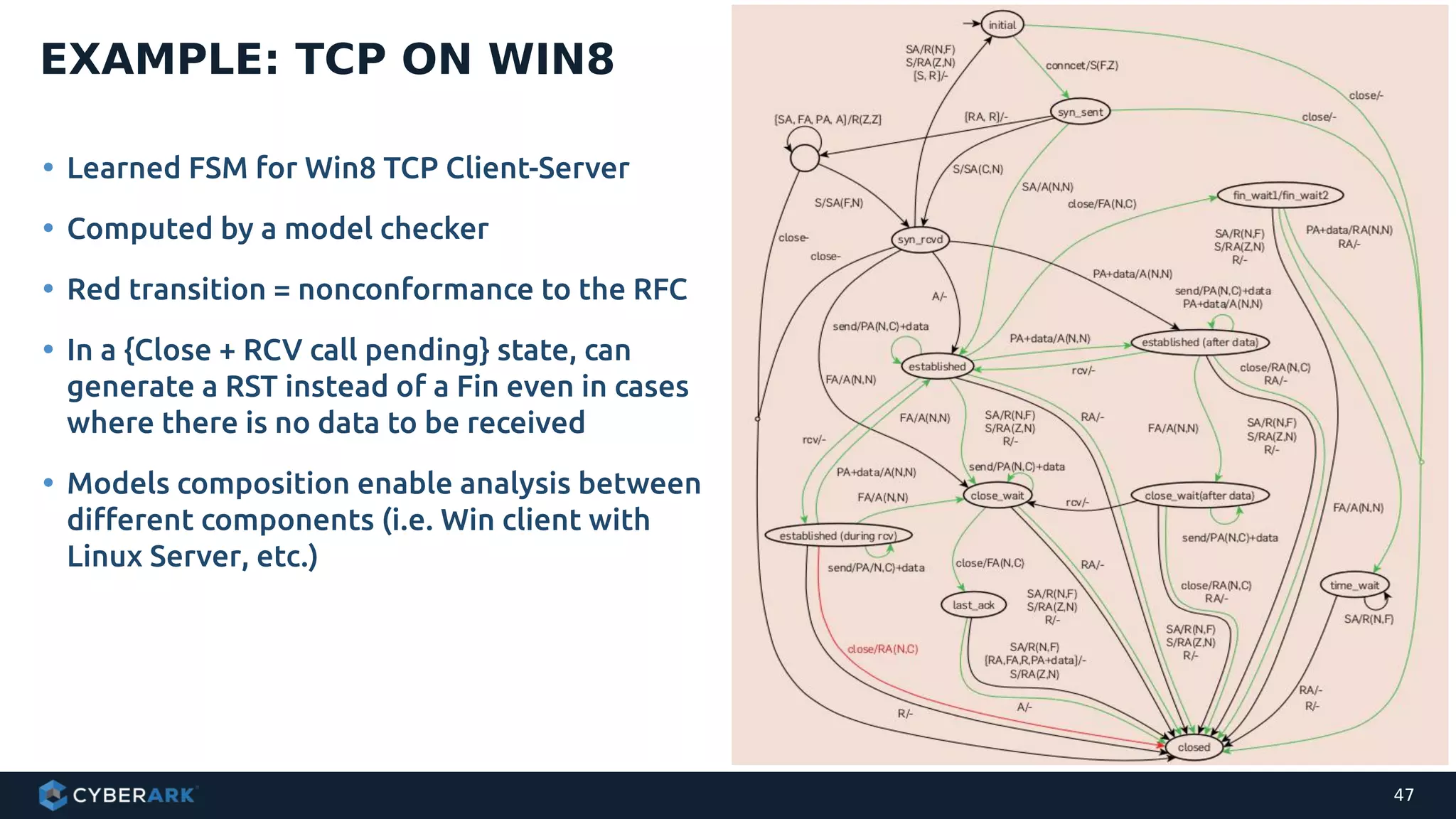
• Learned FSM for Win8 TCP Client-Server
• Computed by a model checker
• Red transition = nonconformance to the RFC
• In a {Close + RCV call pending} state, can
generate a RST instead of a Fin even in cases
where there is no data to be received
• Models composition enable analysis between
different components (i.e. Win client with
Linux Server, etc.)
EXAMPLE: TCP ON WIN8
47
48
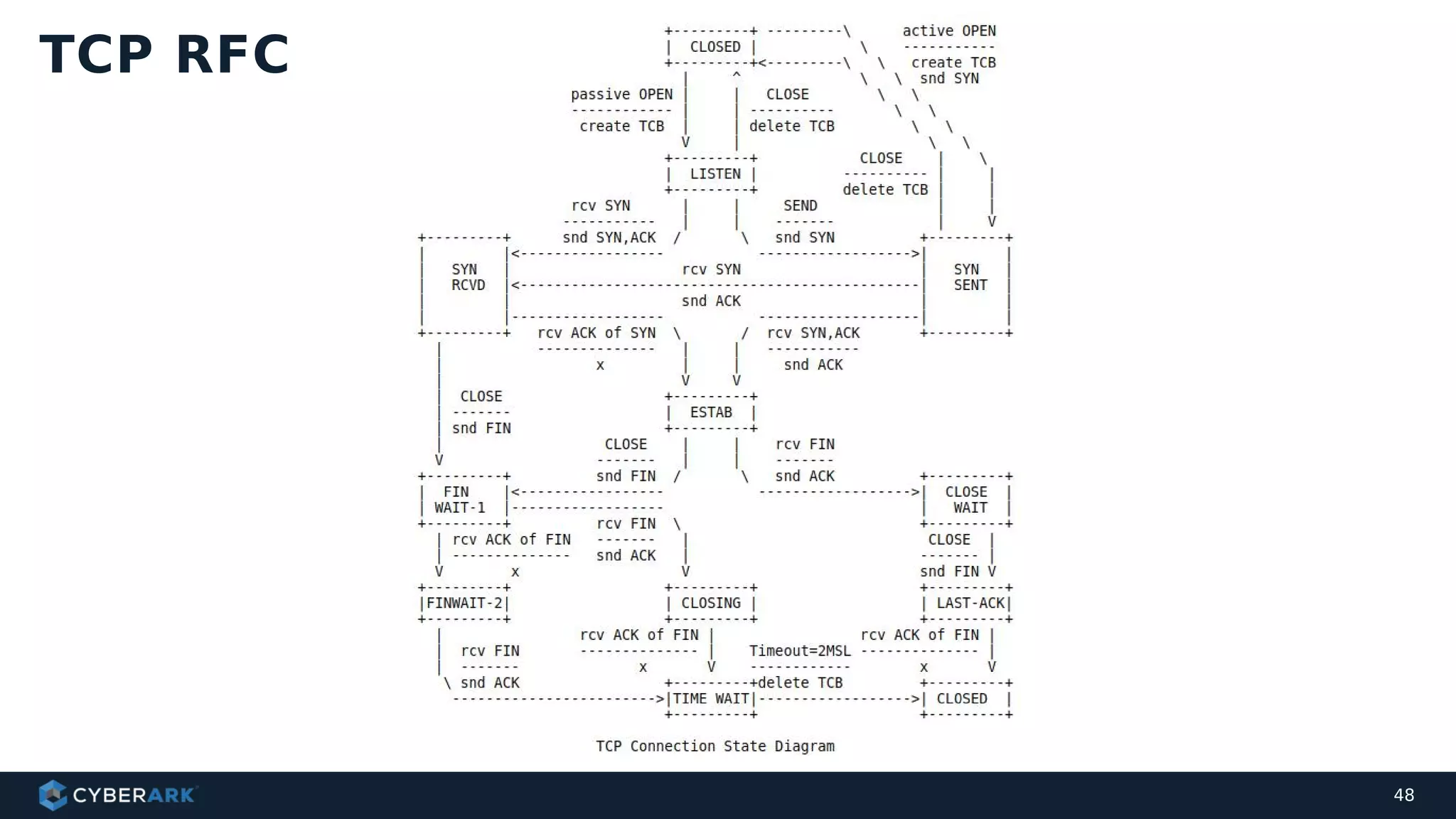
TCP RFC
49
SUMMARY
Analysis of cryptographic protocols using formal methods and model checkers is very complex,
and requires a steep learning curve.
But
Security protocols are excellent candidates for rigorous analysis techniques because they are:
• Critical components of any distributed security architecture
• Very difficult to evaluate by hand
• Deceptively simple looking
• the literature is full of protocols that appear to be secure but have subsequently been found to fall
prey to some subtle attack, sometimes years later.
SUMMARY
50
THANK YOU!
Ofer Rivlin
ofer.rivlin@cyberark.com
https://www.linkedin.com/in/ofer-rivlin/
Twitter: @0xriv3r
51
• Fiterău-Broştean, Janssen, Vaandrager: Combining model learning and model checking to analyze TCP implementations (2016).
Springer
• {J.Whitefield, Liqun.Chen, S.Schneider, H.Treharne, S.Wesemeyer}@surrey.ac.uk: "Formal Analysis of V2X Revocation
Protocols"
• https://pdfs.semanticscholar.org/6658/591533a5a41d88af1bbb112591645c0f61e0.pdf
• https://tools.ietf.org/html/rfc793
• https://www.kb.cert.org/vuls/id/612636
• http://people.irisa.fr/Thomas.Genet/span/
• https://tamarin-prover.github.io
REFERENCES
52

How to hack cryptographic protocols with Formal Methods

  • 1.
    HOW TO HACK CRYPTOGRAPHICPROTOCOLS WITH FORMAL METHODS Ofer Rivlin 1
  • 2.
    2 Step Alice-Bob NotationDescription 1 A -> B: {Na.A}_Kb A sends a message to B with a Nonce Na + its identity. The message is encrypted using Kb which is B’s public key 2 A <- B: {Na.Nb}_Ka B returns a message to A with Na and with Nb - a new nonce by B. The message is encrypted using Ka which is A’s public key 3 A -> B: {Nb}_Kb A proves its identity by returning Nb to B. The message is encrypted using Kb which is B’s public key A mutual authentication protocol The nonce data are secrets that are shared between A & B How do we know if this protocol is safe?
  • 3.
    • Intro • Mybackground, scope, goals & subject of this presentation • The problem • The suggested solution • A few words on Formal Methods & Model Checker • Analysis tools demos • Avispa & Tamarin Prover • Advanced attacks/analysis • Summary AGENDA 3
  • 4.
  • 5.
    • Lead theproduct security at CyberArk • 10 years of cybersecurity experience • 10 years of experience as a software developer and architect • 3 years of Formal Methods experience in development tools for Provable Software • Passionate about cutting edge technology and cybersecurity! MY BACKGROUND 5 • Ofer Rivlin • ofer.rivlin@cyberark.com • https://www.linkedin.com/in/ofer-rivlin/ • Twitter: @0xriv3r
  • 6.
    • FSM (FiniteState Machine) models for understanding the behavior of systems such as security protocols • Model Checking - for analyzing the finite-state models • (not to be confused with Model Learning) • Stay at high level • level of familiarity with the subject • recognize the benefits of using formal methods when designing/hacking cryptographic protocols PRESENTATION SCOPE 6
  • 7.
  • 8.
    8 Step Alice-Bob NotationDescription 1 A -> B: {Na.A}_Kb A sends a message to B with a Nonce Na + its identity. The message is encrypted using Kb which is B’s public key 2 A <- B: {Na.Nb}_Ka B returns a message to A with Na and with Nb - a new nonce by B. The message is encrypted using Ka which is A’s public key 3 A -> B: {Nb}_Kb A proves its identity by returning Nb to B. The message is encrypted using Kb which is B’s public key A mutual authentication protocol The nonce data are secrets that are shared between A & B IS THIS PROTOCOL SAFE?
  • 9.
    • the Needham-Schroeder(Roger Needham & Michael Schroeder) Public Key protocol (1978) • Mutual authentication with public keys (using a trusted key server) • The MITM attack was published by Gavin Lowe, by using a model checker in 1996 (Link), 18 years later! THE NEEDHAM SCHROEDER PUBLIC KEY PROTOCOL 9
  • 10.
  • 11.
    11 Step Alice-Bob NotationDescription 1 A -> B: {Na.A}_Kb   2 A <- B: {Na.Nb.B}_Ka Instead of: A <- B: {Na.Nb}_Ka in the first version   The intruder cannot successfully replay the message (step 4 in the attack) because A is expecting a message containing the identity of i whereas the message will have identity of B 3 A -> B: {Nb}_Kb   THE FIX
  • 12.
    12 Roger Needham: Cryptography protocols arethree line programs that people still manage to get wrong
  • 13.
    13 3 LINE PROGRAMS? TLS1.3 COMPONENTS – IS THIS SAFE?
  • 14.
    14 3 LINE PROGRAMS? TLS1.3 (DOWNGRADE PROTECTION) – IS THIS SAFE?
  • 15.
  • 16.
    Detect design vulnerabilitiesthat can lead to logical attacks GOAL – TO PREVENT LOGICAL ATTACKS 16
  • 17.
    17 THE PROCESS Define thesystem’s specs using a modeling language (Formal- mathematical syntax) Define a set of theorems about the behavior of a system
  • 18.
  • 19.
    • This isa complex techiqe that requires a steep learning curve • Used in complex, Safety Critical Systems • Where exponential growth in possible state space in complex systems that need to be evaluated WHY FORMAL VERIFICATION THROUGH MODEL CHECKING? 19
  • 20.
    WHAT IS AMODEL CHECKER? 20
  • 21.
  • 22.
    22 Dr. Strange: I wentforward in time to view alternate futures. To see all the possible outcomes of the coming conflict. Peter Quill: How many did you see? Dr. Strange: Fourteen million six hundred and five. Tony Stark: How many did we win? Dr. Strange: ...One.
  • 23.
    23 Model Checker: I triedall alternate paths. To see all the possible outcomes of this model. Hacker: How many did you see? Model Checker: Fourteen million six hundred and five. Hacker: How many can we exploit? Model Checker: ...One.
  • 24.
    24 Model Checker: I triedall alternate paths. To see all the possible outcomes of this model. Protocol Designer (Thanos): How many did you see? Model Checker: Fourteen million six hundred and five. Protocol Designer (Thanos): How many are exploitable? Model Checker: ...One.
  • 25.
    • Coverage: exhaustiveexploration of all possible behaviors • Verify each behavior against the required theorems through mathematical proofs • Can verify systems that are not finite space, using abstraction • Provide a counter example, i.e. a Fault Trace MODEL CHECKER GOALS 25
  • 26.
    • Assumption: Theintruder is an Insider! • Intruder has full control over the network • Intruder can play role(s) of (honest/normal) principals • Knows all the public data of the network • Possible actions: • Start any number of parallel protocol sessions • Intercept any message • Generate new messages, using observed data and initial knowledge (e.g. public keys) DOLEV-YAO INTRUDER MODEL 26
  • 27.
    • Assumption: thecryptography is secure! • Intruder cannot break cryptography • Intruder cannot encrypt/decrypt messages if s/he doesn't have the key • Intruder cannot guess a secret key or a nonce * we check only the protocol’s logic ** we assume the cryptography, random, etc. are secure DOLEV-YAO INTRUDER MODEL 27
  • 28.
  • 29.
  • 30.
    GOOGLE SAML SINGLESIGN ON VULNERABILITY 30
  • 32.
    DEMO - PROTOCOLSIMULATION
  • 33.
    DEMO - ATTACKSIMULATION
  • 34.
  • 35.
  • 37.
    COOPERATIVE INTELLIGENT TRANSPORTATIONSYSTEMS (CITS) detect insider attacks based on attacker behavior V2X Revocation Protocol
  • 38.
    ANALYSIS WITH RESPECTTO SECURITY PROPERTIES •Example: •For every execution, if action a2 occurs then action a1 must previously have occurred •Authentication property, for instance: •if agent A receive a message, and agent B send that message, then the authentication property is that A’s receipt of the message guarantees that B sent it • i.e., it was not spoofed by the adversary • every execution satisfies this property
  • 39.
    ORDER FOR SELFREVOCATION REQUEST & RESPONSE - R-TOKEN
  • 40.
  • 41.
    41 DEMO - ATTACKSIMULATION
  • 42.
  • 43.
    • Model Learning: •(‘active automata learning’ or ‘protocol state fuzzing’) • building finite-state models from observed input–output data on implementations • An example • Java Secure Socket Extension: • a model was learned for Java version 1.8.0.25. • Found out that the model contained two parallel paths of application data transistions: • a TLS protocol run + another unexpected run • Possible attack: • the client and server would think they are talking on a secure connection, where in reality they are talking on an open connection • (A fix was released as part of a critical security update) MODEL LEARNING 43
  • 44.
  • 45.
    45 SECURITY ANALYSIS OFLEARNED MODEL Model Learning
  • 46.
    46 COMPARE LEARNED MODELTO SPECS MODEL conformance testing tool (CT) conformance testing (Provable Software - mbt)
  • 47.
    • Learned FSMfor Win8 TCP Client-Server • Computed by a model checker • Red transition = nonconformance to the RFC • In a {Close + RCV call pending} state, can generate a RST instead of a Fin even in cases where there is no data to be received • Models composition enable analysis between different components (i.e. Win client with Linux Server, etc.) EXAMPLE: TCP ON WIN8 47
  • 48.
  • 49.
  • 50.
    Analysis of cryptographicprotocols using formal methods and model checkers is very complex, and requires a steep learning curve. But Security protocols are excellent candidates for rigorous analysis techniques because they are: • Critical components of any distributed security architecture • Very difficult to evaluate by hand • Deceptively simple looking • the literature is full of protocols that appear to be secure but have subsequently been found to fall prey to some subtle attack, sometimes years later. SUMMARY 50
  • 51.
  • 52.
    • Fiterău-Broştean, Janssen,Vaandrager: Combining model learning and model checking to analyze TCP implementations (2016). Springer • {J.Whitefield, Liqun.Chen, S.Schneider, H.Treharne, S.Wesemeyer}@surrey.ac.uk: "Formal Analysis of V2X Revocation Protocols" • https://pdfs.semanticscholar.org/6658/591533a5a41d88af1bbb112591645c0f61e0.pdf • https://tools.ietf.org/html/rfc793 • https://www.kb.cert.org/vuls/id/612636 • http://people.irisa.fr/Thomas.Genet/span/ • https://tamarin-prover.github.io REFERENCES 52