KPI Dashboard Component 
Balance Scorecard 
Jorge Higueros 
Jorge.higueros@gmail.com
Who I am 
Jorge Higueros 
• 10 Years IT Experience 
• Master IT security Systems 
• Cobit 5 Certified 
• Offensive Security Certified 
• ITIL V3 Service Operation 
• ISO 20000 Implementing 
• PCI Auditor
Introduction 
We talk about the requirements for reports, KPIs, and 
metrics differ for each business/organization. 
A range of metrics that can be used will be covered, along 
with information on what types of reports are useful, how 
we built the KPI system with Nagios XI , and objectives 
we used to evaluate the KPIs.
Benefits 
● Know the KPIs and the activities specific for ITIL 
processes; 
● Identify, select and analyze KPIs from the IT Service 
Management perspective; 
● Exercise the utilization of ITIL practices, the 
application of IT standards and interpret the 
connections between processes around Nagios.
Agenda 
• What is driving IT Today? 
• IT Performance Managment 
• What is a Key Performance Indicator (KPI)? 
• What Are Metrics? 
• ITIL Service Design with Nagios XI 
• Our Target Availability Management 
• Our Target Capacity Planing
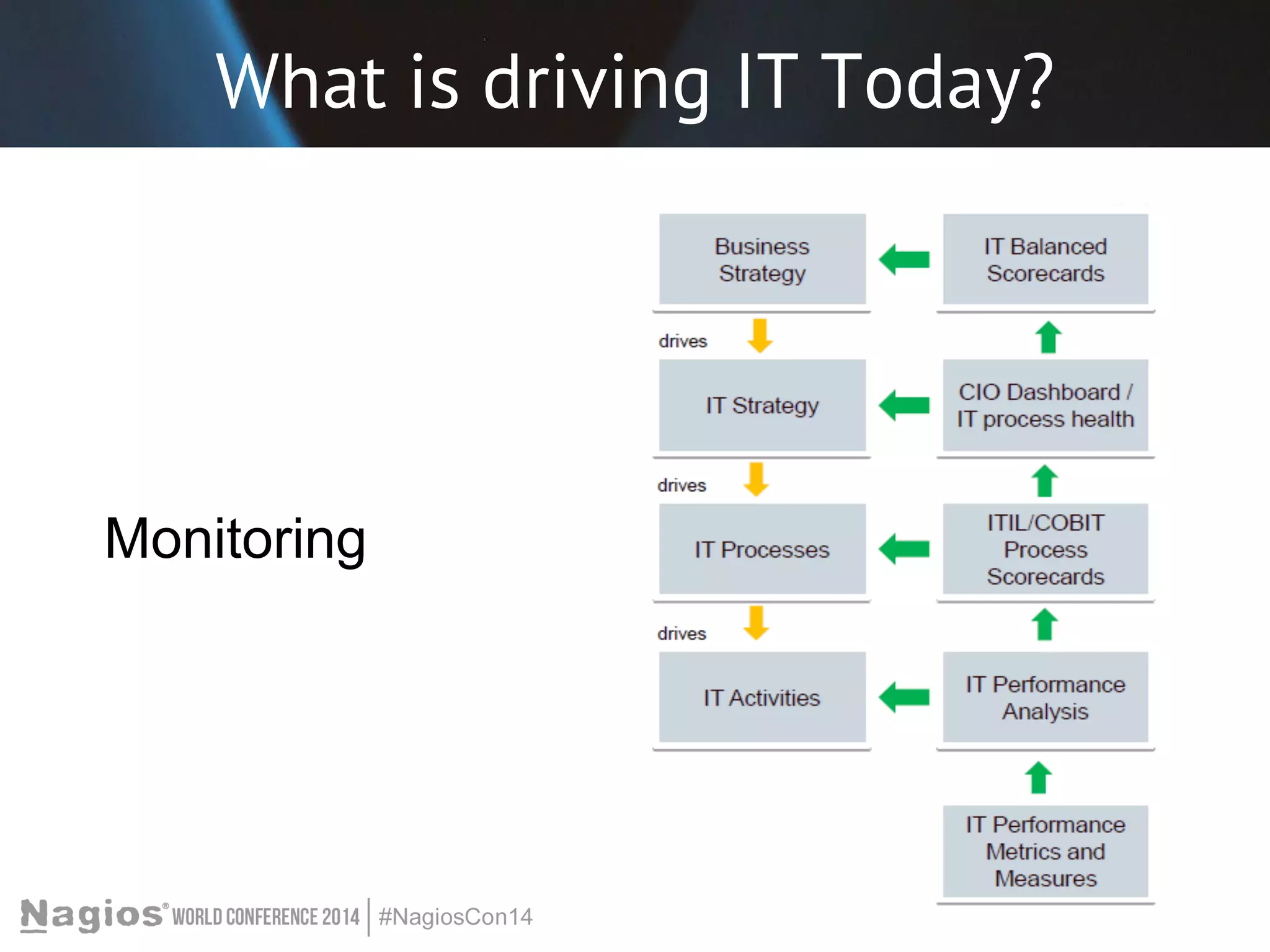
What is driving IT Today? 
Monitoring
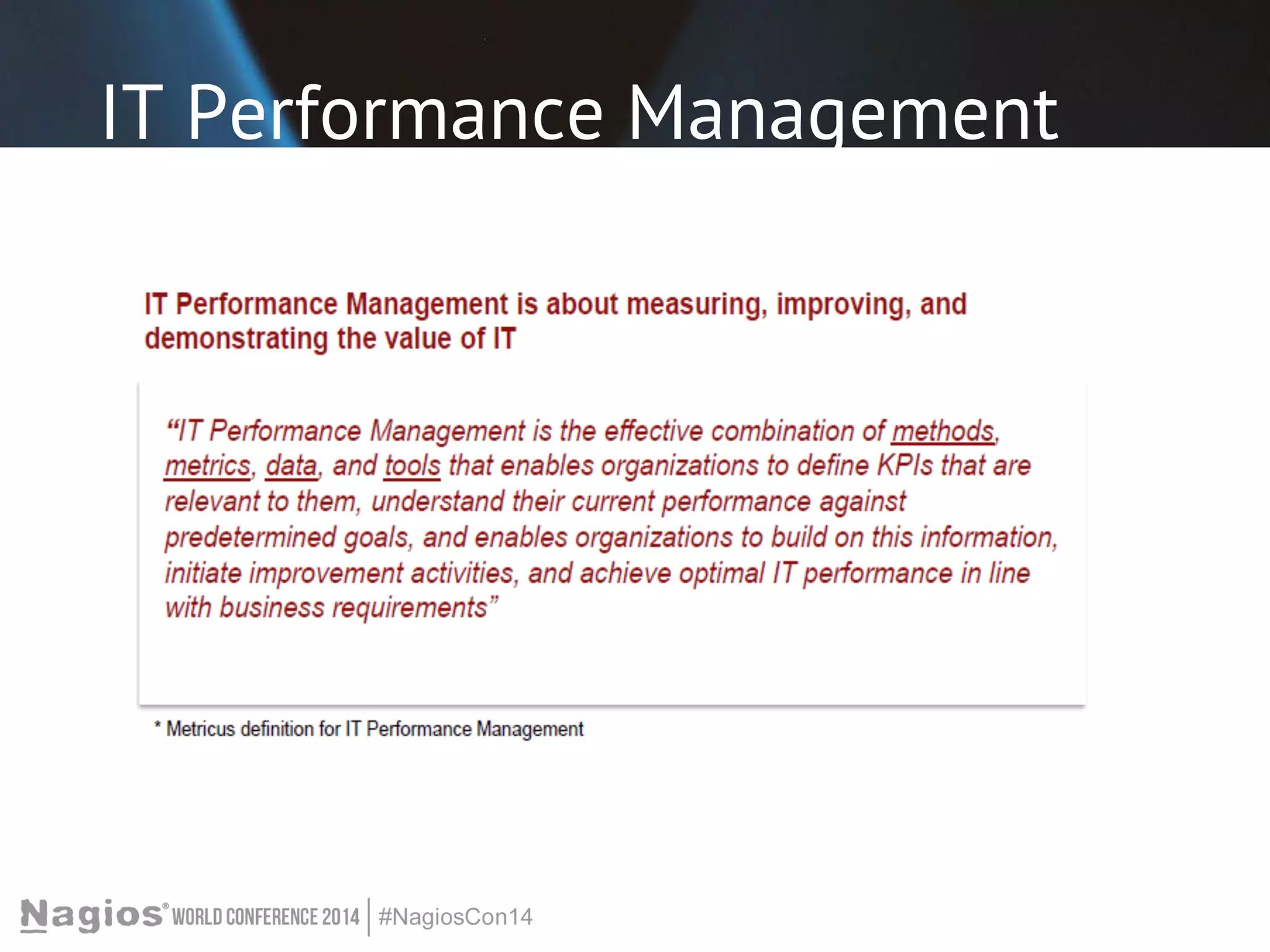
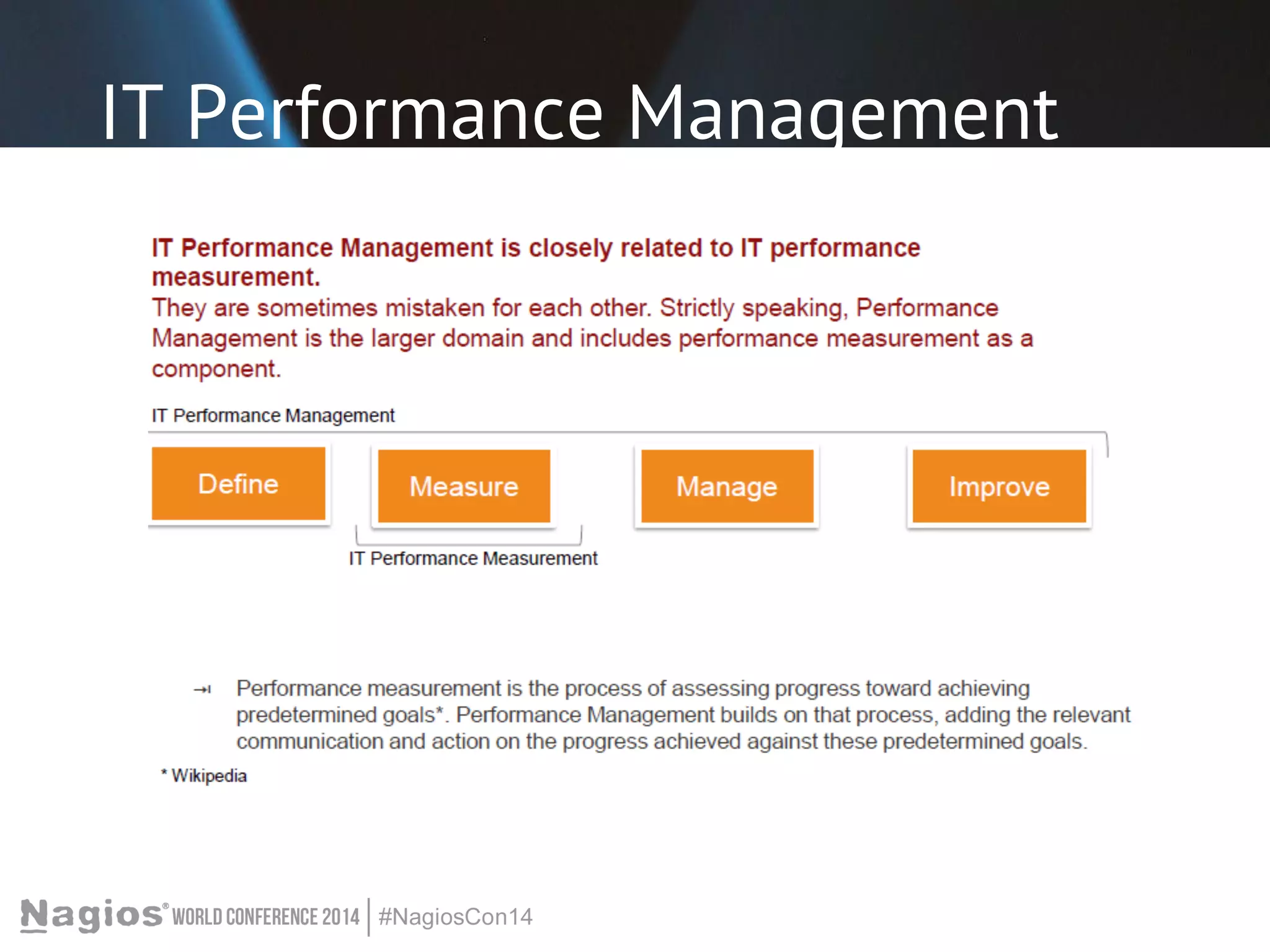
IT Performance Management
IT Performance Management 
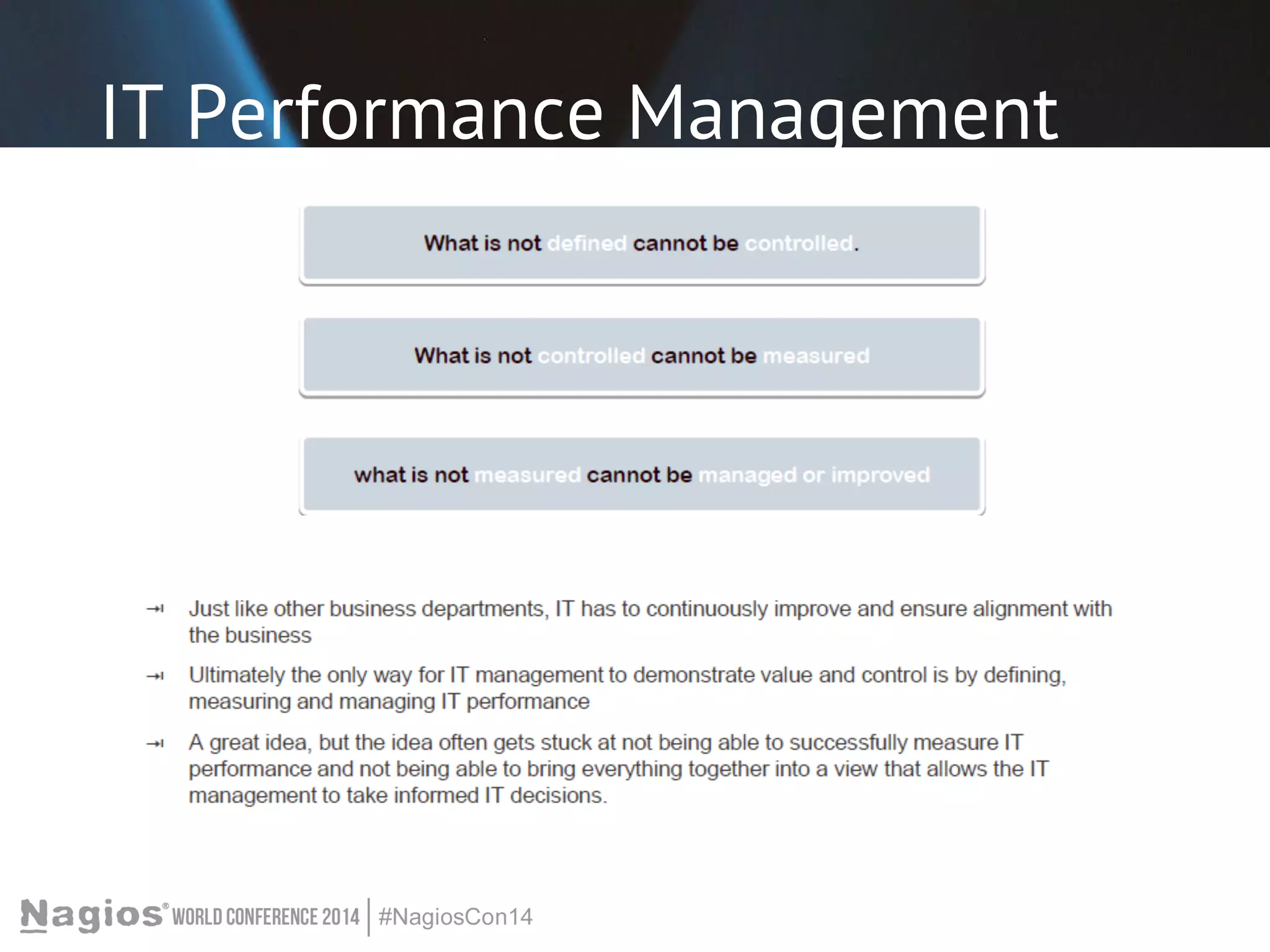
IT Performance Management
IT Performance Management 
IT Performance Management
IT Performance Management 
IT Performance Management
What is a Key Performance 
Indicator (KPI)?
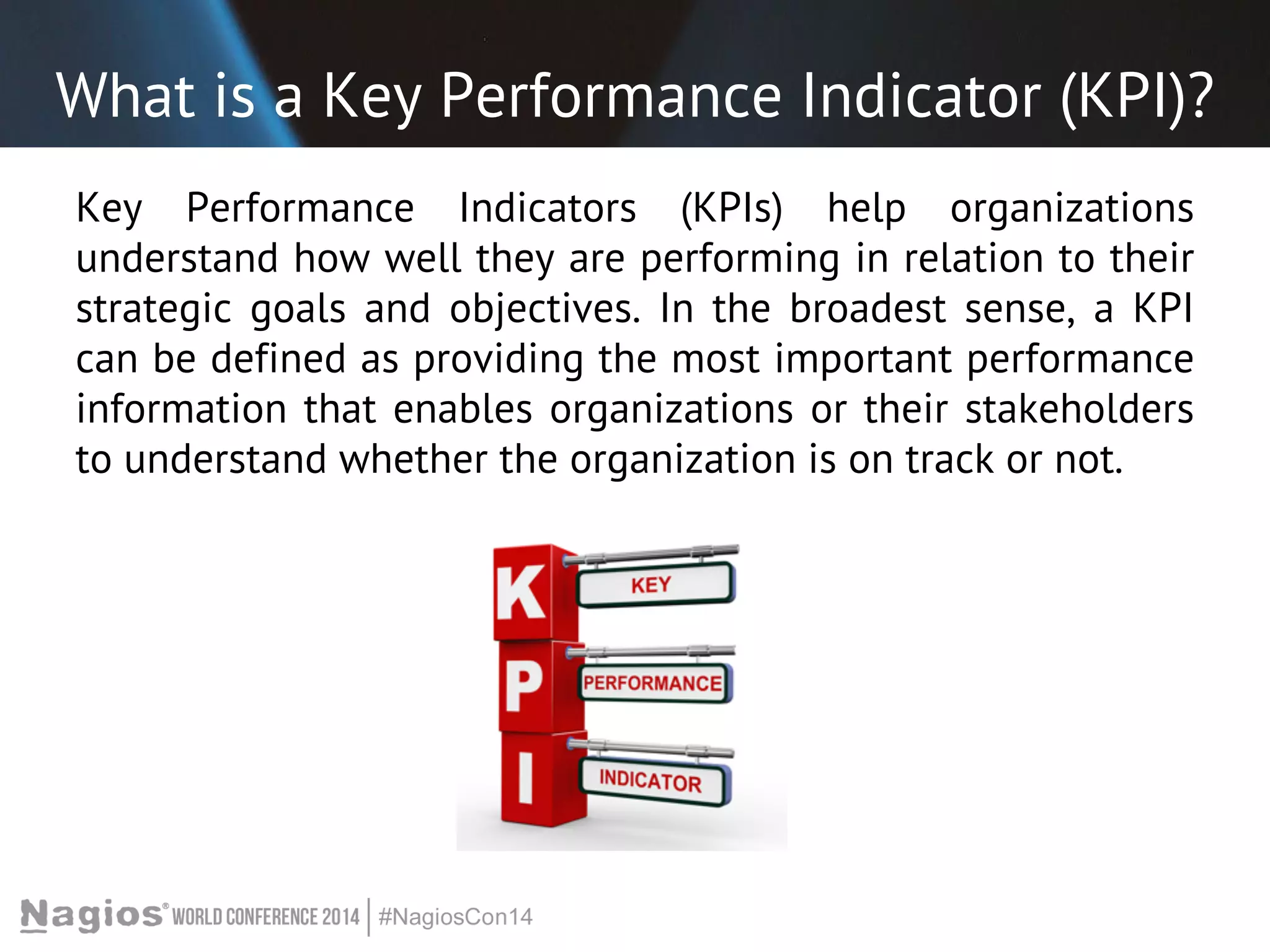
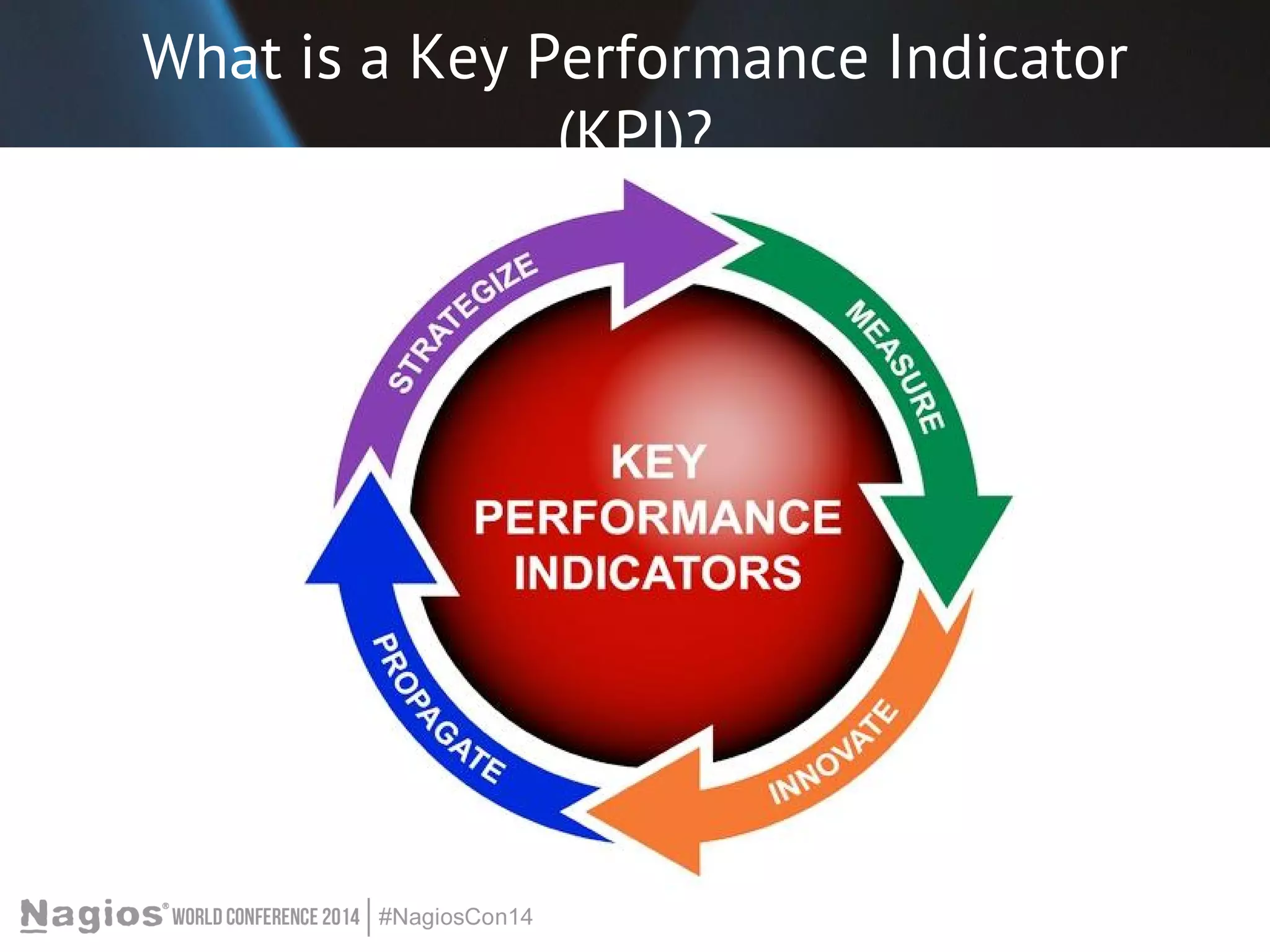
What is a Key Performance Indicator (KPI)? 
Key Performance Indicators (KPIs) help organizations 
understand how well they are performing in relation to their 
strategic goals and objectives. In the broadest sense, a KPI 
can be defined as providing the most important performance 
information that enables organizations or their stakeholders 
to understand whether the organization is on track or not.
What is a Key Performance Indicator 
(KPI)?
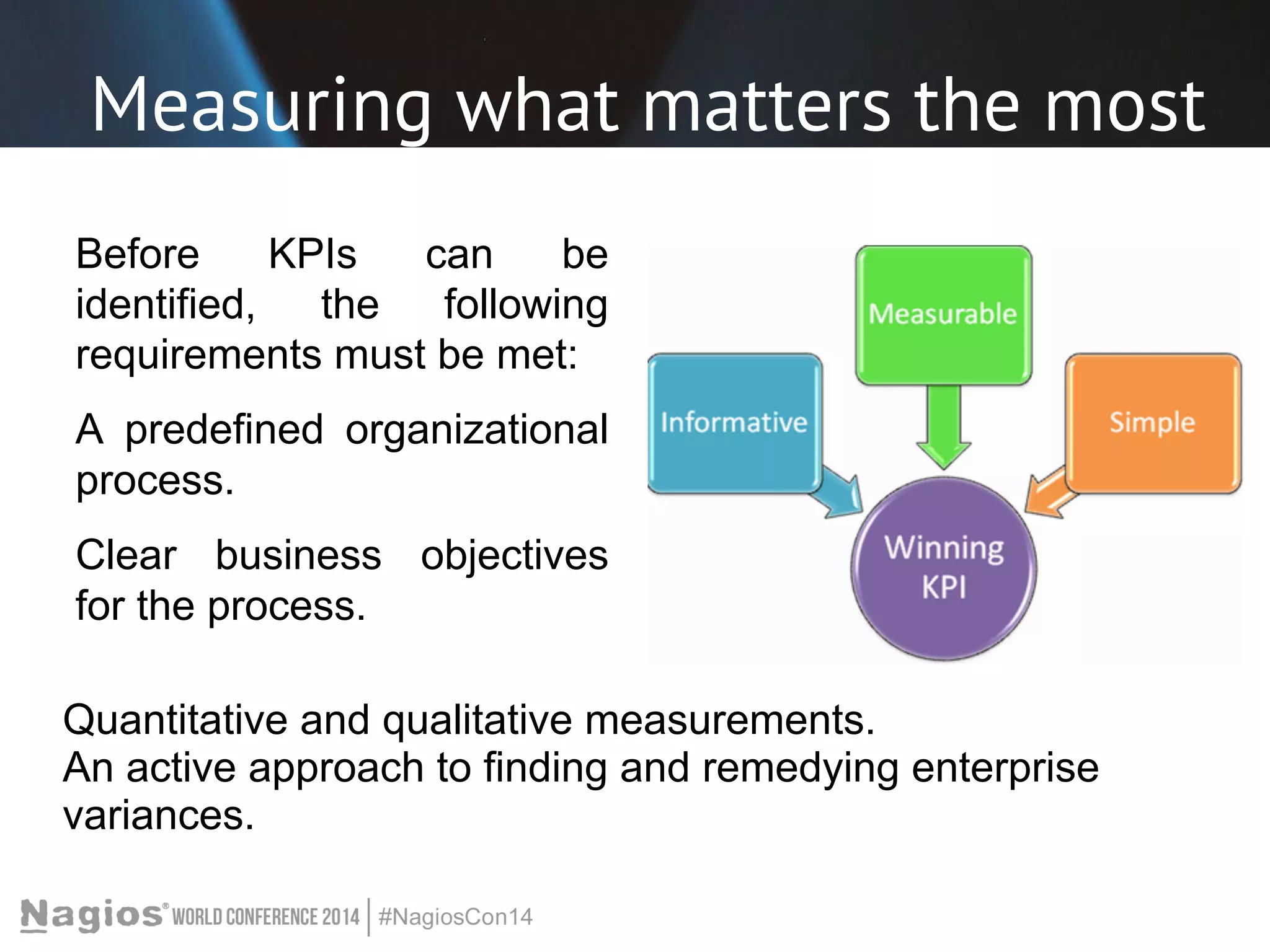
Measuring what matters the most 
Before KPIs can be 
identified, the following 
requirements must be met: 
A predefined organizational 
process. 
Clear business objectives 
for the process. 
Quantitative and qualitative measurements. 
An active approach to finding and remedying enterprise 
variances.
Example 
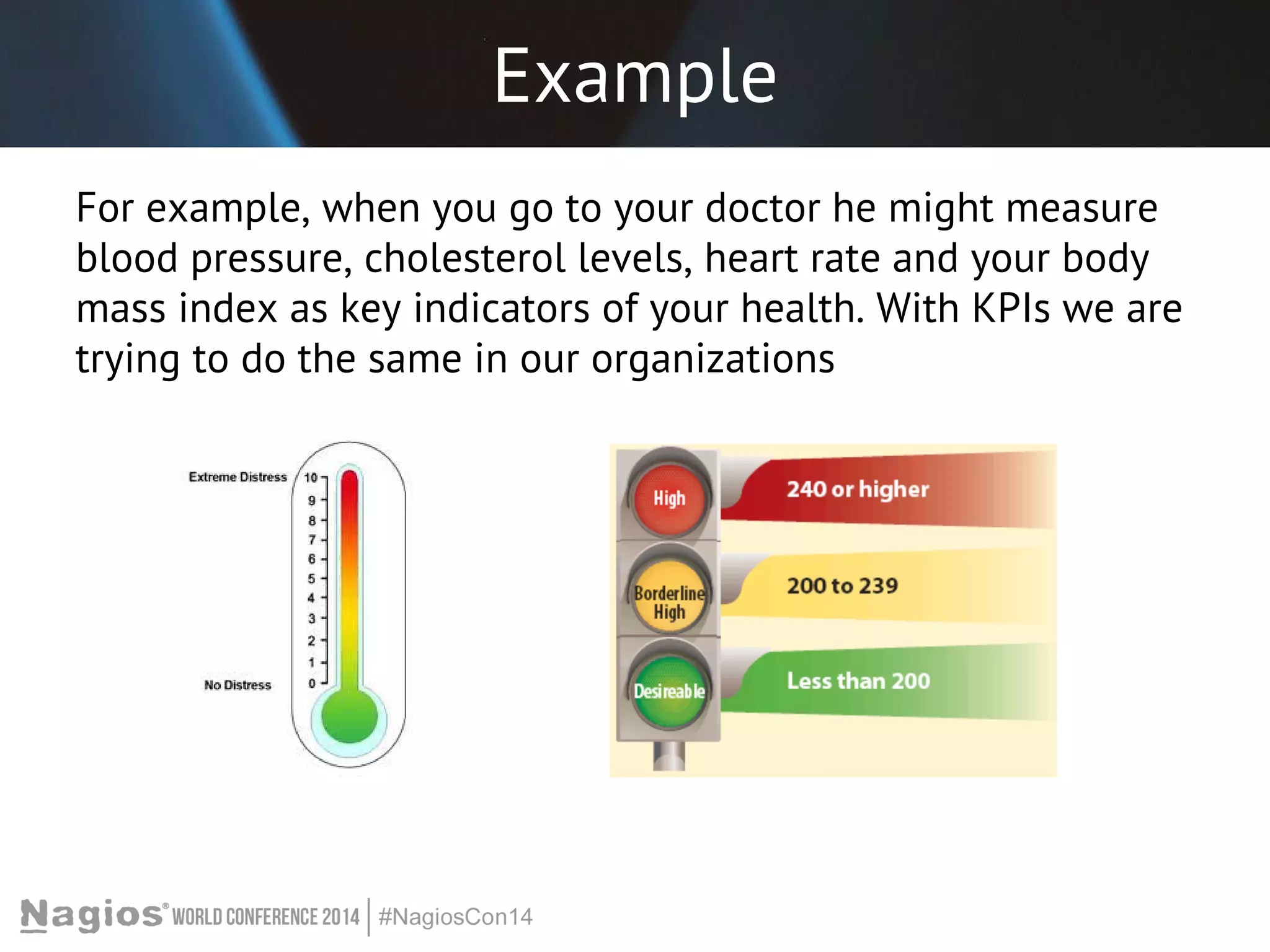
For example, when you go to your doctor he might measure 
blood pressure, cholesterol levels, heart rate and your body 
mass index as key indicators of your health. With KPIs we are 
trying to do the same in our organizations
Why Use KPIs? 
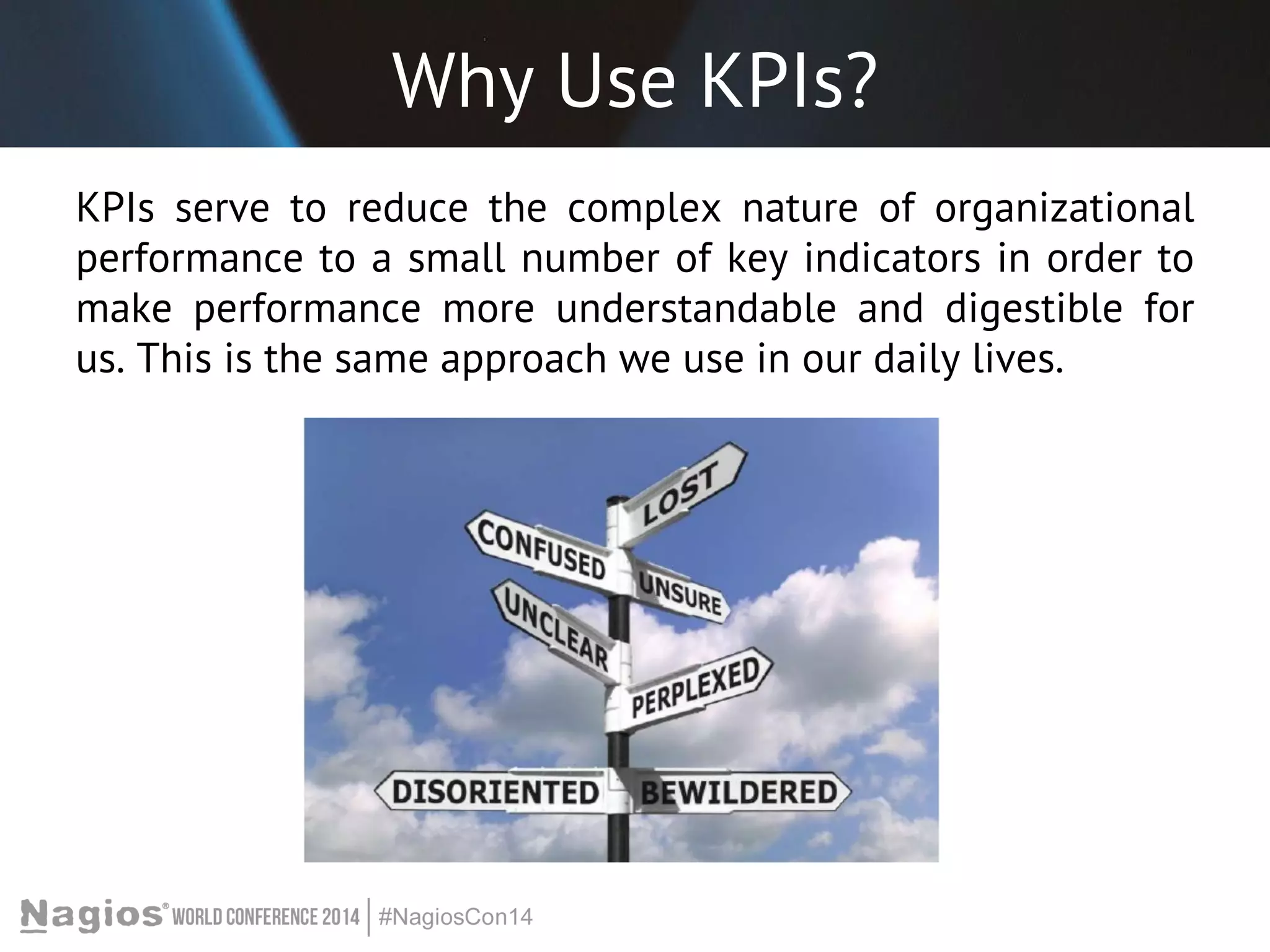
KPIs serve to reduce the complex nature of organizational 
performance to a small number of key indicators in order to 
make performance more understandable and digestible for 
us. This is the same approach we use in our daily lives.
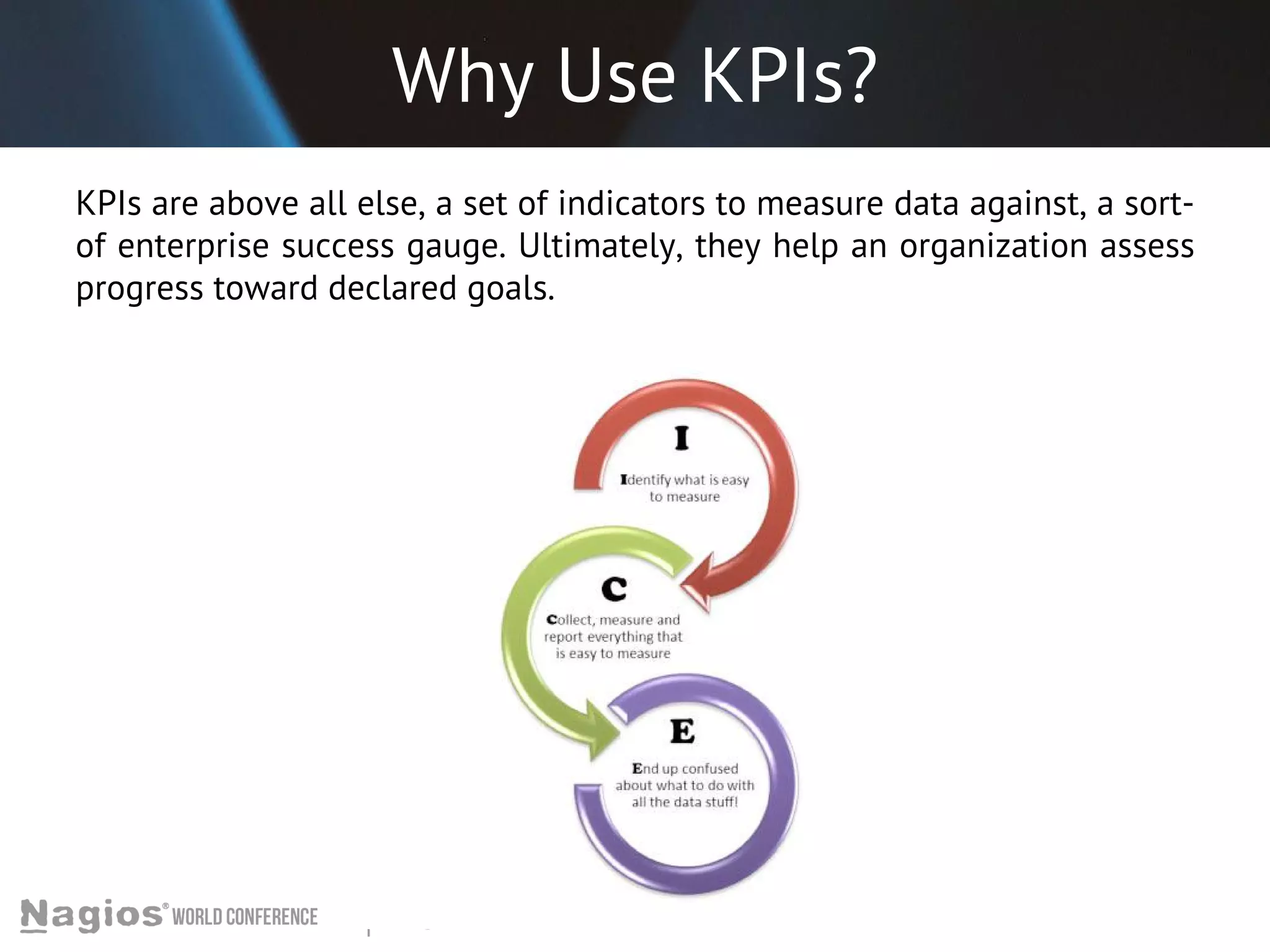
Why Use KPIs? 
KPIs are above all else, a set of indicators to measure data against, a sort-of 
enterprise success gauge. Ultimately, they help an organization assess 
progress toward declared goals.
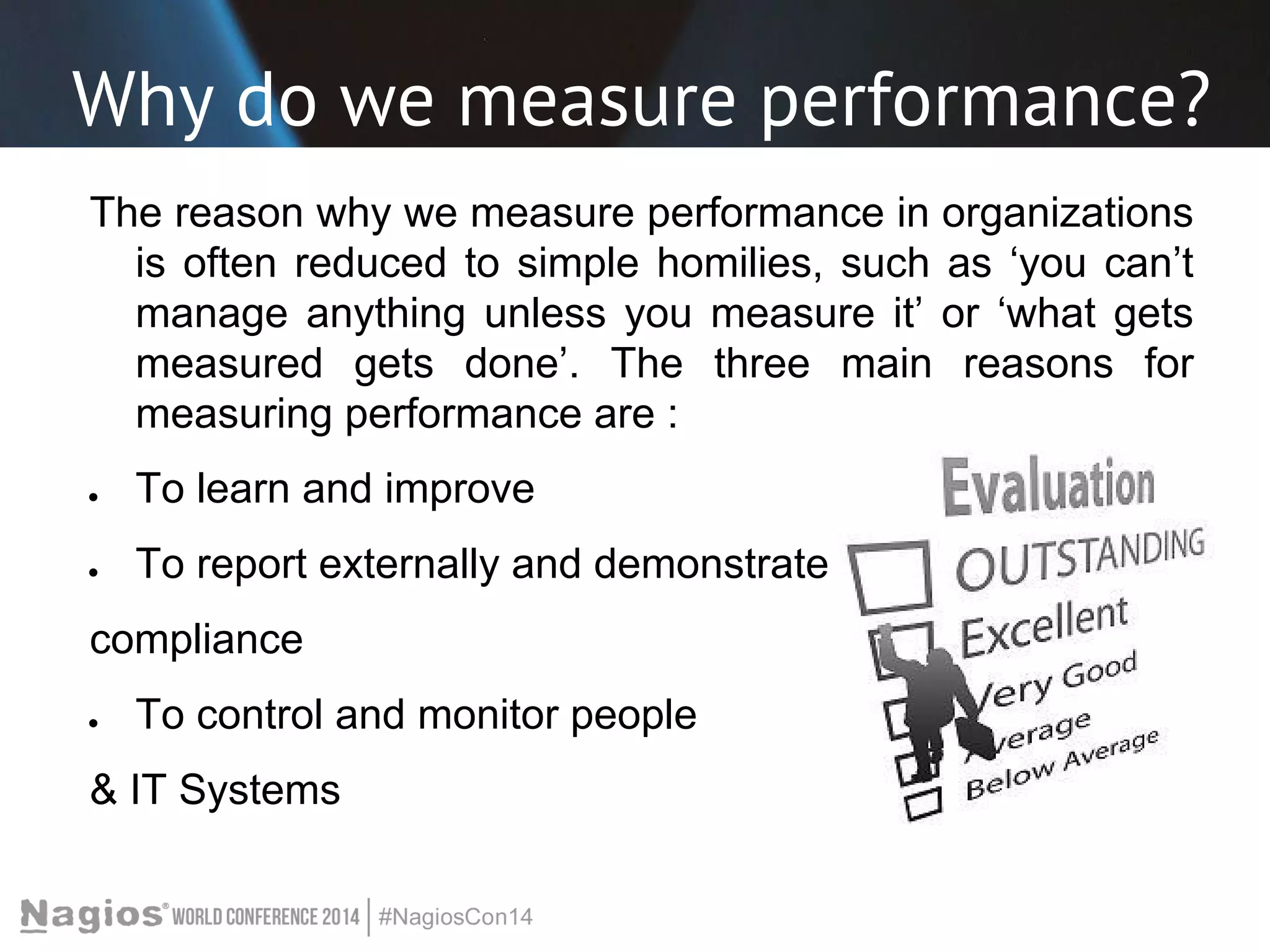
Why do we measure performance? 
The reason why we measure performance in organizations 
is often reduced to simple homilies, such as ‘you can’t 
manage anything unless you measure it’ or ‘what gets 
measured gets done’. The three main reasons for 
measuring performance are : 
● To learn and improve 
● To report externally and demonstrate 
compliance 
● To control and monitor people 
& IT Systems
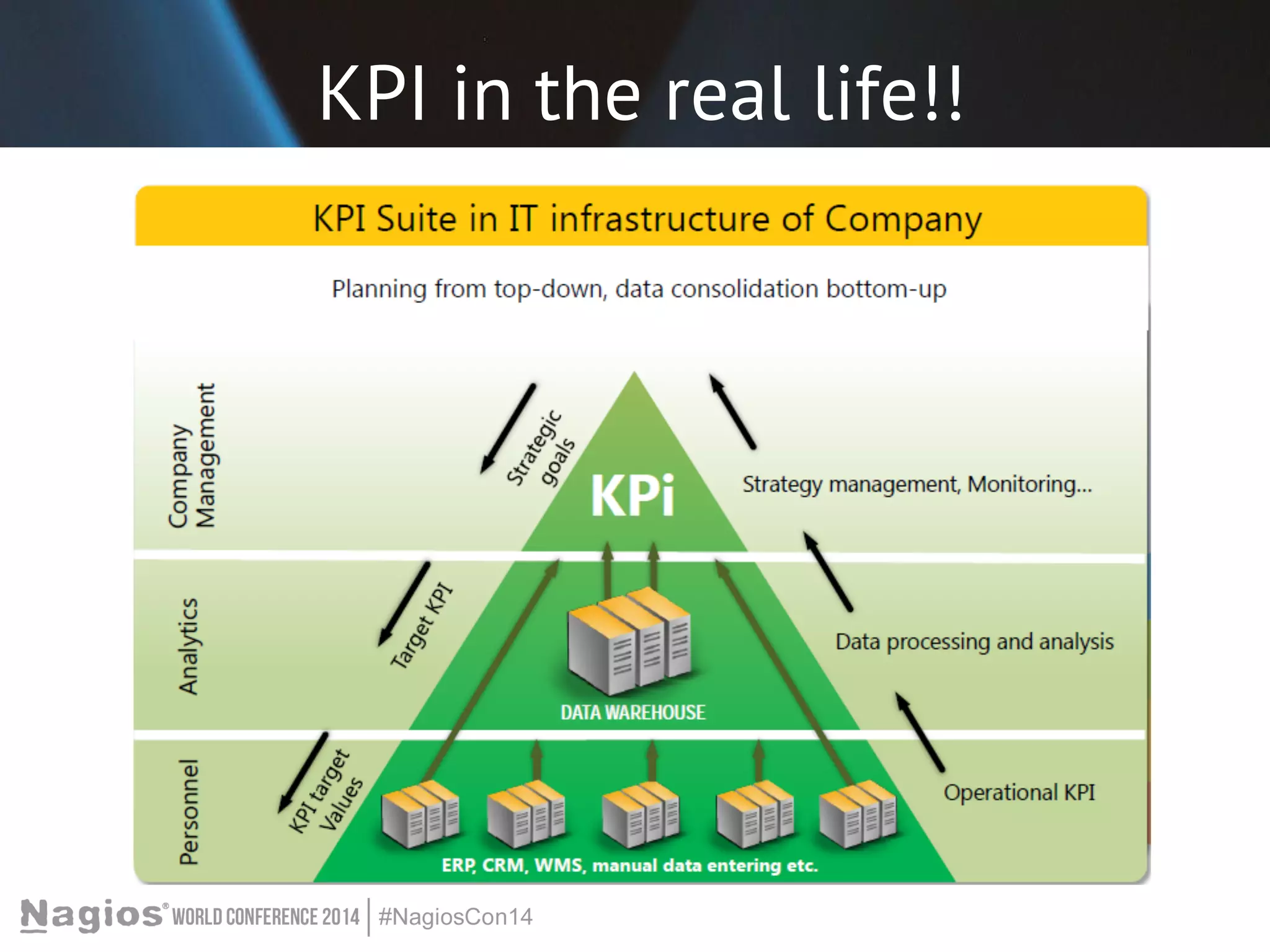
KPI in the real life!!
Metrics?
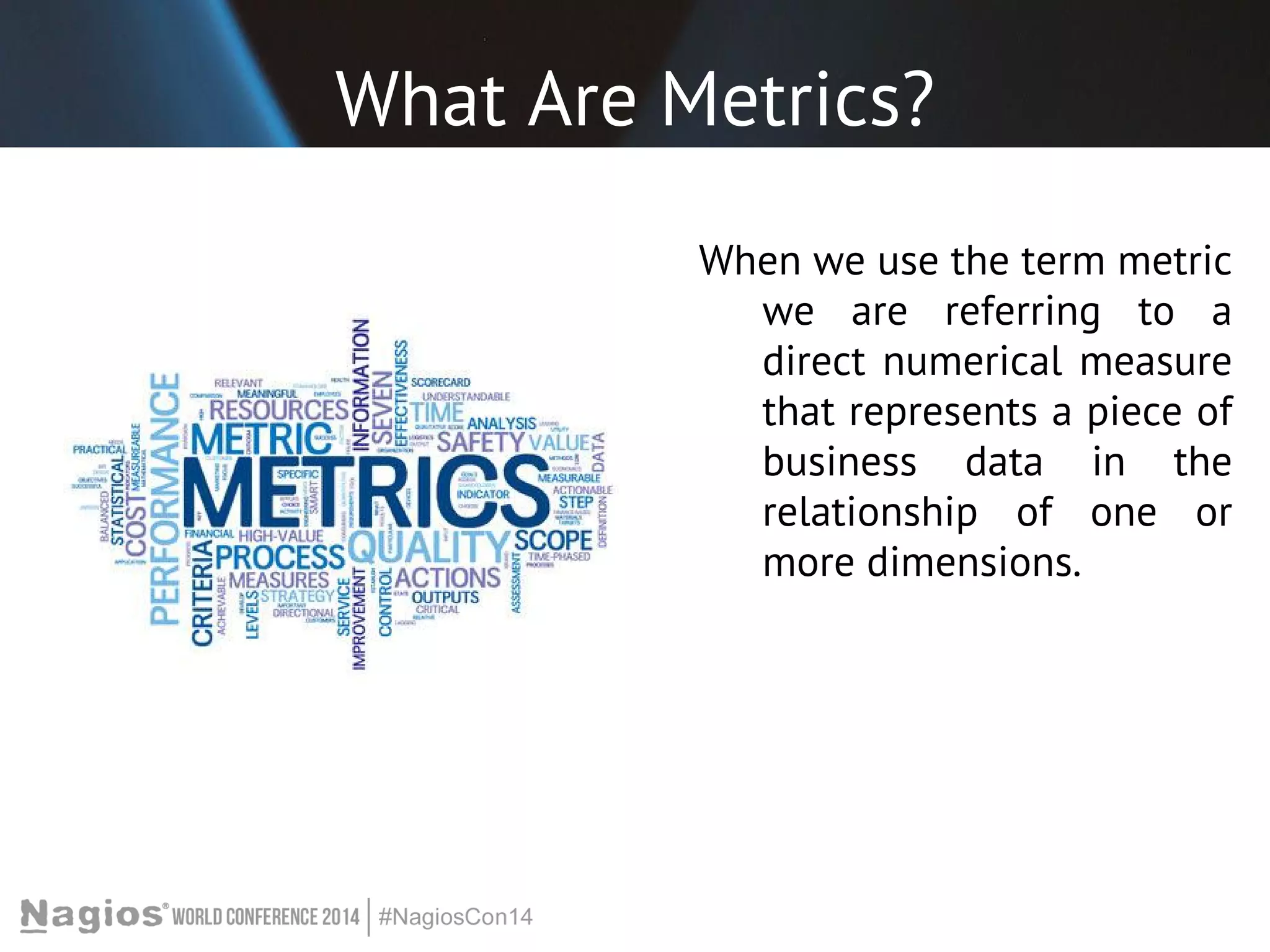
What Are Metrics? 
When we use the term metric 
we are referring to a 
direct numerical measure 
that represents a piece of 
business data in the 
relationship of one or 
more dimensions.
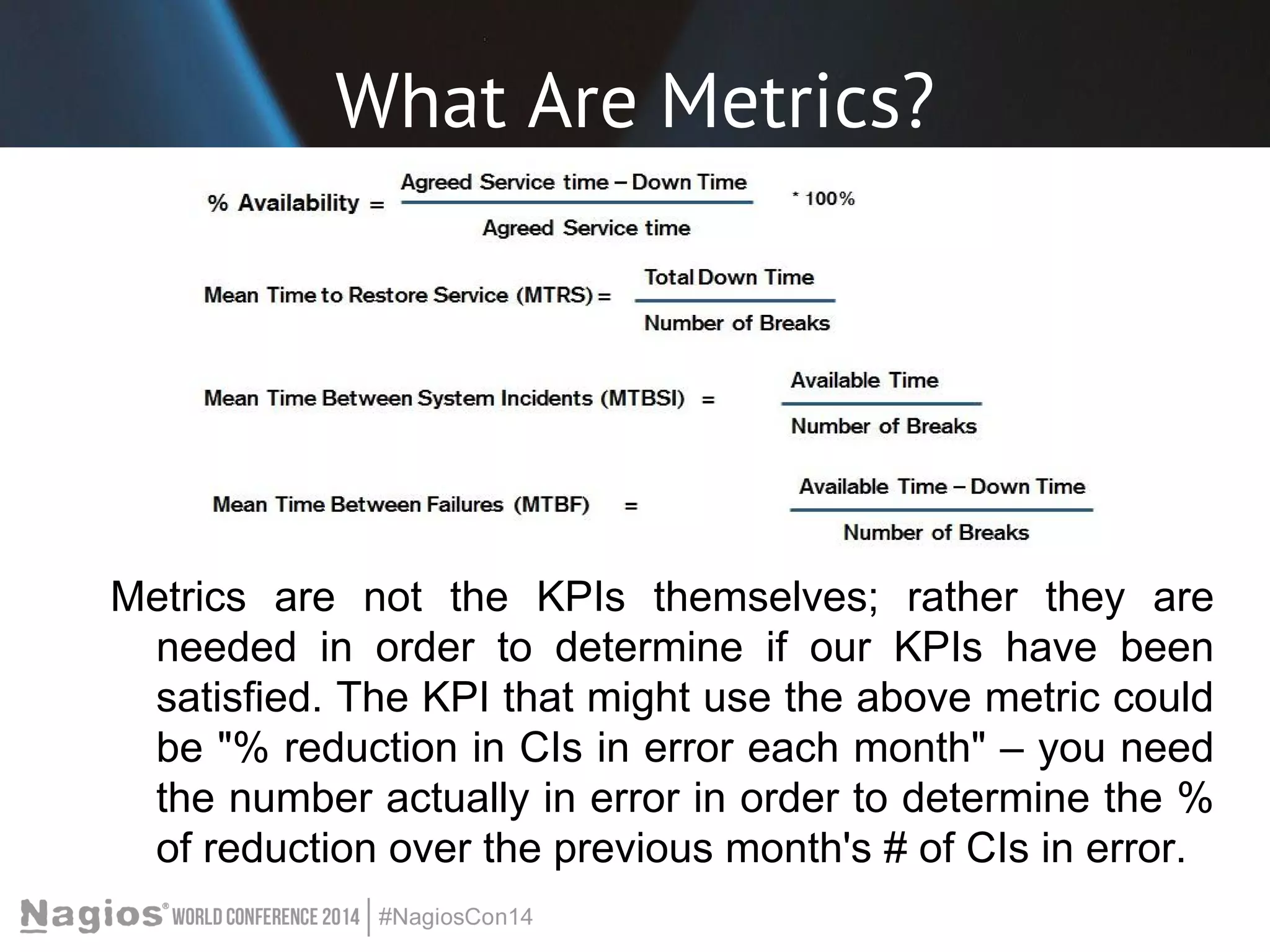
What Are Metrics? 
Metrics are not the KPIs themselves; rather they are 
needed in order to determine if our KPIs have been 
satisfied. The KPI that might use the above metric could 
be "% reduction in CIs in error each month" – you need 
the number actually in error in order to determine the % 
of reduction over the previous month's # of CIs in error.
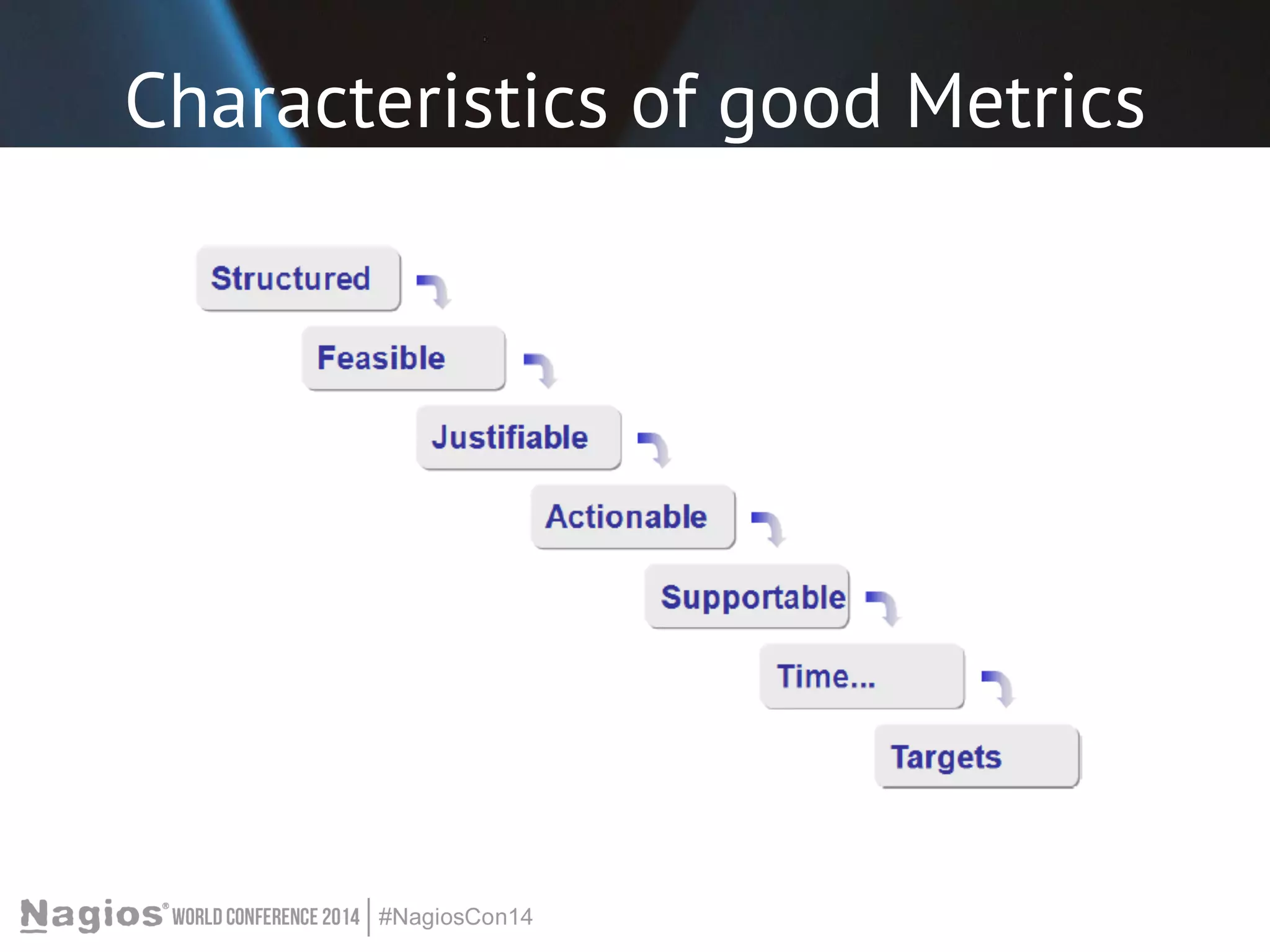
Characteristics of good Metrics
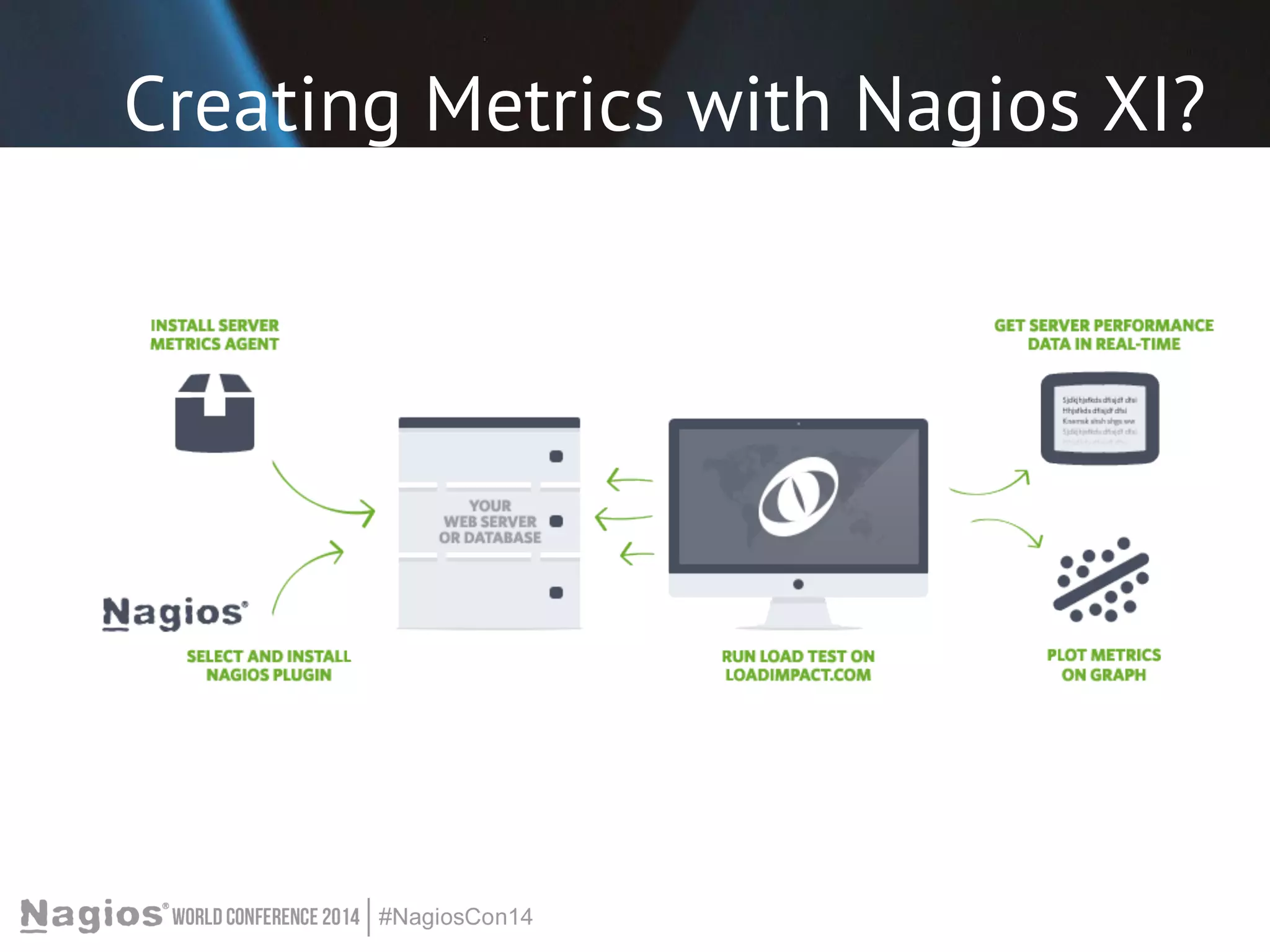
Creating Metrics with Nagios XI?
Service Design With Nagios XI
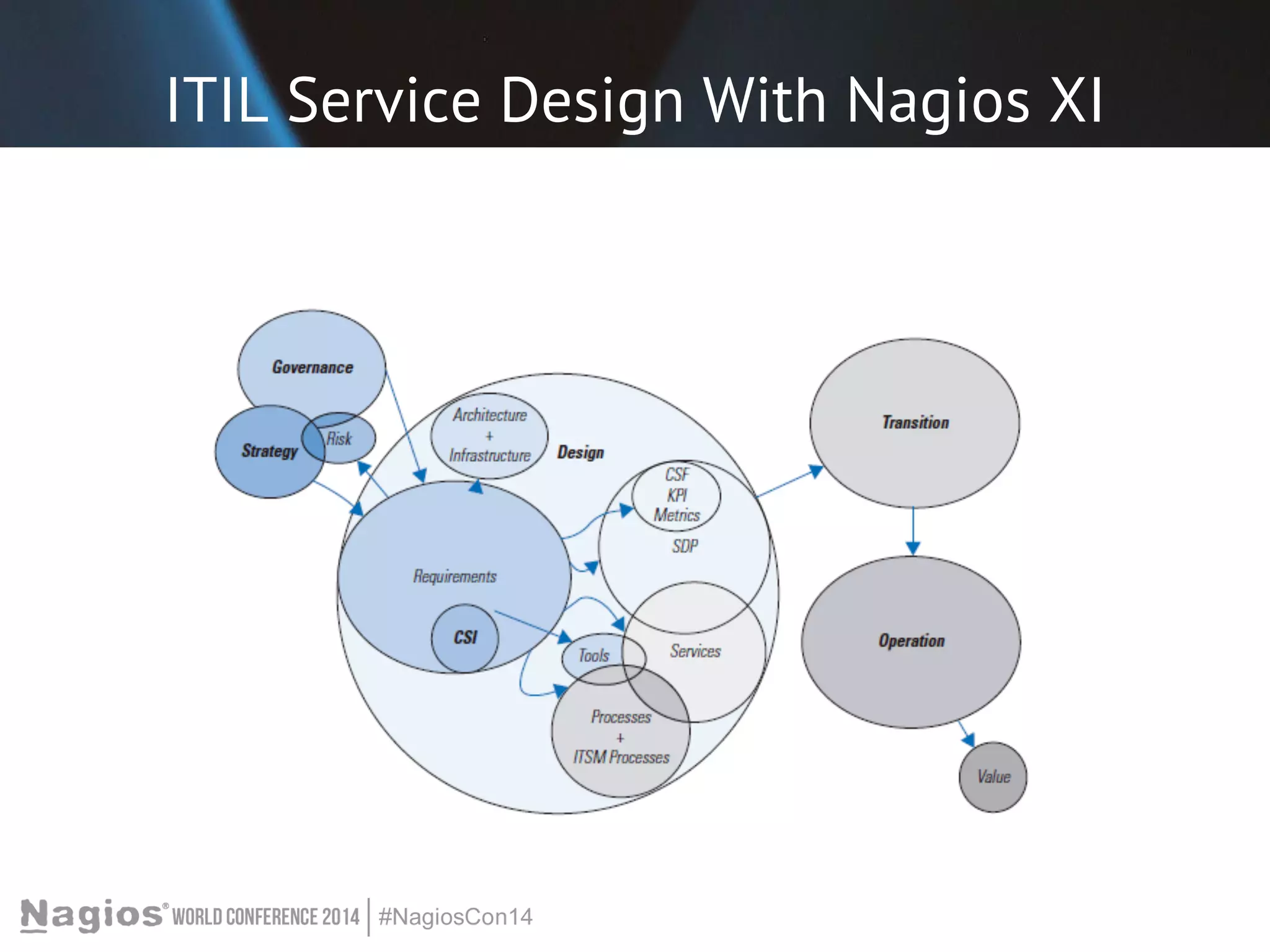
ITIL Service Design With Nagios XI
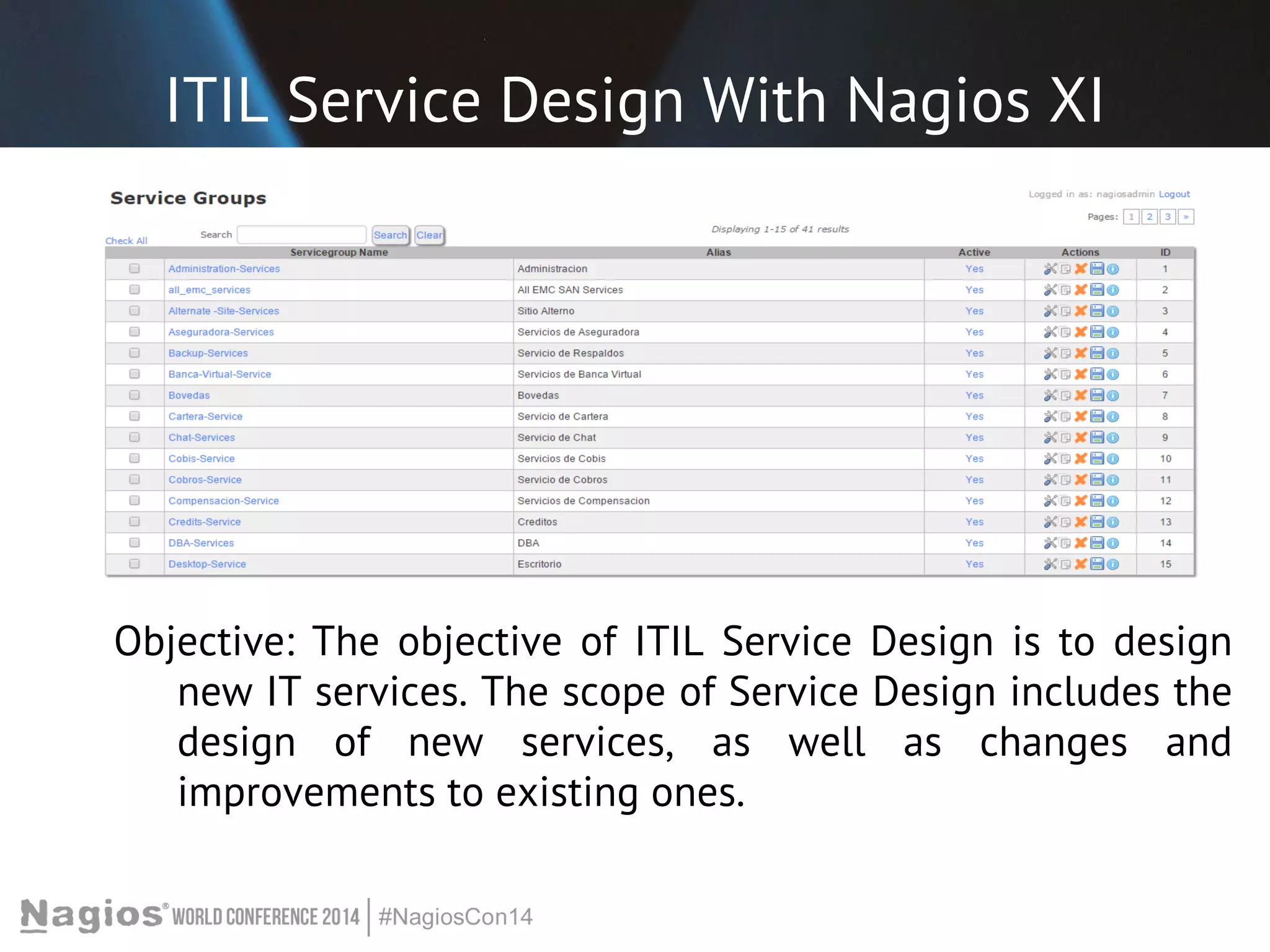
ITIL Service Design With Nagios XI 
Objective: The objective of ITIL Service Design is to design 
new IT services. The scope of Service Design includes the 
design of new services, as well as changes and 
improvements to existing ones.
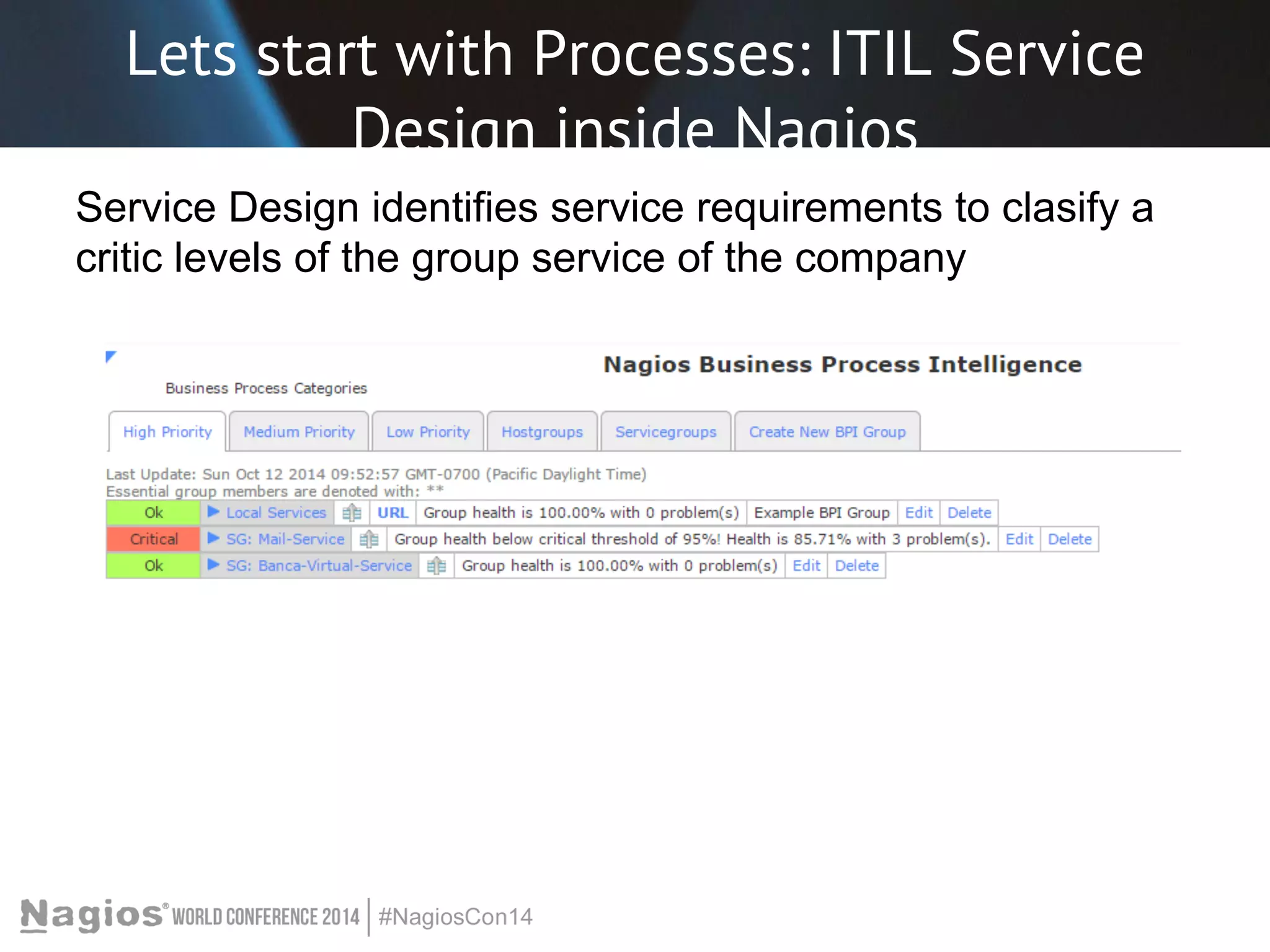
Lets start with Processes: ITIL Service 
Design inside Nagios 
Service Design identifies service requirements to clasify a 
critic levels of the group service of the company
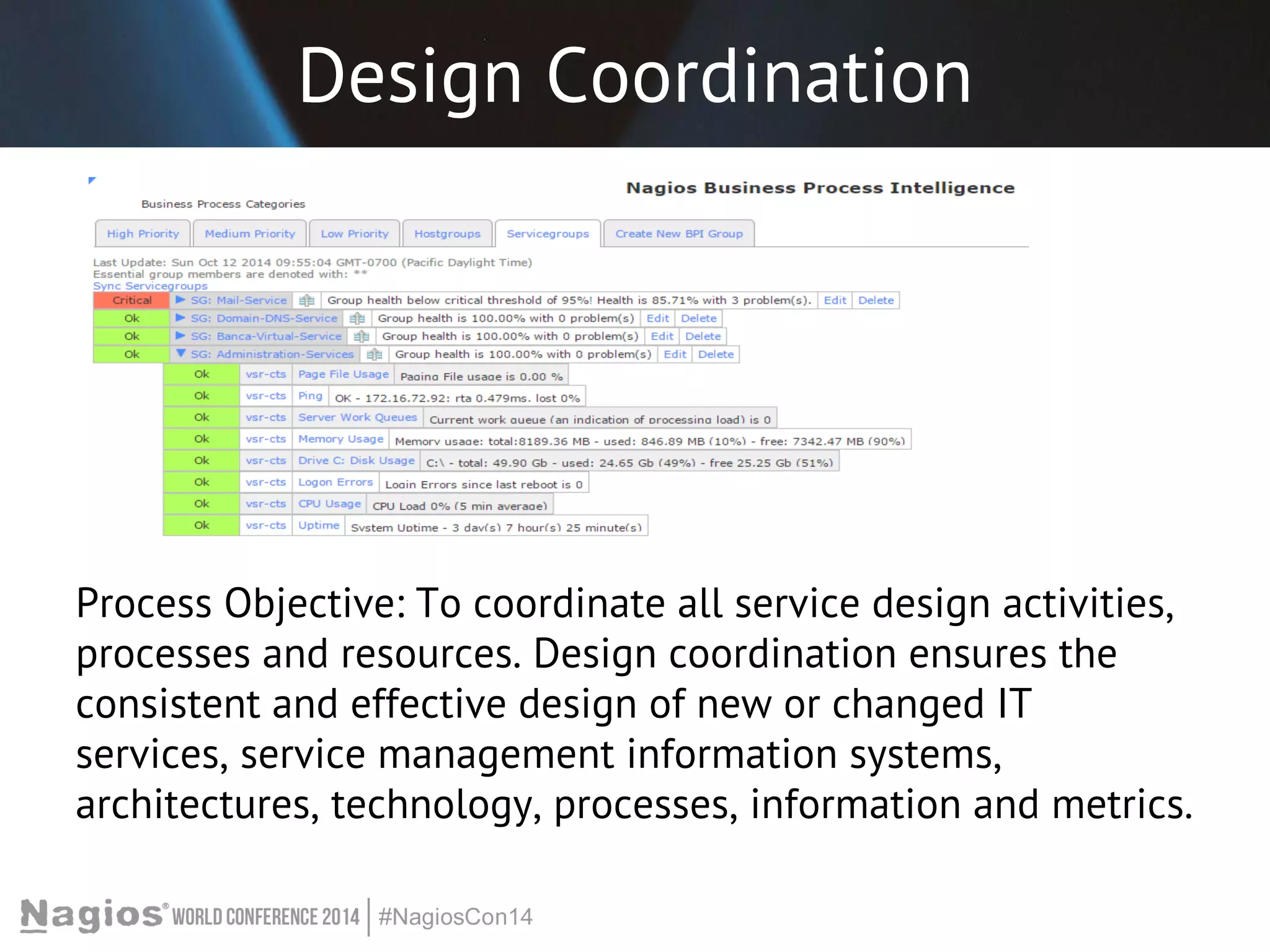
Design Coordination 
Process Objective: To coordinate all service design activities, 
processes and resources. Design coordination ensures the 
consistent and effective design of new or changed IT 
services, service management information systems, 
architectures, technology, processes, information and metrics.
KPI Availability Management 
Component for Nagios XI
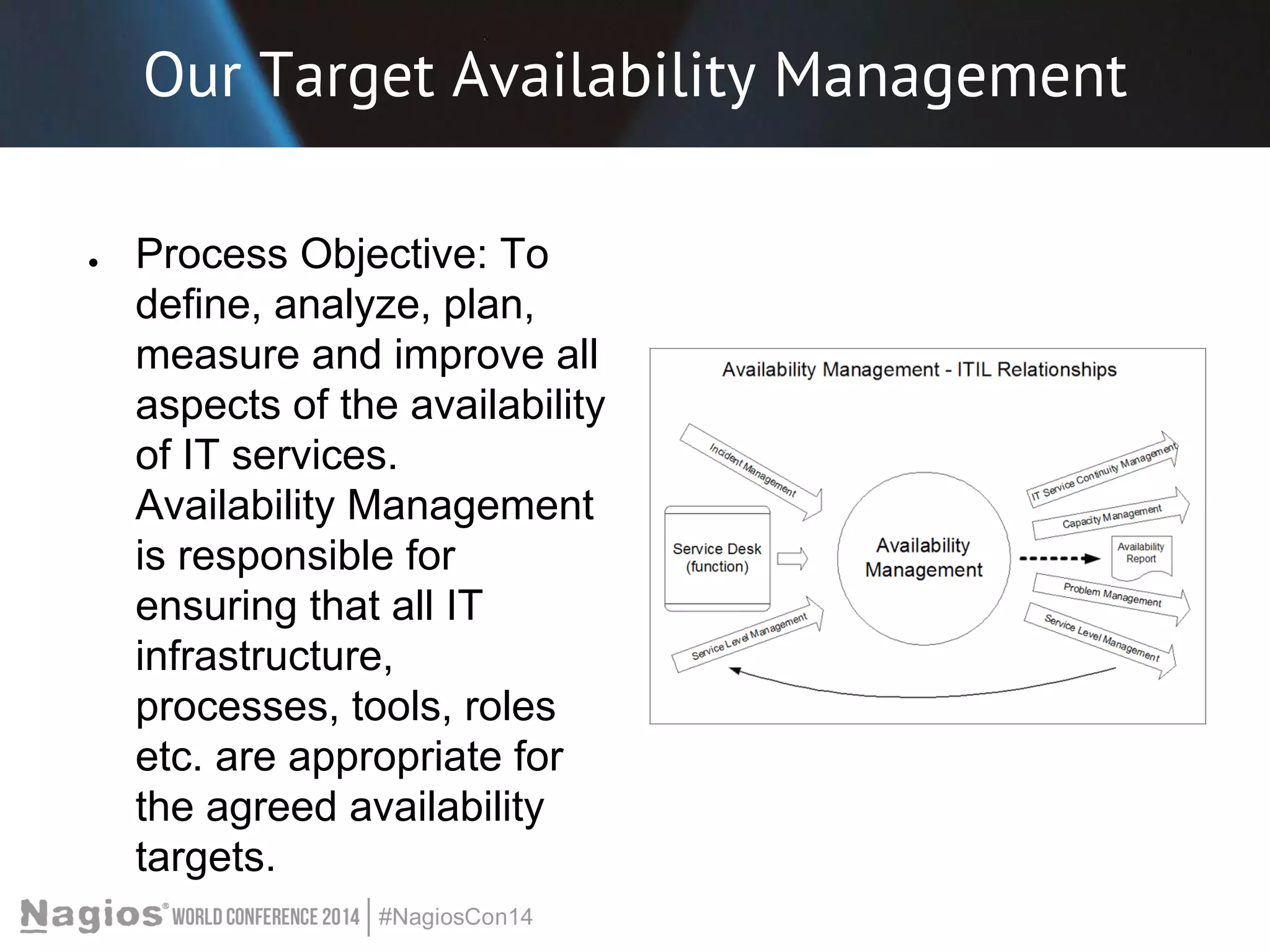
Our Target Availability Management 
● Process Objective: To 
define, analyze, plan, 
measure and improve all 
aspects of the availability 
of IT services. 
Availability Management 
is responsible for 
ensuring that all IT 
infrastructure, 
processes, tools, roles 
etc. are appropriate for 
the agreed availability 
targets.
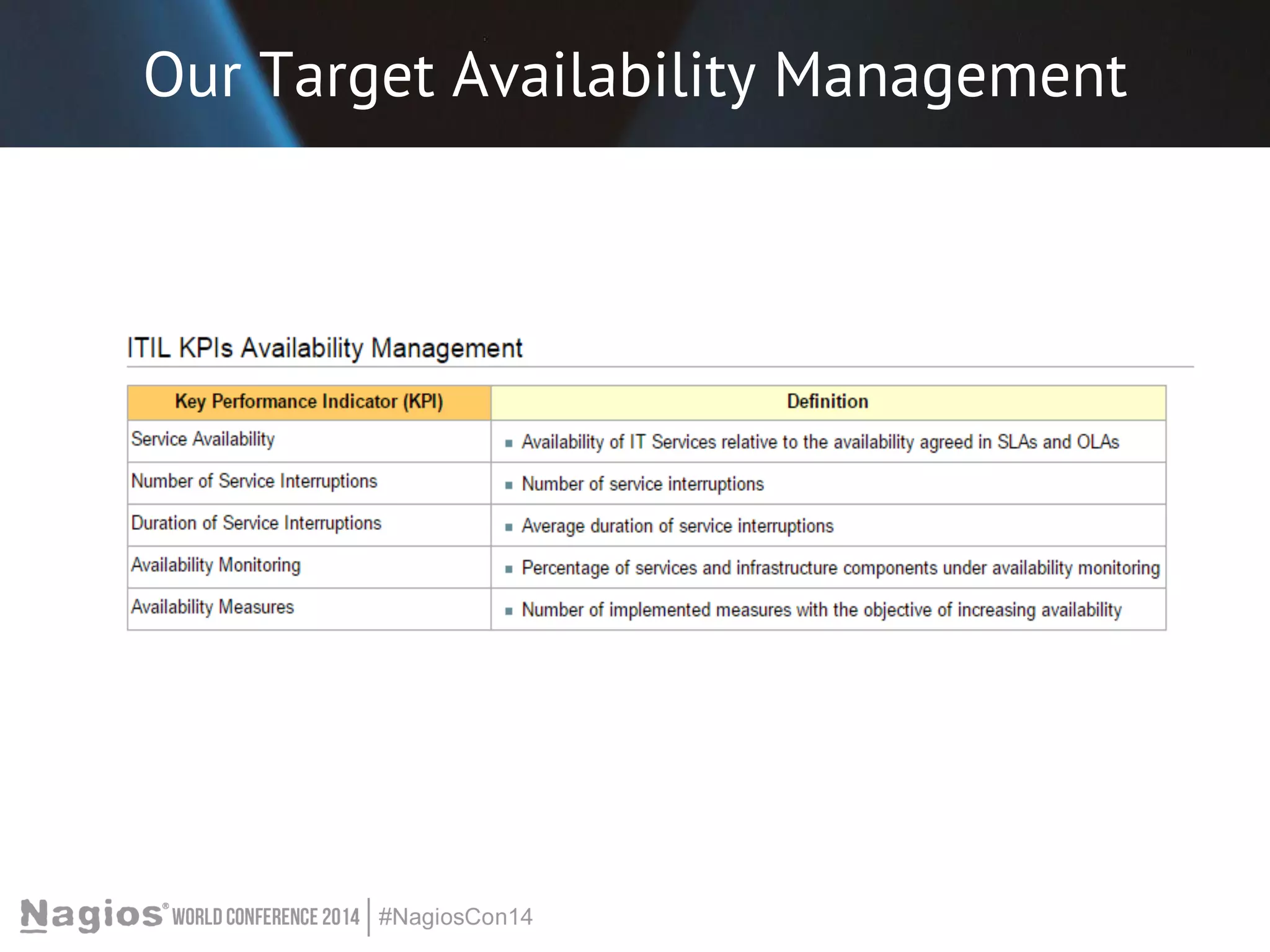
Our Target Availability Management
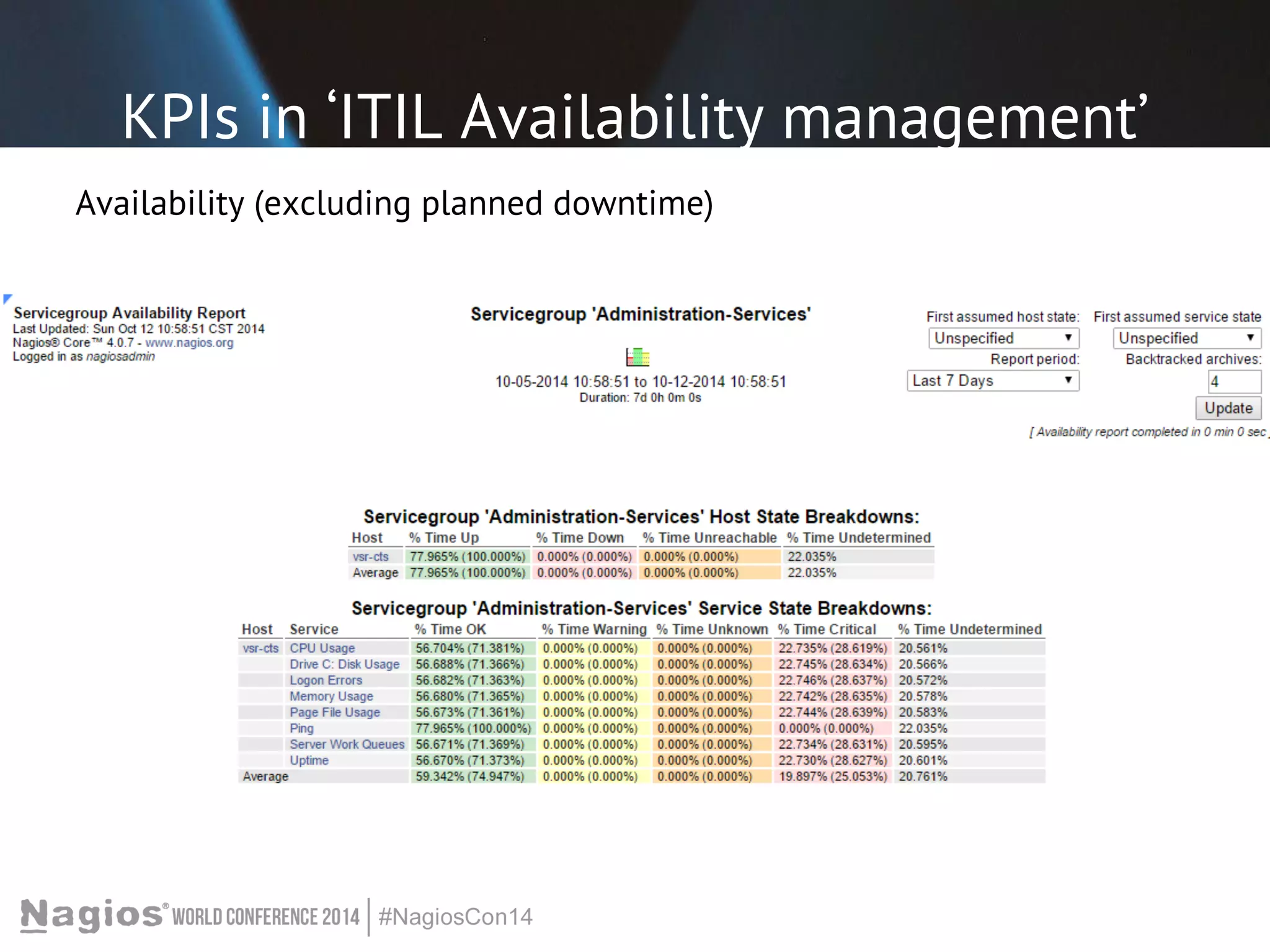
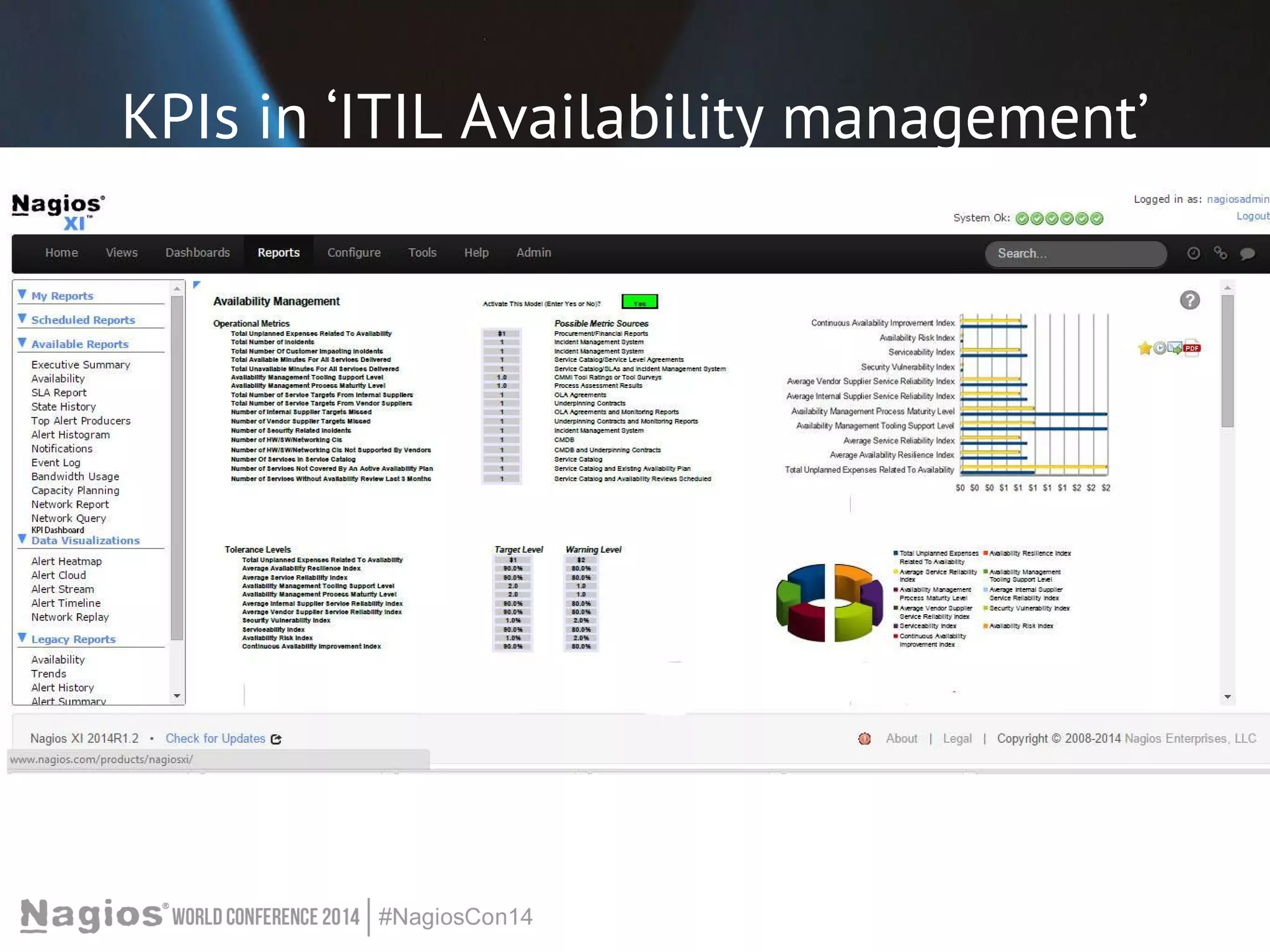
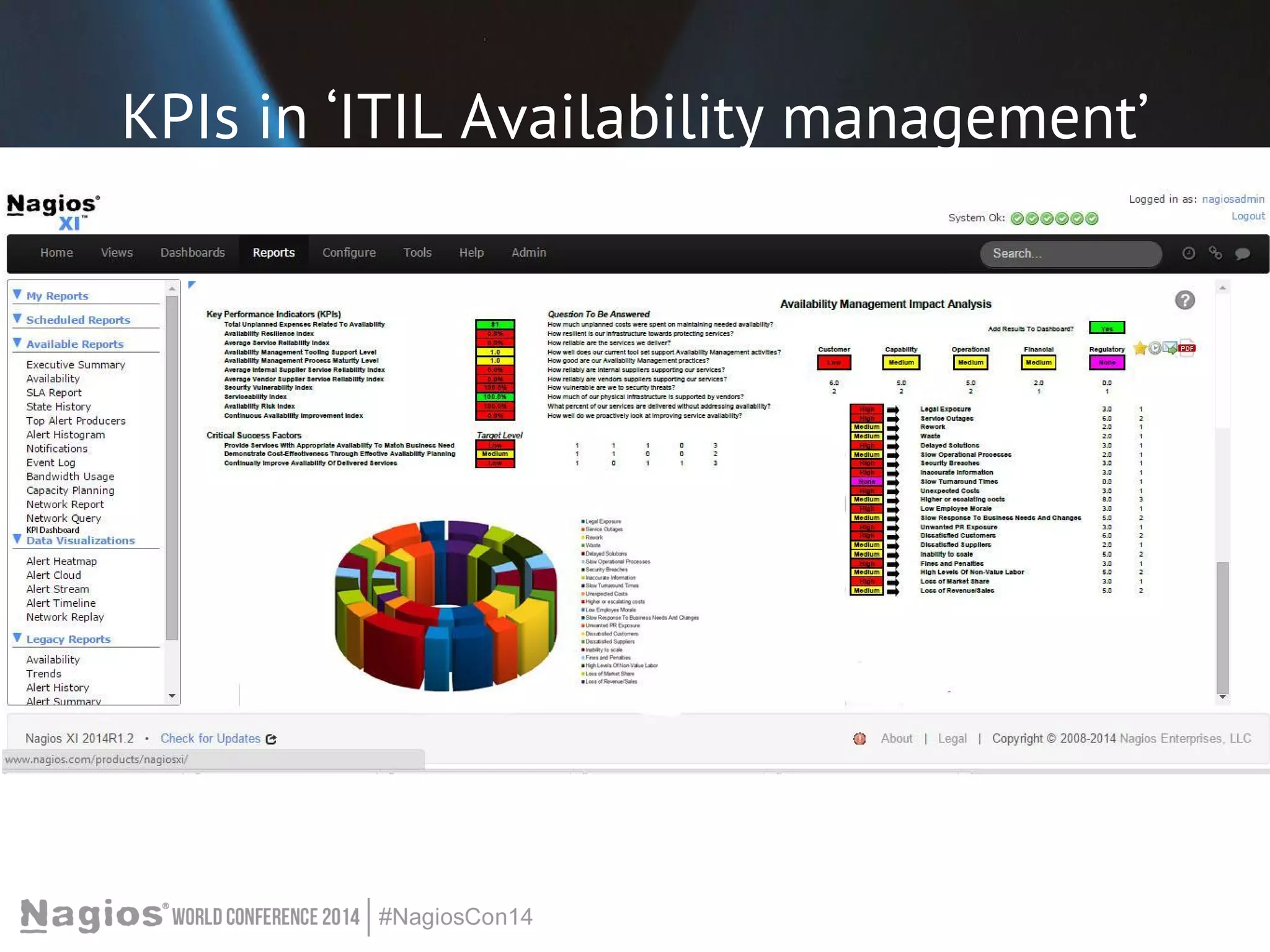
KPIs in ‘ITIL Availability management’ 
Availability (excluding planned downtime)
KPIs ‘Availability management 
Dashboard’
KPIs in ‘ITIL Availability management’
Nagios ‘ Availability management 
Report’
KPI Capacity Planing Component 
for Nagios XI
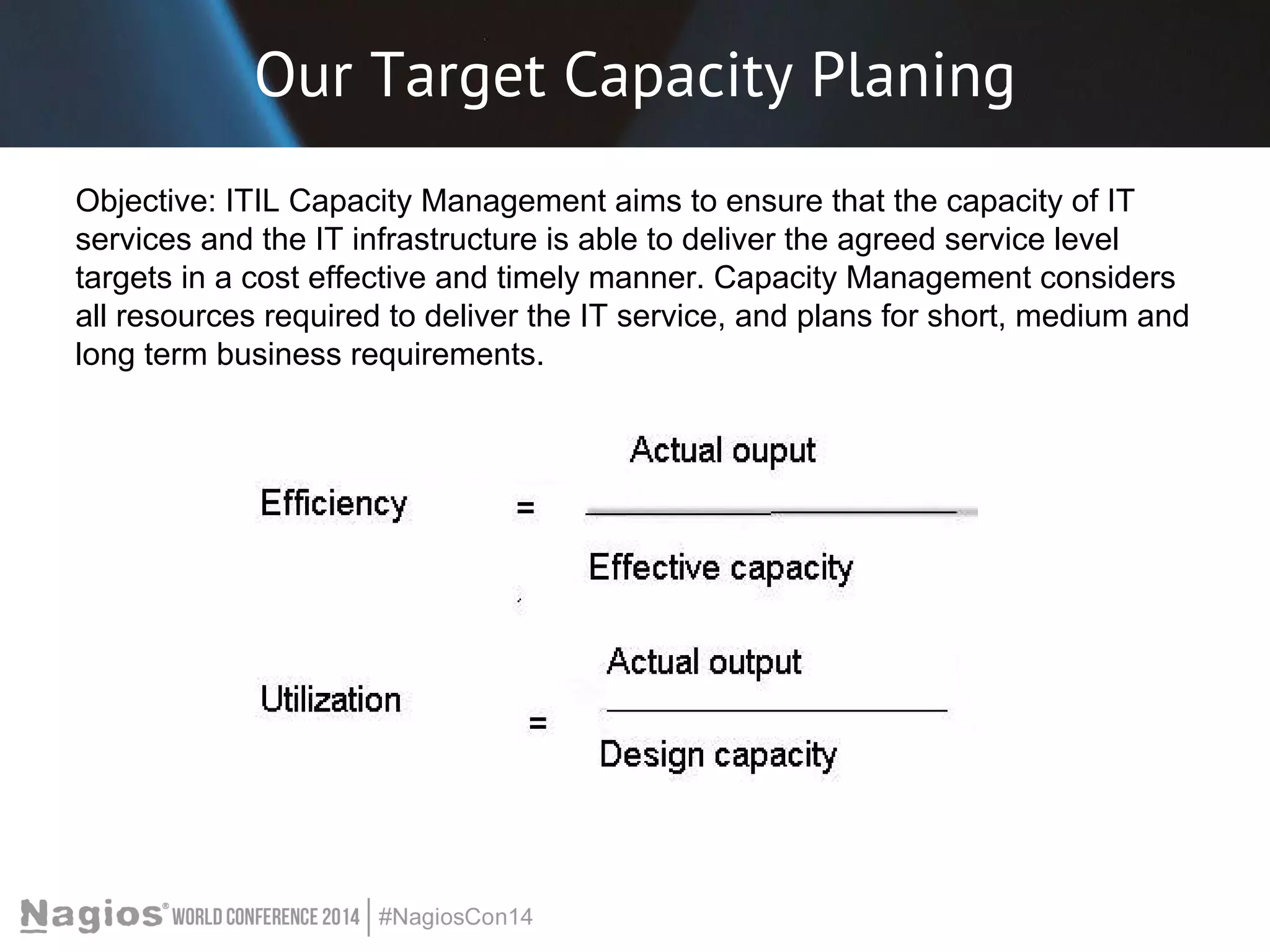
Our Target Capacity Planing 
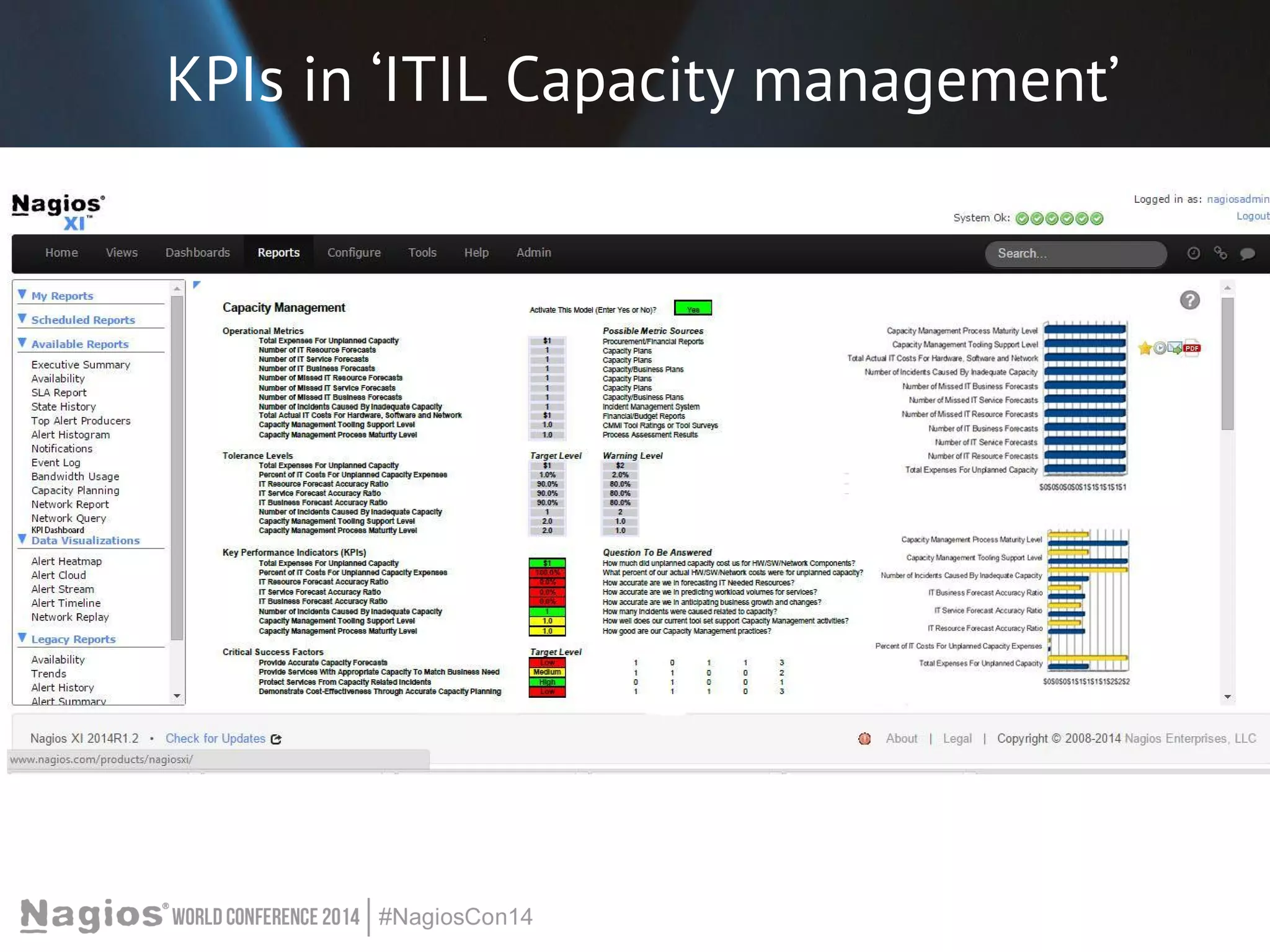
Objective: ITIL Capacity Management aims to ensure that the capacity of IT 
services and the IT infrastructure is able to deliver the agreed service level 
targets in a cost effective and timely manner. Capacity Management considers 
all resources required to deliver the IT service, and plans for short, medium and 
long term business requirements.
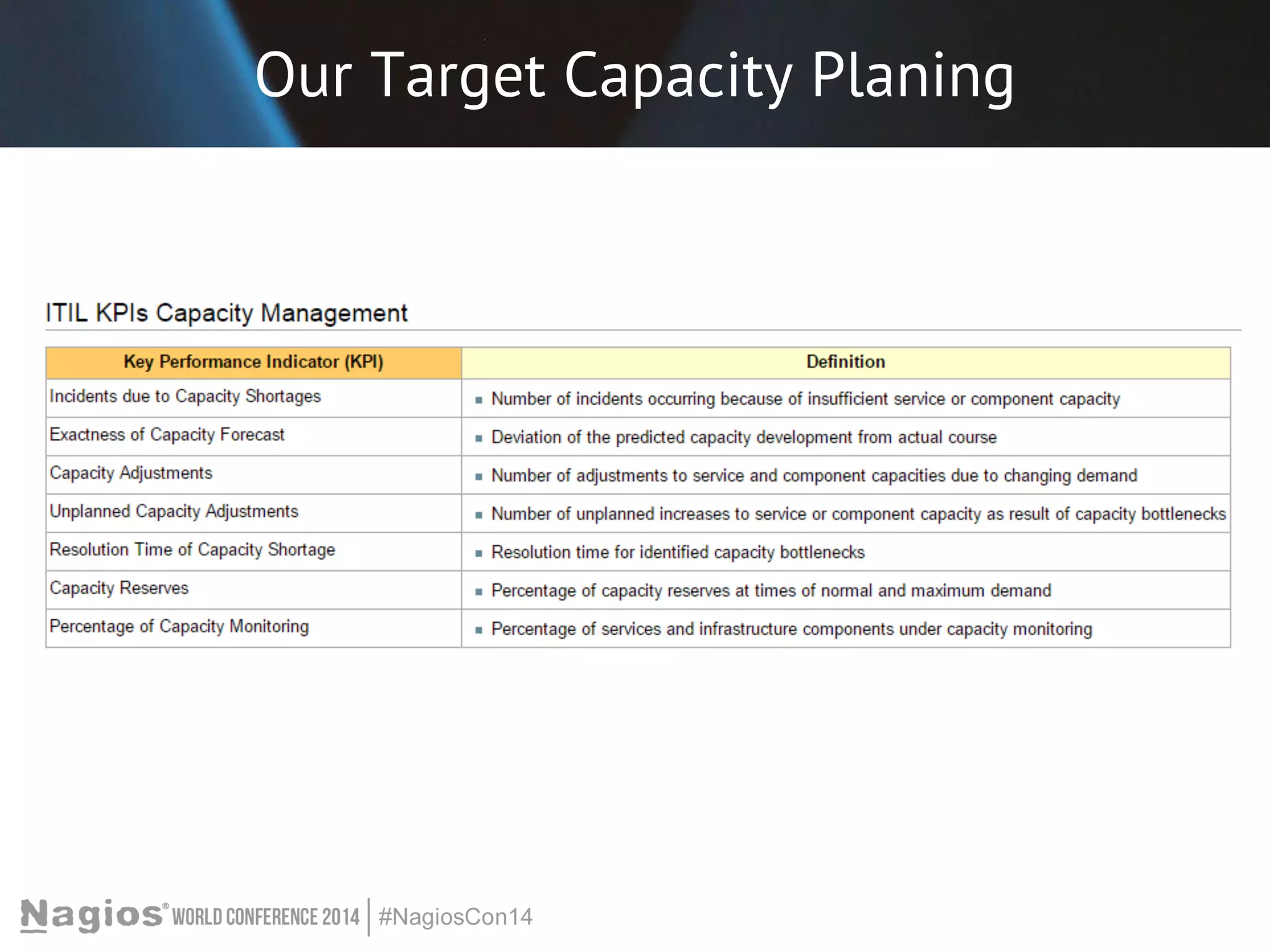
Our Target Capacity Planing
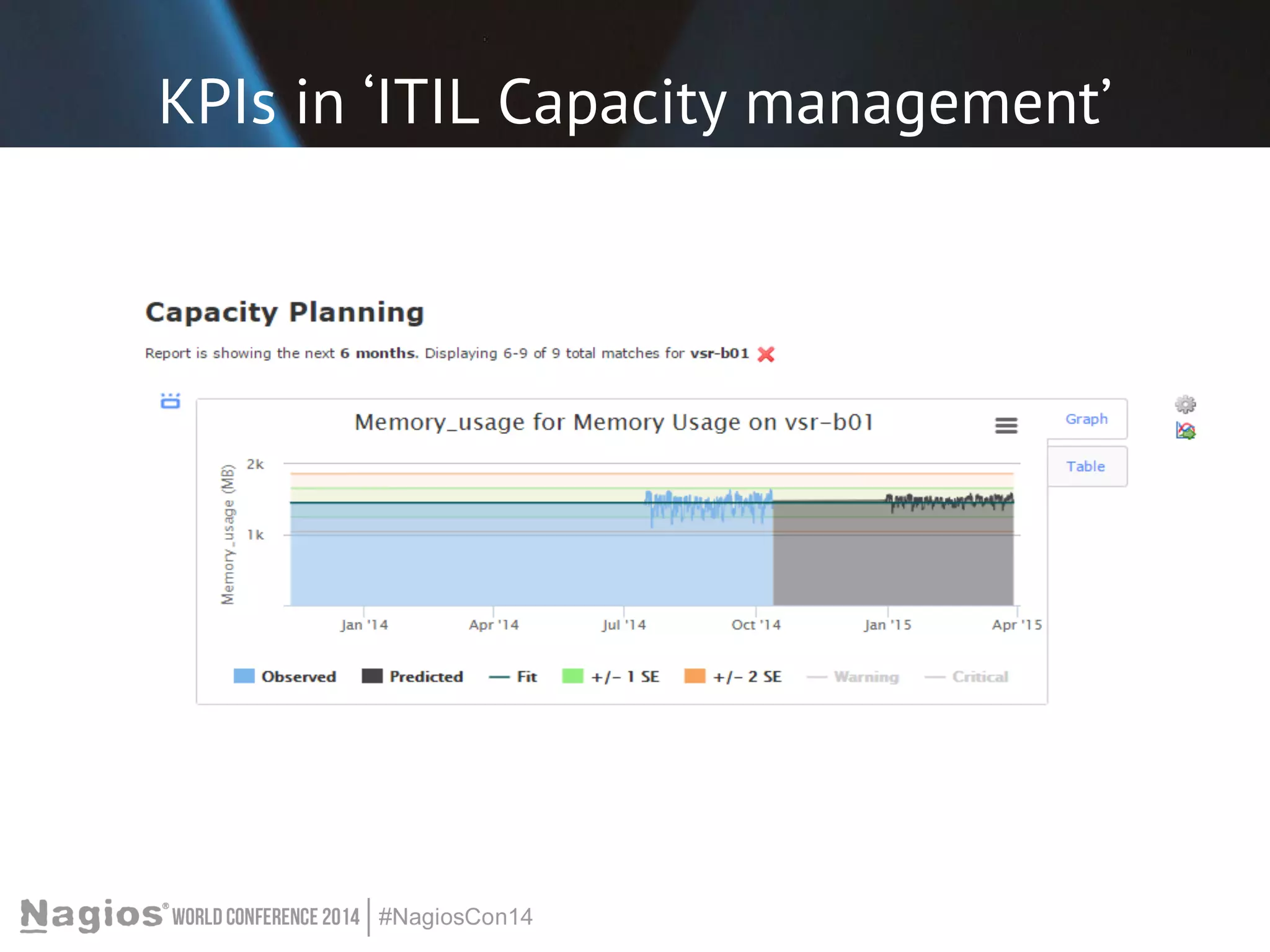
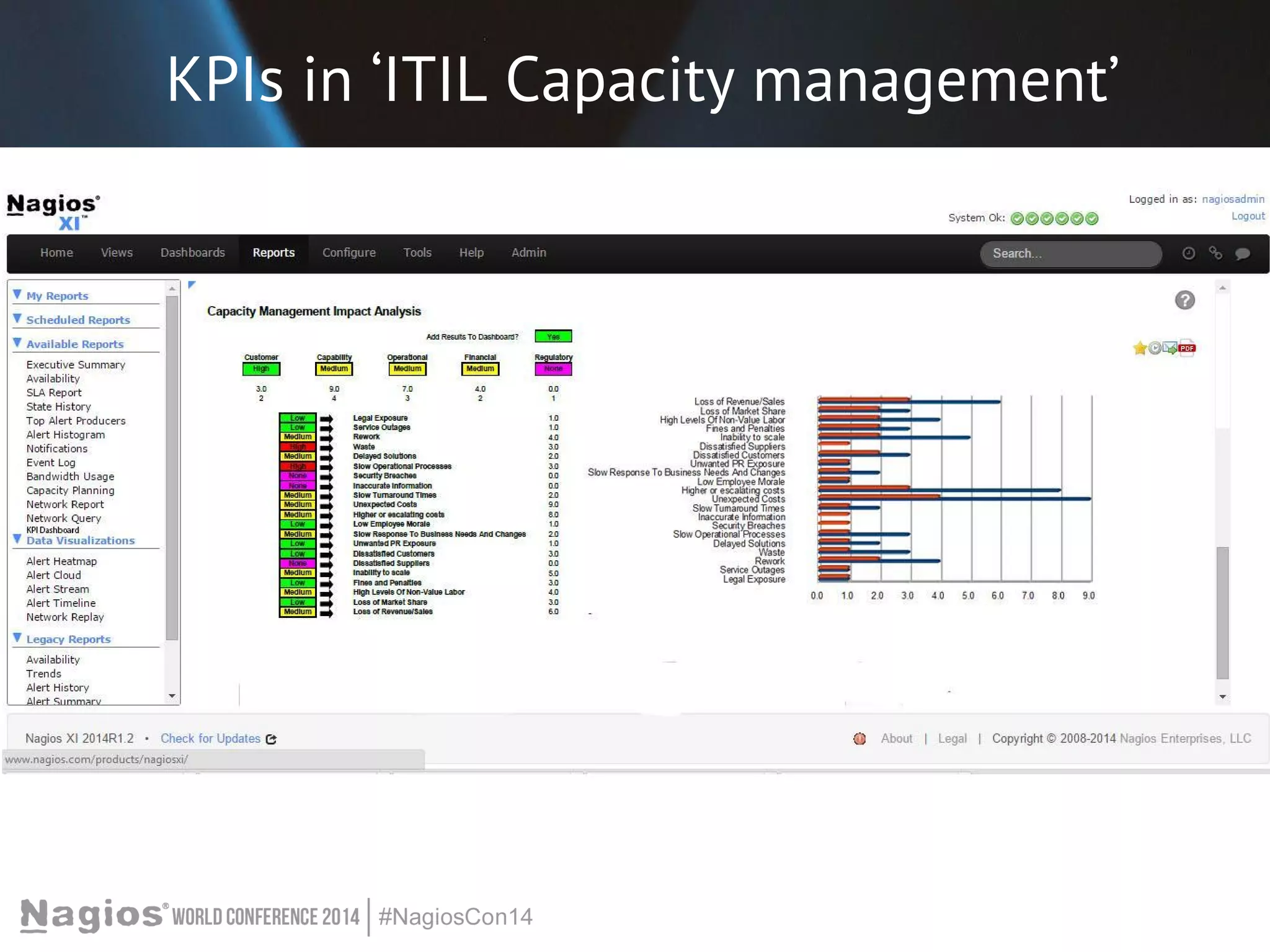
KPIs in ‘ITIL Capacity management’
KPIs in ‘ Capacity management 
Report’
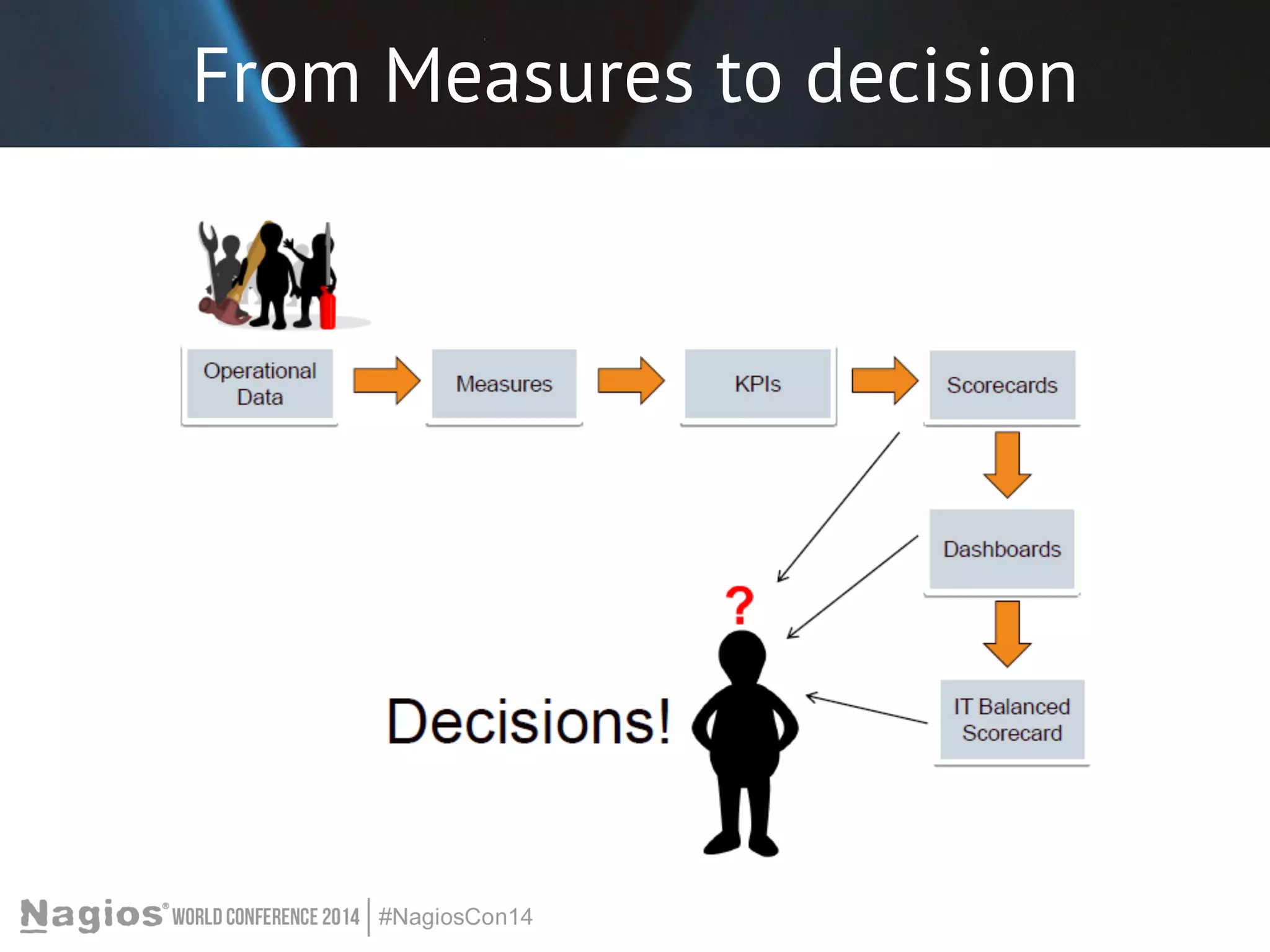
From Measures to decision
Conclusions 
● Metrics need not be viewed as an arcane dark art. Instead, the use of KPIs should be grounded 
in measuring the progress towards, and protection of, the objective(s) of a process. If the 
objective is clearly understood then the identification of metrics and how they should be 
constructed become much more apparent. In addition, it helps to bear in mind where the 
processes are at in terms of adoption in the organization and the behavior that the metric may 
drive. 
● Understand what stakeholders need and tailor metrics and reports accordingly. It is far better to 
start focused and evolve KPIs and reporting to stay relevant and truly help stakeholders with 
their management decisions. Hopefully this document has given you some ideas to discuss in 
your teams and improve the value that metrics bring
The End 
Jorge Higueros 
jorge.higueros@consulmatic.com

Nagios Conference 2014 - Jorge Higueros - Making KPIs Component Work For You With Nagios

  • 1.
    KPI Dashboard Component Balance Scorecard Jorge Higueros Jorge.higueros@gmail.com
  • 2.
    Who I am Jorge Higueros • 10 Years IT Experience • Master IT security Systems • Cobit 5 Certified • Offensive Security Certified • ITIL V3 Service Operation • ISO 20000 Implementing • PCI Auditor
  • 3.
    Introduction We talkabout the requirements for reports, KPIs, and metrics differ for each business/organization. A range of metrics that can be used will be covered, along with information on what types of reports are useful, how we built the KPI system with Nagios XI , and objectives we used to evaluate the KPIs.
  • 4.
    Benefits ● Knowthe KPIs and the activities specific for ITIL processes; ● Identify, select and analyze KPIs from the IT Service Management perspective; ● Exercise the utilization of ITIL practices, the application of IT standards and interpret the connections between processes around Nagios.
  • 5.
    Agenda • Whatis driving IT Today? • IT Performance Managment • What is a Key Performance Indicator (KPI)? • What Are Metrics? • ITIL Service Design with Nagios XI • Our Target Availability Management • Our Target Capacity Planing
  • 6.
    What is drivingIT Today? Monitoring
  • 7.
  • 8.
    IT Performance Management IT Performance Management
  • 9.
    IT Performance Management IT Performance Management
  • 10.
    IT Performance Management IT Performance Management
  • 11.
    What is aKey Performance Indicator (KPI)?
  • 12.
    What is aKey Performance Indicator (KPI)? Key Performance Indicators (KPIs) help organizations understand how well they are performing in relation to their strategic goals and objectives. In the broadest sense, a KPI can be defined as providing the most important performance information that enables organizations or their stakeholders to understand whether the organization is on track or not.
  • 13.
    What is aKey Performance Indicator (KPI)?
  • 14.
    Measuring what mattersthe most Before KPIs can be identified, the following requirements must be met: A predefined organizational process. Clear business objectives for the process. Quantitative and qualitative measurements. An active approach to finding and remedying enterprise variances.
  • 15.
    Example For example,when you go to your doctor he might measure blood pressure, cholesterol levels, heart rate and your body mass index as key indicators of your health. With KPIs we are trying to do the same in our organizations
  • 16.
    Why Use KPIs? KPIs serve to reduce the complex nature of organizational performance to a small number of key indicators in order to make performance more understandable and digestible for us. This is the same approach we use in our daily lives.
  • 17.
    Why Use KPIs? KPIs are above all else, a set of indicators to measure data against, a sort-of enterprise success gauge. Ultimately, they help an organization assess progress toward declared goals.
  • 18.
    Why do wemeasure performance? The reason why we measure performance in organizations is often reduced to simple homilies, such as ‘you can’t manage anything unless you measure it’ or ‘what gets measured gets done’. The three main reasons for measuring performance are : ● To learn and improve ● To report externally and demonstrate compliance ● To control and monitor people & IT Systems
  • 19.
    KPI in thereal life!!
  • 20.
  • 21.
    What Are Metrics? When we use the term metric we are referring to a direct numerical measure that represents a piece of business data in the relationship of one or more dimensions.
  • 22.
    What Are Metrics? Metrics are not the KPIs themselves; rather they are needed in order to determine if our KPIs have been satisfied. The KPI that might use the above metric could be "% reduction in CIs in error each month" – you need the number actually in error in order to determine the % of reduction over the previous month's # of CIs in error.
  • 23.
  • 24.
  • 25.
  • 26.
    ITIL Service DesignWith Nagios XI
  • 27.
    ITIL Service DesignWith Nagios XI Objective: The objective of ITIL Service Design is to design new IT services. The scope of Service Design includes the design of new services, as well as changes and improvements to existing ones.
  • 28.
    Lets start withProcesses: ITIL Service Design inside Nagios Service Design identifies service requirements to clasify a critic levels of the group service of the company
  • 29.
    Design Coordination ProcessObjective: To coordinate all service design activities, processes and resources. Design coordination ensures the consistent and effective design of new or changed IT services, service management information systems, architectures, technology, processes, information and metrics.
  • 30.
    KPI Availability Management Component for Nagios XI
  • 31.
    Our Target AvailabilityManagement ● Process Objective: To define, analyze, plan, measure and improve all aspects of the availability of IT services. Availability Management is responsible for ensuring that all IT infrastructure, processes, tools, roles etc. are appropriate for the agreed availability targets.
  • 32.
  • 33.
    KPIs in ‘ITILAvailability management’ Availability (excluding planned downtime)
  • 34.
  • 35.
    KPIs in ‘ITILAvailability management’
  • 36.
    KPIs in ‘ITILAvailability management’
  • 37.
    Nagios ‘ Availabilitymanagement Report’
  • 38.
    KPI Capacity PlaningComponent for Nagios XI
  • 39.
    Our Target CapacityPlaning Objective: ITIL Capacity Management aims to ensure that the capacity of IT services and the IT infrastructure is able to deliver the agreed service level targets in a cost effective and timely manner. Capacity Management considers all resources required to deliver the IT service, and plans for short, medium and long term business requirements.
  • 40.
  • 41.
    KPIs in ‘ITILCapacity management’
  • 42.
    KPIs in ‘ITILCapacity management’
  • 43.
    KPIs in ‘ITILCapacity management’
  • 44.
    KPIs in ‘Capacity management Report’
  • 45.
  • 46.
    Conclusions ● Metricsneed not be viewed as an arcane dark art. Instead, the use of KPIs should be grounded in measuring the progress towards, and protection of, the objective(s) of a process. If the objective is clearly understood then the identification of metrics and how they should be constructed become much more apparent. In addition, it helps to bear in mind where the processes are at in terms of adoption in the organization and the behavior that the metric may drive. ● Understand what stakeholders need and tailor metrics and reports accordingly. It is far better to start focused and evolve KPIs and reporting to stay relevant and truly help stakeholders with their management decisions. Hopefully this document has given you some ideas to discuss in your teams and improve the value that metrics bring
  • 48.
    The End JorgeHigueros jorge.higueros@consulmatic.com