KEY PERFORMANCE
INDICATOR (KPI)
By
Ph.Ijaz Hussain
Pharmacy Quality and Medication safety
Supervisor
Definitions
A KPI is a key performance indicator that
measures how your company is performing at
achieving a certain goal or objective. There
are KPIs for every aspect of business, whether
it's financial, marketing, sales, or operational
Key Performance Indicators (KPIs) is a
measure of how your teams are performing to
meet the overall business goals and objectives
Cont…
KEY PERFORMANCE INDICATOR (KPI)
 Key Performance Indicators (KPIs) are the critical
(key) indicators of progress toward an intended
result. KPIs provide a focus for strategic and
operational improvement, create an analytical basis
for decision making and help focus attention on
what matters most.”
 Key Performance Indicators (KPIs) are the subset of
performance indicators most critical to your
business at the highest level of your organization.
KPIs are used to help you measure your progress
toward achieving your strategic goals.”
KEY PERFORMANCE INDICATOR (KPI)
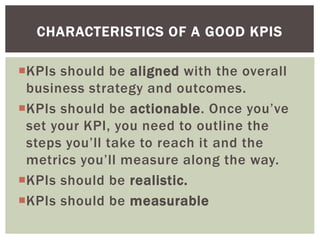
KPIs should be aligned with the overall
business strategy and outcomes.
KPIs should be actionable. Once you’ve
set your KPI, you need to outline the
steps you’ll take to reach it and the
metrics you’ll measure along the way.
KPIs should be realistic.
KPIs should be measurable
CHARACTERISTICS OF A GOOD KPIS
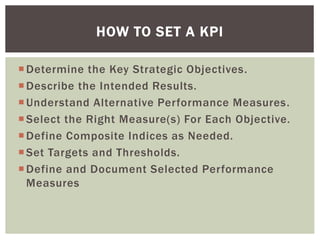
Determine the Key Strategic Objectives.
Describe the Intended Results.
Understand Alternative Performance Measures.
Select the Right Measure(s) For Each Objective.
Define Composite Indices as Needed.
Set Targets and Thresholds.
Define and Document Selected Performance
Measures
HOW TO SET A KPI
KPIs are supposed to align team activities
with the organization’s greater goal, which
means that you have to identify your key
strategic objectives. For example, do you
want to increase your organization’s
overall sales
DETERMINE THE KEY STRATEGIC OBJECTIVES
Once you’ve identified your primary goals,
you’ll need to figure out what success
looks like. For example, let’s say you want
to increase profit by X%. In this case, it’s a
good idea to look at the end goal and work
backward.
DESCRIBE THE INTENDED RESULTS
how do you measure a KPI that can’t be
measured in the “traditional” way? The answer
is using a correlational model and a little bit of
research. Let’s say you’re trying to measure
your brand’s reputation, which can be difficult
to quantify. In this case, you could list down all
the things that correlate with a good reputation,
like shares on social media or inquiries.
Another route you can take is finding the
factors that contribute to a goal’s completion.
UNDERSTAND ALTERNATIVE PERFORMANCE
MEASURES
Once your goal has been clearly identified
and you’ve figured out the steps necessary to
fulfill it, you’re ready to start planning which
measures to use. Keep the various types of
KPIs and their intended functions in mind
when deciding which measure to use. For
example, you wouldn’t establish a qualitative
KPI for the number of sales made or classes
booked in a month. Instead, you’d set a
quantitative KPI
SELECT THE RIGHT MEASURE(S) FOR EACH
OBJECTIVE
Some businesses have big, intangible goals, which
means the data they produce may provide insight into
the intended outcome. This is especially true if the
data identifies several components or dimensions of a
goal. So, how do you create meaningful measures for
more complex situations or objectives?
The answer is a composite index. These indices group
several KPIs together to track how they impact and
affect each other. Composite indices can be extremely
helpful when measuring abstract concepts like brand
loyalty and sentiment
DEFINE COMPOSITE INDICES AS NEEDED
Now that you have your specific measurements, you’ll
need to decide how to interpret the results from these
measures. This is done by setting targets and
thresholds. Without these thresholds, your indicator
becomes more of a metric than a KPI.
So, how do these thresholds work?
Imagine a chart that’s split into three lengthwise
portions. The top portion is green, the middle is yellow,
and the bottom is blue. For example, if this were a
chart indicating sales volume, then an outcome in the
green portion would suggest a high sales volume.
These thresholds serve as an easy way to track
progress over time and reevaluate strategies.
SET TARGETS AND THRESHOLDS
Defining and documenting your performance
measures are crucial for transitioning from
KPI planning to implementation. This
process involves clearly describing the
standard you’ve chosen to use, including the
outcomes it’s supposed to measure, how
data is collected, and how often these
metrics are evaluated. It also clearly defines
essential terms so that data collection is
consistent over time
DEFINE AND DOCUMENT SELECTED
PERFORMANCE MEASURES
Specific, Measure, Attainable, Relevant, Timeframe =
SMART
Is your objective specific?
Can you measure progress towards your goal?
Is the goal realistically attainable?
How relevant is the goal to your organization?
What is the timeframe for achieving this goal?
DEFINING KPI BY SMART FRAMEWORK
There are many types of KPIs that you can
use in your business. Some KPIs are high
level, others are low level within an
organization. The common thread is that
all of these are objectives and you should
use the ones that make most sense for
your business strategy, some of the most
common categories are discussed below
DIFFERENT TYPES OF KPIS
Whereas qualitative KPI is a descriptive
characteristic, something like employee
satisfaction.
QUALITATIVE KPI
Operational Key Performance
Indicator (KPI) evaluates the
efficiency of its day-to-day operations
within an organization. These KPI
helps management identify which
strategies are effective. Examples for
operational KPIs are cost per patient.
OPERATIONAL KPI
Strategic KPIs are more about
monitoring progress or trends
toward a stated destination, and
focus on more long-term, big-
picture goals within an
organization like customer
acquisition cost.
STRATEGIC KPI
A leading KPI measures performance
before the business or process follows a
pattern or trend, this can be used for
future prediction.
LEADING KPI
A lagging KPI measures performance
after the business or process follows a
pattern or trend, such as annual sales
for the previous year.
LAGGING KPI
 https://www.klipfolio.com/resources/articles/what-is-a-key-
performance-indicator
 https://people.ai/blog/how-to-develop-kpis/
REFERENCES

Key Performance Indicator (KPI).pptx

  • 1.
    KEY PERFORMANCE INDICATOR (KPI) By Ph.IjazHussain Pharmacy Quality and Medication safety Supervisor
  • 2.
    Definitions A KPI isa key performance indicator that measures how your company is performing at achieving a certain goal or objective. There are KPIs for every aspect of business, whether it's financial, marketing, sales, or operational Key Performance Indicators (KPIs) is a measure of how your teams are performing to meet the overall business goals and objectives Cont… KEY PERFORMANCE INDICATOR (KPI)
  • 3.
     Key PerformanceIndicators (KPIs) are the critical (key) indicators of progress toward an intended result. KPIs provide a focus for strategic and operational improvement, create an analytical basis for decision making and help focus attention on what matters most.”  Key Performance Indicators (KPIs) are the subset of performance indicators most critical to your business at the highest level of your organization. KPIs are used to help you measure your progress toward achieving your strategic goals.” KEY PERFORMANCE INDICATOR (KPI)
  • 4.
    KPIs should bealigned with the overall business strategy and outcomes. KPIs should be actionable. Once you’ve set your KPI, you need to outline the steps you’ll take to reach it and the metrics you’ll measure along the way. KPIs should be realistic. KPIs should be measurable CHARACTERISTICS OF A GOOD KPIS
  • 5.
    Determine the KeyStrategic Objectives. Describe the Intended Results. Understand Alternative Performance Measures. Select the Right Measure(s) For Each Objective. Define Composite Indices as Needed. Set Targets and Thresholds. Define and Document Selected Performance Measures HOW TO SET A KPI
  • 6.
    KPIs are supposedto align team activities with the organization’s greater goal, which means that you have to identify your key strategic objectives. For example, do you want to increase your organization’s overall sales DETERMINE THE KEY STRATEGIC OBJECTIVES
  • 7.
    Once you’ve identifiedyour primary goals, you’ll need to figure out what success looks like. For example, let’s say you want to increase profit by X%. In this case, it’s a good idea to look at the end goal and work backward. DESCRIBE THE INTENDED RESULTS
  • 8.
    how do youmeasure a KPI that can’t be measured in the “traditional” way? The answer is using a correlational model and a little bit of research. Let’s say you’re trying to measure your brand’s reputation, which can be difficult to quantify. In this case, you could list down all the things that correlate with a good reputation, like shares on social media or inquiries. Another route you can take is finding the factors that contribute to a goal’s completion. UNDERSTAND ALTERNATIVE PERFORMANCE MEASURES
  • 9.
    Once your goalhas been clearly identified and you’ve figured out the steps necessary to fulfill it, you’re ready to start planning which measures to use. Keep the various types of KPIs and their intended functions in mind when deciding which measure to use. For example, you wouldn’t establish a qualitative KPI for the number of sales made or classes booked in a month. Instead, you’d set a quantitative KPI SELECT THE RIGHT MEASURE(S) FOR EACH OBJECTIVE
  • 10.
    Some businesses havebig, intangible goals, which means the data they produce may provide insight into the intended outcome. This is especially true if the data identifies several components or dimensions of a goal. So, how do you create meaningful measures for more complex situations or objectives? The answer is a composite index. These indices group several KPIs together to track how they impact and affect each other. Composite indices can be extremely helpful when measuring abstract concepts like brand loyalty and sentiment DEFINE COMPOSITE INDICES AS NEEDED
  • 11.
    Now that youhave your specific measurements, you’ll need to decide how to interpret the results from these measures. This is done by setting targets and thresholds. Without these thresholds, your indicator becomes more of a metric than a KPI. So, how do these thresholds work? Imagine a chart that’s split into three lengthwise portions. The top portion is green, the middle is yellow, and the bottom is blue. For example, if this were a chart indicating sales volume, then an outcome in the green portion would suggest a high sales volume. These thresholds serve as an easy way to track progress over time and reevaluate strategies. SET TARGETS AND THRESHOLDS
  • 12.
    Defining and documentingyour performance measures are crucial for transitioning from KPI planning to implementation. This process involves clearly describing the standard you’ve chosen to use, including the outcomes it’s supposed to measure, how data is collected, and how often these metrics are evaluated. It also clearly defines essential terms so that data collection is consistent over time DEFINE AND DOCUMENT SELECTED PERFORMANCE MEASURES
  • 13.
    Specific, Measure, Attainable,Relevant, Timeframe = SMART Is your objective specific? Can you measure progress towards your goal? Is the goal realistically attainable? How relevant is the goal to your organization? What is the timeframe for achieving this goal? DEFINING KPI BY SMART FRAMEWORK
  • 14.
    There are manytypes of KPIs that you can use in your business. Some KPIs are high level, others are low level within an organization. The common thread is that all of these are objectives and you should use the ones that make most sense for your business strategy, some of the most common categories are discussed below DIFFERENT TYPES OF KPIS
  • 15.
    Whereas qualitative KPIis a descriptive characteristic, something like employee satisfaction. QUALITATIVE KPI
  • 16.
    Operational Key Performance Indicator(KPI) evaluates the efficiency of its day-to-day operations within an organization. These KPI helps management identify which strategies are effective. Examples for operational KPIs are cost per patient. OPERATIONAL KPI
  • 17.
    Strategic KPIs aremore about monitoring progress or trends toward a stated destination, and focus on more long-term, big- picture goals within an organization like customer acquisition cost. STRATEGIC KPI
  • 18.
    A leading KPImeasures performance before the business or process follows a pattern or trend, this can be used for future prediction. LEADING KPI
  • 19.
    A lagging KPImeasures performance after the business or process follows a pattern or trend, such as annual sales for the previous year. LAGGING KPI
  • 20.