
tIdentifying and Measuring KPI’sLiz Marenakos
What are KPI’s?Key Performance Indicators, or KPI’s, are quantifiable measures of an organization’s performance, activities, or success.Used to measure progress towards goalsTranslate an organization’s mission into clear, measurable outcomes
Why are they important to nonprofits?Transparency to internal and external audiencesAccountability to Donors/FundersProof of Delivery on Mission
Financial KPI’s – The basicsWhile KPI’s can be organization or even campaign specific, basic financial KPI’s are relevant to most nonprofits. Some examples:Average Donor ContributionCost per dollar raisedProgram EfficiencyLiquidityFundraising EfficiencyOperating RelianceEmployee Productivity
3 Important RatiosThree key ratios that are of interest to nonprofit stakeholders Program efficiency ratio – How much of every expense dollar goes to programs?Operating reliance ratio – How much of your total expenses are covered by program services revenue?Fundraising efficiency ratio – What multiple is your contribution revenue of your fundraising expenses?
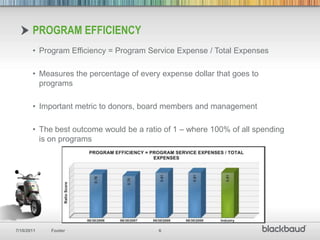
Program EfficiencyProgram Efficiency = Program Service Expense / Total ExpensesMeasures the percentage of every expense dollar that goes to programsImportant metric to donors, board members and managementThe best outcome would be a ratio of 1 – where 100% of all spending is on programs
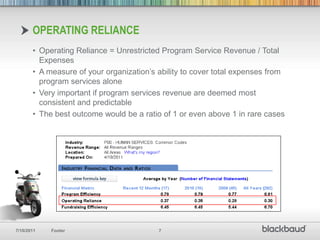
Operating relianceOperating Reliance = Unrestricted Program Service Revenue / Total Expenses
A measure of your organization’s ability to cover total expenses from program services alone
Very important if program services revenue are deemed most consistent and predictable
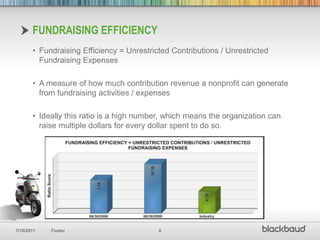
The best outcome would be a ratio of 1 or even above 1 in rare casesFundraising EfficiencyFundraising Efficiency = Unrestricted Contributions / Unrestricted Fundraising Expenses
A measure of how much contribution revenue a nonprofit can generate from fundraising activities / expenses
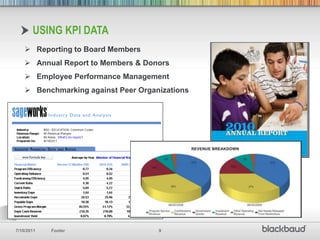
Ideally this ratio is a high number, which means the organization can raise multiple dollars for every dollar spent to do so. Using KPI DataReporting to Board Members
Annual Report to Members & Donors
Employee Performance Management
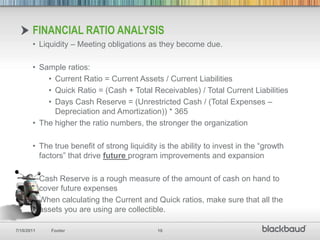
Benchmarking against Peer OrganizationsFinancial Ratio AnalysisLiquidity – Meeting obligations as they become due.
Sample ratios:
Current Ratio = Current Assets / Current Liabilities
Quick Ratio = (Cash + Total Receivables) / Total Current Liabilities
Days Cash Reserve = (Unrestricted Cash / (Total Expenses – Depreciation and Amortization)) * 365
The higher the ratio numbers, the stronger the organization

Identifying and Measuring KPIs

  • 1.
    tIdentifying and MeasuringKPI’sLiz Marenakos
  • 2.
    What are KPI’s?KeyPerformance Indicators, or KPI’s, are quantifiable measures of an organization’s performance, activities, or success.Used to measure progress towards goalsTranslate an organization’s mission into clear, measurable outcomes
  • 3.
    Why are theyimportant to nonprofits?Transparency to internal and external audiencesAccountability to Donors/FundersProof of Delivery on Mission
  • 4.
    Financial KPI’s –The basicsWhile KPI’s can be organization or even campaign specific, basic financial KPI’s are relevant to most nonprofits. Some examples:Average Donor ContributionCost per dollar raisedProgram EfficiencyLiquidityFundraising EfficiencyOperating RelianceEmployee Productivity
  • 5.
    3 Important RatiosThreekey ratios that are of interest to nonprofit stakeholders Program efficiency ratio – How much of every expense dollar goes to programs?Operating reliance ratio – How much of your total expenses are covered by program services revenue?Fundraising efficiency ratio – What multiple is your contribution revenue of your fundraising expenses?
  • 6.
    Program EfficiencyProgram Efficiency= Program Service Expense / Total ExpensesMeasures the percentage of every expense dollar that goes to programsImportant metric to donors, board members and managementThe best outcome would be a ratio of 1 – where 100% of all spending is on programs
  • 7.
    Operating relianceOperating Reliance= Unrestricted Program Service Revenue / Total Expenses
  • 8.
    A measure ofyour organization’s ability to cover total expenses from program services alone
  • 9.
    Very important ifprogram services revenue are deemed most consistent and predictable
  • 10.
    The best outcomewould be a ratio of 1 or even above 1 in rare casesFundraising EfficiencyFundraising Efficiency = Unrestricted Contributions / Unrestricted Fundraising Expenses
  • 11.
    A measure ofhow much contribution revenue a nonprofit can generate from fundraising activities / expenses
  • 12.
    Ideally this ratiois a high number, which means the organization can raise multiple dollars for every dollar spent to do so. Using KPI DataReporting to Board Members
  • 13.
    Annual Report toMembers & Donors
  • 14.
  • 15.
    Benchmarking against PeerOrganizationsFinancial Ratio AnalysisLiquidity – Meeting obligations as they become due.
  • 16.
  • 17.
    Current Ratio =Current Assets / Current Liabilities
  • 18.
    Quick Ratio =(Cash + Total Receivables) / Total Current Liabilities
  • 19.
    Days Cash Reserve= (Unrestricted Cash / (Total Expenses – Depreciation and Amortization)) * 365
  • 20.
    The higher theratio numbers, the stronger the organization

Editor's Notes

  • #2 Section header
  • #14 Let’s take a look at how our sample organization compares to its peers….
  • #15 Section header
  • #16 High level business model – raise money and supplies to build and sell houses to those who could not otherwise afford them.
  • #20 TITLE SLIDE.