


Use Nagios to monitor your public cloud
monitoring complex Ubuntu deployments
Matt Bruzek - matthew.bruzek@canonical.com
Computing infrastructure is only getting
more complex
Life is too short to monitor your infrastructure by hand!
How many people here use a configuration
management tool to deploy or monitor their
environment?
Chef/Puppet/Ansible/other?
Everyone here is using Nagios differently
❖ Monitoring different things
❖ Different architectures or operating systems
❖ Different production environments
❖ Using different cloud provider
❖ Bare metal servers
... at least we all agree on Nagios!
If there was a change to your
network/servers/cloud provider
could your automation tool handle a major change?
Can we continue to have
artisanal infrastructures?
How many false positive monitoring errors do we get
from infrastructure changes?
When you take a machine out of service,
does that same process
remove the host from monitoring?
If yes that is great, if not it should!
The services we deploy should know how to
monitor themselves!
Crazy right? Well, what if they could?
Let’s say you were asked to monitor some
new big data solution
demo time!
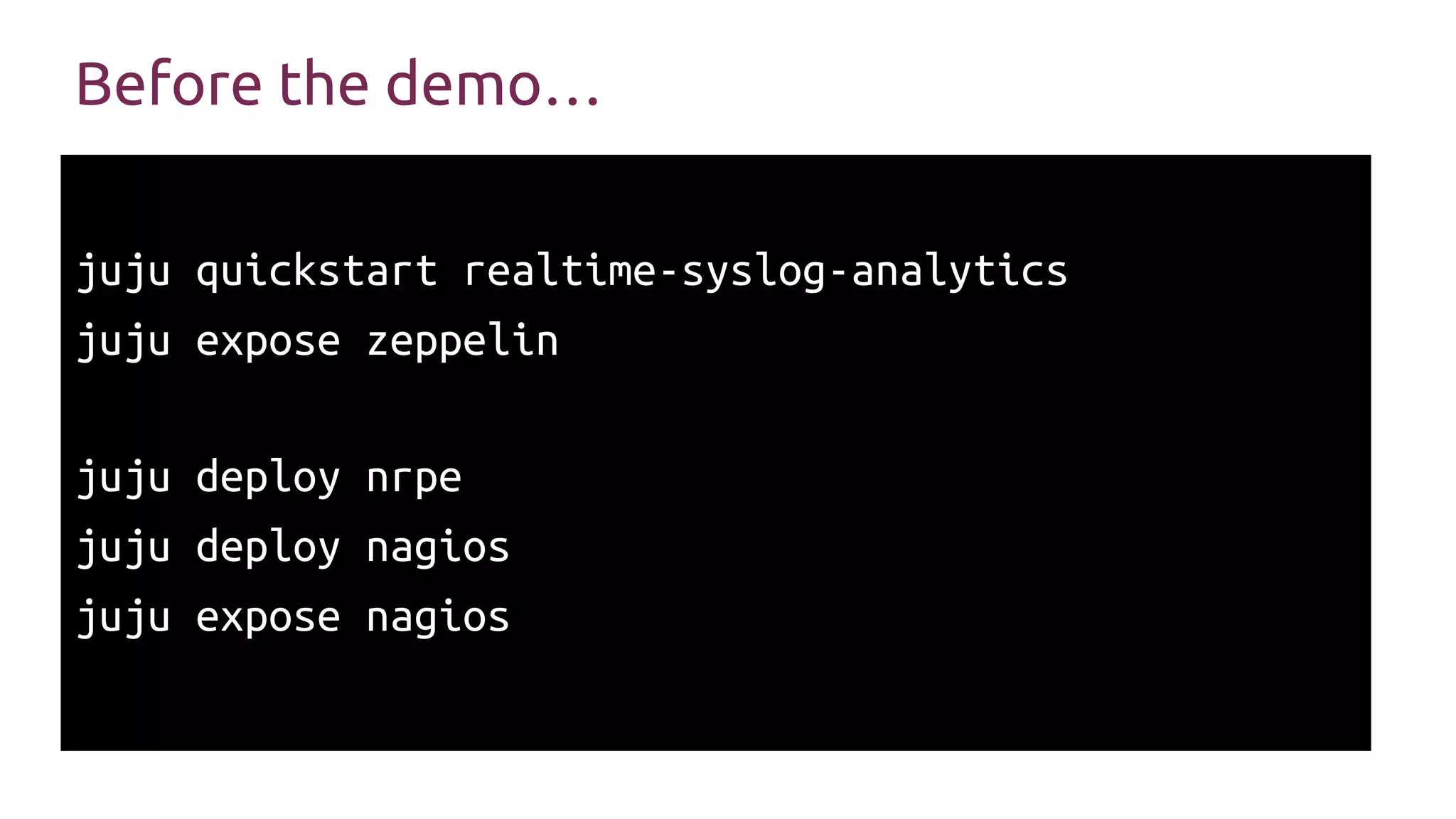
Before the demo…
juju quickstart realtime-syslog-analytics
juju expose zeppelin
juju deploy nrpe
juju deploy nagios
juju expose nagios
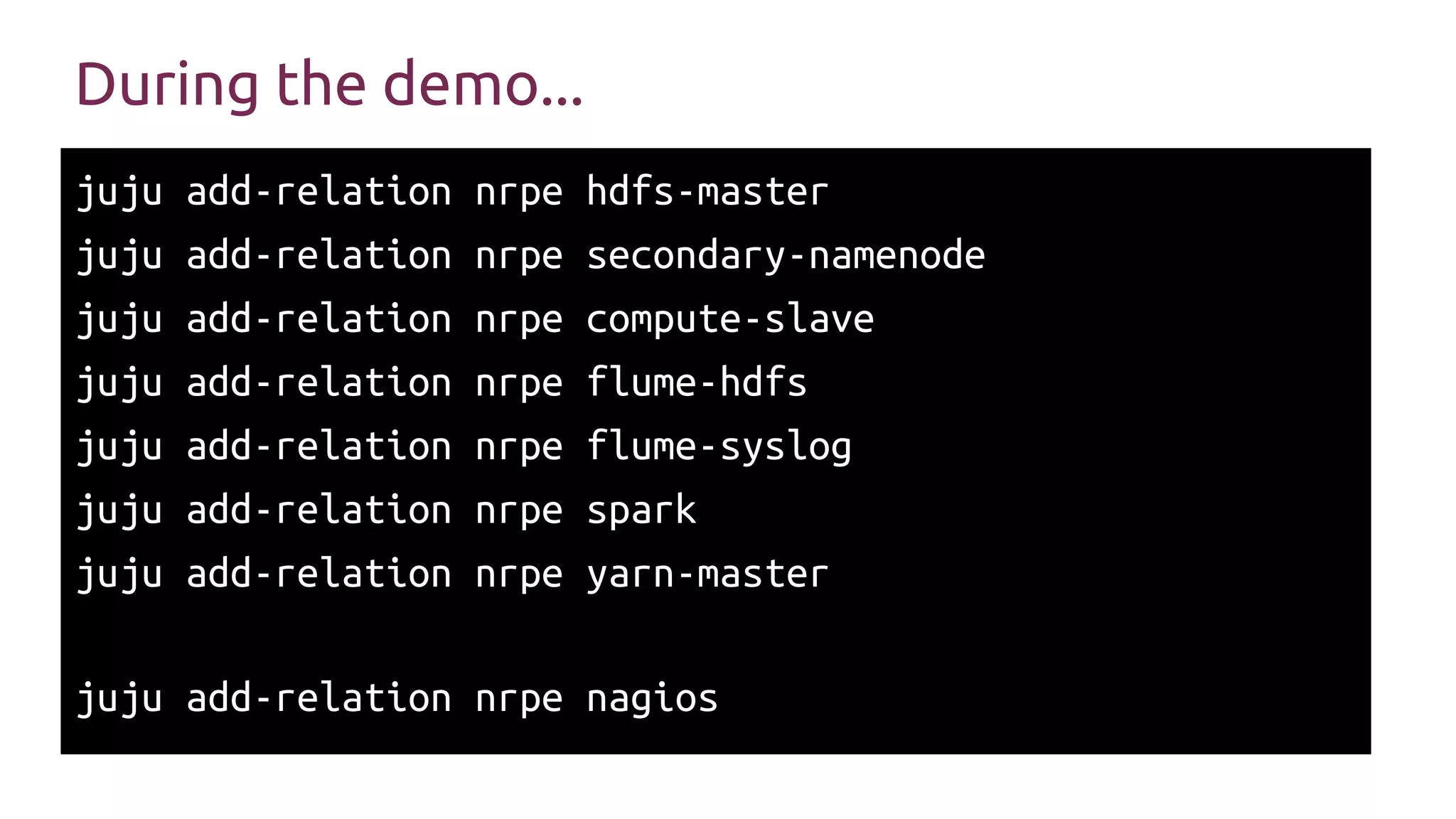
During the demo...
juju add-relation nrpe hdfs-master
juju add-relation nrpe secondary-namenode
juju add-relation nrpe compute-slave
juju add-relation nrpe flume-hdfs
juju add-relation nrpe flume-syslog
juju add-relation nrpe spark
juju add-relation nrpe yarn-master
juju add-relation nrpe nagios
What was that?
Juju in action with Nagios!
That looked fake
Juju
❖ An open source service orchestration software project
➢ that provides a language to model cloud deployments
➢ Cloud or bare metal agnostic, define the model and it is
repeatable on a variety of environments.
❖ Not just a configuration management tool
➢ Juju follows the service through the complete lifecycle
■ add or remove relations, scale up or down services
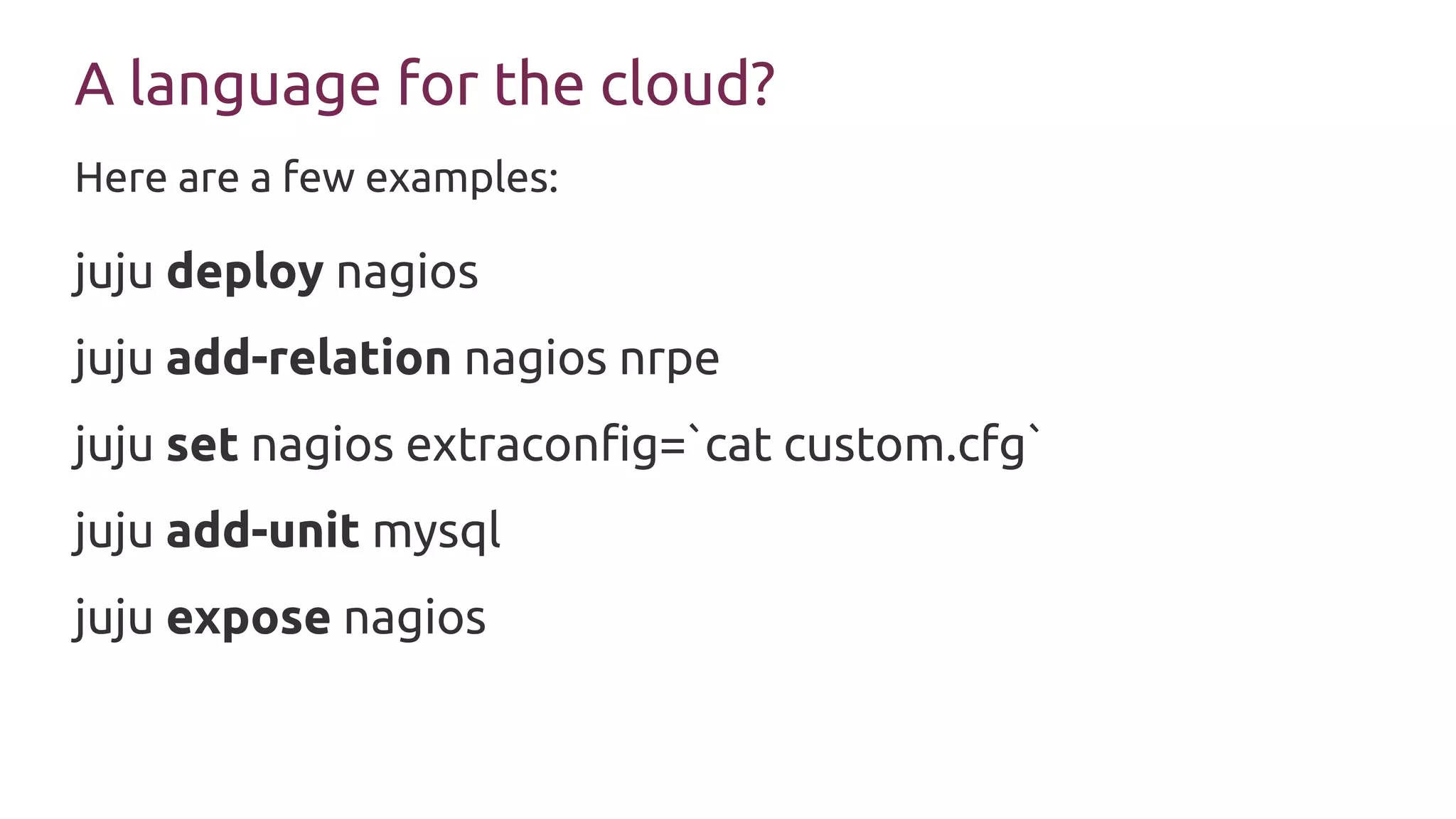
A language for the cloud?
juju deploy nagios
juju add-relation nagios nrpe
juju set nagios extraconfig=`cat custom.cfg`
juju add-unit mysql
juju expose nagios
Here are a few examples:
Define a model and share it with others to
deploy the same model on different clouds
And monitor every charm (service)
How does Juju work?
cloud images, cloud-init, and charm code
Charms
Charms
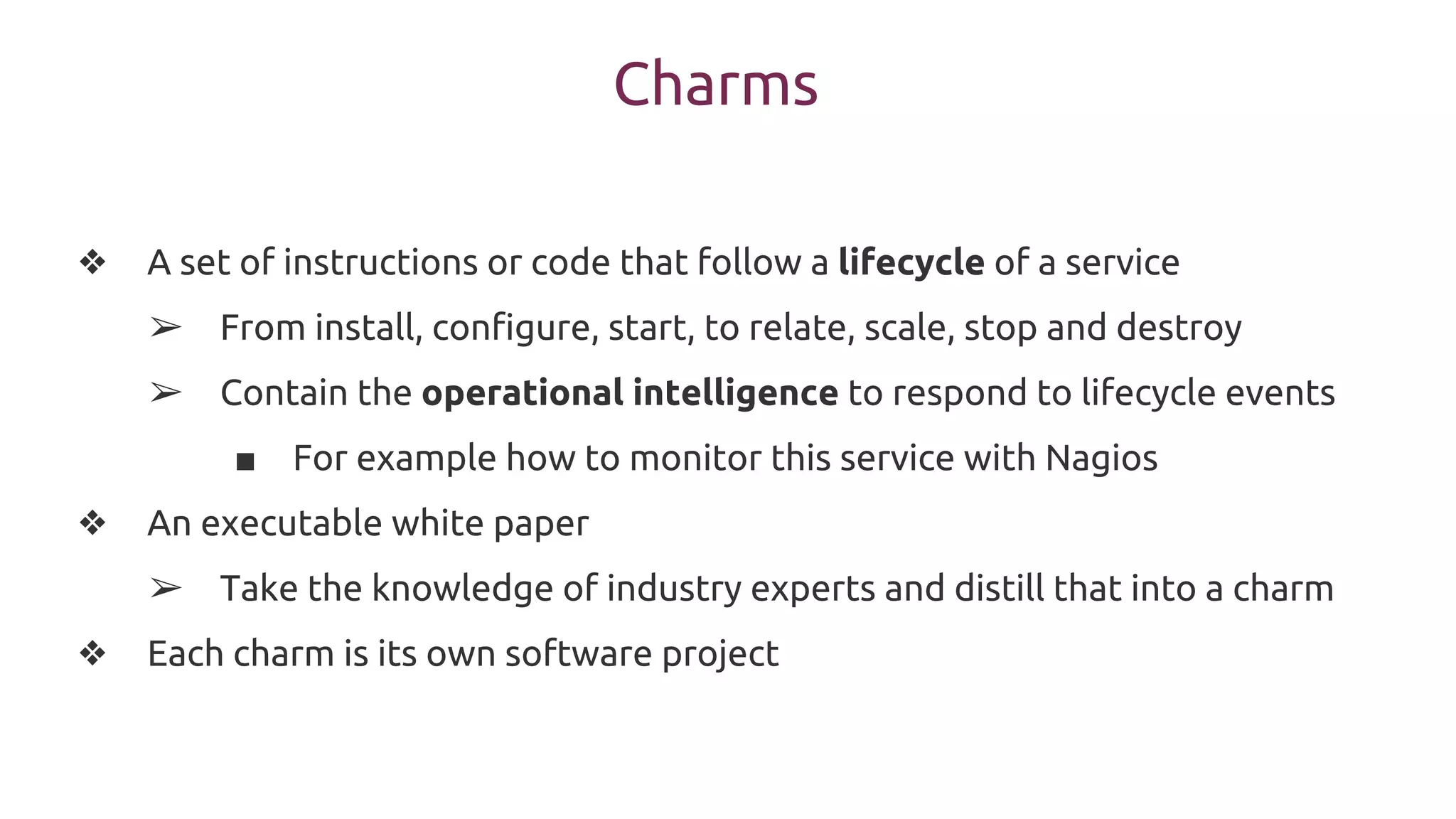
❖ A set of instructions or code that follow a lifecycle of a service
➢ From install, configure, start, to relate, scale, stop and destroy
➢ Contain the operational intelligence to respond to lifecycle events
■ For example how to monitor this service with Nagios
❖ An executable white paper
➢ Take the knowledge of industry experts and distill that into a charm
❖ Each charm is its own software project
Charms
❖ A collection of files with specific directory structure
❖ Charms can be written in any language
➢ From scripting languages to compiled binary files, really anything
❖ The code must take advantage of the event hook architecture
➢ Juju fires events, each event has a hook, charm code responds to events
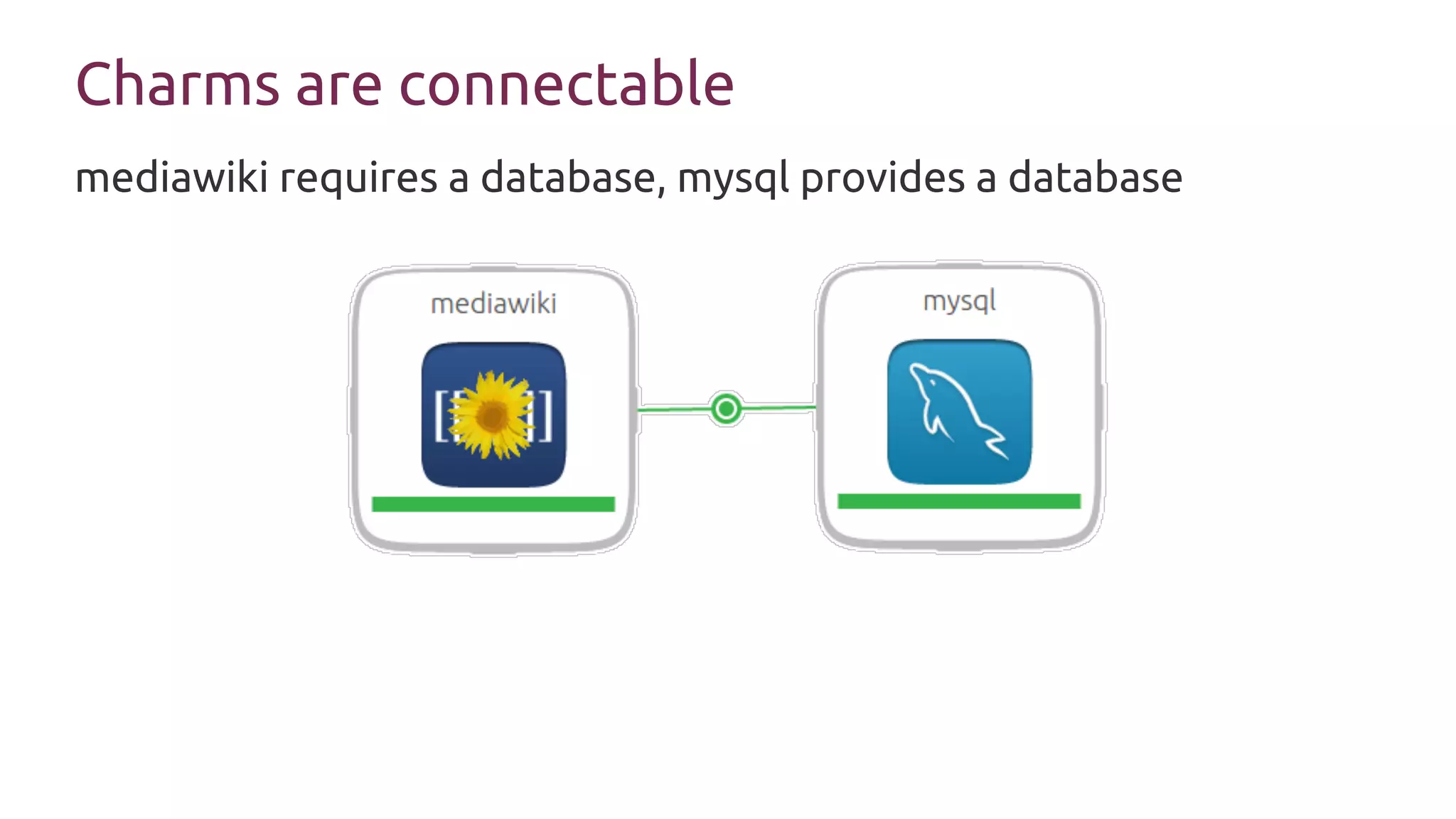
Charms are connectable
mediawiki requires a database, mysql provides a database
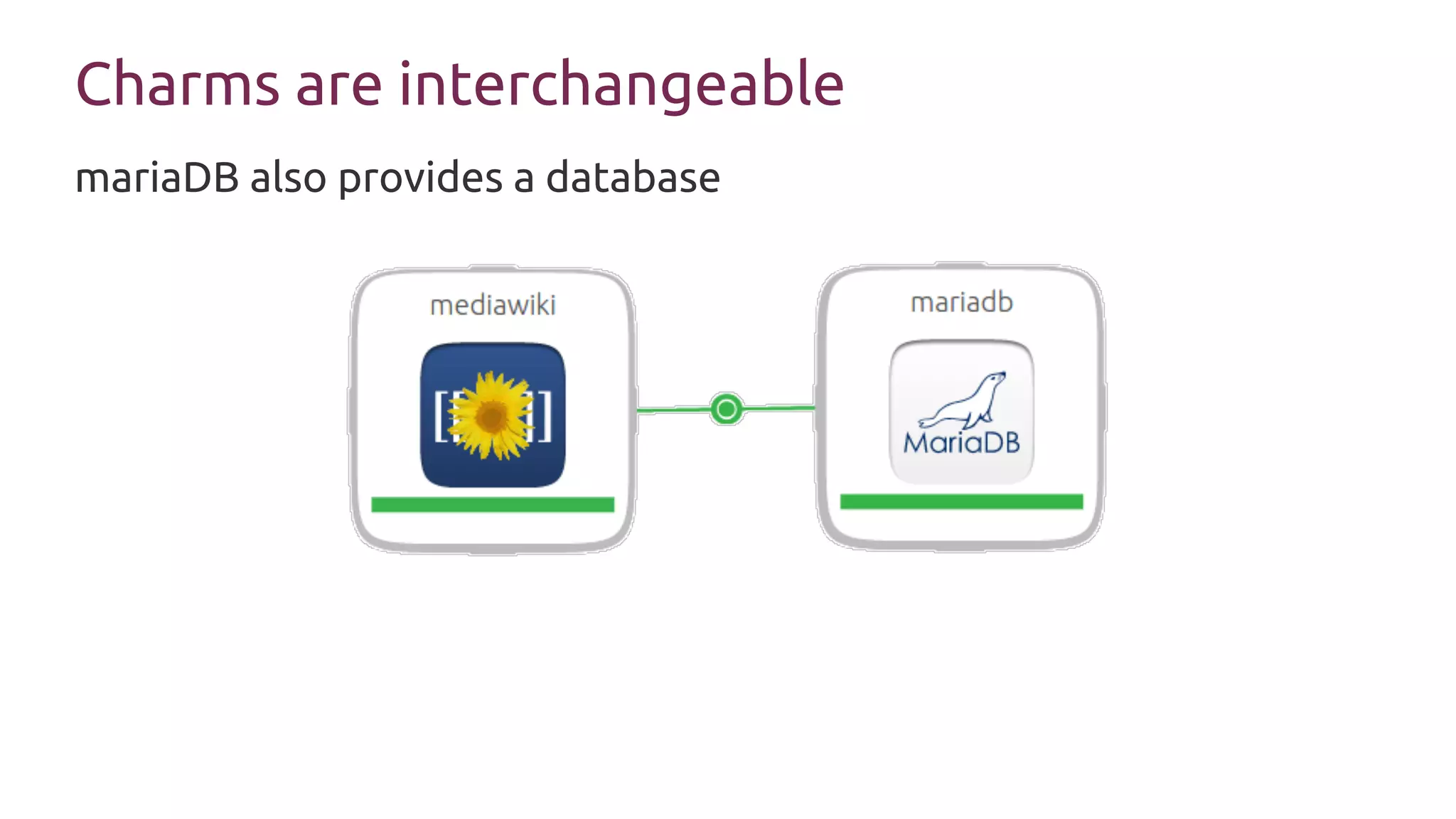
Charms are interchangeable
mariaDB also provides a database
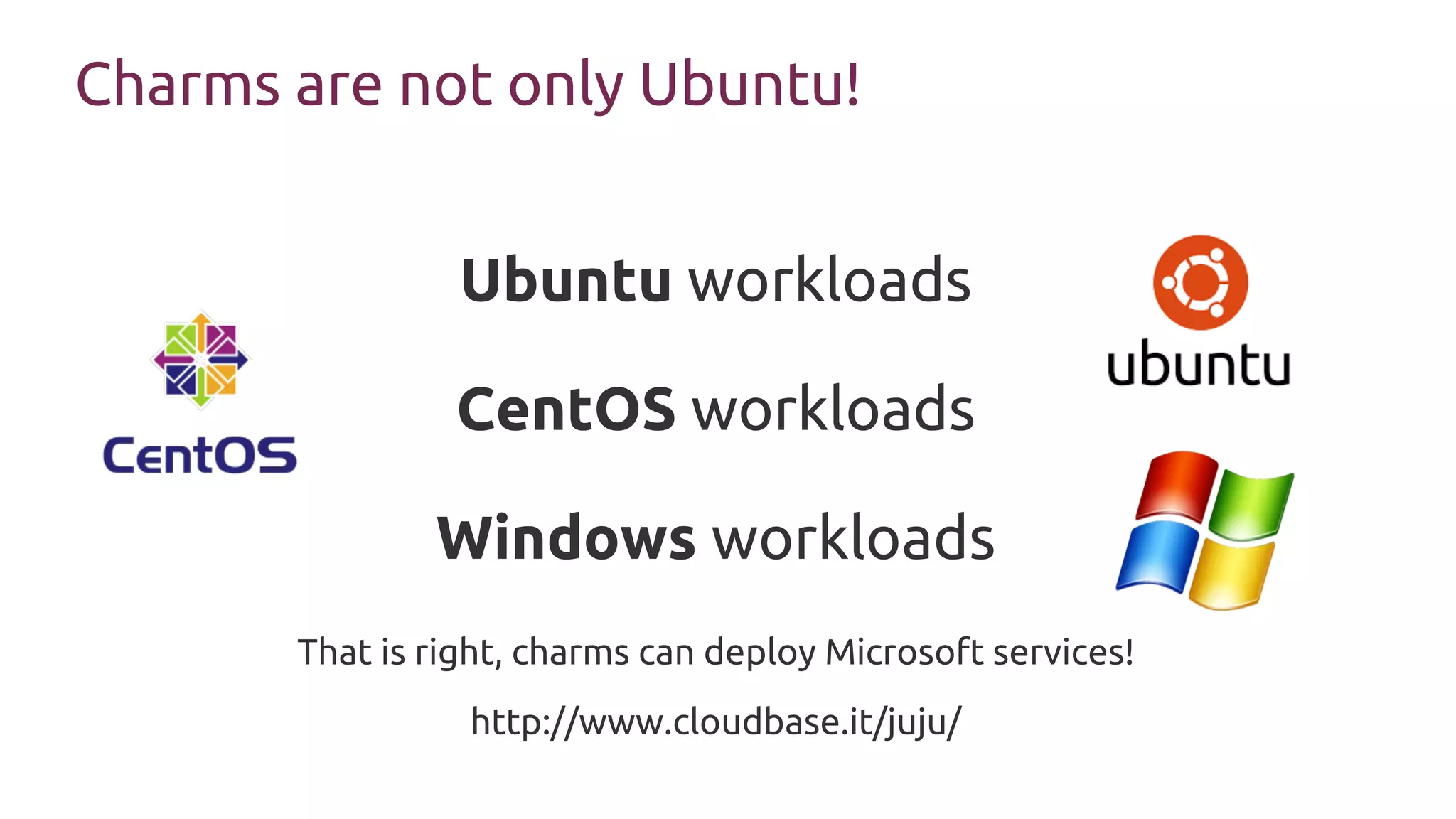
Charms are not only Ubuntu!
Ubuntu workloads
CentOS workloads
Windows workloads
That is right, charms can deploy Microsoft services!
http://www.cloudbase.it/juju/
Charm are building blocks
Over 260 charms in the “charm store”
mostly free and open source software
Curated for quality and reliability
The nagios and nrpe charms can monitor
every charm in Juju
There is room for improvement
Bundles are the model
Bundles define deployment with configuration and constraints
Bundles are:
❖ Collection of charms (services)
❖ Relations
❖ Configuration
Bundles can be deployed in a single step.
Bundles allow easy repeatability for sharing complex
deployments with other people.
In Juju the model is portable
Move your application to another cloud
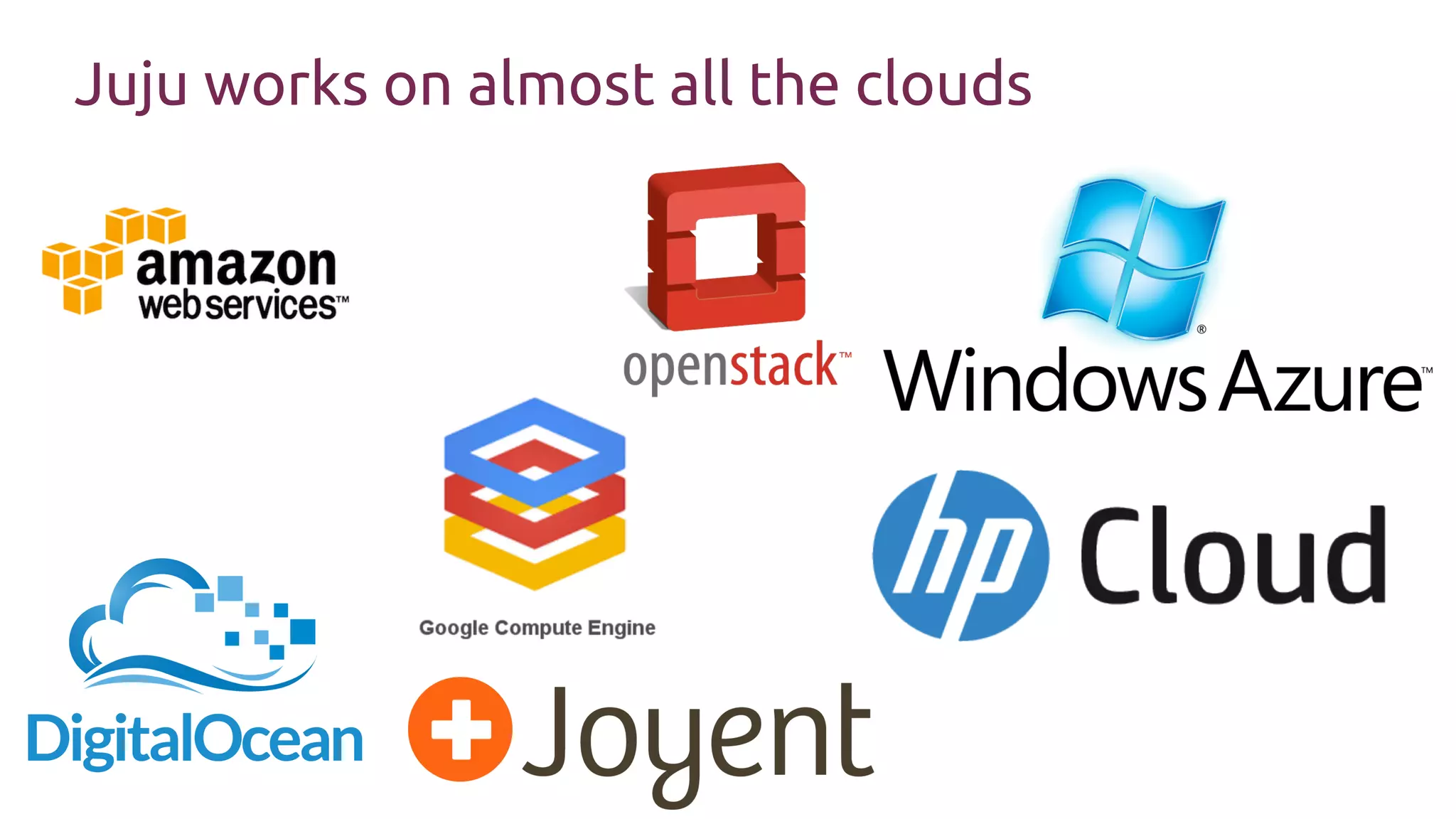
Juju works on almost all the clouds
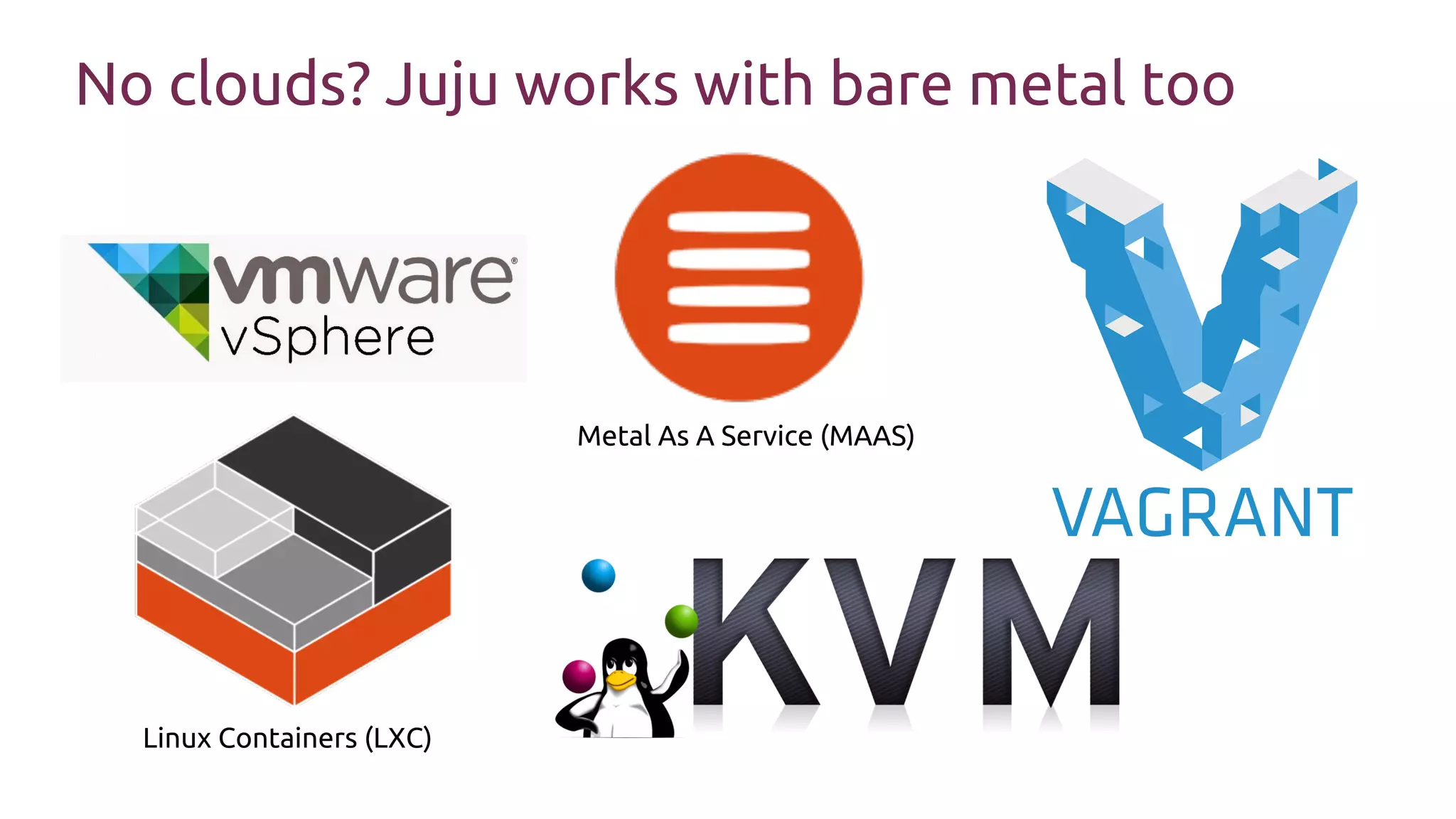
No clouds? Juju works with bare metal too
Metal As A Service (MAAS)
Linux Containers (LXC)
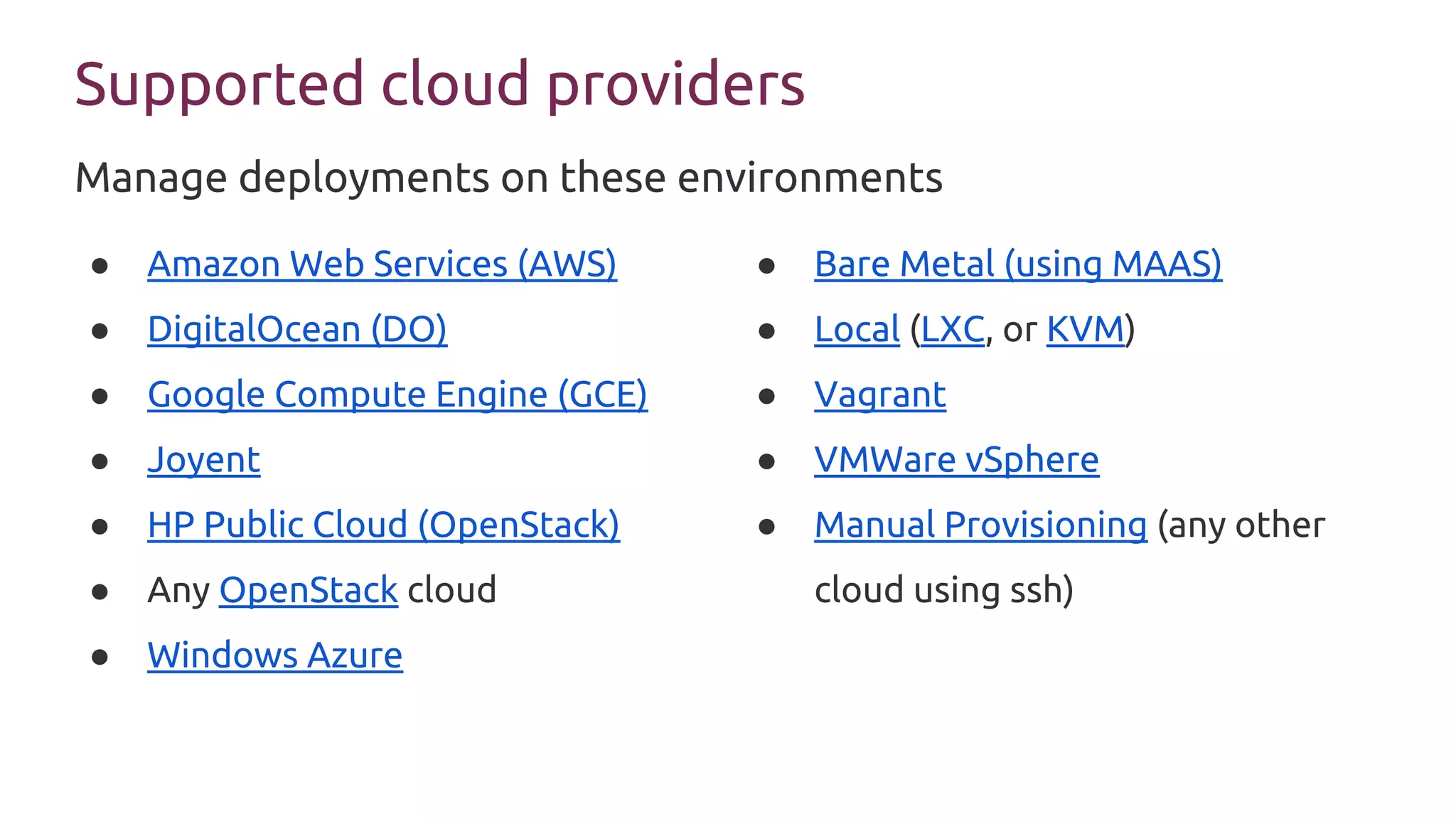
Supported cloud providers
● Amazon Web Services (AWS)
● DigitalOcean (DO)
● Google Compute Engine (GCE)
● Joyent
● HP Public Cloud (OpenStack)
● Any OpenStack cloud
● Windows Azure
● Bare Metal (using MAAS)
● Local (LXC, or KVM)
● Vagrant
● VMWare vSphere
● Manual Provisioning (any other
cloud using ssh)
Manage deployments on these environments
What does that portability give you?
The ability to run on the cloud that runs your application the best
Summary
create model solutions, deploy them in a consistent and reproducible way
and you can monitor every service in the deployment with Nagios!
Where to go for more information
https://jujucharms.com
Github: https://github.com/juju/juju
Mailing list: https://lists.ubuntu.com/mailman/listinfo/juju
Nagios charm: https://jujucharms.com/nagios/
NRPE charm: https://jujucharms.com/nrpe/
Nagios & Ubuntu
Debian package archive (apt)
Nagios core 3
Nagios plugins 1.5
Installing Nagios core 4 on Ubuntu is still a manual process
Manual can’t be done at scale
We (I) am working on it!
Where are we?

Matt Bruzek - Monitoring Your Public Cloud With Nagios

  • 1.
    Use Nagios tomonitor your public cloud monitoring complex Ubuntu deployments Matt Bruzek - matthew.bruzek@canonical.com
  • 2.
    Computing infrastructure isonly getting more complex Life is too short to monitor your infrastructure by hand!
  • 3.
    How many peoplehere use a configuration management tool to deploy or monitor their environment? Chef/Puppet/Ansible/other?
  • 4.
    Everyone here isusing Nagios differently ❖ Monitoring different things ❖ Different architectures or operating systems ❖ Different production environments ❖ Using different cloud provider ❖ Bare metal servers ... at least we all agree on Nagios!
  • 5.
    If there wasa change to your network/servers/cloud provider could your automation tool handle a major change?
  • 6.
    Can we continueto have artisanal infrastructures? How many false positive monitoring errors do we get from infrastructure changes?
  • 7.
    When you takea machine out of service, does that same process remove the host from monitoring? If yes that is great, if not it should!
  • 8.
    The services wedeploy should know how to monitor themselves! Crazy right? Well, what if they could?
  • 9.
    Let’s say youwere asked to monitor some new big data solution demo time!
  • 10.
    Before the demo… jujuquickstart realtime-syslog-analytics juju expose zeppelin juju deploy nrpe juju deploy nagios juju expose nagios
  • 11.
    During the demo... jujuadd-relation nrpe hdfs-master juju add-relation nrpe secondary-namenode juju add-relation nrpe compute-slave juju add-relation nrpe flume-hdfs juju add-relation nrpe flume-syslog juju add-relation nrpe spark juju add-relation nrpe yarn-master juju add-relation nrpe nagios
  • 12.
    What was that? Jujuin action with Nagios!
  • 13.
  • 14.
    Juju ❖ An opensource service orchestration software project ➢ that provides a language to model cloud deployments ➢ Cloud or bare metal agnostic, define the model and it is repeatable on a variety of environments. ❖ Not just a configuration management tool ➢ Juju follows the service through the complete lifecycle ■ add or remove relations, scale up or down services
  • 15.
    A language forthe cloud? juju deploy nagios juju add-relation nagios nrpe juju set nagios extraconfig=`cat custom.cfg` juju add-unit mysql juju expose nagios Here are a few examples:
  • 16.
    Define a modeland share it with others to deploy the same model on different clouds And monitor every charm (service)
  • 17.
    How does Jujuwork? cloud images, cloud-init, and charm code
  • 18.
  • 19.
    Charms ❖ A setof instructions or code that follow a lifecycle of a service ➢ From install, configure, start, to relate, scale, stop and destroy ➢ Contain the operational intelligence to respond to lifecycle events ■ For example how to monitor this service with Nagios ❖ An executable white paper ➢ Take the knowledge of industry experts and distill that into a charm ❖ Each charm is its own software project
  • 20.
    Charms ❖ A collectionof files with specific directory structure ❖ Charms can be written in any language ➢ From scripting languages to compiled binary files, really anything ❖ The code must take advantage of the event hook architecture ➢ Juju fires events, each event has a hook, charm code responds to events
  • 21.
    Charms are connectable mediawikirequires a database, mysql provides a database
  • 22.
    Charms are interchangeable mariaDBalso provides a database
  • 23.
    Charms are notonly Ubuntu! Ubuntu workloads CentOS workloads Windows workloads That is right, charms can deploy Microsoft services! http://www.cloudbase.it/juju/
  • 24.
    Charm are buildingblocks Over 260 charms in the “charm store” mostly free and open source software Curated for quality and reliability
  • 25.
    The nagios andnrpe charms can monitor every charm in Juju There is room for improvement
  • 26.
    Bundles are themodel Bundles define deployment with configuration and constraints
  • 27.
    Bundles are: ❖ Collectionof charms (services) ❖ Relations ❖ Configuration Bundles can be deployed in a single step. Bundles allow easy repeatability for sharing complex deployments with other people.
  • 28.
    In Juju themodel is portable Move your application to another cloud
  • 29.
    Juju works onalmost all the clouds
  • 30.
    No clouds? Jujuworks with bare metal too Metal As A Service (MAAS) Linux Containers (LXC)
  • 31.
    Supported cloud providers ●Amazon Web Services (AWS) ● DigitalOcean (DO) ● Google Compute Engine (GCE) ● Joyent ● HP Public Cloud (OpenStack) ● Any OpenStack cloud ● Windows Azure ● Bare Metal (using MAAS) ● Local (LXC, or KVM) ● Vagrant ● VMWare vSphere ● Manual Provisioning (any other cloud using ssh) Manage deployments on these environments
  • 32.
    What does thatportability give you? The ability to run on the cloud that runs your application the best
  • 33.
    Summary create model solutions,deploy them in a consistent and reproducible way and you can monitor every service in the deployment with Nagios!
  • 34.
    Where to gofor more information https://jujucharms.com Github: https://github.com/juju/juju Mailing list: https://lists.ubuntu.com/mailman/listinfo/juju Nagios charm: https://jujucharms.com/nagios/ NRPE charm: https://jujucharms.com/nrpe/
  • 35.
    Nagios & Ubuntu Debianpackage archive (apt) Nagios core 3 Nagios plugins 1.5 Installing Nagios core 4 on Ubuntu is still a manual process Manual can’t be done at scale We (I) am working on it! Where are we?