National accreditation board
for testing and calibration
of laboratories (NABL)
Nitish kumar
M.Sc Neurotechnology (3rd year)
JIPMER
Contents
• Why laboratory accreditation
• NABL and its history
• Services provided
• Scope
• Intl recognition
• Laboratory classification
• Pre requisites for accreditation with
procedure
• Calibration
• Post examination process
• Guidelines and checklists
• Benefits of accreditation
• Summary & References
Why laboratory
accreditation?
• The liberalization of trade and
industry policies of the Government
of India has created quality
consciousness in domestic trade and
provided greater thrust for export.
• As a consequence testing centres
and laboratories have to
demonstrably operate at an
internationally acceptable level of
competence.
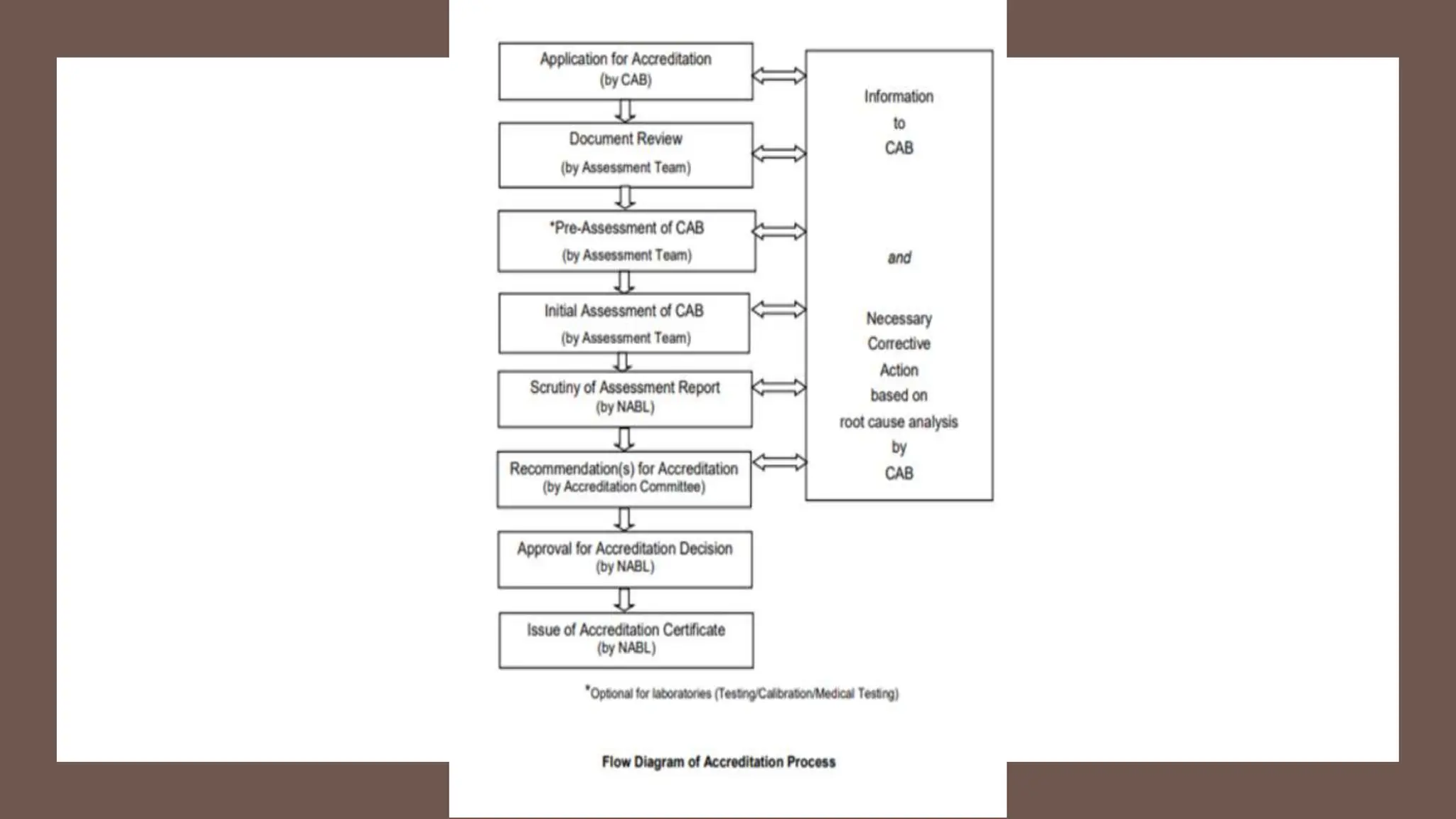
• Accreditation is a process of
conformity assessment by the
third party for determining the
competence of laboratories to
perform an assessment task.
• It is a process where a formal
authoritative body
gives recognition based on
international standards.
• The body for performing this task
is called conformity
assessment body (CAB).
NABL
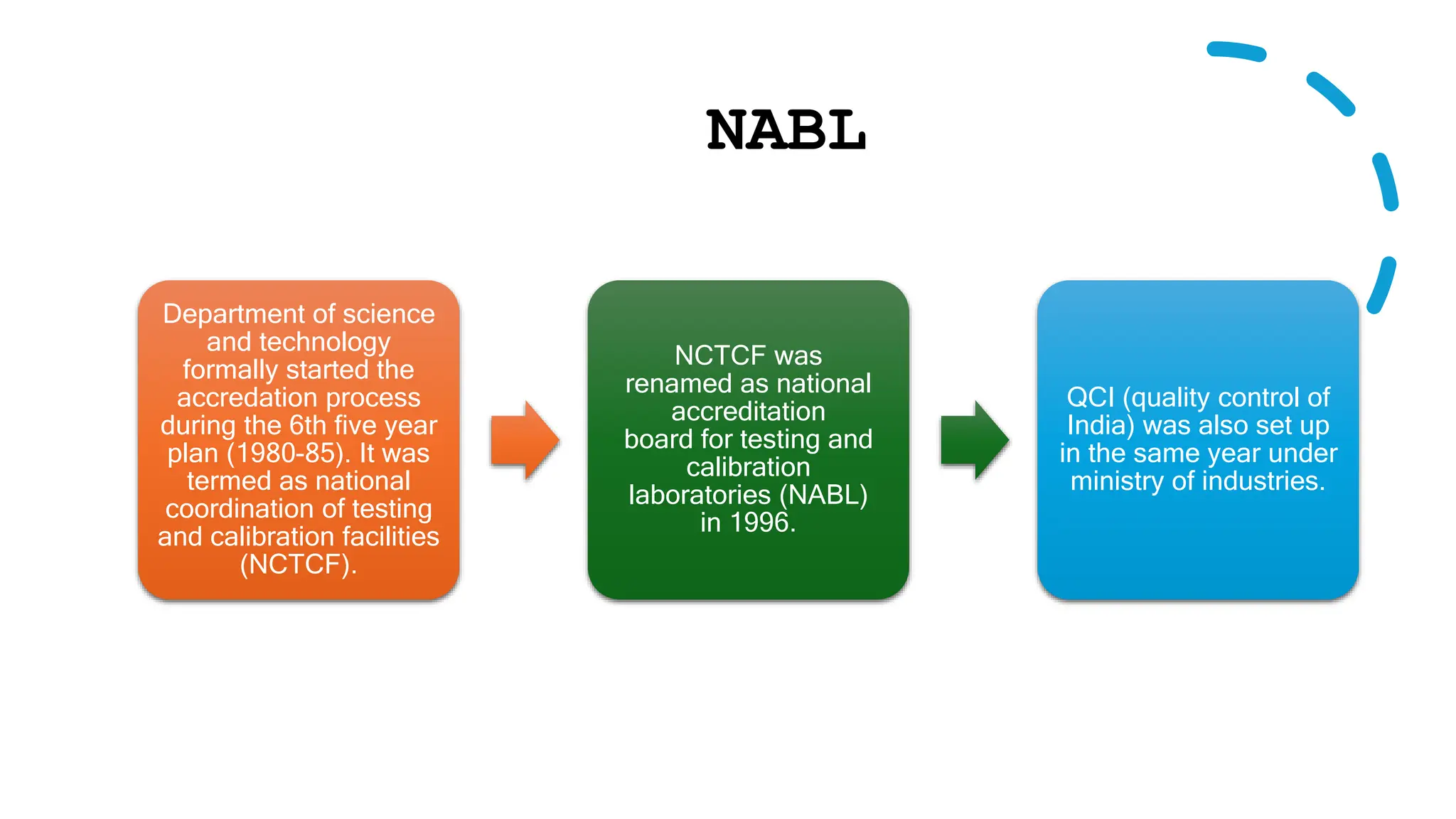
Department of science
and technology
formally started the
accredation process
during the 6th five year
plan (1980-85). It was
termed as national
coordination of testing
and calibration facilities
(NCTCF).
NCTCF was
renamed as national
accreditation
board for testing and
calibration
laboratories (NABL)
in 1996.
QCI (quality control of
India) was also set up
in the same year under
ministry of industries.
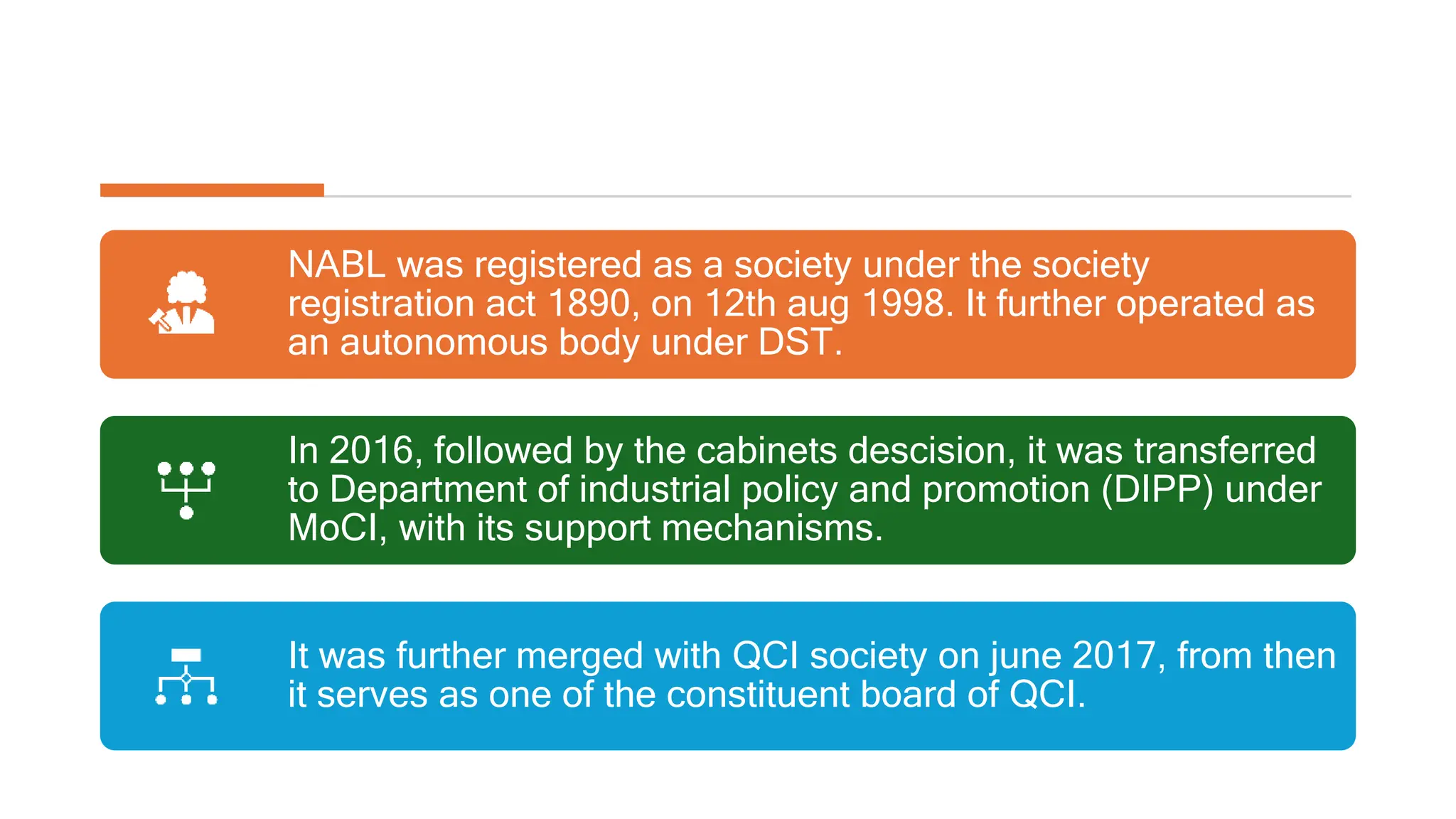
NABL was registered as a society under the society
registration act 1890, on 12th aug 1998. It further operated as
an autonomous body under DST.
In 2016, followed by the cabinets descision, it was transferred
to Department of industrial policy and promotion (DIPP) under
MoCI, with its support mechanisms.
It was further merged with QCI society on june 2017, from then
it serves as one of the constituent board of QCI.
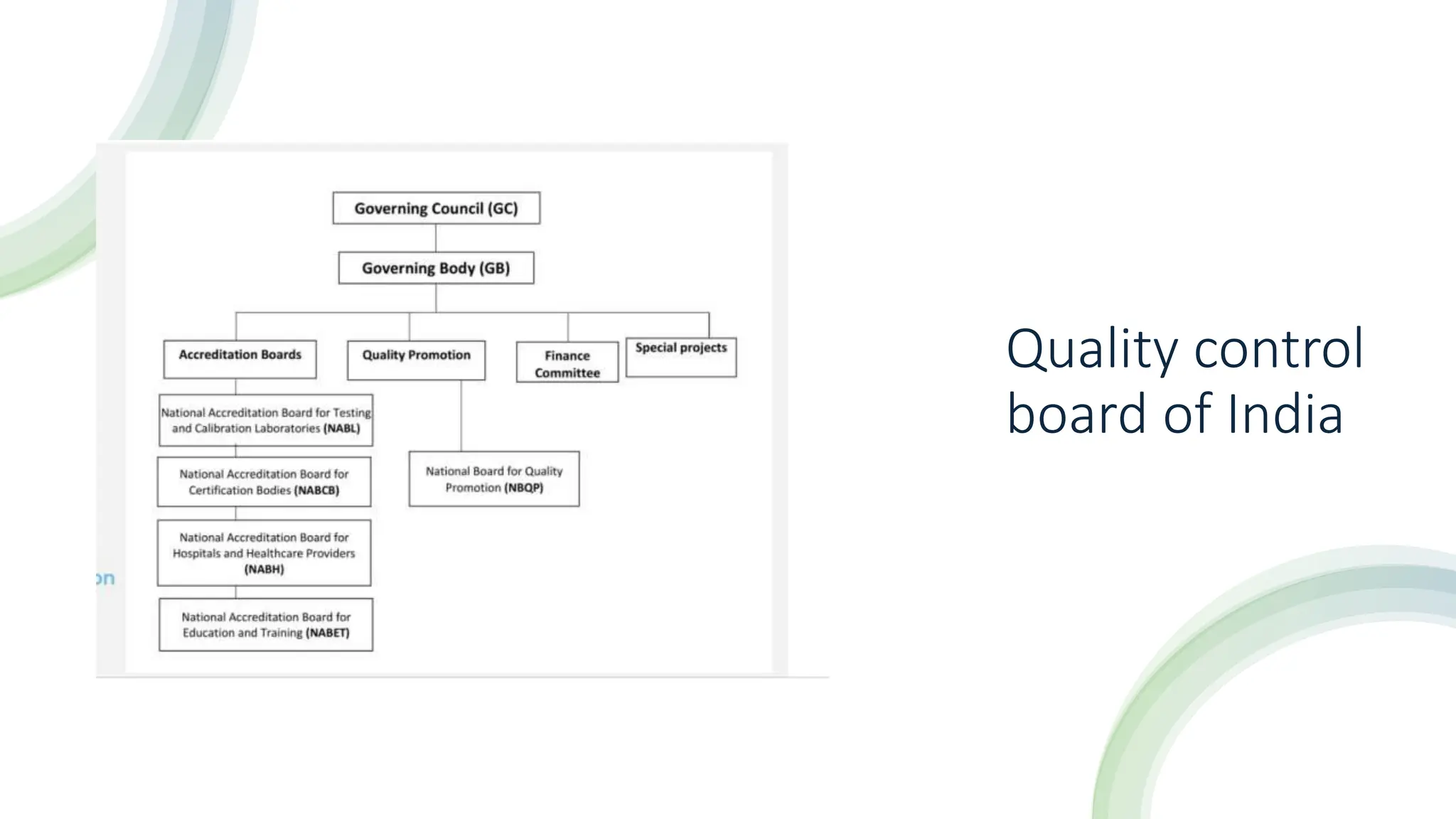
Quality control
board of India
QCI coordinates its
activities with help of 5
constituents boards .
Services
provided
NABL provides voluntary accreditation services as per
international standards to:
1. Testing laboratories in accordance with ISO/IEC 17025
‘General Requirements for the Competence of Testing and
Calibration Laboratories’
2. Calibration laboratories in accordance with ISO/IEC 17025
‘General Requirements for the Competence of Testing and
Calibration Laboratories’
Services
provided
3. Medical testing laboratories in accordance with ISO
15189 ‘Medical laboratories Requirements for quality and
competence’
4. Proficiency Testing Providers (PTP) in accordance with
ISO/IEC 17043 “Conformity assessment - General requirements for
(the Competence of) Proficiency Testing Providers” and
5. Reference Material Producers (RMP) in accordance with
ISO 17034 “General requirements for the competence of
Reference Material Producers”.
Scope of NABL
accreditation (In
medical field)
NABL 112
Medical Field:
1. Clinical Biochemistry
2. Clinical Pathology
3. Hematology
4. Microbiology & Infectious disease serology
5. Histopathology
6. Cytopathology
7. Flow Cytometry
8. Cytogenetics
9. Molecular Testing
10. Medical Imaging
International
recognition
• NABL maintains linkages from international bodies in
relevance to its character.
• It is a full member of Asia pacific accreditation cooperation
(APAC) and international laboratory accreditation
cooperation (ILAC).
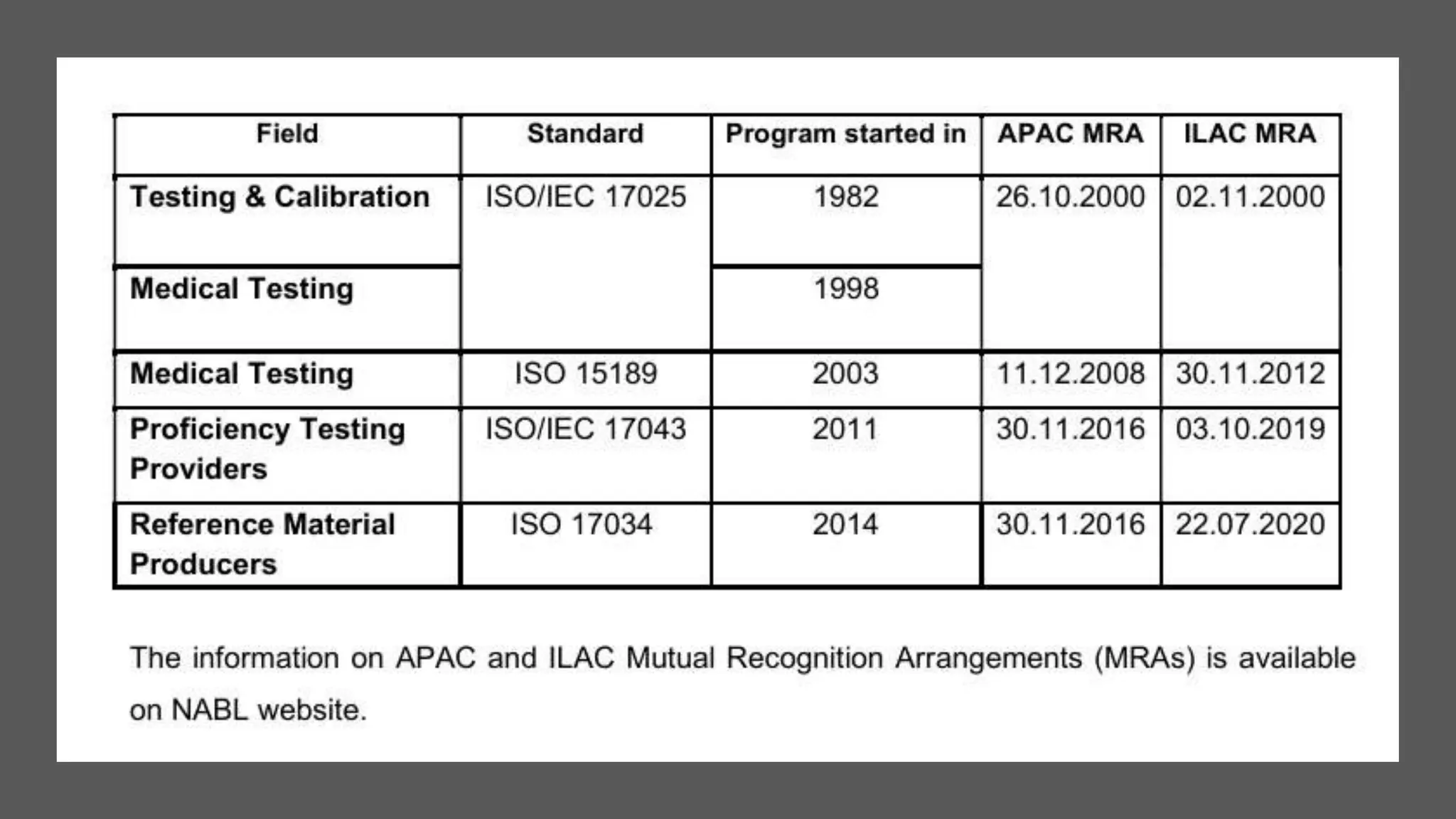
• It is also a signatory of mutual recognition
agreement (MRA) since 2000.
The following
classification of
laboratories
shall be used
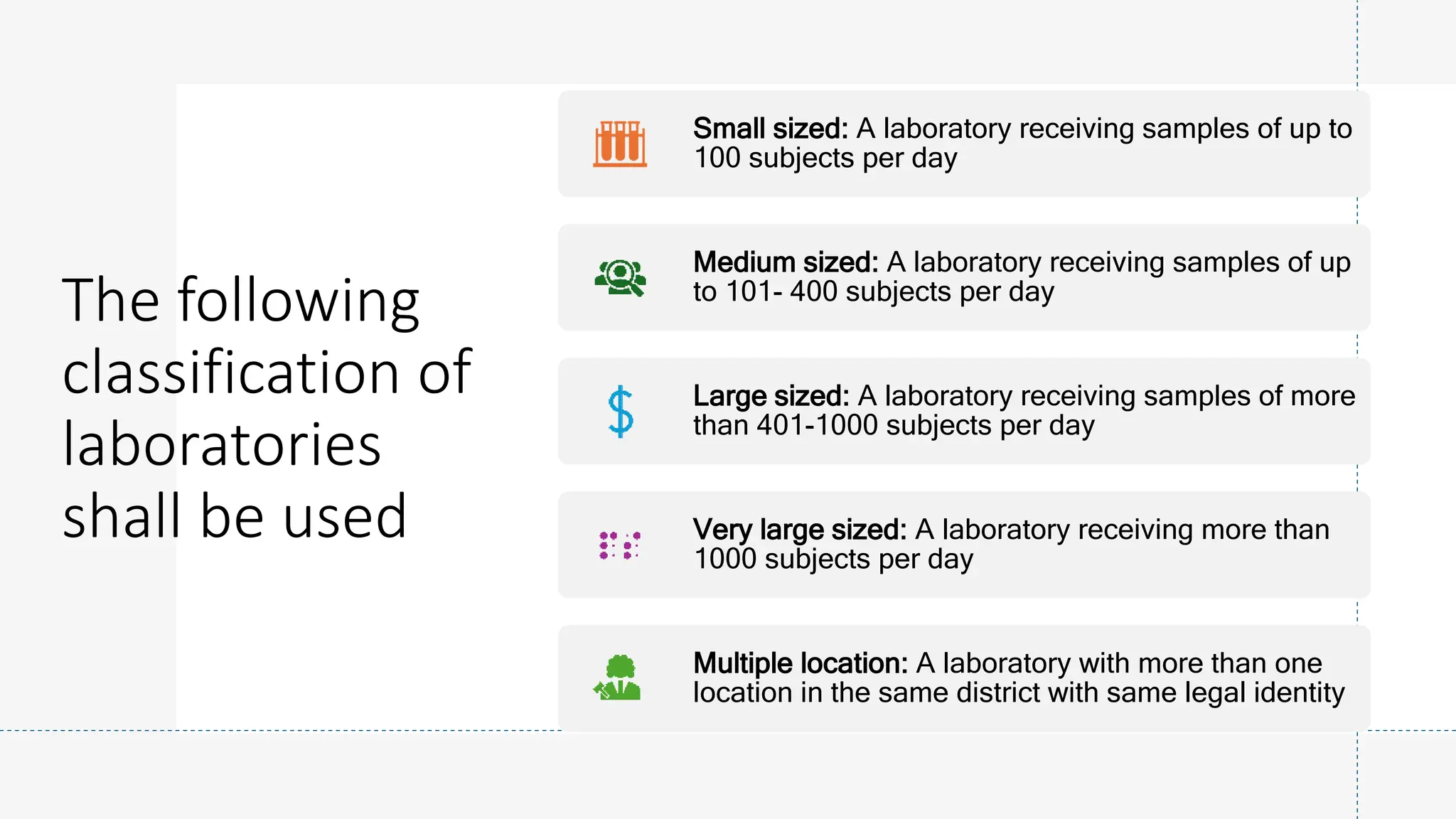
Small sized: A laboratory receiving samples of up to
100 subjects per day
Medium sized: A laboratory receiving samples of up
to 101- 400 subjects per day
Large sized: A laboratory receiving samples of more
than 401-1000 subjects per day
Very large sized: A laboratory receiving more than
1000 subjects per day
Multiple location: A laboratory with more than one
location in the same district with same legal identity
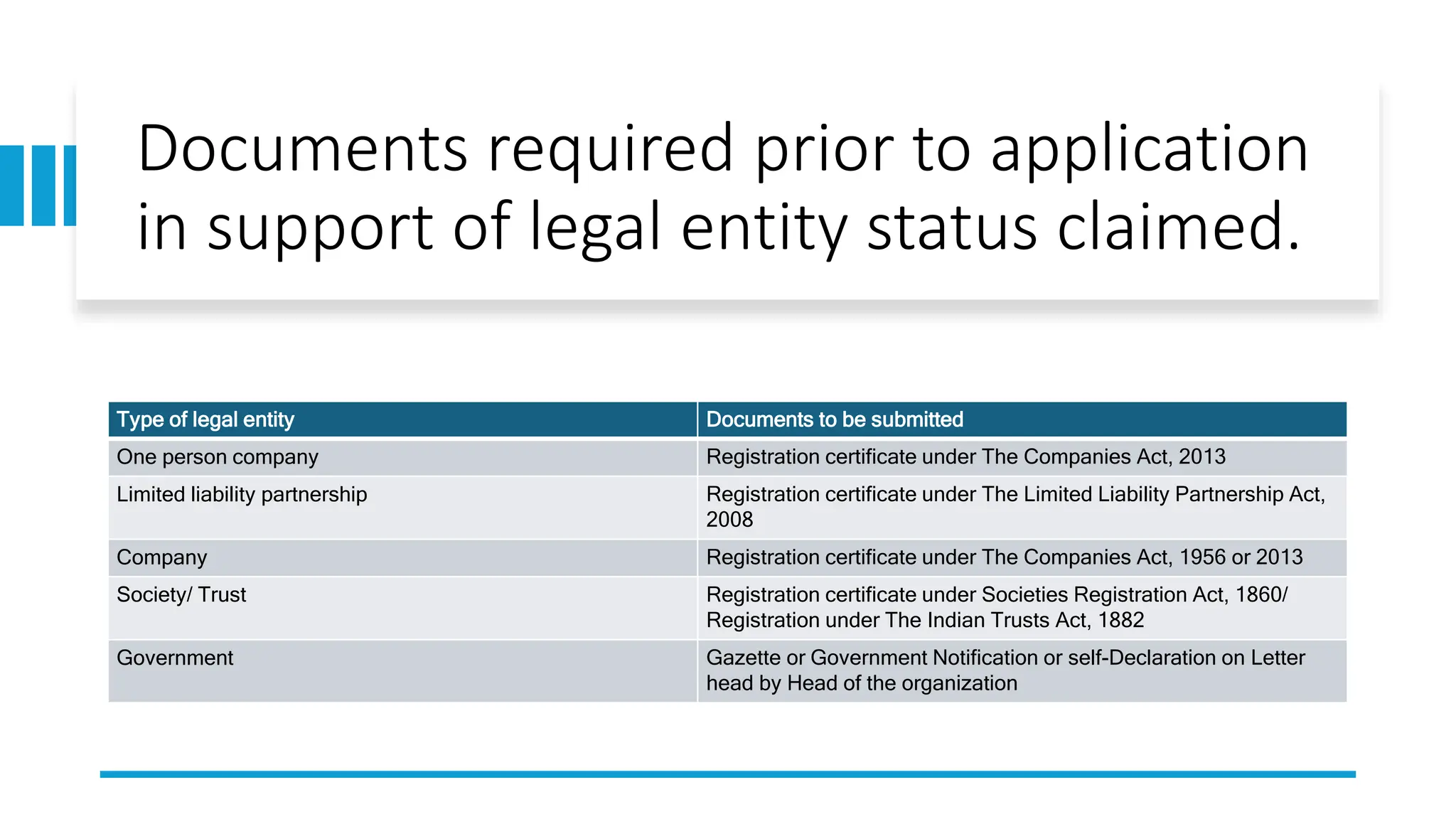
Documents required prior to application
in support of legal entity status claimed.
Type of legal entity Documents to be submitted
One person company Registration certificate under The Companies Act, 2013
Limited liability partnership Registration certificate under The Limited Liability Partnership Act,
2008
Company Registration certificate under The Companies Act, 1956 or 2013
Society/ Trust Registration certificate under Societies Registration Act, 1860/
Registration under The Indian Trusts Act, 1882
Government Gazette or Government Notification or self-Declaration on Letter
head by Head of the organization
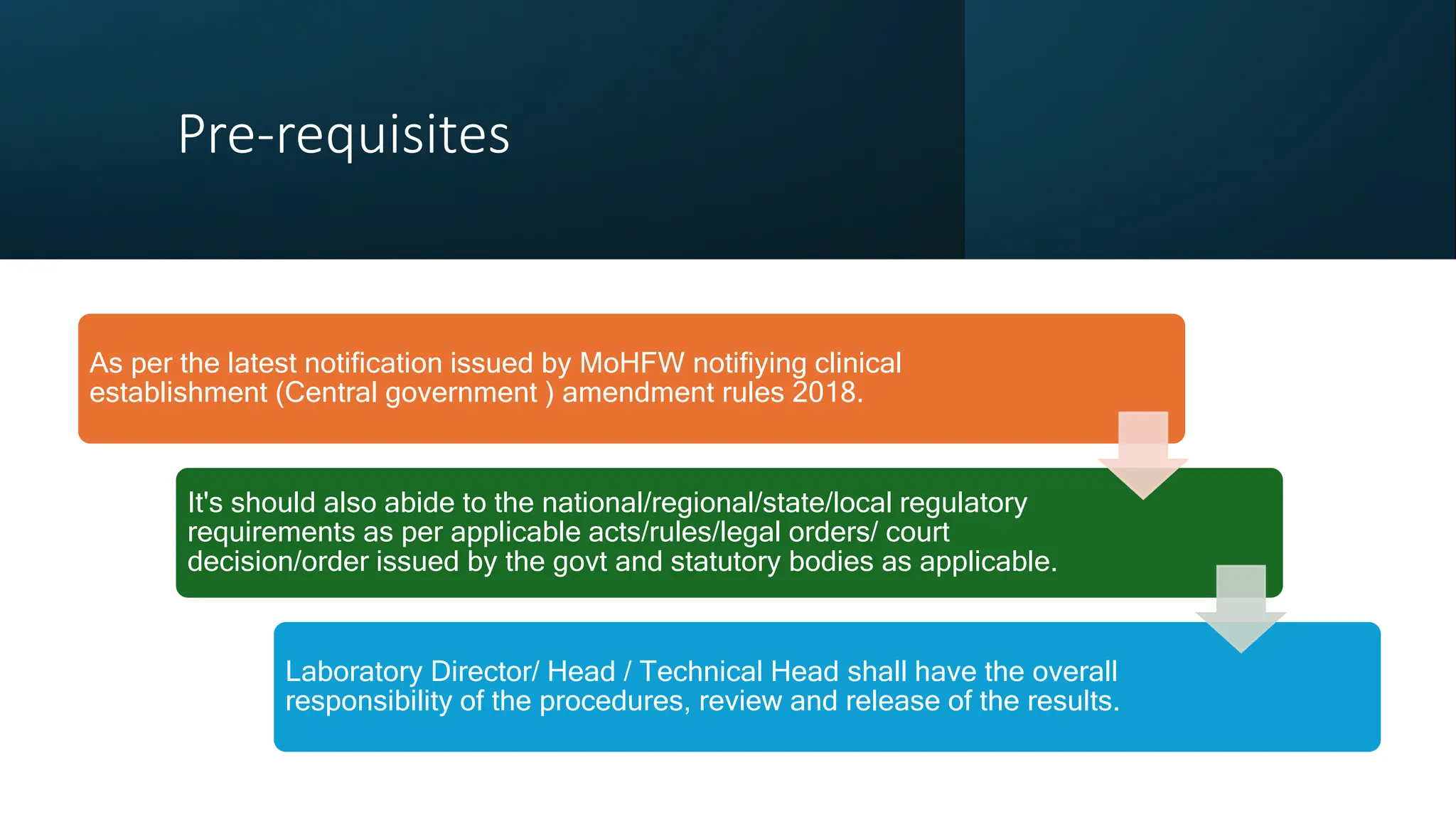
Pre-requisites
As per the latest notification issued by MoHFW notifiying clinical
establishment (Central government ) amendment rules 2018.
It's should also abide to the national/regional/state/local regulatory
requirements as per applicable acts/rules/legal orders/ court
decision/order issued by the govt and statutory bodies as applicable.
Laboratory Director/ Head / Technical Head shall have the overall
responsibility of the procedures, review and release of the results.
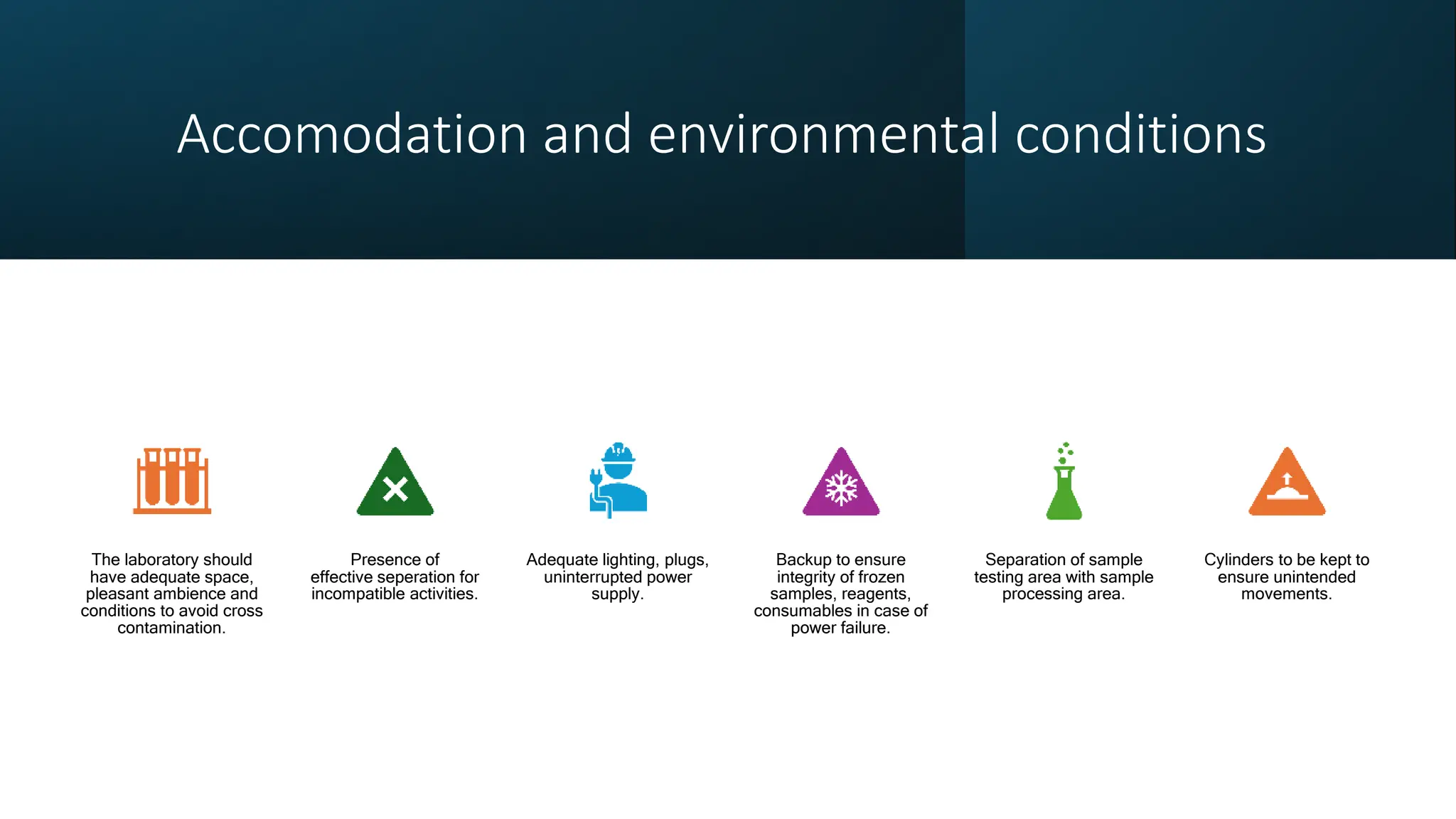
Accomodation and environmental conditions
The laboratory should
have adequate space,
pleasant ambience and
conditions to avoid cross
contamination.
Presence of
effective seperation for
incompatible activities.
Adequate lighting, plugs,
uninterrupted power
supply.
Backup to ensure
integrity of frozen
samples, reagents,
consumables in case of
power failure.
Separation of sample
testing area with sample
processing area.
Cylinders to be kept to
ensure unintended
movements.
Storage and labelling
• All reagents, consumables, stains, media, kits, drugs
shall be stored as per recommended by the
manufacturer.
• It should be labelled with:
1. Content,
2. Quantity,
3. Titration,
4. Date received/ prepared,
5.Date of opening,
6. Expiry date,
7. Storage requirements.
Calibration
Policy of calibration and tracebility as per NABL 142.
It should be calibrated as per the NPL (National physical
laboratory) protocols or calibration laboratory accredited by
NABL or other MRA partners.
Calibration (contd.)
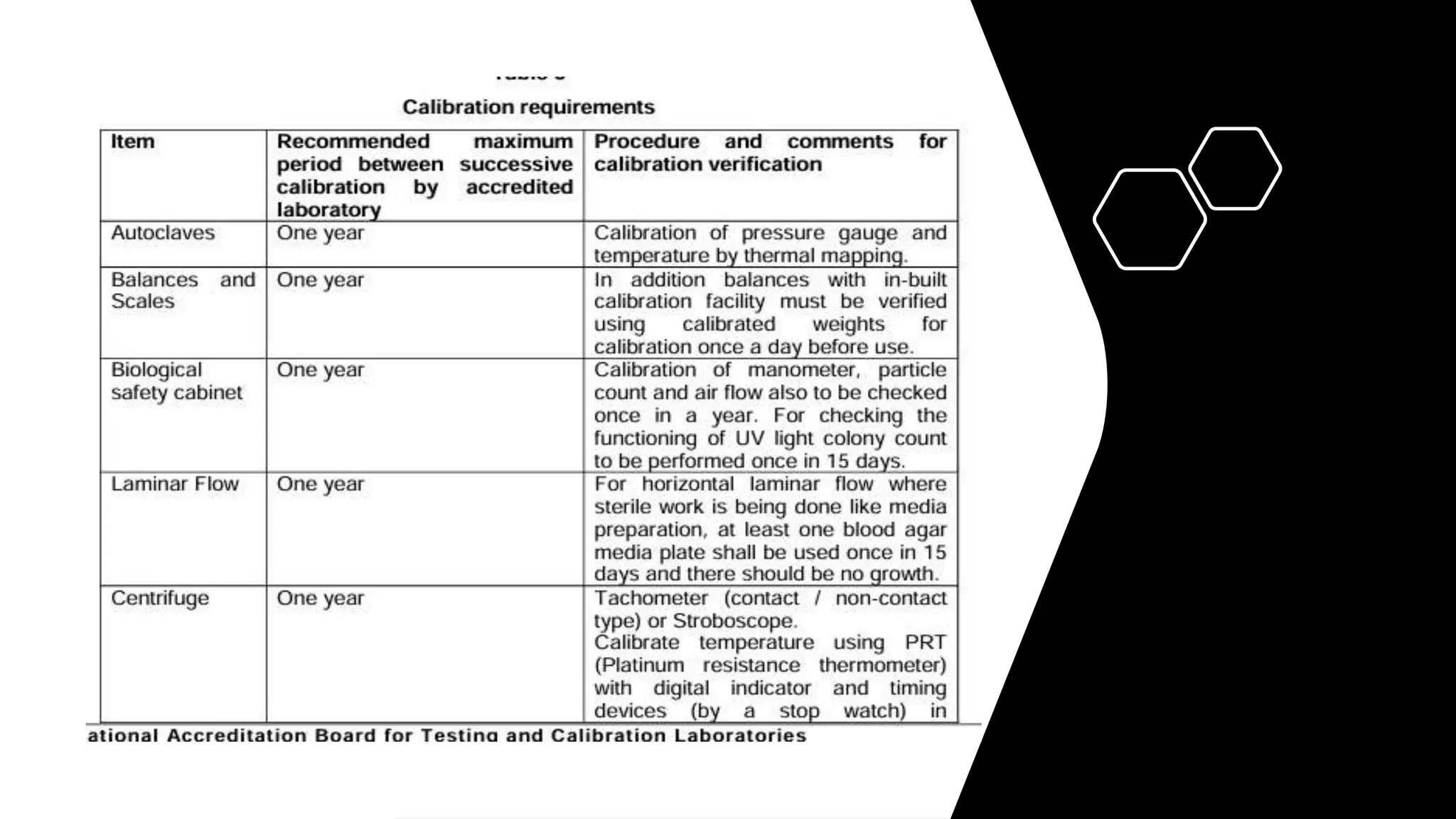
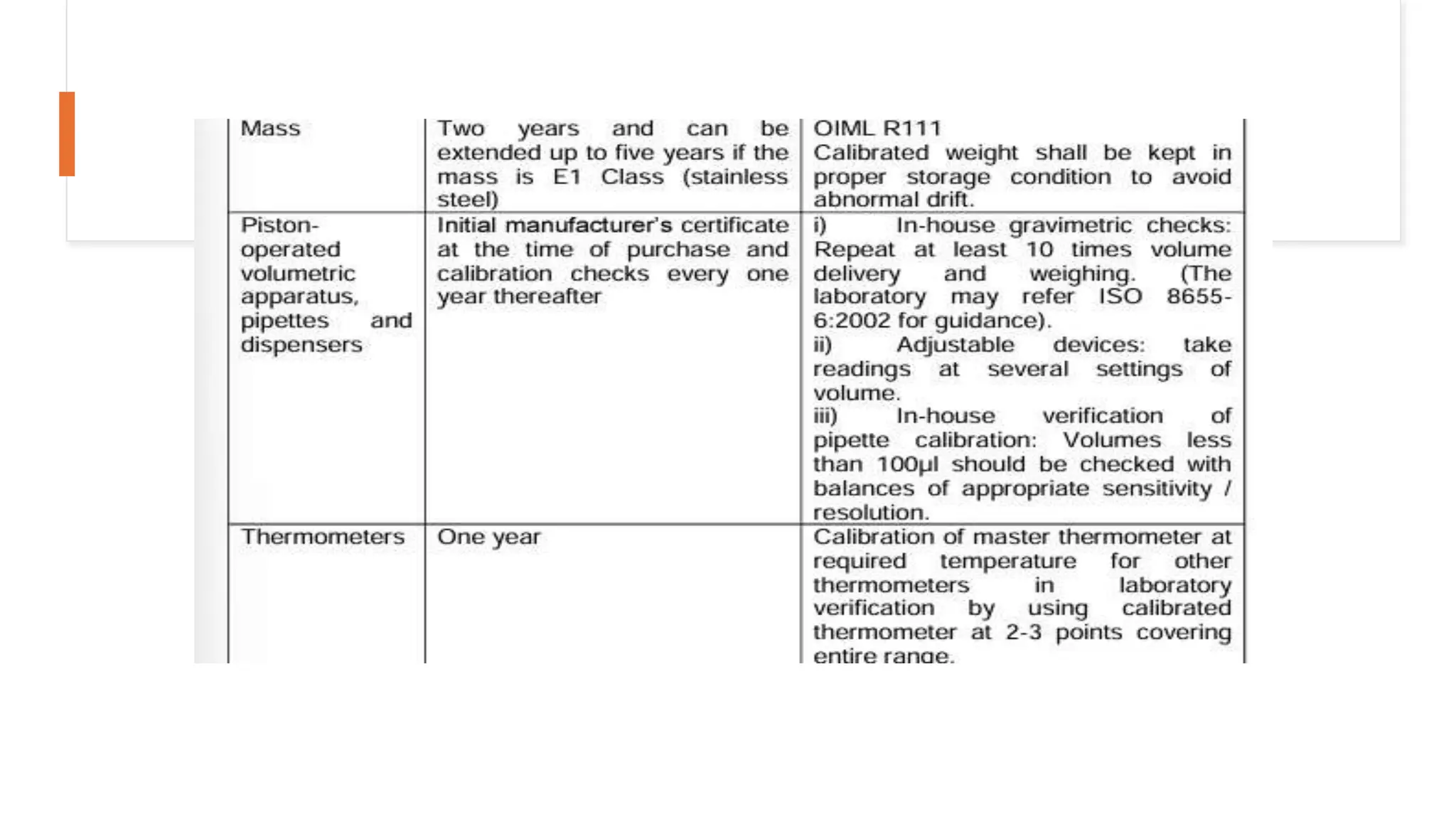
All equipments should be calibrated by NABL accredited laboratory prior to
commisioning.
Calibration certificate isn't valid unless it contains accepted procedure and
traceability.
The interval also depends upon the frequency of use, quality and ruggedness, a
complaince report may be asked from the calibration lab.
At the time of installation, Installation qualification (IQ), Operational qualification
(OQ), and Performance qualification (PQ) should be documented.
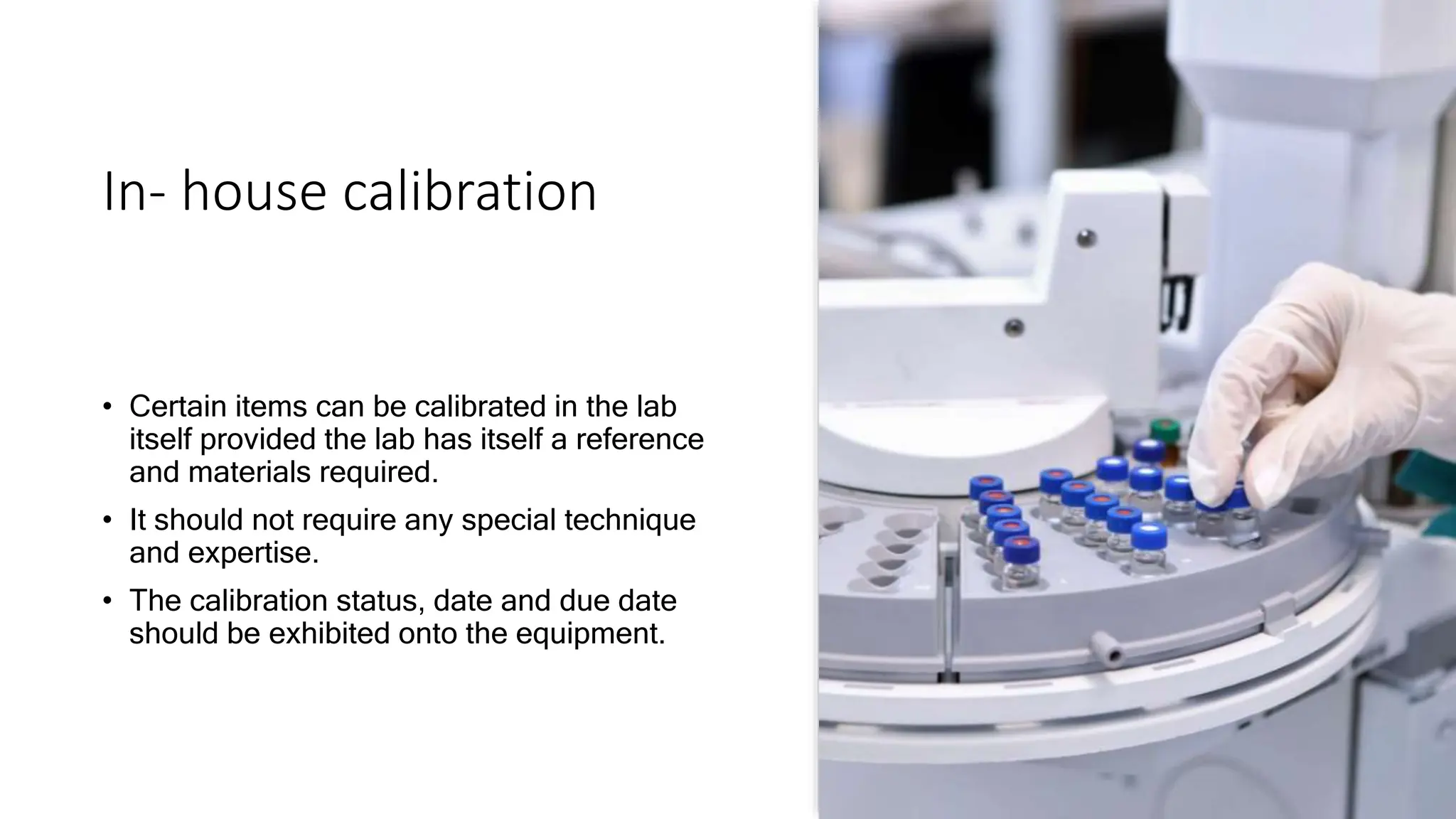
In- house calibration
• Certain items can be calibrated in the lab
itself provided the lab has itself a reference
and materials required.
• It should not require any special technique
and expertise.
• The calibration status, date and due date
should be exhibited onto the equipment.
Measurement for uncertainty of
values
• The precision of lab equipment's is determined by
running stable records and controls.
• The SD and %CV should be determined by
the laboratory mean .
• The imprecision %CV (if any) from data
obtained must always remain in the acceptable range.
• Its recommended that minimum of 6 months internal QC
data should be used to calculate routine imprecision.
Post examination
processes
It includes :
a. Retention of samples
b. Disposal of biomedical waste
i. Treatment outside laboratory premises
ii. Treatment inside laboratory
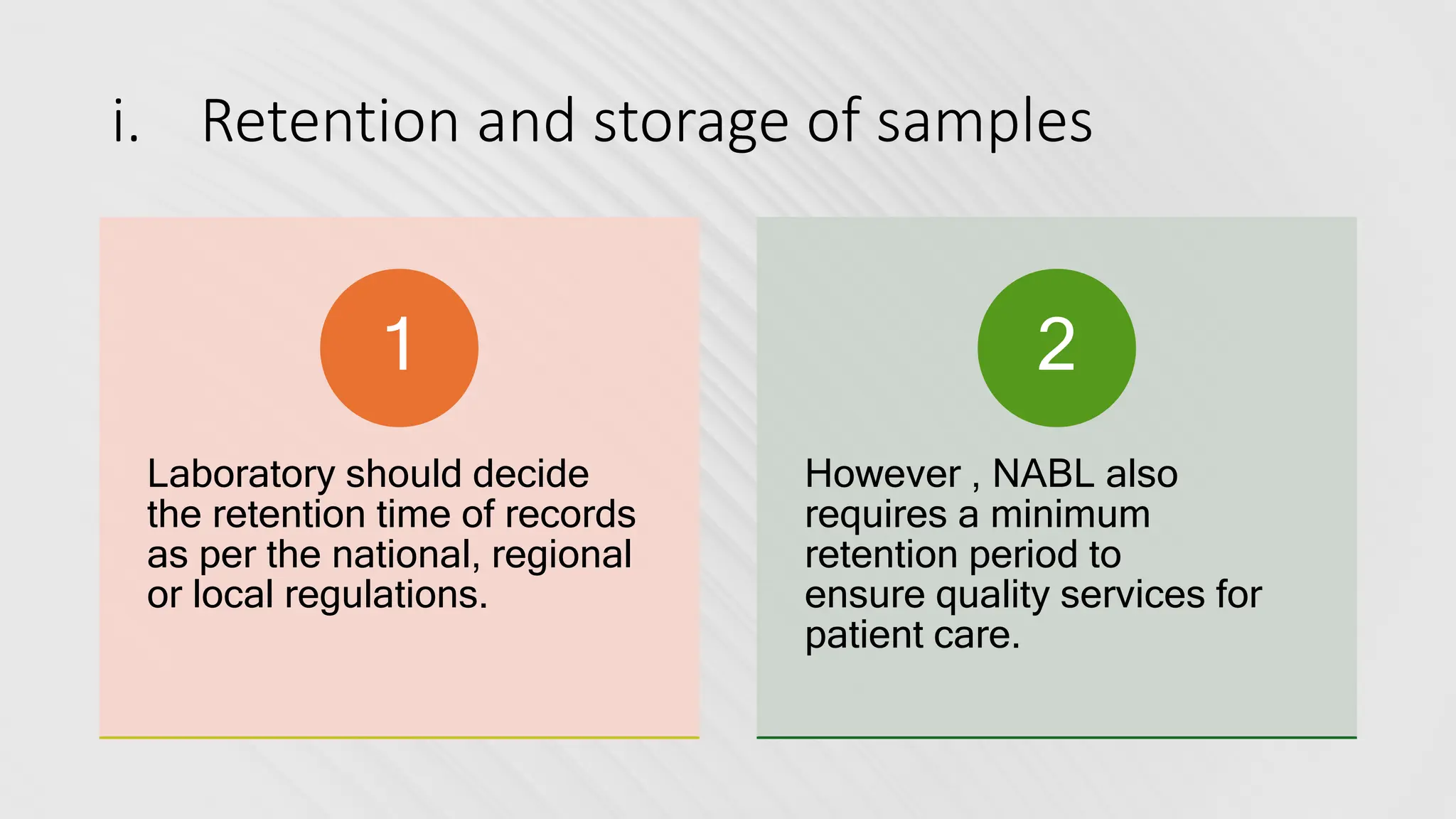
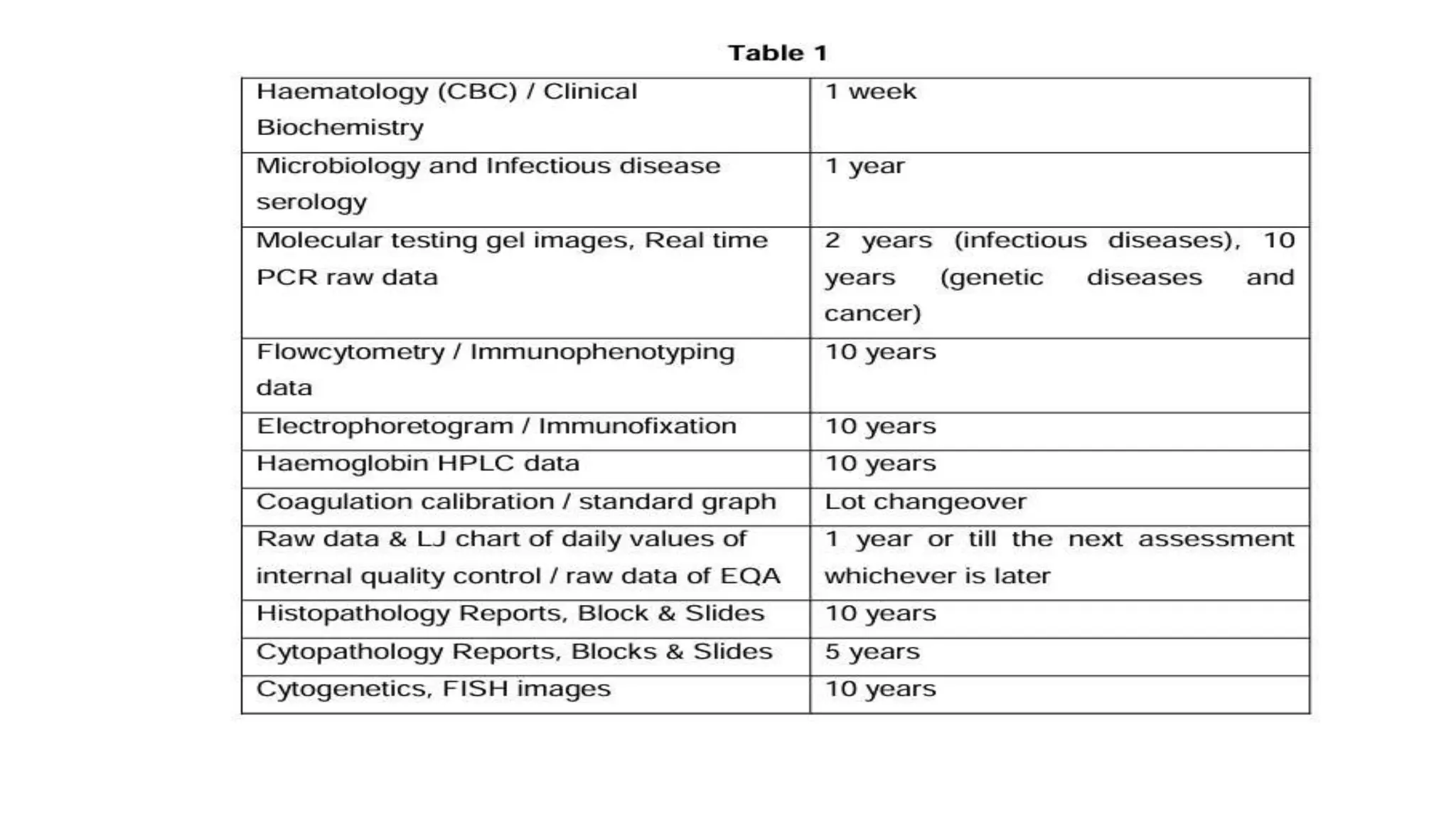
i. Retention and storage of samples
Laboratory should decide
the retention time of records
as per the national, regional
or local regulations.
1
However , NABL also
requires a minimum
retention period to
ensure quality services for
patient care.
2
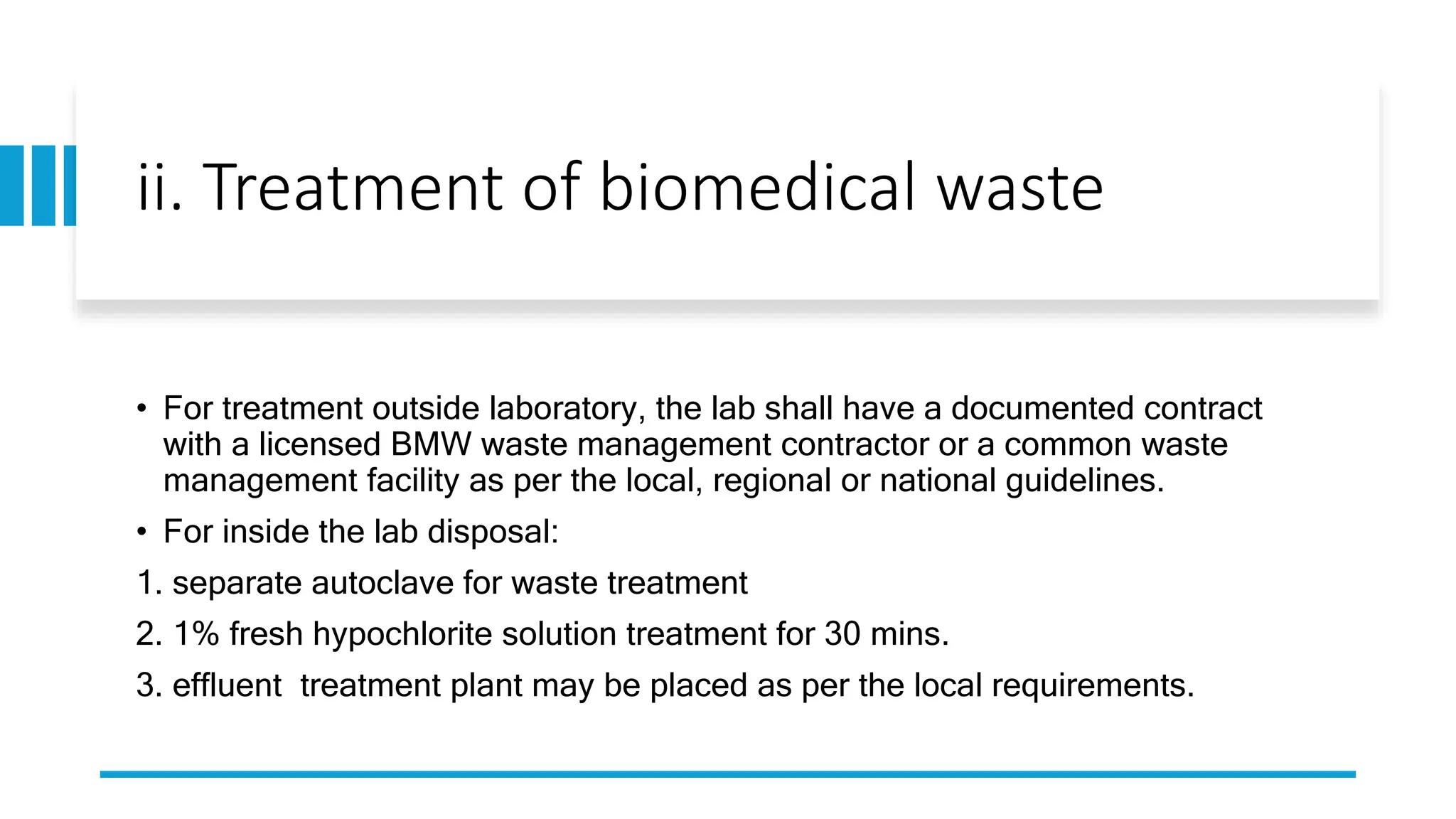
ii. Treatment of biomedical waste
• For treatment outside laboratory, the lab shall have a documented contract
with a licensed BMW waste management contractor or a common waste
management facility as per the local, regional or national guidelines.
• For inside the lab disposal:
1. separate autoclave for waste treatment
2. 1% fresh hypochlorite solution treatment for 30 mins.
3. effluent treatment plant may be placed as per the local requirements.
Reporting and release
of results
• Identification by name and signature of authorizing
authority.
• Labs should establish and display critical limits for
immediate attention.
• Provisions for interim report in case of absence of
authorizing authority.
• Maintenance of patients reports privacy as per the ethical
guidelines.
• Storage of the results as per the protocol.
Guidelines for sample collection facility
of medical laboratory
• Maintaining the integrity of sample at all stages i.e. collection, handling and
transportation plays a vital role to ensure the reliability of the test results.
• The collection center must be defined as:
• 1. Ownership
• 2. Management
• 3. Franchise
Guidelines (contd.)
• Evaluation of training imparted to staff for
collection, processing and storage of data.
• Conduct internal audit at collection centers.
• Collection centers will also be accessed by
NABL which may or may not be by the same
team.
• Major non-conformities during inspection might
lead to non- approval or further derecognition.
• Only NABL approved sample collection centers
can be claimed as sample source during its valid
accreditation cycle.
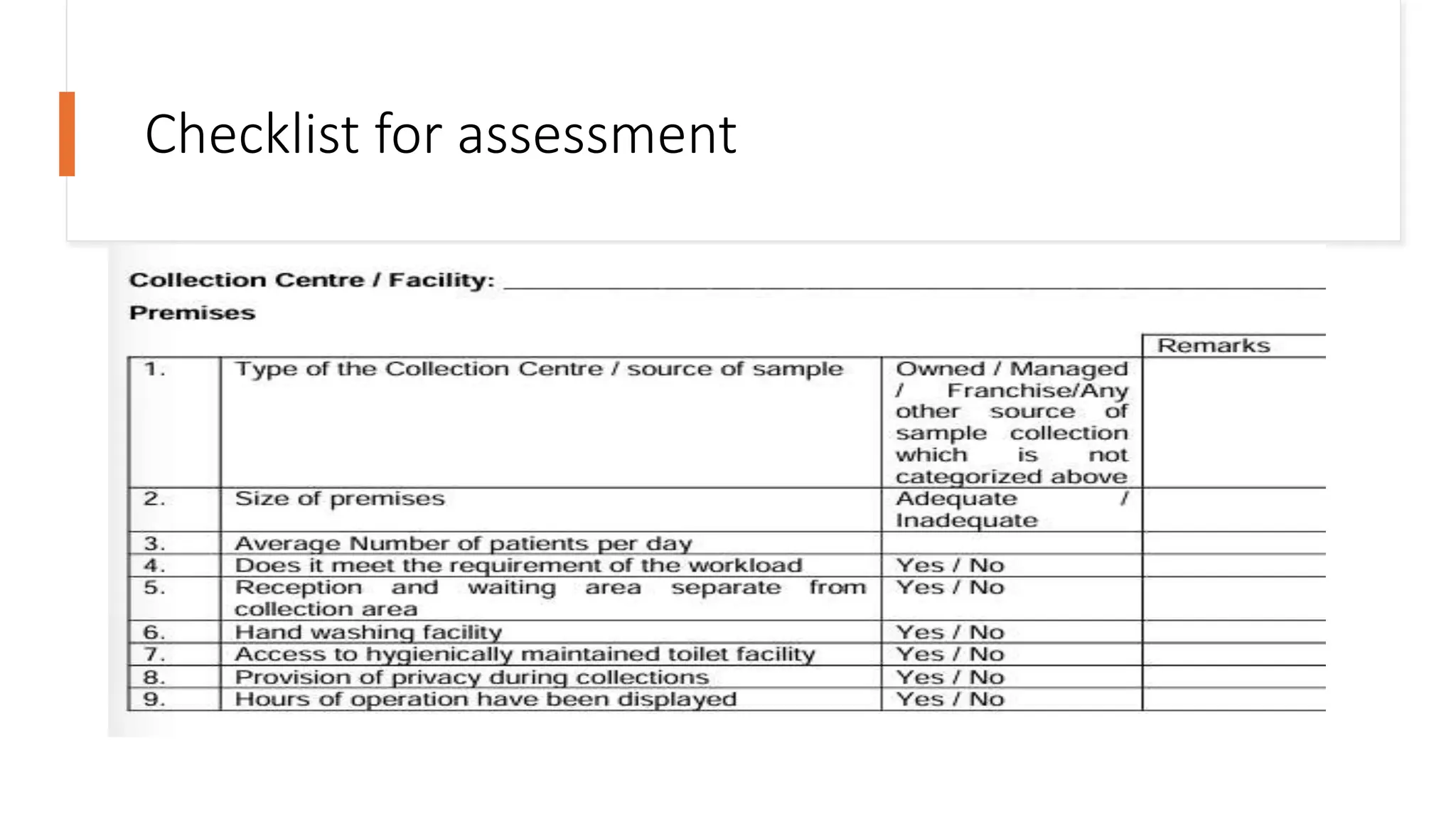
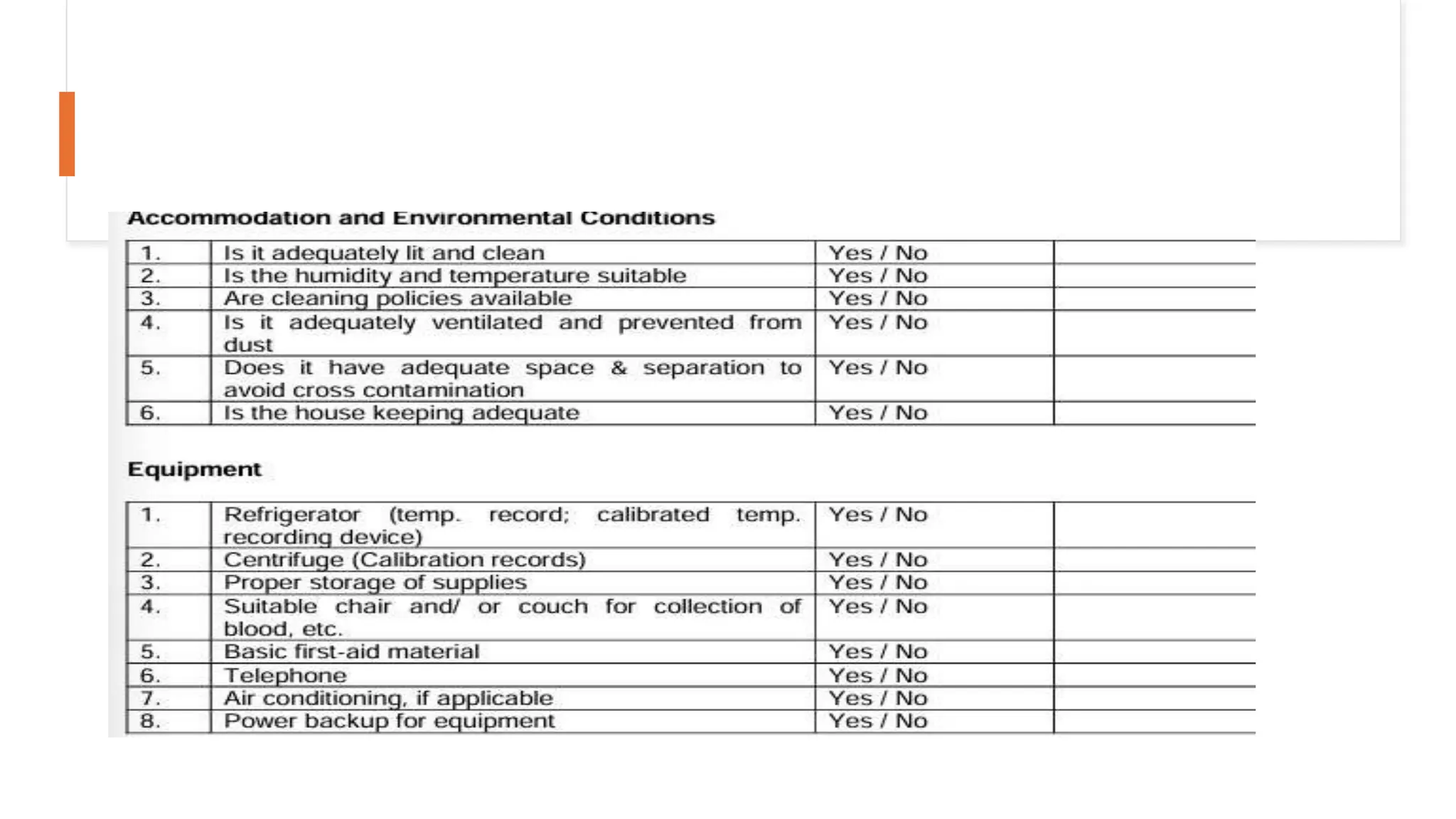
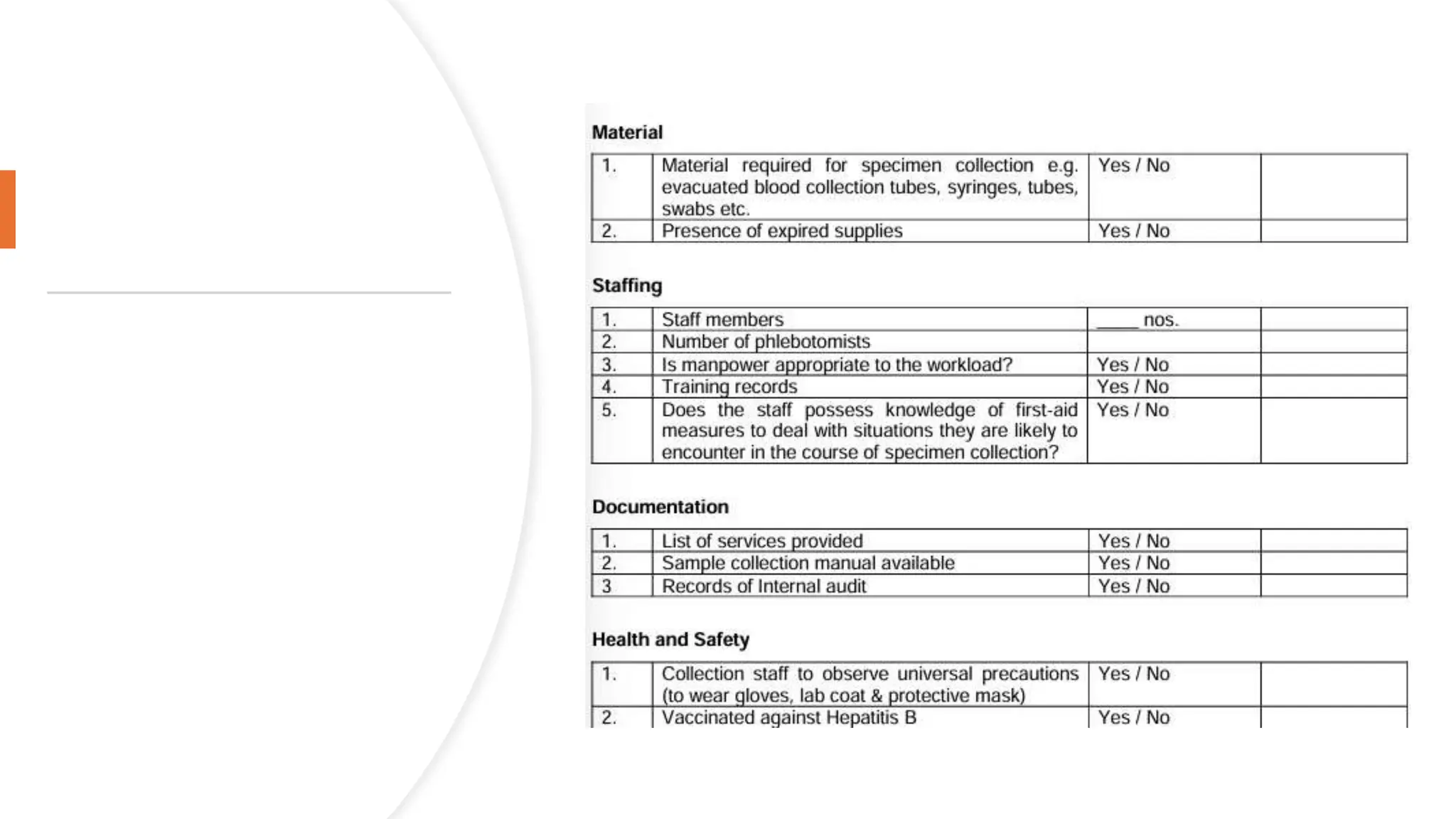
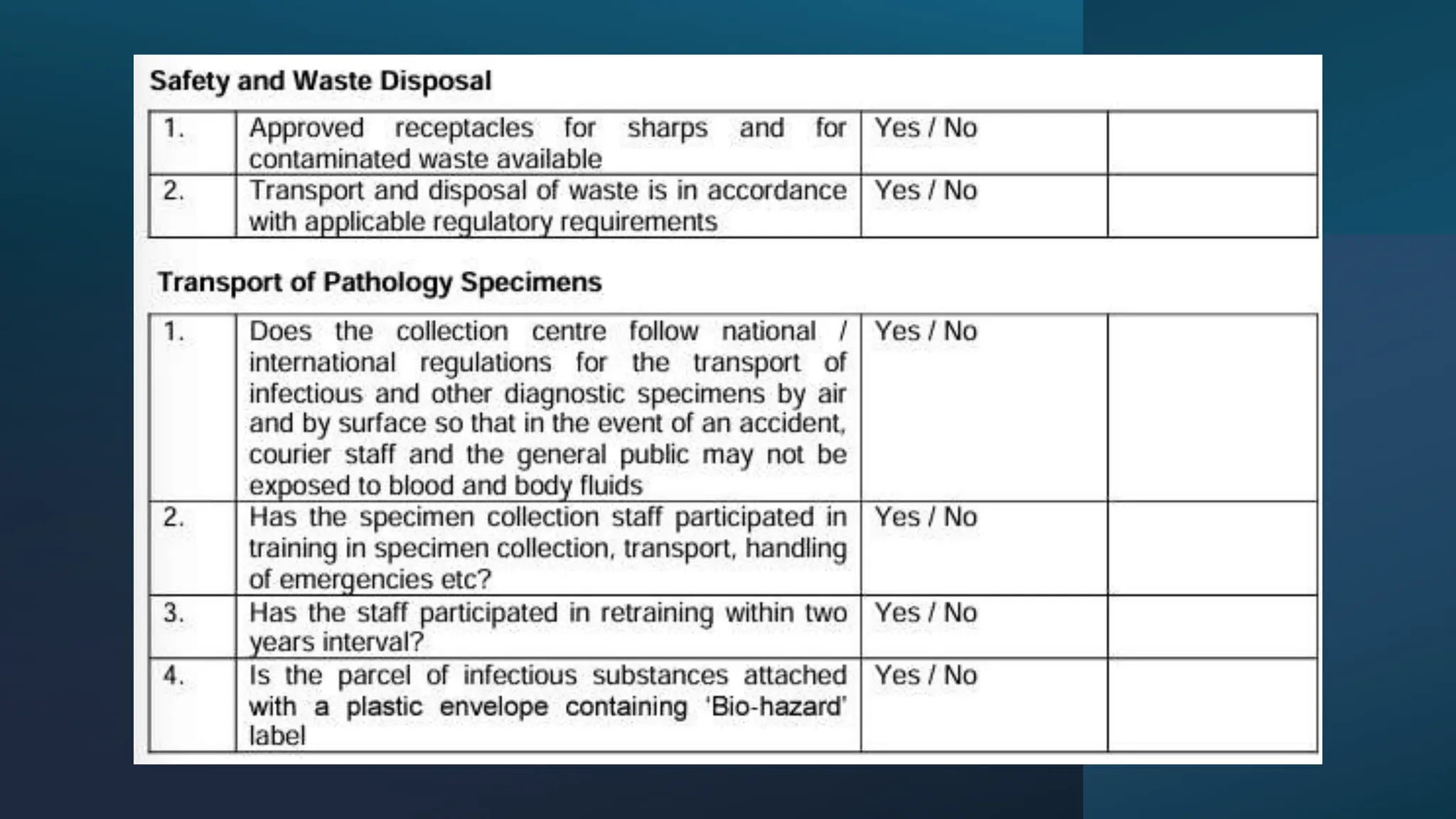
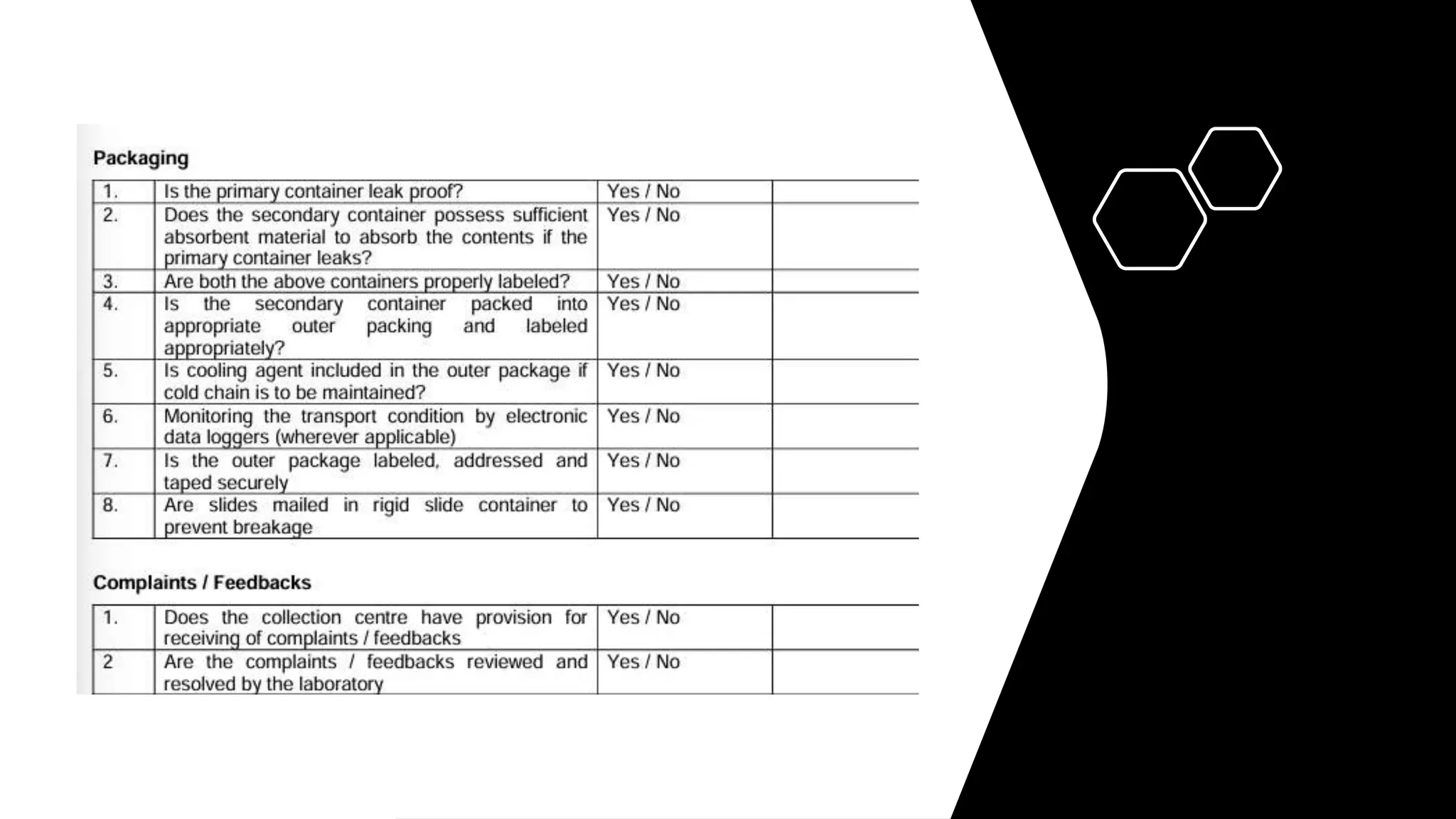
Checklist for assessment
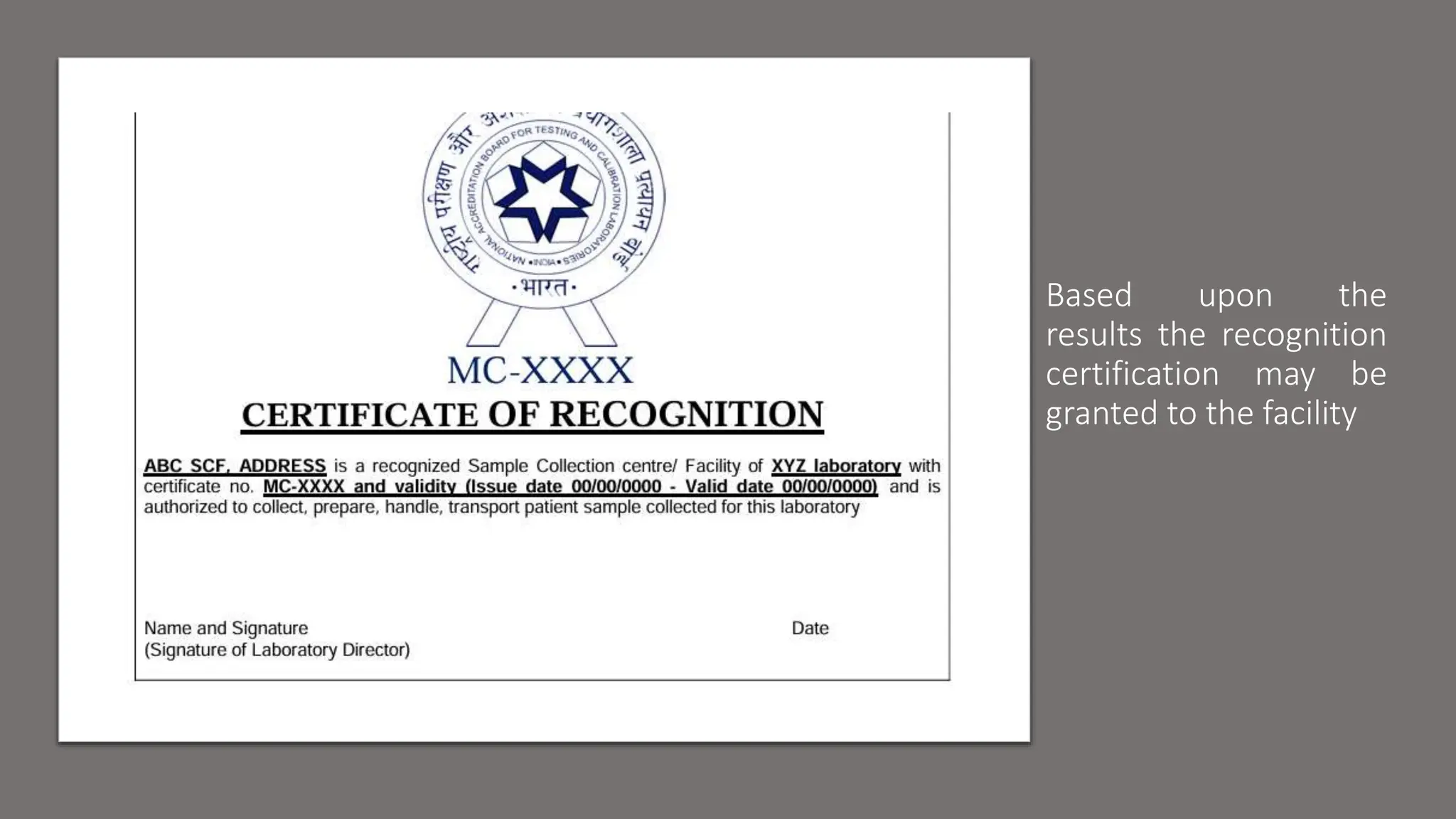
Based upon the
results the recognition
certification may be
granted to the facility
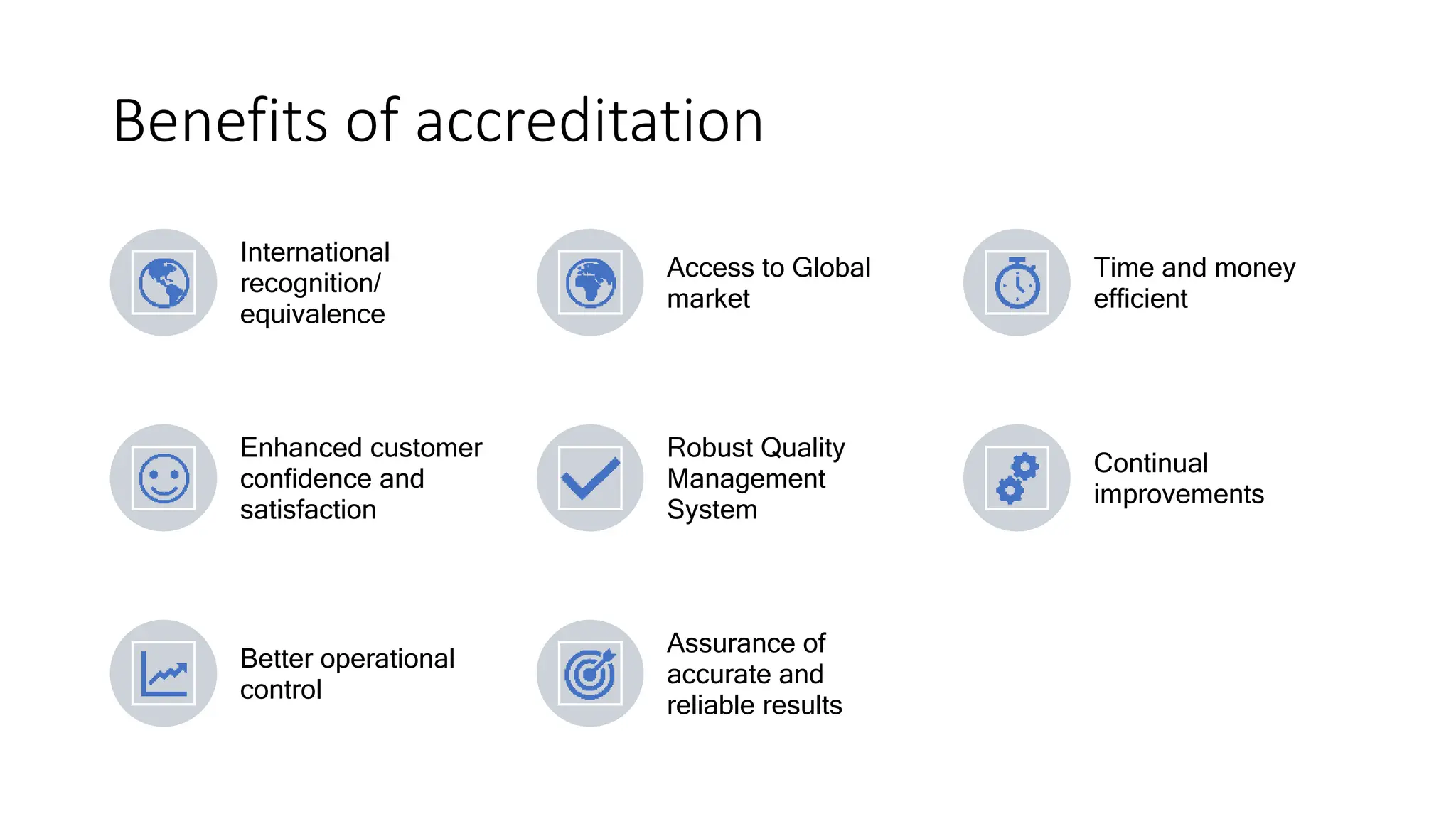
Benefits of accreditation
International
recognition/
equivalence
Access to Global
market
Time and money
efficient
Enhanced customer
confidence and
satisfaction
Robust Quality
Management
System
Continual
improvements
Better operational
control
Assurance of
accurate and
reliable results
Summary
• Accreditation is a process of conformity assessment by the third party for
determining the competence of laboratories to perform an assessment task.
• The body for performing this task is called conformity assessment body (CAB).
• NABL provides voluntary accreditation services as per international standards for
testing and calibration laboratories.
• It is a full member of Asia pacific accreditation cooperation (APAC) and international
laboratory accreditation cooperation (ILAC).
• As per the latest notification issued by MoHFW notifiying clinical establishment
(Central government ) amendment rules 2018
Summary
• NABL also requires a minimum retention period to ensure quality services for patient care.
• All equipment's should be calibrated by NABL accredited laboratory prior to commissioning.
• Calibration certificate isn't valid unless it contains accepted procedure and traceability.
• For treatment outside laboratory, the lab shall have a documented contract with a licensed BMW
waste management contractor or a common waste management facility as per the local, regional or
national guidelines.
• Maintaining the integrity of sample at all stages i.e. collection, handling and transportation plays a
vital role to ensure the reliability of the test results.
• Only NABL approved sample collection centers can be claimed as sample source during its
valid accreditation cycle.
References
• National accreditation board for testing and calibration
laboratories. NABL India (nabl-india.org)
• NABL docs 100A,100B,111,112,126,128,130. Accreditation
Documents (nabl-india.org)
• Quality council of india, THE ORGANISATION – QCI (qcin.org)

National accreditation for testing and calibration of biological laboratories (NABL)

  • 1.
    National accreditation board fortesting and calibration of laboratories (NABL) Nitish kumar M.Sc Neurotechnology (3rd year) JIPMER
  • 2.
    Contents • Why laboratoryaccreditation • NABL and its history • Services provided • Scope • Intl recognition • Laboratory classification • Pre requisites for accreditation with procedure • Calibration • Post examination process • Guidelines and checklists • Benefits of accreditation • Summary & References
  • 3.
    Why laboratory accreditation? • Theliberalization of trade and industry policies of the Government of India has created quality consciousness in domestic trade and provided greater thrust for export. • As a consequence testing centres and laboratories have to demonstrably operate at an internationally acceptable level of competence.
  • 4.
    • Accreditation isa process of conformity assessment by the third party for determining the competence of laboratories to perform an assessment task. • It is a process where a formal authoritative body gives recognition based on international standards. • The body for performing this task is called conformity assessment body (CAB).
  • 5.
    NABL Department of science andtechnology formally started the accredation process during the 6th five year plan (1980-85). It was termed as national coordination of testing and calibration facilities (NCTCF). NCTCF was renamed as national accreditation board for testing and calibration laboratories (NABL) in 1996. QCI (quality control of India) was also set up in the same year under ministry of industries.
  • 6.
    NABL was registeredas a society under the society registration act 1890, on 12th aug 1998. It further operated as an autonomous body under DST. In 2016, followed by the cabinets descision, it was transferred to Department of industrial policy and promotion (DIPP) under MoCI, with its support mechanisms. It was further merged with QCI society on june 2017, from then it serves as one of the constituent board of QCI.
  • 8.
  • 9.
    QCI coordinates its activitieswith help of 5 constituents boards .
  • 10.
    Services provided NABL provides voluntaryaccreditation services as per international standards to: 1. Testing laboratories in accordance with ISO/IEC 17025 ‘General Requirements for the Competence of Testing and Calibration Laboratories’ 2. Calibration laboratories in accordance with ISO/IEC 17025 ‘General Requirements for the Competence of Testing and Calibration Laboratories’
  • 11.
    Services provided 3. Medical testinglaboratories in accordance with ISO 15189 ‘Medical laboratories Requirements for quality and competence’ 4. Proficiency Testing Providers (PTP) in accordance with ISO/IEC 17043 “Conformity assessment - General requirements for (the Competence of) Proficiency Testing Providers” and 5. Reference Material Producers (RMP) in accordance with ISO 17034 “General requirements for the competence of Reference Material Producers”.
  • 12.
    Scope of NABL accreditation(In medical field) NABL 112 Medical Field: 1. Clinical Biochemistry 2. Clinical Pathology 3. Hematology 4. Microbiology & Infectious disease serology 5. Histopathology 6. Cytopathology 7. Flow Cytometry 8. Cytogenetics 9. Molecular Testing 10. Medical Imaging
  • 13.
    International recognition • NABL maintainslinkages from international bodies in relevance to its character. • It is a full member of Asia pacific accreditation cooperation (APAC) and international laboratory accreditation cooperation (ILAC). • It is also a signatory of mutual recognition agreement (MRA) since 2000.
  • 15.
    The following classification of laboratories shallbe used Small sized: A laboratory receiving samples of up to 100 subjects per day Medium sized: A laboratory receiving samples of up to 101- 400 subjects per day Large sized: A laboratory receiving samples of more than 401-1000 subjects per day Very large sized: A laboratory receiving more than 1000 subjects per day Multiple location: A laboratory with more than one location in the same district with same legal identity
  • 16.
    Documents required priorto application in support of legal entity status claimed. Type of legal entity Documents to be submitted One person company Registration certificate under The Companies Act, 2013 Limited liability partnership Registration certificate under The Limited Liability Partnership Act, 2008 Company Registration certificate under The Companies Act, 1956 or 2013 Society/ Trust Registration certificate under Societies Registration Act, 1860/ Registration under The Indian Trusts Act, 1882 Government Gazette or Government Notification or self-Declaration on Letter head by Head of the organization
  • 17.
    Pre-requisites As per thelatest notification issued by MoHFW notifiying clinical establishment (Central government ) amendment rules 2018. It's should also abide to the national/regional/state/local regulatory requirements as per applicable acts/rules/legal orders/ court decision/order issued by the govt and statutory bodies as applicable. Laboratory Director/ Head / Technical Head shall have the overall responsibility of the procedures, review and release of the results.
  • 18.
    Accomodation and environmentalconditions The laboratory should have adequate space, pleasant ambience and conditions to avoid cross contamination. Presence of effective seperation for incompatible activities. Adequate lighting, plugs, uninterrupted power supply. Backup to ensure integrity of frozen samples, reagents, consumables in case of power failure. Separation of sample testing area with sample processing area. Cylinders to be kept to ensure unintended movements.
  • 19.
    Storage and labelling •All reagents, consumables, stains, media, kits, drugs shall be stored as per recommended by the manufacturer. • It should be labelled with: 1. Content, 2. Quantity, 3. Titration, 4. Date received/ prepared, 5.Date of opening, 6. Expiry date, 7. Storage requirements.
  • 21.
    Calibration Policy of calibrationand tracebility as per NABL 142. It should be calibrated as per the NPL (National physical laboratory) protocols or calibration laboratory accredited by NABL or other MRA partners.
  • 24.
    Calibration (contd.) All equipmentsshould be calibrated by NABL accredited laboratory prior to commisioning. Calibration certificate isn't valid unless it contains accepted procedure and traceability. The interval also depends upon the frequency of use, quality and ruggedness, a complaince report may be asked from the calibration lab. At the time of installation, Installation qualification (IQ), Operational qualification (OQ), and Performance qualification (PQ) should be documented.
  • 25.
    In- house calibration •Certain items can be calibrated in the lab itself provided the lab has itself a reference and materials required. • It should not require any special technique and expertise. • The calibration status, date and due date should be exhibited onto the equipment.
  • 26.
    Measurement for uncertaintyof values • The precision of lab equipment's is determined by running stable records and controls. • The SD and %CV should be determined by the laboratory mean . • The imprecision %CV (if any) from data obtained must always remain in the acceptable range. • Its recommended that minimum of 6 months internal QC data should be used to calculate routine imprecision.
  • 27.
    Post examination processes It includes: a. Retention of samples b. Disposal of biomedical waste i. Treatment outside laboratory premises ii. Treatment inside laboratory
  • 28.
    i. Retention andstorage of samples Laboratory should decide the retention time of records as per the national, regional or local regulations. 1 However , NABL also requires a minimum retention period to ensure quality services for patient care. 2
  • 30.
    ii. Treatment ofbiomedical waste • For treatment outside laboratory, the lab shall have a documented contract with a licensed BMW waste management contractor or a common waste management facility as per the local, regional or national guidelines. • For inside the lab disposal: 1. separate autoclave for waste treatment 2. 1% fresh hypochlorite solution treatment for 30 mins. 3. effluent treatment plant may be placed as per the local requirements.
  • 31.
    Reporting and release ofresults • Identification by name and signature of authorizing authority. • Labs should establish and display critical limits for immediate attention. • Provisions for interim report in case of absence of authorizing authority. • Maintenance of patients reports privacy as per the ethical guidelines. • Storage of the results as per the protocol.
  • 32.
    Guidelines for samplecollection facility of medical laboratory • Maintaining the integrity of sample at all stages i.e. collection, handling and transportation plays a vital role to ensure the reliability of the test results. • The collection center must be defined as: • 1. Ownership • 2. Management • 3. Franchise
  • 33.
    Guidelines (contd.) • Evaluationof training imparted to staff for collection, processing and storage of data. • Conduct internal audit at collection centers. • Collection centers will also be accessed by NABL which may or may not be by the same team. • Major non-conformities during inspection might lead to non- approval or further derecognition. • Only NABL approved sample collection centers can be claimed as sample source during its valid accreditation cycle.
  • 34.
  • 39.
    Based upon the resultsthe recognition certification may be granted to the facility
  • 40.
    Benefits of accreditation International recognition/ equivalence Accessto Global market Time and money efficient Enhanced customer confidence and satisfaction Robust Quality Management System Continual improvements Better operational control Assurance of accurate and reliable results
  • 42.
    Summary • Accreditation isa process of conformity assessment by the third party for determining the competence of laboratories to perform an assessment task. • The body for performing this task is called conformity assessment body (CAB). • NABL provides voluntary accreditation services as per international standards for testing and calibration laboratories. • It is a full member of Asia pacific accreditation cooperation (APAC) and international laboratory accreditation cooperation (ILAC). • As per the latest notification issued by MoHFW notifiying clinical establishment (Central government ) amendment rules 2018
  • 43.
    Summary • NABL alsorequires a minimum retention period to ensure quality services for patient care. • All equipment's should be calibrated by NABL accredited laboratory prior to commissioning. • Calibration certificate isn't valid unless it contains accepted procedure and traceability. • For treatment outside laboratory, the lab shall have a documented contract with a licensed BMW waste management contractor or a common waste management facility as per the local, regional or national guidelines. • Maintaining the integrity of sample at all stages i.e. collection, handling and transportation plays a vital role to ensure the reliability of the test results. • Only NABL approved sample collection centers can be claimed as sample source during its valid accreditation cycle.
  • 44.
    References • National accreditationboard for testing and calibration laboratories. NABL India (nabl-india.org) • NABL docs 100A,100B,111,112,126,128,130. Accreditation Documents (nabl-india.org) • Quality council of india, THE ORGANISATION – QCI (qcin.org)