MR.GOPAL ,..MSC (N),
MEDICAL SURGICAL NURSING
ASSISTANT PROFESSOR
GANGA COLLEGE OF NURSING
COIMBATORE
•
CONTENT OVERVIEW
• ANATOMY & PHYSIOLOGY OF THE HEART
• INTRODUCTION
• DEFINITION
• CAUSES
• PATHOPHYSIOLOGY
• SYMPTOMS
• DIAGNOSTIC EVALUATION
• MANAGEMENT
• COMPLICATIONS
•
INTRODUCTION
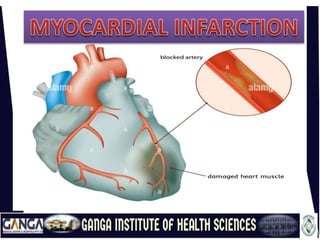
Acute myocardial infarction (AMI) is
necrosis of heart muscle due to inadequate
blood supply following an acute coronary
occlusion. This occlusion is usually due to
plaque rupture or fissuring with
superimposed thrombosis. Rarely, this may
result from coronary spasm, coronary
embolism or vasculitis.
DEFINITION
A Myocardial infarction occurs as a
result of sustained ischemia, causing
irreversible myocardial cell death (necrosis).
A heart attack is when blood vessels
that supply blood to the heart are blocked,
preventing enough oxygen from getting to
the heart. This causes the muscles to die.
CAUSES
LIFE STYLE
• Tobacco smoking
• Excessive alcohol
• Physical Inactivity
• High saturated diet and cholesterol
CAUSES
PHYSIOLOGICAL CHARACTERISICS
(MODIFIABLE)
• Elevated LDL cholestrol
• Low plasma HDL cholestrol
• Elevated plasma triglyceride
• Hyperglycemia
• Obesity
• Thrombogenic factors
CAUSES
DISEASE CONDITION
• Atherosclerosis
• Coronary thrombosis/ embolism
• Platelet aggregation
• Coronary artery stenosis/ spasm
• Shock /haemorrhage
• CKD
• Complication from heart surgery
CAUSES
PERSONAL CHARACTERISTICS
(NON MODIFIABLE)
• FAMILY HISTORY OF CHD
• MALE GENDER
• OLDER AGE
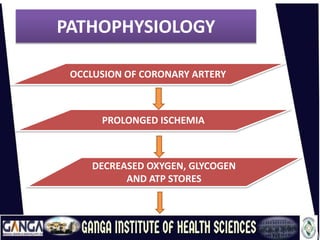
PATHOPHYSIOLOGY
OCCLUSION OF CORONARY ARTERY
PROLONGED ISCHEMIA
DECREASED OXYGEN, GLYCOGEN
AND ATP STORES
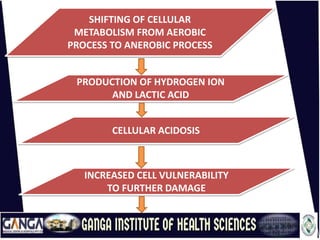
SHIFTING OF CELLULAR
METABOLISM FROM AEROBIC
PROCESS TO ANEROBIC PROCESS
PRODUCTION OF HYDROGEN ION
AND LACTIC ACID
CELLULAR ACIDOSIS
INCREASED CELL VULNERABILITY
TO FURTHER DAMAGE
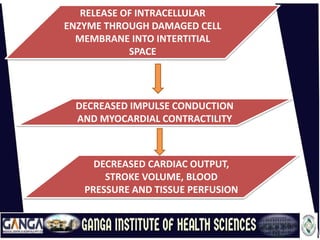
RELEASE OF INTRACELLULAR
ENZYME THROUGH DAMAGED CELL
MEMBRANE INTO INTERTITIAL
SPACE
DECREASED IMPULSE CONDUCTION
AND MYOCARDIAL CONTRACTILITY
DECREASED CARDIAC OUTPUT,
STROKE VOLUME, BLOOD
PRESSURE AND TISSUE PERFUSION
SYMPTOMS
Chest pain (central chest pain may not be the
main symptom):
• Three quarters of patients present with
characteristic central or epigastric chest pain
radiating to the arms, shoulders, neck, or jaw.
• The pain is described as substernal pressure,
squeezing, aching, burning, or even sharp pain.
• Radiation to the left arm or neck is common.
• Chest pain may be associated with sweating,
nausea, vomiting, dyspnoea, fatigue and/or
palpitations.
• Anxiety & Fainting
• Cough
• Light-headedness, dizziness
• Nausea and vomiting
• Palpitations (feeling like your heart is
beating too fast or irregularly)
• Shortness of breath
• Sweating, which may be extreme.
• Pale skin
• Diaphoresis (an excessive form of
sweating),
• Light-headedness, and
• Palpitations
• Loss of consciousness
• inadequate blood flow to the brain
• and cardiogenic shock.
• Sudden death
• due to the development of ventricular
fibrillation.
DIAGNOSTIC EVALUATION
• Patient history
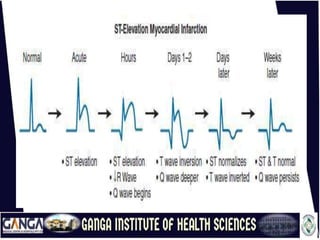
• ECG- ST elevation signifying ischemia.
• Cardiac enzymes and isoenzymes. CPK
MB (isoenzyme in cardiac muscle): Elevates
within 4–8 hrs, peaks in 12–20 hrs, returns to
normal in 48–72 hrs.
• LDH. Elevates within 8–24 hrs, peaks within 72–
144 hrs and may take as long as 14 days to
return to normal. An LDH1 greater than
LDH2 (flipped ratio) helps confirm/diagnose MI
if not detected in acute phase.
• Troponins. Troponin I (cTnI) and troponin T
(cTnT): Levels are elevated at 4–6 hr, peak at
14–18 hr, and return to baseline over 6–7
days. These enzymes have increased
specificity for necrosis and are therefore
useful in diagnosing postoperative MI when
MB-CPK may be elevated related to skeletal
trauma.
• Electrolytes. Imbalances
of sodium and potassium can alter
conduction and compromise contractility.
• WBC. Leukocytosis (10,000–20,000) usually
appears on the second day after MI because
of the inflammatory process.
• ESR : Rises on second or third day after MI,
indicating inflammatory response.
• ABGs/pulse oximetry: May indicate hypoxia or
acute/chronic lung disease processes.
• Lipids (total lipids, HDL, LDL, VLDL, total
cholesterol, triglycerides,
phospholipids): Elevations may reflect
arteriosclerosis as a cause for coronary narrowing
or spasm.
• Chest x-ray: May be normal or show an enlarged
cardiac shadow suggestive of HF or
ventricular aneurysm.
• Two-dimensional echocardiogram: May be done to
determine dimensions of chambers,
septal/ventricular wall motion, ejection fraction
(blood flow), and valve configuration/function.
• Nuclear imaging studies: Persantine or
Thallium: Evaluates myocardial blood flow
and status of myocardial cells, e.g.,
location/extent of acute/previous MI.
• Coronary angiography: Visualizes
narrowing/occlusion of coronary arteries and
is usually done in conjunction with
measurements of chamber pressures and
assessment of left ventricular function
(ejection fraction). Procedure is not usually
done in acute phase of MI unless angioplasty
or emergency heart surgery is imminent.
• Digital subtraction angiography
(DSA). Technique used to visualize status of
arterial bypass grafts and to detect peripheral
artery disease.
• Magnetic resonance imaging (MRI). Allows
visualization of blood flow, cardiac chambers
or intraventricular septum, valves, vascular
lesions, plaque formations, areas of
necrosis/infarction, and blood clots.
• Exercise stress test. Determines cardiovascular
response to activity (often done in conjunction
with thallium imaging in the recovery phase).
• Myoglobin: The myoglobin level can
elevate within 1 to 2 hours of acute MI
and peaks within 3 to 15 hours.
• Troponin: (troponin T and troponin I):
• Troponin I levels rise in about 3 hours,
peak at 14 to 18 hours, and remain
elevated for 5 to 7 days.
• Troponin T levels rise in 3 to 5 hours and
remain elevated for 10 to 14 days
MEDICAL MANAGEMENT
• OXYGEN THERAPY
• THROMBOLYTIC THERAPY
– Urokinase
– Streptokinase
• ANALGESICS THERAPY
– Morphine
• VASODILATOR THERAPY
– Nitroglycerin
• ACE INHIBITORS
– Captopril
– Enalapril
• BETA-ADRENERGIC BLOCKING AGENT
– Propenolol
• CALCIUM CHANNEL BLOCKERS
– Nifedipine
• ANTOCOAGULANT THERAPY
– Heparin
SURGICAL MANAGEMENT
• CABG (CORONARY ARTERY BYPASS GRAFT)
• PTCA (PERCUTANEOUS TRANSLUMINAL
CORONARY ANGIOPLASTY)
• ATHERECTOMY
• TRANSMYOCARDIAL LASER
REVASCULARIZATION
NURSING DIAGNOSIS
• Acute pain on chest related to myocardial
ischemia
• Ineffective peripheral tissue perfusion related
to decreased oxygenation
• Decreased cardiac output related to decreased
cardiac contractility
• Ineffective breathing pattern related to
increased effort of breath
• Impaired physical mobility related to chest pain
• Activity intolerance related to chest pain
COMPLICATION
• Heart failure. If a large area of the heart
muscle is damaged then the pumping ability
of the heart may be reduced.
• Abnormal heart rhythms may occur if the
electrical activity of the heart is affected.
• Renal / Respiratory failure
Myocardial infarction

Myocardial infarction

  • 1.
    MR.GOPAL ,..MSC (N), MEDICALSURGICAL NURSING ASSISTANT PROFESSOR GANGA COLLEGE OF NURSING COIMBATORE
  • 2.
  • 3.
    CONTENT OVERVIEW • ANATOMY& PHYSIOLOGY OF THE HEART • INTRODUCTION • DEFINITION • CAUSES • PATHOPHYSIOLOGY • SYMPTOMS • DIAGNOSTIC EVALUATION • MANAGEMENT • COMPLICATIONS
  • 4.
  • 5.
    INTRODUCTION Acute myocardial infarction(AMI) is necrosis of heart muscle due to inadequate blood supply following an acute coronary occlusion. This occlusion is usually due to plaque rupture or fissuring with superimposed thrombosis. Rarely, this may result from coronary spasm, coronary embolism or vasculitis.
  • 6.
    DEFINITION A Myocardial infarctionoccurs as a result of sustained ischemia, causing irreversible myocardial cell death (necrosis). A heart attack is when blood vessels that supply blood to the heart are blocked, preventing enough oxygen from getting to the heart. This causes the muscles to die.
  • 7.
    CAUSES LIFE STYLE • Tobaccosmoking • Excessive alcohol • Physical Inactivity • High saturated diet and cholesterol
  • 8.
    CAUSES PHYSIOLOGICAL CHARACTERISICS (MODIFIABLE) • ElevatedLDL cholestrol • Low plasma HDL cholestrol • Elevated plasma triglyceride • Hyperglycemia • Obesity • Thrombogenic factors
  • 9.
    CAUSES DISEASE CONDITION • Atherosclerosis •Coronary thrombosis/ embolism • Platelet aggregation • Coronary artery stenosis/ spasm • Shock /haemorrhage • CKD • Complication from heart surgery
  • 10.
    CAUSES PERSONAL CHARACTERISTICS (NON MODIFIABLE) •FAMILY HISTORY OF CHD • MALE GENDER • OLDER AGE
  • 11.
    PATHOPHYSIOLOGY OCCLUSION OF CORONARYARTERY PROLONGED ISCHEMIA DECREASED OXYGEN, GLYCOGEN AND ATP STORES
  • 12.
    SHIFTING OF CELLULAR METABOLISMFROM AEROBIC PROCESS TO ANEROBIC PROCESS PRODUCTION OF HYDROGEN ION AND LACTIC ACID CELLULAR ACIDOSIS INCREASED CELL VULNERABILITY TO FURTHER DAMAGE
  • 13.
    RELEASE OF INTRACELLULAR ENZYMETHROUGH DAMAGED CELL MEMBRANE INTO INTERTITIAL SPACE DECREASED IMPULSE CONDUCTION AND MYOCARDIAL CONTRACTILITY DECREASED CARDIAC OUTPUT, STROKE VOLUME, BLOOD PRESSURE AND TISSUE PERFUSION
  • 14.
    SYMPTOMS Chest pain (centralchest pain may not be the main symptom): • Three quarters of patients present with characteristic central or epigastric chest pain radiating to the arms, shoulders, neck, or jaw. • The pain is described as substernal pressure, squeezing, aching, burning, or even sharp pain. • Radiation to the left arm or neck is common. • Chest pain may be associated with sweating, nausea, vomiting, dyspnoea, fatigue and/or palpitations.
  • 15.
    • Anxiety &Fainting • Cough • Light-headedness, dizziness • Nausea and vomiting • Palpitations (feeling like your heart is beating too fast or irregularly) • Shortness of breath • Sweating, which may be extreme. • Pale skin
  • 16.
    • Diaphoresis (anexcessive form of sweating), • Light-headedness, and • Palpitations • Loss of consciousness • inadequate blood flow to the brain • and cardiogenic shock. • Sudden death • due to the development of ventricular fibrillation.
  • 17.
    DIAGNOSTIC EVALUATION • Patienthistory • ECG- ST elevation signifying ischemia. • Cardiac enzymes and isoenzymes. CPK MB (isoenzyme in cardiac muscle): Elevates within 4–8 hrs, peaks in 12–20 hrs, returns to normal in 48–72 hrs. • LDH. Elevates within 8–24 hrs, peaks within 72– 144 hrs and may take as long as 14 days to return to normal. An LDH1 greater than LDH2 (flipped ratio) helps confirm/diagnose MI if not detected in acute phase.
  • 18.
    • Troponins. TroponinI (cTnI) and troponin T (cTnT): Levels are elevated at 4–6 hr, peak at 14–18 hr, and return to baseline over 6–7 days. These enzymes have increased specificity for necrosis and are therefore useful in diagnosing postoperative MI when MB-CPK may be elevated related to skeletal trauma. • Electrolytes. Imbalances of sodium and potassium can alter conduction and compromise contractility. • WBC. Leukocytosis (10,000–20,000) usually appears on the second day after MI because of the inflammatory process.
  • 19.
    • ESR :Rises on second or third day after MI, indicating inflammatory response. • ABGs/pulse oximetry: May indicate hypoxia or acute/chronic lung disease processes. • Lipids (total lipids, HDL, LDL, VLDL, total cholesterol, triglycerides, phospholipids): Elevations may reflect arteriosclerosis as a cause for coronary narrowing or spasm. • Chest x-ray: May be normal or show an enlarged cardiac shadow suggestive of HF or ventricular aneurysm. • Two-dimensional echocardiogram: May be done to determine dimensions of chambers, septal/ventricular wall motion, ejection fraction (blood flow), and valve configuration/function.
  • 20.
    • Nuclear imagingstudies: Persantine or Thallium: Evaluates myocardial blood flow and status of myocardial cells, e.g., location/extent of acute/previous MI. • Coronary angiography: Visualizes narrowing/occlusion of coronary arteries and is usually done in conjunction with measurements of chamber pressures and assessment of left ventricular function (ejection fraction). Procedure is not usually done in acute phase of MI unless angioplasty or emergency heart surgery is imminent.
  • 21.
    • Digital subtractionangiography (DSA). Technique used to visualize status of arterial bypass grafts and to detect peripheral artery disease. • Magnetic resonance imaging (MRI). Allows visualization of blood flow, cardiac chambers or intraventricular septum, valves, vascular lesions, plaque formations, areas of necrosis/infarction, and blood clots. • Exercise stress test. Determines cardiovascular response to activity (often done in conjunction with thallium imaging in the recovery phase).
  • 22.
    • Myoglobin: Themyoglobin level can elevate within 1 to 2 hours of acute MI and peaks within 3 to 15 hours. • Troponin: (troponin T and troponin I): • Troponin I levels rise in about 3 hours, peak at 14 to 18 hours, and remain elevated for 5 to 7 days. • Troponin T levels rise in 3 to 5 hours and remain elevated for 10 to 14 days
  • 24.
    MEDICAL MANAGEMENT • OXYGENTHERAPY • THROMBOLYTIC THERAPY – Urokinase – Streptokinase • ANALGESICS THERAPY – Morphine • VASODILATOR THERAPY – Nitroglycerin
  • 25.
    • ACE INHIBITORS –Captopril – Enalapril • BETA-ADRENERGIC BLOCKING AGENT – Propenolol • CALCIUM CHANNEL BLOCKERS – Nifedipine • ANTOCOAGULANT THERAPY – Heparin
  • 26.
    SURGICAL MANAGEMENT • CABG(CORONARY ARTERY BYPASS GRAFT) • PTCA (PERCUTANEOUS TRANSLUMINAL CORONARY ANGIOPLASTY) • ATHERECTOMY • TRANSMYOCARDIAL LASER REVASCULARIZATION
  • 27.
    NURSING DIAGNOSIS • Acutepain on chest related to myocardial ischemia • Ineffective peripheral tissue perfusion related to decreased oxygenation • Decreased cardiac output related to decreased cardiac contractility • Ineffective breathing pattern related to increased effort of breath • Impaired physical mobility related to chest pain • Activity intolerance related to chest pain
  • 28.
    COMPLICATION • Heart failure.If a large area of the heart muscle is damaged then the pumping ability of the heart may be reduced. • Abnormal heart rhythms may occur if the electrical activity of the heart is affected. • Renal / Respiratory failure