MYOCARDIAL INFARCTION
BY: S.APARNA SELVAM
CONTENTS:
1. Definition
2. Types of infarcts
3. Etiology
4. Pathophysiology
5. Clinical features
6. Complications
7. investigations
8. Management
MYOCARDIAL INFARCTION
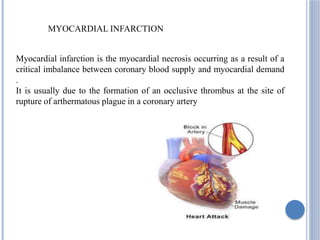
Myocardial infarction is the myocardial necrosis occurring as a result of a
critical imbalance between coronary blood supply and myocardial demand
.
It is usually due to the formation of an occlusive thrombus at the site of
rupture of arthermatous plague in a coronary artery
TYPES OF INFARCTS
1. According to anatomic region of left ventricle invoved:
 Anterior
 Posterior
 Lateral
 Septal
 Circumferential
 Combinations- Anterolateral, Posterolateral, Anteroseptal
2. According to degree of thickness of ventricular wall involved:
 Transmural (full thickness)
 Laminar (subendocardial)
3. According to age of infarcts:
 Newly formed (acute, recent, fresh)
 Advanced infarcts (old, healed, organised)
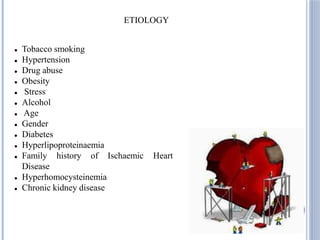
 Tobacco smoking
 Hypertension
 Drug abuse
 Obesity
 Stress
 Alcohol
 Age
 Gender
 Diabetes
 Hyperlipoproteinaemia
 Family history of Ischaemic Heart
Disease
 Hyperhomocysteinemia
 Chronic kidney disease
ETIOLOGY
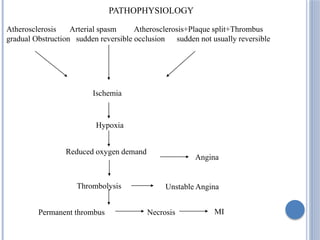
Atherosclerosis Arterial spasm Atherosclerosis+Plaque split+Thrombus
gradual Obstruction sudden reversible occlusion sudden not usually reversible
Ischemia
Hypoxia
Reduced oxygen demand
Thrombolysis
Permanent thrombus Necrosis MI
Unstable Angina
Angina
PATHOPHYSIOLOGY
CLINICAL FEATURES
Symptoms-
 Pain in the area between shoulder blades, arm, chest, chest, jaw, left arm, or
upper abdomen
 dizziness, fatigue, light-headedness, clammy skin, cold sweat, or sweating
 Gastrointestinal: heartburn, indigestion, nausea, or vomiting
 Chest: Chest pain, discomfort, fullness, or tightness
 Neck: discomfort or tightness
 Arm: discomfort or tightness anxiety, feeling of impending doom,
 sensation of an abnormal heartbeat, shortness of breath, or shoulder discomfort
Signs-
Mild fever
Pallor ,seating
Tachycardia/bradycardia
Arrhythmias
Narrow pulse pressure
Raised jvp
Diffuse apical impulses
Soft first heart sound
Pericardial friction rub
Basal crepitations

COMPLICATIONS
 Cardiogenic shock
 Arrhythmia's ;
 Sinus bradycardia
 Sinus tachycardia
 Ventricular ectopic beats
 Accelerated idioventricular rhythm
 Atrial tachycardia
 Atrial fibrillation
 Heart blocks
 Cardiac failure,most commonly manifesting as pulmonary edema
 Infarction of mitral papillary muscles leading to mitral regurgitation and
pulmonary edema
 Rupture of inter ventricular septum leading to a murmur of VSD and
severe hypo-tension
 Cardiac tamponade due to rupture of ventricular into pericardial sac
 DVT and pulmonary embolism
 Ventricular aneurysm and dyskinetic/akinetic segments
 Dresselar’s syndrome
INVESTIGATIONS
 ELECTROCARDIOGRAM (ECG)
i. ST segment elevation
ii. T wave inversion
iii.appearance of wide deep Q wave
 MAGNETIC RESONANCE IMAGING (MRI)
 ANGIOGRAPHY
 POSITRON EMISSION TOMOGRAPHY (PET )
 CHEST X- RAY
 ECHOCARDIOGRAPHY
 RADIONUCLIDE SCANNING
 BLOOD INVESTIGATIONS
 PLASMA ENZYMES(cardiac injury enzymes)
i. Aspartate aminotransferase
ii.Lactate dehydrogenase
iii.Myoglobin
iv.Troponins
v.creatine kinase
MANAGEMENT
NON-PHARMACOLOGICAL
 Counseling and education of patients
 Life style measures
 Smoking cessation
 Avoid Alcohol intake
 Diet and nutrition
 Salt restriction
PHARMACOLOGICAL
 Thrombolytic agents
 Anticoagulants
 Antiplatelet agents
 Antihypertensive agents
 Lipid lowering drugs
 Vasodialators
 Others
 i) Analgesics ii) Antiulcer drugs
 iii) Antidepressants
SURGICAL
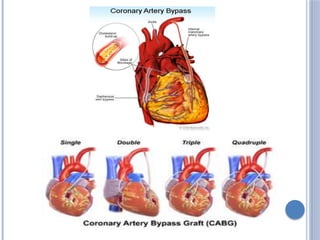
 Coronary artery bypass graft (CABG) surgery
 Coronary artery bypass surgery, also known as coronary artery bypass
graft surgery, and colloquially heart bypass or bypass surgery, is a
surgical procedure to restore normal blood flow to an obstructed
coronary artery.
 There are two main approaches. In one, the left internal thoracic artery
(internal mammary artery) is diverted to the left anterior descending
branch of the left coronary artery. In the other, a great saphenous vein is
removed from a leg; one end is attached to the aorta or one of its major
branches, and the other end is attached to the obstructed artery
immediately after the obstruction to restore blood flow.
 This surgery is usually performed with the heart stopped, necessitating
the usage of cardiopulmonary bypass; however, two alternative
techniques are also available allowing CABG to be performed on a
beating heart either without using the cardiopulmonary bypass deemed
as "off-pump" surgery or performing beating surgery using partial
assistance of the cardiopulmonary bypass called as "on-pump beating"
surgery. The latter gathers the advantages of the on-pump stopped and
off-pump while minimizing their respective side-effects.
 This surgery is often indicated when coronary arteries have a 50% to
 Percutaneous coronary intervention (PCI)
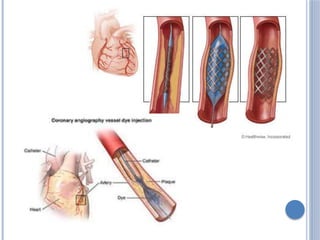
 Percutaneous coronary intervention (PCI) is a non-surgical
procedure used to treat narrowing (stenosis) of the coronary arteries
of the heart found in coronary artery disease. After accessing the
blood stream through the femoral or radial artery, the procedure
uses coronary catheterization to visualise the blood vessels on X-
ray imaging. After this, an interventional cardiologist can perform a
coronary angioplasty, using a balloon catheter in which a deflated
balloon is advanced into the obstructed artery and inflated to relieve
the narrowing; certain devices such as stents can be deployed to
keep the blood vessel open.
 Treatment after a myocardial infarction
 Aspirin: to reduce the ’stickiness’ of platelets in the blood
which helps to prevent blood clots forming.
 Clopidogrel in addition to aspirin, especially after
angioplasty with stenting.
 A beta-blocker : to slow the heart rate, lower blood pressure
and to reduce the chance of abnormal heart rhythms
developing
 An ACE inhibitor or angiotensin converting enzyme-
inhibitor : ACE inhibitors have a number of actions
including lowering the blood pressure, reducing the risk of
structural changes in the damaged heart muscle and having a
protective effect concerning future events
 A statin drug : to lower the level of cholesterol and other
blood lipids in your blood. This helps to prevent the build-up
of atheroma and therefore reduces the risk in the future.
MYOCARDIAL INFARCTION

MYOCARDIAL INFARCTION

  • 1.
  • 2.
    CONTENTS: 1. Definition 2. Typesof infarcts 3. Etiology 4. Pathophysiology 5. Clinical features 6. Complications 7. investigations 8. Management
  • 3.
    MYOCARDIAL INFARCTION Myocardial infarctionis the myocardial necrosis occurring as a result of a critical imbalance between coronary blood supply and myocardial demand . It is usually due to the formation of an occlusive thrombus at the site of rupture of arthermatous plague in a coronary artery
  • 4.
    TYPES OF INFARCTS 1.According to anatomic region of left ventricle invoved:  Anterior  Posterior  Lateral  Septal  Circumferential  Combinations- Anterolateral, Posterolateral, Anteroseptal 2. According to degree of thickness of ventricular wall involved:  Transmural (full thickness)  Laminar (subendocardial) 3. According to age of infarcts:  Newly formed (acute, recent, fresh)  Advanced infarcts (old, healed, organised)
  • 5.
     Tobacco smoking Hypertension  Drug abuse  Obesity  Stress  Alcohol  Age  Gender  Diabetes  Hyperlipoproteinaemia  Family history of Ischaemic Heart Disease  Hyperhomocysteinemia  Chronic kidney disease ETIOLOGY
  • 6.
    Atherosclerosis Arterial spasmAtherosclerosis+Plaque split+Thrombus gradual Obstruction sudden reversible occlusion sudden not usually reversible Ischemia Hypoxia Reduced oxygen demand Thrombolysis Permanent thrombus Necrosis MI Unstable Angina Angina PATHOPHYSIOLOGY
  • 7.
    CLINICAL FEATURES Symptoms-  Painin the area between shoulder blades, arm, chest, chest, jaw, left arm, or upper abdomen  dizziness, fatigue, light-headedness, clammy skin, cold sweat, or sweating  Gastrointestinal: heartburn, indigestion, nausea, or vomiting  Chest: Chest pain, discomfort, fullness, or tightness  Neck: discomfort or tightness  Arm: discomfort or tightness anxiety, feeling of impending doom,  sensation of an abnormal heartbeat, shortness of breath, or shoulder discomfort
  • 8.
    Signs- Mild fever Pallor ,seating Tachycardia/bradycardia Arrhythmias Narrowpulse pressure Raised jvp Diffuse apical impulses Soft first heart sound Pericardial friction rub Basal crepitations 
  • 9.
    COMPLICATIONS  Cardiogenic shock Arrhythmia's ;  Sinus bradycardia  Sinus tachycardia  Ventricular ectopic beats  Accelerated idioventricular rhythm  Atrial tachycardia  Atrial fibrillation  Heart blocks  Cardiac failure,most commonly manifesting as pulmonary edema  Infarction of mitral papillary muscles leading to mitral regurgitation and pulmonary edema  Rupture of inter ventricular septum leading to a murmur of VSD and severe hypo-tension  Cardiac tamponade due to rupture of ventricular into pericardial sac  DVT and pulmonary embolism  Ventricular aneurysm and dyskinetic/akinetic segments  Dresselar’s syndrome
  • 10.
    INVESTIGATIONS  ELECTROCARDIOGRAM (ECG) i.ST segment elevation ii. T wave inversion iii.appearance of wide deep Q wave  MAGNETIC RESONANCE IMAGING (MRI)  ANGIOGRAPHY  POSITRON EMISSION TOMOGRAPHY (PET )  CHEST X- RAY  ECHOCARDIOGRAPHY  RADIONUCLIDE SCANNING  BLOOD INVESTIGATIONS  PLASMA ENZYMES(cardiac injury enzymes) i. Aspartate aminotransferase ii.Lactate dehydrogenase iii.Myoglobin iv.Troponins v.creatine kinase
  • 11.
    MANAGEMENT NON-PHARMACOLOGICAL  Counseling andeducation of patients  Life style measures  Smoking cessation  Avoid Alcohol intake  Diet and nutrition  Salt restriction PHARMACOLOGICAL  Thrombolytic agents  Anticoagulants  Antiplatelet agents  Antihypertensive agents  Lipid lowering drugs  Vasodialators  Others  i) Analgesics ii) Antiulcer drugs  iii) Antidepressants
  • 12.
    SURGICAL  Coronary arterybypass graft (CABG) surgery  Coronary artery bypass surgery, also known as coronary artery bypass graft surgery, and colloquially heart bypass or bypass surgery, is a surgical procedure to restore normal blood flow to an obstructed coronary artery.  There are two main approaches. In one, the left internal thoracic artery (internal mammary artery) is diverted to the left anterior descending branch of the left coronary artery. In the other, a great saphenous vein is removed from a leg; one end is attached to the aorta or one of its major branches, and the other end is attached to the obstructed artery immediately after the obstruction to restore blood flow.  This surgery is usually performed with the heart stopped, necessitating the usage of cardiopulmonary bypass; however, two alternative techniques are also available allowing CABG to be performed on a beating heart either without using the cardiopulmonary bypass deemed as "off-pump" surgery or performing beating surgery using partial assistance of the cardiopulmonary bypass called as "on-pump beating" surgery. The latter gathers the advantages of the on-pump stopped and off-pump while minimizing their respective side-effects.  This surgery is often indicated when coronary arteries have a 50% to
  • 14.
     Percutaneous coronaryintervention (PCI)  Percutaneous coronary intervention (PCI) is a non-surgical procedure used to treat narrowing (stenosis) of the coronary arteries of the heart found in coronary artery disease. After accessing the blood stream through the femoral or radial artery, the procedure uses coronary catheterization to visualise the blood vessels on X- ray imaging. After this, an interventional cardiologist can perform a coronary angioplasty, using a balloon catheter in which a deflated balloon is advanced into the obstructed artery and inflated to relieve the narrowing; certain devices such as stents can be deployed to keep the blood vessel open.
  • 16.
     Treatment aftera myocardial infarction  Aspirin: to reduce the ’stickiness’ of platelets in the blood which helps to prevent blood clots forming.  Clopidogrel in addition to aspirin, especially after angioplasty with stenting.  A beta-blocker : to slow the heart rate, lower blood pressure and to reduce the chance of abnormal heart rhythms developing  An ACE inhibitor or angiotensin converting enzyme- inhibitor : ACE inhibitors have a number of actions including lowering the blood pressure, reducing the risk of structural changes in the damaged heart muscle and having a protective effect concerning future events  A statin drug : to lower the level of cholesterol and other blood lipids in your blood. This helps to prevent the build-up of atheroma and therefore reduces the risk in the future.