 INTRODUCTION
 HISTORY
 PROS AND CONS
 STRUCTURE
 SEBI GUIDELINES
 TERMS RELATED TO MF
 TYPES
 RATIOS
 MF TAXATION
 FUTURE OF MUTUAL FUND INDUSTRY
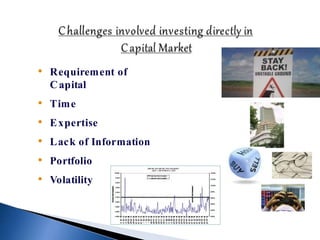
• Requirement of
Capital
• Time
• Expertise
• Lack of Information
• Portfolio
• Volatility
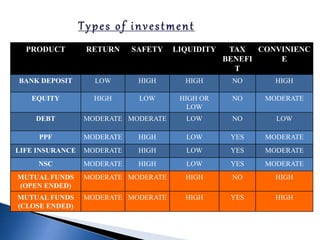
PRODUCT RETURN SAFETY LIQUIDITY TAX
BENEFI
T
CONVINIENC
E
BANK DEPOSIT LOW HIGH HIGH NO HIGH
EQUITY HIGH LOW HIGH OR
LOW
NO MODERATE
DEBT MODERATE MODERATE LOW NO LOW
PPF MODERATE HIGH LOW YES MODERATE
LIFE INSURANCE MODERATE HIGH LOW YES MODERATE
NSC MODERATE HIGH LOW YES MODERATE
MUTUAL FUNDS
(OPEN ENDED)
MODERATE MODERATE HIGH NO HIGH
MUTUAL FUNDS
(CLOSE ENDED)
MODERATE MODERATE HIGH YES HIGH
5
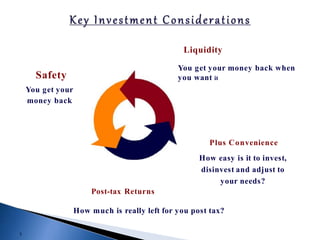
Safety
You get your
money back
Liquidity
You get your money back when
you want it
Plus Convenience
How easy is it to invest,
disinvest and adjust to
your needs?
Post-tax Returns
How much is really left for you post tax?
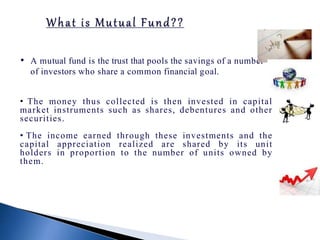
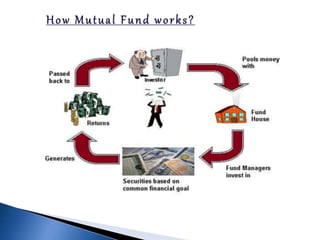
• A mutual fund is the trust that pools the savings of a number
of investors who share a common financial goal.
• The money thus collected is then invested in capital
market instruments such as shares, debentures and other
securities.
• The income earned through these investments and the
capital appreciation realized are shared by its unit
holders in proportion to the number of units owned by
them.
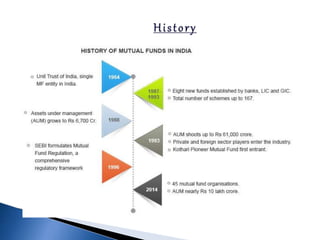
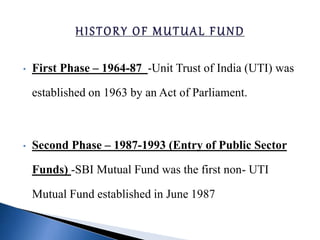
• First Phase – 1964-87 -Unit Trust of India (UTI) was
established on 1963 by an Act of Parliament.
• Second Phase – 1987-1993 (Entry of Public Sector
Funds) -SBI Mutual Fund was the first non- UTI
Mutual Fund established in June 1987
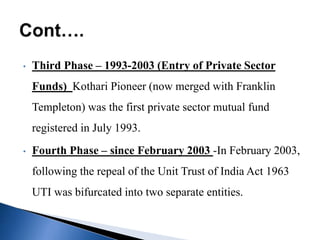
• Third Phase – 1993-2003 (Entry of Private Sector
Funds) Kothari Pioneer (now merged with Franklin
Templeton) was the first private sector mutual fund
registered in July 1993.
• Fourth Phase – since February 2003 -In February 2003,
following the repeal of the Unit Trust of India Act 1963
UTI was bifurcated into two separate entities.
• Professional Management
• Diversification
• Convenient Administration
• Return potential
• Low cost
• Liquidity
• Transparency
• Flexibility
• Choice of schemes
• Well regulated
• Tax benefits
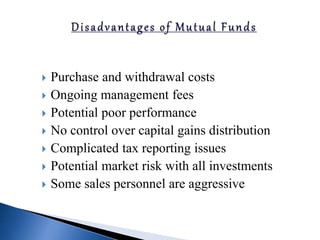
 Purchase and withdrawal costs
 Ongoing management fees
 Potential poor performance
 No control over capital gains distribution
 Complicated tax reporting issues
 Potential market risk with all investments
 Some sales personnel are aggressive
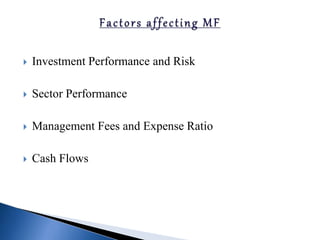
 Investment Performance and Risk
 Sector Performance
 Management Fees and Expense Ratio
 Cash Flows
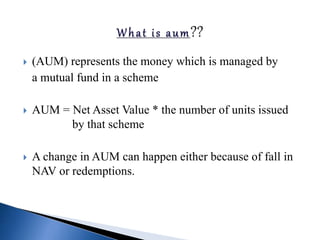
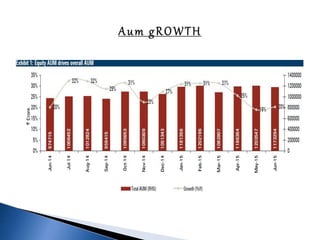
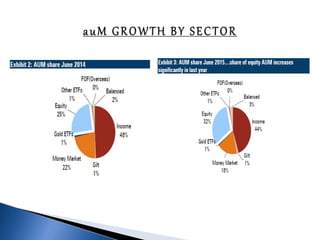
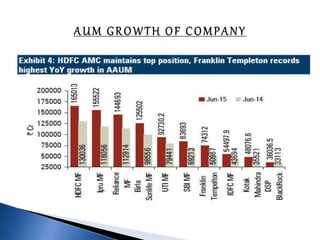
 (AUM) represents the money which is managed by
a mutual fund in a scheme
 AUM = Net Asset Value * the number of units issued
by that scheme
 A change in AUM can happen either because of fall in
NAV or redemptions.
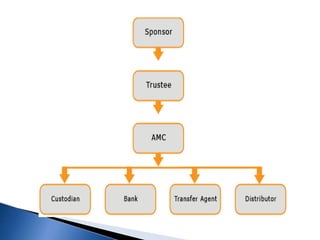
MF should have the following 3-tier structure, they are:
 Sponsor
 Trustee / Trust
 Asset Management Company
 Custodian and other parties
 Akin to the promoter of the company
 Contributes atleast 40% of the net worth of the AMC.
 Posses sound financial record over five years period
 Establishes the fund
 Gets the fund registered with SEBI
 Forms a trust and appoints a board of trustee
 Holds assets on behalf of unit holders in trust
 Trustees are caretaker of unit holders money.
 Two third of the trustees shall be independent persons (not
associated with the sponsor).
 Trustees ensure that the system, processes & personnel are
in place
 Resolves Unit holders Grievances
 Appoint AMC and custodian
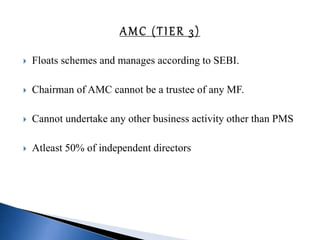
 Floats schemes and manages according to SEBI.
 Chairman of AMC cannot be a trustee of any MF.
 Cannot undertake any other business activity other than PMS
 Atleast 50% of independent directors
 Holds the funds securities in safekeeping
 Settles securities transaction for the fund
 Collects interest & dividends paid on securities
 Records information on corporate actions
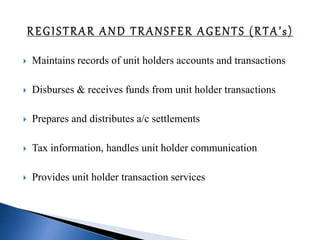
 Maintains records of unit holders accounts and transactions
 Disburses & receives funds from unit holder transactions
 Prepares and distributes a/c settlements
 Tax information, handles unit holder communication
 Provides unit holder transaction services
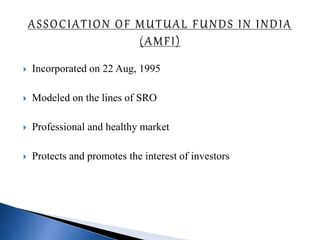
 Incorporated on 22 Aug, 1995
 Modeled on the lines of SRO
 Professional and healthy market
 Protects and promotes the interest of investors
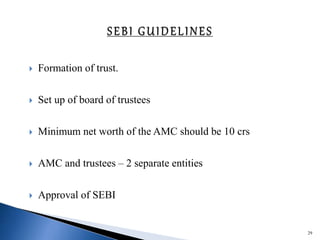
 Formation of trust.
 Set up of board of trustees
 Minimum net worth of the AMC should be 10 crs
 AMC and trustees – 2 separate entities
 Approval of SEBI
29
 Registration of MF schemes
 90% minimum distribution of profits
 A common format to disclose their entire portfolios on half-
yearly basis
 fully revise and update offer document and memorandum at least
once in two years
 Bring uniformity in disclosures of various categories of
advertisements
 Reduce initial offer period from a maximum of 45 days to 30
days
 Dispatch statements of account once the minimum subscription
amount specified in the offer document is received
 Invest in mortgaged backed securities of investment grade given
by credit rating agency.
 Identify and make provisions for the non-performing assets
(NPAs)
 Disclose information in a revised format on unit capital, reserves,
performance in terms of dividend and rise/fall in NAV during the
half-year period, annualized yields over the last 1, 3, 5 years in
addition to percentage of management fees etc.
 Declare their NAV s and sale/repurchase prices of all schemes
updated daily on regular basis on the AMFI website by 8.00 p.m.
and declare NA V s of their close ended schemes on every
Wednesday
 un-audited half-yearly results are to be published before the
expiry of one month from the close of each half-year
 All the schemes by mutual funds shall be launched within six
months from the date of the letter containing observations from
SEBI on the scheme offer document
 Mutual funds are required to disclose large unit-holdings in the
scheme, which are over 25% of the NAV
 Mutual, beneficial and proportional owners
 Receive dividend within 30 days of declaration
 In case of redemption, 10 working days. If the
AMC fails, an interest of 15% is paid.
 In case of failure to claim the redemption
proceeds, then NAV is applicable
33
 Right to receive audited annual reports and other
relevant information
 Right to wound up a scheme if unit holders representing
75% of scheme’s assets pass a resolution
 Right to be informed about the fundamental attributes of
a scheme
 Can approach Investor relations officer for grievance
redressal
34
 NFO is launched in the market to raise capital
 AMC launches new schemes, under the name of the Trust
 NFOs are offered for a stipulated period.
 Investors can invest in these schemes at the offer price
(most cases Rs 10) for stipulated period only.
 After the NFO period, investors can take exposure in
these funds only at the prevailing NAV.
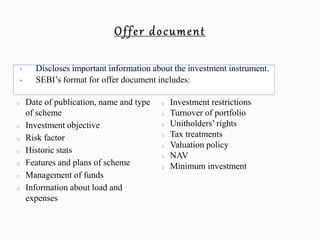
• Discloses important information about the investment instrument.
• SEBI’s format for offer document includes:
o Date of publication, name and type
of scheme
o Investment objective
o Risk factor
o Historic stats
o Features and plans of scheme
o Management of funds
o Information about load and
expenses
o Investment restrictions
o Turnover of portfolio
o Unitholders’ rights
o Tax treatments
o Valuation policy
o NAV
o Minimum investment
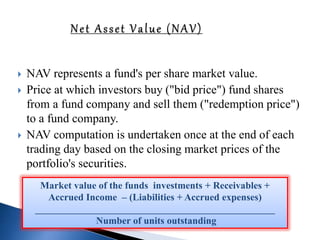
 NAV represents a fund's per share market value.
 Price at which investors buy ("bid price") fund shares
from a fund company and sell them ("redemption price")
to a fund company.
 NAV computation is undertaken once at the end of each
trading day based on the closing market prices of the
portfolio's securities.
Market value of the funds investments + Receivables +
Accrued Income – (Liabilities + Accrued expenses)
_________________________________________________
Number of units outstanding
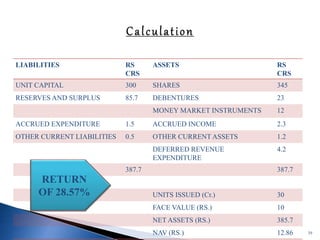
LIABILITIES RS
CRS
ASSETS RS
CRS
UNIT CAPITAL 300 SHARES 345
RESERVES AND SURPLUS 85.7 DEBENTURES 23
MONEY MARKET INSTRUMENTS 12
ACCRUED EXPENDITURE 1.5 ACCRUED INCOME 2.3
OTHER CURRENT LIABILITIES 0.5 OTHER CURRENT ASSETS 1.2
DEFERRED REVENUE
EXPENDITURE
4.2
387.7 387.7
UNITS ISSUED (Cr.) 30
FACE VALUE (RS.) 10
NET ASSETS (RS.) 385.7
NAV (RS.) 12.86 39
RETURN
OF 28.57%
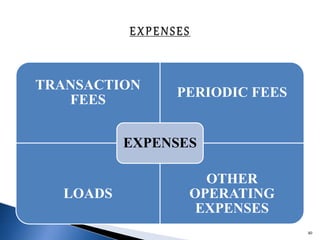
TRANSACTION
FEES
PERIODIC FEES
LOADS
OTHER
OPERATING
EXPENSES
EXPENSES
40
41
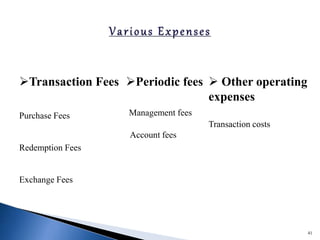
Transaction Fees
Purchase Fees
Redemption Fees
Exchange Fees
Periodic fees
Management fees
Account fees
 Other operating
expenses
Transaction costs
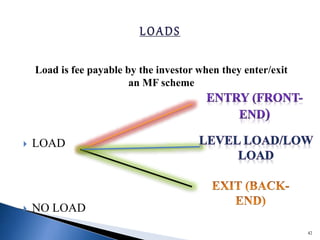
 LOAD
 NO LOAD
42
Load is fee payable by the investor when they enter/exit
an MF scheme
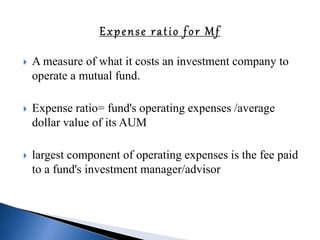
 A measure of what it costs an investment company to
operate a mutual fund.
 Expense ratio= fund's operating expenses /average
dollar value of its AUM
 largest component of operating expenses is the fee paid
to a fund's investment manager/advisor
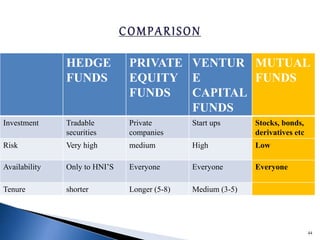
HEDGE
FUNDS
PRIVATE
EQUITY
FUNDS
VENTUR
E
CAPITAL
FUNDS
MUTUAL
FUNDS
Investment Tradable
securities
Private
companies
Start ups Stocks, bonds,
derivatives etc
Risk Very high medium High Low
Availability Only to HNI’S Everyone Everyone Everyone
Tenure shorter Longer (5-8) Medium (3-5)
44
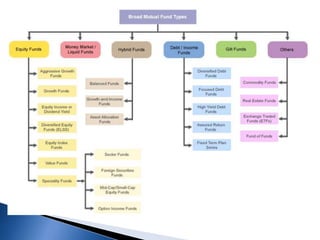
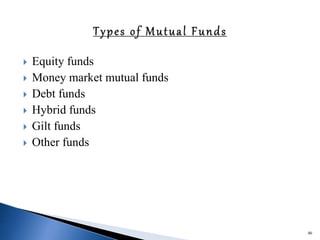
 Equity funds
 Money market mutual funds
 Debt funds
 Hybrid funds
 Gilt funds
 Other funds
46
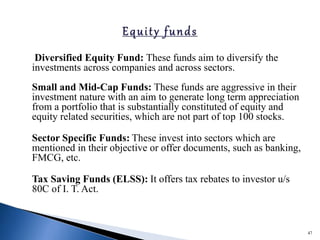
Diversified Equity Fund: These funds aim to diversify the
investments across companies and across sectors.
Small and Mid-Cap Funds: These funds are aggressive in their
investment nature with an aim to generate long term appreciation
from a portfolio that is substantially constituted of equity and
equity related securities, which are not part of top 100 stocks.
Sector Specific Funds: These invest into sectors which are
mentioned in their objective or offer documents, such as banking,
FMCG, etc.
Tax Saving Funds (ELSS): It offers tax rebates to investor u/s
80C of I. T. Act.
47
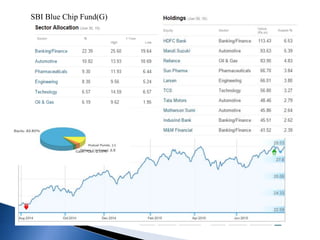
SBI Blue Chip Fund(G)
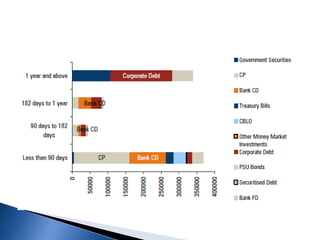
 Also known as Money Market Schemes
 These funds provide easy liquidity and preservation of capital.
 These schemes invest in short-term instruments like Treasury
Bills, inter-bank call money market, CPs and CDs.
 These funds are meant for short-term cash management of
corporate houses and are meant for an investment horizon of 1
day to 3 months.
49
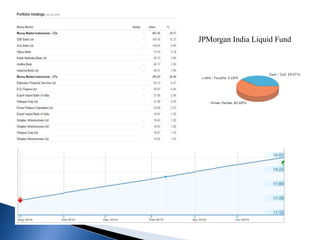
JPMorgan India Liquid Fund
Gilt Funds: Invest their corpus in securities issued by government. These
funds carry zero default risk but are associated with Interest Rate Risk.
Income Funds: Invest a major portion into various debt instruments such
as bonds, corporate debentures and government securities.
Monthly Income Plan (MIPs): MIPS invests maximum of their total
corpus in debt instruments while they take minimum exposure in equities.
It gets benefit of both equity and debt market.
Short Term Plans (STPs): These investments are meant for a horizon of
three to six months. These funds primarily invest in short term papers like
Certificate of Deposits (CDs) and Commercial Papers (CPs)
51
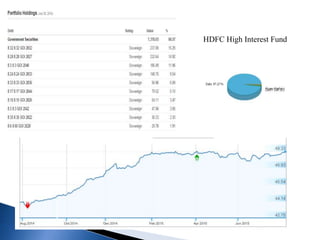
HDFC High Interest Fund
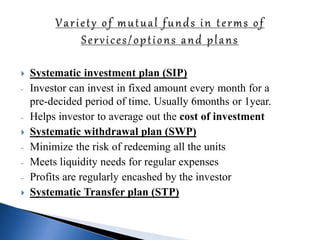
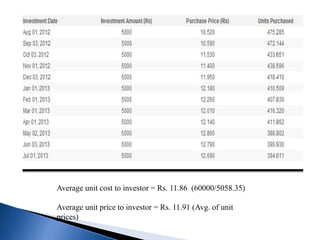
 Systematic investment plan (SIP)
- Investor can invest in fixed amount every month for a
pre-decided period of time. Usually 6months or 1year.
- Helps investor to average out the cost of investment
 Systematic withdrawal plan (SWP)
- Minimize the risk of redeeming all the units
- Meets liquidity needs for regular expenses
- Profits are regularly encashed by the investor
 Systematic Transfer plan (STP)
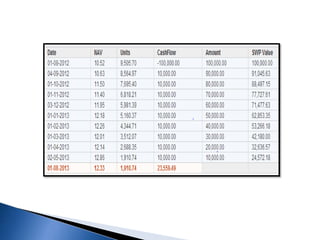
Average unit cost to investor = Rs. 11.86 (60000/5058.35)
Average unit price to investor = Rs. 11.91 (Avg. of unit
prices)
 Systematic withdrawal plan (SWP)
- Minimize the risk of redeeming all the units
- Meets liquidity needs for regular expenses
- Profits are regularly encashed by the investor
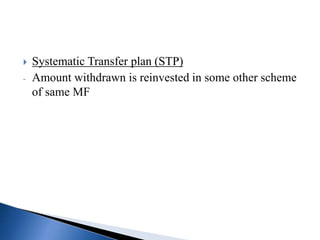
 Systematic Transfer plan (STP)
- Amount withdrawn is reinvested in some other scheme
of same MF
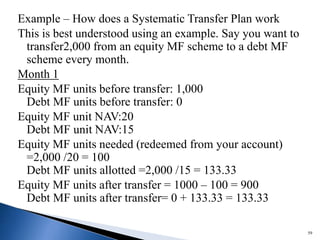
Example – How does a Systematic Transfer Plan work
This is best understood using an example. Say you want to
transfer2,000 from an equity MF scheme to a debt MF
scheme every month.
Month 1
Equity MF units before transfer: 1,000
Debt MF units before transfer: 0
Equity MF unit NAV:20
Debt MF unit NAV:15
Equity MF units needed (redeemed from your account)
=2,000 /20 = 100
Debt MF units allotted =2,000 /15 = 133.33
Equity MF units after transfer = 1000 – 100 = 900
Debt MF units after transfer= 0 + 133.33 = 133.33
59
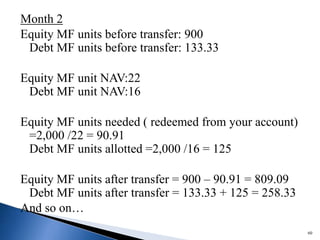
Month 2
Equity MF units before transfer: 900
Debt MF units before transfer: 133.33
Equity MF unit NAV:22
Debt MF unit NAV:16
Equity MF units needed ( redeemed from your account)
=2,000 /22 = 90.91
Debt MF units allotted =2,000 /16 = 125
Equity MF units after transfer = 900 – 90.91 = 809.09
Debt MF units after transfer = 133.33 + 125 = 258.33
And so on…
60
 To attract Risk averse investors
 Scheme aims at protecting initial capital investment
and does not guarantee returns
 Example :
1) If you invest Rs. 100 ; after 1 year returns is 20% so
end of the year it becomes Rs. 100 + 20= Rs. 120.
2) Now second year also you make a profit of 20% so
your money is Rs. 120 + 24 = Rs. 144
3) After 2 years your money of Rs. 100 is now Rs. 144 so
your
Absolute returns for 2 years is 44% whereas Annualized
returns is 20% year on year.
62
 SEBI regulation on disclosure in offer document,
advertisment etc.
 Steps:
 calculate growth in number of units (dividend re-
invested)
 calculate opening wealth
 calculate closing wealth
 Returns
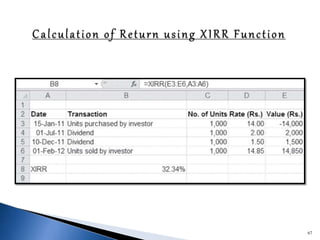
◦ XIRR
◦ Dividend Re-investment
(CAGR)
◦ Compounding of Periodic
Returns
• Risk
◦ Standard Deviation
◦ Alpha
◦ Beta
◦ Weighted Average
Maturity
◦ Modified Duration
 Risk Adjusted Returns
◦ Sharpe Ratio
◦ Sortino Ratio
◦ Treynor Ratio
◦ Jensen’s Alpha
65
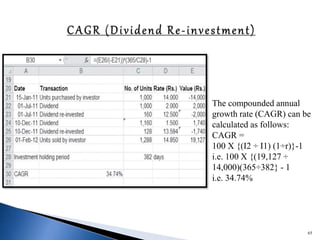
The compounded annual
growth rate (CAGR) can be
calculated as follows:
CAGR =
100 X {(I2 ÷ I1) (1÷r)}-1
i.e. 100 X {(19,127 ÷
14,000)(365÷382} - 1
i.e. 34.74%
 It is rate of return for the period of holding
 Also known as total return or point to point returns.
 HPR = {[INCOME+(END PRICE – BEGINNING
PRICE)]*BEGINNING PRICE}*100
 HPR ={ [2+(12-10)]/10}*100 = 40%
DIVIDEND 2 HPR 40%
BEG.PRICE 10
ENDPRICE 12
HOLDINGPERIOD 1YEAR
67
68
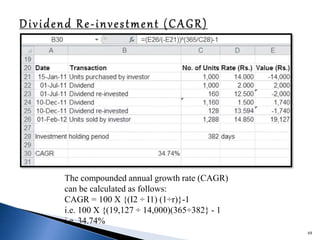
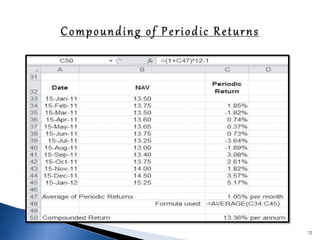
The compounded annual growth rate (CAGR)
can be calculated as follows:
CAGR = 100 X {(I2 ÷ I1) (1÷r)}-1
i.e. 100 X {(19,127 ÷ 14,000)(365÷382} - 1
i.e. 34.74%
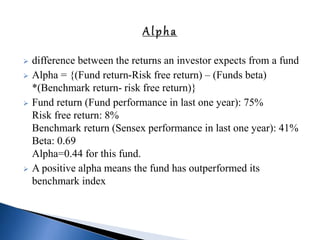
 difference between the returns an investor expects from a fund
 Alpha = {(Fund return-Risk free return) – (Funds beta)
*(Benchmark return- risk free return)}
 Fund return (Fund performance in last one year): 75%
Risk free return: 8%
Benchmark return (Sensex performance in last one year): 41%
Beta: 0.69
Alpha=0.44 for this fund.
 A positive alpha means the fund has outperformed its
benchmark index
 Market risk is measured by Beta
 It relates the return of a stock or mutual fund to a market index
 Reflects the sensitivity of a fund’s return to fluctuations in
market index
 Calculation of Beta: Y = a + βX
 Beta = 1 indicates -security's price will move with the market.
 Beta < 1 means security will be less volatile than the market.
 Beta > 1 indicates that the security's price will be more volatile
than the market.
 Eg- if a stock's beta is 1.2, it's 20% more volatile than the
market.
 It quantifies how a fund performs relative to the risk it
takes
 Sharpe index measures risk premium of a portfolio,
relative to the total amount for risk in the portfolio
Sharpe Index =(Rp) – (Rt)/ Standard Deviations
of the Portfolio Return
Portfolio Average Return (Rp)
Risk Free Rate of Interest (Rt)
71
72
 Beta compares a fund's returns with a benchmark, standard
deviation measures how far a fund's recent numbers stray from
its long-term average.
 Fund X has a 10% average rate of return and a standard
deviation of 5%, most of the time, its return will range from 5%
to 15%.
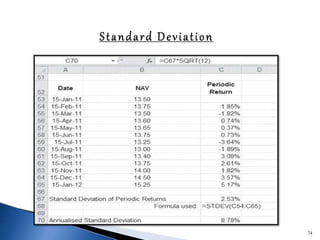
 Large standard deviation supposedly shows a more risky fund
than a smaller one
 Higher the deviation, higher the risk & vice versa.
 It is calculated by taking the square root of variance.
73
74
75
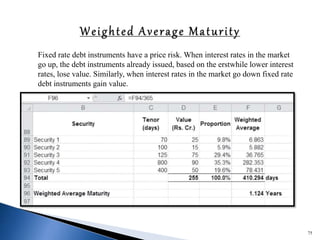
Fixed rate debt instruments have a price risk. When interest rates in the market
go up, the debt instruments already issued, based on the erstwhile lower interest
rates, lose value. Similarly, when interest rates in the market go down fixed rate
debt instruments gain value.
76
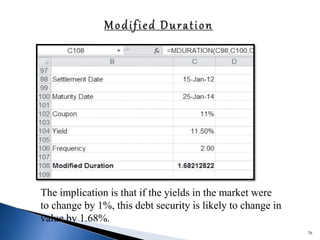
The implication is that if the yields in the market were
to change by 1%, this debt security is likely to change in
value by 1.68%.
77
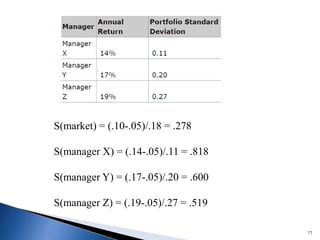
S(market) = (.10-.05)/.18 = .278
S(manager X) = (.14-.05)/.11 = .818
S(manager Y) = (.17-.05)/.20 = .600
S(manager Z) = (.19-.05)/.27 = .519
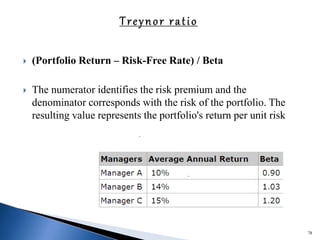
 (Portfolio Return – Risk-Free Rate) / Beta
 The numerator identifies the risk premium and the
denominator corresponds with the risk of the portfolio. The
resulting value represents the portfolio's return per unit risk
78
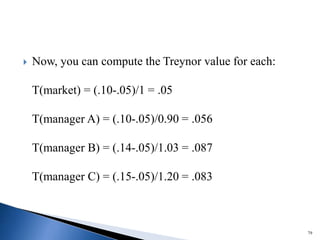
 Now, you can compute the Treynor value for each:
T(market) = (.10-.05)/1 = .05
T(manager A) = (.10-.05)/0.90 = .056
T(manager B) = (.14-.05)/1.03 = .087
T(manager C) = (.15-.05)/1.20 = .083
79
Alpha is the risk-adjusted return on an investment
 Alpha demonstrates whether your investment
outperformed or underperformed a risk-related
benchmark
 The formula for alpha is expressed as follows:
a = Rp – [Rf + (Rm – Rf) ß]
Where:
 Rp = Realized return of portfolio
 Rm = Market return
 Rf = risk-free rate
80
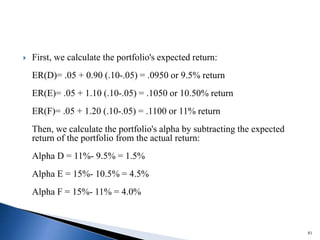
 First, we calculate the portfolio's expected return:
ER(D)= .05 + 0.90 (.10-.05) = .0950 or 9.5% return
ER(E)= .05 + 1.10 (.10-.05) = .1050 or 10.50% return
ER(F)= .05 + 1.20 (.10-.05) = .1100 or 11% return
Then, we calculate the portfolio's alpha by subtracting the expected
return of the portfolio from the actual return:
Alpha D = 11%- 9.5% = 1.5%
Alpha E = 15%- 10.5% = 4.5%
Alpha F = 15%- 11% = 4.0%
81
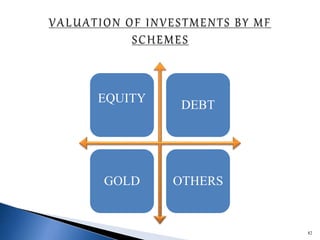
EQUITY
DEBT
GOLD OTHERS
82
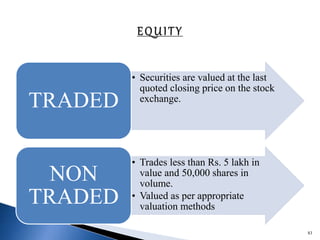
• Securities are valued at the last
quoted closing price on the stock
exchange.
TRADED
• Trades less than Rs. 5 lakh in
value and 50,000 shares in
volume.
• Valued as per appropriate
valuation methods
NON
TRADED
83
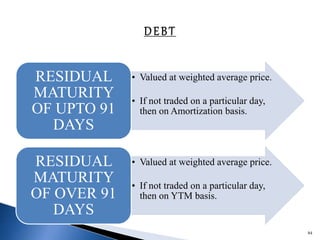
• Valued at weighted average price.
• If not traded on a particular day,
then on Amortization basis.
RESIDUAL
MATURITY
OF UPTO 91
DAYS
• Valued at weighted average price.
• If not traded on a particular day,
then on YTM basis.
RESIDUAL
MATURITY
OF OVER 91
DAYS
84
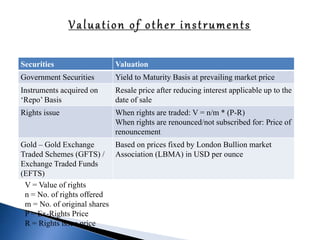
Securities Valuation
Government Securities Yield to Maturity Basis at prevailing market price
Instruments acquired on
‘Repo’ Basis
Resale price after reducing interest applicable up to the
date of sale
Rights issue When rights are traded: V = n/m * (P-R)
When rights are renounced/not subscribed for: Price of
renouncement
Gold – Gold Exchange
Traded Schemes (GFTS) /
Exchange Traded Funds
(EFTS)
Based on prices fixed by London Bullion market
Association (LBMA) in USD per ounce
V = Value of rights
n = No. of rights offered
m = No. of original shares
P = Ex-Rights Price
R = Rights issue price
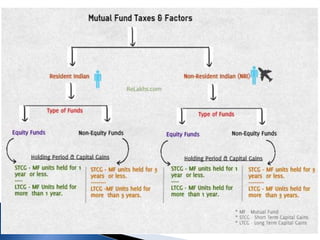
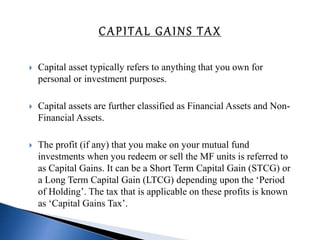
 Capital asset typically refers to anything that you own for
personal or investment purposes.
 Capital assets are further classified as Financial Assets and Non-
Financial Assets.
 The profit (if any) that you make on your mutual fund
investments when you redeem or sell the MF units is referred to
as Capital Gains. It can be a Short Term Capital Gain (STCG) or
a Long Term Capital Gain (LTCG) depending upon the ‘Period
of Holding’. The tax that is applicable on these profits is known
as ‘Capital Gains Tax’.
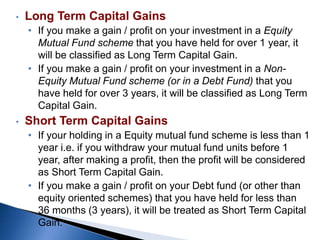
• Long Term Capital Gains
• If you make a gain / profit on your investment in a Equity
Mutual Fund scheme that you have held for over 1 year, it
will be classified as Long Term Capital Gain.
• If you make a gain / profit on your investment in a Non-
Equity Mutual Fund scheme (or in a Debt Fund) that you
have held for over 3 years, it will be classified as Long Term
Capital Gain.
• Short Term Capital Gains
• If your holding in a Equity mutual fund scheme is less than 1
year i.e. if you withdraw your mutual fund units before 1
year, after making a profit, then the profit will be considered
as Short Term Capital Gain.
• If you make a gain / profit on your Debt fund (or other than
equity oriented schemes) that you have held for less than
36 months (3 years), it will be treated as Short Term Capital
Gain.
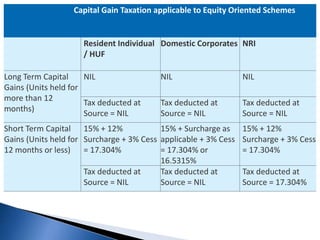
Capital Gain Taxation applicable to Equity Oriented Schemes
Resident Individual
/ HUF
Domestic Corporates NRI
Long Term Capital
Gains (Units held for
more than 12
months)
NIL NIL NIL
Tax deducted at
Source = NIL
Tax deducted at
Source = NIL
Tax deducted at
Source = NIL
Short Term Capital
Gains (Units held for
12 months or less)
15% + 12%
Surcharge + 3% Cess
= 17.304%
15% + Surcharge as
applicable + 3% Cess
= 17.304% or
16.5315%
15% + 12%
Surcharge + 3% Cess
= 17.304%
Tax deducted at
Source = NIL
Tax deducted at
Source = NIL
Tax deducted at
Source = 17.304%
Capital Gain Taxation applicable to Schemes other than equity oriented
schemes
Resident Individual /
HUF
Domestic
Corporates
NRI
Long Term Capital Gains
[Units held for more than
36 months] (Listed Units)
20% with indexation + 12%
Surcharge + 3% Cess
= 23.072%
20% with indexation +
Surcharge as applicable +
3% Cess
= 22.042% or 23.072%
20% with indexation +
12% Surcharge + 3%
Cess
= 23.072%
Tax deducted at Source =
NIL
Tax deducted at Source =
NIL
Tax deducted at Source
= 23.072%
Long Term Capital Gains
[Units held for more than
36 months] (Unlisted
Units)
20% with indexation + 12%
Surcharge + 3% Cess
= 23.072%
20% with indexation +
Surcharge as applicable +
3% Cess
= 22.042% or 23.072%
10% without indexation
+ 12% Surcharge + 3%
Cess
= 11.536%
Tax deducted at Source =
NIL
Tax deducted at Source =
NIL
Tax deducted at Source
= 11.536%
Short Term Capital Gains
(Units held for less than 36
months)
30%^ + 12% Surcharge +
3% Cess = 34.608%
30% + Surcharge as
applicable + 3% Cess =
34.608% or 33.063%
30%^ + 12% Surcharge
+ 3% Cess = 34.608%
Tax deducted at Source =
NIL
Tax deducted at Source =
NIL
Tax deducted at Source
= 34.608% (Listed and
Unlisted) ^
 The securities transaction tax (STT) was introduced in India a few years
ago, to stop tax avoidance of capital gains tax.
 Transactions in stock, index options and futures would also be subject to
transaction tax. Tax is applicable whether you buy or sell the securities.
 STT is levied on every purchase or sale of securities that are listed on the
Indian stock exchanges. This would include shares, derivatives or equity-
oriented mutual funds units.
 The rate of tax that is deducted is determined by the central government,
and it varies with different types of transactions and securities.
 STT is deducted at source by the broker or AMC, at the time of the
transaction itself, the net result is that it pushes up the cost of the
transaction done.
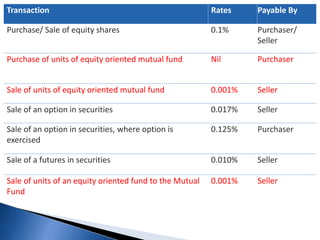
Transaction Rates Payable By
Purchase/ Sale of equity shares 0.1% Purchaser/
Seller
Purchase of units of equity oriented mutual fund Nil Purchaser
Sale of units of equity oriented mutual fund 0.001% Seller
Sale of an option in securities 0.017% Seller
Sale of an option in securities, where option is
exercised
0.125% Purchaser
Sale of a futures in securities 0.010% Seller
Sale of units of an equity oriented fund to the Mutual
Fund
0.001% Seller
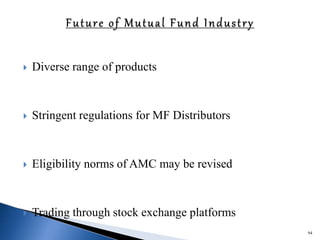
 Diverse range of products
 Stringent regulations for MF Distributors
 Eligibility norms of AMC may be revised
 Trading through stock exchange platforms
94
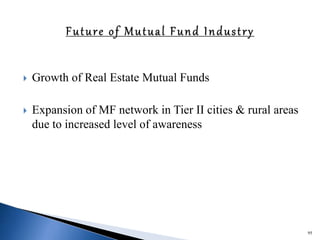
 Growth of Real Estate Mutual Funds
 Expansion of MF network in Tier II cities & rural areas
due to increased level of awareness
95
mutual fund

mutual fund

  • 2.
     INTRODUCTION  HISTORY PROS AND CONS  STRUCTURE  SEBI GUIDELINES  TERMS RELATED TO MF  TYPES  RATIOS  MF TAXATION  FUTURE OF MUTUAL FUND INDUSTRY
  • 3.
    • Requirement of Capital •Time • Expertise • Lack of Information • Portfolio • Volatility
  • 4.
    PRODUCT RETURN SAFETYLIQUIDITY TAX BENEFI T CONVINIENC E BANK DEPOSIT LOW HIGH HIGH NO HIGH EQUITY HIGH LOW HIGH OR LOW NO MODERATE DEBT MODERATE MODERATE LOW NO LOW PPF MODERATE HIGH LOW YES MODERATE LIFE INSURANCE MODERATE HIGH LOW YES MODERATE NSC MODERATE HIGH LOW YES MODERATE MUTUAL FUNDS (OPEN ENDED) MODERATE MODERATE HIGH NO HIGH MUTUAL FUNDS (CLOSE ENDED) MODERATE MODERATE HIGH YES HIGH
  • 5.
    5 Safety You get your moneyback Liquidity You get your money back when you want it Plus Convenience How easy is it to invest, disinvest and adjust to your needs? Post-tax Returns How much is really left for you post tax?
  • 7.
    • A mutualfund is the trust that pools the savings of a number of investors who share a common financial goal. • The money thus collected is then invested in capital market instruments such as shares, debentures and other securities. • The income earned through these investments and the capital appreciation realized are shared by its unit holders in proportion to the number of units owned by them.
  • 11.
    • First Phase– 1964-87 -Unit Trust of India (UTI) was established on 1963 by an Act of Parliament. • Second Phase – 1987-1993 (Entry of Public Sector Funds) -SBI Mutual Fund was the first non- UTI Mutual Fund established in June 1987
  • 12.
    • Third Phase– 1993-2003 (Entry of Private Sector Funds) Kothari Pioneer (now merged with Franklin Templeton) was the first private sector mutual fund registered in July 1993. • Fourth Phase – since February 2003 -In February 2003, following the repeal of the Unit Trust of India Act 1963 UTI was bifurcated into two separate entities.
  • 14.
    • Professional Management •Diversification • Convenient Administration • Return potential • Low cost • Liquidity • Transparency • Flexibility • Choice of schemes • Well regulated • Tax benefits
  • 15.
     Purchase andwithdrawal costs  Ongoing management fees  Potential poor performance  No control over capital gains distribution  Complicated tax reporting issues  Potential market risk with all investments  Some sales personnel are aggressive
  • 16.
     Investment Performanceand Risk  Sector Performance  Management Fees and Expense Ratio  Cash Flows
  • 17.
     (AUM) representsthe money which is managed by a mutual fund in a scheme  AUM = Net Asset Value * the number of units issued by that scheme  A change in AUM can happen either because of fall in NAV or redemptions.
  • 21.
    MF should havethe following 3-tier structure, they are:  Sponsor  Trustee / Trust  Asset Management Company  Custodian and other parties
  • 23.
     Akin tothe promoter of the company  Contributes atleast 40% of the net worth of the AMC.  Posses sound financial record over five years period  Establishes the fund  Gets the fund registered with SEBI  Forms a trust and appoints a board of trustee
  • 24.
     Holds assetson behalf of unit holders in trust  Trustees are caretaker of unit holders money.  Two third of the trustees shall be independent persons (not associated with the sponsor).  Trustees ensure that the system, processes & personnel are in place  Resolves Unit holders Grievances  Appoint AMC and custodian
  • 25.
     Floats schemesand manages according to SEBI.  Chairman of AMC cannot be a trustee of any MF.  Cannot undertake any other business activity other than PMS  Atleast 50% of independent directors
  • 26.
     Holds thefunds securities in safekeeping  Settles securities transaction for the fund  Collects interest & dividends paid on securities  Records information on corporate actions
  • 27.
     Maintains recordsof unit holders accounts and transactions  Disburses & receives funds from unit holder transactions  Prepares and distributes a/c settlements  Tax information, handles unit holder communication  Provides unit holder transaction services
  • 28.
     Incorporated on22 Aug, 1995  Modeled on the lines of SRO  Professional and healthy market  Protects and promotes the interest of investors
  • 29.
     Formation oftrust.  Set up of board of trustees  Minimum net worth of the AMC should be 10 crs  AMC and trustees – 2 separate entities  Approval of SEBI 29
  • 30.
     Registration ofMF schemes  90% minimum distribution of profits  A common format to disclose their entire portfolios on half- yearly basis  fully revise and update offer document and memorandum at least once in two years  Bring uniformity in disclosures of various categories of advertisements  Reduce initial offer period from a maximum of 45 days to 30 days
  • 31.
     Dispatch statementsof account once the minimum subscription amount specified in the offer document is received  Invest in mortgaged backed securities of investment grade given by credit rating agency.  Identify and make provisions for the non-performing assets (NPAs)  Disclose information in a revised format on unit capital, reserves, performance in terms of dividend and rise/fall in NAV during the half-year period, annualized yields over the last 1, 3, 5 years in addition to percentage of management fees etc.  Declare their NAV s and sale/repurchase prices of all schemes updated daily on regular basis on the AMFI website by 8.00 p.m. and declare NA V s of their close ended schemes on every Wednesday
  • 32.
     un-audited half-yearlyresults are to be published before the expiry of one month from the close of each half-year  All the schemes by mutual funds shall be launched within six months from the date of the letter containing observations from SEBI on the scheme offer document  Mutual funds are required to disclose large unit-holdings in the scheme, which are over 25% of the NAV
  • 33.
     Mutual, beneficialand proportional owners  Receive dividend within 30 days of declaration  In case of redemption, 10 working days. If the AMC fails, an interest of 15% is paid.  In case of failure to claim the redemption proceeds, then NAV is applicable 33
  • 34.
     Right toreceive audited annual reports and other relevant information  Right to wound up a scheme if unit holders representing 75% of scheme’s assets pass a resolution  Right to be informed about the fundamental attributes of a scheme  Can approach Investor relations officer for grievance redressal 34
  • 35.
     NFO islaunched in the market to raise capital  AMC launches new schemes, under the name of the Trust  NFOs are offered for a stipulated period.  Investors can invest in these schemes at the offer price (most cases Rs 10) for stipulated period only.  After the NFO period, investors can take exposure in these funds only at the prevailing NAV.
  • 36.
    • Discloses importantinformation about the investment instrument. • SEBI’s format for offer document includes: o Date of publication, name and type of scheme o Investment objective o Risk factor o Historic stats o Features and plans of scheme o Management of funds o Information about load and expenses o Investment restrictions o Turnover of portfolio o Unitholders’ rights o Tax treatments o Valuation policy o NAV o Minimum investment
  • 37.
     NAV representsa fund's per share market value.  Price at which investors buy ("bid price") fund shares from a fund company and sell them ("redemption price") to a fund company.  NAV computation is undertaken once at the end of each trading day based on the closing market prices of the portfolio's securities. Market value of the funds investments + Receivables + Accrued Income – (Liabilities + Accrued expenses) _________________________________________________ Number of units outstanding
  • 39.
    LIABILITIES RS CRS ASSETS RS CRS UNITCAPITAL 300 SHARES 345 RESERVES AND SURPLUS 85.7 DEBENTURES 23 MONEY MARKET INSTRUMENTS 12 ACCRUED EXPENDITURE 1.5 ACCRUED INCOME 2.3 OTHER CURRENT LIABILITIES 0.5 OTHER CURRENT ASSETS 1.2 DEFERRED REVENUE EXPENDITURE 4.2 387.7 387.7 UNITS ISSUED (Cr.) 30 FACE VALUE (RS.) 10 NET ASSETS (RS.) 385.7 NAV (RS.) 12.86 39 RETURN OF 28.57%
  • 40.
  • 41.
    41 Transaction Fees Purchase Fees RedemptionFees Exchange Fees Periodic fees Management fees Account fees  Other operating expenses Transaction costs
  • 42.
     LOAD  NOLOAD 42 Load is fee payable by the investor when they enter/exit an MF scheme
  • 43.
     A measureof what it costs an investment company to operate a mutual fund.  Expense ratio= fund's operating expenses /average dollar value of its AUM  largest component of operating expenses is the fee paid to a fund's investment manager/advisor
  • 44.
    HEDGE FUNDS PRIVATE EQUITY FUNDS VENTUR E CAPITAL FUNDS MUTUAL FUNDS Investment Tradable securities Private companies Start upsStocks, bonds, derivatives etc Risk Very high medium High Low Availability Only to HNI’S Everyone Everyone Everyone Tenure shorter Longer (5-8) Medium (3-5) 44
  • 46.
     Equity funds Money market mutual funds  Debt funds  Hybrid funds  Gilt funds  Other funds 46
  • 47.
    Diversified Equity Fund:These funds aim to diversify the investments across companies and across sectors. Small and Mid-Cap Funds: These funds are aggressive in their investment nature with an aim to generate long term appreciation from a portfolio that is substantially constituted of equity and equity related securities, which are not part of top 100 stocks. Sector Specific Funds: These invest into sectors which are mentioned in their objective or offer documents, such as banking, FMCG, etc. Tax Saving Funds (ELSS): It offers tax rebates to investor u/s 80C of I. T. Act. 47
  • 48.
  • 49.
     Also knownas Money Market Schemes  These funds provide easy liquidity and preservation of capital.  These schemes invest in short-term instruments like Treasury Bills, inter-bank call money market, CPs and CDs.  These funds are meant for short-term cash management of corporate houses and are meant for an investment horizon of 1 day to 3 months. 49
  • 50.
  • 51.
    Gilt Funds: Investtheir corpus in securities issued by government. These funds carry zero default risk but are associated with Interest Rate Risk. Income Funds: Invest a major portion into various debt instruments such as bonds, corporate debentures and government securities. Monthly Income Plan (MIPs): MIPS invests maximum of their total corpus in debt instruments while they take minimum exposure in equities. It gets benefit of both equity and debt market. Short Term Plans (STPs): These investments are meant for a horizon of three to six months. These funds primarily invest in short term papers like Certificate of Deposits (CDs) and Commercial Papers (CPs) 51
  • 52.
  • 54.
     Systematic investmentplan (SIP) - Investor can invest in fixed amount every month for a pre-decided period of time. Usually 6months or 1year. - Helps investor to average out the cost of investment  Systematic withdrawal plan (SWP) - Minimize the risk of redeeming all the units - Meets liquidity needs for regular expenses - Profits are regularly encashed by the investor  Systematic Transfer plan (STP)
  • 55.
    Average unit costto investor = Rs. 11.86 (60000/5058.35) Average unit price to investor = Rs. 11.91 (Avg. of unit prices)
  • 56.
     Systematic withdrawalplan (SWP) - Minimize the risk of redeeming all the units - Meets liquidity needs for regular expenses - Profits are regularly encashed by the investor
  • 58.
     Systematic Transferplan (STP) - Amount withdrawn is reinvested in some other scheme of same MF
  • 59.
    Example – Howdoes a Systematic Transfer Plan work This is best understood using an example. Say you want to transfer2,000 from an equity MF scheme to a debt MF scheme every month. Month 1 Equity MF units before transfer: 1,000 Debt MF units before transfer: 0 Equity MF unit NAV:20 Debt MF unit NAV:15 Equity MF units needed (redeemed from your account) =2,000 /20 = 100 Debt MF units allotted =2,000 /15 = 133.33 Equity MF units after transfer = 1000 – 100 = 900 Debt MF units after transfer= 0 + 133.33 = 133.33 59
  • 60.
    Month 2 Equity MFunits before transfer: 900 Debt MF units before transfer: 133.33 Equity MF unit NAV:22 Debt MF unit NAV:16 Equity MF units needed ( redeemed from your account) =2,000 /22 = 90.91 Debt MF units allotted =2,000 /16 = 125 Equity MF units after transfer = 900 – 90.91 = 809.09 Debt MF units after transfer = 133.33 + 125 = 258.33 And so on… 60
  • 61.
     To attractRisk averse investors  Scheme aims at protecting initial capital investment and does not guarantee returns
  • 62.
     Example : 1)If you invest Rs. 100 ; after 1 year returns is 20% so end of the year it becomes Rs. 100 + 20= Rs. 120. 2) Now second year also you make a profit of 20% so your money is Rs. 120 + 24 = Rs. 144 3) After 2 years your money of Rs. 100 is now Rs. 144 so your Absolute returns for 2 years is 44% whereas Annualized returns is 20% year on year. 62
  • 63.
     SEBI regulationon disclosure in offer document, advertisment etc.  Steps:  calculate growth in number of units (dividend re- invested)  calculate opening wealth  calculate closing wealth
  • 64.
     Returns ◦ XIRR ◦Dividend Re-investment (CAGR) ◦ Compounding of Periodic Returns • Risk ◦ Standard Deviation ◦ Alpha ◦ Beta ◦ Weighted Average Maturity ◦ Modified Duration  Risk Adjusted Returns ◦ Sharpe Ratio ◦ Sortino Ratio ◦ Treynor Ratio ◦ Jensen’s Alpha
  • 65.
    65 The compounded annual growthrate (CAGR) can be calculated as follows: CAGR = 100 X {(I2 ÷ I1) (1÷r)}-1 i.e. 100 X {(19,127 ÷ 14,000)(365÷382} - 1 i.e. 34.74%
  • 66.
     It israte of return for the period of holding  Also known as total return or point to point returns.  HPR = {[INCOME+(END PRICE – BEGINNING PRICE)]*BEGINNING PRICE}*100  HPR ={ [2+(12-10)]/10}*100 = 40% DIVIDEND 2 HPR 40% BEG.PRICE 10 ENDPRICE 12 HOLDINGPERIOD 1YEAR
  • 67.
  • 68.
    68 The compounded annualgrowth rate (CAGR) can be calculated as follows: CAGR = 100 X {(I2 ÷ I1) (1÷r)}-1 i.e. 100 X {(19,127 ÷ 14,000)(365÷382} - 1 i.e. 34.74%
  • 69.
     difference betweenthe returns an investor expects from a fund  Alpha = {(Fund return-Risk free return) – (Funds beta) *(Benchmark return- risk free return)}  Fund return (Fund performance in last one year): 75% Risk free return: 8% Benchmark return (Sensex performance in last one year): 41% Beta: 0.69 Alpha=0.44 for this fund.  A positive alpha means the fund has outperformed its benchmark index
  • 70.
     Market riskis measured by Beta  It relates the return of a stock or mutual fund to a market index  Reflects the sensitivity of a fund’s return to fluctuations in market index  Calculation of Beta: Y = a + βX  Beta = 1 indicates -security's price will move with the market.  Beta < 1 means security will be less volatile than the market.  Beta > 1 indicates that the security's price will be more volatile than the market.  Eg- if a stock's beta is 1.2, it's 20% more volatile than the market.
  • 71.
     It quantifieshow a fund performs relative to the risk it takes  Sharpe index measures risk premium of a portfolio, relative to the total amount for risk in the portfolio Sharpe Index =(Rp) – (Rt)/ Standard Deviations of the Portfolio Return Portfolio Average Return (Rp) Risk Free Rate of Interest (Rt) 71
  • 72.
  • 73.
     Beta comparesa fund's returns with a benchmark, standard deviation measures how far a fund's recent numbers stray from its long-term average.  Fund X has a 10% average rate of return and a standard deviation of 5%, most of the time, its return will range from 5% to 15%.  Large standard deviation supposedly shows a more risky fund than a smaller one  Higher the deviation, higher the risk & vice versa.  It is calculated by taking the square root of variance. 73
  • 74.
  • 75.
    75 Fixed rate debtinstruments have a price risk. When interest rates in the market go up, the debt instruments already issued, based on the erstwhile lower interest rates, lose value. Similarly, when interest rates in the market go down fixed rate debt instruments gain value.
  • 76.
    76 The implication isthat if the yields in the market were to change by 1%, this debt security is likely to change in value by 1.68%.
  • 77.
    77 S(market) = (.10-.05)/.18= .278 S(manager X) = (.14-.05)/.11 = .818 S(manager Y) = (.17-.05)/.20 = .600 S(manager Z) = (.19-.05)/.27 = .519
  • 78.
     (Portfolio Return– Risk-Free Rate) / Beta  The numerator identifies the risk premium and the denominator corresponds with the risk of the portfolio. The resulting value represents the portfolio's return per unit risk 78
  • 79.
     Now, youcan compute the Treynor value for each: T(market) = (.10-.05)/1 = .05 T(manager A) = (.10-.05)/0.90 = .056 T(manager B) = (.14-.05)/1.03 = .087 T(manager C) = (.15-.05)/1.20 = .083 79
  • 80.
    Alpha is therisk-adjusted return on an investment  Alpha demonstrates whether your investment outperformed or underperformed a risk-related benchmark  The formula for alpha is expressed as follows: a = Rp – [Rf + (Rm – Rf) ß] Where:  Rp = Realized return of portfolio  Rm = Market return  Rf = risk-free rate 80
  • 81.
     First, wecalculate the portfolio's expected return: ER(D)= .05 + 0.90 (.10-.05) = .0950 or 9.5% return ER(E)= .05 + 1.10 (.10-.05) = .1050 or 10.50% return ER(F)= .05 + 1.20 (.10-.05) = .1100 or 11% return Then, we calculate the portfolio's alpha by subtracting the expected return of the portfolio from the actual return: Alpha D = 11%- 9.5% = 1.5% Alpha E = 15%- 10.5% = 4.5% Alpha F = 15%- 11% = 4.0% 81
  • 82.
  • 83.
    • Securities arevalued at the last quoted closing price on the stock exchange. TRADED • Trades less than Rs. 5 lakh in value and 50,000 shares in volume. • Valued as per appropriate valuation methods NON TRADED 83
  • 84.
    • Valued atweighted average price. • If not traded on a particular day, then on Amortization basis. RESIDUAL MATURITY OF UPTO 91 DAYS • Valued at weighted average price. • If not traded on a particular day, then on YTM basis. RESIDUAL MATURITY OF OVER 91 DAYS 84
  • 85.
    Securities Valuation Government SecuritiesYield to Maturity Basis at prevailing market price Instruments acquired on ‘Repo’ Basis Resale price after reducing interest applicable up to the date of sale Rights issue When rights are traded: V = n/m * (P-R) When rights are renounced/not subscribed for: Price of renouncement Gold – Gold Exchange Traded Schemes (GFTS) / Exchange Traded Funds (EFTS) Based on prices fixed by London Bullion market Association (LBMA) in USD per ounce V = Value of rights n = No. of rights offered m = No. of original shares P = Ex-Rights Price R = Rights issue price
  • 88.
     Capital assettypically refers to anything that you own for personal or investment purposes.  Capital assets are further classified as Financial Assets and Non- Financial Assets.  The profit (if any) that you make on your mutual fund investments when you redeem or sell the MF units is referred to as Capital Gains. It can be a Short Term Capital Gain (STCG) or a Long Term Capital Gain (LTCG) depending upon the ‘Period of Holding’. The tax that is applicable on these profits is known as ‘Capital Gains Tax’.
  • 89.
    • Long TermCapital Gains • If you make a gain / profit on your investment in a Equity Mutual Fund scheme that you have held for over 1 year, it will be classified as Long Term Capital Gain. • If you make a gain / profit on your investment in a Non- Equity Mutual Fund scheme (or in a Debt Fund) that you have held for over 3 years, it will be classified as Long Term Capital Gain. • Short Term Capital Gains • If your holding in a Equity mutual fund scheme is less than 1 year i.e. if you withdraw your mutual fund units before 1 year, after making a profit, then the profit will be considered as Short Term Capital Gain. • If you make a gain / profit on your Debt fund (or other than equity oriented schemes) that you have held for less than 36 months (3 years), it will be treated as Short Term Capital Gain.
  • 90.
    Capital Gain Taxationapplicable to Equity Oriented Schemes Resident Individual / HUF Domestic Corporates NRI Long Term Capital Gains (Units held for more than 12 months) NIL NIL NIL Tax deducted at Source = NIL Tax deducted at Source = NIL Tax deducted at Source = NIL Short Term Capital Gains (Units held for 12 months or less) 15% + 12% Surcharge + 3% Cess = 17.304% 15% + Surcharge as applicable + 3% Cess = 17.304% or 16.5315% 15% + 12% Surcharge + 3% Cess = 17.304% Tax deducted at Source = NIL Tax deducted at Source = NIL Tax deducted at Source = 17.304%
  • 91.
    Capital Gain Taxationapplicable to Schemes other than equity oriented schemes Resident Individual / HUF Domestic Corporates NRI Long Term Capital Gains [Units held for more than 36 months] (Listed Units) 20% with indexation + 12% Surcharge + 3% Cess = 23.072% 20% with indexation + Surcharge as applicable + 3% Cess = 22.042% or 23.072% 20% with indexation + 12% Surcharge + 3% Cess = 23.072% Tax deducted at Source = NIL Tax deducted at Source = NIL Tax deducted at Source = 23.072% Long Term Capital Gains [Units held for more than 36 months] (Unlisted Units) 20% with indexation + 12% Surcharge + 3% Cess = 23.072% 20% with indexation + Surcharge as applicable + 3% Cess = 22.042% or 23.072% 10% without indexation + 12% Surcharge + 3% Cess = 11.536% Tax deducted at Source = NIL Tax deducted at Source = NIL Tax deducted at Source = 11.536% Short Term Capital Gains (Units held for less than 36 months) 30%^ + 12% Surcharge + 3% Cess = 34.608% 30% + Surcharge as applicable + 3% Cess = 34.608% or 33.063% 30%^ + 12% Surcharge + 3% Cess = 34.608% Tax deducted at Source = NIL Tax deducted at Source = NIL Tax deducted at Source = 34.608% (Listed and Unlisted) ^
  • 92.
     The securitiestransaction tax (STT) was introduced in India a few years ago, to stop tax avoidance of capital gains tax.  Transactions in stock, index options and futures would also be subject to transaction tax. Tax is applicable whether you buy or sell the securities.  STT is levied on every purchase or sale of securities that are listed on the Indian stock exchanges. This would include shares, derivatives or equity- oriented mutual funds units.  The rate of tax that is deducted is determined by the central government, and it varies with different types of transactions and securities.  STT is deducted at source by the broker or AMC, at the time of the transaction itself, the net result is that it pushes up the cost of the transaction done.
  • 93.
    Transaction Rates PayableBy Purchase/ Sale of equity shares 0.1% Purchaser/ Seller Purchase of units of equity oriented mutual fund Nil Purchaser Sale of units of equity oriented mutual fund 0.001% Seller Sale of an option in securities 0.017% Seller Sale of an option in securities, where option is exercised 0.125% Purchaser Sale of a futures in securities 0.010% Seller Sale of units of an equity oriented fund to the Mutual Fund 0.001% Seller
  • 94.
     Diverse rangeof products  Stringent regulations for MF Distributors  Eligibility norms of AMC may be revised  Trading through stock exchange platforms 94
  • 95.
     Growth ofReal Estate Mutual Funds  Expansion of MF network in Tier II cities & rural areas due to increased level of awareness 95

Editor's Notes

  • #12 . The first scheme launched by UTI was Unit Scheme 1964. At the end of 1988 UTI had Rs.6, 700 crores of assets under management.
  • #29 SRO- SELF REGULATORY ORGANIZATION-  non-governmental organization that has the power to create and enforce industry regulations and standards. The priority is to protect investors through the establishment of rules that promote ethics and equality.
  • #70 Whereas, a negative alpha indicates an underperformance of the fund. The more positive an alpha the healthier for investors.   Here, the fund has underperformed since an alpha we computed is less than beta. It mean’s fund has produced less returns considering the risks fund is taking while comparing it with actual return to the one predicted by beta.   Note: The ideal time period for analysing alpha and beta value is one year returns from their funds.
  • #91 $ - Surcharge at the rate of 12% is levied in case of individual/HUF unit holders where their income exceeds ` 1 crore. @- Surcharge at the rate of 7% is levied for domestic corporate unit holders where the income exceeds ` 1 crore but less than ` 10 crores and at the rate of 12%, where income exceeds ` 10 crores. #- Short term/long term capital gain tax will be deducted at the time of redemption of units in case of NRI investors only.
  • #92  The Finance Act, 2015 provides tax exemption to unit holders upon consolidation or merger of mutual fund schemes, provided consolidation is of two or more schemes of equity oriented fund or two or more schemes of a fund other than equity oriented fund. For the purpose of determining the tax payable, the amount of distributed income be increased to such amount as would, after reduction of tax from such increased amount, be equal to the income distributed by the Mutual Fund. The impact of the same has not been reected above. $ - Surcharge at the rate of 12% is levied in case of individual/HUF unit holders where their income exceeds Rs. 1 crore. @- Surcharge at the rate of 7% is levied for domestic corporate unit holders where the income exceeds Rs 1 crore but less than Rs 10 crores and at the rate of 12%, where income exceeds Rs 10 crores. #- Short term/long term capital gain tax will be deducted at the time of redemption of units in case of NRI investors only. ^- Assuming the investor falls into the highest tax bracket Education Cess at the rate 3% will continue to apply on tax plus surcharge