COMMERCE AND MANAGEMENT ASSOCIATIONMUTUAL FUNDSBy : Vinayak Pai ,IInd Bcom, SVS College BantwalVenue: Academy Hall
   Introduction             Mutual fund is a mechanism for pooling the resources by issuing units to the investors & investing funds in securities in accordance with objectives as disclosed in offer document.           Unit Trust of India was the first mutual fund set up in India in the year 1963.  In early 1990’s Government allowed public sector banks & institutions to set up mutual funds.  In early 1992, Securities and exchange Board of India (SEBI) Act was passed.  As far as MFs are concerned, SEBI formulates policies & regulates the MFs to protect the interest of the investors.
Meaning         Mutual Fund is a pool of money, which is collected from many investors and invested by  Asset Management Company (AMC) to achieve some common objective of the investors.         Mutual fund is a collective investment process. AMC invests collected money in various securities to generate returns for the investors. In  mutual fund investors are the owners of the funds.    `
Definitions According to Praveen N Shroff MF is" a portfolio of stock market shares and other financial instruments, built with funds collected from small investors, whose primary concern is security of investment’’.         According to SEBI Regulations,1996 “MF means a fund established in the form of a trust to raise monies through the sale of units to the public or a section of public undergone or more schemes for investing in securities, in accordance with regulations’’.
ObjectivesMobilizing small savingsDiversification of portfolioInvestors educationInvestment researchStability Safe investment
Formation & ManagementSEBI (MF) Regulations,1996 regulates the structures of MFs in India. MFs are constituted in the form of a public trust created under the INDIAN TRUSTS Act 1882. This trust will be created by Sponsor of the MF.  The Sponsor will make initial contribution in this trust.
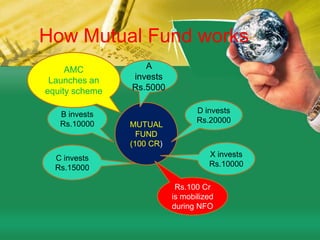
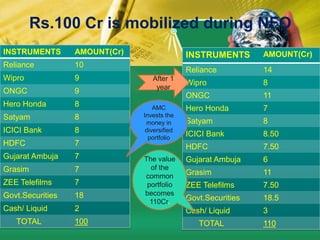
How Mutual Fund worksAMC Launches an equity schemeA  investsRs.5000D investsRs.20000MUTUAL FUND(100 CR)B investsRs.10000X investsRs.10000C invests Rs.15000Rs.100 Cr is mobilized during NFO
Rs.100 Cr is mobilized during NFOAfter 1 yearAMC  Invests the money in diversified  portfolioThe value of the common portfolio becomes 110Cr.
After one year of investmentValue of A’s investment Rs.5500The common fool rises by 10%Value of D’s investmentRs.22000Value B’s investmentRs.11000MUTUAL FUND(110 CR)Value of X’s investsRs.11000Value of C’s investment Rs.15500
Parties to a Mutual Fund     As per these regulations , MF should have the following 3-tier structure, they are:SponsorTrustee / TrustAsset Management CompanyCustodian     Other functionaries
SponsorSEBI Regulations define Sponsor as any person who either  itself or association with another body corporate establishes a MF.         Sponsor can be compared with a promoter of a company.    E.g.; HDFC Mutual Fund ,UTI MF etc….        Sponsor creates a public trust under Indian Trust Act,1882 (which becomes MF)  and appoints Trustees (by approval of SEBI)
Activities of the Sponsor PROMOTING MF
CONTRIBUTING CAPITAL
APPOINTING OF TRUSTEES
TRACK RECORDING
PROFIT MAKINGTrust / Trustee           A Mutual Fund is formed as a trust.  Trustee manages a trust. They are responsible to the investors in the MF. They take care of the interests of investors in the MF.      Trustees can be formed in two ways Board of Trustees : Appointed by Sponsor of MF. Trustee company : A company registered under Companies Act can be appointed as the Trustee company.
Activities of Trustees Ensuring the activities of the MF    (In accordance with SEBI Regulations,1996) Ensuring the activities of AMC Approving the schemes floated by AMC Reporting SEBI, about the activities of AMC Entering into Investing Management Agreement (IMA) with AMC Appointing Auditors  Appointing Key Personnel Dismissing the AMC (in the extreme cases)
ASSET MANAGEMENT COMPANY (AMC)          An AMC is a company ,registered under the Companies Act,1956 .  The operational management of a MF is in the hands of the AMC. It is also known as Fund Manager .          It designs various schemes of the MF, analyses corporate  performance and securities, and buys and sells securities.         The MF pays a small fee to the AMC for management of its fund.
Features of an AMC It is a Private Limited Company AMC ‘s are registered with SEBI It must have a minimum net worth of Rs.10Cr at all times An AMC cannot act as a AMC of more than one MF All the investments, sale and purchase of securities are done by the AMC AMC cannot undertake any business other than asset management of MF
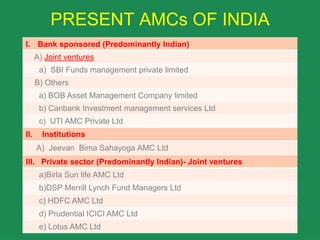
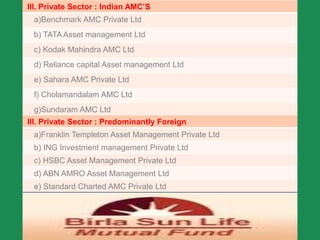
PRESENT AMCs OF INDIA
Other Functionaries          The following functionaries are appointed for specialized functions- CUSTODIAN DEPOSITORY PARTICIPANT REGISTRAR AND TRANSFER AGENTS BROKER SELLING AND DISTIBUTION AGENTS LEGAL ADVISORS AND AUDITORS BANKERS
ROLE CUSTODIAN         The most important asset of any  MF is its portfolio.  Hence, it becomes very important to keep safe the securities. This responsibility is on Custodian. When the securities are held in the demat form, they ensure that the securities bought are transferred to the Demat A/c.       Custodians also do what is necessary regarding any corporate  action like bonus issues, rights offer, offer for sale buy-back and such other things on the advice of AMC.
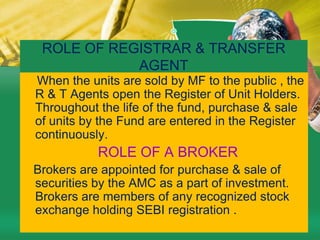
ROLE OF REGISTRAR & TRANSFER AGENTWhen the units are sold by MF to the public , the R & T Agents open the Register of Unit Holders.  Throughout the life of the fund, purchase & sale of units by the Fund are entered in the Register continuously.  ROLE OF A BROKERBrokers are appointed for purchase & sale of     securities by the AMC as a part of investment.  Brokers are members of any recognized stock exchange holding SEBI registration .
ROLE  OF SELLING & DISTRIBUTION AGENT         These agents are appointed to popularize the units of MF among the investors.  They are marketing agents or salesman for the units of MF.  They bring in investors fund for a commission.ROLE OF A DEPOSITORY PARTICIPANTSAMC purchases corporate and other securities which may have to be held in the demat form.  For this purpose the trustees open a demat a/c with a Depository Participants(DP). DP is any bank or financial service company opening & operating demat accounts on behalf of clients either with NSDL or CDSL.
ROLE OF AUDITOR & LEGAL ADVISOR AUDITOR : Like the auditor of any other firm, he inspects the books of accounts maintained and the transactions carried on.  LEGAL ADVISOR: Lawyers or Advocates are employed to comply with legal formalities.
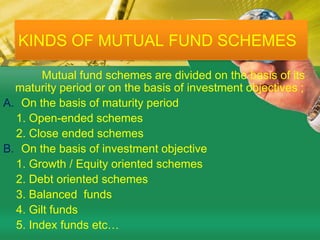
KINDS OF MUTUAL FUND SCHEMES            Mutual fund schemes are divided on the basis of its maturity period or on the basis of investment objectives ;On the basis of maturity period    1. Open-ended schemes    2. Close ended schemesOn the basis of investment objective    1. Growth / Equity oriented schemes    2. Debt oriented schemes    3. Balanced  funds    4. Gilt funds    5. Index funds etc…
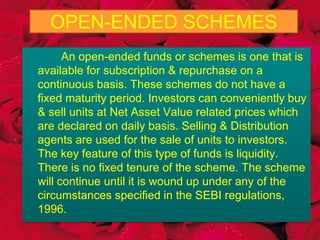
OPEN-ENDED SCHEMES           An open-ended funds or schemes is one that is available for subscription & repurchase on a continuous basis. These schemes do not have a fixed maturity period. Investors can conveniently buy & sell units at Net Asset Value related prices which are declared on daily basis. Selling & Distribution agents are used for the sale of units to investors. The key feature of this type of funds is liquidity. There is no fixed tenure of the scheme. The scheme will continue until it is wound up under any of the circumstances specified in the SEBI regulations, 1996.
CLOSE-END FUNDS          A close-end funds has a stipulated maturity period. The fund is open for subscription only during a specified period at the time of launch of  the schemes. Investors can invest in the schemes at the time of the initial public issue & thereafter they can buy or sell the units of the schemes on the stock exchanges where the units are listed. In order to provide an exist route to the investors, some close-ended funds give an option of selling back the units to the MF through periodic repurchase at NAV related prices. These MF schemes disclose NAV generally on weekly basis
GROWTH/ EQUITY SCHEMES       The fund under the scheme is predominantly invested in equity shares of companies. The main aim is to tap capital gains in the medium to long-term. Fluctuations in share prices may affect the growth or value of the fund. It has comparatively high risk, high return potential & highly extremely  volatile. An investor entering an equity fund should understand that he is taking risk & should be prepared to remain invested in a scheme for a long tenure.
DEBT ORIENTED SCHEMES         A scheme, which invests in debt securities, is known as a debt fund or debt oriented fund or income fund. The fund invests funds in bonds, debentures, Govt. securities, commercial paper & other money market instruments. Such funds are less risky compared to equity schemes. These funds are not affected because of fluctuations in equity markets. However, opportunity of capital appreciation are also limited in such funds. The NAVs of such funds are affected because of changes in interest rates in the country.
BALANCED SCHEMES        The aim of balanced funds is to provide both growth & regular income as such schemes invest both in equities & fixed income securities in the proportion indicated in their offer documents. These are appropriate for investors looking for moderate growth. They generally invest 40-60% in equity & debt instruments. These funds are also affected because of fluctuations in share prices in the stock markets.
MONEY MARKET OR LIQUID FUNDS        These funds are also income funds & their aim is to provide easy liquidity, preservation of capital & moderate income. These schemes invest exclusively in safer short-term instruments such as treasury bills, certificate of deposit, commercial  paper & inter-bank call money, Govt. securities ,etc.  Returns on these schemes fluctuate much less compared to other funds. These funds are appropriate for corporate & individual investors as a mean to park their surplus for short periods.
GILT FUNDS & INDEX FUNDS         Gilt funds invest exclusively in government securities. Govt. securities have no default risk. These funds aim to invest in totally risk free securities. Risk management is total & return is secondary.         Index funds are invested in the shares included in a share index. Amount is allocated among the stocks in such a percentage which each stock claims in the index by way of weightage. The returns are related to the movement in the index.
EQUITY LINKED SAVINGS SCHEME(ELSS)           This scheme was brought into existence in 1992 by a notification of Ministry of Finance. Investors in this scheme are eligible for tax benefits. From the financial year 2005-06 an amount invested in ELSS is eligible to be included in sec 80c deduction up to Rs.1,00,000.  There is a lock in period of 3-years. It is eligible for exemption from capital gains. The fund raised through this scheme is invested in equity shares essentially. These schemes also known as Tax Savings schemes.
EXCHANGE TRADED FUND(ETF)        ETFs are open end-funds that trade on the exchange. Like index funds , ETFs are benchmarked to a stock exchange index. An ETF is a fund created out of specified shares or stocks surrendered by the unit holder.
FUND OF FUNDS SCHEME         It is a fund that is invested not in the securities of companies, but in the units of the same MF or in the units of other MFs. MF stands for diversification of investment. E.g.: Franklin Templeton India Life Stage Fund of Funds.         There are some other types of schemes also they are Fixed term plan series, Theme funds, Contra funds and etc…
NET ASSET VALUE(NAV) & ITS COMPUTATION         The value of the units of a MF scheme is its net asset value (NAV) on a particular day. The NAV of a scheme is calculated as follows:NAV=Market value of investment + Current Assets + other expenses + accrued income – current liabilities- other liabilities- accrued expenses.            All the MFs calculate the NAV continuously & disclose it everyday by posting it on the website of Association of MFs of India(AMFI). The repurchase price & the selling price are calculated on based on the NAV.
PRINCIPLE OF TIME DIVERSIFICATION           This principle of time diversification has given rise to the concept of:Systematic Investment Plan (SIP)Systematic Withdrawal Plan (SWP)Systematic Transfer Plan (STP)
Systematic Investment Plan(SIP)          This is a mode of investment where by the investor invests a fixed amount every month in a particular scheme. It is similar to a recurring bank deposit. As a concept, it is revolutionary. When the NAV is less, the investors will receive more number of units ( as in a declining market) . When the market is booming, he gets less number of units. But , the total investment until that date goes up high because of higher NAV.
Systematic Withdrawal Plan (SWP)       SWP is a mirror image of SIP. Under SWP, the investor would withdraw constant amounts periodically.  The benefits are the same, namely that through SWP the investor can temper gains & losses, though it does not prevent losses.  SWP also has income tax implications.Systematic Transfer Plan(STP)
BENEFITS OF MUTUAL FUNDS           MF play a very dominant  role in the capital formation of the country. The specific benefits of MFs can be as given below:Suitability for Small InvestorsRisk managementWholesale investmentInvestors EducationInvestment ResearchLiquidity of stock marketDevelopment of money market
Savings MobilizationHigher returnsDiversification Very high liquidityAttracting foreign investorsFull time management of the fundsMany schemesGiving a size to the fund of small investorsHighly regulated

Mutual funds vinayak pai

  • 1.
    COMMERCE AND MANAGEMENTASSOCIATIONMUTUAL FUNDSBy : Vinayak Pai ,IInd Bcom, SVS College BantwalVenue: Academy Hall
  • 2.
    Introduction Mutual fund is a mechanism for pooling the resources by issuing units to the investors & investing funds in securities in accordance with objectives as disclosed in offer document. Unit Trust of India was the first mutual fund set up in India in the year 1963. In early 1990’s Government allowed public sector banks & institutions to set up mutual funds. In early 1992, Securities and exchange Board of India (SEBI) Act was passed. As far as MFs are concerned, SEBI formulates policies & regulates the MFs to protect the interest of the investors.
  • 3.
    Meaning Mutual Fund is a pool of money, which is collected from many investors and invested by Asset Management Company (AMC) to achieve some common objective of the investors. Mutual fund is a collective investment process. AMC invests collected money in various securities to generate returns for the investors. In mutual fund investors are the owners of the funds. `
  • 4.
    Definitions According toPraveen N Shroff MF is" a portfolio of stock market shares and other financial instruments, built with funds collected from small investors, whose primary concern is security of investment’’. According to SEBI Regulations,1996 “MF means a fund established in the form of a trust to raise monies through the sale of units to the public or a section of public undergone or more schemes for investing in securities, in accordance with regulations’’.
  • 5.
    ObjectivesMobilizing small savingsDiversificationof portfolioInvestors educationInvestment researchStability Safe investment
  • 6.
    Formation & ManagementSEBI(MF) Regulations,1996 regulates the structures of MFs in India. MFs are constituted in the form of a public trust created under the INDIAN TRUSTS Act 1882. This trust will be created by Sponsor of the MF. The Sponsor will make initial contribution in this trust.
  • 7.
    How Mutual FundworksAMC Launches an equity schemeA investsRs.5000D investsRs.20000MUTUAL FUND(100 CR)B investsRs.10000X investsRs.10000C invests Rs.15000Rs.100 Cr is mobilized during NFO
  • 8.
    Rs.100 Cr ismobilized during NFOAfter 1 yearAMC Invests the money in diversified portfolioThe value of the common portfolio becomes 110Cr.
  • 9.
    After one yearof investmentValue of A’s investment Rs.5500The common fool rises by 10%Value of D’s investmentRs.22000Value B’s investmentRs.11000MUTUAL FUND(110 CR)Value of X’s investsRs.11000Value of C’s investment Rs.15500
  • 10.
    Parties to aMutual Fund As per these regulations , MF should have the following 3-tier structure, they are:SponsorTrustee / TrustAsset Management CompanyCustodian Other functionaries
  • 11.
    SponsorSEBI Regulations defineSponsor as any person who either itself or association with another body corporate establishes a MF. Sponsor can be compared with a promoter of a company. E.g.; HDFC Mutual Fund ,UTI MF etc…. Sponsor creates a public trust under Indian Trust Act,1882 (which becomes MF) and appoints Trustees (by approval of SEBI)
  • 12.
    Activities of theSponsor PROMOTING MF
  • 13.
  • 14.
  • 15.
  • 16.
    PROFIT MAKINGTrust /Trustee A Mutual Fund is formed as a trust. Trustee manages a trust. They are responsible to the investors in the MF. They take care of the interests of investors in the MF. Trustees can be formed in two ways Board of Trustees : Appointed by Sponsor of MF. Trustee company : A company registered under Companies Act can be appointed as the Trustee company.
  • 17.
    Activities of TrusteesEnsuring the activities of the MF (In accordance with SEBI Regulations,1996) Ensuring the activities of AMC Approving the schemes floated by AMC Reporting SEBI, about the activities of AMC Entering into Investing Management Agreement (IMA) with AMC Appointing Auditors Appointing Key Personnel Dismissing the AMC (in the extreme cases)
  • 18.
    ASSET MANAGEMENT COMPANY(AMC) An AMC is a company ,registered under the Companies Act,1956 . The operational management of a MF is in the hands of the AMC. It is also known as Fund Manager . It designs various schemes of the MF, analyses corporate performance and securities, and buys and sells securities. The MF pays a small fee to the AMC for management of its fund.
  • 19.
    Features of anAMC It is a Private Limited Company AMC ‘s are registered with SEBI It must have a minimum net worth of Rs.10Cr at all times An AMC cannot act as a AMC of more than one MF All the investments, sale and purchase of securities are done by the AMC AMC cannot undertake any business other than asset management of MF
  • 20.
  • 22.
    Other Functionaries The following functionaries are appointed for specialized functions- CUSTODIAN DEPOSITORY PARTICIPANT REGISTRAR AND TRANSFER AGENTS BROKER SELLING AND DISTIBUTION AGENTS LEGAL ADVISORS AND AUDITORS BANKERS
  • 23.
    ROLE CUSTODIAN The most important asset of any MF is its portfolio. Hence, it becomes very important to keep safe the securities. This responsibility is on Custodian. When the securities are held in the demat form, they ensure that the securities bought are transferred to the Demat A/c. Custodians also do what is necessary regarding any corporate action like bonus issues, rights offer, offer for sale buy-back and such other things on the advice of AMC.
  • 24.
    ROLE OF REGISTRAR& TRANSFER AGENTWhen the units are sold by MF to the public , the R & T Agents open the Register of Unit Holders. Throughout the life of the fund, purchase & sale of units by the Fund are entered in the Register continuously. ROLE OF A BROKERBrokers are appointed for purchase & sale of securities by the AMC as a part of investment. Brokers are members of any recognized stock exchange holding SEBI registration .
  • 25.
    ROLE OFSELLING & DISTRIBUTION AGENT These agents are appointed to popularize the units of MF among the investors. They are marketing agents or salesman for the units of MF. They bring in investors fund for a commission.ROLE OF A DEPOSITORY PARTICIPANTSAMC purchases corporate and other securities which may have to be held in the demat form. For this purpose the trustees open a demat a/c with a Depository Participants(DP). DP is any bank or financial service company opening & operating demat accounts on behalf of clients either with NSDL or CDSL.
  • 26.
    ROLE OF AUDITOR& LEGAL ADVISOR AUDITOR : Like the auditor of any other firm, he inspects the books of accounts maintained and the transactions carried on. LEGAL ADVISOR: Lawyers or Advocates are employed to comply with legal formalities.
  • 27.
    KINDS OF MUTUALFUND SCHEMES Mutual fund schemes are divided on the basis of its maturity period or on the basis of investment objectives ;On the basis of maturity period 1. Open-ended schemes 2. Close ended schemesOn the basis of investment objective 1. Growth / Equity oriented schemes 2. Debt oriented schemes 3. Balanced funds 4. Gilt funds 5. Index funds etc…
  • 28.
    OPEN-ENDED SCHEMES An open-ended funds or schemes is one that is available for subscription & repurchase on a continuous basis. These schemes do not have a fixed maturity period. Investors can conveniently buy & sell units at Net Asset Value related prices which are declared on daily basis. Selling & Distribution agents are used for the sale of units to investors. The key feature of this type of funds is liquidity. There is no fixed tenure of the scheme. The scheme will continue until it is wound up under any of the circumstances specified in the SEBI regulations, 1996.
  • 29.
    CLOSE-END FUNDS A close-end funds has a stipulated maturity period. The fund is open for subscription only during a specified period at the time of launch of the schemes. Investors can invest in the schemes at the time of the initial public issue & thereafter they can buy or sell the units of the schemes on the stock exchanges where the units are listed. In order to provide an exist route to the investors, some close-ended funds give an option of selling back the units to the MF through periodic repurchase at NAV related prices. These MF schemes disclose NAV generally on weekly basis
  • 30.
    GROWTH/ EQUITY SCHEMES The fund under the scheme is predominantly invested in equity shares of companies. The main aim is to tap capital gains in the medium to long-term. Fluctuations in share prices may affect the growth or value of the fund. It has comparatively high risk, high return potential & highly extremely volatile. An investor entering an equity fund should understand that he is taking risk & should be prepared to remain invested in a scheme for a long tenure.
  • 31.
    DEBT ORIENTED SCHEMES A scheme, which invests in debt securities, is known as a debt fund or debt oriented fund or income fund. The fund invests funds in bonds, debentures, Govt. securities, commercial paper & other money market instruments. Such funds are less risky compared to equity schemes. These funds are not affected because of fluctuations in equity markets. However, opportunity of capital appreciation are also limited in such funds. The NAVs of such funds are affected because of changes in interest rates in the country.
  • 32.
    BALANCED SCHEMES The aim of balanced funds is to provide both growth & regular income as such schemes invest both in equities & fixed income securities in the proportion indicated in their offer documents. These are appropriate for investors looking for moderate growth. They generally invest 40-60% in equity & debt instruments. These funds are also affected because of fluctuations in share prices in the stock markets.
  • 33.
    MONEY MARKET ORLIQUID FUNDS These funds are also income funds & their aim is to provide easy liquidity, preservation of capital & moderate income. These schemes invest exclusively in safer short-term instruments such as treasury bills, certificate of deposit, commercial paper & inter-bank call money, Govt. securities ,etc. Returns on these schemes fluctuate much less compared to other funds. These funds are appropriate for corporate & individual investors as a mean to park their surplus for short periods.
  • 34.
    GILT FUNDS &INDEX FUNDS Gilt funds invest exclusively in government securities. Govt. securities have no default risk. These funds aim to invest in totally risk free securities. Risk management is total & return is secondary. Index funds are invested in the shares included in a share index. Amount is allocated among the stocks in such a percentage which each stock claims in the index by way of weightage. The returns are related to the movement in the index.
  • 35.
    EQUITY LINKED SAVINGSSCHEME(ELSS) This scheme was brought into existence in 1992 by a notification of Ministry of Finance. Investors in this scheme are eligible for tax benefits. From the financial year 2005-06 an amount invested in ELSS is eligible to be included in sec 80c deduction up to Rs.1,00,000. There is a lock in period of 3-years. It is eligible for exemption from capital gains. The fund raised through this scheme is invested in equity shares essentially. These schemes also known as Tax Savings schemes.
  • 36.
    EXCHANGE TRADED FUND(ETF) ETFs are open end-funds that trade on the exchange. Like index funds , ETFs are benchmarked to a stock exchange index. An ETF is a fund created out of specified shares or stocks surrendered by the unit holder.
  • 37.
    FUND OF FUNDSSCHEME It is a fund that is invested not in the securities of companies, but in the units of the same MF or in the units of other MFs. MF stands for diversification of investment. E.g.: Franklin Templeton India Life Stage Fund of Funds. There are some other types of schemes also they are Fixed term plan series, Theme funds, Contra funds and etc…
  • 38.
    NET ASSET VALUE(NAV)& ITS COMPUTATION The value of the units of a MF scheme is its net asset value (NAV) on a particular day. The NAV of a scheme is calculated as follows:NAV=Market value of investment + Current Assets + other expenses + accrued income – current liabilities- other liabilities- accrued expenses. All the MFs calculate the NAV continuously & disclose it everyday by posting it on the website of Association of MFs of India(AMFI). The repurchase price & the selling price are calculated on based on the NAV.
  • 39.
    PRINCIPLE OF TIMEDIVERSIFICATION This principle of time diversification has given rise to the concept of:Systematic Investment Plan (SIP)Systematic Withdrawal Plan (SWP)Systematic Transfer Plan (STP)
  • 40.
    Systematic Investment Plan(SIP) This is a mode of investment where by the investor invests a fixed amount every month in a particular scheme. It is similar to a recurring bank deposit. As a concept, it is revolutionary. When the NAV is less, the investors will receive more number of units ( as in a declining market) . When the market is booming, he gets less number of units. But , the total investment until that date goes up high because of higher NAV.
  • 41.
    Systematic Withdrawal Plan(SWP) SWP is a mirror image of SIP. Under SWP, the investor would withdraw constant amounts periodically. The benefits are the same, namely that through SWP the investor can temper gains & losses, though it does not prevent losses. SWP also has income tax implications.Systematic Transfer Plan(STP)
  • 42.
    BENEFITS OF MUTUALFUNDS MF play a very dominant role in the capital formation of the country. The specific benefits of MFs can be as given below:Suitability for Small InvestorsRisk managementWholesale investmentInvestors EducationInvestment ResearchLiquidity of stock marketDevelopment of money market
  • 43.
    Savings MobilizationHigher returnsDiversificationVery high liquidityAttracting foreign investorsFull time management of the fundsMany schemesGiving a size to the fund of small investorsHighly regulated