Project Report
( Submitted for the Degree of B.Com (Honours)
in Accounting and Finance under the University
of Calcutta).


       Title of the Project
“Study and Analysis of Mutual Funds”
               Submitted by
                VIVEK SAHA
                  Roll No.-
              Registration No.-


     ACKNOWLEDGEMENT
Before we get into thick of things, I would like to add a few
words of appreciation for the people who have been a part of
this project right from its inception. The writing of this project
has been one of the significant academic challenges I have faced
and without the support, patience, and guidance of the people
involved, this task would not have been completed. It is to them
I owe my deepest gratitude.

      It gives me immense pleasure in presenting this project
report on “STUDY and ANALYSIS OF MUTUAL FUNDS IN INDIA”.
It has been my privilege to have a team of project is a result of
sheer hard work, and determination put in by me with the help
of my project guide.

     I hereby take this opportunity to add a special note of
thanks for Prof TANMAY GHOSH, who undertook to act as my
mentor despite his many other academic and professional
commitments. His wisdom, knowledge, and commitment to the
highest standards inspired and motivated me. Without his
insight, support, and energy, this project wouldn’t have kick-
started and neither would have reached fruitfulness.

     I also feel heartiest sense of obligation to my library staff
members & seniors, who helped me in collection of data &
resources material & also in its processing as well as in drafting
manuscript. The project is dedicated to all those people, who
helped me while doing this project.
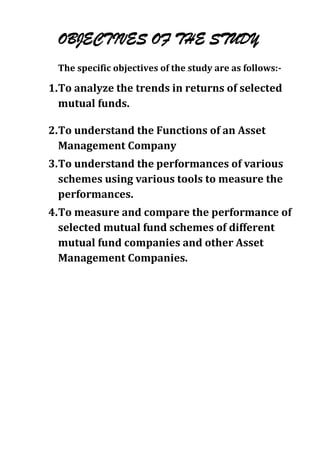
OBJECTIVES OF THE STUDY
 The specific objectives of the study are as follows:-

1. To analyze the trends in returns of selected
   mutual funds.

2. To understand the Functions of an Asset
   Management Company
3. To understand the performances of various
   schemes using various tools to measure the
   performances.
4. To measure and compare the performance of
   selected mutual fund schemes of different
   mutual fund companies and other Asset
   Management Companies.
Supervisor’s Certificate

This is to certify that Mr. VIVEK SAHA, a student of B.Com (Honours) in
Accounting & Finance of Acharya Girish Chandra College under the
University of Calcutta has worked under my supervision and guidance for his
project work and prepared a Project Report with the title “STUDY and
ANALYSIS OF MUTUAL FUNDS IN INDIA”.

The project which he is submitting is his genuine and original work to the
best of my knowledge.


                                                     Signature

     Place: Kolkata                     Name: Prof. Tanmay Ghosh.
     Date:                              Designation:
Student’s Declaration

I hereby declare that the Project Work with the title “STUDY and ANALYSIS OF
MUTUAL FUNDS IN INDIA” submitted by me for partial fulfillment of the degree of
B.Com (Honours) in Accountancy & Finance under the University of Calcutta is my
original work and has not been submitted earlier to any other University for the
fulfillment of the requirement for any course of study.
I also declare that no chapter of this manuscript in whole or in part has been
incorporated in this report from any earlier work done by others or by me. However,
extracts of any literature which has been used for this report has been duly
acknowledged providing details of such literature in the references.


                                                 Signature
Place: KOLKATA                      Name : Vivek Saha
Date:                              Address : 29, Durgabari Road, Kolkata - 700028
                                   Registration No.: 141-1121-0096-10
                                   Roll No.: 1141-61-0195
INDEX
Serial            Topics            Page
 No.                                 No.
  1           Introduction            1
  2    Why Select Mutual Fund?        2
  3     History of Mutual Fund      3-4
  4 Advantages of Mutual Fund       5-6
  5      Disadvantages of MF        7-8
  6      Types of MF in India       9-14
  7        SEBI Regulations        15-16
  8               AMFI             17-18
  9      Mutual Fund in India     19-23
 10      Unit Trust of India MF   24-32
 11     State Bank of India MF    33-36
 12    Future Prospect of MF in   37-38
                  India
 13      MF Fees & Expenses        39
 14     Definition on key terms   40-41
 15         Data Collection         -
 16            Conclusion          42
 17           Bibliography         43
INTRODUCTION
To state in simple words, a mutual fund collects the savings
from small investors, invest them in Government and other
corporate securities and earn income through interest and
dividends, besides capital gain. It works on the principle of”
small drop of water makes a big ocean’.
.


DEFINITION
The Securities and Exchange Board of India (Mutual
Funds) Regulation, 1993 defines a mutual fund “a
fund established in the form of a trust by a sponsor,
to raise monies by the trustees through the sale of
units to the, public, under one or more schemes, for
investing in securities in accordance with these
regulations”


According to Weston J. Fred and Brigham, Eugene, F,
Unit trusts are “corporations which accept dollars
from savers and then use these dollars to buy stock,
long term bonds, short term debt instruments issued
by business or government units; these corporations
pool funds and thus reduce risk by diversification”.


Why Select Mutual Funds ?
The risk return trade-off indicates that if investor is
willing to take higher risk then correspondingly he can expect
higher returns and vice-versa if he pertains to lower risk
instruments, which would be satisfied by lower returns. For
example, if an investors opt for bank FD, which provide
moderate return with minimal risk. But as he moves ahead 10
invest in capital protected funds and the profit-bonds that gives
us more return which is slightly higher as compared to the
bank deposits but the risk involved also increases in the same
proportion.

    Thus investors choose mutual funds as their primary
means of investing, as Mutual funds provide professional
management, diversification, convenience and liquidity.

     That doesn't mean mutual fund investments risk free.

     This is because the money that is pooled in are not
invested only in debts funds which are less riskier but are also
invested in the stock markets which involves a higher risk but
can expect higher returns. Hedge fund involves a very high risk
since it is mostly traded in the derivatives market which is
considered very volatile.


HISTORY OF MUTUAL FUNDS
An open-end fund is one that is available for subscription all
through the year. These do not have a fixed maturity. Investors can
conveniently buy and sell units at Net Asset Value ("NAV") related
prices. The key feature of open-end schemes is liquidity
The Mutual fund industry in India started in 963 with the formation
of UTI (united trust of India), at the initiative of government of
India. The history of Mutual Funds in India can be broadly divided
into Four Phases.

First Phase- 1964-87

     Unit Trust of India was established by an act of Parliament. It
was set up by the Reserve Bank of India and functioned under the
Regulatory and Administrative control of the Reserve Bank of
India. In 1978 UTI was de-linked from the RBI and IDBI took over
the regulatory and administrative control in place of RBI. The first
scheme launched by UTI was Unit Scheme 1964. At the end of 1988
UTI had Rs. 6700 crores of assets under management.
Second phase- 1987-1993 (entry of public sector funds).

      1987 marketed the entry of non-UTI, public sector mutual
funds set up by public sector banks and life insurance Corporation
of India (LIC) and general Insurance Corporation of India (GIC). SBI
Mutual fund was the first non-UTI Mutual fund established in June
1987 followed by can bank Mutual fund (Dec 1987), Punjab
national bank mutual fund (August 89). India bank mutual fund
(Nov 89). Bank of India (June 90), bank of Baroda mutual fund (Oct
92). LIC established its mutual fund in Nov 1989 while GIC had set
up its mutual fund in December 1990 at the end of 1993, the mutual
fund industry had asset under management of Rs.47,004 crores.

Third phase- 1993-2003 (entry of private sector funds)

     With the entry of private sector funds in 1993, an era
started in the Indian mutual fund industry, giving the Indian
investors a wider choice of fund families, Also. 1993 was the
year in which the first mutual fund regulations came into being,
under which all mutual funds, except UTI were to be registered
and governed, the Kothari pioneer (now merged with Franklin
Templeton) was the first private sector mutual fund registered
in July 1993. The 1993 SEBI (mutual funds ) registrations were
substituted by a more comprehensive and revised mutual
funds regulations in 1996 the number of mutual funds houses
went on increasing, with many foreign mutual funds setting up
funds in India and also the industry has witnessed several
mergers and acquisition. As at the of Jan 2003, there were 33
mutual funds with total assets of Rs. 1,21,805 crores. The UTI
with Rs. 44,541 crores of assets under management was way
ahead of other mutual funds.

Fourthphase-2003-2005:

      This phase had bitter experience for UTI. It was bifurcated
into two separate entities. One is the Specified Undertaking of
the Unit Trust of India with AUM of Rs.29,835 crores (as on
January 2003). The Specified Undertaking of Unit Trust of
India, functioning under an administrator and under the rules
framed by Government of India and does not come under the
purview of the Mutual Fund Regulations.
The second is the UTI Mutual Fund Ltd, sponsored by SBI, PNB,
BOB and LIC. It is registered with SEBI and functions under the
Mutual Fund Regulations. With the bifurcation of the erstwhile
UTI which had in March 2000 more than Rs.76,000 crores of
AUM and with the setting up of a UTI Mutual Fund, conforming
to the SEBI Mutual Fund Regulations, and with recent mergers
taking place among different private sector funds, the mutual
fund industry has entered . At the end of September 2004,
there were 29 funds, which manage assets of Rs.153108 crores
under 421 schemes.
ADVANTAGES OF MUTUAL FUNDS:
     lf mutual funds are emerging as the favorite investment
vehicle, it is because of the many advantages they have over other
forms and the avenues of investing, particularly for the investor
who has limited resources available in terms of capital and
the ability to carry out detailed research and market
monitoring. The following are the major advantages offered by
mutual funds to all investors:

1. Portfolio Diversification:

     Each investor in the fund is a part owner of all the fund's
assets, thus enabling him to hold a diversified investment
portfolio even with a small amount of investment that would
otherwise require big capital.

2. Professional Management:
     Even if an investor has a big amount of capital available to
him, he benefits from the professional management skills
brought in by the fund in the management of the investor's
portfolio. The investment management skills, along with the
needed research into available investment options, ensure a
much better return than what an investor can manage on his
own. Few investors have the skill and resources of their own to
succeed in today’s fast moving, global and sophisticated markets.

3. Reduction/Diversification Of Risk:
      When an investor invests directly, all the risk of potential
loss is his own, whether he places a deposit with a company or a
bank, or he buys share or debenture on his own or in any other
from. While investing in the pool of funds with investors, the
potential losses are also shared with other investors. The risk
reduction is one of the most important benefits of a collective
investment vehicle like the mutual fund.
4. Reduction Of Transaction Costs:
     What is true of risk as also true of the transaction costs. The
investor bears all the costs or investing such as brokerage or
custody of securities. When going through a fund, he has the
benefit of economics of scale; the funds pay lesser costs because
of larger volumes, a benefit passed on to its investors.

5. Liquidity:
     Often, investors hold shares or bonds they cannot directly,
easily and quickly sell. When they invest in the units or a fund,
they can generally cash their investments any time, by selling
their units to the fund if open-ended, or selling them in the
market if the fund is close-end. Liquidity of investment is clearly a
big benefit.

6. Convenience And Flexibility:
     Mutual fund management companies offer many investor
services that a direct market investor cannot get. Investors can
easily transfer their holding from One scheme to the other; get
updated market information and so on.

7. Tax Benefits:
      Any income distributed after March 31, 2002 will be subject
to tax in the assessment of all Unit holders. However, as a measure
of concession to Unit holders of open-ended equity- oriented
funds, income distributions for the year ending March 31. 2003
will be taxed at a concessional rate of 10.5%.
      In case of Individuals and Hindu Undivided Families (HUF) a
deduction upto Rs. 9,000 from the Total Income will be admissible
in respect of income from investments specified in Section 80L,
including income from Units of the Mutual Fund. Units of the
schemes are not subject to Wealth-Tax and Gift-Tax.
DISADVANTAGES OF INVESTING
THROUGH MUTUAL FUNDS:

1. No Control Over Costs:

      An investor in a mutual fund has no control of the overall costs
of investing. The investor pays investment management fees as long
as he remains with the fund, albeit in return for the professional
management and research. Fees are payable even if the value of his
investments is declining. A mutual fund investor also pays fund
distribution costs, which he would not incur in direct investing.
However, this shortcoming only means that there is a cost to obtain
the mutual fund services.

2. No Tailor-Made Portfolio:

      Investors who invest on their own can build their own portfolios
of shares and bonds and other securities, Investing through fund
means he delegates this decision to the fund managers, The very-
high-net-worth individuals or large corporate investors may find this
to be a constraint in achieving their objectives. However, most
mutual fund managers help investors overcome this constraint by
offering families of funds - a large number of different schemes -
within their own management company. An investor can choose from
different investment plans and constructs a portfolio to his choices.

3. Managing A Portfolio Of Funds:

      Availability of a large number of funds can actually mean too
much choice for the investor. He may again need advice on how to
select a fund to achieve his objectives, quite similar to the situation
when he has individual shares or bonds to select.

4. The Wisdom Of Professional Management:
                                                                2
                                                                0
     That's right, this is not an advantage. The average mutual 2
fund manager is no better at picking stocks than the average non-
                                                                0
professional, but charges fees.
5. No Control:
      Unlike picking your own individual stocks, a mutual fund puts
you in the passenger seat of somebody else's car.

6. Dilution:
      Mutual funds generally have such small holdings of so many
different stocks that insanely great performance by a fund's top
holdings still doesn't make much of a difference in a mutual fund's
total performance.

7. Buried Costs:
     Many mutual funds specialize in burying their costs and in hiring
salesmen who do not make those costs clear to their clients.


                                                                 2
                                                                 1
                                                                 2
TYPES OF MUTUAL FUNDS SCHEMES                                    1
IN INDIA
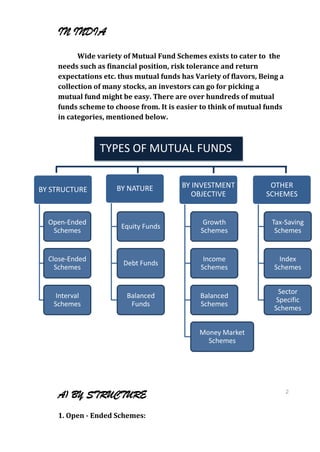
          Wide variety of Mutual Fund Schemes exists to cater to the
    needs such as financial position, risk tolerance and return
    expectations etc. thus mutual funds has Variety of flavors, Being a
    collection of many stocks, an investors can go for picking a
    mutual fund might be easy. There are over hundreds of mutual
    funds scheme to choose from. It is easier to think of mutual funds
    in categories, mentioned below.


                TYPES OF MUTUAL FUNDS


                     BY NATURE          BY INVESTMENT             OTHER
BY STRUCTURE
                                           OBJECTIVE             SCHEMES


  Open-Ended                                   Growth              Tax-Saving
                      Equity Funds
   Schemes                                    Schemes               Schemes


  Close-Ended                                  Income                 Index
                       Debt Funds
    Schemes                                   Schemes               Schemes


                                                                      Sector
    Interval            Balanced              Balanced
                                                                     Specific
   Schemes               Funds                Schemes
                                                                    Schemes


                                              Money Market
                                                Schemes


    A) BY STRUCTURE                                                       2
                                                                          2
                                                                          2
                                                                          2
    1. Open - Ended Schemes:
An open-end fund is one that is available for subscription all
through the year. These do not have a fixed maturity. Investors "an
conveniently buy and sell units at Net Asset Value (“NAV”) related
prices. The key feature of open-end schemes is liquidity.

2. Close - Ended Schemes:

      A closed-end fund has a stipulated maturity period which
generally ranging from 3 to 15 years. The fund is open for
subscription only during a specified period. Investors can
invest in the scheme at the time of the initial public issue and
thereafter they can buy or sell the units of the schemes on the
stock exchanges: where they are listed. In order to provide an
exit route t0 the investors, some close-ended funds give an option
of selling back the units to the Mutual Fund through periodic
repurchase at NAV related prices. SEBI Regulations stipulate that at
least One of the two exit routes is provided t0 the investor.

3. Interval Schemes:

     Interval Schemes are that scheme, which combines the
features of open-ended and close- ended schemes. The units may be
traded on the stock exchange or may be open for sale or redemption
during pre-determined intervals at NA V related prices.


                                                                 2
                                                                 3
                                                                 2
                                                                 3
B) BY NATURE

  1. Equity Fund:

        These funds invest the maximum part of their corpus into
  equities holdings. The structure of the fund may vary different for
  different schemes and the fund manager’s outlook on different stocks.
  The Equity Funds are sub-classified depending upon their investment
  objective, as follows:

  • Diversified Equity Funds
  • Mid-Cap Funds
  • Sector Specific Funds
  • Tax Savings Funds (ELSS)

  Equity investments are meant for a longer time horizon, thus Equity
  funds rank high on the risk-return matrix.

  2. Debt Funds

        The objective of these Funds is to invest in debt papers,
  Government authorities, private companies, banks and financial
  institutions are some of the major issuers of debt papers. By investing
  in debt instruments, these funds ensure low risk and provide stable
  income to the investors. Debt funds are further classified as:

• Gilt Funds: Invest their corpus in securities issued by
   Government, popularly known as Government of India debt papers.
  These Funds carry zero Default risk but are associated with Interest
  Rate risk. These schemes are safer as they invest in papers backed by
  Government.

• Income Funds: Invest a major portion into various debt
   instruments such as bonds, corporate debentures and Government
   securities.
                                                                    2
                                                                    4
                                                                    2
                                                                    4
• MIPs: Invests maximum of their total corpus in debt instruments
  while they take minimum exposure in equities. It gets benefit of
  both equity and debt market. These scheme ranks slightly high on the
  risk-return matrix when compared with other debt schemes.

• Short Term Plans (STPs): Meant for investment horizon for three to six
  months. These funds primarily invest in short term papers like
  Certificate of Deposits (CDs) and Commercial Papers (CPs). Some
  portion of the corpus is also invested in corporate debentures.

•    Liquid Funds: Also known as Money Market Schemes, These funds
    provides easy liquidity and preservation of capital, These schemes
    invest in short-term instruments like Treasury Bills, inter-bank call
    money market, CPs and CDs. These funds are meant for short-term cash
    management of corporate houses and are meant for an investment
    horizon of 1 day to 3 months. These schemes rank low on risk-return
    matrix and are considered to be the safest amongst all categories of
    mutual funds.


    3. Balanced Funds

          As the name suggest they are a mix of both equity and debt funds.
    They invest in both equities and fixed income securities, which are in
    line with pre-defined investment objective of the scheme. These
    schemes aim to provide investors with the best of both the worlds.
    Equity part provides growth and the debt part provides stability in
    returns.
    Further the mutual funds can be broadly classified on the basis of
    investment parameter viz; each category of funds is backed by an
    investment philosophy, which is pre-defined in the objectives of the
    fund. The investor can align his own investment needs with the funds
    objective and invest accordingly.


                                                                      2
                                                                      5
                                                                      2
                                                                      5
C) BY INVESTMENT OBJECTIVE

Growth Schemes:

     Growth Schemes are also known as equity schemes. The
aim of these schemes is to provide capital appreciation over
medium to long term. These schemes normally invest a major
part of their fund in equities and are willing to bear short-term
decline in value for possible future appreciation.

Income Schemes:

      Income Schemes are also known as debt schemes. The aim
of these schemes is to provide regular and steady income to
investors. These schemes generally invest in fixed income
securities such as bonds and corporate debentures. Capital
appreciation in such schemes may be limited.

Balanced Schemes:
     Balanced Schemes aim to provide both growth and income
by periodically distributing a part of the income and capital gains
they can. These schemes invest in both shares and fixed income
securities, in the proportion indicated in their offer documents
(normally 50:50).

Money Market Schemes:
     Money Market Schemes aim to provide easy liquidity,
preservation of capital and moderate income. These schemes
generally invest in safer, short-term instruments, such as
treasury bills, certificates of deposit, commercial paper and
inter-bank call money.

                                                                2
                                                                6
                                                                2
                                                                6
OTHER SCHEMES
Tax Saving Schemes:

      Tax-saving schemes offer tax rebates to the investors under
tax laws prescribed from time to time. Under Sec.88 of the Income
Tax Act, contributions made to any Equity Linked Savings Scheme
(ELSS) are eligible for rebate.

Index Schemes:
     Index schemes attempt to replicate the performance of a
particular index such as the BSE Sensex or the NSE 50. The
portfolio of these schemes will consist of only those stocks that
constitute the index. The percentage of each stock to the total
holding will be identical to the stocks index weightage. And
hence, the returns from such schemes would be more or less
equivalent to those of the Index.


Sector Specific Schemes:
     These are the funds/schemes which invest in the securities
of only those sectors or industries as specified in the offer
documents, e.g., Pharmaceuticals, Software, Fast Moving
Consumer Goods (FMCG), Petroleum stocks, etc. The returns in
these funds are dependent on the performance of the respective
sectors/industries. While these funds may give higher returns,
they are more risky compared to diversified funds. Investors need
to keep a watch on the performance of those sectors/industries
and must exit at an appropriate time.


                                                              2
                                                              7
                                                              2
                                                              7
SEBI REGULATIONS:
1. As far as mutual funds are concerned, SEBI formulates
   policies and regulates the mutual funds to protect the
   interest of the investors.

2. SEBI notified regulations for the mutual funds in 1993.
   Thereafter, mutual funds sponsored by private sector
   entities were allowed to enter the capital market.

3. The regulations were fully revised in 1996 and have
   been amended thereafter from time to time.

4. SEBI has also issued guidelines to the mutual funds
   from time to time to protect the interests of investors.

5. All mutual funds whether promoted by public sector or
   private sector entities including those promoted by
   foreign entities are governed by the same set of
   Regulations. The risks associated with the schemes
   launched by the mutual funds sponsored by these
   entities are of similar type. There is no distinction in
   regulatory requirements for these mutual funds and all
   are subject to monitoring and inspections by SEBI.

6. SEBI Regulations require that at least two thirds of the
   directors of trustee company or board of trustees must
   be independent i.e. they should not be associated with
   the sponsors.


                                                              2
                                                              8
                                                              2
                                                              8
7. Also, 50% of the directors of AMC must be independent.
   All mutual funds are required to be registered with
   SEBI before they launch any scheme.

8. Further SEBI Regulations, inter-alia, stipulate that
   MF’s cannot guarantee returns in any scheme and that
   each scheme is subject to 20:25 condition [i.e.
   minimum 20 investors per scheme and one investor
   can hold more than 25% stake in the corpus in that one
   scheme].


9. Also, SEBI has permitted MF’s to launch schemes
   overseas subject various restrictions and also to launch
   schemes linked to Real Estate, Options and Futures,
   Commodities, etc.


                                                              2
                                                              9
                                                              2
                                                              9
ASSOCIATION OF MUTUAL FUNDS
  IN INDIA (AMFI):
      With the increase in mutual fund players in India, a need for
  mutual fund association in India was generated to function as a
  non-profit organization, Association of Mutual Funds in India,
  (AMFI) was incorporated on 22nd August, 1995.

       AMFI is an apex body of all Asset Management Companies
  (AMC) which has been registered with SEBI. Till date all the AMCs
  are that have launched mutual fund schemes are its members. It
  functions under the supervision and guidelines of its Board of
  Directors.

  Association of Mutual Funds India has brought down the Indian
  Mutual Fund Industry to a professional and healthy market with
  ethical lines enhancing and maintaining standards. It follows the
  principle of both protecting and promoting the interests of
  mutual funds as well as their unit holders.

  The Objectives of Association of Mutual Funds in India:
       The Association of Mutual Funds of India works with 30
  registered AMCs of the country. It has certain defined objectives
  which juxtapose the guidelines of its Board of Directors, the
  objectives are as follows:

1. This mutual fund association of India maintains high
   professional and ethical standards in all areas of operation of the
   industry.

2. It also recommends and promotes the top class business
   practices and code of conduct which is followed by members and
                                                               3
                                                                  0
                                                                  3
                                                                  0
related people engaged in the activities of mutual fund and asset
  management. The agencies that are by any means connected or
  involved in the field of capital markets and financial services also
  involved in this code or conduct of the association.

3. AMFI interacts with SEBI and works according to SEBIs
   guidelines in the mutual fund industry.

4. Association of Mutual Fund of India do represent the
   Government of India, The Reserve Bank of India and other
   related bodies on manners relating to the Mutual Fund Industry.

5. It develops a team or well qualified and trained Agent
  distributors. It implements a programme of training and
  certification for all intermediaries and other engaged in the
  mutual fund industry.

6. AMFI undertakes all India awareness programme for investors in
   order to promote proper understanding of the concept and
   working of mutual funds.

7. At last but not the least association of mutual fund of India also
   disseminate information’s on Mutual Fund Industry and
   undertakes studies and research either directly or in association
   with other bodies.


  AMFI Publications:
        AMFI publish mainly two types of bulletin. One is on the
  monthly basis and the other is quarterly. These publications are
  of great support for the investors to get intimation of the know-
  how or their parked money.

                                                                  3
                                                                  1
                                                                  3
                                                                  1
MUTUAL FUNDS
     IN INDIA
In 1963, the day the concept of Mutual Fund took birth in
India. Unit Trust of India invited investors or rather to
those who believed in savings, to park their money in
UTI Mutual Fund.

For 30 years, it had goaled without a single second
player. Though the 1988 year saw some new mutual fund
companies but UTI remained in a monopoly position.

The performance of mutual funds in India in the initial
phase was not even closer to satisfactory level. People
rarely understood, and of course investing was out of
question. But yes, some 24 million shareholders were
accustomed with guaranteed high returns by the
beginning of the liberalization of the industry in 1992.
This good record of UTI became marketing tool for new
entrants. The expectations of investors touched the sky
in profitability factor. However, people were miles away
from the preparedness of risks factor after the
liberalization.

The net asset value (NA V) of mutual funds in India
declined when stock prices started falling in the year
                                                            3
1992. Those days, the market regulations did not allow      2
                                                            3
portfolio shifts into alternative investments, There        2
was rather no choice apart from holding the cash or to
further continue investing in shares. One more thing
to be noted, since only closed-end funds were floated in
the market, the investors disinvested by selling at a loss
in the secondary market.

The performance of mutual funds in India suffered
qualitatively. The 1992 stock market scandal, the losses
by disinvestments and of course the lack of transparent
rules in the whereabouts rocked confidence among the
investors. Partly owing to a relatively weak stock
market performance, mutual funds how not yet
recovered, with funds trading at an average discount of
1020 percent of their net asset value.

The Securities and Exchange Board of India (SEBI)
came out with comprehensive regulation in 1993
which defined the structure of Mutual Fund and Asset
Management Companies for the first time.

The supervisory authority adopted a set of measures to
create a transparent and competitive environment in
mutual funds. Some of them were like relaxing
investment restrictions into the market, introduction of
open-ended funds and paving the gateway for mutual
                                                             3
                                                             3
funds to launch pension schemes.                             3
                                                             3
The measure was taken to make mutual funds the key
instrument for long-term saving. The more the variety
offered, the quantitative will be investors.

Several private sectors Mutual Funds were launched in
1993 and 1994. The share of the private players has
risen rapidly since then. Currently there are 43 Mutual
Funds in India.

At last to mention, as long as mutual fund companies are
performing with lower risks and higher profitability
within a short span of time, more and more people will be
inclined to invest until and unless they are fully educated
with the do’s and don'ts of mutual funds.

Mutual fund industry has seen a lot of changes in past
few decades with multinational companies coming into
this country, bringing in their professional expertise in
managing funds worldwide. In the past few months
there has been a consolidation phase going on in the
mutual fund industry in India. Now investors have a wide
range of Schemes to choose from depending on their
individual profile.


                                                              3
                                                              4
                                                              3
                                                              4
MUTUAL FUND COMPANIES IN INDIA:

     The first introduction of a mutual fund in India occurred in
     1963, when the Government of India launched UNIT TRUST OF
     INDIA (UTI).

     Until 1987, UTI enjoyed a monopoly in the Indian Mutual Fund
     market. Then a host of other government controlled Indian
     Financial companies came up with their own funds, these
     included STATE BANK OF INDIA, CANARA BANK, AND PUNJAB
     NATIONAL BANK.

     This market was made open to private players in 1993, as a
     result of the historic constitutional amendments brought
     forward by the then Congress-led Government under the
     regime of Liberalization, Privatization and Globalization.

     Kothari Pioneer was the first private sector mutual fund
     company in India which has now merged with Franklin
     Templeton. Just after ten years with private sector player’s
     penetration, the total assets rose up to Rs. 1218.05 bn.

     Mutual Funds are an under tapped market in India. Despite
     being available in the market for over two decades now with
     Assets under Management equaling Rs. 78,171,152 Lakhs (as
     of 28th February 2010) less than 10% of Indian
     households have invested in mutual funds.
                                                            3
     A recent report on Mutual Fund Investments in India    5
                                                            3
     published by research and analytics firm BOSTON    ANALYTICS
                                                            5
suggests investors are holding back their money into mutual
         funds due to their perceived high risk and a lack of
         information on how mutual’s funds work. This report is based
         on a survey of approx 10000 respondents in 15 Indian cities
         and towns as of March 2010. There are 43 Mutual’s funds
         recently in India.


Major Mutual Fund Companies in India

   1.    ABN AMRO Mutual Fund
   2.    Bank of Baroda Mutual Fund
   3.    HSBC Mutual Fund
   4.    ING Vysya Mutual Fund
   5.    Prudential ICICI Mutual Fund
   6.    State Bank of India Mutual Fund
   7.    Tata Mutual Fund
   8.    Unit Trust of India Mutual Fund
   9.    Reliance Mutual Fund
   10.   Standard Chartered Mutual Fund
   11.   Birla Sun Life Mutual Fund
   12.   HDFC Mutual Fund
   13.   Escorts Mutual Fund
   14.   Alliance Capital Mutual Fund
   15.   Franklin Templeton India Mutual Fund
   16.   Morgan Stanley Mutual Fund India
   17.   IIFL Mutual Fund
   18.   IDFC Mutual Fund
   19.   Indiabulls Mutual Fund
   20.   LIC Nomura Mutual Fund
   21.   JM Financial Mutual Fund
   22.   Axis Mutual Fund
   23.   BNP Paribas Mutual Fund
   24.   BOI AXA Mutual Fund
   25.   Deutsche Mutual Fund
   26.   Edelweiss Mutual Fund
   27.   IDBI Mutual Fund
   28.   JP Morgan Mutual Fund
   29.   Kotak Mahindra Mutual Fund
   30.   L&T Mutual Fund                                        3
                                                                6
                                                                3
                                                                6
UNIT TRUST OF INDIA MUTUAL FUND
Unit Trust of India was created by the UTI Act passed by the Parliament in
1963. For more than two decades, it remained the sole vehicle for investment
in the capital market by the Indian citizens. In mid- 1980s Public Sector
Banks were allowed to open mutual funds. The real vibrancy and competition
in the Mutual Fund industry came with the setting up of the Regulator SEBI
and its laying down the MF Regulations in 1993. UTI maintained its pre-
eminent place till 2001, when 8 massive decline in the market indices and
negative investor sentiments after Ketan Parekh scam created doubts about
the capacity of UTI to meet its obligations to the investors. This was further
compounded by two factors namely, its flagship and largest scheme US 64
was sold and re-purchased not at intrinsic NA V but at artificial price and its
Assured Return Schemes had promised returns as high as 18% over a period
going up to two decades.

UTI Mutual Fund is managed by UTI Asset Management Company Private
Limited (Est.: Jan 14, 2003) who has been appointed by the UTI Trustee
Company Private Limited for managing the schemes of UTI Mutual Fund
and the schemes transferred / migrated from UTI Mutual Fund.

           No. of schemes                             94
           No. of schemes including options          366
           Equity Schemes                             97
           Debt Schemes                              225
           Short term debt Schemes                    20
           Equity & Debt                              12
           Money Market                                0
           Gilt Fund                                  11
                                                                         3
                                                                         7
Corpus under management                                                  3
                                                                         7
Rs. 71770.05 Crs. as on Jan 31, 2013.
Some of the funds have won famous awards, including the Best Infra
Fund globally from Lipper. UTI has been able to benchmark its employee
compensation to the best in the market.

Besides running domestic MF Schemes UTI AMC is also registered portfolio
manager under the SEBI (Portfolio Managers) Regulations.

This company runs two successful funds with large international investors
being active participants. UTI has also launched a Private Equity
Infrastructure fund along with HSH Nord Bank of Germany and Shinsei Bank
of Japan.


Vision:

To be the most Preferred Mutual Fund.


Mission:

       1.   The most trusted brand, admired by all stakeholders.
       2.   The largest and most efficient money manager with global presence.
       3.   The best in class customer service provider.
       4.   The most preferred employer.
       5.   The most innovative and best wealth creator.

Assets Under Management:        UTI Asset Management Co. Ltd

Sponsor:
 a.   State Bank of India
 b.   Bank of Baroda
 c.   Punjab National Bank
 d.   Life Insurance Corporation of India

                                                                        3
                                                                        8
Trustee:     UTI Trustee Co. Limited.                                   3
                                                                        8
SCHEMES

  A) EQUITY FUND
  1. UTI Energy Fund (Open Ended Fund):

        Investment will be made in stocks of those companies engaged in
  the following are:


 Petro sector - oil and gas products & processing
 All types of Power generation companies.
 Companies related to storage of energy.
 Companies manufacturing energy development equipment related (like petro
  and power)
 Consultancy & Finance Companies.


  2. UTI Banking Sector Fund (Open Ended Fund):

       An open-ended equity fund with the objective to provide capital
appreciation through investments in the stocks of the companies/institutions
engaged in the banking and financial services activities.


  3. UTI Infrastructure Fund (Open Ended Fund):

        An open-ended equity fund with the objective to provide Capital
appreciation through investing in the stocks of the companies engaged in the
sectors like Metals, Building materials, oil and gas, power, chemicals,
engineering etc. The fund will invest in the stocks of the companies which form
                                                                        3
part of Infrastructure Industries.                                      9
                                                                       3
                                                                       9
4. UTI Equity Tax Savings Plan (Open Ended Fund):

     An open-ended equity fund investing a minimum of 80% in equity and
equity related instruments. It aims at enabling members to avail tax rebate
under Section 80C of the Income Tax Act, 1962 and provide them with the
benefits of growth.


  5. UTI Master Equity Plan Unit Scheme (Close Ended Fund):

       The scheme primarily aims at securing for the investors capital
appreciation by investing the funds or the scheme in equity shares of companies
with good growth prospects.


  6. UTI Equity Fund (Open Ended Fund):

     UTI Equity Fund is open-ended equity scheme with an objective of
investing at least 80% of its funds in equity and equity related instrument with
medium to high risk profile and upto 20% in debt and money market
instruments with low to medium risk profile.


  7. UTI MNC Fund (Open Ended Fund):

     An open-ended equity fund with the objective to invest predominantly in
the equity shares of multinational companies in diverse sectors such as FMCG,
Pharmaceutical, Engineering etc.


  8. UTI Dividend Yield Fund (Open Ended Fund):

      It aims to provide medium to long term capital gains and/or dividend
distribution by investing predominantly in equity and equity related
instruments which offer high dividend yield.


                                                                         4
                                                                         0
                                                                         4
                                                                         0
Some other Equity Funds are:-
1. UTI Master share Unit Scheme (Open-Ended Fund)

2. UTI Mid-Cap Fund (Open-Ended Fund)

3. UTI Opportunities Fund (Open-Ended Fund)

4. UTI Transportation and Logistics Fund (Auto Sector

    Fund) (Open-Ended Fund)

5. UTI Growth Sector Fund - Pharma (Open Ended Fund)

6. Growth Sector Fund - Services (Open Ended Fund)

7. UTI Leadership Equity Fund (Open-Ended Fund)

8. UTI Contra Fund (Open-Ended Fund)

9. UTI Spread Fund (Open-Ended Fund)

10. UTI Growth Sector Fund - Software (Open Ended Fund)

11. UTI Master Plus Unit Scheme (Open Ended Fund)

12. UTI Master Value Fund (Open Ended Fund)

13. UTI Top 100 Fund (Open Ended Fund)

14. UTI Wealth Builder Fund (Closed-Ended Fund)

15. UTI Long Term Advantage Fund – Series I(Closed-

  Ended Fund)

16. UTI India Lifestyle Fund (Closed-Ended Fund)
                                                    4
17. UTI Rajiv Gandhi Equity Savings Schemes (Open-Ended
                                                  1
                                                    4
                                                    1
  Fund)
B) Index Fund:
1. UTI Master Index Fund (Open Ended Fund):

     UTI MF is an open-ended passive fund with the primary investment
objective to invest in securities of companies comprising the BSE
Sensex in the same weightage as these companies have in BSE
Sensex.


2. UTI Gold Exchange Traded Fund (Open Ended Fund):

      To endeavor to provide returns that, before expense, closely track the
performance and yield of Gold. There can be no assurance or guarantee that
the investment objective of UTI-Gold ETF will be achieved.

3. UTI Sunder (Open Ended Fund):

      To provide investment returns that, before expenses,
closely correspond to the performance and yield of the basket of
securities underlying the S & P CNX Nifty Index.


C) ASSETS FUND
  UTI Variable Investment Scheme:

      UTI VIS-ILP is an open ended scheme with the objective of
providing the investors with a product that would enable them to
diversify their risks through a suitable allocation between debt and equity
asset classes and thereby generate superior risk-adjusted returns through a
dynamic asset allocation process.

                                                                      42
                                                                      42
D) BALANCED FUND:

1. UTI Mahila Unit Scheme (Open Ended Fund):

      To invest in a portfolio of equity/equity related securities
and debt and money market instruments with a view
to generate reasonable income with moderate capital
appreciation. The asset allocation will be Debt: Minimum
70%, Maximum 100% Equity: Minimum 0%, Maximum 30%.


2. UTI Balanced Fund (Open Ended Fund):

     An open-ended balanced fund investing between 40% to
75% in equity /equity related securities and the balance in
debt (fixed income securities) with a view to generate
regular income together with capital appreciation.


3. UTI Unit Link Insurance Plan (Open Ended Fund):

     To provide return through growth in the NAV or throug
dividend distribution and re-investment thereof.

Some other Balanced Funds are:-
      1.UTI Retirement Benefit Pension Fund (Open-

         Ended Fund)

      2.UTI CCP (Children Career Plan) Advantage

         Fund (Open-Ended Fund)

      3.UTI Charitable, Religion Trust And

         Registered Society (Open-Ended Fund)                        64
                                                                     64
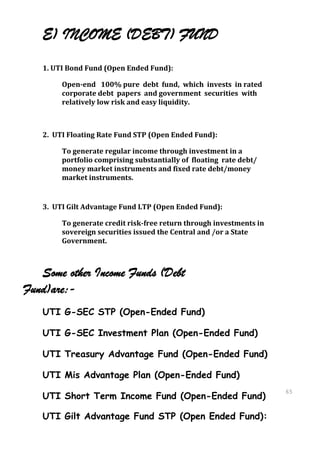
E) INCOME (DEBT) FUND
   1. UTI Bond Fund (Open Ended Fund):

        Open-end 100% pure debt fund, which invests in rated
        corporate debt papers and government securities with
        relatively low risk and easy liquidity.


   2. UTI Floating Rate Fund STP (Open Ended Fund):

        To generate regular income through investment in a
        portfolio comprising substantially of floating rate debt/
        money market instruments and fixed rate debt/money
        market instruments.


   3. UTI Gilt Advantage Fund LTP (Open Ended Fund):

        To generate credit risk-free return through investments in
        sovereign securities issued the Central and /or a State
        Government.


   Some other Income Funds (Debt
Fund)are:-
   UTI G-SEC STP (Open-Ended Fund)

   UTI G-SEC Investment Plan (Open-Ended Fund)

   UTI Treasury Advantage Fund (Open-Ended Fund)

   UTI Mis Advantage Plan (Open-Ended Fund)
                                                                     65
   UTI Short Term Income Fund (Open-Ended Fund)                      65


   UTI Gilt Advantage Fund STP (Open Ended Fund):
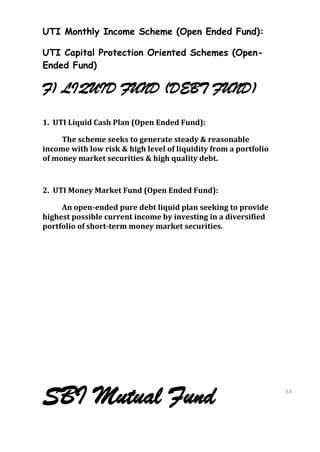
UTI Monthly Income Scheme (Open Ended Fund):

UTI Capital Protection Oriented Schemes (Open-
Ended Fund)

F) LIQUID FUND (DEBT FUND)
1. UTI Liquid Cash Plan (Open Ended Fund):

     The scheme seeks to generate steady & reasonable
income with low risk & high level of liquidity from a portfolio
of money market securities & high quality debt.


2. UTI Money Market Fund (Open Ended Fund):

     An open-ended pure debt liquid plan seeking to provide
highest possible current income by investing in a diversified
portfolio of short-term money market securities.


SBI Mutual Fund                                                   66
                                                                  66
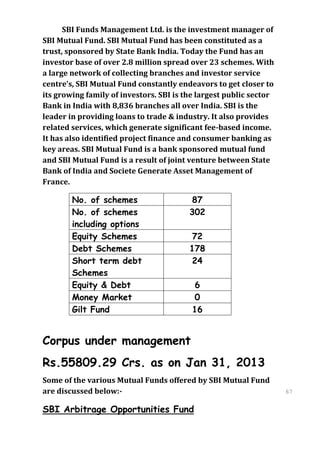
SBI Funds Management Ltd. is the investment manager of
SBI Mutual Fund. SBI Mutual Fund has been constituted as a
trust, sponsored by State Bank India. Today the Fund has an
investor base of over 2.8 million spread over 23 schemes. With
a large network of collecting branches and investor service
centre’s, SBI Mutual Fund constantly endeavors to get closer to
its growing family of investors. SBI is the largest public sector
Bank in India with 8,836 branches all over India. SBI is the
leader in providing loans to trade & industry. It also provides
related services, which generate significant fee-based income.
It has also identified project finance and consumer banking as
key areas. SBI Mutual Fund is a bank sponsored mutual fund
and SBI Mutual Fund is a result of joint venture between State
Bank of India and Societe Generate Asset Management of
France.

        No. of schemes                   87
        No. of schemes                   302
        including options
        Equity Schemes                   72
        Debt Schemes                     178
        Short term debt                  24
        Schemes
        Equity & Debt                     6
        Money Market                      0
        Gilt Fund                        16


Corpus under management
Rs.55809.29 Crs. as on Jan 31, 2013
Some of the various Mutual Funds offered by SBI Mutual Fund
are discussed below:-                                               67
                                                                    67

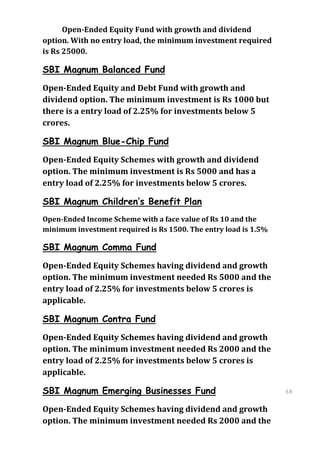
SBI Arbitrage Opportunities Fund
Open-Ended Equity Fund with growth and dividend
option. With no entry load, the minimum investment required
is Rs 25000.

SBI Magnum Balanced Fund
Open-Ended Equity and Debt Fund with growth and
dividend option. The minimum investment is Rs 1000 but
there is a entry load of 2.25% for investments below 5
crores.

SBI Magnum Blue-Chip Fund
Open-Ended Equity Schemes with growth and dividend
option. The minimum investment is Rs 5000 and has a
entry load of 2.25% for investments below 5 crores.

SBI Magnum Children’s Benefit Plan
Open-Ended Income Scheme with a face value of Rs 10 and the
minimum investment required is Rs 1500. The entry load is 1.5%

SBI Magnum Comma Fund
Open-Ended Equity Schemes having dividend and growth
option. The minimum investment needed Rs 5000 and the
entry load of 2.25% for investments below 5 crores is
applicable.

SBI Magnum Contra Fund
Open-Ended Equity Schemes having dividend and growth
option. The minimum investment needed Rs 2000 and the
entry load of 2.25% for investments below 5 crores is
applicable.

SBI Magnum Emerging Businesses Fund                              68
                                                                 68
Open-Ended Equity Schemes having dividend and growth
option. The minimum investment needed Rs 2000 and the
entry load of 2.25% for investments below 5 crores is
applicable.

SBI Magnum Equity Fund
Open-Ended Diversified Equity Fund having dividend and
growth option. The minimum investment is Rs 1000 and
the entry load of 2.25% for investments below 5 crores is
applicable.

SBI Magnum FMCG Fund
Open-Ended Equity Schemes with a face value of Rs 10. The
minimum investment needed is Rs 1000 and the entry load
of 2.25% for investments below 5 crores is applicable.

SBI Magnum Gilt Fund Long Term Plan
Open-Ended Gilt Schemes with quarterly dividend option
and growth option. As far as minimum investment is
concerned, it is Rs 25,000/- and in multiples of Rs. 5,000 /-
thereafter for the Growth option and Rs. 1,00,000/- and in
multiples of Rs. 5,000/- thereafter for Dividend option.

SBI Magnum Gilt Fund Short Term Plan
Open-Ended Gilt Schemes with monthly dividend option
and growth option with a minimum investment of Rs
25,000/- and in multiples of Rs. 5,000 /- thereafter for the
Growth option and Rs. 1,00,000/- and in multiples of Rs.
5,000/- thereafter for Dividend option.


Some other SBI Mutual Funds are:-
                                                                69
                                                                69
    SBI Magnum Insta Cash Fund
 SBI Magnum Insta Cash Fund- Liquid Floater
          Plan
         SBI Magnum Institutional Income Fund
         SBI Magnum IT Fund
         SBI Magnum Midcap Fund
         SBI Magnum Monthly Income Plan
         SBI Magnum Monthly Income Plan Floater
         SBI Magnum Multicap Fund
         SBI Magnum Global Fund
         SBI Magnum Income Fund
         SBI Magnum Income Plus Fund
          Investment Plan
         SBI Magnum Income Plus Fund Savings
          Plan
         SBI Magnum Index Fund
         SBI Magnum Multiplier Plus
         SBI Magnum NRI Investment Fund
         SBI Magnum NRI Investment Fund Flexi
          Asset Plan
         SBI Magnum Pharma Fund
         SBI Magnum Tax Gain Scheme 1993
         SBI Premier Liquid Fund
         SBI ONE India Fund (Close-Ended)


Future Prospect of Mutual Funds in India                                 70
                                                                         70


    The Future of Mutual Funds in India suggests that the industry has
got huge scopes of development in the times to come.

     The Future of Mutual Funds in India is quite bright, Mutual Funds
     are one the most popular forms of investments as these funds are
     diversification, professional management, and liquidity. In the
     year 2004, the mutual fund industry in India was worth Rs 1,
     50,537 crores. The mutual fund industry expected to grow at a
     rate of 13.4% over the next 10 years.


  Mutual Fund Assets under Management                       (MF
AUM) Growth

     1. In March 1998, the MF AUM was 68, 984 crores.

     2. In March 2000, the MF AUM was 93, 717 crores and the
        percentage growth was 26%.

     3. In March 2001, the MF AUM was 83, 131 crores and the
        percentage growth was 13%.

     4. In March 2002, the MF AUM was 94, 017 crores and the
        percentage growth was 12%.

     5. In March 2003, the MF AUM was 75, 306 crores and the
        percentage growth was 25%.

     6. In March 2004, the MF AUM was 1, 37, 626 crores and the
        percentage growth was 45%.

     7. In September 2004, the MF AUM was 1, 51, 141 crores and the
        percentage growth was 9% in 6(six) months time.

     8. In December 2004, the MF AUM was 1, 49, 300 crores and the
        percentage growth was 1% in 2(two) months time.


   Future of MF in India – Facts on growth                               71
                                                                         71
Important aspects related to the future of MF in India are:-

   1. The growth rate was 100% in 6 (six) previous years.

   2. The saving rate in India is 23%.

   3. There is a huge scope in the future for the expansion of the
      mutual funds industry.

   4. A number of foreign based assets management companies are
      venturing into Indian markets.

   5. The Securities Exchange Board of India has allowed the
      introduction of commodity mutual funds.

   6. The emphasis is being given on the effective corporate
      governance of Mutual Funds.

   7. The Mutual funds in India has the scope of penetrating into the
      rural and semi urban areas.

   8. Financial Planners are introduced into the market, which
      would provide the people with better financial planning.


MUTUAL FUND FEES AND EXPENSES                                           72
                                                                        72
        Mutual fund fees and expenses are charges that may he
   incurred by investors who hold mutual funds. Running a mutual
fund involves costs, including shareholder transaction costs,
investment advisory fees, and marketing and distribution
expenses. Funds pass along these costs to investors in a number of
ways.

1. Transaction Cost

          Purchase Fee
          Redemption Fee
          Exchange Fee

2. Periodic Fees

          Management Fee’s
          Account Fee’s

3. Other Operating Expenses

         i. Transaction Cost
        ii. Loads :
          Front-End load
          Back-End load
          Level Load/ Low Load
          No-Load Fund


                                                                     73
                                                                     73
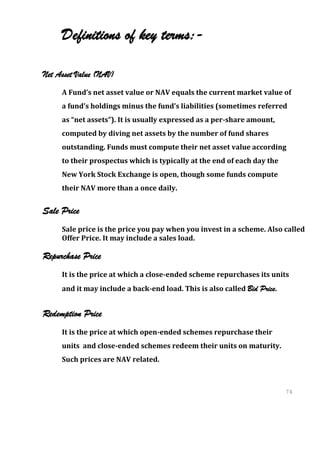
Definitions of key terms:-

Net Asset Value (NAV)
     A Fund’s net asset value or NAV equals the current market value of
     a fund’s holdings minus the fund’s liabilities (sometimes referred
     as “net assets”). It is usually expressed as a per-share amount,
     computed by diving net assets by the number of fund shares
     outstanding. Funds must compute their net asset value according
     to their prospectus which is typically at the end of each day the
     New York Stock Exchange is open, though some funds compute
     their NAV more than a once daily.


Sale Price
     Sale price is the price you pay when you invest in a scheme. Also called
     Offer Price. It may include a sales load.

Repurchase Price
     It is the price at which a close-ended scheme repurchases its units
     and it may include a back-end load. This is also called Bid Price.


Redemption Price
     It is the price at which open-ended schemes repurchase their
     units and close-ended schemes redeem their units on maturity.
     Such prices are NAV related.


                                                                          74
                                                                          74
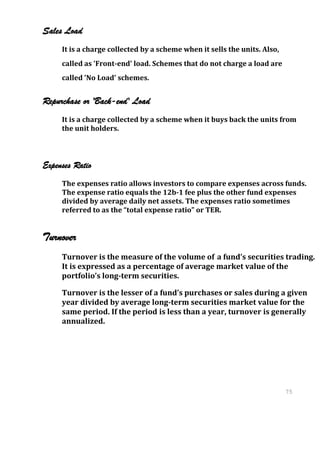
Sales Load
     It is a charge collected by a scheme when it sells the units. Also,
     called as 'Front-end' load. Schemes that do not charge a load are
     called 'No Load' schemes.


Repurchase or 'Back-end' Load
     It is a charge collected by a scheme when it buys back the units from
     the unit holders.


Expenses Ratio
     The expenses ratio allows investors to compare expenses across funds.
     The expense ratio equals the 12b-1 fee plus the other fund expenses
     divided by average daily net assets. The expenses ratio sometimes
     referred to as the “total expense ratio” or TER.


Turnover
     Turnover is the measure of the volume of a fund’s securities trading.
     It is expressed as a percentage of average market value of the
     portfolio’s long-term securities.

     Turnover is the lesser of a fund’s purchases or sales during a given
     year divided by average long-term securities market value for the
     same period. If the period is less than a year, turnover is generally
     annualized.


                                                                           75
                                                                           75
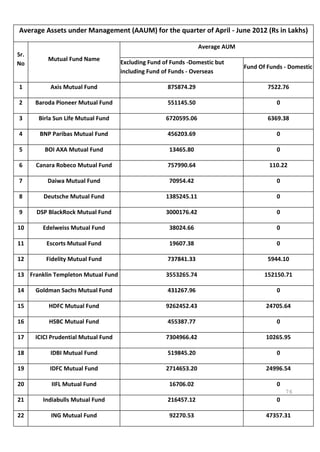
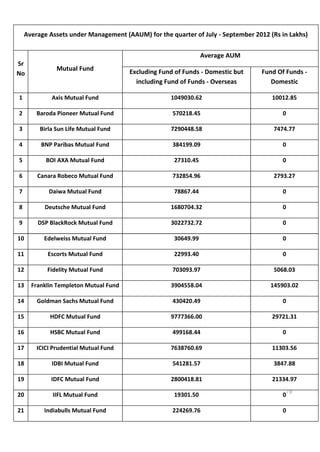
Average Assets under Management (AAUM) for the quarter of April - June 2012 (Rs in Lakhs)

                                                                  Average AUM
Sr.
          Mutual Fund Name
No                                   Excluding Fund of Funds -Domestic but
                                                                                Fund Of Funds - Domestic
                                     including Fund of Funds - Overseas

1          Axis Mutual Fund                          875874.29                          7522.76

2     Baroda Pioneer Mutual Fund                     551145.50                             0

3      Birla Sun Life Mutual Fund                    6720595.06                         6369.38

4      BNP Paribas Mutual Fund                       456203.69                             0

5        BOI AXA Mutual Fund                          13465.80                             0

6     Canara Robeco Mutual Fund                      757990.64                          110.22

7         Daiwa Mutual Fund                           70954.42                             0

8       Deutsche Mutual Fund                         1385245.11                            0

9     DSP BlackRock Mutual Fund                      3000176.42                            0

10      Edelweiss Mutual Fund                         38024.66                             0

11        Escorts Mutual Fund                         19607.38                             0

12       Fidelity Mutual Fund                        737841.33                          5944.10

13 Franklin Templeton Mutual Fund                    3553265.74                        152150.71

14    Goldman Sachs Mutual Fund                      431267.96                             0

15        HDFC Mutual Fund                           9262452.43                        24705.64

16        HSBC Mutual Fund                           455387.77                             0

17    ICICI Prudential Mutual Fund                   7304966.42                        10265.95

18         IDBI Mutual Fund                          519845.20                             0

19         IDFC Mutual Fund                          2714653.20                        24996.54

20         IIFL Mutual Fund                           16706.02                             0
                                                                                               76
21      Indiabulls Mutual Fund                       216457.12                             0 76

22         ING Mutual Fund                            92270.53                         47357.31
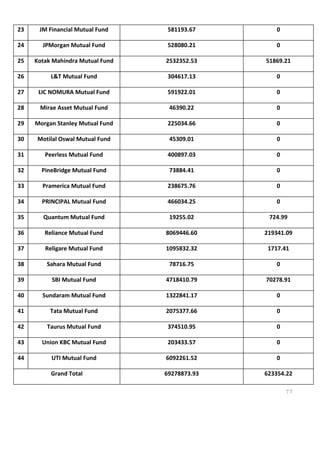
23    JM Financial Mutual Fund     581193.67       0

24     JPMorgan Mutual Fund        528080.21       0

25   Kotak Mahindra Mutual Fund   2532352.53    51869.21

26        L&T Mutual Fund          304617.13       0

27    LIC NOMURA Mutual Fund       591922.01       0

28    Mirae Asset Mutual Fund      46390.22        0

29   Morgan Stanley Mutual Fund    225034.66       0

30   Motilal Oswal Mutual Fund     45309.01        0

31      Peerless Mutual Fund       400897.03       0

32     PineBridge Mutual Fund      73884.41        0

33     Pramerica Mutual Fund       238675.76       0

34     PRINCIPAL Mutual Fund       466034.25       0

35     Quantum Mutual Fund         19255.02      724.99

36      Reliance Mutual Fund      8069446.60    219341.09

37      Religare Mutual Fund      1095832.32     1717.41

38       Sahara Mutual Fund        78716.75        0

39        SBI Mutual Fund         4718410.79    70278.91

40     Sundaram Mutual Fund       1322841.17       0

41        Tata Mutual Fund        2075377.66       0

42       Taurus Mutual Fund        374510.95       0

43     Union KBC Mutual Fund       203433.57       0

44        UTI Mutual Fund         6092261.52       0

          Grand Total             69278873.93   623354.22

                                                       77
                                                       77
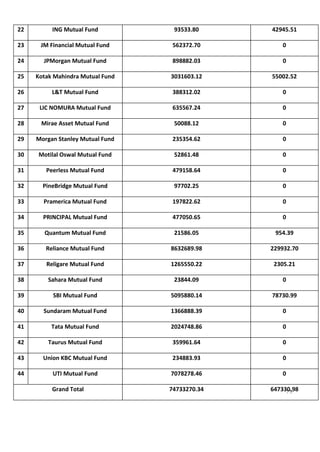
Average Assets under Management (AAUM) for the quarter of July - September 2012 (Rs in Lakhs)


                                                                Average AUM
Sr
               Mutual Fund             Excluding Fund of Funds - Domestic but    Fund Of Funds -
No
                                         including Fund of Funds - Overseas         Domestic

1            Axis Mutual Fund                       1049030.62                       10012.85

2       Baroda Pioneer Mutual Fund                   570218.45                          0

3        Birla Sun Life Mutual Fund                 7290448.58                       7474.77

4        BNP Paribas Mutual Fund                     384199.09                          0

5          BOI AXA Mutual Fund                       27310.45                           0

6       Canara Robeco Mutual Fund                    732854.96                       2793.27

7           Daiwa Mutual Fund                        78867.44                           0

8         Deutsche Mutual Fund                      1680704.32                          0

9       DSP BlackRock Mutual Fund                   3022732.72                          0

10        Edelweiss Mutual Fund                      30649.99                           0

11          Escorts Mutual Fund                      22993.40                           0

12         Fidelity Mutual Fund                      703093.97                       5068.03

13    Franklin Templeton Mutual Fund                3904558.04                      145903.02

14      Goldman Sachs Mutual Fund                    430420.49                          0

15          HDFC Mutual Fund                        9777366.00                       29721.31

16          HSBC Mutual Fund                         499168.44                          0

17      ICICI Prudential Mutual Fund                7638760.69                       11303.56

18           IDBI Mutual Fund                        541281.57                       3847.88

19           IDFC Mutual Fund                       2800418.81                       21334.97
                                                                                         78
20           IIFL Mutual Fund                        19301.50                           0
                                                                                         78

21        Indiabulls Mutual Fund                     224269.76                          0
22        ING Mutual Fund          93533.80     42945.51

23    JM Financial Mutual Fund     562372.70       0

24     JPMorgan Mutual Fund        898882.03       0

25   Kotak Mahindra Mutual Fund   3031603.12    55002.52

26        L&T Mutual Fund          388312.02       0

27    LIC NOMURA Mutual Fund       635567.24       0

28    Mirae Asset Mutual Fund      50088.12        0

29   Morgan Stanley Mutual Fund    235354.62       0

30   Motilal Oswal Mutual Fund     52861.48        0

31      Peerless Mutual Fund       479158.64       0

32     PineBridge Mutual Fund      97702.25        0

33     Pramerica Mutual Fund       197822.62       0

34     PRINCIPAL Mutual Fund       477050.65       0

35     Quantum Mutual Fund         21586.05      954.39

36      Reliance Mutual Fund      8632689.98    229932.70

37      Religare Mutual Fund      1265550.22     2305.21

38       Sahara Mutual Fund        23844.09        0

39        SBI Mutual Fund         5095880.14    78730.99

40     Sundaram Mutual Fund       1366888.39       0

41        Tata Mutual Fund        2024748.86       0

42       Taurus Mutual Fund        359961.64       0

43     Union KBC Mutual Fund       234883.93       0

44        UTI Mutual Fund         7078278.46       0

          Grand Total             74733270.34   647330.98
                                                     79
                                                    79
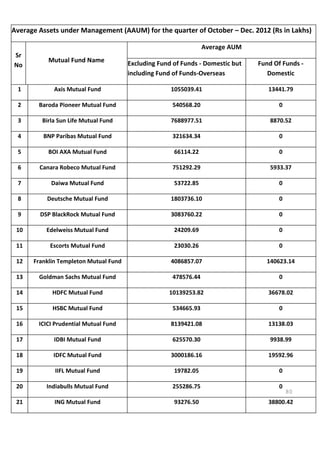
Average Assets under Management (AAUM) for the quarter of October – Dec. 2012 (Rs in Lakhs)

                                                                 Average AUM
Sr
           Mutual Fund Name            Excluding Fund of Funds - Domestic but   Fund Of Funds -
No
                                       including Fund of Funds-Overseas            Domestic

 1           Axis Mutual Fund                        1055039.41                    13441.79

 2      Baroda Pioneer Mutual Fund                   540568.20                        0

 3       Birla Sun Life Mutual Fund                  7688977.51                     8870.52

 4       BNP Paribas Mutual Fund                     321634.34                        0

 5         BOI AXA Mutual Fund                        66114.22                        0

 6      Canara Robeco Mutual Fund                    751292.29                      5933.37

 7          Daiwa Mutual Fund                         53722.85                        0

 8        Deutsche Mutual Fund                       1803736.10                       0

 9      DSP BlackRock Mutual Fund                    3083760.22                       0

 10       Edelweiss Mutual Fund                       24209.69                        0

 11         Escorts Mutual Fund                       23030.26                        0

 12   Franklin Templeton Mutual Fund                 4086857.07                   140623.14

 13     Goldman Sachs Mutual Fund                    478576.44                        0

 14         HDFC Mutual Fund                        10139253.82                    36678.02

 15         HSBC Mutual Fund                         534665.93                        0

 16     ICICI Prudential Mutual Fund                 8139421.08                    13138.03

 17          IDBI Mutual Fund                        625570.30                      9938.99

 18          IDFC Mutual Fund                        3000186.16                    19592.96

 19          IIFL Mutual Fund                         19782.05                        0

 20       Indiabulls Mutual Fund                     255286.75                        0
                                                                                          80
                                                                                          80
 21          ING Mutual Fund                          93276.50                     38800.42
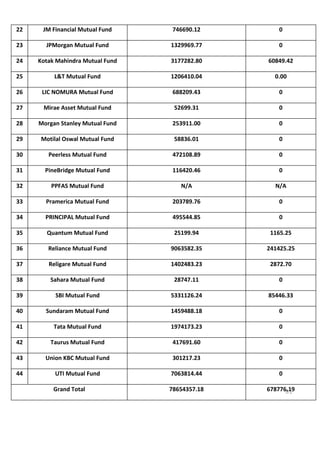
22    JM Financial Mutual Fund     746690.12       0

23     JPMorgan Mutual Fund       1329969.77       0

24   Kotak Mahindra Mutual Fund   3177282.80    60849.42

25        L&T Mutual Fund         1206410.04      0.00

26    LIC NOMURA Mutual Fund       688209.43       0

27    Mirae Asset Mutual Fund      52699.31        0

28   Morgan Stanley Mutual Fund    253911.00       0

29   Motilal Oswal Mutual Fund     58836.01        0

30      Peerless Mutual Fund       472108.89       0

31     PineBridge Mutual Fund      116420.46       0

32       PPFAS Mutual Fund           N/A          N/A

33     Pramerica Mutual Fund       203789.76       0

34     PRINCIPAL Mutual Fund       495544.85       0

35     Quantum Mutual Fund         25199.94      1165.25

36      Reliance Mutual Fund      9063582.35    241425.25

37      Religare Mutual Fund      1402483.23     2872.70

38       Sahara Mutual Fund        28747.11        0

39        SBI Mutual Fund         5331126.24    85446.33

40     Sundaram Mutual Fund       1459488.18       0

41        Tata Mutual Fund        1974173.23       0

42       Taurus Mutual Fund        417691.60       0

43     Union KBC Mutual Fund       301217.23       0

44        UTI Mutual Fund         7063814.44       0

          Grand Total             78654357.18   678776.19
                                                      81
                                                       81
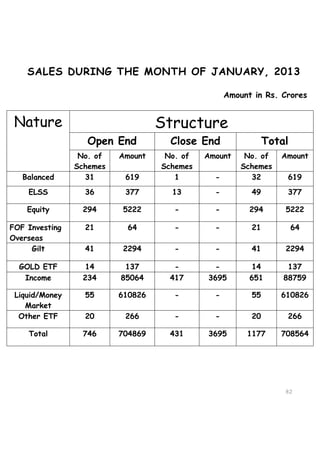
SALES DURING THE MONTH OF JANUARY, 2013

                                                   Amount in Rs. Crores


 Nature                            Structure
                  Open End           Close End                Total
                 No. of   Amount    No. of   Amount     No. of   Amount
                Schemes            Schemes             Schemes
   Balanced       31       619        1        -         32       619
    ELSS          36       377       13        -         49       377

    Equity       294      5222       -         -         294      5222

FOF Investing     21        64       -         -         21           64
Overseas
     Gilt         41      2294       -         -         41       2294

  GOLD ETF        14       137       -         -          14       137
   Income        234      85064     417      3695        651      88759

 Liquid/Money     55      610826     -         -         55      610826
    Market
  Other ETF       20       266       -         -         20       266

    Total        746      704869    431      3695       1177     708564


                                                                  82
                                                                  82
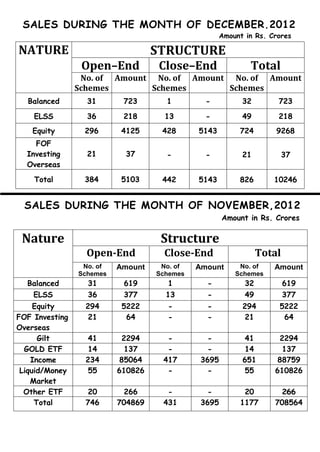
SALES DURING THE MONTH OF DECEMBER,2012
                                                    Amount in Rs. Crores

NATURE                             STRUCTURE
                 Open–End           Close–End               Total
                 No. of Amount No. of Amount No. of Amount
                Schemes       Schemes       Schemes
  Balanced        31       723       1         -          32        723

    ELSS          36       218       13        -          49        218
    Equity       296       4125     428      5143        724        9268
    FOF
  Investing       21        37       -         -          21            37
  Overseas
    Total        384       5103     442      5143        826       10246


 SALES DURING THE MONTH OF NOVEMBER,2012
                                                     Amount in Rs. Crores

 Nature                             Structure
                  Open-End           Close-End                  Total
                 No. of   Amount    No. of   Amount      No. of    Amount
                Schemes            Schemes              Schemes
  Balanced        31       619       1         -           32           619
    ELSS          36       377       13        -           49           377
     Equity       294      5222      -         -          294       5222
FOF Investing      21       64       -         -           21        64
Overseas
      Gilt         41      2294      -          -          41       2294
  GOLD ETF         14       137      -          -          14        137
    Income        234      85064    417       3695        651       88759
 Liquid/Money      55     610826     -          -          55      610826
    Market
  Other ETF        20       266      -          -         20         266
                                                                      83
                                                                      83
     Total        746     704869    431       3695       1177      708564
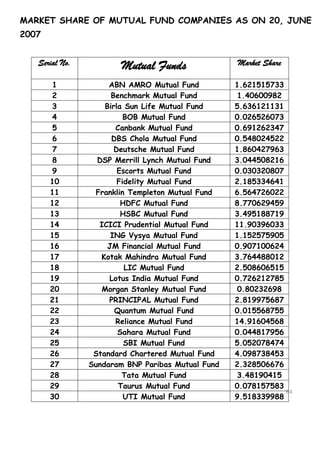
MARKET SHARE OF MUTUAL FUND COMPANIES AS ON 20, JUNE
2007


   Serial No.           Mutual Funds               Market Share

       1             ABN AMRO Mutual Fund          1.621515733
       2              Benchmark Mutual Fund         1.40600982
       3            Birla Sun Life Mutual Fund     5.636121131
       4                  BOB Mutual Fund          0.026526073
       5               Canbank Mutual Fund         0.691262347
       6              DBS Chola Mutual Fund        0.548024522
       7               Deutsche Mutual Fund        1.860427963
       8          DSP Merrill Lynch Mutual Fund    3.044508216
       9                Escorts Mutual Fund        0.030320807
       10               Fidelity Mutual Fund       2.185334641
       11        Franklin Templeton Mutual Fund    6.564726022
       12                HDFC Mutual Fund          8.770629459
       13                HSBC Mutual Fund          3.495188719
       14         ICICI Prudential Mutual Fund     11.90396033
       15             ING Vysya Mutual Fund        1.152575905
       16            JM Financial Mutual Fund      0.907100624
       17          Kotak Mahindra Mutual Fund      3.764488012
       18                 LIC Mutual Fund          2.508606515
       19            Lotus India Mutual Fund       0.726212785
       20          Morgan Stanley Mutual Fund       0.80232698
       21            PRINCIPAL Mutual Fund         2.819975687
       22              Quantum Mutual Fund         0.015568755
       23              Reliance Mutual Fund        14.91604568
       24               Sahara Mutual Fund         0.044817956
       25                 SBI Mutual Fund          5.052078474
       26        Standard Chartered Mutual Fund    4.098738453
       27       Sundaram BNP Paribas Mutual Fund   2.328506676
       28                Tata Mutual Fund           3.48190415
       29               Taurus Mutual Fund         0.078157583
                                                               84
       30                 UTI Mutual Fund          9.518339988 84
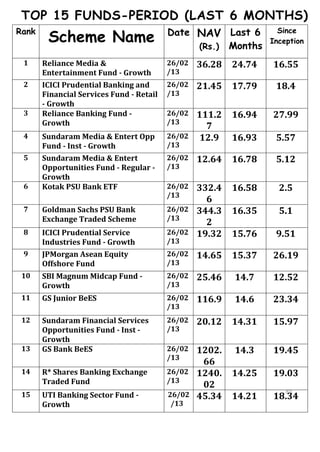
TOP 15 FUNDS-PERIOD (LAST 6 MONTHS)
        Scheme Name                       Date NAV Last 6
Rank                                                                Since
                                                                  Inception
                                               (Rs.) Months
 1     Reliance Media &                   26/02   36.28   24.74   16.55
       Entertainment Fund - Growth        /13
 2     ICICI Prudential Banking and       26/02   21.45   17.79    18.4
       Financial Services Fund - Retail   /13
       - Growth
 3     Reliance Banking Fund -            26/02   111.2   16.94   27.99
       Growth                             /13
                                                    7
 4     Sundaram Media & Entert Opp        26/02    12.9   16.93    5.57
       Fund - Inst - Growth               /13
 5     Sundaram Media & Entert            26/02   12.64   16.78    5.12
       Opportunities Fund - Regular -     /13
       Growth
 6     Kotak PSU Bank ETF                 26/02   332.4   16.58     2.5
                                          /13
                                                    6
 7     Goldman Sachs PSU Bank             26/02   344.3   16.35     5.1
       Exchange Traded Scheme             /13
                                                    2
 8     ICICI Prudential Service           26/02   19.32   15.76    9.51
       Industries Fund - Growth           /13
 9     JPMorgan Asean Equity              26/02   14.65   15.37   26.19
       Offshore Fund                      /13
 10    SBI Magnum Midcap Fund -           26/02   25.46   14.7    12.52
       Growth                             /13
 11    GS Junior BeES                     26/02   116.9   14.6    23.34
                                          /13
 12    Sundaram Financial Services        26/02   20.12   14.31   15.97
       Opportunities Fund - Inst -        /13
       Growth
 13    GS Bank BeES                       26/02   1202.   14.3    19.45
                                          /13
                                                   66
 14    R* Shares Banking Exchange         26/02   1240.   14.25   19.03
       Traded Fund                        /13
                                                   02
                                                                      85
 15    UTI Banking Sector Fund -          26/02   45.34   14.21   18.34
                                                                    85
       Growth                              /13
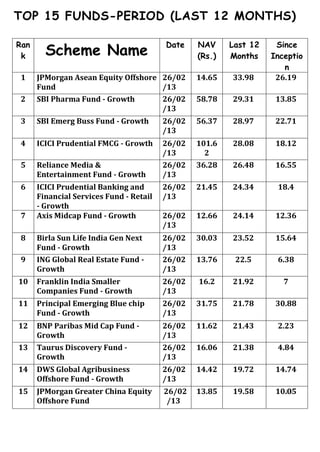
TOP 15 FUNDS-PERIOD (LAST 12 MONTHS)

Ran
        Scheme Name
                                         Date    NAV     Last 12    Since
 k                                               (Rs.)   Months    Inceptio
                                                                      n
1     JPMorgan Asean Equity Offshore 26/02       14.65   33.98      26.19
      Fund                           /13
2     SBI Pharma Fund - Growth           26/02   58.78   29.31      13.85
                                         /13
3     SBI Emerg Buss Fund - Growth       26/02   56.37   28.97      22.71
                                         /13
4     ICICI Prudential FMCG - Growth     26/02   101.6   28.08      18.12
                                         /13       2
5     Reliance Media &                   26/02   36.28   26.48      16.55
      Entertainment Fund - Growth        /13
6     ICICI Prudential Banking and       26/02   21.45   24.34      18.4
      Financial Services Fund - Retail   /13
      - Growth
7     Axis Midcap Fund - Growth          26/02   12.66   24.14      12.36
                                         /13
8     Birla Sun Life India Gen Next      26/02   30.03   23.52      15.64
      Fund - Growth                      /13
9     ING Global Real Estate Fund -      26/02   13.76    22.5      6.38
      Growth                             /13
10    Franklin India Smaller             26/02   16.2    21.92        7
      Companies Fund - Growth            /13
11    Principal Emerging Blue chip       26/02   31.75   21.78      30.88
      Fund - Growth                      /13
12    BNP Paribas Mid Cap Fund -         26/02   11.62   21.43      2.23
      Growth                             /13
13    Taurus Discovery Fund -            26/02   16.06   21.38      4.84
      Growth                             /13
14    DWS Global Agribusiness            26/02   14.42   19.72      14.74
      Offshore Fund - Growth             /13
15    JPMorgan Greater China Equity      26/02   13.85   19.58      10.05
                                                                      86
                                                                      86
      Offshore Fund                       /13
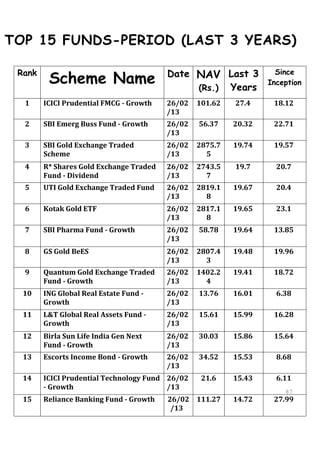
TOP 15 FUNDS-PERIOD (LAST 3 YEARS)

         Scheme Name                     Date NAV Last 3
 Rank                                                               Since
                                                                  Inception
                                              (Rs.) Years
  1     ICICI Prudential FMCG - Growth   26/02   101.62   27.4     18.12
                                         /13
  2     SBI Emerg Buss Fund - Growth     26/02   56.37    20.32    22.71
                                         /13
  3     SBI Gold Exchange Traded         26/02   2875.7   19.74    19.57
        Scheme                           /13       5
  4     R* Shares Gold Exchange Traded   26/02   2743.5   19.7      20.7
        Fund - Dividend                  /13       7
  5     UTI Gold Exchange Traded Fund    26/02   2819.1   19.67     20.4
                                         /13       8
  6     Kotak Gold ETF                   26/02   2817.1   19.65     23.1
                                         /13       8
  7     SBI Pharma Fund - Growth         26/02   58.78    19.64    13.85
                                         /13
  8     GS Gold BeES                     26/02   2807.4   19.48    19.96
                                         /13       3
  9     Quantum Gold Exchange Traded     26/02   1402.2   19.41    18.72
        Fund - Growth                    /13       4
  10    ING Global Real Estate Fund -    26/02   13.76    16.01     6.38
        Growth                           /13
  11    L&T Global Real Assets Fund -    26/02   15.61    15.99    16.28
        Growth                           /13
  12    Birla Sun Life India Gen Next    26/02   30.03    15.86    15.64
        Fund - Growth                    /13
  13    Escorts Income Bond - Growth     26/02   34.52    15.53     8.68
                                         /13
  14    ICICI Prudential Technology Fund 26/02    21.6    15.43     6.11
        - Growth                         /13
                                                                      87
  15    Reliance Banking Fund - Growth   26/02 111.27     14.72    27.99
                                                                      87
                                          /13
TOP 15 FUNDS-PERIOD (LAST 5 YEARS)

        Scheme Name                     Date NAV Last 5
Rank                                                              Since
                                                                Inception
                                             (Rs.) Years
 1     Reliance Pharma Fund -           26/02   64.92   22.67    23.88
       Growth                           /13
 2     UTI Gold Exchange Traded         26/02   2819.   18.41    20.4
       Fund                             /13      18
 3     Kotak Gold ETF                   26/02   2817.   18.37    23.1
                                        /13      18
 4     GS Gold BeES                     26/02   2807.   18.36    19.96
                                        /13      43
 5     R* Shares Gold Exchange          26/02   2743.   18.03    20.7
       Traded Fund - Dividend           /13      57
 6     Quantum Gold Exchange            26/02   1402.   17.91    18.72
       Traded Fund - Growth             /13      24
 7     UTI Pharma and Healthcare        26/02   45.2    16.48    11.58
       Fund - Growth                    /13
 8     ICICI Prudential FMCG - Growth   26/02101.6      16.01    18.12
                                        /13    2
 9     ICICI Prudential Discovery Fund 26/02 24.86      13.88    13.95
       - IP- Growth                     /13
 10    UTI Transportation and           26/02   30.15   13.87    13.08
       Logistics Fund - Growth          /13
 11    Birla Sun Life MNC Fund -        26/02 244.9     13.82    18.48
       Growth                           /13     8
 12    SBI Pharma Fund - Growth         26/02 58.78      13      13.85
                                        /13
 13    UTI MNC Fund - Growth            26/02   69.44   12.97    13.91
                                        /13
 14    Reliance Banking Fund -          26/02111.2      12.63    27.99
       Growth                           /13    7
 15    ICICI Prudential Discovery Fund 26/02 54.6       12.59     22
       - Growth                         /13                         88
                                                                    88
UTI MF Performance as on 26th Feb, 2013
    Scheme Name                     Performance ( % Return )                    Fund Size
                                   30 Days    91 Days   1 Year    3 Year    Rs. in Cr.       As on
UTI - MIS - Advantage Fund -        -0.7612    1.2621   8.8597    7.0271      564.65      Jan 31, 2013

Growth
UTI - MIS - Advantage Fund -       -0.7615     1.2615   8.8606    7.0319      564.65      Jan 31, 2013

Flexi Dividend
UTI - MIS - Advantage Fund- Dir    -0.7764      NA       NA        NA         564.65      Jan 31, 2013

- Monthly Dividend
UTI - MIS - Advantage Fund-        -0.8337     1.0443   7.9012    6.1053      564.65      Jan 31, 2013

Monthly Dividend
UTI Balanced Fund - Dividend       -4.2278     1.0249   4.3081    4.7996      959.3       Jan 31, 2013

UTI Balanced Fund - Growth         -4.2276     1.0384   9.1076    6.3859      959.3       Jan 31, 2013

UTI Banking Sector Fund -          -8.0373     2.612    10.3326   10.6441     402.02      Jan 31, 2013

Dividend
UTI Banking Sector Fund - Growth   -8.0372     2.606    10.3118   11.1049     402.02      Jan 31, 2013

UTI Bond Fund - Dividend            0.7489      4.33    10.8656   9.0987     1675.92      Jan 31, 2013

UTI Bond Fund - Growth              0.7497     4.5491   11.7135   9.8762     1675.92      Jan 31, 2013

UTI Childrens Career Balanced      -1.3907     1.8812   9.4924    8.1041     2945.26      Jan 31, 2013

Plan
UTI Childrens Career Balanced      -1.3716      NA       NA        NA        2945.26      Jan 31, 2013

Plan-Dir
UTI Contra Fund - Dividend         -8.0575     0.7187   4.0065    -0.4431     150.15      Jan 31, 2013

UTI Contra Fund - Growth           -8.0571     0.7482   3.9464    -0.4596     150.15      Jan 31, 2013

UTI Credit Opportunities Fund -     0.3391     2.1674    NA        NA         214.82      Jan 31, 2013

Dividend
UTI Credit Opportunities Fund -     0.3391     2.1674    NA        NA         214.82      Jan 31, 2013

Growth
UTI CRTS 81 - Dividend             -0.8693     1.7998   11.4193   9.8809      342.63      Jan 31, 2013

UTI CRTS 81 - Growth               -0.8694     1.8006   12.464    10.6568     342.63      Jan 31, 2013

UTI Dividend Yield Fund -          -5.1686     1.1681    3.493     7.408     3627.98      Jan 31, 2013

Dividend
UTI Dividend Yield Fund - Growth   -5.1691     1.1731    3.515    7.4416     3627.98      Jan 31, 2013

UTI Dynamic Bond Fund - Dividend    0.6213     3.2549   9.3644     NA         992.09      Jan 31, 2013

UTI Dynamic Bond Fund - Growth      0.6221     3.2543   10.3418    NA         992.09     89 31, 2013
                                                                                          Jan
                                                                                         89
UTI Energy Fund - Dividend         -8.5001    -1.7816   -7.886    -5.5012     302.01      Jan 31, 2013

UTI Energy Fund - Growth           -8.5003    -1.7819   -7.9968   -5.5316     302.01      Jan 31, 2013
UTI Equity Fund - Dividend            -2.1094    4.07     13.336    10.3225   2389.61     Jan 31, 2013

UTI Equity Fund - Growth              -4.6074   1.3835    10.4092   9.3594    2389.61     Jan 31, 2013

UTI Equity Tax Savings   Plan -       -4.4033   1.4497    8.2194    4.9128     475.96     Jan 31, 2013

Dividend
UTI Equity Tax Savings   Plan -       -4.4035    1.432    8.2551    4.9253     475.96     Jan 31, 2013

Growth
UTI Floating Rate Fund   - STP -      0.6763    2.1192     8.918    7.7424    1940.66     Jan 31, 2013

Growth
UTI Floating Rate Fund   - STP -      0.4232    1.8624    8.4717    7.5355    1940.66     Jan 31, 2013

IP - Flexi Dividend
UTI Floating Rate Fund   - STP -      0.6763    2.1192    9.5795    8.5093    1940.66     Jan 31, 2013

IP - Growth
UTI G-Sec Fund - STP     - Dividend   0.6318    2.5129    7.7421    6.3297     13.76      Jan 31, 2013

UTI G-Sec Fund - STP - Growth         0.6307    2.5118    8.7063    6.8255     13.76      Jan 31, 2013

UTI Gilt Advantage   Fund - L T -     1.0209     5.379    10.3434   8.1522     212.56     Jan 31, 2013

PF Plan - Dividend
UTI Gilt Advantage   Fund - L T -     1.0208    5.3796    11.007    8.6578     212.56     Jan 31, 2013

PF Plan - Growth
UTI Gilt Advantage   Fund - L T P     1.0208    5.3793    11.0068   8.6589     212.56     Jan 31, 2013

- Dividend
UTI Gilt Advantage   Fund - L T P      1.021    5.3793    11.0062   8.6573     212.56     Jan 31, 2013

- Growth
UTI Gold ETF                          -3.9511   -9.4018   2.2051    19.6731    736.02     Jan 31, 2013

UTI India Lifestyle Fund -            -4.2744    0.904    12.2616   11.7703    358.57     Jan 31, 2013

Dividend
UTI India Lifestyle Fund - Growth     -4.2744   0.9047    12.2625   11.7706    358.57     Jan 31, 2013

UTI Infrastructure Fund -             -8.353    -2.2354   -2.1571   -6.338    1806.12     Jan 31, 2013

Dividend
UTI Infrastructure Fund - Growth      -8.3534   -2.2203   -2.1339   -6.2752   1806.12     Jan 31, 2013

UTI Leadership Equity Fund -          -5.4992   2.4209    10.2229   5.0069     620.15     Jan 31, 2013

Dividend
UTI Leadership Equity Fund -          -5.4993   2.4024    10.1916   4.9459     620.15     Jan 31, 2013

Growth
UTI Liquid Fund - Cash Plan - IP      0.6931    2.1043    9.3709    8.1985    12858.84    Jan 31, 2013

- Growth
UTI Liquid Fund - Cash Plan - IP      0.5423    1.6439    7.2759    6.4202    12858.84    Jan 31, 2013

- Monthly Dividend
UTI Liquid Fund - Cash Plan - Reg     0.6389    1.9357    8.7062    7.5976    12858.84   90 31, 2013
                                                                                          Jan

- Growth                                                                                 90

UTI Liquid Fund - Cash Plan - Reg     0.5299    1.6001    7.2496    6.2614    12858.84    Jan 31, 2013

- Monthly Div
UTI Mahila Unit Scheme -           -1.1039   1.0036    6.7611    5.9317    231.41     Jan 31, 2013

Dividend
UTI Mahila Unit Scheme - Growth    -1.1039   1.0036    6.7616    5.9317    231.41     Jan 31, 2013

UTI Master Value Fund - Dividend   -6.8359   -2.5636   2.9595    6.4766    633.47     Jan 31, 2013

UTI Master Value Fund - Growth     -6.836    -2.5628   2.9646    6.6306    633.47     Jan 31, 2013

UTI Mastershare - Dividend         -4.5733   1.3504     6.234    6.0546    2375.71    Jan 31, 2013

UTI Mastershare - Growth           -4.573    1.3609    6.9982    6.3802    2375.71    Jan 31, 2013

UTI Mid Cap Fund - Dividend        -6.4354   -3.6418   11.0938   6.2721    285.95     Jan 31, 2013

UTI Mid Cap Fund - Growth          -6.4354   -3.6436   11.0994   6.2685    285.95     Jan 31, 2013

UTI MNC Fund - Dividend            -3.4882   -2.0667   7.4881    13.8452   255.87     Jan 31, 2013

UTI MNC Fund - Growth              -3.4882   -2.0714   7.4143    13.8094   255.87     Jan 31, 2013

UTI Money Market - IP - Growth     0.7022    2.1231    9.4264    8.2431    2418.7     Jan 31, 2013

UTI Money Market - Ret - Flexi     0.2326    1.5373    7.5527    6.6336    2418.7     Jan 31, 2013

Dividend
UTI Money Market - Ret -           0.6481    1.9581    8.7993    7.6917    2418.7     Jan 31, 2013

Growth
UTI Money Market - Ret - Perd      0.2327    1.5373    7.5503    6.6112    2418.7     Jan 31, 2013

Dividend
UTI Monthly Income Scheme -        -0.4824   1.6081    7.2783    6.2806    318.48     Jan 31, 2013

Dividend
UTI Monthly Income Scheme -        -0.4013   1.8521    8.3208    7.2683    318.48     Jan 31, 2013

Growth
UTI Nifty Fund - Dividend          -5.2944   1.8295    6.4646    5.3599    177.49     Jan 31, 2013

UTI Nifty Fund - Growth            -5.2941   1.8284    6.4692    5.3668    177.49     Jan 31, 2013

UTI Opportunities Fund -Dividend   -4.7911   -0.653    6.9369    10.2218   3580.48    Jan 31, 2013

UTI Opportunities Fund - Growth    -4.7908   -0.6644   7.0106    10.3731   3580.48    Jan 31, 2013

UTI Pharma and Healthcare Fund     -2.6047   0.1858    15.3893   13.3624   103.87     Jan 31, 2013

- Dividend
UTI Pharma and Healthcare Fund     -2.605    0.1598    15.4112   13.4932   103.87     Jan 31, 2013

- Growth

UTI Services Industries Fund -     -2.2966   4.1375    11.0688   6.6018    220.73     Jan 31, 2013

Dividend
UTI Services Industries Fund -     -2.2964    4.144    11.0567   6.5905    220.73     Jan 31, 2013

Growth                                                                               91
                                                                                     91
UTI Short Term Income Fund -       0.6516    2.6532    9.7926    8.3212    2270.77    Jan 31, 2013

Ret - Dividend
UTI Short Term Income Fund -       0.6517    2.8288    10.5024    8.905    2270.77    Jan 31, 2013
Ret - Growth
UTI Spread Fund - Dividend           0.5496    1.8493    8.6016    7.4612     26.91     Jan 31, 2013

UTI Spread Fund - Growth             0.5498    1.8482    8.5995    7.4636     26.91     Jan 31, 2013

UTI Top 100 Fund - Dividend          -4.0377   -1.0839   5.3964     5.801    628.07     Jan 31, 2013

UTI Top 100 Fund - Growth            -4.0373   -1.0497   5.3995    5.8037    628.07     Jan 31, 2013

UTI Transportation and Logistics     -6.2738   -1.2871    6.535    10.4558    55.1      Jan 31, 2013

Fund - Dividend
UTI Transportation and Logistics     -6.274    -1.2685   6.5286    10.536     55.1      Jan 31, 2013

Fund - Growth
UTI Treasury Advantage Fund -        0.6948    2.1356    9.4982    8.4344    10793.3    Jan 31, 2013

IP - Growth
UTI Treasury Advantage Fund -        0.6099    1.8663    8.2965    7.4961    10793.3    Jan 31, 2013

IP - Mthly Dividend
UTI ULIP                             -1.6199   1.4472    10.3365   8.5794    2509.47    Jan 31, 2013

UTI Wealth Builder Fund   - Series   -5.0262   -3.3671   6.8351    10.2855   602.65     Jan 31, 2013

II - Dividend
UTI Wealth Builder Fund   - Series   -5.0265   -3.3755   6.8838    10.576    602.65     Jan 31, 2013

II - Growth
UTI-CCP Advantage Fund    -          -5.9639   -0.3749   5.9475    5.1604     85.52     Jan 31, 2013

Dividend
UTI-CCP Advantage Fund    -          -5.9639   -0.3749   5.9475    5.1606     85.52     Jan 31, 2013

Growth
UTI-MEPUS                            -5.6603   1.9098    7.1902    6.4309    1299.21    Jan 31, 2013


                                                                                       92
                                                                                       92
Conclusion
      It is hopeful that this study creates awareness that the mutual funds are
worth investment practice. The various schemes of mutual funds provide the
investors with a wide range of investments options according to his risk bearing
capacities and interest. Besides they also give a handy return to the investors. The
project analyses various schemes of Different Companies.

      In India Mutual funds are playing important role. The mutual funds
companies pool the savings of small investors and invest those collected huge
amount of funds in different sectors of the economy. They are performing like
intermediary between small investor and the Indian capital market. In recent years
many mutual fund companies are established. Through this competition is
increased among the companies. To encounter the competition the different
companies are introducing different types of mutual fund schemes with attractive
returns and low risk. So it is an advantage to the investors.

      The stock market has been rising for over six years now. This in turn has not
only protected the money invested in funds but has also to helped grow these
investments.

       This has also instilled greater confidence among fund investors who are
 investing more into the market through the MF route than ever before.


     Reliance India mutual funds provide major benefits to a
 common man who wants to make his life better than previous.

       India's largest mutual fund, UTI, still controls nearly 80 per cent
 of the market. Also, the mutual fund industry as a whole gets less than 2 per cent
 of household savings against the 46 per cent that go into bank deposits. Some

 fund managers say this only indicates the sector's potential. "lf mutual   funds
                                                                              93
 succeed in chipping away at bank deposits, even a triple digit 93

 growth is possible over the next few years”.
BIBLIOGRAPHY
Websites:
       www.google.com
       www.mutualfundsindia.com
       www.bseindia.com
       www.sbimf.com
       www.amfiindia.com
       www.slideshare.net
       www.ekikrat.in
       www.utimf.com

Journal:
“Comparative study and analysis of Mutual Funds”,
ICAI.


                                             94
                                             94

Study on Mutual Fund

  • 1.
    Project Report ( Submittedfor the Degree of B.Com (Honours) in Accounting and Finance under the University of Calcutta). Title of the Project “Study and Analysis of Mutual Funds” Submitted by VIVEK SAHA Roll No.- Registration No.- ACKNOWLEDGEMENT
  • 2.
    Before we getinto thick of things, I would like to add a few words of appreciation for the people who have been a part of this project right from its inception. The writing of this project has been one of the significant academic challenges I have faced and without the support, patience, and guidance of the people involved, this task would not have been completed. It is to them I owe my deepest gratitude. It gives me immense pleasure in presenting this project report on “STUDY and ANALYSIS OF MUTUAL FUNDS IN INDIA”. It has been my privilege to have a team of project is a result of sheer hard work, and determination put in by me with the help of my project guide. I hereby take this opportunity to add a special note of thanks for Prof TANMAY GHOSH, who undertook to act as my mentor despite his many other academic and professional commitments. His wisdom, knowledge, and commitment to the highest standards inspired and motivated me. Without his insight, support, and energy, this project wouldn’t have kick- started and neither would have reached fruitfulness. I also feel heartiest sense of obligation to my library staff members & seniors, who helped me in collection of data & resources material & also in its processing as well as in drafting manuscript. The project is dedicated to all those people, who helped me while doing this project.
  • 3.
    OBJECTIVES OF THESTUDY The specific objectives of the study are as follows:- 1. To analyze the trends in returns of selected mutual funds. 2. To understand the Functions of an Asset Management Company 3. To understand the performances of various schemes using various tools to measure the performances. 4. To measure and compare the performance of selected mutual fund schemes of different mutual fund companies and other Asset Management Companies.
  • 4.
    Supervisor’s Certificate This isto certify that Mr. VIVEK SAHA, a student of B.Com (Honours) in Accounting & Finance of Acharya Girish Chandra College under the University of Calcutta has worked under my supervision and guidance for his project work and prepared a Project Report with the title “STUDY and ANALYSIS OF MUTUAL FUNDS IN INDIA”. The project which he is submitting is his genuine and original work to the best of my knowledge. Signature Place: Kolkata Name: Prof. Tanmay Ghosh. Date: Designation:
  • 5.
    Student’s Declaration I herebydeclare that the Project Work with the title “STUDY and ANALYSIS OF MUTUAL FUNDS IN INDIA” submitted by me for partial fulfillment of the degree of B.Com (Honours) in Accountancy & Finance under the University of Calcutta is my original work and has not been submitted earlier to any other University for the fulfillment of the requirement for any course of study. I also declare that no chapter of this manuscript in whole or in part has been incorporated in this report from any earlier work done by others or by me. However, extracts of any literature which has been used for this report has been duly acknowledged providing details of such literature in the references. Signature Place: KOLKATA Name : Vivek Saha Date: Address : 29, Durgabari Road, Kolkata - 700028 Registration No.: 141-1121-0096-10 Roll No.: 1141-61-0195
  • 6.
    INDEX Serial Topics Page No. No. 1 Introduction 1 2 Why Select Mutual Fund? 2 3 History of Mutual Fund 3-4 4 Advantages of Mutual Fund 5-6 5 Disadvantages of MF 7-8 6 Types of MF in India 9-14 7 SEBI Regulations 15-16 8 AMFI 17-18 9 Mutual Fund in India 19-23 10 Unit Trust of India MF 24-32 11 State Bank of India MF 33-36 12 Future Prospect of MF in 37-38 India 13 MF Fees & Expenses 39 14 Definition on key terms 40-41 15 Data Collection - 16 Conclusion 42 17 Bibliography 43
  • 7.
    INTRODUCTION To state insimple words, a mutual fund collects the savings from small investors, invest them in Government and other corporate securities and earn income through interest and dividends, besides capital gain. It works on the principle of” small drop of water makes a big ocean’. . DEFINITION The Securities and Exchange Board of India (Mutual Funds) Regulation, 1993 defines a mutual fund “a fund established in the form of a trust by a sponsor, to raise monies by the trustees through the sale of units to the, public, under one or more schemes, for investing in securities in accordance with these regulations” According to Weston J. Fred and Brigham, Eugene, F, Unit trusts are “corporations which accept dollars from savers and then use these dollars to buy stock, long term bonds, short term debt instruments issued by business or government units; these corporations pool funds and thus reduce risk by diversification”. Why Select Mutual Funds ?
  • 8.
    The risk returntrade-off indicates that if investor is willing to take higher risk then correspondingly he can expect higher returns and vice-versa if he pertains to lower risk instruments, which would be satisfied by lower returns. For example, if an investors opt for bank FD, which provide moderate return with minimal risk. But as he moves ahead 10 invest in capital protected funds and the profit-bonds that gives us more return which is slightly higher as compared to the bank deposits but the risk involved also increases in the same proportion. Thus investors choose mutual funds as their primary means of investing, as Mutual funds provide professional management, diversification, convenience and liquidity. That doesn't mean mutual fund investments risk free. This is because the money that is pooled in are not invested only in debts funds which are less riskier but are also invested in the stock markets which involves a higher risk but can expect higher returns. Hedge fund involves a very high risk since it is mostly traded in the derivatives market which is considered very volatile. HISTORY OF MUTUAL FUNDS
  • 9.
    An open-end fundis one that is available for subscription all through the year. These do not have a fixed maturity. Investors can conveniently buy and sell units at Net Asset Value ("NAV") related prices. The key feature of open-end schemes is liquidity The Mutual fund industry in India started in 963 with the formation of UTI (united trust of India), at the initiative of government of India. The history of Mutual Funds in India can be broadly divided into Four Phases. First Phase- 1964-87 Unit Trust of India was established by an act of Parliament. It was set up by the Reserve Bank of India and functioned under the Regulatory and Administrative control of the Reserve Bank of India. In 1978 UTI was de-linked from the RBI and IDBI took over the regulatory and administrative control in place of RBI. The first scheme launched by UTI was Unit Scheme 1964. At the end of 1988 UTI had Rs. 6700 crores of assets under management. Second phase- 1987-1993 (entry of public sector funds). 1987 marketed the entry of non-UTI, public sector mutual funds set up by public sector banks and life insurance Corporation of India (LIC) and general Insurance Corporation of India (GIC). SBI Mutual fund was the first non-UTI Mutual fund established in June 1987 followed by can bank Mutual fund (Dec 1987), Punjab national bank mutual fund (August 89). India bank mutual fund (Nov 89). Bank of India (June 90), bank of Baroda mutual fund (Oct 92). LIC established its mutual fund in Nov 1989 while GIC had set up its mutual fund in December 1990 at the end of 1993, the mutual fund industry had asset under management of Rs.47,004 crores. Third phase- 1993-2003 (entry of private sector funds) With the entry of private sector funds in 1993, an era started in the Indian mutual fund industry, giving the Indian
  • 10.
    investors a widerchoice of fund families, Also. 1993 was the year in which the first mutual fund regulations came into being, under which all mutual funds, except UTI were to be registered and governed, the Kothari pioneer (now merged with Franklin Templeton) was the first private sector mutual fund registered in July 1993. The 1993 SEBI (mutual funds ) registrations were substituted by a more comprehensive and revised mutual funds regulations in 1996 the number of mutual funds houses went on increasing, with many foreign mutual funds setting up funds in India and also the industry has witnessed several mergers and acquisition. As at the of Jan 2003, there were 33 mutual funds with total assets of Rs. 1,21,805 crores. The UTI with Rs. 44,541 crores of assets under management was way ahead of other mutual funds. Fourthphase-2003-2005: This phase had bitter experience for UTI. It was bifurcated into two separate entities. One is the Specified Undertaking of the Unit Trust of India with AUM of Rs.29,835 crores (as on January 2003). The Specified Undertaking of Unit Trust of India, functioning under an administrator and under the rules framed by Government of India and does not come under the purview of the Mutual Fund Regulations. The second is the UTI Mutual Fund Ltd, sponsored by SBI, PNB, BOB and LIC. It is registered with SEBI and functions under the Mutual Fund Regulations. With the bifurcation of the erstwhile UTI which had in March 2000 more than Rs.76,000 crores of AUM and with the setting up of a UTI Mutual Fund, conforming to the SEBI Mutual Fund Regulations, and with recent mergers taking place among different private sector funds, the mutual fund industry has entered . At the end of September 2004, there were 29 funds, which manage assets of Rs.153108 crores under 421 schemes.
  • 11.
    ADVANTAGES OF MUTUALFUNDS: lf mutual funds are emerging as the favorite investment vehicle, it is because of the many advantages they have over other forms and the avenues of investing, particularly for the investor who has limited resources available in terms of capital and the ability to carry out detailed research and market monitoring. The following are the major advantages offered by mutual funds to all investors: 1. Portfolio Diversification: Each investor in the fund is a part owner of all the fund's assets, thus enabling him to hold a diversified investment portfolio even with a small amount of investment that would otherwise require big capital. 2. Professional Management: Even if an investor has a big amount of capital available to him, he benefits from the professional management skills brought in by the fund in the management of the investor's portfolio. The investment management skills, along with the needed research into available investment options, ensure a much better return than what an investor can manage on his own. Few investors have the skill and resources of their own to succeed in today’s fast moving, global and sophisticated markets. 3. Reduction/Diversification Of Risk: When an investor invests directly, all the risk of potential loss is his own, whether he places a deposit with a company or a bank, or he buys share or debenture on his own or in any other from. While investing in the pool of funds with investors, the potential losses are also shared with other investors. The risk reduction is one of the most important benefits of a collective investment vehicle like the mutual fund.
  • 12.
    4. Reduction OfTransaction Costs: What is true of risk as also true of the transaction costs. The investor bears all the costs or investing such as brokerage or custody of securities. When going through a fund, he has the benefit of economics of scale; the funds pay lesser costs because of larger volumes, a benefit passed on to its investors. 5. Liquidity: Often, investors hold shares or bonds they cannot directly, easily and quickly sell. When they invest in the units or a fund, they can generally cash their investments any time, by selling their units to the fund if open-ended, or selling them in the market if the fund is close-end. Liquidity of investment is clearly a big benefit. 6. Convenience And Flexibility: Mutual fund management companies offer many investor services that a direct market investor cannot get. Investors can easily transfer their holding from One scheme to the other; get updated market information and so on. 7. Tax Benefits: Any income distributed after March 31, 2002 will be subject to tax in the assessment of all Unit holders. However, as a measure of concession to Unit holders of open-ended equity- oriented funds, income distributions for the year ending March 31. 2003 will be taxed at a concessional rate of 10.5%. In case of Individuals and Hindu Undivided Families (HUF) a deduction upto Rs. 9,000 from the Total Income will be admissible in respect of income from investments specified in Section 80L, including income from Units of the Mutual Fund. Units of the schemes are not subject to Wealth-Tax and Gift-Tax.
  • 13.
    DISADVANTAGES OF INVESTING THROUGHMUTUAL FUNDS: 1. No Control Over Costs: An investor in a mutual fund has no control of the overall costs of investing. The investor pays investment management fees as long as he remains with the fund, albeit in return for the professional management and research. Fees are payable even if the value of his investments is declining. A mutual fund investor also pays fund distribution costs, which he would not incur in direct investing. However, this shortcoming only means that there is a cost to obtain the mutual fund services. 2. No Tailor-Made Portfolio: Investors who invest on their own can build their own portfolios of shares and bonds and other securities, Investing through fund means he delegates this decision to the fund managers, The very- high-net-worth individuals or large corporate investors may find this to be a constraint in achieving their objectives. However, most mutual fund managers help investors overcome this constraint by offering families of funds - a large number of different schemes - within their own management company. An investor can choose from different investment plans and constructs a portfolio to his choices. 3. Managing A Portfolio Of Funds: Availability of a large number of funds can actually mean too much choice for the investor. He may again need advice on how to select a fund to achieve his objectives, quite similar to the situation when he has individual shares or bonds to select. 4. The Wisdom Of Professional Management: 2 0 That's right, this is not an advantage. The average mutual 2 fund manager is no better at picking stocks than the average non- 0 professional, but charges fees.
  • 14.
    5. No Control: Unlike picking your own individual stocks, a mutual fund puts you in the passenger seat of somebody else's car. 6. Dilution: Mutual funds generally have such small holdings of so many different stocks that insanely great performance by a fund's top holdings still doesn't make much of a difference in a mutual fund's total performance. 7. Buried Costs: Many mutual funds specialize in burying their costs and in hiring salesmen who do not make those costs clear to their clients. 2 1 2 TYPES OF MUTUAL FUNDS SCHEMES 1
  • 15.
    IN INDIA Wide variety of Mutual Fund Schemes exists to cater to the needs such as financial position, risk tolerance and return expectations etc. thus mutual funds has Variety of flavors, Being a collection of many stocks, an investors can go for picking a mutual fund might be easy. There are over hundreds of mutual funds scheme to choose from. It is easier to think of mutual funds in categories, mentioned below. TYPES OF MUTUAL FUNDS BY NATURE BY INVESTMENT OTHER BY STRUCTURE OBJECTIVE SCHEMES Open-Ended Growth Tax-Saving Equity Funds Schemes Schemes Schemes Close-Ended Income Index Debt Funds Schemes Schemes Schemes Sector Interval Balanced Balanced Specific Schemes Funds Schemes Schemes Money Market Schemes A) BY STRUCTURE 2 2 2 2 1. Open - Ended Schemes:
  • 16.
    An open-end fundis one that is available for subscription all through the year. These do not have a fixed maturity. Investors "an conveniently buy and sell units at Net Asset Value (“NAV”) related prices. The key feature of open-end schemes is liquidity. 2. Close - Ended Schemes: A closed-end fund has a stipulated maturity period which generally ranging from 3 to 15 years. The fund is open for subscription only during a specified period. Investors can invest in the scheme at the time of the initial public issue and thereafter they can buy or sell the units of the schemes on the stock exchanges: where they are listed. In order to provide an exit route t0 the investors, some close-ended funds give an option of selling back the units to the Mutual Fund through periodic repurchase at NAV related prices. SEBI Regulations stipulate that at least One of the two exit routes is provided t0 the investor. 3. Interval Schemes: Interval Schemes are that scheme, which combines the features of open-ended and close- ended schemes. The units may be traded on the stock exchange or may be open for sale or redemption during pre-determined intervals at NA V related prices. 2 3 2 3
  • 17.
    B) BY NATURE 1. Equity Fund: These funds invest the maximum part of their corpus into equities holdings. The structure of the fund may vary different for different schemes and the fund manager’s outlook on different stocks. The Equity Funds are sub-classified depending upon their investment objective, as follows: • Diversified Equity Funds • Mid-Cap Funds • Sector Specific Funds • Tax Savings Funds (ELSS) Equity investments are meant for a longer time horizon, thus Equity funds rank high on the risk-return matrix. 2. Debt Funds The objective of these Funds is to invest in debt papers, Government authorities, private companies, banks and financial institutions are some of the major issuers of debt papers. By investing in debt instruments, these funds ensure low risk and provide stable income to the investors. Debt funds are further classified as: • Gilt Funds: Invest their corpus in securities issued by Government, popularly known as Government of India debt papers. These Funds carry zero Default risk but are associated with Interest Rate risk. These schemes are safer as they invest in papers backed by Government. • Income Funds: Invest a major portion into various debt instruments such as bonds, corporate debentures and Government securities. 2 4 2 4
  • 18.
    • MIPs: Investsmaximum of their total corpus in debt instruments while they take minimum exposure in equities. It gets benefit of both equity and debt market. These scheme ranks slightly high on the risk-return matrix when compared with other debt schemes. • Short Term Plans (STPs): Meant for investment horizon for three to six months. These funds primarily invest in short term papers like Certificate of Deposits (CDs) and Commercial Papers (CPs). Some portion of the corpus is also invested in corporate debentures. • Liquid Funds: Also known as Money Market Schemes, These funds provides easy liquidity and preservation of capital, These schemes invest in short-term instruments like Treasury Bills, inter-bank call money market, CPs and CDs. These funds are meant for short-term cash management of corporate houses and are meant for an investment horizon of 1 day to 3 months. These schemes rank low on risk-return matrix and are considered to be the safest amongst all categories of mutual funds. 3. Balanced Funds As the name suggest they are a mix of both equity and debt funds. They invest in both equities and fixed income securities, which are in line with pre-defined investment objective of the scheme. These schemes aim to provide investors with the best of both the worlds. Equity part provides growth and the debt part provides stability in returns. Further the mutual funds can be broadly classified on the basis of investment parameter viz; each category of funds is backed by an investment philosophy, which is pre-defined in the objectives of the fund. The investor can align his own investment needs with the funds objective and invest accordingly. 2 5 2 5
  • 19.
    C) BY INVESTMENTOBJECTIVE Growth Schemes: Growth Schemes are also known as equity schemes. The aim of these schemes is to provide capital appreciation over medium to long term. These schemes normally invest a major part of their fund in equities and are willing to bear short-term decline in value for possible future appreciation. Income Schemes: Income Schemes are also known as debt schemes. The aim of these schemes is to provide regular and steady income to investors. These schemes generally invest in fixed income securities such as bonds and corporate debentures. Capital appreciation in such schemes may be limited. Balanced Schemes: Balanced Schemes aim to provide both growth and income by periodically distributing a part of the income and capital gains they can. These schemes invest in both shares and fixed income securities, in the proportion indicated in their offer documents (normally 50:50). Money Market Schemes: Money Market Schemes aim to provide easy liquidity, preservation of capital and moderate income. These schemes generally invest in safer, short-term instruments, such as treasury bills, certificates of deposit, commercial paper and inter-bank call money. 2 6 2 6
  • 20.
    OTHER SCHEMES Tax SavingSchemes: Tax-saving schemes offer tax rebates to the investors under tax laws prescribed from time to time. Under Sec.88 of the Income Tax Act, contributions made to any Equity Linked Savings Scheme (ELSS) are eligible for rebate. Index Schemes: Index schemes attempt to replicate the performance of a particular index such as the BSE Sensex or the NSE 50. The portfolio of these schemes will consist of only those stocks that constitute the index. The percentage of each stock to the total holding will be identical to the stocks index weightage. And hence, the returns from such schemes would be more or less equivalent to those of the Index. Sector Specific Schemes: These are the funds/schemes which invest in the securities of only those sectors or industries as specified in the offer documents, e.g., Pharmaceuticals, Software, Fast Moving Consumer Goods (FMCG), Petroleum stocks, etc. The returns in these funds are dependent on the performance of the respective sectors/industries. While these funds may give higher returns, they are more risky compared to diversified funds. Investors need to keep a watch on the performance of those sectors/industries and must exit at an appropriate time. 2 7 2 7
  • 21.
    SEBI REGULATIONS: 1. Asfar as mutual funds are concerned, SEBI formulates policies and regulates the mutual funds to protect the interest of the investors. 2. SEBI notified regulations for the mutual funds in 1993. Thereafter, mutual funds sponsored by private sector entities were allowed to enter the capital market. 3. The regulations were fully revised in 1996 and have been amended thereafter from time to time. 4. SEBI has also issued guidelines to the mutual funds from time to time to protect the interests of investors. 5. All mutual funds whether promoted by public sector or private sector entities including those promoted by foreign entities are governed by the same set of Regulations. The risks associated with the schemes launched by the mutual funds sponsored by these entities are of similar type. There is no distinction in regulatory requirements for these mutual funds and all are subject to monitoring and inspections by SEBI. 6. SEBI Regulations require that at least two thirds of the directors of trustee company or board of trustees must be independent i.e. they should not be associated with the sponsors. 2 8 2 8
  • 22.
    7. Also, 50%of the directors of AMC must be independent. All mutual funds are required to be registered with SEBI before they launch any scheme. 8. Further SEBI Regulations, inter-alia, stipulate that MF’s cannot guarantee returns in any scheme and that each scheme is subject to 20:25 condition [i.e. minimum 20 investors per scheme and one investor can hold more than 25% stake in the corpus in that one scheme]. 9. Also, SEBI has permitted MF’s to launch schemes overseas subject various restrictions and also to launch schemes linked to Real Estate, Options and Futures, Commodities, etc. 2 9 2 9
  • 23.
    ASSOCIATION OF MUTUALFUNDS IN INDIA (AMFI): With the increase in mutual fund players in India, a need for mutual fund association in India was generated to function as a non-profit organization, Association of Mutual Funds in India, (AMFI) was incorporated on 22nd August, 1995. AMFI is an apex body of all Asset Management Companies (AMC) which has been registered with SEBI. Till date all the AMCs are that have launched mutual fund schemes are its members. It functions under the supervision and guidelines of its Board of Directors. Association of Mutual Funds India has brought down the Indian Mutual Fund Industry to a professional and healthy market with ethical lines enhancing and maintaining standards. It follows the principle of both protecting and promoting the interests of mutual funds as well as their unit holders. The Objectives of Association of Mutual Funds in India: The Association of Mutual Funds of India works with 30 registered AMCs of the country. It has certain defined objectives which juxtapose the guidelines of its Board of Directors, the objectives are as follows: 1. This mutual fund association of India maintains high professional and ethical standards in all areas of operation of the industry. 2. It also recommends and promotes the top class business practices and code of conduct which is followed by members and 3 0 3 0
  • 24.
    related people engagedin the activities of mutual fund and asset management. The agencies that are by any means connected or involved in the field of capital markets and financial services also involved in this code or conduct of the association. 3. AMFI interacts with SEBI and works according to SEBIs guidelines in the mutual fund industry. 4. Association of Mutual Fund of India do represent the Government of India, The Reserve Bank of India and other related bodies on manners relating to the Mutual Fund Industry. 5. It develops a team or well qualified and trained Agent distributors. It implements a programme of training and certification for all intermediaries and other engaged in the mutual fund industry. 6. AMFI undertakes all India awareness programme for investors in order to promote proper understanding of the concept and working of mutual funds. 7. At last but not the least association of mutual fund of India also disseminate information’s on Mutual Fund Industry and undertakes studies and research either directly or in association with other bodies. AMFI Publications: AMFI publish mainly two types of bulletin. One is on the monthly basis and the other is quarterly. These publications are of great support for the investors to get intimation of the know- how or their parked money. 3 1 3 1
  • 25.
    MUTUAL FUNDS IN INDIA In 1963, the day the concept of Mutual Fund took birth in India. Unit Trust of India invited investors or rather to those who believed in savings, to park their money in UTI Mutual Fund. For 30 years, it had goaled without a single second player. Though the 1988 year saw some new mutual fund companies but UTI remained in a monopoly position. The performance of mutual funds in India in the initial phase was not even closer to satisfactory level. People rarely understood, and of course investing was out of question. But yes, some 24 million shareholders were accustomed with guaranteed high returns by the beginning of the liberalization of the industry in 1992. This good record of UTI became marketing tool for new entrants. The expectations of investors touched the sky in profitability factor. However, people were miles away from the preparedness of risks factor after the liberalization. The net asset value (NA V) of mutual funds in India declined when stock prices started falling in the year 3 1992. Those days, the market regulations did not allow 2 3 portfolio shifts into alternative investments, There 2
  • 26.
    was rather nochoice apart from holding the cash or to further continue investing in shares. One more thing to be noted, since only closed-end funds were floated in the market, the investors disinvested by selling at a loss in the secondary market. The performance of mutual funds in India suffered qualitatively. The 1992 stock market scandal, the losses by disinvestments and of course the lack of transparent rules in the whereabouts rocked confidence among the investors. Partly owing to a relatively weak stock market performance, mutual funds how not yet recovered, with funds trading at an average discount of 1020 percent of their net asset value. The Securities and Exchange Board of India (SEBI) came out with comprehensive regulation in 1993 which defined the structure of Mutual Fund and Asset Management Companies for the first time. The supervisory authority adopted a set of measures to create a transparent and competitive environment in mutual funds. Some of them were like relaxing investment restrictions into the market, introduction of open-ended funds and paving the gateway for mutual 3 3 funds to launch pension schemes. 3 3
  • 27.
    The measure wastaken to make mutual funds the key instrument for long-term saving. The more the variety offered, the quantitative will be investors. Several private sectors Mutual Funds were launched in 1993 and 1994. The share of the private players has risen rapidly since then. Currently there are 43 Mutual Funds in India. At last to mention, as long as mutual fund companies are performing with lower risks and higher profitability within a short span of time, more and more people will be inclined to invest until and unless they are fully educated with the do’s and don'ts of mutual funds. Mutual fund industry has seen a lot of changes in past few decades with multinational companies coming into this country, bringing in their professional expertise in managing funds worldwide. In the past few months there has been a consolidation phase going on in the mutual fund industry in India. Now investors have a wide range of Schemes to choose from depending on their individual profile. 3 4 3 4
  • 28.
    MUTUAL FUND COMPANIESIN INDIA: The first introduction of a mutual fund in India occurred in 1963, when the Government of India launched UNIT TRUST OF INDIA (UTI). Until 1987, UTI enjoyed a monopoly in the Indian Mutual Fund market. Then a host of other government controlled Indian Financial companies came up with their own funds, these included STATE BANK OF INDIA, CANARA BANK, AND PUNJAB NATIONAL BANK. This market was made open to private players in 1993, as a result of the historic constitutional amendments brought forward by the then Congress-led Government under the regime of Liberalization, Privatization and Globalization. Kothari Pioneer was the first private sector mutual fund company in India which has now merged with Franklin Templeton. Just after ten years with private sector player’s penetration, the total assets rose up to Rs. 1218.05 bn. Mutual Funds are an under tapped market in India. Despite being available in the market for over two decades now with Assets under Management equaling Rs. 78,171,152 Lakhs (as of 28th February 2010) less than 10% of Indian households have invested in mutual funds. 3 A recent report on Mutual Fund Investments in India 5 3 published by research and analytics firm BOSTON ANALYTICS 5
  • 29.
    suggests investors areholding back their money into mutual funds due to their perceived high risk and a lack of information on how mutual’s funds work. This report is based on a survey of approx 10000 respondents in 15 Indian cities and towns as of March 2010. There are 43 Mutual’s funds recently in India. Major Mutual Fund Companies in India 1. ABN AMRO Mutual Fund 2. Bank of Baroda Mutual Fund 3. HSBC Mutual Fund 4. ING Vysya Mutual Fund 5. Prudential ICICI Mutual Fund 6. State Bank of India Mutual Fund 7. Tata Mutual Fund 8. Unit Trust of India Mutual Fund 9. Reliance Mutual Fund 10. Standard Chartered Mutual Fund 11. Birla Sun Life Mutual Fund 12. HDFC Mutual Fund 13. Escorts Mutual Fund 14. Alliance Capital Mutual Fund 15. Franklin Templeton India Mutual Fund 16. Morgan Stanley Mutual Fund India 17. IIFL Mutual Fund 18. IDFC Mutual Fund 19. Indiabulls Mutual Fund 20. LIC Nomura Mutual Fund 21. JM Financial Mutual Fund 22. Axis Mutual Fund 23. BNP Paribas Mutual Fund 24. BOI AXA Mutual Fund 25. Deutsche Mutual Fund 26. Edelweiss Mutual Fund 27. IDBI Mutual Fund 28. JP Morgan Mutual Fund 29. Kotak Mahindra Mutual Fund 30. L&T Mutual Fund 3 6 3 6
  • 30.
    UNIT TRUST OFINDIA MUTUAL FUND Unit Trust of India was created by the UTI Act passed by the Parliament in 1963. For more than two decades, it remained the sole vehicle for investment in the capital market by the Indian citizens. In mid- 1980s Public Sector Banks were allowed to open mutual funds. The real vibrancy and competition in the Mutual Fund industry came with the setting up of the Regulator SEBI and its laying down the MF Regulations in 1993. UTI maintained its pre- eminent place till 2001, when 8 massive decline in the market indices and negative investor sentiments after Ketan Parekh scam created doubts about the capacity of UTI to meet its obligations to the investors. This was further compounded by two factors namely, its flagship and largest scheme US 64 was sold and re-purchased not at intrinsic NA V but at artificial price and its Assured Return Schemes had promised returns as high as 18% over a period going up to two decades. UTI Mutual Fund is managed by UTI Asset Management Company Private Limited (Est.: Jan 14, 2003) who has been appointed by the UTI Trustee Company Private Limited for managing the schemes of UTI Mutual Fund and the schemes transferred / migrated from UTI Mutual Fund. No. of schemes 94 No. of schemes including options 366 Equity Schemes 97 Debt Schemes 225 Short term debt Schemes 20 Equity & Debt 12 Money Market 0 Gilt Fund 11 3 7 Corpus under management 3 7 Rs. 71770.05 Crs. as on Jan 31, 2013.
  • 31.
    Some of thefunds have won famous awards, including the Best Infra Fund globally from Lipper. UTI has been able to benchmark its employee compensation to the best in the market. Besides running domestic MF Schemes UTI AMC is also registered portfolio manager under the SEBI (Portfolio Managers) Regulations. This company runs two successful funds with large international investors being active participants. UTI has also launched a Private Equity Infrastructure fund along with HSH Nord Bank of Germany and Shinsei Bank of Japan. Vision: To be the most Preferred Mutual Fund. Mission: 1. The most trusted brand, admired by all stakeholders. 2. The largest and most efficient money manager with global presence. 3. The best in class customer service provider. 4. The most preferred employer. 5. The most innovative and best wealth creator. Assets Under Management: UTI Asset Management Co. Ltd Sponsor: a. State Bank of India b. Bank of Baroda c. Punjab National Bank d. Life Insurance Corporation of India 3 8 Trustee: UTI Trustee Co. Limited. 3 8
  • 32.
    SCHEMES A)EQUITY FUND 1. UTI Energy Fund (Open Ended Fund): Investment will be made in stocks of those companies engaged in the following are:  Petro sector - oil and gas products & processing  All types of Power generation companies.  Companies related to storage of energy.  Companies manufacturing energy development equipment related (like petro and power)  Consultancy & Finance Companies. 2. UTI Banking Sector Fund (Open Ended Fund): An open-ended equity fund with the objective to provide capital appreciation through investments in the stocks of the companies/institutions engaged in the banking and financial services activities. 3. UTI Infrastructure Fund (Open Ended Fund): An open-ended equity fund with the objective to provide Capital appreciation through investing in the stocks of the companies engaged in the sectors like Metals, Building materials, oil and gas, power, chemicals, engineering etc. The fund will invest in the stocks of the companies which form 3 part of Infrastructure Industries. 9 3 9
  • 33.
    4. UTI EquityTax Savings Plan (Open Ended Fund): An open-ended equity fund investing a minimum of 80% in equity and equity related instruments. It aims at enabling members to avail tax rebate under Section 80C of the Income Tax Act, 1962 and provide them with the benefits of growth. 5. UTI Master Equity Plan Unit Scheme (Close Ended Fund): The scheme primarily aims at securing for the investors capital appreciation by investing the funds or the scheme in equity shares of companies with good growth prospects. 6. UTI Equity Fund (Open Ended Fund): UTI Equity Fund is open-ended equity scheme with an objective of investing at least 80% of its funds in equity and equity related instrument with medium to high risk profile and upto 20% in debt and money market instruments with low to medium risk profile. 7. UTI MNC Fund (Open Ended Fund): An open-ended equity fund with the objective to invest predominantly in the equity shares of multinational companies in diverse sectors such as FMCG, Pharmaceutical, Engineering etc. 8. UTI Dividend Yield Fund (Open Ended Fund): It aims to provide medium to long term capital gains and/or dividend distribution by investing predominantly in equity and equity related instruments which offer high dividend yield. 4 0 4 0
  • 34.
    Some other EquityFunds are:- 1. UTI Master share Unit Scheme (Open-Ended Fund) 2. UTI Mid-Cap Fund (Open-Ended Fund) 3. UTI Opportunities Fund (Open-Ended Fund) 4. UTI Transportation and Logistics Fund (Auto Sector Fund) (Open-Ended Fund) 5. UTI Growth Sector Fund - Pharma (Open Ended Fund) 6. Growth Sector Fund - Services (Open Ended Fund) 7. UTI Leadership Equity Fund (Open-Ended Fund) 8. UTI Contra Fund (Open-Ended Fund) 9. UTI Spread Fund (Open-Ended Fund) 10. UTI Growth Sector Fund - Software (Open Ended Fund) 11. UTI Master Plus Unit Scheme (Open Ended Fund) 12. UTI Master Value Fund (Open Ended Fund) 13. UTI Top 100 Fund (Open Ended Fund) 14. UTI Wealth Builder Fund (Closed-Ended Fund) 15. UTI Long Term Advantage Fund – Series I(Closed- Ended Fund) 16. UTI India Lifestyle Fund (Closed-Ended Fund) 4 17. UTI Rajiv Gandhi Equity Savings Schemes (Open-Ended 1 4 1 Fund)
  • 35.
    B) Index Fund: 1.UTI Master Index Fund (Open Ended Fund): UTI MF is an open-ended passive fund with the primary investment objective to invest in securities of companies comprising the BSE Sensex in the same weightage as these companies have in BSE Sensex. 2. UTI Gold Exchange Traded Fund (Open Ended Fund): To endeavor to provide returns that, before expense, closely track the performance and yield of Gold. There can be no assurance or guarantee that the investment objective of UTI-Gold ETF will be achieved. 3. UTI Sunder (Open Ended Fund): To provide investment returns that, before expenses, closely correspond to the performance and yield of the basket of securities underlying the S & P CNX Nifty Index. C) ASSETS FUND UTI Variable Investment Scheme: UTI VIS-ILP is an open ended scheme with the objective of providing the investors with a product that would enable them to diversify their risks through a suitable allocation between debt and equity asset classes and thereby generate superior risk-adjusted returns through a dynamic asset allocation process. 42 42
  • 36.
    D) BALANCED FUND: 1.UTI Mahila Unit Scheme (Open Ended Fund): To invest in a portfolio of equity/equity related securities and debt and money market instruments with a view to generate reasonable income with moderate capital appreciation. The asset allocation will be Debt: Minimum 70%, Maximum 100% Equity: Minimum 0%, Maximum 30%. 2. UTI Balanced Fund (Open Ended Fund): An open-ended balanced fund investing between 40% to 75% in equity /equity related securities and the balance in debt (fixed income securities) with a view to generate regular income together with capital appreciation. 3. UTI Unit Link Insurance Plan (Open Ended Fund): To provide return through growth in the NAV or throug dividend distribution and re-investment thereof. Some other Balanced Funds are:- 1.UTI Retirement Benefit Pension Fund (Open- Ended Fund) 2.UTI CCP (Children Career Plan) Advantage Fund (Open-Ended Fund) 3.UTI Charitable, Religion Trust And Registered Society (Open-Ended Fund) 64 64
  • 37.
    E) INCOME (DEBT)FUND 1. UTI Bond Fund (Open Ended Fund): Open-end 100% pure debt fund, which invests in rated corporate debt papers and government securities with relatively low risk and easy liquidity. 2. UTI Floating Rate Fund STP (Open Ended Fund): To generate regular income through investment in a portfolio comprising substantially of floating rate debt/ money market instruments and fixed rate debt/money market instruments. 3. UTI Gilt Advantage Fund LTP (Open Ended Fund): To generate credit risk-free return through investments in sovereign securities issued the Central and /or a State Government. Some other Income Funds (Debt Fund)are:- UTI G-SEC STP (Open-Ended Fund) UTI G-SEC Investment Plan (Open-Ended Fund) UTI Treasury Advantage Fund (Open-Ended Fund) UTI Mis Advantage Plan (Open-Ended Fund) 65 UTI Short Term Income Fund (Open-Ended Fund) 65 UTI Gilt Advantage Fund STP (Open Ended Fund):
  • 38.
    UTI Monthly IncomeScheme (Open Ended Fund): UTI Capital Protection Oriented Schemes (Open- Ended Fund) F) LIQUID FUND (DEBT FUND) 1. UTI Liquid Cash Plan (Open Ended Fund): The scheme seeks to generate steady & reasonable income with low risk & high level of liquidity from a portfolio of money market securities & high quality debt. 2. UTI Money Market Fund (Open Ended Fund): An open-ended pure debt liquid plan seeking to provide highest possible current income by investing in a diversified portfolio of short-term money market securities. SBI Mutual Fund 66 66
  • 39.
    SBI Funds ManagementLtd. is the investment manager of SBI Mutual Fund. SBI Mutual Fund has been constituted as a trust, sponsored by State Bank India. Today the Fund has an investor base of over 2.8 million spread over 23 schemes. With a large network of collecting branches and investor service centre’s, SBI Mutual Fund constantly endeavors to get closer to its growing family of investors. SBI is the largest public sector Bank in India with 8,836 branches all over India. SBI is the leader in providing loans to trade & industry. It also provides related services, which generate significant fee-based income. It has also identified project finance and consumer banking as key areas. SBI Mutual Fund is a bank sponsored mutual fund and SBI Mutual Fund is a result of joint venture between State Bank of India and Societe Generate Asset Management of France. No. of schemes 87 No. of schemes 302 including options Equity Schemes 72 Debt Schemes 178 Short term debt 24 Schemes Equity & Debt 6 Money Market 0 Gilt Fund 16 Corpus under management Rs.55809.29 Crs. as on Jan 31, 2013 Some of the various Mutual Funds offered by SBI Mutual Fund are discussed below:- 67 67 SBI Arbitrage Opportunities Fund
  • 40.
    Open-Ended Equity Fundwith growth and dividend option. With no entry load, the minimum investment required is Rs 25000. SBI Magnum Balanced Fund Open-Ended Equity and Debt Fund with growth and dividend option. The minimum investment is Rs 1000 but there is a entry load of 2.25% for investments below 5 crores. SBI Magnum Blue-Chip Fund Open-Ended Equity Schemes with growth and dividend option. The minimum investment is Rs 5000 and has a entry load of 2.25% for investments below 5 crores. SBI Magnum Children’s Benefit Plan Open-Ended Income Scheme with a face value of Rs 10 and the minimum investment required is Rs 1500. The entry load is 1.5% SBI Magnum Comma Fund Open-Ended Equity Schemes having dividend and growth option. The minimum investment needed Rs 5000 and the entry load of 2.25% for investments below 5 crores is applicable. SBI Magnum Contra Fund Open-Ended Equity Schemes having dividend and growth option. The minimum investment needed Rs 2000 and the entry load of 2.25% for investments below 5 crores is applicable. SBI Magnum Emerging Businesses Fund 68 68 Open-Ended Equity Schemes having dividend and growth option. The minimum investment needed Rs 2000 and the
  • 41.
    entry load of2.25% for investments below 5 crores is applicable. SBI Magnum Equity Fund Open-Ended Diversified Equity Fund having dividend and growth option. The minimum investment is Rs 1000 and the entry load of 2.25% for investments below 5 crores is applicable. SBI Magnum FMCG Fund Open-Ended Equity Schemes with a face value of Rs 10. The minimum investment needed is Rs 1000 and the entry load of 2.25% for investments below 5 crores is applicable. SBI Magnum Gilt Fund Long Term Plan Open-Ended Gilt Schemes with quarterly dividend option and growth option. As far as minimum investment is concerned, it is Rs 25,000/- and in multiples of Rs. 5,000 /- thereafter for the Growth option and Rs. 1,00,000/- and in multiples of Rs. 5,000/- thereafter for Dividend option. SBI Magnum Gilt Fund Short Term Plan Open-Ended Gilt Schemes with monthly dividend option and growth option with a minimum investment of Rs 25,000/- and in multiples of Rs. 5,000 /- thereafter for the Growth option and Rs. 1,00,000/- and in multiples of Rs. 5,000/- thereafter for Dividend option. Some other SBI Mutual Funds are:- 69 69  SBI Magnum Insta Cash Fund
  • 42.
     SBI MagnumInsta Cash Fund- Liquid Floater Plan  SBI Magnum Institutional Income Fund  SBI Magnum IT Fund  SBI Magnum Midcap Fund  SBI Magnum Monthly Income Plan  SBI Magnum Monthly Income Plan Floater  SBI Magnum Multicap Fund  SBI Magnum Global Fund  SBI Magnum Income Fund  SBI Magnum Income Plus Fund Investment Plan  SBI Magnum Income Plus Fund Savings Plan  SBI Magnum Index Fund  SBI Magnum Multiplier Plus  SBI Magnum NRI Investment Fund  SBI Magnum NRI Investment Fund Flexi Asset Plan  SBI Magnum Pharma Fund  SBI Magnum Tax Gain Scheme 1993  SBI Premier Liquid Fund  SBI ONE India Fund (Close-Ended) Future Prospect of Mutual Funds in India 70 70 The Future of Mutual Funds in India suggests that the industry has
  • 43.
    got huge scopesof development in the times to come. The Future of Mutual Funds in India is quite bright, Mutual Funds are one the most popular forms of investments as these funds are diversification, professional management, and liquidity. In the year 2004, the mutual fund industry in India was worth Rs 1, 50,537 crores. The mutual fund industry expected to grow at a rate of 13.4% over the next 10 years. Mutual Fund Assets under Management (MF AUM) Growth 1. In March 1998, the MF AUM was 68, 984 crores. 2. In March 2000, the MF AUM was 93, 717 crores and the percentage growth was 26%. 3. In March 2001, the MF AUM was 83, 131 crores and the percentage growth was 13%. 4. In March 2002, the MF AUM was 94, 017 crores and the percentage growth was 12%. 5. In March 2003, the MF AUM was 75, 306 crores and the percentage growth was 25%. 6. In March 2004, the MF AUM was 1, 37, 626 crores and the percentage growth was 45%. 7. In September 2004, the MF AUM was 1, 51, 141 crores and the percentage growth was 9% in 6(six) months time. 8. In December 2004, the MF AUM was 1, 49, 300 crores and the percentage growth was 1% in 2(two) months time. Future of MF in India – Facts on growth 71 71
  • 44.
    Important aspects relatedto the future of MF in India are:- 1. The growth rate was 100% in 6 (six) previous years. 2. The saving rate in India is 23%. 3. There is a huge scope in the future for the expansion of the mutual funds industry. 4. A number of foreign based assets management companies are venturing into Indian markets. 5. The Securities Exchange Board of India has allowed the introduction of commodity mutual funds. 6. The emphasis is being given on the effective corporate governance of Mutual Funds. 7. The Mutual funds in India has the scope of penetrating into the rural and semi urban areas. 8. Financial Planners are introduced into the market, which would provide the people with better financial planning. MUTUAL FUND FEES AND EXPENSES 72 72 Mutual fund fees and expenses are charges that may he incurred by investors who hold mutual funds. Running a mutual
  • 45.
    fund involves costs,including shareholder transaction costs, investment advisory fees, and marketing and distribution expenses. Funds pass along these costs to investors in a number of ways. 1. Transaction Cost  Purchase Fee  Redemption Fee  Exchange Fee 2. Periodic Fees  Management Fee’s  Account Fee’s 3. Other Operating Expenses i. Transaction Cost ii. Loads :  Front-End load  Back-End load  Level Load/ Low Load  No-Load Fund 73 73
  • 46.
    Definitions of keyterms:- Net Asset Value (NAV) A Fund’s net asset value or NAV equals the current market value of a fund’s holdings minus the fund’s liabilities (sometimes referred as “net assets”). It is usually expressed as a per-share amount, computed by diving net assets by the number of fund shares outstanding. Funds must compute their net asset value according to their prospectus which is typically at the end of each day the New York Stock Exchange is open, though some funds compute their NAV more than a once daily. Sale Price Sale price is the price you pay when you invest in a scheme. Also called Offer Price. It may include a sales load. Repurchase Price It is the price at which a close-ended scheme repurchases its units and it may include a back-end load. This is also called Bid Price. Redemption Price It is the price at which open-ended schemes repurchase their units and close-ended schemes redeem their units on maturity. Such prices are NAV related. 74 74
  • 47.
    Sales Load It is a charge collected by a scheme when it sells the units. Also, called as 'Front-end' load. Schemes that do not charge a load are called 'No Load' schemes. Repurchase or 'Back-end' Load It is a charge collected by a scheme when it buys back the units from the unit holders. Expenses Ratio The expenses ratio allows investors to compare expenses across funds. The expense ratio equals the 12b-1 fee plus the other fund expenses divided by average daily net assets. The expenses ratio sometimes referred to as the “total expense ratio” or TER. Turnover Turnover is the measure of the volume of a fund’s securities trading. It is expressed as a percentage of average market value of the portfolio’s long-term securities. Turnover is the lesser of a fund’s purchases or sales during a given year divided by average long-term securities market value for the same period. If the period is less than a year, turnover is generally annualized. 75 75
  • 48.
    Average Assets underManagement (AAUM) for the quarter of April - June 2012 (Rs in Lakhs) Average AUM Sr. Mutual Fund Name No Excluding Fund of Funds -Domestic but Fund Of Funds - Domestic including Fund of Funds - Overseas 1 Axis Mutual Fund 875874.29 7522.76 2 Baroda Pioneer Mutual Fund 551145.50 0 3 Birla Sun Life Mutual Fund 6720595.06 6369.38 4 BNP Paribas Mutual Fund 456203.69 0 5 BOI AXA Mutual Fund 13465.80 0 6 Canara Robeco Mutual Fund 757990.64 110.22 7 Daiwa Mutual Fund 70954.42 0 8 Deutsche Mutual Fund 1385245.11 0 9 DSP BlackRock Mutual Fund 3000176.42 0 10 Edelweiss Mutual Fund 38024.66 0 11 Escorts Mutual Fund 19607.38 0 12 Fidelity Mutual Fund 737841.33 5944.10 13 Franklin Templeton Mutual Fund 3553265.74 152150.71 14 Goldman Sachs Mutual Fund 431267.96 0 15 HDFC Mutual Fund 9262452.43 24705.64 16 HSBC Mutual Fund 455387.77 0 17 ICICI Prudential Mutual Fund 7304966.42 10265.95 18 IDBI Mutual Fund 519845.20 0 19 IDFC Mutual Fund 2714653.20 24996.54 20 IIFL Mutual Fund 16706.02 0 76 21 Indiabulls Mutual Fund 216457.12 0 76 22 ING Mutual Fund 92270.53 47357.31
  • 49.
    23 JM Financial Mutual Fund 581193.67 0 24 JPMorgan Mutual Fund 528080.21 0 25 Kotak Mahindra Mutual Fund 2532352.53 51869.21 26 L&T Mutual Fund 304617.13 0 27 LIC NOMURA Mutual Fund 591922.01 0 28 Mirae Asset Mutual Fund 46390.22 0 29 Morgan Stanley Mutual Fund 225034.66 0 30 Motilal Oswal Mutual Fund 45309.01 0 31 Peerless Mutual Fund 400897.03 0 32 PineBridge Mutual Fund 73884.41 0 33 Pramerica Mutual Fund 238675.76 0 34 PRINCIPAL Mutual Fund 466034.25 0 35 Quantum Mutual Fund 19255.02 724.99 36 Reliance Mutual Fund 8069446.60 219341.09 37 Religare Mutual Fund 1095832.32 1717.41 38 Sahara Mutual Fund 78716.75 0 39 SBI Mutual Fund 4718410.79 70278.91 40 Sundaram Mutual Fund 1322841.17 0 41 Tata Mutual Fund 2075377.66 0 42 Taurus Mutual Fund 374510.95 0 43 Union KBC Mutual Fund 203433.57 0 44 UTI Mutual Fund 6092261.52 0 Grand Total 69278873.93 623354.22 77 77
  • 50.
    Average Assets underManagement (AAUM) for the quarter of July - September 2012 (Rs in Lakhs) Average AUM Sr Mutual Fund Excluding Fund of Funds - Domestic but Fund Of Funds - No including Fund of Funds - Overseas Domestic 1 Axis Mutual Fund 1049030.62 10012.85 2 Baroda Pioneer Mutual Fund 570218.45 0 3 Birla Sun Life Mutual Fund 7290448.58 7474.77 4 BNP Paribas Mutual Fund 384199.09 0 5 BOI AXA Mutual Fund 27310.45 0 6 Canara Robeco Mutual Fund 732854.96 2793.27 7 Daiwa Mutual Fund 78867.44 0 8 Deutsche Mutual Fund 1680704.32 0 9 DSP BlackRock Mutual Fund 3022732.72 0 10 Edelweiss Mutual Fund 30649.99 0 11 Escorts Mutual Fund 22993.40 0 12 Fidelity Mutual Fund 703093.97 5068.03 13 Franklin Templeton Mutual Fund 3904558.04 145903.02 14 Goldman Sachs Mutual Fund 430420.49 0 15 HDFC Mutual Fund 9777366.00 29721.31 16 HSBC Mutual Fund 499168.44 0 17 ICICI Prudential Mutual Fund 7638760.69 11303.56 18 IDBI Mutual Fund 541281.57 3847.88 19 IDFC Mutual Fund 2800418.81 21334.97 78 20 IIFL Mutual Fund 19301.50 0 78 21 Indiabulls Mutual Fund 224269.76 0
  • 51.
    22 ING Mutual Fund 93533.80 42945.51 23 JM Financial Mutual Fund 562372.70 0 24 JPMorgan Mutual Fund 898882.03 0 25 Kotak Mahindra Mutual Fund 3031603.12 55002.52 26 L&T Mutual Fund 388312.02 0 27 LIC NOMURA Mutual Fund 635567.24 0 28 Mirae Asset Mutual Fund 50088.12 0 29 Morgan Stanley Mutual Fund 235354.62 0 30 Motilal Oswal Mutual Fund 52861.48 0 31 Peerless Mutual Fund 479158.64 0 32 PineBridge Mutual Fund 97702.25 0 33 Pramerica Mutual Fund 197822.62 0 34 PRINCIPAL Mutual Fund 477050.65 0 35 Quantum Mutual Fund 21586.05 954.39 36 Reliance Mutual Fund 8632689.98 229932.70 37 Religare Mutual Fund 1265550.22 2305.21 38 Sahara Mutual Fund 23844.09 0 39 SBI Mutual Fund 5095880.14 78730.99 40 Sundaram Mutual Fund 1366888.39 0 41 Tata Mutual Fund 2024748.86 0 42 Taurus Mutual Fund 359961.64 0 43 Union KBC Mutual Fund 234883.93 0 44 UTI Mutual Fund 7078278.46 0 Grand Total 74733270.34 647330.98 79 79
  • 52.
    Average Assets underManagement (AAUM) for the quarter of October – Dec. 2012 (Rs in Lakhs) Average AUM Sr Mutual Fund Name Excluding Fund of Funds - Domestic but Fund Of Funds - No including Fund of Funds-Overseas Domestic 1 Axis Mutual Fund 1055039.41 13441.79 2 Baroda Pioneer Mutual Fund 540568.20 0 3 Birla Sun Life Mutual Fund 7688977.51 8870.52 4 BNP Paribas Mutual Fund 321634.34 0 5 BOI AXA Mutual Fund 66114.22 0 6 Canara Robeco Mutual Fund 751292.29 5933.37 7 Daiwa Mutual Fund 53722.85 0 8 Deutsche Mutual Fund 1803736.10 0 9 DSP BlackRock Mutual Fund 3083760.22 0 10 Edelweiss Mutual Fund 24209.69 0 11 Escorts Mutual Fund 23030.26 0 12 Franklin Templeton Mutual Fund 4086857.07 140623.14 13 Goldman Sachs Mutual Fund 478576.44 0 14 HDFC Mutual Fund 10139253.82 36678.02 15 HSBC Mutual Fund 534665.93 0 16 ICICI Prudential Mutual Fund 8139421.08 13138.03 17 IDBI Mutual Fund 625570.30 9938.99 18 IDFC Mutual Fund 3000186.16 19592.96 19 IIFL Mutual Fund 19782.05 0 20 Indiabulls Mutual Fund 255286.75 0 80 80 21 ING Mutual Fund 93276.50 38800.42
  • 53.
    22 JM Financial Mutual Fund 746690.12 0 23 JPMorgan Mutual Fund 1329969.77 0 24 Kotak Mahindra Mutual Fund 3177282.80 60849.42 25 L&T Mutual Fund 1206410.04 0.00 26 LIC NOMURA Mutual Fund 688209.43 0 27 Mirae Asset Mutual Fund 52699.31 0 28 Morgan Stanley Mutual Fund 253911.00 0 29 Motilal Oswal Mutual Fund 58836.01 0 30 Peerless Mutual Fund 472108.89 0 31 PineBridge Mutual Fund 116420.46 0 32 PPFAS Mutual Fund N/A N/A 33 Pramerica Mutual Fund 203789.76 0 34 PRINCIPAL Mutual Fund 495544.85 0 35 Quantum Mutual Fund 25199.94 1165.25 36 Reliance Mutual Fund 9063582.35 241425.25 37 Religare Mutual Fund 1402483.23 2872.70 38 Sahara Mutual Fund 28747.11 0 39 SBI Mutual Fund 5331126.24 85446.33 40 Sundaram Mutual Fund 1459488.18 0 41 Tata Mutual Fund 1974173.23 0 42 Taurus Mutual Fund 417691.60 0 43 Union KBC Mutual Fund 301217.23 0 44 UTI Mutual Fund 7063814.44 0 Grand Total 78654357.18 678776.19 81 81
  • 54.
    SALES DURING THEMONTH OF JANUARY, 2013 Amount in Rs. Crores Nature Structure Open End Close End Total No. of Amount No. of Amount No. of Amount Schemes Schemes Schemes Balanced 31 619 1 - 32 619 ELSS 36 377 13 - 49 377 Equity 294 5222 - - 294 5222 FOF Investing 21 64 - - 21 64 Overseas Gilt 41 2294 - - 41 2294 GOLD ETF 14 137 - - 14 137 Income 234 85064 417 3695 651 88759 Liquid/Money 55 610826 - - 55 610826 Market Other ETF 20 266 - - 20 266 Total 746 704869 431 3695 1177 708564 82 82
  • 55.
    SALES DURING THEMONTH OF DECEMBER,2012 Amount in Rs. Crores NATURE STRUCTURE Open–End Close–End Total No. of Amount No. of Amount No. of Amount Schemes Schemes Schemes Balanced 31 723 1 - 32 723 ELSS 36 218 13 - 49 218 Equity 296 4125 428 5143 724 9268 FOF Investing 21 37 - - 21 37 Overseas Total 384 5103 442 5143 826 10246 SALES DURING THE MONTH OF NOVEMBER,2012 Amount in Rs. Crores Nature Structure Open-End Close-End Total No. of Amount No. of Amount No. of Amount Schemes Schemes Schemes Balanced 31 619 1 - 32 619 ELSS 36 377 13 - 49 377 Equity 294 5222 - - 294 5222 FOF Investing 21 64 - - 21 64 Overseas Gilt 41 2294 - - 41 2294 GOLD ETF 14 137 - - 14 137 Income 234 85064 417 3695 651 88759 Liquid/Money 55 610826 - - 55 610826 Market Other ETF 20 266 - - 20 266 83 83 Total 746 704869 431 3695 1177 708564
  • 56.
    MARKET SHARE OFMUTUAL FUND COMPANIES AS ON 20, JUNE 2007 Serial No. Mutual Funds Market Share 1 ABN AMRO Mutual Fund 1.621515733 2 Benchmark Mutual Fund 1.40600982 3 Birla Sun Life Mutual Fund 5.636121131 4 BOB Mutual Fund 0.026526073 5 Canbank Mutual Fund 0.691262347 6 DBS Chola Mutual Fund 0.548024522 7 Deutsche Mutual Fund 1.860427963 8 DSP Merrill Lynch Mutual Fund 3.044508216 9 Escorts Mutual Fund 0.030320807 10 Fidelity Mutual Fund 2.185334641 11 Franklin Templeton Mutual Fund 6.564726022 12 HDFC Mutual Fund 8.770629459 13 HSBC Mutual Fund 3.495188719 14 ICICI Prudential Mutual Fund 11.90396033 15 ING Vysya Mutual Fund 1.152575905 16 JM Financial Mutual Fund 0.907100624 17 Kotak Mahindra Mutual Fund 3.764488012 18 LIC Mutual Fund 2.508606515 19 Lotus India Mutual Fund 0.726212785 20 Morgan Stanley Mutual Fund 0.80232698 21 PRINCIPAL Mutual Fund 2.819975687 22 Quantum Mutual Fund 0.015568755 23 Reliance Mutual Fund 14.91604568 24 Sahara Mutual Fund 0.044817956 25 SBI Mutual Fund 5.052078474 26 Standard Chartered Mutual Fund 4.098738453 27 Sundaram BNP Paribas Mutual Fund 2.328506676 28 Tata Mutual Fund 3.48190415 29 Taurus Mutual Fund 0.078157583 84 30 UTI Mutual Fund 9.518339988 84
  • 57.
    TOP 15 FUNDS-PERIOD(LAST 6 MONTHS) Scheme Name Date NAV Last 6 Rank Since Inception (Rs.) Months 1 Reliance Media & 26/02 36.28 24.74 16.55 Entertainment Fund - Growth /13 2 ICICI Prudential Banking and 26/02 21.45 17.79 18.4 Financial Services Fund - Retail /13 - Growth 3 Reliance Banking Fund - 26/02 111.2 16.94 27.99 Growth /13 7 4 Sundaram Media & Entert Opp 26/02 12.9 16.93 5.57 Fund - Inst - Growth /13 5 Sundaram Media & Entert 26/02 12.64 16.78 5.12 Opportunities Fund - Regular - /13 Growth 6 Kotak PSU Bank ETF 26/02 332.4 16.58 2.5 /13 6 7 Goldman Sachs PSU Bank 26/02 344.3 16.35 5.1 Exchange Traded Scheme /13 2 8 ICICI Prudential Service 26/02 19.32 15.76 9.51 Industries Fund - Growth /13 9 JPMorgan Asean Equity 26/02 14.65 15.37 26.19 Offshore Fund /13 10 SBI Magnum Midcap Fund - 26/02 25.46 14.7 12.52 Growth /13 11 GS Junior BeES 26/02 116.9 14.6 23.34 /13 12 Sundaram Financial Services 26/02 20.12 14.31 15.97 Opportunities Fund - Inst - /13 Growth 13 GS Bank BeES 26/02 1202. 14.3 19.45 /13 66 14 R* Shares Banking Exchange 26/02 1240. 14.25 19.03 Traded Fund /13 02 85 15 UTI Banking Sector Fund - 26/02 45.34 14.21 18.34 85 Growth /13
  • 58.
    TOP 15 FUNDS-PERIOD(LAST 12 MONTHS) Ran Scheme Name Date NAV Last 12 Since k (Rs.) Months Inceptio n 1 JPMorgan Asean Equity Offshore 26/02 14.65 33.98 26.19 Fund /13 2 SBI Pharma Fund - Growth 26/02 58.78 29.31 13.85 /13 3 SBI Emerg Buss Fund - Growth 26/02 56.37 28.97 22.71 /13 4 ICICI Prudential FMCG - Growth 26/02 101.6 28.08 18.12 /13 2 5 Reliance Media & 26/02 36.28 26.48 16.55 Entertainment Fund - Growth /13 6 ICICI Prudential Banking and 26/02 21.45 24.34 18.4 Financial Services Fund - Retail /13 - Growth 7 Axis Midcap Fund - Growth 26/02 12.66 24.14 12.36 /13 8 Birla Sun Life India Gen Next 26/02 30.03 23.52 15.64 Fund - Growth /13 9 ING Global Real Estate Fund - 26/02 13.76 22.5 6.38 Growth /13 10 Franklin India Smaller 26/02 16.2 21.92 7 Companies Fund - Growth /13 11 Principal Emerging Blue chip 26/02 31.75 21.78 30.88 Fund - Growth /13 12 BNP Paribas Mid Cap Fund - 26/02 11.62 21.43 2.23 Growth /13 13 Taurus Discovery Fund - 26/02 16.06 21.38 4.84 Growth /13 14 DWS Global Agribusiness 26/02 14.42 19.72 14.74 Offshore Fund - Growth /13 15 JPMorgan Greater China Equity 26/02 13.85 19.58 10.05 86 86 Offshore Fund /13
  • 59.
    TOP 15 FUNDS-PERIOD(LAST 3 YEARS) Scheme Name Date NAV Last 3 Rank Since Inception (Rs.) Years 1 ICICI Prudential FMCG - Growth 26/02 101.62 27.4 18.12 /13 2 SBI Emerg Buss Fund - Growth 26/02 56.37 20.32 22.71 /13 3 SBI Gold Exchange Traded 26/02 2875.7 19.74 19.57 Scheme /13 5 4 R* Shares Gold Exchange Traded 26/02 2743.5 19.7 20.7 Fund - Dividend /13 7 5 UTI Gold Exchange Traded Fund 26/02 2819.1 19.67 20.4 /13 8 6 Kotak Gold ETF 26/02 2817.1 19.65 23.1 /13 8 7 SBI Pharma Fund - Growth 26/02 58.78 19.64 13.85 /13 8 GS Gold BeES 26/02 2807.4 19.48 19.96 /13 3 9 Quantum Gold Exchange Traded 26/02 1402.2 19.41 18.72 Fund - Growth /13 4 10 ING Global Real Estate Fund - 26/02 13.76 16.01 6.38 Growth /13 11 L&T Global Real Assets Fund - 26/02 15.61 15.99 16.28 Growth /13 12 Birla Sun Life India Gen Next 26/02 30.03 15.86 15.64 Fund - Growth /13 13 Escorts Income Bond - Growth 26/02 34.52 15.53 8.68 /13 14 ICICI Prudential Technology Fund 26/02 21.6 15.43 6.11 - Growth /13 87 15 Reliance Banking Fund - Growth 26/02 111.27 14.72 27.99 87 /13
  • 60.
    TOP 15 FUNDS-PERIOD(LAST 5 YEARS) Scheme Name Date NAV Last 5 Rank Since Inception (Rs.) Years 1 Reliance Pharma Fund - 26/02 64.92 22.67 23.88 Growth /13 2 UTI Gold Exchange Traded 26/02 2819. 18.41 20.4 Fund /13 18 3 Kotak Gold ETF 26/02 2817. 18.37 23.1 /13 18 4 GS Gold BeES 26/02 2807. 18.36 19.96 /13 43 5 R* Shares Gold Exchange 26/02 2743. 18.03 20.7 Traded Fund - Dividend /13 57 6 Quantum Gold Exchange 26/02 1402. 17.91 18.72 Traded Fund - Growth /13 24 7 UTI Pharma and Healthcare 26/02 45.2 16.48 11.58 Fund - Growth /13 8 ICICI Prudential FMCG - Growth 26/02101.6 16.01 18.12 /13 2 9 ICICI Prudential Discovery Fund 26/02 24.86 13.88 13.95 - IP- Growth /13 10 UTI Transportation and 26/02 30.15 13.87 13.08 Logistics Fund - Growth /13 11 Birla Sun Life MNC Fund - 26/02 244.9 13.82 18.48 Growth /13 8 12 SBI Pharma Fund - Growth 26/02 58.78 13 13.85 /13 13 UTI MNC Fund - Growth 26/02 69.44 12.97 13.91 /13 14 Reliance Banking Fund - 26/02111.2 12.63 27.99 Growth /13 7 15 ICICI Prudential Discovery Fund 26/02 54.6 12.59 22 - Growth /13 88 88
  • 61.
    UTI MF Performanceas on 26th Feb, 2013 Scheme Name Performance ( % Return ) Fund Size 30 Days 91 Days 1 Year 3 Year Rs. in Cr. As on UTI - MIS - Advantage Fund - -0.7612 1.2621 8.8597 7.0271 564.65 Jan 31, 2013 Growth UTI - MIS - Advantage Fund - -0.7615 1.2615 8.8606 7.0319 564.65 Jan 31, 2013 Flexi Dividend UTI - MIS - Advantage Fund- Dir -0.7764 NA NA NA 564.65 Jan 31, 2013 - Monthly Dividend UTI - MIS - Advantage Fund- -0.8337 1.0443 7.9012 6.1053 564.65 Jan 31, 2013 Monthly Dividend UTI Balanced Fund - Dividend -4.2278 1.0249 4.3081 4.7996 959.3 Jan 31, 2013 UTI Balanced Fund - Growth -4.2276 1.0384 9.1076 6.3859 959.3 Jan 31, 2013 UTI Banking Sector Fund - -8.0373 2.612 10.3326 10.6441 402.02 Jan 31, 2013 Dividend UTI Banking Sector Fund - Growth -8.0372 2.606 10.3118 11.1049 402.02 Jan 31, 2013 UTI Bond Fund - Dividend 0.7489 4.33 10.8656 9.0987 1675.92 Jan 31, 2013 UTI Bond Fund - Growth 0.7497 4.5491 11.7135 9.8762 1675.92 Jan 31, 2013 UTI Childrens Career Balanced -1.3907 1.8812 9.4924 8.1041 2945.26 Jan 31, 2013 Plan UTI Childrens Career Balanced -1.3716 NA NA NA 2945.26 Jan 31, 2013 Plan-Dir UTI Contra Fund - Dividend -8.0575 0.7187 4.0065 -0.4431 150.15 Jan 31, 2013 UTI Contra Fund - Growth -8.0571 0.7482 3.9464 -0.4596 150.15 Jan 31, 2013 UTI Credit Opportunities Fund - 0.3391 2.1674 NA NA 214.82 Jan 31, 2013 Dividend UTI Credit Opportunities Fund - 0.3391 2.1674 NA NA 214.82 Jan 31, 2013 Growth UTI CRTS 81 - Dividend -0.8693 1.7998 11.4193 9.8809 342.63 Jan 31, 2013 UTI CRTS 81 - Growth -0.8694 1.8006 12.464 10.6568 342.63 Jan 31, 2013 UTI Dividend Yield Fund - -5.1686 1.1681 3.493 7.408 3627.98 Jan 31, 2013 Dividend UTI Dividend Yield Fund - Growth -5.1691 1.1731 3.515 7.4416 3627.98 Jan 31, 2013 UTI Dynamic Bond Fund - Dividend 0.6213 3.2549 9.3644 NA 992.09 Jan 31, 2013 UTI Dynamic Bond Fund - Growth 0.6221 3.2543 10.3418 NA 992.09 89 31, 2013 Jan 89 UTI Energy Fund - Dividend -8.5001 -1.7816 -7.886 -5.5012 302.01 Jan 31, 2013 UTI Energy Fund - Growth -8.5003 -1.7819 -7.9968 -5.5316 302.01 Jan 31, 2013
  • 62.
    UTI Equity Fund- Dividend -2.1094 4.07 13.336 10.3225 2389.61 Jan 31, 2013 UTI Equity Fund - Growth -4.6074 1.3835 10.4092 9.3594 2389.61 Jan 31, 2013 UTI Equity Tax Savings Plan - -4.4033 1.4497 8.2194 4.9128 475.96 Jan 31, 2013 Dividend UTI Equity Tax Savings Plan - -4.4035 1.432 8.2551 4.9253 475.96 Jan 31, 2013 Growth UTI Floating Rate Fund - STP - 0.6763 2.1192 8.918 7.7424 1940.66 Jan 31, 2013 Growth UTI Floating Rate Fund - STP - 0.4232 1.8624 8.4717 7.5355 1940.66 Jan 31, 2013 IP - Flexi Dividend UTI Floating Rate Fund - STP - 0.6763 2.1192 9.5795 8.5093 1940.66 Jan 31, 2013 IP - Growth UTI G-Sec Fund - STP - Dividend 0.6318 2.5129 7.7421 6.3297 13.76 Jan 31, 2013 UTI G-Sec Fund - STP - Growth 0.6307 2.5118 8.7063 6.8255 13.76 Jan 31, 2013 UTI Gilt Advantage Fund - L T - 1.0209 5.379 10.3434 8.1522 212.56 Jan 31, 2013 PF Plan - Dividend UTI Gilt Advantage Fund - L T - 1.0208 5.3796 11.007 8.6578 212.56 Jan 31, 2013 PF Plan - Growth UTI Gilt Advantage Fund - L T P 1.0208 5.3793 11.0068 8.6589 212.56 Jan 31, 2013 - Dividend UTI Gilt Advantage Fund - L T P 1.021 5.3793 11.0062 8.6573 212.56 Jan 31, 2013 - Growth UTI Gold ETF -3.9511 -9.4018 2.2051 19.6731 736.02 Jan 31, 2013 UTI India Lifestyle Fund - -4.2744 0.904 12.2616 11.7703 358.57 Jan 31, 2013 Dividend UTI India Lifestyle Fund - Growth -4.2744 0.9047 12.2625 11.7706 358.57 Jan 31, 2013 UTI Infrastructure Fund - -8.353 -2.2354 -2.1571 -6.338 1806.12 Jan 31, 2013 Dividend UTI Infrastructure Fund - Growth -8.3534 -2.2203 -2.1339 -6.2752 1806.12 Jan 31, 2013 UTI Leadership Equity Fund - -5.4992 2.4209 10.2229 5.0069 620.15 Jan 31, 2013 Dividend UTI Leadership Equity Fund - -5.4993 2.4024 10.1916 4.9459 620.15 Jan 31, 2013 Growth UTI Liquid Fund - Cash Plan - IP 0.6931 2.1043 9.3709 8.1985 12858.84 Jan 31, 2013 - Growth UTI Liquid Fund - Cash Plan - IP 0.5423 1.6439 7.2759 6.4202 12858.84 Jan 31, 2013 - Monthly Dividend UTI Liquid Fund - Cash Plan - Reg 0.6389 1.9357 8.7062 7.5976 12858.84 90 31, 2013 Jan - Growth 90 UTI Liquid Fund - Cash Plan - Reg 0.5299 1.6001 7.2496 6.2614 12858.84 Jan 31, 2013 - Monthly Div
  • 63.
    UTI Mahila UnitScheme - -1.1039 1.0036 6.7611 5.9317 231.41 Jan 31, 2013 Dividend UTI Mahila Unit Scheme - Growth -1.1039 1.0036 6.7616 5.9317 231.41 Jan 31, 2013 UTI Master Value Fund - Dividend -6.8359 -2.5636 2.9595 6.4766 633.47 Jan 31, 2013 UTI Master Value Fund - Growth -6.836 -2.5628 2.9646 6.6306 633.47 Jan 31, 2013 UTI Mastershare - Dividend -4.5733 1.3504 6.234 6.0546 2375.71 Jan 31, 2013 UTI Mastershare - Growth -4.573 1.3609 6.9982 6.3802 2375.71 Jan 31, 2013 UTI Mid Cap Fund - Dividend -6.4354 -3.6418 11.0938 6.2721 285.95 Jan 31, 2013 UTI Mid Cap Fund - Growth -6.4354 -3.6436 11.0994 6.2685 285.95 Jan 31, 2013 UTI MNC Fund - Dividend -3.4882 -2.0667 7.4881 13.8452 255.87 Jan 31, 2013 UTI MNC Fund - Growth -3.4882 -2.0714 7.4143 13.8094 255.87 Jan 31, 2013 UTI Money Market - IP - Growth 0.7022 2.1231 9.4264 8.2431 2418.7 Jan 31, 2013 UTI Money Market - Ret - Flexi 0.2326 1.5373 7.5527 6.6336 2418.7 Jan 31, 2013 Dividend UTI Money Market - Ret - 0.6481 1.9581 8.7993 7.6917 2418.7 Jan 31, 2013 Growth UTI Money Market - Ret - Perd 0.2327 1.5373 7.5503 6.6112 2418.7 Jan 31, 2013 Dividend UTI Monthly Income Scheme - -0.4824 1.6081 7.2783 6.2806 318.48 Jan 31, 2013 Dividend UTI Monthly Income Scheme - -0.4013 1.8521 8.3208 7.2683 318.48 Jan 31, 2013 Growth UTI Nifty Fund - Dividend -5.2944 1.8295 6.4646 5.3599 177.49 Jan 31, 2013 UTI Nifty Fund - Growth -5.2941 1.8284 6.4692 5.3668 177.49 Jan 31, 2013 UTI Opportunities Fund -Dividend -4.7911 -0.653 6.9369 10.2218 3580.48 Jan 31, 2013 UTI Opportunities Fund - Growth -4.7908 -0.6644 7.0106 10.3731 3580.48 Jan 31, 2013 UTI Pharma and Healthcare Fund -2.6047 0.1858 15.3893 13.3624 103.87 Jan 31, 2013 - Dividend UTI Pharma and Healthcare Fund -2.605 0.1598 15.4112 13.4932 103.87 Jan 31, 2013 - Growth UTI Services Industries Fund - -2.2966 4.1375 11.0688 6.6018 220.73 Jan 31, 2013 Dividend UTI Services Industries Fund - -2.2964 4.144 11.0567 6.5905 220.73 Jan 31, 2013 Growth 91 91 UTI Short Term Income Fund - 0.6516 2.6532 9.7926 8.3212 2270.77 Jan 31, 2013 Ret - Dividend UTI Short Term Income Fund - 0.6517 2.8288 10.5024 8.905 2270.77 Jan 31, 2013
  • 64.
    Ret - Growth UTISpread Fund - Dividend 0.5496 1.8493 8.6016 7.4612 26.91 Jan 31, 2013 UTI Spread Fund - Growth 0.5498 1.8482 8.5995 7.4636 26.91 Jan 31, 2013 UTI Top 100 Fund - Dividend -4.0377 -1.0839 5.3964 5.801 628.07 Jan 31, 2013 UTI Top 100 Fund - Growth -4.0373 -1.0497 5.3995 5.8037 628.07 Jan 31, 2013 UTI Transportation and Logistics -6.2738 -1.2871 6.535 10.4558 55.1 Jan 31, 2013 Fund - Dividend UTI Transportation and Logistics -6.274 -1.2685 6.5286 10.536 55.1 Jan 31, 2013 Fund - Growth UTI Treasury Advantage Fund - 0.6948 2.1356 9.4982 8.4344 10793.3 Jan 31, 2013 IP - Growth UTI Treasury Advantage Fund - 0.6099 1.8663 8.2965 7.4961 10793.3 Jan 31, 2013 IP - Mthly Dividend UTI ULIP -1.6199 1.4472 10.3365 8.5794 2509.47 Jan 31, 2013 UTI Wealth Builder Fund - Series -5.0262 -3.3671 6.8351 10.2855 602.65 Jan 31, 2013 II - Dividend UTI Wealth Builder Fund - Series -5.0265 -3.3755 6.8838 10.576 602.65 Jan 31, 2013 II - Growth UTI-CCP Advantage Fund - -5.9639 -0.3749 5.9475 5.1604 85.52 Jan 31, 2013 Dividend UTI-CCP Advantage Fund - -5.9639 -0.3749 5.9475 5.1606 85.52 Jan 31, 2013 Growth UTI-MEPUS -5.6603 1.9098 7.1902 6.4309 1299.21 Jan 31, 2013 92 92
  • 65.
    Conclusion It is hopeful that this study creates awareness that the mutual funds are worth investment practice. The various schemes of mutual funds provide the investors with a wide range of investments options according to his risk bearing capacities and interest. Besides they also give a handy return to the investors. The project analyses various schemes of Different Companies. In India Mutual funds are playing important role. The mutual funds companies pool the savings of small investors and invest those collected huge amount of funds in different sectors of the economy. They are performing like intermediary between small investor and the Indian capital market. In recent years many mutual fund companies are established. Through this competition is increased among the companies. To encounter the competition the different companies are introducing different types of mutual fund schemes with attractive returns and low risk. So it is an advantage to the investors. The stock market has been rising for over six years now. This in turn has not only protected the money invested in funds but has also to helped grow these investments. This has also instilled greater confidence among fund investors who are investing more into the market through the MF route than ever before. Reliance India mutual funds provide major benefits to a common man who wants to make his life better than previous. India's largest mutual fund, UTI, still controls nearly 80 per cent of the market. Also, the mutual fund industry as a whole gets less than 2 per cent of household savings against the 46 per cent that go into bank deposits. Some fund managers say this only indicates the sector's potential. "lf mutual funds 93 succeed in chipping away at bank deposits, even a triple digit 93 growth is possible over the next few years”.
  • 66.
    BIBLIOGRAPHY Websites:  www.google.com  www.mutualfundsindia.com  www.bseindia.com  www.sbimf.com  www.amfiindia.com  www.slideshare.net  www.ekikrat.in  www.utimf.com Journal: “Comparative study and analysis of Mutual Funds”, ICAI. 94 94