CONTENTS
Sl.No. DESCRIPTION PAGE NO.
CHAPTER – I INTRODUCTION 2-39
CHPATER – II COMPANY PROFILE 40-52
CHPATER – III REVIEW OF LITERATURE 53-60
CHAPTER – IV DATA ANALYSIS AND INTERPRETATION 61-89
CHAPTER – V CONCLUSIONS AND SUGGESTIONS 90-95
BIBLIOGRAPHY 96
1
CHAPTER-1
INTRODUCTION
INTRODUCTION
2
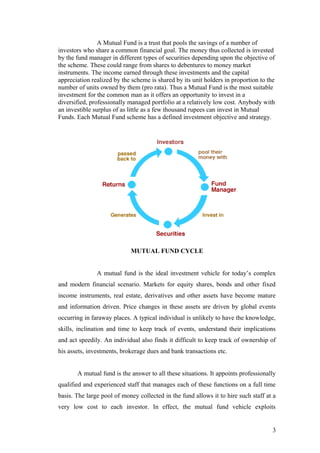
A Mutual Fund is a trust that pools the savings of a number of
investors who share a common financial goal. The money thus collected is invested
by the fund manager in different types of securities depending upon the objective of
the scheme. These could range from shares to debentures to money market
instruments. The income earned through these investments and the capital
appreciation realized by the scheme is shared by its unit holders in proportion to the
number of units owned by them (pro rata). Thus a Mutual Fund is the most suitable
investment for the common man as it offers an opportunity to invest in a
diversified, professionally managed portfolio at a relatively low cost. Anybody with
an investible surplus of as little as a few thousand rupees can invest in Mutual
Funds. Each Mutual Fund scheme has a defined investment objective and strategy.
MUTUAL FUND CYCLE
A mutual fund is the ideal investment vehicle for today’s complex
and modern financial scenario. Markets for equity shares, bonds and other fixed
income instruments, real estate, derivatives and other assets have become mature
and information driven. Price changes in these assets are driven by global events
occurring in faraway places. A typical individual is unlikely to have the knowledge,
skills, inclination and time to keep track of events, understand their implications
and act speedily. An individual also finds it difficult to keep track of ownership of
his assets, investments, brokerage dues and bank transactions etc.
A mutual fund is the answer to all these situations. It appoints professionally
qualified and experienced staff that manages each of these functions on a full time
basis. The large pool of money collected in the fund allows it to hire such staff at a
very low cost to each investor. In effect, the mutual fund vehicle exploits
3
economies of scale in all three areas – research, investments and transaction
processing. While the concept of individuals coming together to invest money
collectively is not new, the mutual fund in its present form is a 20th
century
phenomenon. In fact, mutual funds gained popularity only after the Second World
War. Globally, there are thousands of firms offering tens of thousands of mutual
funds with different investment objectives.
Typical asset management companies utilize a basic set of resources to
achieve success for their investors:
• Investment Services - These are the planned programs that seek to balance
growth with risk. These programs usually combine various types of
investments such as stocks, bonds, and precious metals.
Research - Asset management companies employ an array of researchers and
consultants who concentrate on individual market sectors and try to forecast how
each sector will perform in the short, mid, and long terms.
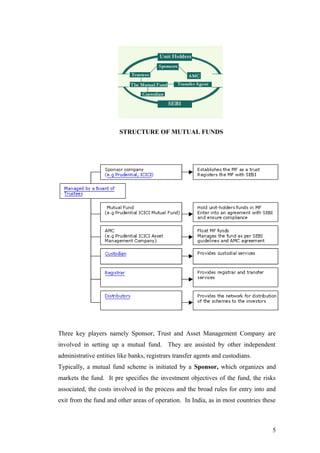
STRUCTURE OF MUTUAL FUNDS
There are many entities involved in the mutual funds organization. The structure is
explained below. It mainly comprises the following
4
STRUCTURE OF MUTUAL FUNDS
Three key players namely Sponsor, Trust and Asset Management Company are
involved in setting up a mutual fund. They are assisted by other independent
administrative entities like banks, registrars transfer agents and custodians.
Typically, a mutual fund scheme is initiated by a Sponsor, which organizes and
markets the fund. It pre specifies the investment objectives of the fund, the risks
associated, the costs involved in the process and the broad rules for entry into and
exit from the fund and other areas of operation. In India, as in most countries these
5
sponsors need approval from the regulator viz, SEBI (Securities Exchange Board
of India), SEBI looks at track record of the sponsor and its financial strength.
Sponsor:
Sponsor means any person who acting alone or with another body corporate
establishes a mutual fund. The sponsor of a fund is similar to the promoter of a
company as he gets the fund registered with SEBI. SEBI will register the mutual
fund if the sponsor fulfills the following criteria.
• The sponsor should have a sound track record and general reputation of
fairness and integrity in all his business transactions. This means that the
sponsor should have been doing business in financial services worth of the
immediately preceding year should be more than the capital contribution of
the sponsor in AMC and the sponsor should show profits after providing
depreciation, interest and tax for three out of the immediately preceding five
years.
• The sponsor and any of the directors or principal officers to be employed by
the mutual fund, should not have been found guilty of fraud or convicted of
an offence involving moral turpitude or guilty of economic offences.
The sponsor forms a trust and appoints a Board of Trustees. He also appoints
an Asset Management Company as fund managers. The sponsor, either directly
or acting through the Trustees also appoints a custodian to hold the fund assets.
The sponsor is required to contribute at least 40 per cent of the minimum net
worth of the asset management company.
Trusts:
A mutual fund in India is constituted in the form of a public Trust created under
the Indian Trust Act, 1882. The sponsor forms the Trust and registers it with
SEBI. The fund sponsor acts as the settler of the Trust, contributing to its initial
capital and appoints as trustee to hold the assets of the Trust for the benefit of
the unit holders, who are the beneficiaries of the trust. The fund then invites
investors to contribute their money in the common pool, by subscribing to
6
‘units’ issued by various schemes established by the Trust as evidence of their
beneficial interest in the fund. Thus, a mutual fund is just a ‘pass through’
vehicle. Most of the funds in India are managed by the Board of Trustees,
which is an independent body and acts as protector of the unit holders’ interests.
At least, 50 per cent of the trustees shall be independent trustees (who are not
associated with an associate, subsidiary or sponsor in any manner). The trustees
shall be accountable for and be the custodian of funds/property of respective
scheme.
Asset Management Company
The trustees appoint the Asset Management Company with the prior approval of
SEBI. The AMC is a coany formed and registered under the Companies Act,
1956, to manage the affairs of the mutual fund and operate the schemes of such
mutual funds. It charges a fee for the services it renders to the mutual fund
trust. It acts as the investment manager to the Trust under the supervision and
direction of the trustees. The AMC, in the name of he Trust, floats and then
manages the different investment schemes as per SEBI regulations and the Trust
Deed. The AMC should be registered with SEBI. The AMC of a mutual fund
must have a net worth of at least Rs. 10 Crore at all times and this net worth
should be in the form of cash. It cannot act as a trustee of any other mutual
fund. It is required to disclose the scheme particulars and base of calculation of
NAV. It can undertake specific activities such as advisory services and
financial consultancy. It must submit quarterly reports to the mutual fund. The
trustees are empowered to terminate the appointment of the AMC and may
appoint a new AMC with the prior approval of the SEBI and unit-holders. At
least 50 per cent of the directors of the board of directors of AMC should not be
associated with the sponsor or its subsidiaries or the trustees.
Custodian
The AMC has to hire an outside custodian, which is responsible for the custody
of the assets of the fund. The custodian is also responsible for the receipt of all
kinds of cash and non-cash benefits such as bonus, dividends, rights, etc. The
custodian is usually a bank or any other financially sound institutions.
7
Transfer Agent
AMC’s also hire a registry and transfer agent which takes care of purchase and
sale of the units of the fund, issues certificates/account statements to investors,
issues redemption checks, maintains the register of members, makes dividend
payments and handles investor related services like change of address,
replacement of lost unit certificates etc.
Obligations of an AMC:
• The AMC shall take all the reasonable steps and exercise due diligence
to ensure that any scheme is not contrary to the Trust deed and
provisions of investment of funds pertaining to any scheme is not
contrary to the provisions of the regulations and Trust deed.
• The AMC shall exercise due diligence and care in all its investment
decisions. The AMC shall be responsible for the acts of commission or
commissions by its employees or the persons whose services have been
procured.
• An AMC shall submit to the trustee’s quarterly reports.
• The trustees at the request of an AMC can terminate the assignments of
the AMC.
• An AMC shall not deal in securities through any broker associated with
a sponsor or a firm which is an associate of sponsor beyond 5 per cent of
the daily gross business of the mutual fund.
• No AMC shall utilize services of the sponsor or any of its associates,
employees, or their relatives for the purpose of any securities transaction
and distribution and sale of securities, unless disclosure is made to the
unit-holders and brokerage/commission paid is disclosed in half-yearly
accounts of the mutual fund.
• No person, who has been found guilty of any economic offence or
involved in violation of securities law, should be appointed as key
personnel.
8
• The AMC shall abide by his code of conduct specified in the fifth
schedule.
• The registrars and share transfer agents to be appointed by AMC are to
be registered with SEBI.
9
MUTUAL FUND INVESTORS.
Mutual funds in India are open to investment by
(a) Residents including
• Resident Indians Individuals, including high net worth individuals and
the retail or small investors
• Indian Trusts/Charitable Institutions
• Banks
• Non-Banking Finance Companies
• Insurance Companies
• Provident Fund
(b) Non-residents, including
• Non-resident Indians
• Other Corporate Bodies (OCBs)
(c) Foreign Entities, namely, Foreign Institutional Investors (FIIs)
registered with SEBI. Foreign citizens/entities are however not
allowed to invest in mutual funds in India.
10
OBJECTIVES OF THE STUDY
• To study the performance of the selected mutual funds and comparing with
the SBI Mutual Funds.
• To offer the suggestions for investors how to choose best schemes.
• To study about the returns pay by the different selected Mutual funds
• To evaluate the performance of different kinds of mutual funds in SBI
mutual funds to compare with ICICI prudential.
• To offer the suggestions for investors as well as mutual fund companies.
SCOPE OF THE STUDY
The scope of the study is to give clear picture about the comparing
and selecting best mutual fund schemes and to suggest measures to
overcome the problems.
11
NEED OF THE STUDY
While selecting the investment avenues, we have to consider the investor
needs like available funds and risk willing to take and expected return from the
securities. But he cannot select his own portfolio and manage on his own. So he
needs a portfolio manager to manage his invest able funds. The mutual funds
provide the services of portfolio manager, so we can select the mutual funds for
investments. To know which fund is best for his needs, I have chosen the
comparative performance of selected mutual fund schemes with special reference to
SBI Mutual Fund schemes and ICICI Prudential.
12
LIMITATIONS
 The main limitation of mutual fund is that it takes to invest money.
Unfortunately, most mutual funds receive money when markets are in boom
phase and investors are willing to try out mutual funds. Since it is difficult
to invest all funds in one day, there is some money waiting to be invested.
Further, there may be a time lag before investment opportunities are
identified.
 Mutual funds, although regulated by the Government, are not insured
against losses. The Federal Deposit Insurance Corporation (FDIC) only
insures against certain losses at banks, credit unions, savings and loans but
not mutual funds.
 The other limitation of mutual is the trading limitation, where the funds are
highly liquid in general; most mutual funds (called open-ended funds)
cannot be bought or sold in the middle of the trading day. Investor can also
buy and sell them at the end of the day, after they have calculated the
current value of their holdings. Absence of investment focus for an
individual investor, gain from a single security is very less comparatively
direct investment by the investor
13
RESEARCH METHODOLOGY
Primary Data:-
It has been collected from industrial guides and other executive form different
Functional areas.
Secondary Data:-
It has been collected from the websites, Company records & Economic Times
news papers.
Tools of Analysis:-
Expected return or mean return and standard deviation are used to analyze the
data.
14
CHAPTER-2
COMPANY PRFOILE
15
Company profile:
STATE BANK OF INDIA - MUTUAL FUND
A partner for life
SBI Mutual Fund (SBI MF) is one of the largest mutual funds in the
country with an investor base of over 4.6 million. With over 20 years of rich
experience in fund management, SBI MF brings forward its expertise in
consistently delivering value to its investors
Proven Skills in wealth generation:
SBI Mutual Fund is India’s largest bank sponsored mutual fund and has an
enviable track record in judicious investments and consistent wealth creation.
The fund traces its lineage to SBI - India’s largest banking enterprise. The
institution has grown immensely since its inception and today it is India's
largest bank, patronized by over 80% of the top corporate houses of the
country.
SBI Mutual Fund is a joint venture between the State Bank of India and
Société General Asset Management, one of the world’s leading fund
management companies that manages over US$ 500 Billion worldwide.
Exploiting expertise, compounding growth:
In twenty years of operation, the fund has launched 38 schemes and
successfully redeemed fifteen of them. In the process it has rewarded it’s
investors handsomely with consistently high returns.
16
A total of over 5.4 million investors have reposed their faith in the wealth
generation expertise of the Mutual Fund.
Schemes of the Mutual fund have consistently outperformed benchmark
indices and have emerged as the preferred investment for millions of investors
and HNI’s.
Today, the fund manages over Rs. 51,461 crores of assets and has a diverse
profile of investors actively parking their investments across 36 active
schemes.
The fund serves this vast family of investors by reaching out to them through
network of over 130 points of acceptance, 28 investor service centers, 46
investor service desks and 56 district organizers.
SBI Mutual is the first bank-sponsored fund to launch an offshore fund –
Resurgent India Opportunities Fund.
Growth through innovation and stable investment policies is the SBI MF
credo.
KEY PERSONNEL
Mr. Achal K. Gupta
Managing Director & Chief Executive Officer
Mr. Didier Turpin
Dy. Chief Executive Officer
Mr. Navneet Munot
Chief Investment Officer
Mr. R. S. Srinivas Jain
Chief Marketing Officer
Mr. Ashwini K Jain
Chief Operating Officer
17
Mr. C A Santosh
Chief Manager - Customer Service.
Ms. Aparna Nirgude
Chief Risk Officer
Ms. Vinaya Datar
Company Secretary & Compliance Officer
Mr. Parijat Agrawals
Head – Fixed Income
Risk Management Team:
The Risk Management unit is a separate division within the organization
headed by the Chief Risk Officer (CRO). A Risk Management Committee,
comprising the MD, Deputy CEO, CRO, COO, CIO and the CMO meets on a
regular basis to manage risk within the organization.
The CRO is responsible for risk management over all the functions within the
organization including Investments, Marketing, Operations, etc. Currently, the
CRO is an experienced investment professional and is assisted by a two-
member team, one being an investment Professional with an MBA in Finance
and the other being an investment professional deputed from SGAM.
SBI- MUTUAL FUND PRODUCTS:
 EQUITY SCHEMES:
The investments of these schemes will predominantly be in the stock markets
and endeavor will be to provide investors the opportunity to benefit from the
higher returns which stock markets can provide. However they are also
exposed to the volatility and attendant risks of stock markets and hence should
be chosen only by such investors who have high risk taking capacities and are
willing to think long term. Equity Funds include diversified Equity Funds,
Sectoral Funds and Index Funds. Diversified Equity Funds invest in various
stocks across different sectors while Sectoral funds which are specialized
18
Equity Funds restrict their investments only to shares of a particular sector
and hence, are riskier than Diversified Equity Funds. Index Funds invest
passively only in the stocks of a particular index and the performance of such
funds move with the movements of the index.
♦ Magnum COMMA Fund
♦ Magnum Equity Fund
♦ Magnum Global Fund
♦ Magnum Index Fund
♦ Magnum MidCap Fund
♦ Magnum Multicap Fund
♦ Magnum Multiplier Plus 1993
♦ Magnum Sector Funds Umbrella
MSFU - FMCG Fund
MSFU - Emerging Businesses Fund
MSFU - IT Fund
MSFU - Pharma Fund
MSFU - Contra Fund
♦ SBI Arbitrage Opportunities Fund
♦ SBI Blue chip Fund
♦ SBI Infrastructure Fund - Series I
♦ SBI Magnum Taxgain Scheme 1993
♦ SBI ONE India Fund
♦ SBI TAX ADVANTAGE FUND - SERIES I
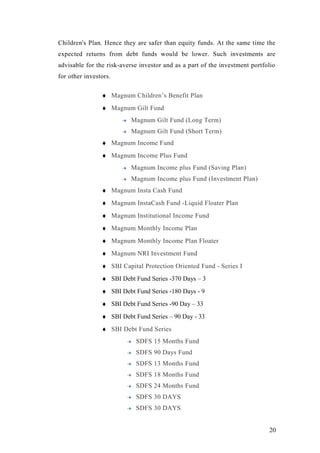
 DEBT SCHEMES:
Debt Funds invest only in debt instruments such as Corporate Bonds,
Government Securities and Money Market instruments either completely
avoiding any investments in the stock markets as in Income Funds or Gilt
Funds or having a small exposure to equities as in Monthly Income Plans or
19
Children's Plan. Hence they are safer than equity funds. At the same time the
expected returns from debt funds would be lower. Such investments are
advisable for the risk-averse investor and as a part of the investment portfolio
for other investors.
♦ Magnum Children’s Benefit Plan
♦ Magnum Gilt Fund
Magnum Gilt Fund (Long Term)
Magnum Gilt Fund (Short Term)
♦ Magnum Income Fund
♦ Magnum Income Plus Fund
Magnum Income plus Fund (Saving Plan)
Magnum Income plus Fund (Investment Plan)
♦ Magnum Insta Cash Fund
♦ Magnum InstaCash Fund -Liquid Floater Plan
♦ Magnum Institutional Income Fund
♦ Magnum Monthly Income Plan
♦ Magnum Monthly Income Plan Floater
♦ Magnum NRI Investment Fund
♦ SBI Capital Protection Oriented Fund - Series I
♦ SBI Debt Fund Series -370 Days – 3
♦ SBI Debt Fund Series -180 Days - 9
♦ SBI Debt Fund Series -90 Day – 33
♦ SBI Debt Fund Series – 90 Day - 33
♦ SBI Debt Fund Series
SDFS 15 Months Fund
SDFS 90 Days Fund
SDFS 13 Months Fund
SDFS 18 Months Fund
SDFS 24 Months Fund
SDFS 30 DAYS
SDFS 30 DAYS
20
SDFS 60 Days Fund
SDFS 180 Days Fund
SDFS 30 DAYS
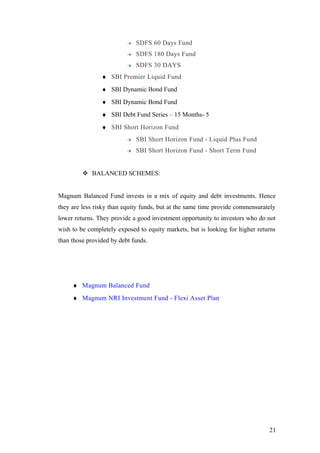
♦ SBI Premier Liquid Fund
♦ SBI Dynamic Bond Fund
♦ SBI Debt Fund Series – 15 Months- 5
♦ SBI Short Horizon Fund
SBI Short Horizon Fund - Liquid Plus Fund
SBI Short Horizon Fund - Short Term Fund
 BALANCED SCHEMES:
Magnum Balanced Fund invests in a mix of equity and debt investments. Hence
they are less risky than equity funds, but at the same time provide commensurately
lower returns. They provide a good investment opportunity to investors who do not
wish to be completely exposed to equity markets, but is looking for higher returns
than those provided by debt funds.
♦ Magnum Balanced Fund
♦ Magnum NRI Investment Fund - Flexi Asset Plan
21
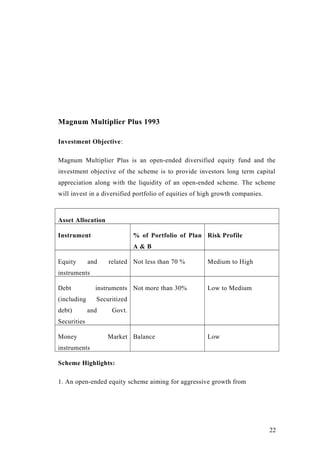
Magnum Multiplier Plus 1993
Investment Objective:
Magnum Multiplier Plus is an open-ended diversified equity fund and the
investment objective of the scheme is to provide investors long term capital
appreciation along with the liquidity of an open-ended scheme. The scheme
will invest in a diversified portfolio of equities of high growth companies.
Asset Allocation
Instrument % of Portfolio of Plan
A & B
Risk Profile
Equity and related
instruments
Not less than 70 % Medium to High
Debt instruments
(including Securitized
debt) and Govt.
Securities
Not more than 30% Low to Medium
Money Market
instruments
Balance Low
Scheme Highlights:
1. An open-ended equity scheme aiming for aggressive growth from
22
investments in equities.
2. Scheme opens for Resident Indians, Trusts, and Indian Corporates and
on a fully repatriable basis for NRIs, FIIs & Overseas Corporate
Bodies.
3. Facility to reinvest dividend proceeds into the scheme at NAV.
4. Easy entry and exit on the basis of sales and repurchase prices
determined daily. NAV will be declared on every business day.
5. Nomination facility available for individuals applying on their behalf
either singly or jointly upto three.
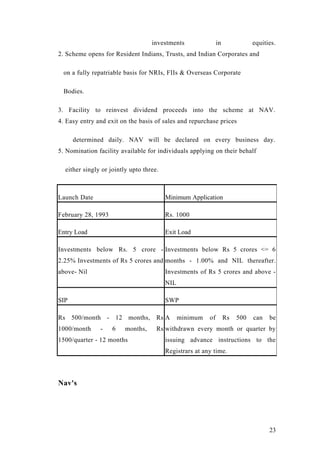
Launch Date Minimum Application
February 28, 1993 Rs. 1000
Entry Load Exit Load
Investments below Rs. 5 crore -
2.25% Investments of Rs 5 crores and
above- Nil
Investments below Rs 5 crores <= 6
months - 1.00% and NIL thereafter.
Investments of Rs 5 crores and above -
NIL
SIP SWP
Rs 500/month - 12 months, Rs
1000/month - 6 months, Rs
1500/quarter - 12 months
A minimum of Rs 500 can be
withdrawn every month or quarter by
issuing advance instructions to the
Registrars at any time.
Nav's
23
MSFU - Emerging Businesses Fund
Investment Objective
To provide the investors maximum growth opportunity through equity
investments in stocks of growth oriented sectors of the economy. There are
five sub-funds dedicated to specific investment themes viz. Information
Technology, Pharmaceuticals, FMCG, Contrarian (investment in stocks
currently out of favour) and Emerging Businesses. The investment objective
of the Emerging Business Fund would be to participate in the growth potential
presented by various companies that are considered emergent and have export
orientation/outsourcing opportunities or are globally competitive by investing
in the stocks representing such companies. The fund may also evaluate
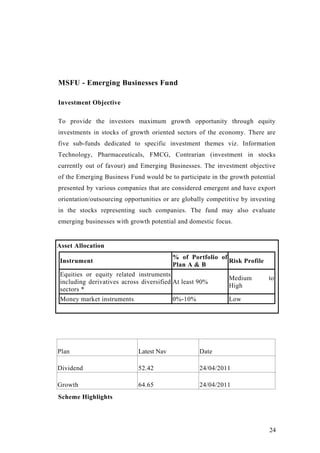
emerging businesses with growth potential and domestic focus.
Asset Allocation
Instrument
% of Portfolio of
Plan A & B
Risk Profile
Equities or equity related instruments
including derivatives across diversified
sectors *
At least 90%
Medium to
High
Money market instruments 0%-10% Low
Scheme Highlights
Plan Latest Nav Date
Dividend 52.42 24/04/2011
Growth 64.65 24/04/2011
24
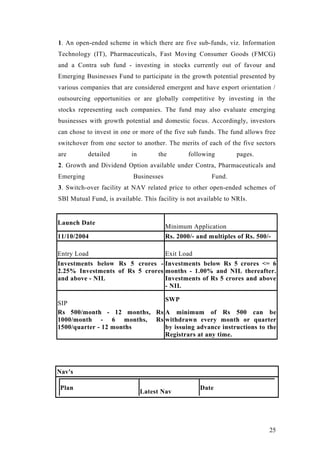
1. An open-ended scheme in which there are five sub-funds, viz. Information
Technology (IT), Pharmaceuticals, Fast Moving Consumer Goods (FMCG)
and a Contra sub fund - investing in stocks currently out of favour and
Emerging Businesses Fund to participate in the growth potential presented by
various companies that are considered emergent and have export orientation /
outsourcing opportunities or are globally competitive by investing in the
stocks representing such companies. The fund may also evaluate emerging
businesses with growth potential and domestic focus. Accordingly, investors
can chose to invest in one or more of the five sub funds. The fund allows free
switchover from one sector to another. The merits of each of the five sectors
are detailed in the following pages.
2. Growth and Dividend Option available under Contra, Pharmaceuticals and
Emerging Businesses Fund.
3. Switch-over facility at NAV related price to other open-ended schemes of
SBI Mutual Fund, is available. This facility is not available to NRIs.
Launch Date
Minimum Application
11/10/2004 Rs. 2000/- and multiples of Rs. 500/-
Entry Load Exit Load
Investments below Rs 5 crores -
2.25% Investments of Rs 5 crores
and above - NIL
Investments below Rs 5 crores <= 6
months - 1.00% and NIL thereafter.
Investments of Rs 5 crores and above
- NIL
SIP
SWP
Rs 500/month - 12 months, Rs
1000/month - 6 months, Rs
1500/quarter - 12 months
A minimum of Rs 500 can be
withdrawn every month or quarter
by issuing advance instructions to the
Registrars at any time.
Nav's
Plan
Latest Nav
Date
25
Emerging Businesses Fund
– Growth 35.26
24/04/2008
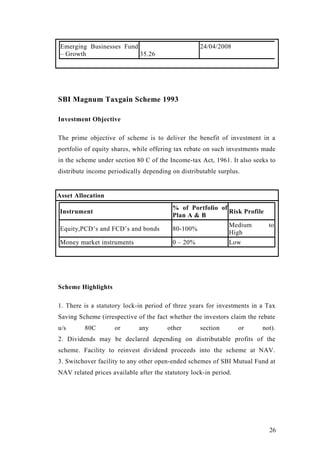
SBI Magnum Taxgain Scheme 1993
Investment Objective
The prime objective of scheme is to deliver the benefit of investment in a
portfolio of equity shares, while offering tax rebate on such investments made
in the scheme under section 80 C of the Income-tax Act, 1961. It also seeks to
distribute income periodically depending on distributable surplus.
Asset Allocation
Instrument
% of Portfolio of
Plan A & B
Risk Profile
Equity,PCD’s and FCD’s and bonds 80-100%
Medium to
High
Money market instruments 0 – 20% Low
Scheme Highlights
1. There is a statutory lock-in period of three years for investments in a Tax
Saving Scheme (irrespective of the fact whether the investors claim the rebate
u/s 80C or any other section or not).
2. Dividends may be declared depending on distributable profits of the
scheme. Facility to reinvest dividend proceeds into the scheme at NAV.
3. Switchover facility to any other open-ended schemes of SBI Mutual Fund at
NAV related prices available after the statutory lock-in period.
26
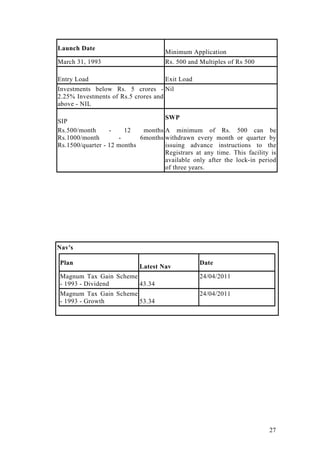
Launch Date
Minimum Application
March 31, 1993 Rs. 500 and Multiples of Rs 500
Entry Load Exit Load
Investments below Rs. 5 crores -
2.25% Investments of Rs.5 crores and
above - NIL
Nil
SIP
SWP
Rs.500/month - 12 months
Rs.1000/month - 6months
Rs.1500/quarter - 12 months
A minimum of Rs. 500 can be
withdrawn every month or quarter by
issuing advance instructions to the
Registrars at any time. This facility is
available only after the lock-in period
of three years.
Nav's
Plan
Latest Nav
Date
Magnum Tax Gain Scheme
- 1993 - Dividend 43.34
24/04/2011
Magnum Tax Gain Scheme
- 1993 - Growth 53.34
24/04/2011
27
CHAPTER-3
28
REVIEW OF LITERATURE
SEBI – Securities and Exchange Board of India:
Securities and Exchange Board of India (SEBI) is a board (autonomous body)
created by the Government of India in 1988 and given statutory form in 1992 with
the SEBI Act 1992 with its head office at Mumbai.
The Securities and Exchange Board of India is perhaps the most important
regulatory body. Similar to the Securities Exchange Commission in the US, it is the
authority that has to always be on its toes. More so, when the markets are doing
well and there are a spate of IPOs (initial public offerings) or FPO’s (follow-on
public offerings) like now.
Its main mandate is to protect the interest of investors in the securities markets and
to promote the development of and to regulate the securities markets so as to
establish a dynamic and efficient securities market.
When investors have complaints against listed companies or registered
intermediaries, SEBI acts as the nodal agency for addressing these complaints, if
29
they are not solved directly between the parties concerned, or if the investor is not
happy with the response.
SEBI has listed certain categories of grievances for which investors can file
complaints with it. These include:
• Non-receipt of refund order or allotment advice in case of investment in
IPO's, FPO's and rights issues
• Non-receipt of dividend from listed companies
• Non-receipt of share certificates after transfer from listed companies
• Non-receipt of debentures after transfer or non-receipt of interest or
principal on redemption and non-receipt of interest on delayed repayment
• Non-receipt of rights offer letter
Collective investment schemes like plantation companies. Investors can send
complaints to SEBI regarding non-receipt of invested principal and returns there
from.
Mutual funds/venture capital funds/foreign venture capital investors/foreign
institutional investors/portfolio managers/custodians - Complaints mutual funds like
non-receipt or delay in receipt of dividends/redemptions, non-availability of
portfolio disclosures, non-receipt of transaction statement, etc.
Brokers - This is the most common area of complaints for the average investor.
Complaints against brokers stem from disputes over brokerage rates, non-receipt of
purchased shares or payments for sold shares, auction of shares sold and delivered
timely, but delay at broker's end, etc.
Complaints against securities lending intermediaries may arise due to non-receipt of
shares lent by the investor or interest thereupon, or non-receipt of funds upon return
of borrowed shares or excessive interest charged upon borrowing.
Complaints against merchant bankers, registrar and transfer agents, bankers to
issues and underwriters generally stem from problems in primary market issues,
like non-disclosures, service issues etc.
30
Complaints against securities exchanges, clearing or settlement houses or
depositories - these concern irregularities or failure to act diligently, like the
Calcutta Stock Exchange in the last securities scam or the NSDL in the recent IPO
scam.
Derivative trading - Many investors sign legal papers empowering the broker to
trade on their behalf, without proper knowledge and wake up on seeing their margin
money eroded due to sustained losses.
In other instances, major complaints are against brokers squaring off outstanding
derivatives positions due to lack of margins or not giving the client adequate time or
notice, leading to huge losses for investors/traders. These happen especially when
markets turn volatile of see sustained and large one- way movements.
There are other areas such as corporate governance, corporate restructuring,
acquisitions, buybacks, delisting and other compliance related issues for which one
could approach SEBI. For all this one can
• File complaints electronically on the SEBI website
• Get a complaint registration number
• Track the status of the complaint online
• SEBI looks into the merit of the complaint and takes up the matter with the
concerned company or intermediary
It can also direct intermediaries to redress the investor complaints satisfactorily if
the case merits such an order one can also send grievances by post or fax.
In other words, there is a wide range of issues that come under the jurisdiction of
SEBI. And the onus is entirely on it to keep the stocks markets healthy.
31
TYPES OF MUTUAL FUND SCHEMES:
• By Structure
o Open-ended schemes
o Close-ended schemes
o Interval schemes
• By Investment Objective
o Growth schemes
o Income schemes
o Balance schemes
o Money Market schemes
• Other types of schemes
o Tax Saving schemes
o Special schemes
o Index schemes
o Sector specific schemes
32
Schemes according to maturity period:
A mutual fund scheme can be classified into open-ended scheme or close-ended
scheme depending on its maturity period.
Open-ended Fund / Scheme
An open-ended fund or scheme is one that is available for subscription and
repurchase on a continuous basis. These schemes do not have a fixed maturity
period. Investors can conveniently buy and sell units at Net Asset Value (NAV)
related prices which are declared on a daily basis. The key feature of open-end
schemes is liquidity.
Close-ended Fund / Scheme
A close-ended fund or scheme has a stipulated maturity period e.g. 5-7 years. The
fund is open for subscription only during a specified period at the time of launch of
the scheme. Investors can invest in the scheme at the time of the initial public issue
and thereafter they can buy or sell the units of the scheme on the stock exchanges
where the units are listed. In order to provide an exit route to the investors, some
close-ended funds give an option of selling back the units to the mutual fund
through periodic repurchase at NAV related prices. SEBI Regulations stipulate that
at least one of the two exit routes is provided to the investor i.e. either repurchase
facility or through listing on stock exchanges. These mutual funds schemes disclose
NAV generally on weekly basis.
Interval scheme
Interval funds combine the features of open-ended & closed ended schemes. They
are open for sale or redemption during pre-determined intervals at NAV related
prices.
33
Schemes according to Investment Objective:
A scheme can also be classified as growth scheme, income scheme, or balanced
scheme considering its investment objective. Such schemes may be open-ended or
close-ended schemes as described earlier. Such schemes may be classified mainly
as follows:
Growth / Equity Oriented Schemes
The aim of growth funds is to provide capital appreciation over the medium to long-
term. Such schemes normally invest a major part of their corpus in equities. Such
funds have comparatively high risks.
These schemes provide different options to the investors like dividend option,
capital appreciation, etc. and the investors may choose an option depending on their
preferences. The investors must indicate the option in the application form. The
mutual funds also allow the investors to change the options at a later date. Growth
schemes are good for investors having a long-term outlook seeking appreciation
over a period of time.
Income / Debt Oriented Scheme
The aim of income funds is to provide regular and steady income to investors. Such
schemes generally invest in fixed income securities such as bonds, corporate
debentures, Government securities and money market instruments. Such funds are
less risky compared to equity schemes. These funds are not affected because of
fluctuations in equity markets. However, opportunities of capital appreciation are
also limited in such funds. The NAVs of such funds are affected because of change
in interest rates in the country. If the interest rates fall, NAVs of such funds are
likely to increase in the short run and vice versa. However, long term investors may
not bother about these fluctuations.
Balanced Fund
The aim of balanced funds is to provide both growth and regular income as such
schemes invest both in equities and fixed income securities in the proportion
34
indicated in their offer documents. These are appropriate for investors looking for
moderate growth. They generally invest 40-60% in equity and debt instruments.
These funds are also affected because of fluctuations in share prices in the stock
markets. However, NAVs of such funds are likely to be less volatile compared to
pure equity funds.
Money Market or Liquid Fund
These funds are also income funds and their aim is to provide easy liquidity,
preservation of capital and moderate income.
These schemes invest exclusively in safer short-term instruments such as treasury
bills, certificates of deposit, commercial paper and inter-bank call money,
government securities, etc. Returns on these schemes fluctuate much less compared
to other funds. These funds are appropriate for corporate and individual investors as
a means to park their surplus funds for short periods.
Other Schemes
Tax Saving Schemes
These schemes offer tax rebates to the investors under specific provisions of the
Income Tax Act, 1961 as the Government offers tax incentives for investment in
specified avenues. e.g. Equity Linked Savings Schemes (ELSS). Pension schemes
launched by the mutual funds also offer tax benefits. These schemes are growth
oriented and invest pre-dominantly in equities. Their growth opportunities and risks
associated are like any equity-oriented scheme.
Gilt Fund
These funds invest exclusively in government securities. Government securities
have no default risk. NAVs of these schemes also fluctuate due to change in interest
rates and other economic factors as is the case with income or debt oriented
schemes.
Index Funds
35
Index Funds replicate the portfolio of a particular index such as the BSE Sensitive
index, S&P NSE 50 index (Nifty), etc these schemes invest in the securities in the
same weight age comprising of an index. NAVs of such schemes would rise or fall
in accordance with the rise or fall in the index, though not exactly by the same
percentage due to some factors known as "tracking error" in technical terms.
Necessary disclosures in this regard are made in the offer document of the mutual
fund scheme.
There are also exchange traded index funds launched by the mutual funds which are
traded on the stock exchanges.
Sector specific funds / schemes
These are the funds/schemes which invest in the securities of only those sectors or
industries as specified in the offer documents. e.g. Pharmaceuticals, Software, Fast
Moving Consumer Goods (FMCG), Petroleum stocks, etc. The returns in these
funds are dependent on the performance of the respective sectors/industries. While
these funds may give higher returns, they are more risky compared to diversified
funds. Investors need to keep a watch on the performance of those sectors/industries
and must exit at an appropriate time. They may also seek advice of an expert.
36
Advantages & Disadvantages of Mutual Funds
The advantages of investing in a Mutual Fund are:
• Professional Management –
The primary advantage of funds (at least theoretically) is the professional
management of your money. Investors purchase funds because they do not have the
time or the expertise to manage their own portfolio. A mutual fund is a relatively
inexpensive way for a small investor to get a full-time manager to make and
monitor investments.
• Diversification –
By owning shares in a mutual fund instead of owning individual stocks or bonds,
your risk is spread out. The idea behind diversification is to invest in a large number
of assets so that a loss in any particular investment is minimized by gains in others.
In other words, the more stocks and bonds you own, the less any one of them can
hurt you (think about Enron). Large mutual funds typically own hundreds of
different stocks in many different industries. It wouldn't be possible for an investor
to build this kind of a portfolio with a small amount of money.
• Economies of Scale –
Because a mutual fund buys and sells large amounts of securities at a time, its
transaction costs are lower than you as an individual would pay.
37
• Convenient Administration:
Investing in a Mutual Fund reduces paperwork and helps you avoid many problems
such as bad deliveries, delayed payments and follow up with brokers and
companies. Mutual Funds save your time and make investing easy and convenient.
• Return Potential
Over a medium to long-term, Mutual Funds have the potential to provide a higher
return as they invest in a diversified basket of selected securities.
• LowCosts
Mutual Funds are a relatively less expensive way to invest compared to directly
investing in the capital markets because the benefits of scale in brokerage,
custodial, demat costs, depository costs etc and other fees translate into lower costs
for investors.
• Liquidity
In open-end schemes, the investor gets the money back promptly at net asset value
related prices from the Mutual Fund. In closed-end schemes, the units can be sold
on a stock exchange at the prevailing market price or the investor can avail of the
facility of direct repurchase at NAV related prices by the MutualFund.
• Transparency
You get regular information on the value of your investment in addition to
disclosure on the specific investments made by your scheme, the proportion
38
invested in each class of assets and the fund manager's investment strategy and
outlook.
• Flexibility
Through features such as regular investment plans, regular withdrawal plans and
dividend reinvestment plans, you can systematically invest or withdraw funds
according to your needs and convenience.
• Affordability
Investors individually may lack sufficient funds to invest in high-grade stocks. A
mutual fund because of its large corpus allows even a small investor to take the
benefit of its investment strategy.
• Choice of Schemes:
Mutual Funds offer a family of schemes to suit your varying needs over a lifetime.
• Well-Regulated
All Mutual Funds are registered with SEBI and they function within the provisions
of strict regulations designed to protect the interests of investors. The operations of
Mutual Funds are regularly monitored by SEBI.
AMFI is the supervisory body of Mutual Fund Industry.
• Simplicity –
Buying a mutual fund is easy! Pretty well any bank has its own line of mutual
funds, and the minimum investment is small. Most companies also have automatic
purchase plans whereby as little as $100 can be invested on a monthly basis.
39
Disadvantages of Mutual Funds:
The disadvantages of investing in a Mutual Fund are:
• Professional Management-
Did you notice how we qualified the advantage of professional management with
the word "theoretically"? Many investors debate over whether or not the so-called
professionals are any better than you or I at picking stocks. Management is by no
means infallible, and, even if the fund loses money, the manager still takes his/her
cut. We'll talk about this in detail in a later section.
• Costs –
Mutual funds don't exist solely to make your life easier--all funds are in it for a
profit. The mutual fund industry is masterful at burying costs under layers of
jargon. These costs are so complicated that in this tutorial we have devoted an entire
section to the subject.
• Dilution –
40
It's possible to have too much diversification (this is explained in our article entitled
"Are You Over-Diversified?"). Because funds have small holdings in so many
different companies, high returns from a few investments often don't make much
difference on the overall return. Dilution is also the result of a successful fund
getting too big. When money pours into funds that have had strong success, the
manager often has trouble finding a good investment for all the new money.
• Taxes –
When making decisions about your money, fund managers don't consider your
personal tax situation. For example, when a fund manager sells a security, a capital-
gain tax is triggered, which affects how profitable the individual is from the sale. It
might have been more advantageous for the individual to defer the capital gains
liability.
The above pyramid speaks about the different types of risk and the respective
growth associated with the risk.
It can be seen that, at the lower level risk is very less and their more safety. This
kind of portfolio is usually preferred by the in the third level of their life cycle i.e.
mainly people who are pension holders.
As we move on to the pyramid we see that there is average risk and reasonable
growth and income. These are people in second level of their life cycle who are
well settled in life who are ready to take the calculated risk.
The last level depicts a picture of people who can assume the highest risk. These are
people who have just started their career who can take high risk.
WHY TO INVEST IN MUTUAL FUNDS:
A proven principle of sound investment is –do not put all eggs in one
basket. Investment in mutual funds is beneficial due to following reasons.
41
• They help in pooling of funds and investing in large basket of shares of
different companies. Thus by investing in diverse companies, mutual
funds can protect against unexpected fall in value of investment.
• An average investor does not have enough time and resources to
develop professional attitude towards their investment. Here
professional fund managers engaged by mutual funds take desirable
investment decision on behalf of investors so as to make better
utilization of resources.
• Investment in mutual funds is comparatively more liquid because
investor can sell the units in open market or can approach mutual fund
to repurchase the units at net asset value depending upon the type of
scheme.
• Investors can avail tax rebates by investing in different tax saving
schemes floated by these funds, approved by the government.
• Operating cost is minimized per head because of large size of investible
funds, there by realizing more net income of investors.
HISTORY OF MUTUAL FUND
Mutual funds made an opening in India in 1963 under the enactment f Unit Trust of
India (UTI), which came out with is debut scheme named US-64, an open ended
scheme n, which is operating till date. Up to 1986-87 it had launched 20 schemes;
mobilizing net resources amounting to Rs. 4564 crores for these 23 long years up to
1987 UTI enjoyed complete monopoly of the unit trust business in India. It
remained one and the only mutual fund in India.
42
It was in 1986 that the government of India amended banking regulation
act and allowed commercial banks in public sector to set up mutual funds. This lead
to promotion of ‘SBI-MUTUAL FUND’ by State Bank Of India (SBI) in July 1987
followed by
• Canara Bank
• Indian bank
• Bank of India
• Bank of Baroda
• Punjab National bank
The government of India further granted permission to Insurance Corporation to
public sector to float mutual funds. The following were the corporations,
 Life Insurance Corporation
 General Insurance of Corporation
This was the picture till 1991, but when in 1991 the government of India followed a
policy of liberalization, privatization, and globalization it opened the gates to
private sector to launch mutual funds.
The History of Indian mutual fund industry can be broadly classified in to
The four phases:
Phase 1— July 1964 to November 1987
Phase 1— November 1987- October 1993
43
Phase 3--- October 1993- February 2003
Phase 4-- since February 2003
Phase 1--- MONOPOLY OF UTI
This period was marked by the operations of a single institution, UTI, which
prepared ground for the future mutual fund industry.
The first decade of UTI’s operations was the formative period.
The first and still more popular product launched by UTI was US-64. Due to
immense popularity of unit 64, UTI launched a reinvestment plan in 1966-67.
Another popular scheme, Unit Linked Insurance Plan (ULIP), was launched in
1971. By the end of June 1974 there were six lakhs unit holders with UTI .the unit
capital totaled Rs.152 crore and investible funds Rs.172 crore.
The second phase of operations (1974-84) was one of the consolidation
and expansion. In this period UTI was delinked from RBI .The period was marked
by the introduction of open ended growth funds. Six new schemes were introduced
during 1981-84. by the end of June 84 the investible funds crossed Rs. 1000 crore
and unit holders numbered to 17 lakhs.
During 1984-87, innovative and widely accepted schemes such as Children’s
Gift Growth Fund, Master share were launched. The first Indian off shore fund,
India Fund was launched in august 1986.
Towards the end of 1980s, winds of change had started blowing in the
Indian economy. UTI was one of the few organizations to prepare fully to face the
emerging challenges. In the following years it launched all round diversification
programmes through backward and forward integration in order to retain its
position as the undisputed market leader.
Phase 2—PUBLIC SECTOR COMPETITION
This period was marked by the entry of non-UTI
public sector mutual funds in the market, bringing in competition. With the opening
44
up of the economy many public sector financial institution established mutual funds
in India. However, the mutual fund industry remained the exclusive domain of the
public sector in this period.
The first non-UTI mutual fund ---- SBI mutual fund –was launched
by the State Bank of India in 1987.this was followed by Canbank mutual fund
scheme (launched in December 1987),LIC mutual fund scheme (launched in June
1989) and Indian bank mutual fund scheme (launched in January 1990).
The entry of the public sector mutual funds created waves in the market and
attracted small investors. The cumulative mobilization of resources went up from
Rs.4500 crores in 1987 (mobilized by UTI alone.) to Rs.19000 crore in 1990
(mobilized collectively by UTI, SBI mutual fund, CANBANK mutual fund, LIC
mutual fund, and Ind Bank mutual fund).
With the entry of three more mutual funds in the market namely, Bank of India
mutual fund, GIC mutual fund , PNB mutual fund ,collection increased to
Rs.37,480 crore (1991-92) indicating a 96% increase in between 1989-90 and 91-
92. However UTI continued to be the dominantly player in the market, though its
share declined marginally from 87.9 % in 1988-89 to 84% in 1991-92.
The years 1992-93 and 93-94 saw a decline in collections by the public sector
mutual funds. The total collection declined from the 2500 crore to 1960 crore in 92-
93. There were two reasons for the fall in the collection. First, SEBI had prohibited
mutual funds from any scheme with an assured return. Second according to mutual
fund regulations, 1993, Indian mutual funds were to form Asset Management
Company (AMC) pending which they could not launch any scheme.
Before 1989 there were no regulatory guidelines for the mutual fund
industry in India. The first such guidelines for setting up and regulating mutual
funds were issued by Reserve Bank Of India but they were applicable to mutual
funds floated by banks. Then the guidelines were issued by the government of India
in 1990 covering all mutual funds and making them mandatory for all the mutual
funds to be registered with SEBI. These guidelines also set the norms for
45
registration, management, investment objectives, disclosure, pricing and valuation
of securities, and so on.
These guidelines were revised and Security and Exchange Board of India (SEBI)
regulations 1993 came in to effect on the 20th
Jan 1993, rules for formulation,
administration, and management of mutual
funds in India were clearly laid down. The regulation made the formulation of
AMC and listing of the closed ended schemes compulsory. With view to protect the
investor’s right disclosure, norm was also tightened.
Another significant development during this period was the opening up of the
mutual funds market to the private sector.
PHASE 3-EMEREGENCE OF COMPETITATIVE MARKET.
A new era in mutual fund industry began with the entry of private sector funds
in 1993, posing a serious competition to the existing public sector funds. The new
private sector funds have distinctive operational advantages. They are:
 Most of them are jointly floated by Indian organization along with
experienced foreign asset management companies, facilitating access the
latest technology and foreign fund management strategies.
 Private sector funds are able to attract the best managerial talents from the
public sector.
 Starting of the mutual funds has been easier for them because infrastructural
inputs created by the public sector mutual funds were already available.
The first private sector mutual fund to launch a scheme was the Madras
based Kothari Pioneer Mutual fund. It launched the open ended prima fund in
November 1993.
46
During the year 93-94, five private sector mutual funds namely
• Kothari Pioneer Mutual Fund
• ICICI Mutual fund
• 20th
century mutual fund
• Morgan Stanley Mutual Fund
• Taurus Mutual fund
During 1994-95 six more private sector funds were launched they are
• Apple mutual fund
• JM mutual fund
• Shriram mutual fund
• CRB mutual fund
• Alliance mutual fund
• Birla mutual fund
Between 1993 and 1995, further regulatory measures were introduced
47
• The government of India has allowed NRIs and Overseas Corporate
Bodies (OCB) to invest in UTI and other mutual funds (in both
primary and secondary market).
• The practice of obtaining prior approval for advertising by mutual
funds has been dispensed with..
• Mutual funds are allowed to invest in money market instruments up
to 25% of resources mobilized.
• The practice of reissuing of units of closed ended schemes has been
dispensed with.
• Mutual funds are allowed to buy back their own units from the
secondary marketing case they are traded at a substantial discount to
NAV.
• With effect from 1 December 1993 new issuers have been allowed to
reserve 20% of the public issue for mutual funds.
• Mutual funds have been allowed to launch income schemes with
assured returns one at a time.
PHASE-4 - (SINCE 2003 FEBRUARY)
On Feb 2003, UTI was bifurcated in to 2 separate entities. One is
specified undertaking of the UTI with asset under management of Rs.29, 835 crores
as at the end of Jan 2003. The second is the UTI mutual funds Limited, sponsored
by the State Bank of India, Bank of Baroda and Life Insurance Corporation of
India. UTI is functioning under an administrator and rules framed by the
government of India do not come under the purview of the Mutual fund
Regulations. The Mutual Funds Limited is registered with SEBI and functions
48
under the Mutual Fund Regulations. With the bifurcation of the erstwhile UTI, with
the setting up of a UTI mutual fund, confirming to the SEBI Mutual Fund
Regulations and recent mergers taking place among different private sector funds,
the mutual fund industry has entered its current phases of consolidation and growth.
At the end of September 2004, there are 29 funds, which manage assets
of Rs. 153108 crores under 421 different schemes.
At the end of July 2005 the status of mutual fund industry was
No of schemes amount (crores)
Open ended schemes 414 1, 64,998
Closed ended schemes 46 10 920
Risk factors associated with investing in mutual funds:
Mutual funds and securities investments are subject to market risks and there is no
assurance or guarantee that the objectives of the schemes will be achieved
As with any investment in securities, the NAV of the units issued under the
schemes can rise or fall depending on the factors and forces affecting capital
markets. Neither the past performance of the mutual funds managed by the
sponsors and their affiliates / associates nor the past performance of the sponsors,
asset management companies (AMC) nor fund is necessarily indicative of the future
performance of the schemes
Equity Funds are open to market risk i.e. there is a possibility that the price of the
stocks in which the Fund has invested may decrease. Of course, the prices may also
go up, making it possible for the Fund to earn profits
49
Debts Funds are open to two main risks - Credit Risk and Interest Rate Risk. Credit
Risk refers to the possibility that the company that has issued the bond or debenture
in which the Fund has invested may default on interest or on principal payments.
Debt Fund managers take care of this by investing in bonds which have good credit
rating
Interest Rate Risk refers to the possibility that the price of the bond in which the
Fund has invested may go down because of an increase in the interest rates in the
economy. In general, it is useful to remember that this is a "see-saw" relationship - a
bond price (and therefore, NAV) goes up when interest rates drop and drops when
interest rates rise.
RISK RETURN ANALYSIS OF THE SCHEMES
A rational investor before investing his or her money in any stock analyses
the risk associated with the particular stock. The actual return he receives
from a stock may vary from the expected one and thus a investor is always
cautious about the rate of risk associated with the particular stock. Hence it
becomes very essential on the part of investors to know the risk as the hard
earned money is being invested with the view to earn good return on the
investment.
Risk mainly consists of two components
Systematic risk
Unsystematic risk
50
Systematic risk
The systematic risk affects the entire market. The economic
conditional, political situations, sociological changes affect the entire market
in turn affecting the company and even the stock market. These situations are
uncontrollable by the corporate and investor.
Unsystematic risk
The unsystematic risk is unique to industries. It differs
from industry to industry. Unsystematic risk stems from managerial
inefficiency, technological change in the production process, availability of
raw materials, changes in the consumer preference, and labour problems. The
nature and magnitude of above mentioned factors differ from industry to
industry and company to company.
In a general view, the risk for any investor would be the probable loss for
investing money in any mutual fund. But when we look at the technical side of
it , we can’t just say that these schemes/fund carry risk without any proof.
They are certain set of formulas to say the percentage of risk associated with
it.
There are certain tools or formulas used to calculate the risk associated with
the schemes. These tools help us to understand the risk associated with the
schemes. These schemes are compared with the benchmark BSE 100.
THE TOOLS USED FOR CALCULATION
Standard Deviation
Beta
Alpha
51
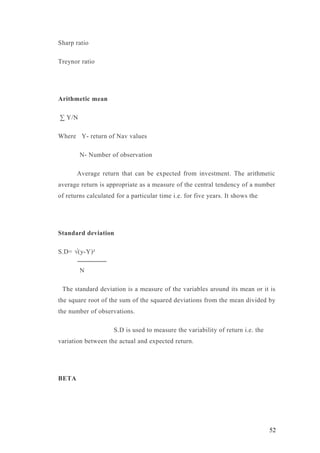
Sharp ratio
Treynor ratio
Arithmetic mean
∑ Y/N
Where Y- return of Nav values
N- Number of observation
Average return that can be expected from investment. The arithmetic
average return is appropriate as a measure of the central tendency of a number
of returns calculated for a particular time i.e. for five years. It shows the
Standard deviation
S.D= √(y-Y)²
N
The standard deviation is a measure of the variables around its mean or it is
the square root of the sum of the squared deviations from the mean divided by
the number of observations.
S.D is used to measure the variability of return i.e. the
variation between the actual and expected return.
BETA
52
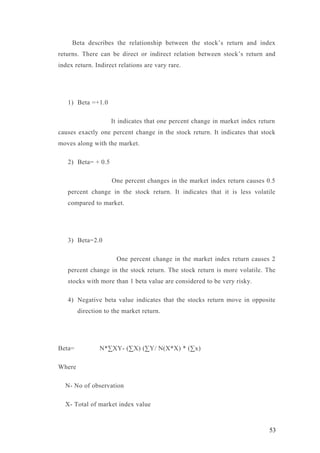
Beta describes the relationship between the stock’s return and index
returns. There can be direct or indirect relation between stock’s return and
index return. Indirect relations are vary rare.
1) Beta =+1.0
It indicates that one percent change in market index return
causes exactly one percent change in the stock return. It indicates that stock
moves along with the market.
2) Beta= + 0.5
One percent changes in the market index return causes 0.5
percent change in the stock return. It indicates that it is less volatile
compared to market.
3) Beta=2.0
One percent change in the market index return causes 2
percent change in the stock return. The stock return is more volatile. The
stocks with more than 1 beta value are considered to be very risky.
4) Negative beta value indicates that the stocks return move in opposite
direction to the market return.
Beta= N*∑XY- (∑X) (∑Y/ N(X*X) * (∑x)
Where
N- No of observation
X- Total of market index value
53
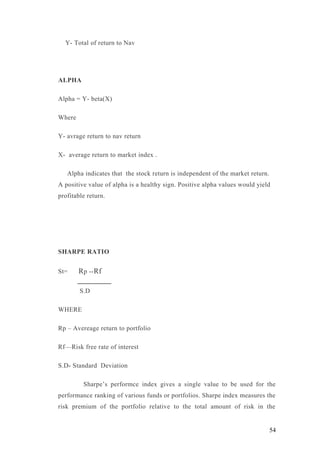
Y- Total of return to Nav
ALPHA
Alpha = Y- beta(X)
Where
Y- avrage return to nav return
X- average return to market index .
Alpha indicates that the stock return is independent of the market return.
A positive value of alpha is a healthy sign. Positive alpha values would yield
profitable return.
SHARPE RATIO
St= Rp --Rf
S.D
WHERE
Rp – Avereage return to portfolio
Rf—Risk free rate of interest
S.D- Standard Deviation
Sharpe’s performce index gives a single value to be used for the
performance ranking of various funds or portfolios. Sharpe index measures the
risk premium of the portfolio relative to the total amount of risk in the
54
portfolio. The risk premium is the difference between the portfolio’s average
rate of return and the risk less rate of return. The standard deviation of the
portfolio indicates the risk.
Higher the value of sharpe ratio better the fund has performed. Sharpe
ratio can be used to rank the desirability of funds or portfolios. The fund that
has performed well comapred to other will be ranked first then the others.
TREYNOR RATIO
Ty= Rp—Rf
B
WHERE
Rp- Average return to portfolio
Rf- Risk less rate of interest.
B- Beta coeffecient
Treynor ratio is based on the concept of characteristic line.
Characteristic line gives the relation between a given market return and fund’s
return. The fund’s performance is measured in relation to market performance.
The ideal fund’s return rises at a faster rate than the market performance when
55
the market is moving upwards and its rate of return declines slowly than the
market return, in the decline.
Treynor’s risk premium of the portfolio is the difference between the aveage
return and the risk less rate of return. The risk premium depends on the
systematic risk assumed in a portfoilo.
CHAPTER-4
56
DATA ANALYSIS
57
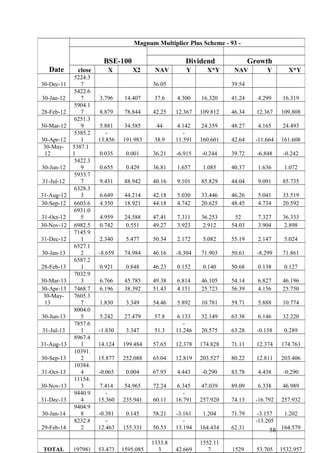
Date
Magnum Multiplier Plus Scheme - 93 -
BSE-100 Dividend Growth
close X X2 NAV Y X*Y NAV Y X*Y
30-Dec-11
5224.3
7 36.05 39.54
30-Jan-12
5422.6
7 3.796 14.407 37.6 4.300 16.320 41.24 4.299 16.319
28-Feb-12
5904.1
7 8.879 78.844 42.25 12.367 109.812 46.34 12.367 109.808
30-Mar-12
6251.3
9 5.881 34.585 44 4.142 24.359 48.27 4.165 24.493
30-Apr-12
5385.2
1
-
13.856 191.983 38.9
-
11.591 160.601 42.64 -11.664 161.608
30-May-
12
5387.1
1 0.035 0.001 36.21 -6.915 -0.244 39.72 -6.848 -0.242
30-Jun-12
5422.3
9 0.655 0.429 36.81 1.657 1.085 40.37 1.636 1.072
31-Jul-12
5933.7
7 9.431 88.942 40.16 9.101 85.829 44.04 9.091 85.735
31-Aug-12
6328.3
3 6.649 44.214 42.18 5.030 33.446 46.26 5.041 33.519
30-Sep-12 6603.6 4.350 18.921 44.18 4.742 20.625 48.45 4.734 20.592
31-Oct-12
6931.0
5 4.959 24.588 47.41 7.311 36.253 52 7.327 36.333
30-Nov-12 6982.5 0.742 0.551 49.27 3.923 2.912 54.03 3.904 2.898
31-Dec-12
7145.9
1 2.340 5.477 50.34 2.172 5.082 55.19 2.147 5.024
30-Jan-13
6527.1
2 -8.659 74.984 46.16 -8.304 71.903 50.61 -8.299 71.861
28-Feb-13
6587.2
1 0.921 0.848 46.23 0.152 0.140 50.68 0.138 0.127
30-Mar-13
7032.9
3 6.766 45.785 49.38 6.814 46.105 54.14 6.827 46.196
30-Apr-13 7468.7 6.196 38.392 51.43 4.151 25.723 56.39 4.156 25.750
30-May-
13
7605.3
7 1.830 3.349 54.46 5.892 10.781 59.71 5.888 10.774
30-Jun-13
8004.0
5 5.242 27.479 57.8 6.133 32.149 63.38 6.146 32.220
31-Jul-13
7857.6
1 -1.830 3.347 51.3
-
11.246 20.575 63.28 -0.158 0.289
31-Aug-13
8967.4
1 14.124 199.484 57.65 12.378 174.828 71.11 12.374 174.763
30-Sep-13
10391.
2 15.877 252.088 65.04 12.819 203.527 80.22 12.811 203.406
31-Oct-13
10384.
4 -0.065 0.004 67.93 4.443 -0.290 83.78 4.438 -0.290
30-Nov-13
11154.
3 7.414 54.965 72.24 6.345 47.039 89.09 6.338 46.989
31-Dec-13
9440.9
4
-
15.360 235.941 60.11
-
16.791 257.920 74.13 -16.792 257.932
30-Jan-14
9404.9
8 -0.381 0.145 58.21 -3.161 1.204 71.79 -3.157 1.202
29-Feb-14
8232.8
2
-
12.463 155.331 50.53
-
13.194 164.434 62.31
-13.205
164.579
TOTAL 197981 53.473 1595.085
1333.8
3 42.669
1552.11
7 1529 53.705 1532.957
58
MAGNUM MULTIPLIER PLUS SCHEME-93 (SBI)
TOOLS FOR CALCULATION
ARITHMETIC MEAN:
ARITHMETIC MEAN DIVIDEND OPTION GROWTH OPTION
X= ∑Y
N
42.669 = 1.580
27
53.705 = 1.998
27
CALCULATION FOR STANDARD DEVIATION:
Magnum Multiplier Plus Scheme – 93 -
Date
Dividend Growth
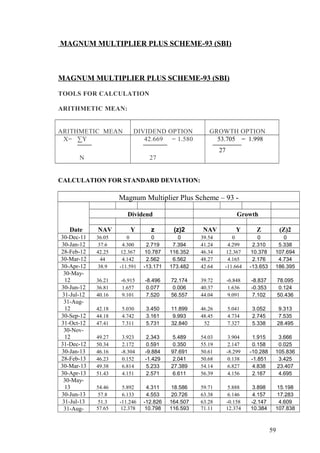
NAV Y z (z)2 NAV Y Z (Z)2
30-Dec-11 36.05 0 0 0 39.54 0 0 0
30-Jan-12 37.6 4.300 2.719 7.394 41.24 4.299 2.310 5.338
28-Feb-12 42.25 12.367 10.787 116.352 46.34 12.367 10.378 107.694
30-Mar-12 44 4.142 2.562 6.562 48.27 4.165 2.176 4.734
30-Apr-12 38.9 -11.591 -13.171 173.482 42.64 -11.664 -13.653 186.395
30-May-
12 36.21 -6.915 -8.496 72.174 39.72 -6.848 -8.837 78.095
30-Jun-12 36.81 1.657 0.077 0.006 40.37 1.636 -0.353 0.124
31-Jul-12 40.16 9.101 7.520 56.557 44.04 9.091 7.102 50.436
31-Aug-
12 42.18 5.030 3.450 11.899 46.26 5.041 3.052 9.313
30-Sep-12 44.18 4.742 3.161 9.993 48.45 4.734 2.745 7.535
31-Oct-12 47.41 7.311 5.731 32.840 52 7.327 5.338 28.495
30-Nov-
12 49.27 3.923 2.343 5.489 54.03 3.904 1.915 3.666
31-Dec-12 50.34 2.172 0.591 0.350 55.19 2.147 0.158 0.025
30-Jan-13 46.16 -8.304 -9.884 97.691 50.61 -8.299 -10.288 105.836
28-Feb-13 46.23 0.152 -1.429 2.041 50.68 0.138 -1.851 3.425
30-Mar-13 49.38 6.814 5.233 27.389 54.14 6.827 4.838 23.407
30-Apr-13 51.43 4.151 2.571 6.611 56.39 4.156 2.167 4.695
30-May-
13 54.46 5.892 4.311 18.586 59.71 5.888 3.898 15.198
30-Jun-13 57.8 6.133 4.553 20.726 63.38 6.146 4.157 17.283
31-Jul-13 51.3 -11.246 -12.826 164.507 63.28 -0.158 -2.147 4.609
31-Aug- 57.65 12.378 10.798 116.593 71.11 12.374 10.384 107.838
59
13
30-Sep-13 65.04 12.819 11.238 126.301 80.22 12.811 10.822 117.117
31-Oct-13 67.93 4.443 2.863 8.197 83.78 4.438 2.449 5.996
30-Nov-
13 72.24 6.345 4.764 22.700 89.09 6.338 4.349 18.913
31-Dec-13 60.11 -16.791 -18.372 337.515 74.13 -16.792 -18.781 352.729
30-Jan-14 58.21 -3.161 -4.741 22.479 71.79 -3.157 -5.146 26.478
29-Feb-14 50.53 -13.194 -14.774 218.270 62.31 -13.205 -15.194 230.866
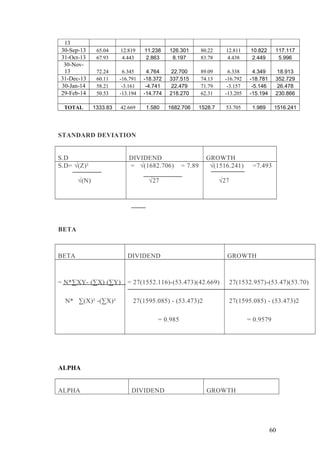
TOTAL 1333.83 42.669 1.580 1682.706 1528.7 53.705 1.989 1516.241
STANDARD DEVIATION
S.D DIVIDEND GROWTH
S.D= √(Z)²
√(N)
= √(1682.706) = 7.89
√27
√(1516.241) =7.493
√27
BETA
BETA DIVIDEND GROWTH
= N*∑XY- (∑X) (∑Y)
N* ∑(X)² -(∑X)²
= 27(1552.116)-(53.473)(42.669)
27(1595.085) - (53.473)2
= 0.985
27(1532.957)-(53.47)(53.70)
27(1595.085) - (53.473)2
= 0.9579
ALPHA
ALPHA DIVIDEND GROWTH
60
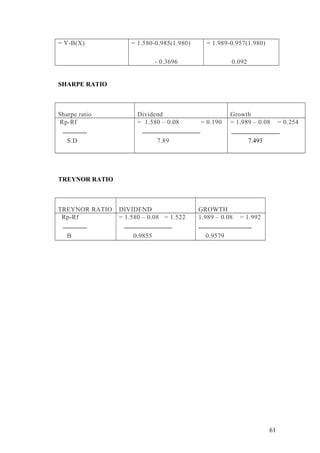
= Y-B(X) = 1.580-0.985(1.980)
- 0.3696
= 1.989-0.957(1.980)
0.092
SHARPE RATIO
Sharpe ratio Dividend Growth
Rp-Rf
S.D
= 1.580 – 0.08 = 0.190
7.89
= 1.989 – 0.08 = 0.254
7.493
TREYNOR RATIO
TREYNOR RATIO DIVIDEND GROWTH
Rp-Rf
B
= 1.580 – 0.08 = 1.522
0.9855
1.989 – 0.08 = 1.992
0.9579
61
POWER PLAN (ICICI PRUDENTIAL):
62
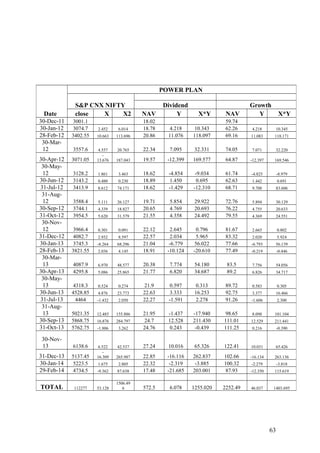
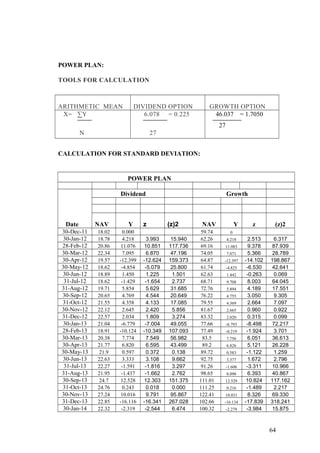
Date
POWER PLAN
S&P CNX NIFTY Dividend Growth
close X X2 NAV Y X*Y NAV Y X*Y
30-Dec-11 3001.1 18.02 59.74
30-Jan-12 3074.7 2.452 6.014 18.78 4.218 10.343 62.26 4.218 10.345
28-Feb-12 3402.55 10.663 113.696 20.86 11.076 118.097 69.16 11.083 118.171
30-Mar-
12 3557.6 4.557 20.765 22.34 7.095 32.331 74.05 7.071 32.220
30-Apr-12 3071.05
-
13.676 187.043 19.57 -12.399 169.577 64.87 -12.397 169.546
30-May-
12 3128.2 1.861 3.463 18.62 -4.854 -9.034 61.74 -4.825 -8.979
30-Jun-12 3143.2 0.480 0.230 18.89 1.450 0.695 62.63 1.442 0.691
31-Jul-12 3413.9 8.612 74.171 18.62 -1.429 -12.310 68.71 9.708 83.606
31-Aug-
12 3588.4 5.111 26.127 19.71 5.854 29.922 72.76 5.894 30.129
30-Sep-12 3744.1 4.339 18.827 20.65 4.769 20.693 76.22 4.755 20.633
31-Oct-12 3954.5 5.620 31.579 21.55 4.358 24.492 79.55 4.369 24.551
30-Nov-
12 3966.4 0.301 0.091 22.12 2.645 0.796 81.67 2.665 0.802
31-Dec-12 4082.7 2.932 8.597 22.57 2.034 5.965 83.32 2.020 5.924
30-Jan-13 3745.3 -8.264 68.296 21.04 -6.779 56.022 77.66 -6.793 56.139
28-Feb-13 3821.55 2.036 4.145 18.91 -10.124 -20.610 77.49 -0.219 -0.446
30-Mar-
13 4087.9 6.970 48.577 20.38 7.774 54.180 83.5 7.756 54.056
30-Apr-13 4295.8 5.086 25.865 21.77 6.820 34.687 89.2 6.826 34.717
30-May-
13 4318.3 0.524 0.274 21.9 0.597 0.313 89.72 0.583 0.305
30-Jun-13 4528.85 4.876 23.773 22.63 3.333 16.253 92.75 3.377 16.466
31-Jul-13 4464 -1.432 2.050 22.27 -1.591 2.278 91.26 -1.606 2.300
31-Aug-
13 5021.35 12.485 155.886 21.95 -1.437 -17.940 98.65 8.098 101.104
30-Sep-13 5868.75 16.876 284.797 24.7 12.528 211.430 111.01 12.529 211.441
31-Oct-13 5762.75 -1.806 3.262 24.76 0.243 -0.439 111.25 0.216 -0.390
30-Nov-
13 6138.6 6.522 42.537 27.24 10.016 65.326 122.41 10.031 65.426
31-Dec-13 5137.45
-
16.309 265.987 22.85 -16.116 262.837 102.66 -16.134 263.136
30-Jan-14 5223.5 1.675 2.805 22.32 -2.319 -3.885 100.32 -2.279 -3.818
29-Feb-14 4734.5 -9.362 87.638 17.48 -21.685 203.001 87.93 -12.350 115.619
TOTAL 112277 53.128
1506.49
6 572.5 6.078 1255.020 2252.49 46.037 1403.695
63
POWER PLAN:
TOOLS FOR CALCULATION
ARITHMETIC MEAN DIVIDEND OPTION GROWTH OPTION
X= ∑Y
N
6.078 = 0.225
27
46.037 = 1.7050
27
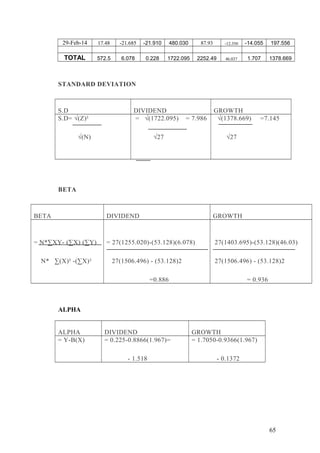
CALCULATION FOR STANDARD DEVIATION:
POWER PLAN
Date
Dividend Growth
NAV Y z (z)2 NAV Y z (z)2
30-Dec-11 18.02 0.000 59.74 0
30-Jan-12 18.78 4.218 3.993 15.940 62.26 4.218 2.513 6.317
28-Feb-12 20.86 11.076 10.851 117.736 69.16 11.083 9.378 87.939
30-Mar-12 22.34 7.095 6.870 47.196 74.05 7.071 5.366 28.789
30-Apr-12 19.57 -12.399 -12.624 159.373 64.87 -12.397 -14.102 198.867
30-May-12 18.62 -4.854 -5.079 25.800 61.74 -4.825 -6.530 42.641
30-Jun-12 18.89 1.450 1.225 1.501 62.63 1.442 -0.263 0.069
31-Jul-12 18.62 -1.429 -1.654 2.737 68.71 9.708 8.003 64.045
31-Aug-12 19.71 5.854 5.629 31.685 72.76 5.894 4.189 17.551
30-Sep-12 20.65 4.769 4.544 20.649 76.22 4.755 3.050 9.305
31-Oct-12 21.55 4.358 4.133 17.085 79.55 4.369 2.664 7.097
30-Nov-12 22.12 2.645 2.420 5.856 81.67 2.665 0.960 0.922
31-Dec-12 22.57 2.034 1.809 3.274 83.32 2.020 0.315 0.099
30-Jan-13 21.04 -6.779 -7.004 49.055 77.66 -6.793 -8.498 72.217
28-Feb-13 18.91 -10.124 -10.349 107.093 77.49 -0.219 -1.924 3.701
30-Mar-13 20.38 7.774 7.549 56.982 83.5 7.756 6.051 36.613
30-Apr-13 21.77 6.820 6.595 43.499 89.2 6.826 5.121 26.228
30-May-13 21.9 0.597 0.372 0.138 89.72 0.583 -1.122 1.259
30-Jun-13 22.63 3.333 3.108 9.662 92.75 3.377 1.672 2.796
31-Jul-13 22.27 -1.591 -1.816 3.297 91.26 -1.606 -3.311 10.966
31-Aug-13 21.95 -1.437 -1.662 2.762 98.65 8.098 6.393 40.867
30-Sep-13 24.7 12.528 12.303 151.375 111.01 12.529 10.824 117.162
31-Oct-13 24.76 0.243 0.018 0.000 111.25 0.216 -1.489 2.217
30-Nov-13 27.24 10.016 9.791 95.867 122.41 10.031 8.326 69.330
31-Dec-13 22.85 -16.116 -16.341 267.028 102.66 -16.134 -17.839 318.241
30-Jan-14 22.32 -2.319 -2.544 6.474 100.32 -2.279 -3.984 15.875
64
29-Feb-14 17.48 -21.685 -21.910 480.030 87.93 -12.350 -14.055 197.556
TOTAL 572.5 6.078 0.228 1722.095 2252.49 46.037 1.707 1378.669
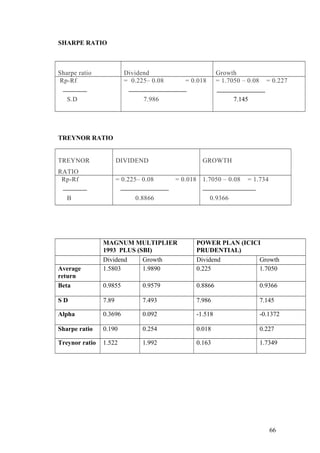
STANDARD DEVIATION
S.D DIVIDEND GROWTH
S.D= √(Z)²
√(N)
= √(1722.095) = 7.986
√27
√(1378.669) =7.145
√27
BETA
BETA DIVIDEND GROWTH
= N*∑XY- (∑X) (∑Y)
N* ∑(X)² -(∑X)²
= 27(1255.020)-(53.128)(6.078)
27(1506.496) - (53.128)2
=0.886
27(1403.695)-(53.128)(46.03)
27(1506.496) - (53.128)2
= 0.936
ALPHA
ALPHA DIVIDEND GROWTH
= Y-B(X) = 0.225-0.8866(1.967)=
- 1.518
= 1.7050-0.9366(1.967)
- 0.1372
65
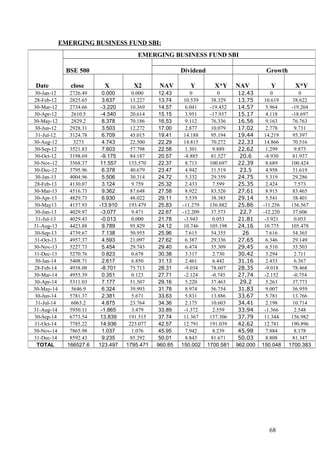
SHARPE RATIO
Sharpe ratio Dividend Growth
Rp-Rf
S.D
= 0.225– 0.08 = 0.018
7.986
= 1.7050 – 0.08 = 0.227
7.145
TREYNOR RATIO
TREYNOR
RATIO
DIVIDEND GROWTH
Rp-Rf
B
= 0.225– 0.08 = 0.018
0.8866
1.7050 – 0.08 = 1.734
0.9366
MAGNUM MULTIPLIER
1993 PLUS (SBI)
POWER PLAN (ICICI
PRUDENTIAL)
Dividend Growth Dividend Growth
Average
return
1.5803 1.9890 0.225 1.7050
Beta 0.9855 0.9579 0.8866 0.9366
S D 7.89 7.493 7.986 7.145
Alpha 0.3696 0.092 -1.518 -0.1372
Sharpe ratio 0.190 0.254 0.018 0.227
Treynor ratio 1.522 1.992 0.163 1.7349
66
ANALYSIS & INTERPRETATION:
• The SBI Magnum Multiplier plus1993 Dividend option & Growth option
has given high returns compared to ICICI prudential Power Plan.
• The larger the Sharpe ratio, better the fund is performing. So, the SBI
Magnum Multiplier plus 1993 fund has a greater Sharpe ratio compared to
ICICI PRUDENTIAL Power Plan, all options show the positive value, this
means funds are performing well.
• Since the market has risen up, this has resulted in funds positive return.
• Since the funds objective is to invest in Diversified portfolios the
benchmarks index has performed very good, which has resulted in good
performance of the fund.
• As per the Treynor index, the SBI Magnum Multiplier 1993 has given
higher returns compared to ICICI PRUDENTIAL Power Plan due to which
the risk is also high. But incase of ICICI PRUDENTIAL Power Plan the
returns are low and the risk is high compared to SBI Magnum Multiplier
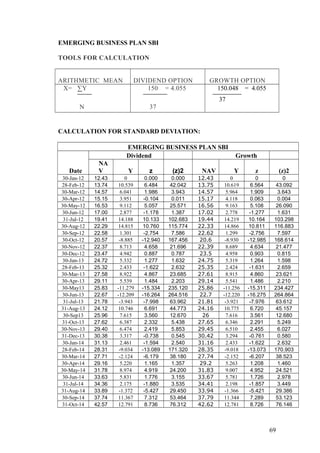
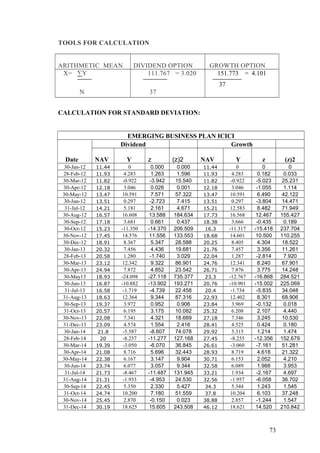
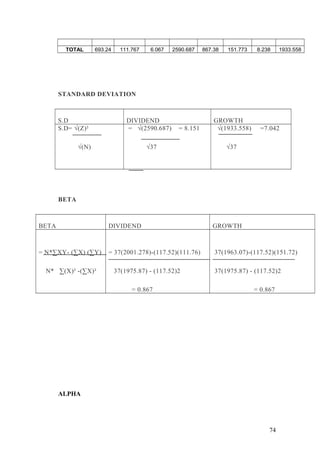
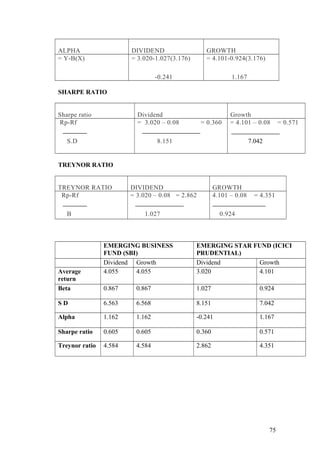
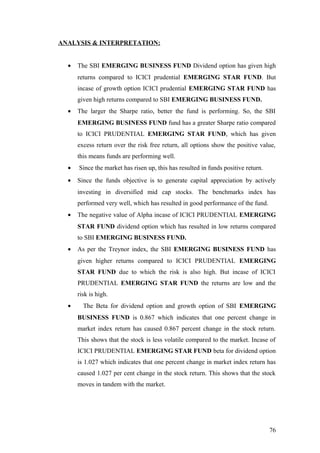
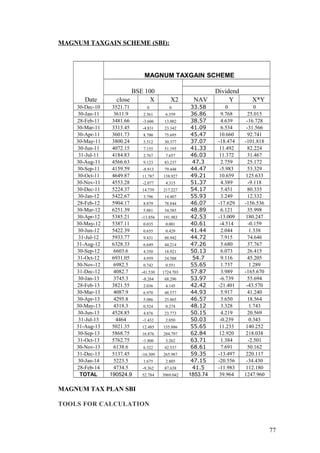
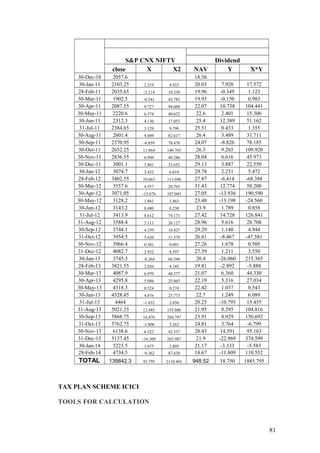
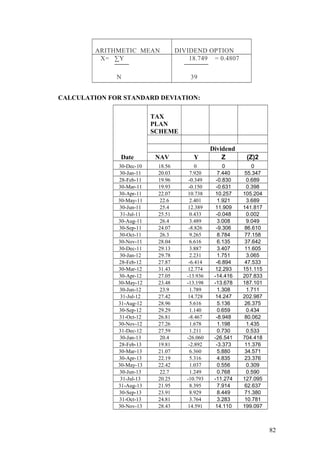
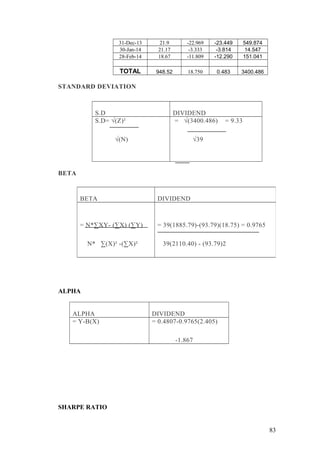
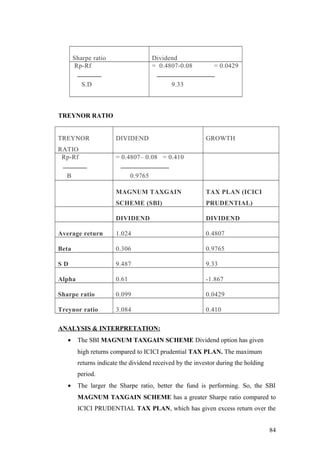
1993.
• As per Beta for dividend option and growth option of SBI Magnum
Multiplier 1993 has got the highest risk. When market is 1 it moves at
0.9855 in dividend &
0.9579 in growth compared to ICICI PRUDENTIAL Power Plan.
• Overall, all the options are performing well.
67
EMERGING BUSINESS FUND SBI:
Date
EMERGING BUSINESS FUND SBI
BSE 500 Dividend Growth
close X X2 NAV Y X*Y NAV Y X*Y
30-Jan-12 2726.49 0.000 0.000 12.43 0 0 12.43 0 0
28-Feb-12 2825.65 3.637 13.227 13.74 10.539 38.329 13.75 10.619 38.622
30-Mar-12 2734.66 -3.220 10.369 14.57 6.041 -19.452 14.57 5.964 -19.204
30-Apr-12 2610.5 -4.540 20.614 15.15 3.951 -17.937 15.17 4.118 -18.697
30-May-12 2829.2 8.378 70.186 16.53 9.112 76.336 16.56 9.163 76.763
30-Jun-12 2928.31 3.503 12.272 17.00 2.877 10.079 17.02 2.778 9.731
31-Jul-12 3124.78 6.709 45.015 19.41 14.188 95.194 19.44 14.219 95.397
30-Aug-12 3273 4.743 22.500 22.29 14.815 70.272 22.33 14.866 70.516
30-Sep-12 3521.83 7.603 57.798 22.58 1.301 9.889 22.62 1.299 9.873
30-Oct-12 3198.69 -9.175 84.187 20.57 -8.885 81.527 20.6 -8.930 81.937
30-Nov-12 3568.37 11.557 133.570 22.37 8.713 100.697 22.39 8.689 100.424
30-Dec-12 3795.96 6.378 40.679 23.47 4.942 31.519 23.5 4.958 31.619
30-Jan-13 4004.96 5.506 30.314 24.72 5.332 29.359 24.75 5.319 29.286
28-Feb-13 4130.07 3.124 9.759 25.32 2.433 7.599 25.35 2.424 7.573
30-Mar-13 4516.73 9.362 87.648 27.58 8.922 83.526 27.61 8.915 83.465
30-Apr-13 4829.73 6.930 48.022 29.11 5.539 38.385 29.14 5.541 38.401
30-May13 4157.93 -13.910 193.479 25.83 -11.279 156.882 25.86 -11.256 156.567
30-Jun-13 4029.97 -3.077 9.471 22.67 -12.209 37.573 22.7 -12.220 37.606
31-Jul-13 4029.43 -0.013 0.000 21.78 -3.943 0.053 21.81 -3.921 0.053
31-Aug-13 4423.88 9.789 95.829 24.12 10.746 105.198 24.16 10.775 105.478
30-Sep-13 4739.67 7.138 50.955 25.96 7.615 54.355 26 7.616 54.365
31-Oct-13 4957.37 4.593 21.097 27.62 6.387 29.336 27.65 6.346 29.149
30-Nov-13 5227.73 5.454 29.743 29.40 6.474 35.309 29.45 6.510 35.503
31-Dec-13 5270.76 0.823 0.678 30.38 3.317 2.730 30.42 3.294 2.711
30-Jan-14 5408.71 2.617 6.850 31.13 2.461 6.442 31.16 2.433 6.367
28-Feb-14 4938.08 -8.701 75.713 28.31 -9.034 78.607 28.35 -9.018 78.468
30-Mar-14 4955.39 0.351 0.123 27.71 -2.124 -0.745 27.74 -2.152 -0.754
30-Apr-14 5311.03 7.177 51.507 29.16 5.220 37.463 29.2 5.263 37.773
30-May-14 5646.9 6.324 39.993 31.78 8.974 56.754 31.83 9.007 56.959
30-Jun-14 5781.37 2.381 5.671 33.63 5.831 13.886 33.67 5.781 13.766
31-Jul-14 6063.2 4.875 23.764 34.36 2.175 10.603 34.41 2.198 10.714
31-Aug-14 5950.11 -1.865 3.479 33.89 -1.372 2.559 33.94 -1.366 2.548
30-Sep-14 6773.54 13.839 191.515 37.74 11.367 157.306 37.79 11.344 156.982
31-Oct-14 7785.22 14.936 223.077 42.57 12.791 191.039 42.62 12.781 190.896
30-Nov-14 7865.98 1.037 1.076 45.95 7.942 8.239 45.98 7.884 8.178
31-Dec-14 8592.43 9.235 85.292 50.01 8.843 81.671 50.03 8.808 81.347
TOTAL 166527.6 123.497 1795.471 960.85 150.002 1700.581 962.000 150.048 1700.383
68
EMERGING BUSINESS PLAN SBI
TOOLS FOR CALCULATION
ARITHMETIC MEAN DIVIDEND OPTION GROWTH OPTION
X= ∑Y
N
150 = 4.055
37
150.048 = 4.055
37
CALCULATION FOR STANDARD DEVIATION:
EMERGING BUSINESS PLAN SBI
Date
Dividend Growth
NA
V Y z (z)2 NAV Y z (z)2
30-Jan-12 12.43 0 0.000 0.000 12.43 0 0 0
28-Feb-12 13.74 10.539 6.484 42.042 13.75 10.619 6.564 43.092
30-Mar-12 14.57 6.041 1.986 3.943 14.57 5.964 1.909 3.643
30-Apr-12 15.15 3.951 -0.104 0.011 15.17 4.118 0.063 0.004
30-May-12 16.53 9.112 5.057 25.571 16.56 9.163 5.108 26.090
30-Jun-12 17.00 2.877 -1.178 1.387 17.02 2.778 -1.277 1.631
31-Jul-12 19.41 14.188 10.133 102.683 19.44 14.219 10.164 103.298
30-Aug-12 22.29 14.815 10.760 115.774 22.33 14.866 10.811 116.883
30-Sep-12 22.58 1.301 -2.754 7.586 22.62 1.299 -2.756 7.597
30-Oct-12 20.57 -8.885 -12.940 167.456 20.6 -8.930 -12.985 168.614
30-Nov-12 22.37 8.713 4.658 21.696 22.39 8.689 4.634 21.477
30-Dec-12 23.47 4.942 0.887 0.787 23.5 4.958 0.903 0.815
30-Jan-13 24.72 5.332 1.277 1.632 24.75 5.319 1.264 1.598
28-Feb-13 25.32 2.433 -1.622 2.632 25.35 2.424 -1.631 2.659
30-Mar-13 27.58 8.922 4.867 23.685 27.61 8.915 4.860 23.621
30-Apr-13 29.11 5.539 1.484 2.203 29.14 5.541 1.486 2.210
30-May13 25.83 -11.279 -15.334 235.120 25.86 -11.256 -15.311 234.427
30-Jun-13 22.67 -12.209 -16.264 264.516 22.7 -12.220 -16.275 264.864
31-Jul-13 21.78 -3.943 -7.998 63.962 21.81 -3.921 -7.976 63.612
31-Aug-13 24.12 10.746 6.691 44.773 24.16 10.775 6.720 45.157
30-Sep13 25.96 7.615 3.560 12.670 26 7.616 3.561 12.680
31-Oct-13 27.62 6.387 2.332 5.438 27.65 6.346 2.291 5.249
30-Nov-13 29.40 6.474 2.419 5.853 29.45 6.510 2.455 6.027
31-Dec-13 30.38 3.317 -0.738 0.545 30.42 3.294 -0.761 0.580
30-Jan-14 31.13 2.461 -1.594 2.540 31.16 2.433 -1.622 2.632
28-Feb-14 28.31 -9.034 -13.089 171.320 28.35 -9.018 -13.073 170.903
30-Mar-14 27.71 -2.124 -6.179 38.180 27.74 -2.152 -6.207 38.523
30-Apr-14 29.16 5.220 1.165 1.357 29.2 5.263 1.208 1.460
30-May-14 31.78 8.974 4.919 24.200 31.83 9.007 4.952 24.521
30-Jun-14 33.63 5.831 1.776 3.155 33.67 5.781 1.726 2.978
31-Jul-14 34.36 2.175 -1.880 3.535 34.41 2.198 -1.857 3.449
31-Aug-14 33.89 -1.372 -5.427 29.450 33.94 -1.366 -5.421 29.386
30-Sep-14 37.74 11.367 7.312 53.464 37.79 11.344 7.289 53.123
31-Oct-14 42.57 12.791 8.736 76.312 42.62 12.781 8.726 76.146
69
30-Nov-14 45.95 7.942 3.887 15.108 45.98 7.884 3.829 14.658
31-Dec-14 50.01 8.843 4.788 22.928 50.03 8.808 4.753 22.593
TOTAL 960.85 150.002 145.947 1593.515 962 150.048 145.993 1596.199
STANDARD DEVIATION
S.D DIVIDEND GROWTH
S.D= √(Z)²
√(N)
= √(1593.515) = 6.563
√37
√(1596.199) =6.568
√37
BETA
BETA DIVIDEND GROWTH
= N*∑XY- (∑X) (∑Y)
N* ∑(X)² -(∑X)²
= 37(1700.58)-(123.49)(150)
37(1795.42) - (123.49)2
= 0.867
37(1700.38)-(53.47)(53.70)
37(1595.085) - (53.473)2
= 0.867
ALPHA
70
ALPHA DIVIDEND GROWTH
= Y-B(X) = 4.055-0.867(3.337)
1.162
= 4.055-0.867(3.337)
1.162
SHARPE RATIO
Sharpe ratio Dividend Growth
Rp-Rf
S.D
= 4.055 – 0.08 = 0.605
6.563
= 4.055 – 0.08 = 0.605
6.568
TREYNOR RATIO
TREYNOR RATIO DIVIDEND GROWTH
Rp-Rf
B
= 4.055 – 0.08 = 4.584
0.867
4.055 – 0.08 = 4.584
0.867
EMERGING STAR FUND ICICI PRUDENTIAL:
71
Date
EMERGING STAR FUND ICICI PRUDENTIAL
BSE 500 Dividend Growth
close X X2 NAV Y X*Y NAV Y X*Y
30-Jan-12 4247.8 0.000 0.000 11.44 0 0 11.44 0 0
28-Feb-12 4388.2 3.305 10.925 11.93 4.283 14.157 11.93 4.283 14.157
30-Mar-12 4275.15 -2.576 6.637 11.82 -0.922 2.375 11.82 -0.922 2.375
30-Apr-12 4024.4 -5.865 34.402 12.18 3.046 -17.864 12.18 3.046 -17.864
30-May-
12 4364.55 8.452 71.440 13.47 10.591 89.518 13.47 10.591 89.518
30-Jun-12 4393.25 0.658 0.432 13.51 0.297 0.195 13.51 0.297 0.195
31-Jul-12 4919.1 11.969 143.269 14.21 5.181 62.018 15.21 12.583 150.615
30-Aug-12 5053 2.722 7.410 16.57 16.608 45.208 17.73 16.568 45.099
30-Sep-12 5303.5 4.957 24.576 17.18 3.681 18.250 18.38 3.666 18.175
30-Oct-12 4714.45 -11.107 123.361 15.23 -11.350 126.067 16.3 -11.317 125.692
30-Nov-12 5242 11.190 125.218 17.45 14.576 163.112 18.68 14.601 163.389
30-Dec-12 5541.45 5.713 32.633 18.91 8.367 47.795 20.25 8.405 48.012
30-Jan-13 5882.9 6.162 37.967 20.32 7.456 45.944 21.76 7.457 45.947
28-Feb-13 5966.65 1.424 2.027 20.58 1.280 1.822 22.04 1.287 1.832
30-Mar-13 6412.1 7.466 55.736 23.12 12.342 92.142 24.76 12.341 92.135
30-Apr-13 6856 6.923 47.926 24.94 7.872 54.496 26.71 7.876 54.522
30-May13 5827.4 -15.003 225.088 18.93 -24.098 361.538 23.3 -12.767 191.539
30-Jun-13 5264.3 -9.663 93.373 16.87 -10.882 105.154 20.76 -10.901 105.339
31-Jul-13 5335.1 1.345 1.809 16.58 -1.719 -2.312 20.4 -1.734 -2.332
31-Aug-13 5940.5 11.347 128.766 18.63 12.364 140.304 22.93 12.402 140.731
30-Sep-13 6510.4 9.593 92.035 19.37 3.972 38.106 23.84 3.969 38.073
31-Oct-13 6823.15 4.804 23.077 20.57 6.195 29.761 25.32 6.208 29.823
30-Nov-13 6967.25 2.112 4.460 22.08 7.341 15.503 27.18 7.346 15.514
31-Dec-13 7106.35 1.996 3.986 23.09 4.574 9.132 28.41 4.525 9.035
30-Jan-14 7268.05 2.275 5.178 21.8 -5.587 -12.712 29.92 5.315 12.094
28-Feb-14 6722.1 -7.512 56.425 20 -8.257 62.023 27.45 -8.255 62.011
30-Mar-14 6878.05 2.320 5.382 19.39 -3.050 -7.076 26.61 -3.060 -7.099
30-Apr-14 7527.3 9.439 89.103 21.08 8.716 82.273 28.93 8.719 82.298
30-May-
14 8022.55 6.579 43.288 22.38 6.167 40.575 30.71 6.153 40.482
30-Jun-14 8699.05 8.432 71.107 23.74 6.077 51.243 32.58 6.089 51.347
31-Jul-14 8849.6 1.731 2.995 21.73 -8.467 -14.653 33.21 1.934 3.347
31-Aug-14 8632.75 -2.450 6.004 21.31 -1.933 4.736 32.56 -1.957 4.796
30-Sep-14 9820.9 13.763 189.428 22.45 5.350 73.628 34.3 5.344 73.551
31-Oct-14 10643.3 8.374 70.124 24.74 10.200 85.418 37.8 10.204 85.449
30-Nov-14 11431.7 7.407 54.864 25.45 2.870 21.257 38.88 2.857 21.163
31-Dec-14 12488.3 9.243 85.429 30.19 18.625 172.144 46.12 18.621 172.113
TOTAL 238343 117.527 1975.876 693.24 111.767 2001.278 867.380 151.773 1963.071
EMERGING STAR FUND ICICI:
72
TOOLS FOR CALCULATION
ARITHMETIC MEAN DIVIDEND OPTION GROWTH OPTION
X= ∑Y
N
111.767 = 3.020
37
151.773 = 4.101
37
CALCULATION FOR STANDARD DEVIATION:
EMERGING BUSINESS PLAN ICICI
Date
Dividend Growth
NAV Y z (z)2 NAV Y z (z)2
30-Jan-12 11.44 0 0.000 0.000 11.44 0 0 0
28-Feb-12 11.93 4.283 1.263 1.596 11.93 4.283 0.182 0.033
30-Mar-12 11.82 -0.922 -3.942 15.540 11.82 -0.922 -5.023 25.231
30-Apr-12 12.18 3.046 0.026 0.001 12.18 3.046 -1.055 1.114
30-May-12 13.47 10.591 7.571 57.322 13.47 10.591 6.490 42.122
30-Jun-12 13.51 0.297 -2.723 7.415 13.51 0.297 -3.804 14.471
31-Jul-12 14.21 5.181 2.161 4.671 15.21 12.583 8.482 71.949
30-Aug-12 16.57 16.608 13.588 184.634 17.73 16.568 12.467 155.427
30-Sep-12 17.18 3.681 0.661 0.437 18.38 3.666 -0.435 0.189
30-Oct-12 15.23 -11.350 -14.370 206.509 16.3 -11.317 -15.418 237.704
30-Nov-12 17.45 14.576 11.556 133.553 18.68 14.601 10.500 110.255
30-Dec-12 18.91 8.367 5.347 28.588 20.25 8.405 4.304 18.522
30-Jan-13 20.32 7.456 4.436 19.681 21.76 7.457 3.356 11.261
28-Feb-13 20.58 1.280 -1.740 3.029 22.04 1.287 -2.814 7.920
30-Mar-13 23.12 12.342 9.322 86.901 24.76 12.341 8.240 67.901
30-Apr-13 24.94 7.872 4.852 23.542 26.71 7.876 3.775 14.248
30-May13 18.93 -24.098 -27.118 735.377 23.3 -12.767 -16.868 284.521
30-Jun-13 16.87 -10.882 -13.902 193.271 20.76 -10.901 -15.002 225.069
31-Jul-13 16.58 -1.719 -4.739 22.458 20.4 -1.734 -5.835 34.048
31-Aug-13 18.63 12.364 9.344 87.316 22.93 12.402 8.301 68.906
30-Sep-13 19.37 3.972 0.952 0.906 23.84 3.969 -0.132 0.018
31-Oct-13 20.57 6.195 3.175 10.082 25.32 6.208 2.107 4.440
30-Nov-13 22.08 7.341 4.321 18.669 27.18 7.346 3.245 10.530
31-Dec-13 23.09 4.574 1.554 2.416 28.41 4.525 0.424 0.180
30-Jan-14 21.8 -5.587 -8.607 74.078 29.92 5.315 1.214 1.474
28-Feb-14 20 -8.257 -11.277 127.168 27.45 -8.255 -12.356 152.679
30-Mar-14 19.39 -3.050 -6.070 36.845 26.61 -3.060 -7.161 51.281
30-Apr-14 21.08 8.716 5.696 32.443 28.93 8.719 4.618 21.322
30-May-14 22.38 6.167 3.147 9.904 30.71 6.153 2.052 4.210
30-Jun-14 23.74 6.077 3.057 9.344 32.58 6.089 1.988 3.953
31-Jul-14 21.73 -8.467 -11.487 131.945 33.21 1.934 -2.167 4.697
31-Aug-14 21.31 -1.933 -4.953 24.530 32.56 -1.957 -6.058 36.702
30-Sep-14 22.45 5.350 2.330 5.427 34.3 5.344 1.243 1.545
31-Oct-14 24.74 10.200 7.180 51.559 37.8 10.204 6.103 37.248
30-Nov-14 25.45 2.870 -0.150 0.023 38.88 2.857 -1.244 1.547
31-Dec-14 30.19 18.625 15.605 243.508 46.12 18.621 14.520 210.842
73
TOTAL 693.24 111.767 6.067 2590.687 867.38 151.773 8.238 1933.558
STANDARD DEVIATION
S.D DIVIDEND GROWTH
S.D= √(Z)²
√(N)
= √(2590.687) = 8.151
√37
√(1933.558) =7.042
√37
BETA
BETA DIVIDEND GROWTH
= N*∑XY- (∑X) (∑Y)
N* ∑(X)² -(∑X)²
= 37(2001.278)-(117.52)(111.76)
37(1975.87) - (117.52)2
= 0.867
37(1963.07)-(117.52)(151.72)
37(1975.87) - (117.52)2
= 0.867
ALPHA
74
ALPHA DIVIDEND GROWTH
= Y-B(X) = 3.020-1.027(3.176)
-0.241
= 4.101-0.924(3.176)
1.167
SHARPE RATIO
Sharpe ratio Dividend Growth
Rp-Rf
S.D
= 3.020 – 0.08 = 0.360
8.151
= 4.101 – 0.08 = 0.571
7.042
TREYNOR RATIO
TREYNOR RATIO DIVIDEND GROWTH
Rp-Rf
B
= 3.020 – 0.08 = 2.862
1.027
4.101 – 0.08 = 4.351
0.924
EMERGING BUSINESS
FUND (SBI)
EMERGING STAR FUND (ICICI
PRUDENTIAL)
Dividend Growth Dividend Growth
Average
return
4.055 4.055 3.020 4.101
Beta 0.867 0.867 1.027 0.924
S D 6.563 6.568 8.151 7.042
Alpha 1.162 1.162 -0.241 1.167
Sharpe ratio 0.605 0.605 0.360 0.571
Treynor ratio 4.584 4.584 2.862 4.351
75
ANALYSIS & INTERPRETATION:
• The SBI EMERGING BUSINESS FUND Dividend option has given high
returns compared to ICICI prudential EMERGING STAR FUND. But
incase of growth option ICICI prudential EMERGING STAR FUND has
given high returns compared to SBI EMERGING BUSINESS FUND.
• The larger the Sharpe ratio, better the fund is performing. So, the SBI
EMERGING BUSINESS FUND fund has a greater Sharpe ratio compared
to ICICI PRUDENTIAL EMERGING STAR FUND, which has given
excess return over the risk free return, all options show the positive value,
this means funds are performing well.
• Since the market has risen up, this has resulted in funds positive return.
• Since the funds objective is to generate capital appreciation by actively
investing in diversified mid cap stocks. The benchmarks index has
performed very well, which has resulted in good performance of the fund.
• The negative value of Alpha incase of ICICI PRUDENTIAL EMERGING
STAR FUND dividend option which has resulted in low returns compared
to SBI EMERGING BUSINESS FUND.
• As per the Treynor index, the SBI EMERGING BUSINESS FUND has
given higher returns compared to ICICI PRUDENTIAL EMERGING
STAR FUND due to which the risk is also high. But incase of ICICI
PRUDENTIAL EMERGING STAR FUND the returns are low and the
risk is high.
• The Beta for dividend option and growth option of SBI EMERGING
BUSINESS FUND is 0.867 which indicates that one percent change in
market index return has caused 0.867 percent change in the stock return.
This shows that the stock is less volatile compared to the market. Incase of
ICICI PRUDENTIAL EMERGING STAR FUND beta for dividend option
is 1.027 which indicates that one percent change in market index return has
caused 1.027 per cent change in the stock return. This shows that the stock
moves in tandem with the market.
76
MAGNUM TAXGAIN SCHEME (SBI):
Date
MAGNUM TAXGAIN SCHEME
BSE 100 Dividend
close X X2 NAV Y X*Y
30-Dec-10 3521.71 0 0 33.58 0 0
30-Jan-11 3611.9 2.561 6.559 36.86 9.768 25.015
28-Feb-11 3481.66 -3.606 13.002 38.57 4.639 -16.728
30-Mar-11 3313.45 -4.831 23.342 41.09 6.534 -31.566
30-Apr-11 3601.73 8.700 75.695 45.47 10.660 92.741
30-May-11 3800.24 5.512 30.377 37.07 -18.474 -101.818
30-Jun-11 4072.15 7.155 51.195 41.33 11.492 82.224
31-Jul-11 4184.83 2.767 7.657 46.03 11.372 31.467
30-Aug-11 4566.63 9.123 83.237 47.3 2.759 25.172
30-Sep-11 4159.59 -8.913 79.448 44.47 -5.983 53.329
30-Oct-11 4649.87 11.787 138.927 49.21 10.659 125.633
30-Nov-11 4553.28 -2.077 4.315 51.37 4.389 -9.118
30-Dec-11 5224.37 14.739 217.227 54.17 5.451 80.335
30-Jan-12 5422.67 3.796 14.407 55.93 3.249 12.332
28-Feb-12 5904.17 8.879 78.844 46.07 -17.629 -156.536
30-Mar-12 6251.39 5.881 34.585 48.89 6.121 35.998
30-Apr-12 5385.21 -13.856 191.983 42.53 -13.009 180.247
30-May-12 5387.11 0.035 0.001 40.61 -4.514 -0.159
30-Jun-12 5422.39 0.655 0.429 41.44 2.044 1.338
31-Jul-12 5933.77 9.431 88.942 44.72 7.915 74.646
31-Aug-12 6328.33 6.649 44.214 47.26 5.680 37.767
30-Sep-12 6603.6 4.350 18.921 50.13 6.073 26.415
31-Oct-12 6931.05 4.959 24.588 54.7 9.116 45.205
30-Nov-12 6982.5 0.742 0.551 55.65 1.737 1.289
31-Dec-12 4082.7 -41.530 1724.703 57.87 3.989 -165.670
30-Jan-13 3745.3 -8.264 68.296 53.97 -6.739 55.694
28-Feb-13 3821.55 2.036 4.145 42.42 -21.401 -43.570
30-Mar-13 4087.9 6.970 48.577 44.93 5.917 41.240
30-Apr-13 4295.8 5.086 25.865 46.57 3.650 18.564
30-May-13 4318.3 0.524 0.274 48.12 3.328 1.743
30-Jun-13 4528.85 4.876 23.773 50.15 4.219 20.569
31-Jul-13 4464 -1.432 2.050 50.03 -0.239 0.343
31-Aug-13 5021.35 12.485 155.886 55.65 11.233 140.252
30-Sep-13 5868.75 16.876 284.797 62.84 12.920 218.038
31-Oct-13 5762.75 -1.806 3.262 63.71 1.384 -2.501
30-Nov-13 6138.6 6.522 42.537 68.61 7.691 50.162
31-Dec-13 5137.45 -16.309 265.987 59.35 -13.497 220.117
30-Jan-14 5223.5 1.675 2.805 47.15 -20.556 -34.430
28-Feb-14 4734.5 -9.362 87.638 41.5 -11.983 112.180
TOTAL 190524.9 52.784 3969.042 1853.74 39.964 1247.960
MAGNUM TAX PLAN SBI
TOOLS FOR CALCULATION
77
ARITHMETIC MEAN DIVIDEND OPTION
X= ∑Y
N
39.964 = 1.024
39
CALCULATION FOR STANDARD DEVIATION:
Date
MAGNUM TAXGAIN SCHEME
Dividend
NAV Y Z (Z)2
30-Dec-10 33.58 0 0 0.000
30-Jan-11 36.86 9.768 8.744 76.453
28-Feb-11 38.57 4.639 3.615 13.069
30-Mar-11 41.09 6.534 5.510 30.355
30-Apr-11 45.47 10.660 9.636 92.843
30-May-11 37.07 -18.474 -19.498 380.161
30-Jun-11 41.33 11.492 10.468 109.574
31-Jul-11 46.03 11.372 10.348 107.079
30-Aug11 47.3 2.759 1.735 3.010
30-Sep-11 44.47 -5.983 -7.007 49.099
30-Oct-11 49.21 10.659 9.635 92.831
30-Nov-11 51.37 4.389 3.365 11.326
30-Dec-11 54.17 5.451 4.427 19.595
30-Jan-12 55.93 3.249 2.225 4.951
28-Feb-12 46.07 -17.629 -18.653 347.941
30-Mar-12 48.89 6.121 5.097 25.981
30-Apr-12 42.53 -13.009 -14.033 196.919
30-May-12 40.61 -4.514 -5.538 30.675
30-Jun-12 41.44 2.044 1.020 1.040
31-Jul-12 44.72 7.915 6.891 47.487
31-Aug-12 47.26 5.680 4.656 21.676
30-Sep-12 50.13 6.073 5.049 25.490
31-Oct-12 54.7 9.116 8.092 65.485
30-Nov-12 55.65 1.737 0.713 0.508
31-Dec-12 57.87 3.989 2.965 8.793
30-Jan-13 53.97 -6.739 -7.763 60.268
28-Feb-13 42.42 -21.401 -22.425 502.871
30-Mar-13 44.93 5.917 4.893 23.942
30-Apr-13 46.57 3.650 2.626 6.897
30-May-13 48.12 3.328 2.304 5.310
30-Jun-13 50.15 4.219 3.195 10.206
31-Jul-13 50.03 -0.239 -1.263 1.596
31-Aug-13 55.65 11.233 10.209 104.229
30-Sep-13 62.84 12.920 11.896 141.516
31-Oct-13 63.71 1.384 0.360 0.130
30-Nov-13 68.61 7.691 6.667 44.450
31-Dec-13 59.35 -13.497 -14.521 210.847
78
30-Jan-14 47.15 -20.556 -21.580 465.697
28-Feb-14 41.5 -11.983 -13.007 169.183
TOTAL 1887.32 39.964 1.052 3509.482
STANDARD DEVIATION
S.D DIVIDEND
S.D= √(Z)²
√(N)
= √(3509.482) = 9.487
√39
BETA
BETA DIVIDEND
= N*∑XY- (∑X) (∑Y)
N* ∑(X)² -(∑X)²
= 39(1247.96)-(52.78)(39.96) = 0.306
39(3969.04) - (52.784)2
ALPHA
ALPHA DIVIDEND
= Y-B(X) = 1.024-0.306(1.353)
0.61
SHARPE RATIO
79
Sharpe ratio Dividend
Rp-Rf
S.D
= 1.024-0.08 = 0.099
9.487
TREYNOR RATIO
TREYNOR RATIO DIVIDEND
Rp-Rf
B
= 1.024 – 0.08 = 3.084
0.306
TAX PLAN SCHEME (ICICI PRUDENTIAL):
Date TAX PLAN SCHEME ICICI PRUDENTIAL
80
S&P CNX NIFTY Dividend
close X X2 NAV Y X*Y
30-Dec-10 2057.6 18.56
30-Jan-11 2103.25 2.219 4.922 20.03 7.920 17.572
28-Feb-11 2035.65 -3.214 10.330 19.96 -0.349 1.123
30-Mar-11 1902.5 -6.541 42.783 19.93 -0.150 0.983
30-Apr-11 2087.55 9.727 94.608 22.07 10.738 104.441
30-May-11 2220.6 6.374 40.622 22.6 2.401 15.306
30-Jun-11 2312.3 4.130 17.053 25.4 12.389 51.162
31-Jul-11 2384.65 3.129 9.790 25.51 0.433 1.355
30-Aug-11 2601.4 9.089 82.617 26.4 3.489 31.711
30-Sep-11 2370.95 -8.859 78.476 24.07 -8.826 78.185
30-Oct-11 2652.25 11.864 140.765 26.3 9.265 109.920
30-Nov-11 2836.55 6.949 48.286 28.04 6.616 45.973
30-Dec-11 3001.1 5.801 33.652 29.13 3.887 22.550
30-Jan-12 3074.7 2.452 6.014 29.78 2.231 5.472
28-Feb-12 3402.55 10.663 113.696 27.87 -6.414 -68.388
30-Mar-12 3557.6 4.557 20.765 31.43 12.774 58.208
30-Apr-12 3071.05 -13.676 187.043 27.05 -13.936 190.590
30-May-12 3128.2 1.861 3.463 23.48 -13.198 -24.560
30-Jun-12 3143.2 0.480 0.230 23.9 1.789 0.858
31-Jul-12 3413.9 8.612 74.171 27.42 14.728 126.841
31-Aug-12 3588.4 5.111 26.127 28.96 5.616 28.708
30-Sep-12 3744.1 4.339 18.827 29.29 1.140 4.944
31-Oct-12 3954.5 5.620 31.579 26.81 -8.467 -47.581
30-Nov-12 3966.4 0.301 0.091 27.26 1.678 0.505
31-Dec-12 4082.7 2.932 8.597 27.59 1.211 3.550
30-Jan-13 3745.3 -8.264 68.296 20.4 -26.060 215.365
28-Feb-13 3821.55 2.036 4.145 19.81 -2.892 -5.888
30-Mar-13 4087.9 6.970 48.577 21.07 6.360 44.330
30-Apr-13 4295.8 5.086 25.865 22.19 5.316 27.034
30-May-13 4318.3 0.524 0.274 22.42 1.037 0.543
30-Jun-13 4528.85 4.876 23.773 22.7 1.249 6.089
31-Jul-13 4464 -1.432 2.050 20.25 -10.793 15.455
31-Aug-13 5021.35 12.485 155.886 21.95 8.395 104.816
30-Sep-13 5868.75 16.876 284.797 23.91 8.929 150.692
31-Oct-13 5762.75 -1.806 3.262 24.81 3.764 -6.799
30-Nov-13 6138.6 6.522 42.537 28.43 14.591 95.163
31-Dec-13 5137.45 -16.309 265.987 21.9 -22.969 374.599
30-Jan-14 5223.5 1.675 2.805 21.17 -3.333 -5.583
28-Feb-14 4734.5 -9.362 87.638 18.67 -11.809 110.552
TOTAL 139842.3 93.795 2110.401 948.52 18.750 1885.795
TAX PLAN SCHEME ICICI
TOOLS FOR CALCULATION
81
ARITHMETIC MEAN DIVIDEND OPTION
X= ∑Y
N
18.749 = 0.4807
39
CALCULATION FOR STANDARD DEVIATION:
Date
TAX
PLAN
SCHEME
Dividend
NAV Y Z (Z)2
30-Dec-10 18.56 0 0 0
30-Jan-11 20.03 7.920 7.440 55.347
28-Feb-11 19.96 -0.349 -0.830 0.689
30-Mar-11 19.93 -0.150 -0.631 0.398
30-Apr-11 22.07 10.738 10.257 105.204
30-May-11 22.6 2.401 1.921 3.689
30-Jun-11 25.4 12.389 11.909 141.817
31-Jul-11 25.51 0.433 -0.048 0.002
30-Aug-11 26.4 3.489 3.008 9.049
30-Sep-11 24.07 -8.826 -9.306 86.610
30-Oct-11 26.3 9.265 8.784 77.158
30-Nov-11 28.04 6.616 6.135 37.642
30-Dec-11 29.13 3.887 3.407 11.605
30-Jan-12 29.78 2.231 1.751 3.065
28-Feb-12 27.87 -6.414 -6.894 47.533
30-Mar-12 31.43 12.774 12.293 151.115
30-Apr-12 27.05 -13.936 -14.416 207.833
30-May-12 23.48 -13.198 -13.678 187.101
30-Jun-12 23.9 1.789 1.308 1.711
31-Jul-12 27.42 14.728 14.247 202.987
31-Aug-12 28.96 5.616 5.136 26.375
30-Sep-12 29.29 1.140 0.659 0.434
31-Oct-12 26.81 -8.467 -8.948 80.062
30-Nov-12 27.26 1.678 1.198 1.435
31-Dec-12 27.59 1.211 0.730 0.533
30-Jan-13 20.4 -26.060 -26.541 704.418
28-Feb-13 19.81 -2.892 -3.373 11.376
30-Mar-13 21.07 6.360 5.880 34.571
30-Apr-13 22.19 5.316 4.835 23.376
30-May-13 22.42 1.037 0.556 0.309
30-Jun-13 22.7 1.249 0.768 0.590
31-Jul-13 20.25 -10.793 -11.274 127.095
31-Aug-13 21.95 8.395 7.914 62.637
30-Sep-13 23.91 8.929 8.449 71.380
31-Oct-13 24.81 3.764 3.283 10.781
30-Nov-13 28.43 14.591 14.110 199.097
82
31-Dec-13 21.9 -22.969 -23.449 549.874
30-Jan-14 21.17 -3.333 -3.814 14.547
28-Feb-14 18.67 -11.809 -12.290 151.041
TOTAL 948.52 18.750 0.483 3400.486
STANDARD DEVIATION
S.D DIVIDEND
S.D= √(Z)²
√(N)
= √(3400.486) = 9.33
√39
BETA
ALPHA
ALPHA DIVIDEND
= Y-B(X) = 0.4807-0.9765(2.405)
-1.867
SHARPE RATIO
BETA DIVIDEND
= N*∑XY- (∑X) (∑Y)
N* ∑(X)² -(∑X)²
= 39(1885.79)-(93.79)(18.75) = 0.9765
39(2110.40) - (93.79)2
83
Sharpe ratio Dividend
Rp-Rf
S.D
= 0.4807-0.08 = 0.0429
9.33
TREYNOR RATIO
TREYNOR
RATIO
DIVIDEND GROWTH
Rp-Rf
B
= 0.4807– 0.08 = 0.410
0.9765
MAGNUM TAXGAIN
SCHEME (SBI)
TAX PLAN (ICICI
PRUDENTIAL)
DIVIDEND DIVIDEND
Average return 1.024 0.4807
Beta 0.306 0.9765
S D 9.487 9.33
Alpha 0.61 -1.867
Sharpe ratio 0.099 0.0429
Treynor ratio 3.084 0.410
ANALYSIS & INTERPRETATION:
• The SBI MAGNUM TAXGAIN SCHEME Dividend option has given
high returns compared to ICICI prudential TAX PLAN. The maximum
returns indicate the dividend received by the investor during the holding
period.
• The larger the Sharpe ratio, better the fund is performing. So, the SBI
MAGNUM TAXGAIN SCHEME has a greater Sharpe ratio compared to
ICICI PRUDENTIAL TAX PLAN, which has given excess return over the
84
risk free return. Which indicates that the high returns of a portfolio are
because of smart investment decisions or a result of excess risk
• Since the market has risen up, this has resulted in funds positive return.
• Since the funds objective is to seek to generate long-term capital
appreciation from a portfolio that is invested predominantly in equity and
equity related securities. The benchmarks index has performed very well,
which has resulted in good performance of the fund.
• The negative value of Alpha of ICICI PRUDENTIAL TAX PLAN dividend
option which has resulted in low returns compared to SBI EMERGING
BUSINESS FUND.
• As per the Treynor index, the SBI MAGNUM TAXGAIN SCHEME has
given higher returns compared to ICICI PRUDENTIAL TAX PLAN which
relates excess return over the risk-free rate.
• The Beta for dividend option of SBI MAGNUM TAXGAIN SCHEME is
0.306 which indicates that one percent change in market index return has
caused 0.306 percent change in the stock return. This shows that the stock is
less volatile compared to the market. Incase of ICICI PRUDENTIAL TAX
PLAN beta for dividend option is 0.9765 which indicates that one percent
change in market index return has caused 0.9765 per cent change in the
stock return. This shows that the stock moves in tandem with the market.
85
CHAPTER-5
FINDINGS & SUGGESTTIONS
86
Findings:
o It is very difficult for an investor to just select schemes for investments in
any fund. Before investing, the investor should go for a detailed study of the
fund, which includes portfolio analysis, type of fund and its return for last
one year, three year, and since inception. & the risk involved in each fund,
which is mentioned in the Fact Sheet
o
o The Beta of SBI MAGNUM MULTIPLIER 1993 PLUS is 0.9855 for
dividend option which indicates that one percent change in market index
return has caused 0.9855 percent change in the stock return., for growth
option it is 0.9579 which indicates that one percent change in market index
return has caused 0.9579 percent change in the stock return. This shows that
the stock is less volatile compared to the market. Incase of ICICI
PRUDENTIAL POWER PLAN beta for dividend option is 0.866 which
indicates that one percent change in market index return has caused 0.866
per cent change in the stock return, for growth option it is 0.9366 which
indicates that one percent change in market index return has caused 0.866
per cent change in the stock return. This shows that the stock is less volatile
compared to the market.
o The Beta for dividend option and growth option of SBI EMERGING
BUSINESS FUND is 0.867 which indicates that one percent change in
market index return has caused 0.867 percent change in the stock return.
This shows that the stock is less volatile compared to the market. Incase of
ICICI PRUDENTIAL EMERGING STAR FUND beta for dividend option
is 1.027 which indicates that one percent change in market index return has
caused 1.027 per cent change in the stock return. This shows that the stock
moves in tandem with the market.
o The Beta for dividend option of SBI MAGNUM TAXGAIN SCHEME is
0.306 which indicates that one percent change in market index return has
caused 0.306 percent change in the stock return. This shows that the stock is
87
less volatile compared to the market. Incase of ICICI PRUDENTIAL TAX
PLAN beta for dividend option is 0.9765 which indicates that one percent
change in market index return has caused 0.9765 per cent change in the
stock return. This shows that the stock moves in tandem with the market.
o The negative value of Alpha incase of ICICI PRUDENTIAL EMERGING
STAR FUND dividend option which has resulted in low returns compared
to SBI EMERGING BUSINESS FUND.
o The negative value of Alpha of ICICI PRUDENTIAL TAX PLAN dividend
option which has resulted in low returns compared to SBI EMERGING
BUSINESS FUND.
o The larger the Sharpe ratio, better the fund is performing. So, the SBI
Magnum Multiplier plus 1993 fund has a greater Sharpe ratio compared to
ICICI PRUDENTIAL Power Plan, all options show the positive value, this
means funds are performing well.
o Treynor ratio is similar to Sharp ratio. it also speaks about the risk
premium associated with the fund. Higher the ratio better the fund has
performed. The only difference between these two schemes is that the
sharp ratio takes in to account both systematic and UN systematic risk
where as Treynor ratio takes in to consideration only systematic risk.
88
SUGETTIONS:
o The financial advisory is recommended that they should first analyze the
needs of the investors and recommend that fund which fulfills the
requirements of the investor. The risk taking ability of the investor
should also be analyzed by looking into his income, nature of work age
of the investor time period of the investment.
o As Treynor ratio speaks about the risk premium associated with the
fund. Higher the ratio better the fund has performed. Compared to
the three funds of SBI & ICICI PRUDENTIAL the EMERGING
BUSINESS FUND of SBI has a higher Treynor ratio which relates
to excess return over risk free rate so I would recommend that the
advisor should concentrate on these fund & recommend the
investors the same.
o If the advisor is recommending any of the SBI fund then I would
recommend investing in EMERGING BUSINESS FUND with a
dividend or growth option as the returns for both option are same, which
would give a very good return, and redeem it in between if there is
down fall in the market since it is a Sectorial fund. If the investor is
interested in EMERGING BUSINESS FUND.
o For a long term investment in diversified equity fund, MAGNUM
MULTIPLIER 1993 PLUS of SBI compared to POWER PLAN of
ICICI PRUDENTIAL is good, taking risk into consideration and its
past performance has been good.
o Complete information should be provided regularly to the advisors as
well as to the investors to keep them updated about developments. As
the customers are not aware, the company should see how best it advises
the investors and also provide the entire information about the Mutual
Fund.
89
CONCLUSION:
The Global market is fast growing in investment business. Countries like US, whole
of Europe spread their investment in different investment alternatives with the help
of advisory services to recommend investor.
In Indian scenario the investments are spread over Bank Deposits, Savings
Certificate, Post Office, Equity Markets and the latest Mutual Fund. Since Mutual
Funds are subject to market risk the investor take help of advisory services for
financial planning which helps the investor to take calculated risk.
It was in 1995, the scenario got changed when depository act was passed and
PAN card details and D mat account was made compulsory for all those
investor who are investing a heavy amount. So as to protect the interest of the
investors. From July 2 of 2007 it has been made mandatory to have PAN card
details, this will enhance the faith of investors in stock market and many
investor would come forward to invest in mutual fund .
No doubt, watching the value of investments go down day after day can be pretty
tough. However, the pain becomes more bearable if one follows a proper
investment plan and invests for the long term. Having a well diversified portfolio as
well as a plan to rebalance it from time to time also helps a great deal. No wonder,
Mutual funds are considered to be the best way to invest in the stock market.
The mutual fund industry has gained a higher growth in the recent years. There are
around 34 Asset Management Companies which are currently operating and the
numbers of Mutual funds are around 630 funds, so it is difficult to analyze each and
every fund in order to known their riskiness and return. Some tools are used to find
risk and return of the fund, which helps an investor to find out their risk.
The schemes taken for study proved to be a good investment avenue for all the
investors as the risk associated with these schemes are low and they are
yielding a very good return.
90
The volatility in the market might have affected the ratios but definitely
not the performance of the schemes. The schemes have been the one of the
best schemes of SBI MF & ICICI PRUDENTIAL.
91
BIBLIOGRAPHY:
• www.sbimf.com
• www.amfiindia.com
• www.bseindia.com
• www.nseindia.com
• www.investopedia.com
• www.researchonline.com
Reference books:
• Security analysis & portfolio management
- Punithavathy Pandian
- Donald E. Fischer
- Ronald J. Jordan
• Business Statistics
- G.C. Beri
- S P Gupta.
92

Mutual fund project sbi mutual funds

  • 1.
    CONTENTS Sl.No. DESCRIPTION PAGENO. CHAPTER – I INTRODUCTION 2-39 CHPATER – II COMPANY PROFILE 40-52 CHPATER – III REVIEW OF LITERATURE 53-60 CHAPTER – IV DATA ANALYSIS AND INTERPRETATION 61-89 CHAPTER – V CONCLUSIONS AND SUGGESTIONS 90-95 BIBLIOGRAPHY 96 1
  • 2.
  • 3.
    A Mutual Fundis a trust that pools the savings of a number of investors who share a common financial goal. The money thus collected is invested by the fund manager in different types of securities depending upon the objective of the scheme. These could range from shares to debentures to money market instruments. The income earned through these investments and the capital appreciation realized by the scheme is shared by its unit holders in proportion to the number of units owned by them (pro rata). Thus a Mutual Fund is the most suitable investment for the common man as it offers an opportunity to invest in a diversified, professionally managed portfolio at a relatively low cost. Anybody with an investible surplus of as little as a few thousand rupees can invest in Mutual Funds. Each Mutual Fund scheme has a defined investment objective and strategy. MUTUAL FUND CYCLE A mutual fund is the ideal investment vehicle for today’s complex and modern financial scenario. Markets for equity shares, bonds and other fixed income instruments, real estate, derivatives and other assets have become mature and information driven. Price changes in these assets are driven by global events occurring in faraway places. A typical individual is unlikely to have the knowledge, skills, inclination and time to keep track of events, understand their implications and act speedily. An individual also finds it difficult to keep track of ownership of his assets, investments, brokerage dues and bank transactions etc. A mutual fund is the answer to all these situations. It appoints professionally qualified and experienced staff that manages each of these functions on a full time basis. The large pool of money collected in the fund allows it to hire such staff at a very low cost to each investor. In effect, the mutual fund vehicle exploits 3
  • 4.
    economies of scalein all three areas – research, investments and transaction processing. While the concept of individuals coming together to invest money collectively is not new, the mutual fund in its present form is a 20th century phenomenon. In fact, mutual funds gained popularity only after the Second World War. Globally, there are thousands of firms offering tens of thousands of mutual funds with different investment objectives. Typical asset management companies utilize a basic set of resources to achieve success for their investors: • Investment Services - These are the planned programs that seek to balance growth with risk. These programs usually combine various types of investments such as stocks, bonds, and precious metals. Research - Asset management companies employ an array of researchers and consultants who concentrate on individual market sectors and try to forecast how each sector will perform in the short, mid, and long terms. STRUCTURE OF MUTUAL FUNDS There are many entities involved in the mutual funds organization. The structure is explained below. It mainly comprises the following 4
  • 5.
    STRUCTURE OF MUTUALFUNDS Three key players namely Sponsor, Trust and Asset Management Company are involved in setting up a mutual fund. They are assisted by other independent administrative entities like banks, registrars transfer agents and custodians. Typically, a mutual fund scheme is initiated by a Sponsor, which organizes and markets the fund. It pre specifies the investment objectives of the fund, the risks associated, the costs involved in the process and the broad rules for entry into and exit from the fund and other areas of operation. In India, as in most countries these 5
  • 6.
    sponsors need approvalfrom the regulator viz, SEBI (Securities Exchange Board of India), SEBI looks at track record of the sponsor and its financial strength. Sponsor: Sponsor means any person who acting alone or with another body corporate establishes a mutual fund. The sponsor of a fund is similar to the promoter of a company as he gets the fund registered with SEBI. SEBI will register the mutual fund if the sponsor fulfills the following criteria. • The sponsor should have a sound track record and general reputation of fairness and integrity in all his business transactions. This means that the sponsor should have been doing business in financial services worth of the immediately preceding year should be more than the capital contribution of the sponsor in AMC and the sponsor should show profits after providing depreciation, interest and tax for three out of the immediately preceding five years. • The sponsor and any of the directors or principal officers to be employed by the mutual fund, should not have been found guilty of fraud or convicted of an offence involving moral turpitude or guilty of economic offences. The sponsor forms a trust and appoints a Board of Trustees. He also appoints an Asset Management Company as fund managers. The sponsor, either directly or acting through the Trustees also appoints a custodian to hold the fund assets. The sponsor is required to contribute at least 40 per cent of the minimum net worth of the asset management company. Trusts: A mutual fund in India is constituted in the form of a public Trust created under the Indian Trust Act, 1882. The sponsor forms the Trust and registers it with SEBI. The fund sponsor acts as the settler of the Trust, contributing to its initial capital and appoints as trustee to hold the assets of the Trust for the benefit of the unit holders, who are the beneficiaries of the trust. The fund then invites investors to contribute their money in the common pool, by subscribing to 6
  • 7.
    ‘units’ issued byvarious schemes established by the Trust as evidence of their beneficial interest in the fund. Thus, a mutual fund is just a ‘pass through’ vehicle. Most of the funds in India are managed by the Board of Trustees, which is an independent body and acts as protector of the unit holders’ interests. At least, 50 per cent of the trustees shall be independent trustees (who are not associated with an associate, subsidiary or sponsor in any manner). The trustees shall be accountable for and be the custodian of funds/property of respective scheme. Asset Management Company The trustees appoint the Asset Management Company with the prior approval of SEBI. The AMC is a coany formed and registered under the Companies Act, 1956, to manage the affairs of the mutual fund and operate the schemes of such mutual funds. It charges a fee for the services it renders to the mutual fund trust. It acts as the investment manager to the Trust under the supervision and direction of the trustees. The AMC, in the name of he Trust, floats and then manages the different investment schemes as per SEBI regulations and the Trust Deed. The AMC should be registered with SEBI. The AMC of a mutual fund must have a net worth of at least Rs. 10 Crore at all times and this net worth should be in the form of cash. It cannot act as a trustee of any other mutual fund. It is required to disclose the scheme particulars and base of calculation of NAV. It can undertake specific activities such as advisory services and financial consultancy. It must submit quarterly reports to the mutual fund. The trustees are empowered to terminate the appointment of the AMC and may appoint a new AMC with the prior approval of the SEBI and unit-holders. At least 50 per cent of the directors of the board of directors of AMC should not be associated with the sponsor or its subsidiaries or the trustees. Custodian The AMC has to hire an outside custodian, which is responsible for the custody of the assets of the fund. The custodian is also responsible for the receipt of all kinds of cash and non-cash benefits such as bonus, dividends, rights, etc. The custodian is usually a bank or any other financially sound institutions. 7
  • 8.
    Transfer Agent AMC’s alsohire a registry and transfer agent which takes care of purchase and sale of the units of the fund, issues certificates/account statements to investors, issues redemption checks, maintains the register of members, makes dividend payments and handles investor related services like change of address, replacement of lost unit certificates etc. Obligations of an AMC: • The AMC shall take all the reasonable steps and exercise due diligence to ensure that any scheme is not contrary to the Trust deed and provisions of investment of funds pertaining to any scheme is not contrary to the provisions of the regulations and Trust deed. • The AMC shall exercise due diligence and care in all its investment decisions. The AMC shall be responsible for the acts of commission or commissions by its employees or the persons whose services have been procured. • An AMC shall submit to the trustee’s quarterly reports. • The trustees at the request of an AMC can terminate the assignments of the AMC. • An AMC shall not deal in securities through any broker associated with a sponsor or a firm which is an associate of sponsor beyond 5 per cent of the daily gross business of the mutual fund. • No AMC shall utilize services of the sponsor or any of its associates, employees, or their relatives for the purpose of any securities transaction and distribution and sale of securities, unless disclosure is made to the unit-holders and brokerage/commission paid is disclosed in half-yearly accounts of the mutual fund. • No person, who has been found guilty of any economic offence or involved in violation of securities law, should be appointed as key personnel. 8
  • 9.
    • The AMCshall abide by his code of conduct specified in the fifth schedule. • The registrars and share transfer agents to be appointed by AMC are to be registered with SEBI. 9
  • 10.
    MUTUAL FUND INVESTORS. Mutualfunds in India are open to investment by (a) Residents including • Resident Indians Individuals, including high net worth individuals and the retail or small investors • Indian Trusts/Charitable Institutions • Banks • Non-Banking Finance Companies • Insurance Companies • Provident Fund (b) Non-residents, including • Non-resident Indians • Other Corporate Bodies (OCBs) (c) Foreign Entities, namely, Foreign Institutional Investors (FIIs) registered with SEBI. Foreign citizens/entities are however not allowed to invest in mutual funds in India. 10
  • 11.
    OBJECTIVES OF THESTUDY • To study the performance of the selected mutual funds and comparing with the SBI Mutual Funds. • To offer the suggestions for investors how to choose best schemes. • To study about the returns pay by the different selected Mutual funds • To evaluate the performance of different kinds of mutual funds in SBI mutual funds to compare with ICICI prudential. • To offer the suggestions for investors as well as mutual fund companies. SCOPE OF THE STUDY The scope of the study is to give clear picture about the comparing and selecting best mutual fund schemes and to suggest measures to overcome the problems. 11
  • 12.
    NEED OF THESTUDY While selecting the investment avenues, we have to consider the investor needs like available funds and risk willing to take and expected return from the securities. But he cannot select his own portfolio and manage on his own. So he needs a portfolio manager to manage his invest able funds. The mutual funds provide the services of portfolio manager, so we can select the mutual funds for investments. To know which fund is best for his needs, I have chosen the comparative performance of selected mutual fund schemes with special reference to SBI Mutual Fund schemes and ICICI Prudential. 12
  • 13.
    LIMITATIONS  The mainlimitation of mutual fund is that it takes to invest money. Unfortunately, most mutual funds receive money when markets are in boom phase and investors are willing to try out mutual funds. Since it is difficult to invest all funds in one day, there is some money waiting to be invested. Further, there may be a time lag before investment opportunities are identified.  Mutual funds, although regulated by the Government, are not insured against losses. The Federal Deposit Insurance Corporation (FDIC) only insures against certain losses at banks, credit unions, savings and loans but not mutual funds.  The other limitation of mutual is the trading limitation, where the funds are highly liquid in general; most mutual funds (called open-ended funds) cannot be bought or sold in the middle of the trading day. Investor can also buy and sell them at the end of the day, after they have calculated the current value of their holdings. Absence of investment focus for an individual investor, gain from a single security is very less comparatively direct investment by the investor 13
  • 14.
    RESEARCH METHODOLOGY Primary Data:- Ithas been collected from industrial guides and other executive form different Functional areas. Secondary Data:- It has been collected from the websites, Company records & Economic Times news papers. Tools of Analysis:- Expected return or mean return and standard deviation are used to analyze the data. 14
  • 15.
  • 16.
    Company profile: STATE BANKOF INDIA - MUTUAL FUND A partner for life SBI Mutual Fund (SBI MF) is one of the largest mutual funds in the country with an investor base of over 4.6 million. With over 20 years of rich experience in fund management, SBI MF brings forward its expertise in consistently delivering value to its investors Proven Skills in wealth generation: SBI Mutual Fund is India’s largest bank sponsored mutual fund and has an enviable track record in judicious investments and consistent wealth creation. The fund traces its lineage to SBI - India’s largest banking enterprise. The institution has grown immensely since its inception and today it is India's largest bank, patronized by over 80% of the top corporate houses of the country. SBI Mutual Fund is a joint venture between the State Bank of India and Société General Asset Management, one of the world’s leading fund management companies that manages over US$ 500 Billion worldwide. Exploiting expertise, compounding growth: In twenty years of operation, the fund has launched 38 schemes and successfully redeemed fifteen of them. In the process it has rewarded it’s investors handsomely with consistently high returns. 16
  • 17.
    A total ofover 5.4 million investors have reposed their faith in the wealth generation expertise of the Mutual Fund. Schemes of the Mutual fund have consistently outperformed benchmark indices and have emerged as the preferred investment for millions of investors and HNI’s. Today, the fund manages over Rs. 51,461 crores of assets and has a diverse profile of investors actively parking their investments across 36 active schemes. The fund serves this vast family of investors by reaching out to them through network of over 130 points of acceptance, 28 investor service centers, 46 investor service desks and 56 district organizers. SBI Mutual is the first bank-sponsored fund to launch an offshore fund – Resurgent India Opportunities Fund. Growth through innovation and stable investment policies is the SBI MF credo. KEY PERSONNEL Mr. Achal K. Gupta Managing Director & Chief Executive Officer Mr. Didier Turpin Dy. Chief Executive Officer Mr. Navneet Munot Chief Investment Officer Mr. R. S. Srinivas Jain Chief Marketing Officer Mr. Ashwini K Jain Chief Operating Officer 17
  • 18.
    Mr. C ASantosh Chief Manager - Customer Service. Ms. Aparna Nirgude Chief Risk Officer Ms. Vinaya Datar Company Secretary & Compliance Officer Mr. Parijat Agrawals Head – Fixed Income Risk Management Team: The Risk Management unit is a separate division within the organization headed by the Chief Risk Officer (CRO). A Risk Management Committee, comprising the MD, Deputy CEO, CRO, COO, CIO and the CMO meets on a regular basis to manage risk within the organization. The CRO is responsible for risk management over all the functions within the organization including Investments, Marketing, Operations, etc. Currently, the CRO is an experienced investment professional and is assisted by a two- member team, one being an investment Professional with an MBA in Finance and the other being an investment professional deputed from SGAM. SBI- MUTUAL FUND PRODUCTS:  EQUITY SCHEMES: The investments of these schemes will predominantly be in the stock markets and endeavor will be to provide investors the opportunity to benefit from the higher returns which stock markets can provide. However they are also exposed to the volatility and attendant risks of stock markets and hence should be chosen only by such investors who have high risk taking capacities and are willing to think long term. Equity Funds include diversified Equity Funds, Sectoral Funds and Index Funds. Diversified Equity Funds invest in various stocks across different sectors while Sectoral funds which are specialized 18
  • 19.
    Equity Funds restricttheir investments only to shares of a particular sector and hence, are riskier than Diversified Equity Funds. Index Funds invest passively only in the stocks of a particular index and the performance of such funds move with the movements of the index. ♦ Magnum COMMA Fund ♦ Magnum Equity Fund ♦ Magnum Global Fund ♦ Magnum Index Fund ♦ Magnum MidCap Fund ♦ Magnum Multicap Fund ♦ Magnum Multiplier Plus 1993 ♦ Magnum Sector Funds Umbrella MSFU - FMCG Fund MSFU - Emerging Businesses Fund MSFU - IT Fund MSFU - Pharma Fund MSFU - Contra Fund ♦ SBI Arbitrage Opportunities Fund ♦ SBI Blue chip Fund ♦ SBI Infrastructure Fund - Series I ♦ SBI Magnum Taxgain Scheme 1993 ♦ SBI ONE India Fund ♦ SBI TAX ADVANTAGE FUND - SERIES I  DEBT SCHEMES: Debt Funds invest only in debt instruments such as Corporate Bonds, Government Securities and Money Market instruments either completely avoiding any investments in the stock markets as in Income Funds or Gilt Funds or having a small exposure to equities as in Monthly Income Plans or 19

  • 20.
    Children's Plan. Hencethey are safer than equity funds. At the same time the expected returns from debt funds would be lower. Such investments are advisable for the risk-averse investor and as a part of the investment portfolio for other investors. ♦ Magnum Children’s Benefit Plan ♦ Magnum Gilt Fund Magnum Gilt Fund (Long Term) Magnum Gilt Fund (Short Term) ♦ Magnum Income Fund ♦ Magnum Income Plus Fund Magnum Income plus Fund (Saving Plan) Magnum Income plus Fund (Investment Plan) ♦ Magnum Insta Cash Fund ♦ Magnum InstaCash Fund -Liquid Floater Plan ♦ Magnum Institutional Income Fund ♦ Magnum Monthly Income Plan ♦ Magnum Monthly Income Plan Floater ♦ Magnum NRI Investment Fund ♦ SBI Capital Protection Oriented Fund - Series I ♦ SBI Debt Fund Series -370 Days – 3 ♦ SBI Debt Fund Series -180 Days - 9 ♦ SBI Debt Fund Series -90 Day – 33 ♦ SBI Debt Fund Series – 90 Day - 33 ♦ SBI Debt Fund Series SDFS 15 Months Fund SDFS 90 Days Fund SDFS 13 Months Fund SDFS 18 Months Fund SDFS 24 Months Fund SDFS 30 DAYS SDFS 30 DAYS 20
  • 21.
    SDFS 60 DaysFund SDFS 180 Days Fund SDFS 30 DAYS ♦ SBI Premier Liquid Fund ♦ SBI Dynamic Bond Fund ♦ SBI Dynamic Bond Fund ♦ SBI Debt Fund Series – 15 Months- 5 ♦ SBI Short Horizon Fund SBI Short Horizon Fund - Liquid Plus Fund SBI Short Horizon Fund - Short Term Fund  BALANCED SCHEMES: Magnum Balanced Fund invests in a mix of equity and debt investments. Hence they are less risky than equity funds, but at the same time provide commensurately lower returns. They provide a good investment opportunity to investors who do not wish to be completely exposed to equity markets, but is looking for higher returns than those provided by debt funds. ♦ Magnum Balanced Fund ♦ Magnum NRI Investment Fund - Flexi Asset Plan 21
  • 22.
    Magnum Multiplier Plus1993 Investment Objective: Magnum Multiplier Plus is an open-ended diversified equity fund and the investment objective of the scheme is to provide investors long term capital appreciation along with the liquidity of an open-ended scheme. The scheme will invest in a diversified portfolio of equities of high growth companies. Asset Allocation Instrument % of Portfolio of Plan A & B Risk Profile Equity and related instruments Not less than 70 % Medium to High Debt instruments (including Securitized debt) and Govt. Securities Not more than 30% Low to Medium Money Market instruments Balance Low Scheme Highlights: 1. An open-ended equity scheme aiming for aggressive growth from 22
  • 23.
    investments in equities. 2.Scheme opens for Resident Indians, Trusts, and Indian Corporates and on a fully repatriable basis for NRIs, FIIs & Overseas Corporate Bodies. 3. Facility to reinvest dividend proceeds into the scheme at NAV. 4. Easy entry and exit on the basis of sales and repurchase prices determined daily. NAV will be declared on every business day. 5. Nomination facility available for individuals applying on their behalf either singly or jointly upto three. Launch Date Minimum Application February 28, 1993 Rs. 1000 Entry Load Exit Load Investments below Rs. 5 crore - 2.25% Investments of Rs 5 crores and above- Nil Investments below Rs 5 crores <= 6 months - 1.00% and NIL thereafter. Investments of Rs 5 crores and above - NIL SIP SWP Rs 500/month - 12 months, Rs 1000/month - 6 months, Rs 1500/quarter - 12 months A minimum of Rs 500 can be withdrawn every month or quarter by issuing advance instructions to the Registrars at any time. Nav's 23
  • 24.
    MSFU - EmergingBusinesses Fund Investment Objective To provide the investors maximum growth opportunity through equity investments in stocks of growth oriented sectors of the economy. There are five sub-funds dedicated to specific investment themes viz. Information Technology, Pharmaceuticals, FMCG, Contrarian (investment in stocks currently out of favour) and Emerging Businesses. The investment objective of the Emerging Business Fund would be to participate in the growth potential presented by various companies that are considered emergent and have export orientation/outsourcing opportunities or are globally competitive by investing in the stocks representing such companies. The fund may also evaluate emerging businesses with growth potential and domestic focus. Asset Allocation Instrument % of Portfolio of Plan A & B Risk Profile Equities or equity related instruments including derivatives across diversified sectors * At least 90% Medium to High Money market instruments 0%-10% Low Scheme Highlights Plan Latest Nav Date Dividend 52.42 24/04/2011 Growth 64.65 24/04/2011 24
  • 25.
    1. An open-endedscheme in which there are five sub-funds, viz. Information Technology (IT), Pharmaceuticals, Fast Moving Consumer Goods (FMCG) and a Contra sub fund - investing in stocks currently out of favour and Emerging Businesses Fund to participate in the growth potential presented by various companies that are considered emergent and have export orientation / outsourcing opportunities or are globally competitive by investing in the stocks representing such companies. The fund may also evaluate emerging businesses with growth potential and domestic focus. Accordingly, investors can chose to invest in one or more of the five sub funds. The fund allows free switchover from one sector to another. The merits of each of the five sectors are detailed in the following pages. 2. Growth and Dividend Option available under Contra, Pharmaceuticals and Emerging Businesses Fund. 3. Switch-over facility at NAV related price to other open-ended schemes of SBI Mutual Fund, is available. This facility is not available to NRIs. Launch Date Minimum Application 11/10/2004 Rs. 2000/- and multiples of Rs. 500/- Entry Load Exit Load Investments below Rs 5 crores - 2.25% Investments of Rs 5 crores and above - NIL Investments below Rs 5 crores <= 6 months - 1.00% and NIL thereafter. Investments of Rs 5 crores and above - NIL SIP SWP Rs 500/month - 12 months, Rs 1000/month - 6 months, Rs 1500/quarter - 12 months A minimum of Rs 500 can be withdrawn every month or quarter by issuing advance instructions to the Registrars at any time. Nav's Plan Latest Nav Date 25
  • 26.
    Emerging Businesses Fund –Growth 35.26 24/04/2008 SBI Magnum Taxgain Scheme 1993 Investment Objective The prime objective of scheme is to deliver the benefit of investment in a portfolio of equity shares, while offering tax rebate on such investments made in the scheme under section 80 C of the Income-tax Act, 1961. It also seeks to distribute income periodically depending on distributable surplus. Asset Allocation Instrument % of Portfolio of Plan A & B Risk Profile Equity,PCD’s and FCD’s and bonds 80-100% Medium to High Money market instruments 0 – 20% Low Scheme Highlights 1. There is a statutory lock-in period of three years for investments in a Tax Saving Scheme (irrespective of the fact whether the investors claim the rebate u/s 80C or any other section or not). 2. Dividends may be declared depending on distributable profits of the scheme. Facility to reinvest dividend proceeds into the scheme at NAV. 3. Switchover facility to any other open-ended schemes of SBI Mutual Fund at NAV related prices available after the statutory lock-in period. 26
  • 27.
    Launch Date Minimum Application March31, 1993 Rs. 500 and Multiples of Rs 500 Entry Load Exit Load Investments below Rs. 5 crores - 2.25% Investments of Rs.5 crores and above - NIL Nil SIP SWP Rs.500/month - 12 months Rs.1000/month - 6months Rs.1500/quarter - 12 months A minimum of Rs. 500 can be withdrawn every month or quarter by issuing advance instructions to the Registrars at any time. This facility is available only after the lock-in period of three years. Nav's Plan Latest Nav Date Magnum Tax Gain Scheme - 1993 - Dividend 43.34 24/04/2011 Magnum Tax Gain Scheme - 1993 - Growth 53.34 24/04/2011 27
  • 28.
  • 29.
    REVIEW OF LITERATURE SEBI– Securities and Exchange Board of India: Securities and Exchange Board of India (SEBI) is a board (autonomous body) created by the Government of India in 1988 and given statutory form in 1992 with the SEBI Act 1992 with its head office at Mumbai. The Securities and Exchange Board of India is perhaps the most important regulatory body. Similar to the Securities Exchange Commission in the US, it is the authority that has to always be on its toes. More so, when the markets are doing well and there are a spate of IPOs (initial public offerings) or FPO’s (follow-on public offerings) like now. Its main mandate is to protect the interest of investors in the securities markets and to promote the development of and to regulate the securities markets so as to establish a dynamic and efficient securities market. When investors have complaints against listed companies or registered intermediaries, SEBI acts as the nodal agency for addressing these complaints, if 29
  • 30.
    they are notsolved directly between the parties concerned, or if the investor is not happy with the response. SEBI has listed certain categories of grievances for which investors can file complaints with it. These include: • Non-receipt of refund order or allotment advice in case of investment in IPO's, FPO's and rights issues • Non-receipt of dividend from listed companies • Non-receipt of share certificates after transfer from listed companies • Non-receipt of debentures after transfer or non-receipt of interest or principal on redemption and non-receipt of interest on delayed repayment • Non-receipt of rights offer letter Collective investment schemes like plantation companies. Investors can send complaints to SEBI regarding non-receipt of invested principal and returns there from. Mutual funds/venture capital funds/foreign venture capital investors/foreign institutional investors/portfolio managers/custodians - Complaints mutual funds like non-receipt or delay in receipt of dividends/redemptions, non-availability of portfolio disclosures, non-receipt of transaction statement, etc. Brokers - This is the most common area of complaints for the average investor. Complaints against brokers stem from disputes over brokerage rates, non-receipt of purchased shares or payments for sold shares, auction of shares sold and delivered timely, but delay at broker's end, etc. Complaints against securities lending intermediaries may arise due to non-receipt of shares lent by the investor or interest thereupon, or non-receipt of funds upon return of borrowed shares or excessive interest charged upon borrowing. Complaints against merchant bankers, registrar and transfer agents, bankers to issues and underwriters generally stem from problems in primary market issues, like non-disclosures, service issues etc. 30
  • 31.
    Complaints against securitiesexchanges, clearing or settlement houses or depositories - these concern irregularities or failure to act diligently, like the Calcutta Stock Exchange in the last securities scam or the NSDL in the recent IPO scam. Derivative trading - Many investors sign legal papers empowering the broker to trade on their behalf, without proper knowledge and wake up on seeing their margin money eroded due to sustained losses. In other instances, major complaints are against brokers squaring off outstanding derivatives positions due to lack of margins or not giving the client adequate time or notice, leading to huge losses for investors/traders. These happen especially when markets turn volatile of see sustained and large one- way movements. There are other areas such as corporate governance, corporate restructuring, acquisitions, buybacks, delisting and other compliance related issues for which one could approach SEBI. For all this one can • File complaints electronically on the SEBI website • Get a complaint registration number • Track the status of the complaint online • SEBI looks into the merit of the complaint and takes up the matter with the concerned company or intermediary It can also direct intermediaries to redress the investor complaints satisfactorily if the case merits such an order one can also send grievances by post or fax. In other words, there is a wide range of issues that come under the jurisdiction of SEBI. And the onus is entirely on it to keep the stocks markets healthy. 31
  • 32.
    TYPES OF MUTUALFUND SCHEMES: • By Structure o Open-ended schemes o Close-ended schemes o Interval schemes • By Investment Objective o Growth schemes o Income schemes o Balance schemes o Money Market schemes • Other types of schemes o Tax Saving schemes o Special schemes o Index schemes o Sector specific schemes 32
  • 33.
    Schemes according tomaturity period: A mutual fund scheme can be classified into open-ended scheme or close-ended scheme depending on its maturity period. Open-ended Fund / Scheme An open-ended fund or scheme is one that is available for subscription and repurchase on a continuous basis. These schemes do not have a fixed maturity period. Investors can conveniently buy and sell units at Net Asset Value (NAV) related prices which are declared on a daily basis. The key feature of open-end schemes is liquidity. Close-ended Fund / Scheme A close-ended fund or scheme has a stipulated maturity period e.g. 5-7 years. The fund is open for subscription only during a specified period at the time of launch of the scheme. Investors can invest in the scheme at the time of the initial public issue and thereafter they can buy or sell the units of the scheme on the stock exchanges where the units are listed. In order to provide an exit route to the investors, some close-ended funds give an option of selling back the units to the mutual fund through periodic repurchase at NAV related prices. SEBI Regulations stipulate that at least one of the two exit routes is provided to the investor i.e. either repurchase facility or through listing on stock exchanges. These mutual funds schemes disclose NAV generally on weekly basis. Interval scheme Interval funds combine the features of open-ended & closed ended schemes. They are open for sale or redemption during pre-determined intervals at NAV related prices. 33
  • 34.
    Schemes according toInvestment Objective: A scheme can also be classified as growth scheme, income scheme, or balanced scheme considering its investment objective. Such schemes may be open-ended or close-ended schemes as described earlier. Such schemes may be classified mainly as follows: Growth / Equity Oriented Schemes The aim of growth funds is to provide capital appreciation over the medium to long- term. Such schemes normally invest a major part of their corpus in equities. Such funds have comparatively high risks. These schemes provide different options to the investors like dividend option, capital appreciation, etc. and the investors may choose an option depending on their preferences. The investors must indicate the option in the application form. The mutual funds also allow the investors to change the options at a later date. Growth schemes are good for investors having a long-term outlook seeking appreciation over a period of time. Income / Debt Oriented Scheme The aim of income funds is to provide regular and steady income to investors. Such schemes generally invest in fixed income securities such as bonds, corporate debentures, Government securities and money market instruments. Such funds are less risky compared to equity schemes. These funds are not affected because of fluctuations in equity markets. However, opportunities of capital appreciation are also limited in such funds. The NAVs of such funds are affected because of change in interest rates in the country. If the interest rates fall, NAVs of such funds are likely to increase in the short run and vice versa. However, long term investors may not bother about these fluctuations. Balanced Fund The aim of balanced funds is to provide both growth and regular income as such schemes invest both in equities and fixed income securities in the proportion 34
  • 35.
    indicated in theiroffer documents. These are appropriate for investors looking for moderate growth. They generally invest 40-60% in equity and debt instruments. These funds are also affected because of fluctuations in share prices in the stock markets. However, NAVs of such funds are likely to be less volatile compared to pure equity funds. Money Market or Liquid Fund These funds are also income funds and their aim is to provide easy liquidity, preservation of capital and moderate income. These schemes invest exclusively in safer short-term instruments such as treasury bills, certificates of deposit, commercial paper and inter-bank call money, government securities, etc. Returns on these schemes fluctuate much less compared to other funds. These funds are appropriate for corporate and individual investors as a means to park their surplus funds for short periods. Other Schemes Tax Saving Schemes These schemes offer tax rebates to the investors under specific provisions of the Income Tax Act, 1961 as the Government offers tax incentives for investment in specified avenues. e.g. Equity Linked Savings Schemes (ELSS). Pension schemes launched by the mutual funds also offer tax benefits. These schemes are growth oriented and invest pre-dominantly in equities. Their growth opportunities and risks associated are like any equity-oriented scheme. Gilt Fund These funds invest exclusively in government securities. Government securities have no default risk. NAVs of these schemes also fluctuate due to change in interest rates and other economic factors as is the case with income or debt oriented schemes. Index Funds 35
  • 36.
    Index Funds replicatethe portfolio of a particular index such as the BSE Sensitive index, S&P NSE 50 index (Nifty), etc these schemes invest in the securities in the same weight age comprising of an index. NAVs of such schemes would rise or fall in accordance with the rise or fall in the index, though not exactly by the same percentage due to some factors known as "tracking error" in technical terms. Necessary disclosures in this regard are made in the offer document of the mutual fund scheme. There are also exchange traded index funds launched by the mutual funds which are traded on the stock exchanges. Sector specific funds / schemes These are the funds/schemes which invest in the securities of only those sectors or industries as specified in the offer documents. e.g. Pharmaceuticals, Software, Fast Moving Consumer Goods (FMCG), Petroleum stocks, etc. The returns in these funds are dependent on the performance of the respective sectors/industries. While these funds may give higher returns, they are more risky compared to diversified funds. Investors need to keep a watch on the performance of those sectors/industries and must exit at an appropriate time. They may also seek advice of an expert. 36
  • 37.
    Advantages & Disadvantagesof Mutual Funds The advantages of investing in a Mutual Fund are: • Professional Management – The primary advantage of funds (at least theoretically) is the professional management of your money. Investors purchase funds because they do not have the time or the expertise to manage their own portfolio. A mutual fund is a relatively inexpensive way for a small investor to get a full-time manager to make and monitor investments. • Diversification – By owning shares in a mutual fund instead of owning individual stocks or bonds, your risk is spread out. The idea behind diversification is to invest in a large number of assets so that a loss in any particular investment is minimized by gains in others. In other words, the more stocks and bonds you own, the less any one of them can hurt you (think about Enron). Large mutual funds typically own hundreds of different stocks in many different industries. It wouldn't be possible for an investor to build this kind of a portfolio with a small amount of money. • Economies of Scale – Because a mutual fund buys and sells large amounts of securities at a time, its transaction costs are lower than you as an individual would pay. 37
  • 38.
    • Convenient Administration: Investingin a Mutual Fund reduces paperwork and helps you avoid many problems such as bad deliveries, delayed payments and follow up with brokers and companies. Mutual Funds save your time and make investing easy and convenient. • Return Potential Over a medium to long-term, Mutual Funds have the potential to provide a higher return as they invest in a diversified basket of selected securities. • LowCosts Mutual Funds are a relatively less expensive way to invest compared to directly investing in the capital markets because the benefits of scale in brokerage, custodial, demat costs, depository costs etc and other fees translate into lower costs for investors. • Liquidity In open-end schemes, the investor gets the money back promptly at net asset value related prices from the Mutual Fund. In closed-end schemes, the units can be sold on a stock exchange at the prevailing market price or the investor can avail of the facility of direct repurchase at NAV related prices by the MutualFund. • Transparency You get regular information on the value of your investment in addition to disclosure on the specific investments made by your scheme, the proportion 38
  • 39.
    invested in eachclass of assets and the fund manager's investment strategy and outlook. • Flexibility Through features such as regular investment plans, regular withdrawal plans and dividend reinvestment plans, you can systematically invest or withdraw funds according to your needs and convenience. • Affordability Investors individually may lack sufficient funds to invest in high-grade stocks. A mutual fund because of its large corpus allows even a small investor to take the benefit of its investment strategy. • Choice of Schemes: Mutual Funds offer a family of schemes to suit your varying needs over a lifetime. • Well-Regulated All Mutual Funds are registered with SEBI and they function within the provisions of strict regulations designed to protect the interests of investors. The operations of Mutual Funds are regularly monitored by SEBI. AMFI is the supervisory body of Mutual Fund Industry. • Simplicity – Buying a mutual fund is easy! Pretty well any bank has its own line of mutual funds, and the minimum investment is small. Most companies also have automatic purchase plans whereby as little as $100 can be invested on a monthly basis. 39
  • 40.
    Disadvantages of MutualFunds: The disadvantages of investing in a Mutual Fund are: • Professional Management- Did you notice how we qualified the advantage of professional management with the word "theoretically"? Many investors debate over whether or not the so-called professionals are any better than you or I at picking stocks. Management is by no means infallible, and, even if the fund loses money, the manager still takes his/her cut. We'll talk about this in detail in a later section. • Costs – Mutual funds don't exist solely to make your life easier--all funds are in it for a profit. The mutual fund industry is masterful at burying costs under layers of jargon. These costs are so complicated that in this tutorial we have devoted an entire section to the subject. • Dilution – 40
  • 41.
    It's possible tohave too much diversification (this is explained in our article entitled "Are You Over-Diversified?"). Because funds have small holdings in so many different companies, high returns from a few investments often don't make much difference on the overall return. Dilution is also the result of a successful fund getting too big. When money pours into funds that have had strong success, the manager often has trouble finding a good investment for all the new money. • Taxes – When making decisions about your money, fund managers don't consider your personal tax situation. For example, when a fund manager sells a security, a capital- gain tax is triggered, which affects how profitable the individual is from the sale. It might have been more advantageous for the individual to defer the capital gains liability. The above pyramid speaks about the different types of risk and the respective growth associated with the risk. It can be seen that, at the lower level risk is very less and their more safety. This kind of portfolio is usually preferred by the in the third level of their life cycle i.e. mainly people who are pension holders. As we move on to the pyramid we see that there is average risk and reasonable growth and income. These are people in second level of their life cycle who are well settled in life who are ready to take the calculated risk. The last level depicts a picture of people who can assume the highest risk. These are people who have just started their career who can take high risk. WHY TO INVEST IN MUTUAL FUNDS: A proven principle of sound investment is –do not put all eggs in one basket. Investment in mutual funds is beneficial due to following reasons. 41
  • 42.
    • They helpin pooling of funds and investing in large basket of shares of different companies. Thus by investing in diverse companies, mutual funds can protect against unexpected fall in value of investment. • An average investor does not have enough time and resources to develop professional attitude towards their investment. Here professional fund managers engaged by mutual funds take desirable investment decision on behalf of investors so as to make better utilization of resources. • Investment in mutual funds is comparatively more liquid because investor can sell the units in open market or can approach mutual fund to repurchase the units at net asset value depending upon the type of scheme. • Investors can avail tax rebates by investing in different tax saving schemes floated by these funds, approved by the government. • Operating cost is minimized per head because of large size of investible funds, there by realizing more net income of investors. HISTORY OF MUTUAL FUND Mutual funds made an opening in India in 1963 under the enactment f Unit Trust of India (UTI), which came out with is debut scheme named US-64, an open ended scheme n, which is operating till date. Up to 1986-87 it had launched 20 schemes; mobilizing net resources amounting to Rs. 4564 crores for these 23 long years up to 1987 UTI enjoyed complete monopoly of the unit trust business in India. It remained one and the only mutual fund in India. 42
  • 43.
    It was in1986 that the government of India amended banking regulation act and allowed commercial banks in public sector to set up mutual funds. This lead to promotion of ‘SBI-MUTUAL FUND’ by State Bank Of India (SBI) in July 1987 followed by • Canara Bank • Indian bank • Bank of India • Bank of Baroda • Punjab National bank The government of India further granted permission to Insurance Corporation to public sector to float mutual funds. The following were the corporations,  Life Insurance Corporation  General Insurance of Corporation This was the picture till 1991, but when in 1991 the government of India followed a policy of liberalization, privatization, and globalization it opened the gates to private sector to launch mutual funds. The History of Indian mutual fund industry can be broadly classified in to The four phases: Phase 1— July 1964 to November 1987 Phase 1— November 1987- October 1993 43
  • 44.
    Phase 3--- October1993- February 2003 Phase 4-- since February 2003 Phase 1--- MONOPOLY OF UTI This period was marked by the operations of a single institution, UTI, which prepared ground for the future mutual fund industry. The first decade of UTI’s operations was the formative period. The first and still more popular product launched by UTI was US-64. Due to immense popularity of unit 64, UTI launched a reinvestment plan in 1966-67. Another popular scheme, Unit Linked Insurance Plan (ULIP), was launched in 1971. By the end of June 1974 there were six lakhs unit holders with UTI .the unit capital totaled Rs.152 crore and investible funds Rs.172 crore. The second phase of operations (1974-84) was one of the consolidation and expansion. In this period UTI was delinked from RBI .The period was marked by the introduction of open ended growth funds. Six new schemes were introduced during 1981-84. by the end of June 84 the investible funds crossed Rs. 1000 crore and unit holders numbered to 17 lakhs. During 1984-87, innovative and widely accepted schemes such as Children’s Gift Growth Fund, Master share were launched. The first Indian off shore fund, India Fund was launched in august 1986. Towards the end of 1980s, winds of change had started blowing in the Indian economy. UTI was one of the few organizations to prepare fully to face the emerging challenges. In the following years it launched all round diversification programmes through backward and forward integration in order to retain its position as the undisputed market leader. Phase 2—PUBLIC SECTOR COMPETITION This period was marked by the entry of non-UTI public sector mutual funds in the market, bringing in competition. With the opening 44
  • 45.
    up of theeconomy many public sector financial institution established mutual funds in India. However, the mutual fund industry remained the exclusive domain of the public sector in this period. The first non-UTI mutual fund ---- SBI mutual fund –was launched by the State Bank of India in 1987.this was followed by Canbank mutual fund scheme (launched in December 1987),LIC mutual fund scheme (launched in June 1989) and Indian bank mutual fund scheme (launched in January 1990). The entry of the public sector mutual funds created waves in the market and attracted small investors. The cumulative mobilization of resources went up from Rs.4500 crores in 1987 (mobilized by UTI alone.) to Rs.19000 crore in 1990 (mobilized collectively by UTI, SBI mutual fund, CANBANK mutual fund, LIC mutual fund, and Ind Bank mutual fund). With the entry of three more mutual funds in the market namely, Bank of India mutual fund, GIC mutual fund , PNB mutual fund ,collection increased to Rs.37,480 crore (1991-92) indicating a 96% increase in between 1989-90 and 91- 92. However UTI continued to be the dominantly player in the market, though its share declined marginally from 87.9 % in 1988-89 to 84% in 1991-92. The years 1992-93 and 93-94 saw a decline in collections by the public sector mutual funds. The total collection declined from the 2500 crore to 1960 crore in 92- 93. There were two reasons for the fall in the collection. First, SEBI had prohibited mutual funds from any scheme with an assured return. Second according to mutual fund regulations, 1993, Indian mutual funds were to form Asset Management Company (AMC) pending which they could not launch any scheme. Before 1989 there were no regulatory guidelines for the mutual fund industry in India. The first such guidelines for setting up and regulating mutual funds were issued by Reserve Bank Of India but they were applicable to mutual funds floated by banks. Then the guidelines were issued by the government of India in 1990 covering all mutual funds and making them mandatory for all the mutual funds to be registered with SEBI. These guidelines also set the norms for 45
  • 46.
    registration, management, investmentobjectives, disclosure, pricing and valuation of securities, and so on. These guidelines were revised and Security and Exchange Board of India (SEBI) regulations 1993 came in to effect on the 20th Jan 1993, rules for formulation, administration, and management of mutual funds in India were clearly laid down. The regulation made the formulation of AMC and listing of the closed ended schemes compulsory. With view to protect the investor’s right disclosure, norm was also tightened. Another significant development during this period was the opening up of the mutual funds market to the private sector. PHASE 3-EMEREGENCE OF COMPETITATIVE MARKET. A new era in mutual fund industry began with the entry of private sector funds in 1993, posing a serious competition to the existing public sector funds. The new private sector funds have distinctive operational advantages. They are:  Most of them are jointly floated by Indian organization along with experienced foreign asset management companies, facilitating access the latest technology and foreign fund management strategies.  Private sector funds are able to attract the best managerial talents from the public sector.  Starting of the mutual funds has been easier for them because infrastructural inputs created by the public sector mutual funds were already available. The first private sector mutual fund to launch a scheme was the Madras based Kothari Pioneer Mutual fund. It launched the open ended prima fund in November 1993. 46
  • 47.
    During the year93-94, five private sector mutual funds namely • Kothari Pioneer Mutual Fund • ICICI Mutual fund • 20th century mutual fund • Morgan Stanley Mutual Fund • Taurus Mutual fund During 1994-95 six more private sector funds were launched they are • Apple mutual fund • JM mutual fund • Shriram mutual fund • CRB mutual fund • Alliance mutual fund • Birla mutual fund Between 1993 and 1995, further regulatory measures were introduced 47
  • 48.
    • The governmentof India has allowed NRIs and Overseas Corporate Bodies (OCB) to invest in UTI and other mutual funds (in both primary and secondary market). • The practice of obtaining prior approval for advertising by mutual funds has been dispensed with.. • Mutual funds are allowed to invest in money market instruments up to 25% of resources mobilized. • The practice of reissuing of units of closed ended schemes has been dispensed with. • Mutual funds are allowed to buy back their own units from the secondary marketing case they are traded at a substantial discount to NAV. • With effect from 1 December 1993 new issuers have been allowed to reserve 20% of the public issue for mutual funds. • Mutual funds have been allowed to launch income schemes with assured returns one at a time. PHASE-4 - (SINCE 2003 FEBRUARY) On Feb 2003, UTI was bifurcated in to 2 separate entities. One is specified undertaking of the UTI with asset under management of Rs.29, 835 crores as at the end of Jan 2003. The second is the UTI mutual funds Limited, sponsored by the State Bank of India, Bank of Baroda and Life Insurance Corporation of India. UTI is functioning under an administrator and rules framed by the government of India do not come under the purview of the Mutual fund Regulations. The Mutual Funds Limited is registered with SEBI and functions 48
  • 49.
    under the MutualFund Regulations. With the bifurcation of the erstwhile UTI, with the setting up of a UTI mutual fund, confirming to the SEBI Mutual Fund Regulations and recent mergers taking place among different private sector funds, the mutual fund industry has entered its current phases of consolidation and growth. At the end of September 2004, there are 29 funds, which manage assets of Rs. 153108 crores under 421 different schemes. At the end of July 2005 the status of mutual fund industry was No of schemes amount (crores) Open ended schemes 414 1, 64,998 Closed ended schemes 46 10 920 Risk factors associated with investing in mutual funds: Mutual funds and securities investments are subject to market risks and there is no assurance or guarantee that the objectives of the schemes will be achieved As with any investment in securities, the NAV of the units issued under the schemes can rise or fall depending on the factors and forces affecting capital markets. Neither the past performance of the mutual funds managed by the sponsors and their affiliates / associates nor the past performance of the sponsors, asset management companies (AMC) nor fund is necessarily indicative of the future performance of the schemes Equity Funds are open to market risk i.e. there is a possibility that the price of the stocks in which the Fund has invested may decrease. Of course, the prices may also go up, making it possible for the Fund to earn profits 49
  • 50.
    Debts Funds areopen to two main risks - Credit Risk and Interest Rate Risk. Credit Risk refers to the possibility that the company that has issued the bond or debenture in which the Fund has invested may default on interest or on principal payments. Debt Fund managers take care of this by investing in bonds which have good credit rating Interest Rate Risk refers to the possibility that the price of the bond in which the Fund has invested may go down because of an increase in the interest rates in the economy. In general, it is useful to remember that this is a "see-saw" relationship - a bond price (and therefore, NAV) goes up when interest rates drop and drops when interest rates rise. RISK RETURN ANALYSIS OF THE SCHEMES A rational investor before investing his or her money in any stock analyses the risk associated with the particular stock. The actual return he receives from a stock may vary from the expected one and thus a investor is always cautious about the rate of risk associated with the particular stock. Hence it becomes very essential on the part of investors to know the risk as the hard earned money is being invested with the view to earn good return on the investment. Risk mainly consists of two components Systematic risk Unsystematic risk 50
  • 51.
    Systematic risk The systematicrisk affects the entire market. The economic conditional, political situations, sociological changes affect the entire market in turn affecting the company and even the stock market. These situations are uncontrollable by the corporate and investor. Unsystematic risk The unsystematic risk is unique to industries. It differs from industry to industry. Unsystematic risk stems from managerial inefficiency, technological change in the production process, availability of raw materials, changes in the consumer preference, and labour problems. The nature and magnitude of above mentioned factors differ from industry to industry and company to company. In a general view, the risk for any investor would be the probable loss for investing money in any mutual fund. But when we look at the technical side of it , we can’t just say that these schemes/fund carry risk without any proof. They are certain set of formulas to say the percentage of risk associated with it. There are certain tools or formulas used to calculate the risk associated with the schemes. These tools help us to understand the risk associated with the schemes. These schemes are compared with the benchmark BSE 100. THE TOOLS USED FOR CALCULATION Standard Deviation Beta Alpha 51
  • 52.
    Sharp ratio Treynor ratio Arithmeticmean ∑ Y/N Where Y- return of Nav values N- Number of observation Average return that can be expected from investment. The arithmetic average return is appropriate as a measure of the central tendency of a number of returns calculated for a particular time i.e. for five years. It shows the Standard deviation S.D= √(y-Y)² N The standard deviation is a measure of the variables around its mean or it is the square root of the sum of the squared deviations from the mean divided by the number of observations. S.D is used to measure the variability of return i.e. the variation between the actual and expected return. BETA 52
  • 53.
    Beta describes therelationship between the stock’s return and index returns. There can be direct or indirect relation between stock’s return and index return. Indirect relations are vary rare. 1) Beta =+1.0 It indicates that one percent change in market index return causes exactly one percent change in the stock return. It indicates that stock moves along with the market. 2) Beta= + 0.5 One percent changes in the market index return causes 0.5 percent change in the stock return. It indicates that it is less volatile compared to market. 3) Beta=2.0 One percent change in the market index return causes 2 percent change in the stock return. The stock return is more volatile. The stocks with more than 1 beta value are considered to be very risky. 4) Negative beta value indicates that the stocks return move in opposite direction to the market return. Beta= N*∑XY- (∑X) (∑Y/ N(X*X) * (∑x) Where N- No of observation X- Total of market index value 53
  • 54.
    Y- Total ofreturn to Nav ALPHA Alpha = Y- beta(X) Where Y- avrage return to nav return X- average return to market index . Alpha indicates that the stock return is independent of the market return. A positive value of alpha is a healthy sign. Positive alpha values would yield profitable return. SHARPE RATIO St= Rp --Rf S.D WHERE Rp – Avereage return to portfolio Rf—Risk free rate of interest S.D- Standard Deviation Sharpe’s performce index gives a single value to be used for the performance ranking of various funds or portfolios. Sharpe index measures the risk premium of the portfolio relative to the total amount of risk in the 54
  • 55.
    portfolio. The riskpremium is the difference between the portfolio’s average rate of return and the risk less rate of return. The standard deviation of the portfolio indicates the risk. Higher the value of sharpe ratio better the fund has performed. Sharpe ratio can be used to rank the desirability of funds or portfolios. The fund that has performed well comapred to other will be ranked first then the others. TREYNOR RATIO Ty= Rp—Rf B WHERE Rp- Average return to portfolio Rf- Risk less rate of interest. B- Beta coeffecient Treynor ratio is based on the concept of characteristic line. Characteristic line gives the relation between a given market return and fund’s return. The fund’s performance is measured in relation to market performance. The ideal fund’s return rises at a faster rate than the market performance when 55
  • 56.
    the market ismoving upwards and its rate of return declines slowly than the market return, in the decline. Treynor’s risk premium of the portfolio is the difference between the aveage return and the risk less rate of return. The risk premium depends on the systematic risk assumed in a portfoilo. CHAPTER-4 56
  • 57.
  • 58.
    Date Magnum Multiplier PlusScheme - 93 - BSE-100 Dividend Growth close X X2 NAV Y X*Y NAV Y X*Y 30-Dec-11 5224.3 7 36.05 39.54 30-Jan-12 5422.6 7 3.796 14.407 37.6 4.300 16.320 41.24 4.299 16.319 28-Feb-12 5904.1 7 8.879 78.844 42.25 12.367 109.812 46.34 12.367 109.808 30-Mar-12 6251.3 9 5.881 34.585 44 4.142 24.359 48.27 4.165 24.493 30-Apr-12 5385.2 1 - 13.856 191.983 38.9 - 11.591 160.601 42.64 -11.664 161.608 30-May- 12 5387.1 1 0.035 0.001 36.21 -6.915 -0.244 39.72 -6.848 -0.242 30-Jun-12 5422.3 9 0.655 0.429 36.81 1.657 1.085 40.37 1.636 1.072 31-Jul-12 5933.7 7 9.431 88.942 40.16 9.101 85.829 44.04 9.091 85.735 31-Aug-12 6328.3 3 6.649 44.214 42.18 5.030 33.446 46.26 5.041 33.519 30-Sep-12 6603.6 4.350 18.921 44.18 4.742 20.625 48.45 4.734 20.592 31-Oct-12 6931.0 5 4.959 24.588 47.41 7.311 36.253 52 7.327 36.333 30-Nov-12 6982.5 0.742 0.551 49.27 3.923 2.912 54.03 3.904 2.898 31-Dec-12 7145.9 1 2.340 5.477 50.34 2.172 5.082 55.19 2.147 5.024 30-Jan-13 6527.1 2 -8.659 74.984 46.16 -8.304 71.903 50.61 -8.299 71.861 28-Feb-13 6587.2 1 0.921 0.848 46.23 0.152 0.140 50.68 0.138 0.127 30-Mar-13 7032.9 3 6.766 45.785 49.38 6.814 46.105 54.14 6.827 46.196 30-Apr-13 7468.7 6.196 38.392 51.43 4.151 25.723 56.39 4.156 25.750 30-May- 13 7605.3 7 1.830 3.349 54.46 5.892 10.781 59.71 5.888 10.774 30-Jun-13 8004.0 5 5.242 27.479 57.8 6.133 32.149 63.38 6.146 32.220 31-Jul-13 7857.6 1 -1.830 3.347 51.3 - 11.246 20.575 63.28 -0.158 0.289 31-Aug-13 8967.4 1 14.124 199.484 57.65 12.378 174.828 71.11 12.374 174.763 30-Sep-13 10391. 2 15.877 252.088 65.04 12.819 203.527 80.22 12.811 203.406 31-Oct-13 10384. 4 -0.065 0.004 67.93 4.443 -0.290 83.78 4.438 -0.290 30-Nov-13 11154. 3 7.414 54.965 72.24 6.345 47.039 89.09 6.338 46.989 31-Dec-13 9440.9 4 - 15.360 235.941 60.11 - 16.791 257.920 74.13 -16.792 257.932 30-Jan-14 9404.9 8 -0.381 0.145 58.21 -3.161 1.204 71.79 -3.157 1.202 29-Feb-14 8232.8 2 - 12.463 155.331 50.53 - 13.194 164.434 62.31 -13.205 164.579 TOTAL 197981 53.473 1595.085 1333.8 3 42.669 1552.11 7 1529 53.705 1532.957 58
  • 59.
    MAGNUM MULTIPLIER PLUSSCHEME-93 (SBI) MAGNUM MULTIPLIER PLUS SCHEME-93 (SBI) TOOLS FOR CALCULATION ARITHMETIC MEAN: ARITHMETIC MEAN DIVIDEND OPTION GROWTH OPTION X= ∑Y N 42.669 = 1.580 27 53.705 = 1.998 27 CALCULATION FOR STANDARD DEVIATION: Magnum Multiplier Plus Scheme – 93 - Date Dividend Growth NAV Y z (z)2 NAV Y Z (Z)2 30-Dec-11 36.05 0 0 0 39.54 0 0 0 30-Jan-12 37.6 4.300 2.719 7.394 41.24 4.299 2.310 5.338 28-Feb-12 42.25 12.367 10.787 116.352 46.34 12.367 10.378 107.694 30-Mar-12 44 4.142 2.562 6.562 48.27 4.165 2.176 4.734 30-Apr-12 38.9 -11.591 -13.171 173.482 42.64 -11.664 -13.653 186.395 30-May- 12 36.21 -6.915 -8.496 72.174 39.72 -6.848 -8.837 78.095 30-Jun-12 36.81 1.657 0.077 0.006 40.37 1.636 -0.353 0.124 31-Jul-12 40.16 9.101 7.520 56.557 44.04 9.091 7.102 50.436 31-Aug- 12 42.18 5.030 3.450 11.899 46.26 5.041 3.052 9.313 30-Sep-12 44.18 4.742 3.161 9.993 48.45 4.734 2.745 7.535 31-Oct-12 47.41 7.311 5.731 32.840 52 7.327 5.338 28.495 30-Nov- 12 49.27 3.923 2.343 5.489 54.03 3.904 1.915 3.666 31-Dec-12 50.34 2.172 0.591 0.350 55.19 2.147 0.158 0.025 30-Jan-13 46.16 -8.304 -9.884 97.691 50.61 -8.299 -10.288 105.836 28-Feb-13 46.23 0.152 -1.429 2.041 50.68 0.138 -1.851 3.425 30-Mar-13 49.38 6.814 5.233 27.389 54.14 6.827 4.838 23.407 30-Apr-13 51.43 4.151 2.571 6.611 56.39 4.156 2.167 4.695 30-May- 13 54.46 5.892 4.311 18.586 59.71 5.888 3.898 15.198 30-Jun-13 57.8 6.133 4.553 20.726 63.38 6.146 4.157 17.283 31-Jul-13 51.3 -11.246 -12.826 164.507 63.28 -0.158 -2.147 4.609 31-Aug- 57.65 12.378 10.798 116.593 71.11 12.374 10.384 107.838 59
  • 60.
    13 30-Sep-13 65.04 12.81911.238 126.301 80.22 12.811 10.822 117.117 31-Oct-13 67.93 4.443 2.863 8.197 83.78 4.438 2.449 5.996 30-Nov- 13 72.24 6.345 4.764 22.700 89.09 6.338 4.349 18.913 31-Dec-13 60.11 -16.791 -18.372 337.515 74.13 -16.792 -18.781 352.729 30-Jan-14 58.21 -3.161 -4.741 22.479 71.79 -3.157 -5.146 26.478 29-Feb-14 50.53 -13.194 -14.774 218.270 62.31 -13.205 -15.194 230.866 TOTAL 1333.83 42.669 1.580 1682.706 1528.7 53.705 1.989 1516.241 STANDARD DEVIATION S.D DIVIDEND GROWTH S.D= √(Z)² √(N) = √(1682.706) = 7.89 √27 √(1516.241) =7.493 √27 BETA BETA DIVIDEND GROWTH = N*∑XY- (∑X) (∑Y) N* ∑(X)² -(∑X)² = 27(1552.116)-(53.473)(42.669) 27(1595.085) - (53.473)2 = 0.985 27(1532.957)-(53.47)(53.70) 27(1595.085) - (53.473)2 = 0.9579 ALPHA ALPHA DIVIDEND GROWTH 60
  • 61.
    = Y-B(X) =1.580-0.985(1.980) - 0.3696 = 1.989-0.957(1.980) 0.092 SHARPE RATIO Sharpe ratio Dividend Growth Rp-Rf S.D = 1.580 – 0.08 = 0.190 7.89 = 1.989 – 0.08 = 0.254 7.493 TREYNOR RATIO TREYNOR RATIO DIVIDEND GROWTH Rp-Rf B = 1.580 – 0.08 = 1.522 0.9855 1.989 – 0.08 = 1.992 0.9579 61
  • 62.
    POWER PLAN (ICICIPRUDENTIAL): 62
  • 63.
    Date POWER PLAN S&P CNXNIFTY Dividend Growth close X X2 NAV Y X*Y NAV Y X*Y 30-Dec-11 3001.1 18.02 59.74 30-Jan-12 3074.7 2.452 6.014 18.78 4.218 10.343 62.26 4.218 10.345 28-Feb-12 3402.55 10.663 113.696 20.86 11.076 118.097 69.16 11.083 118.171 30-Mar- 12 3557.6 4.557 20.765 22.34 7.095 32.331 74.05 7.071 32.220 30-Apr-12 3071.05 - 13.676 187.043 19.57 -12.399 169.577 64.87 -12.397 169.546 30-May- 12 3128.2 1.861 3.463 18.62 -4.854 -9.034 61.74 -4.825 -8.979 30-Jun-12 3143.2 0.480 0.230 18.89 1.450 0.695 62.63 1.442 0.691 31-Jul-12 3413.9 8.612 74.171 18.62 -1.429 -12.310 68.71 9.708 83.606 31-Aug- 12 3588.4 5.111 26.127 19.71 5.854 29.922 72.76 5.894 30.129 30-Sep-12 3744.1 4.339 18.827 20.65 4.769 20.693 76.22 4.755 20.633 31-Oct-12 3954.5 5.620 31.579 21.55 4.358 24.492 79.55 4.369 24.551 30-Nov- 12 3966.4 0.301 0.091 22.12 2.645 0.796 81.67 2.665 0.802 31-Dec-12 4082.7 2.932 8.597 22.57 2.034 5.965 83.32 2.020 5.924 30-Jan-13 3745.3 -8.264 68.296 21.04 -6.779 56.022 77.66 -6.793 56.139 28-Feb-13 3821.55 2.036 4.145 18.91 -10.124 -20.610 77.49 -0.219 -0.446 30-Mar- 13 4087.9 6.970 48.577 20.38 7.774 54.180 83.5 7.756 54.056 30-Apr-13 4295.8 5.086 25.865 21.77 6.820 34.687 89.2 6.826 34.717 30-May- 13 4318.3 0.524 0.274 21.9 0.597 0.313 89.72 0.583 0.305 30-Jun-13 4528.85 4.876 23.773 22.63 3.333 16.253 92.75 3.377 16.466 31-Jul-13 4464 -1.432 2.050 22.27 -1.591 2.278 91.26 -1.606 2.300 31-Aug- 13 5021.35 12.485 155.886 21.95 -1.437 -17.940 98.65 8.098 101.104 30-Sep-13 5868.75 16.876 284.797 24.7 12.528 211.430 111.01 12.529 211.441 31-Oct-13 5762.75 -1.806 3.262 24.76 0.243 -0.439 111.25 0.216 -0.390 30-Nov- 13 6138.6 6.522 42.537 27.24 10.016 65.326 122.41 10.031 65.426 31-Dec-13 5137.45 - 16.309 265.987 22.85 -16.116 262.837 102.66 -16.134 263.136 30-Jan-14 5223.5 1.675 2.805 22.32 -2.319 -3.885 100.32 -2.279 -3.818 29-Feb-14 4734.5 -9.362 87.638 17.48 -21.685 203.001 87.93 -12.350 115.619 TOTAL 112277 53.128 1506.49 6 572.5 6.078 1255.020 2252.49 46.037 1403.695 63
  • 64.
    POWER PLAN: TOOLS FORCALCULATION ARITHMETIC MEAN DIVIDEND OPTION GROWTH OPTION X= ∑Y N 6.078 = 0.225 27 46.037 = 1.7050 27 CALCULATION FOR STANDARD DEVIATION: POWER PLAN Date Dividend Growth NAV Y z (z)2 NAV Y z (z)2 30-Dec-11 18.02 0.000 59.74 0 30-Jan-12 18.78 4.218 3.993 15.940 62.26 4.218 2.513 6.317 28-Feb-12 20.86 11.076 10.851 117.736 69.16 11.083 9.378 87.939 30-Mar-12 22.34 7.095 6.870 47.196 74.05 7.071 5.366 28.789 30-Apr-12 19.57 -12.399 -12.624 159.373 64.87 -12.397 -14.102 198.867 30-May-12 18.62 -4.854 -5.079 25.800 61.74 -4.825 -6.530 42.641 30-Jun-12 18.89 1.450 1.225 1.501 62.63 1.442 -0.263 0.069 31-Jul-12 18.62 -1.429 -1.654 2.737 68.71 9.708 8.003 64.045 31-Aug-12 19.71 5.854 5.629 31.685 72.76 5.894 4.189 17.551 30-Sep-12 20.65 4.769 4.544 20.649 76.22 4.755 3.050 9.305 31-Oct-12 21.55 4.358 4.133 17.085 79.55 4.369 2.664 7.097 30-Nov-12 22.12 2.645 2.420 5.856 81.67 2.665 0.960 0.922 31-Dec-12 22.57 2.034 1.809 3.274 83.32 2.020 0.315 0.099 30-Jan-13 21.04 -6.779 -7.004 49.055 77.66 -6.793 -8.498 72.217 28-Feb-13 18.91 -10.124 -10.349 107.093 77.49 -0.219 -1.924 3.701 30-Mar-13 20.38 7.774 7.549 56.982 83.5 7.756 6.051 36.613 30-Apr-13 21.77 6.820 6.595 43.499 89.2 6.826 5.121 26.228 30-May-13 21.9 0.597 0.372 0.138 89.72 0.583 -1.122 1.259 30-Jun-13 22.63 3.333 3.108 9.662 92.75 3.377 1.672 2.796 31-Jul-13 22.27 -1.591 -1.816 3.297 91.26 -1.606 -3.311 10.966 31-Aug-13 21.95 -1.437 -1.662 2.762 98.65 8.098 6.393 40.867 30-Sep-13 24.7 12.528 12.303 151.375 111.01 12.529 10.824 117.162 31-Oct-13 24.76 0.243 0.018 0.000 111.25 0.216 -1.489 2.217 30-Nov-13 27.24 10.016 9.791 95.867 122.41 10.031 8.326 69.330 31-Dec-13 22.85 -16.116 -16.341 267.028 102.66 -16.134 -17.839 318.241 30-Jan-14 22.32 -2.319 -2.544 6.474 100.32 -2.279 -3.984 15.875 64
  • 65.
    29-Feb-14 17.48 -21.685-21.910 480.030 87.93 -12.350 -14.055 197.556 TOTAL 572.5 6.078 0.228 1722.095 2252.49 46.037 1.707 1378.669 STANDARD DEVIATION S.D DIVIDEND GROWTH S.D= √(Z)² √(N) = √(1722.095) = 7.986 √27 √(1378.669) =7.145 √27 BETA BETA DIVIDEND GROWTH = N*∑XY- (∑X) (∑Y) N* ∑(X)² -(∑X)² = 27(1255.020)-(53.128)(6.078) 27(1506.496) - (53.128)2 =0.886 27(1403.695)-(53.128)(46.03) 27(1506.496) - (53.128)2 = 0.936 ALPHA ALPHA DIVIDEND GROWTH = Y-B(X) = 0.225-0.8866(1.967)= - 1.518 = 1.7050-0.9366(1.967) - 0.1372 65
  • 66.
    SHARPE RATIO Sharpe ratioDividend Growth Rp-Rf S.D = 0.225– 0.08 = 0.018 7.986 = 1.7050 – 0.08 = 0.227 7.145 TREYNOR RATIO TREYNOR RATIO DIVIDEND GROWTH Rp-Rf B = 0.225– 0.08 = 0.018 0.8866 1.7050 – 0.08 = 1.734 0.9366 MAGNUM MULTIPLIER 1993 PLUS (SBI) POWER PLAN (ICICI PRUDENTIAL) Dividend Growth Dividend Growth Average return 1.5803 1.9890 0.225 1.7050 Beta 0.9855 0.9579 0.8866 0.9366 S D 7.89 7.493 7.986 7.145 Alpha 0.3696 0.092 -1.518 -0.1372 Sharpe ratio 0.190 0.254 0.018 0.227 Treynor ratio 1.522 1.992 0.163 1.7349 66
  • 67.
    ANALYSIS & INTERPRETATION: •The SBI Magnum Multiplier plus1993 Dividend option & Growth option has given high returns compared to ICICI prudential Power Plan. • The larger the Sharpe ratio, better the fund is performing. So, the SBI Magnum Multiplier plus 1993 fund has a greater Sharpe ratio compared to ICICI PRUDENTIAL Power Plan, all options show the positive value, this means funds are performing well. • Since the market has risen up, this has resulted in funds positive return. • Since the funds objective is to invest in Diversified portfolios the benchmarks index has performed very good, which has resulted in good performance of the fund. • As per the Treynor index, the SBI Magnum Multiplier 1993 has given higher returns compared to ICICI PRUDENTIAL Power Plan due to which the risk is also high. But incase of ICICI PRUDENTIAL Power Plan the returns are low and the risk is high compared to SBI Magnum Multiplier 1993. • As per Beta for dividend option and growth option of SBI Magnum Multiplier 1993 has got the highest risk. When market is 1 it moves at 0.9855 in dividend & 0.9579 in growth compared to ICICI PRUDENTIAL Power Plan. • Overall, all the options are performing well. 67
  • 68.
    EMERGING BUSINESS FUNDSBI: Date EMERGING BUSINESS FUND SBI BSE 500 Dividend Growth close X X2 NAV Y X*Y NAV Y X*Y 30-Jan-12 2726.49 0.000 0.000 12.43 0 0 12.43 0 0 28-Feb-12 2825.65 3.637 13.227 13.74 10.539 38.329 13.75 10.619 38.622 30-Mar-12 2734.66 -3.220 10.369 14.57 6.041 -19.452 14.57 5.964 -19.204 30-Apr-12 2610.5 -4.540 20.614 15.15 3.951 -17.937 15.17 4.118 -18.697 30-May-12 2829.2 8.378 70.186 16.53 9.112 76.336 16.56 9.163 76.763 30-Jun-12 2928.31 3.503 12.272 17.00 2.877 10.079 17.02 2.778 9.731 31-Jul-12 3124.78 6.709 45.015 19.41 14.188 95.194 19.44 14.219 95.397 30-Aug-12 3273 4.743 22.500 22.29 14.815 70.272 22.33 14.866 70.516 30-Sep-12 3521.83 7.603 57.798 22.58 1.301 9.889 22.62 1.299 9.873 30-Oct-12 3198.69 -9.175 84.187 20.57 -8.885 81.527 20.6 -8.930 81.937 30-Nov-12 3568.37 11.557 133.570 22.37 8.713 100.697 22.39 8.689 100.424 30-Dec-12 3795.96 6.378 40.679 23.47 4.942 31.519 23.5 4.958 31.619 30-Jan-13 4004.96 5.506 30.314 24.72 5.332 29.359 24.75 5.319 29.286 28-Feb-13 4130.07 3.124 9.759 25.32 2.433 7.599 25.35 2.424 7.573 30-Mar-13 4516.73 9.362 87.648 27.58 8.922 83.526 27.61 8.915 83.465 30-Apr-13 4829.73 6.930 48.022 29.11 5.539 38.385 29.14 5.541 38.401 30-May13 4157.93 -13.910 193.479 25.83 -11.279 156.882 25.86 -11.256 156.567 30-Jun-13 4029.97 -3.077 9.471 22.67 -12.209 37.573 22.7 -12.220 37.606 31-Jul-13 4029.43 -0.013 0.000 21.78 -3.943 0.053 21.81 -3.921 0.053 31-Aug-13 4423.88 9.789 95.829 24.12 10.746 105.198 24.16 10.775 105.478 30-Sep-13 4739.67 7.138 50.955 25.96 7.615 54.355 26 7.616 54.365 31-Oct-13 4957.37 4.593 21.097 27.62 6.387 29.336 27.65 6.346 29.149 30-Nov-13 5227.73 5.454 29.743 29.40 6.474 35.309 29.45 6.510 35.503 31-Dec-13 5270.76 0.823 0.678 30.38 3.317 2.730 30.42 3.294 2.711 30-Jan-14 5408.71 2.617 6.850 31.13 2.461 6.442 31.16 2.433 6.367 28-Feb-14 4938.08 -8.701 75.713 28.31 -9.034 78.607 28.35 -9.018 78.468 30-Mar-14 4955.39 0.351 0.123 27.71 -2.124 -0.745 27.74 -2.152 -0.754 30-Apr-14 5311.03 7.177 51.507 29.16 5.220 37.463 29.2 5.263 37.773 30-May-14 5646.9 6.324 39.993 31.78 8.974 56.754 31.83 9.007 56.959 30-Jun-14 5781.37 2.381 5.671 33.63 5.831 13.886 33.67 5.781 13.766 31-Jul-14 6063.2 4.875 23.764 34.36 2.175 10.603 34.41 2.198 10.714 31-Aug-14 5950.11 -1.865 3.479 33.89 -1.372 2.559 33.94 -1.366 2.548 30-Sep-14 6773.54 13.839 191.515 37.74 11.367 157.306 37.79 11.344 156.982 31-Oct-14 7785.22 14.936 223.077 42.57 12.791 191.039 42.62 12.781 190.896 30-Nov-14 7865.98 1.037 1.076 45.95 7.942 8.239 45.98 7.884 8.178 31-Dec-14 8592.43 9.235 85.292 50.01 8.843 81.671 50.03 8.808 81.347 TOTAL 166527.6 123.497 1795.471 960.85 150.002 1700.581 962.000 150.048 1700.383 68
  • 69.
    EMERGING BUSINESS PLANSBI TOOLS FOR CALCULATION ARITHMETIC MEAN DIVIDEND OPTION GROWTH OPTION X= ∑Y N 150 = 4.055 37 150.048 = 4.055 37 CALCULATION FOR STANDARD DEVIATION: EMERGING BUSINESS PLAN SBI Date Dividend Growth NA V Y z (z)2 NAV Y z (z)2 30-Jan-12 12.43 0 0.000 0.000 12.43 0 0 0 28-Feb-12 13.74 10.539 6.484 42.042 13.75 10.619 6.564 43.092 30-Mar-12 14.57 6.041 1.986 3.943 14.57 5.964 1.909 3.643 30-Apr-12 15.15 3.951 -0.104 0.011 15.17 4.118 0.063 0.004 30-May-12 16.53 9.112 5.057 25.571 16.56 9.163 5.108 26.090 30-Jun-12 17.00 2.877 -1.178 1.387 17.02 2.778 -1.277 1.631 31-Jul-12 19.41 14.188 10.133 102.683 19.44 14.219 10.164 103.298 30-Aug-12 22.29 14.815 10.760 115.774 22.33 14.866 10.811 116.883 30-Sep-12 22.58 1.301 -2.754 7.586 22.62 1.299 -2.756 7.597 30-Oct-12 20.57 -8.885 -12.940 167.456 20.6 -8.930 -12.985 168.614 30-Nov-12 22.37 8.713 4.658 21.696 22.39 8.689 4.634 21.477 30-Dec-12 23.47 4.942 0.887 0.787 23.5 4.958 0.903 0.815 30-Jan-13 24.72 5.332 1.277 1.632 24.75 5.319 1.264 1.598 28-Feb-13 25.32 2.433 -1.622 2.632 25.35 2.424 -1.631 2.659 30-Mar-13 27.58 8.922 4.867 23.685 27.61 8.915 4.860 23.621 30-Apr-13 29.11 5.539 1.484 2.203 29.14 5.541 1.486 2.210 30-May13 25.83 -11.279 -15.334 235.120 25.86 -11.256 -15.311 234.427 30-Jun-13 22.67 -12.209 -16.264 264.516 22.7 -12.220 -16.275 264.864 31-Jul-13 21.78 -3.943 -7.998 63.962 21.81 -3.921 -7.976 63.612 31-Aug-13 24.12 10.746 6.691 44.773 24.16 10.775 6.720 45.157 30-Sep13 25.96 7.615 3.560 12.670 26 7.616 3.561 12.680 31-Oct-13 27.62 6.387 2.332 5.438 27.65 6.346 2.291 5.249 30-Nov-13 29.40 6.474 2.419 5.853 29.45 6.510 2.455 6.027 31-Dec-13 30.38 3.317 -0.738 0.545 30.42 3.294 -0.761 0.580 30-Jan-14 31.13 2.461 -1.594 2.540 31.16 2.433 -1.622 2.632 28-Feb-14 28.31 -9.034 -13.089 171.320 28.35 -9.018 -13.073 170.903 30-Mar-14 27.71 -2.124 -6.179 38.180 27.74 -2.152 -6.207 38.523 30-Apr-14 29.16 5.220 1.165 1.357 29.2 5.263 1.208 1.460 30-May-14 31.78 8.974 4.919 24.200 31.83 9.007 4.952 24.521 30-Jun-14 33.63 5.831 1.776 3.155 33.67 5.781 1.726 2.978 31-Jul-14 34.36 2.175 -1.880 3.535 34.41 2.198 -1.857 3.449 31-Aug-14 33.89 -1.372 -5.427 29.450 33.94 -1.366 -5.421 29.386 30-Sep-14 37.74 11.367 7.312 53.464 37.79 11.344 7.289 53.123 31-Oct-14 42.57 12.791 8.736 76.312 42.62 12.781 8.726 76.146 69
  • 70.
    30-Nov-14 45.95 7.9423.887 15.108 45.98 7.884 3.829 14.658 31-Dec-14 50.01 8.843 4.788 22.928 50.03 8.808 4.753 22.593 TOTAL 960.85 150.002 145.947 1593.515 962 150.048 145.993 1596.199 STANDARD DEVIATION S.D DIVIDEND GROWTH S.D= √(Z)² √(N) = √(1593.515) = 6.563 √37 √(1596.199) =6.568 √37 BETA BETA DIVIDEND GROWTH = N*∑XY- (∑X) (∑Y) N* ∑(X)² -(∑X)² = 37(1700.58)-(123.49)(150) 37(1795.42) - (123.49)2 = 0.867 37(1700.38)-(53.47)(53.70) 37(1595.085) - (53.473)2 = 0.867 ALPHA 70
  • 71.
    ALPHA DIVIDEND GROWTH =Y-B(X) = 4.055-0.867(3.337) 1.162 = 4.055-0.867(3.337) 1.162 SHARPE RATIO Sharpe ratio Dividend Growth Rp-Rf S.D = 4.055 – 0.08 = 0.605 6.563 = 4.055 – 0.08 = 0.605 6.568 TREYNOR RATIO TREYNOR RATIO DIVIDEND GROWTH Rp-Rf B = 4.055 – 0.08 = 4.584 0.867 4.055 – 0.08 = 4.584 0.867 EMERGING STAR FUND ICICI PRUDENTIAL: 71
  • 72.
    Date EMERGING STAR FUNDICICI PRUDENTIAL BSE 500 Dividend Growth close X X2 NAV Y X*Y NAV Y X*Y 30-Jan-12 4247.8 0.000 0.000 11.44 0 0 11.44 0 0 28-Feb-12 4388.2 3.305 10.925 11.93 4.283 14.157 11.93 4.283 14.157 30-Mar-12 4275.15 -2.576 6.637 11.82 -0.922 2.375 11.82 -0.922 2.375 30-Apr-12 4024.4 -5.865 34.402 12.18 3.046 -17.864 12.18 3.046 -17.864 30-May- 12 4364.55 8.452 71.440 13.47 10.591 89.518 13.47 10.591 89.518 30-Jun-12 4393.25 0.658 0.432 13.51 0.297 0.195 13.51 0.297 0.195 31-Jul-12 4919.1 11.969 143.269 14.21 5.181 62.018 15.21 12.583 150.615 30-Aug-12 5053 2.722 7.410 16.57 16.608 45.208 17.73 16.568 45.099 30-Sep-12 5303.5 4.957 24.576 17.18 3.681 18.250 18.38 3.666 18.175 30-Oct-12 4714.45 -11.107 123.361 15.23 -11.350 126.067 16.3 -11.317 125.692 30-Nov-12 5242 11.190 125.218 17.45 14.576 163.112 18.68 14.601 163.389 30-Dec-12 5541.45 5.713 32.633 18.91 8.367 47.795 20.25 8.405 48.012 30-Jan-13 5882.9 6.162 37.967 20.32 7.456 45.944 21.76 7.457 45.947 28-Feb-13 5966.65 1.424 2.027 20.58 1.280 1.822 22.04 1.287 1.832 30-Mar-13 6412.1 7.466 55.736 23.12 12.342 92.142 24.76 12.341 92.135 30-Apr-13 6856 6.923 47.926 24.94 7.872 54.496 26.71 7.876 54.522 30-May13 5827.4 -15.003 225.088 18.93 -24.098 361.538 23.3 -12.767 191.539 30-Jun-13 5264.3 -9.663 93.373 16.87 -10.882 105.154 20.76 -10.901 105.339 31-Jul-13 5335.1 1.345 1.809 16.58 -1.719 -2.312 20.4 -1.734 -2.332 31-Aug-13 5940.5 11.347 128.766 18.63 12.364 140.304 22.93 12.402 140.731 30-Sep-13 6510.4 9.593 92.035 19.37 3.972 38.106 23.84 3.969 38.073 31-Oct-13 6823.15 4.804 23.077 20.57 6.195 29.761 25.32 6.208 29.823 30-Nov-13 6967.25 2.112 4.460 22.08 7.341 15.503 27.18 7.346 15.514 31-Dec-13 7106.35 1.996 3.986 23.09 4.574 9.132 28.41 4.525 9.035 30-Jan-14 7268.05 2.275 5.178 21.8 -5.587 -12.712 29.92 5.315 12.094 28-Feb-14 6722.1 -7.512 56.425 20 -8.257 62.023 27.45 -8.255 62.011 30-Mar-14 6878.05 2.320 5.382 19.39 -3.050 -7.076 26.61 -3.060 -7.099 30-Apr-14 7527.3 9.439 89.103 21.08 8.716 82.273 28.93 8.719 82.298 30-May- 14 8022.55 6.579 43.288 22.38 6.167 40.575 30.71 6.153 40.482 30-Jun-14 8699.05 8.432 71.107 23.74 6.077 51.243 32.58 6.089 51.347 31-Jul-14 8849.6 1.731 2.995 21.73 -8.467 -14.653 33.21 1.934 3.347 31-Aug-14 8632.75 -2.450 6.004 21.31 -1.933 4.736 32.56 -1.957 4.796 30-Sep-14 9820.9 13.763 189.428 22.45 5.350 73.628 34.3 5.344 73.551 31-Oct-14 10643.3 8.374 70.124 24.74 10.200 85.418 37.8 10.204 85.449 30-Nov-14 11431.7 7.407 54.864 25.45 2.870 21.257 38.88 2.857 21.163 31-Dec-14 12488.3 9.243 85.429 30.19 18.625 172.144 46.12 18.621 172.113 TOTAL 238343 117.527 1975.876 693.24 111.767 2001.278 867.380 151.773 1963.071 EMERGING STAR FUND ICICI: 72
  • 73.
    TOOLS FOR CALCULATION ARITHMETICMEAN DIVIDEND OPTION GROWTH OPTION X= ∑Y N 111.767 = 3.020 37 151.773 = 4.101 37 CALCULATION FOR STANDARD DEVIATION: EMERGING BUSINESS PLAN ICICI Date Dividend Growth NAV Y z (z)2 NAV Y z (z)2 30-Jan-12 11.44 0 0.000 0.000 11.44 0 0 0 28-Feb-12 11.93 4.283 1.263 1.596 11.93 4.283 0.182 0.033 30-Mar-12 11.82 -0.922 -3.942 15.540 11.82 -0.922 -5.023 25.231 30-Apr-12 12.18 3.046 0.026 0.001 12.18 3.046 -1.055 1.114 30-May-12 13.47 10.591 7.571 57.322 13.47 10.591 6.490 42.122 30-Jun-12 13.51 0.297 -2.723 7.415 13.51 0.297 -3.804 14.471 31-Jul-12 14.21 5.181 2.161 4.671 15.21 12.583 8.482 71.949 30-Aug-12 16.57 16.608 13.588 184.634 17.73 16.568 12.467 155.427 30-Sep-12 17.18 3.681 0.661 0.437 18.38 3.666 -0.435 0.189 30-Oct-12 15.23 -11.350 -14.370 206.509 16.3 -11.317 -15.418 237.704 30-Nov-12 17.45 14.576 11.556 133.553 18.68 14.601 10.500 110.255 30-Dec-12 18.91 8.367 5.347 28.588 20.25 8.405 4.304 18.522 30-Jan-13 20.32 7.456 4.436 19.681 21.76 7.457 3.356 11.261 28-Feb-13 20.58 1.280 -1.740 3.029 22.04 1.287 -2.814 7.920 30-Mar-13 23.12 12.342 9.322 86.901 24.76 12.341 8.240 67.901 30-Apr-13 24.94 7.872 4.852 23.542 26.71 7.876 3.775 14.248 30-May13 18.93 -24.098 -27.118 735.377 23.3 -12.767 -16.868 284.521 30-Jun-13 16.87 -10.882 -13.902 193.271 20.76 -10.901 -15.002 225.069 31-Jul-13 16.58 -1.719 -4.739 22.458 20.4 -1.734 -5.835 34.048 31-Aug-13 18.63 12.364 9.344 87.316 22.93 12.402 8.301 68.906 30-Sep-13 19.37 3.972 0.952 0.906 23.84 3.969 -0.132 0.018 31-Oct-13 20.57 6.195 3.175 10.082 25.32 6.208 2.107 4.440 30-Nov-13 22.08 7.341 4.321 18.669 27.18 7.346 3.245 10.530 31-Dec-13 23.09 4.574 1.554 2.416 28.41 4.525 0.424 0.180 30-Jan-14 21.8 -5.587 -8.607 74.078 29.92 5.315 1.214 1.474 28-Feb-14 20 -8.257 -11.277 127.168 27.45 -8.255 -12.356 152.679 30-Mar-14 19.39 -3.050 -6.070 36.845 26.61 -3.060 -7.161 51.281 30-Apr-14 21.08 8.716 5.696 32.443 28.93 8.719 4.618 21.322 30-May-14 22.38 6.167 3.147 9.904 30.71 6.153 2.052 4.210 30-Jun-14 23.74 6.077 3.057 9.344 32.58 6.089 1.988 3.953 31-Jul-14 21.73 -8.467 -11.487 131.945 33.21 1.934 -2.167 4.697 31-Aug-14 21.31 -1.933 -4.953 24.530 32.56 -1.957 -6.058 36.702 30-Sep-14 22.45 5.350 2.330 5.427 34.3 5.344 1.243 1.545 31-Oct-14 24.74 10.200 7.180 51.559 37.8 10.204 6.103 37.248 30-Nov-14 25.45 2.870 -0.150 0.023 38.88 2.857 -1.244 1.547 31-Dec-14 30.19 18.625 15.605 243.508 46.12 18.621 14.520 210.842 73
  • 74.
    TOTAL 693.24 111.7676.067 2590.687 867.38 151.773 8.238 1933.558 STANDARD DEVIATION S.D DIVIDEND GROWTH S.D= √(Z)² √(N) = √(2590.687) = 8.151 √37 √(1933.558) =7.042 √37 BETA BETA DIVIDEND GROWTH = N*∑XY- (∑X) (∑Y) N* ∑(X)² -(∑X)² = 37(2001.278)-(117.52)(111.76) 37(1975.87) - (117.52)2 = 0.867 37(1963.07)-(117.52)(151.72) 37(1975.87) - (117.52)2 = 0.867 ALPHA 74
  • 75.
    ALPHA DIVIDEND GROWTH =Y-B(X) = 3.020-1.027(3.176) -0.241 = 4.101-0.924(3.176) 1.167 SHARPE RATIO Sharpe ratio Dividend Growth Rp-Rf S.D = 3.020 – 0.08 = 0.360 8.151 = 4.101 – 0.08 = 0.571 7.042 TREYNOR RATIO TREYNOR RATIO DIVIDEND GROWTH Rp-Rf B = 3.020 – 0.08 = 2.862 1.027 4.101 – 0.08 = 4.351 0.924 EMERGING BUSINESS FUND (SBI) EMERGING STAR FUND (ICICI PRUDENTIAL) Dividend Growth Dividend Growth Average return 4.055 4.055 3.020 4.101 Beta 0.867 0.867 1.027 0.924 S D 6.563 6.568 8.151 7.042 Alpha 1.162 1.162 -0.241 1.167 Sharpe ratio 0.605 0.605 0.360 0.571 Treynor ratio 4.584 4.584 2.862 4.351 75
  • 76.
    ANALYSIS & INTERPRETATION: •The SBI EMERGING BUSINESS FUND Dividend option has given high returns compared to ICICI prudential EMERGING STAR FUND. But incase of growth option ICICI prudential EMERGING STAR FUND has given high returns compared to SBI EMERGING BUSINESS FUND. • The larger the Sharpe ratio, better the fund is performing. So, the SBI EMERGING BUSINESS FUND fund has a greater Sharpe ratio compared to ICICI PRUDENTIAL EMERGING STAR FUND, which has given excess return over the risk free return, all options show the positive value, this means funds are performing well. • Since the market has risen up, this has resulted in funds positive return. • Since the funds objective is to generate capital appreciation by actively investing in diversified mid cap stocks. The benchmarks index has performed very well, which has resulted in good performance of the fund. • The negative value of Alpha incase of ICICI PRUDENTIAL EMERGING STAR FUND dividend option which has resulted in low returns compared to SBI EMERGING BUSINESS FUND. • As per the Treynor index, the SBI EMERGING BUSINESS FUND has given higher returns compared to ICICI PRUDENTIAL EMERGING STAR FUND due to which the risk is also high. But incase of ICICI PRUDENTIAL EMERGING STAR FUND the returns are low and the risk is high. • The Beta for dividend option and growth option of SBI EMERGING BUSINESS FUND is 0.867 which indicates that one percent change in market index return has caused 0.867 percent change in the stock return. This shows that the stock is less volatile compared to the market. Incase of ICICI PRUDENTIAL EMERGING STAR FUND beta for dividend option is 1.027 which indicates that one percent change in market index return has caused 1.027 per cent change in the stock return. This shows that the stock moves in tandem with the market. 76
  • 77.
    MAGNUM TAXGAIN SCHEME(SBI): Date MAGNUM TAXGAIN SCHEME BSE 100 Dividend close X X2 NAV Y X*Y 30-Dec-10 3521.71 0 0 33.58 0 0 30-Jan-11 3611.9 2.561 6.559 36.86 9.768 25.015 28-Feb-11 3481.66 -3.606 13.002 38.57 4.639 -16.728 30-Mar-11 3313.45 -4.831 23.342 41.09 6.534 -31.566 30-Apr-11 3601.73 8.700 75.695 45.47 10.660 92.741 30-May-11 3800.24 5.512 30.377 37.07 -18.474 -101.818 30-Jun-11 4072.15 7.155 51.195 41.33 11.492 82.224 31-Jul-11 4184.83 2.767 7.657 46.03 11.372 31.467 30-Aug-11 4566.63 9.123 83.237 47.3 2.759 25.172 30-Sep-11 4159.59 -8.913 79.448 44.47 -5.983 53.329 30-Oct-11 4649.87 11.787 138.927 49.21 10.659 125.633 30-Nov-11 4553.28 -2.077 4.315 51.37 4.389 -9.118 30-Dec-11 5224.37 14.739 217.227 54.17 5.451 80.335 30-Jan-12 5422.67 3.796 14.407 55.93 3.249 12.332 28-Feb-12 5904.17 8.879 78.844 46.07 -17.629 -156.536 30-Mar-12 6251.39 5.881 34.585 48.89 6.121 35.998 30-Apr-12 5385.21 -13.856 191.983 42.53 -13.009 180.247 30-May-12 5387.11 0.035 0.001 40.61 -4.514 -0.159 30-Jun-12 5422.39 0.655 0.429 41.44 2.044 1.338 31-Jul-12 5933.77 9.431 88.942 44.72 7.915 74.646 31-Aug-12 6328.33 6.649 44.214 47.26 5.680 37.767 30-Sep-12 6603.6 4.350 18.921 50.13 6.073 26.415 31-Oct-12 6931.05 4.959 24.588 54.7 9.116 45.205 30-Nov-12 6982.5 0.742 0.551 55.65 1.737 1.289 31-Dec-12 4082.7 -41.530 1724.703 57.87 3.989 -165.670 30-Jan-13 3745.3 -8.264 68.296 53.97 -6.739 55.694 28-Feb-13 3821.55 2.036 4.145 42.42 -21.401 -43.570 30-Mar-13 4087.9 6.970 48.577 44.93 5.917 41.240 30-Apr-13 4295.8 5.086 25.865 46.57 3.650 18.564 30-May-13 4318.3 0.524 0.274 48.12 3.328 1.743 30-Jun-13 4528.85 4.876 23.773 50.15 4.219 20.569 31-Jul-13 4464 -1.432 2.050 50.03 -0.239 0.343 31-Aug-13 5021.35 12.485 155.886 55.65 11.233 140.252 30-Sep-13 5868.75 16.876 284.797 62.84 12.920 218.038 31-Oct-13 5762.75 -1.806 3.262 63.71 1.384 -2.501 30-Nov-13 6138.6 6.522 42.537 68.61 7.691 50.162 31-Dec-13 5137.45 -16.309 265.987 59.35 -13.497 220.117 30-Jan-14 5223.5 1.675 2.805 47.15 -20.556 -34.430 28-Feb-14 4734.5 -9.362 87.638 41.5 -11.983 112.180 TOTAL 190524.9 52.784 3969.042 1853.74 39.964 1247.960 MAGNUM TAX PLAN SBI TOOLS FOR CALCULATION 77
  • 78.
    ARITHMETIC MEAN DIVIDENDOPTION X= ∑Y N 39.964 = 1.024 39 CALCULATION FOR STANDARD DEVIATION: Date MAGNUM TAXGAIN SCHEME Dividend NAV Y Z (Z)2 30-Dec-10 33.58 0 0 0.000 30-Jan-11 36.86 9.768 8.744 76.453 28-Feb-11 38.57 4.639 3.615 13.069 30-Mar-11 41.09 6.534 5.510 30.355 30-Apr-11 45.47 10.660 9.636 92.843 30-May-11 37.07 -18.474 -19.498 380.161 30-Jun-11 41.33 11.492 10.468 109.574 31-Jul-11 46.03 11.372 10.348 107.079 30-Aug11 47.3 2.759 1.735 3.010 30-Sep-11 44.47 -5.983 -7.007 49.099 30-Oct-11 49.21 10.659 9.635 92.831 30-Nov-11 51.37 4.389 3.365 11.326 30-Dec-11 54.17 5.451 4.427 19.595 30-Jan-12 55.93 3.249 2.225 4.951 28-Feb-12 46.07 -17.629 -18.653 347.941 30-Mar-12 48.89 6.121 5.097 25.981 30-Apr-12 42.53 -13.009 -14.033 196.919 30-May-12 40.61 -4.514 -5.538 30.675 30-Jun-12 41.44 2.044 1.020 1.040 31-Jul-12 44.72 7.915 6.891 47.487 31-Aug-12 47.26 5.680 4.656 21.676 30-Sep-12 50.13 6.073 5.049 25.490 31-Oct-12 54.7 9.116 8.092 65.485 30-Nov-12 55.65 1.737 0.713 0.508 31-Dec-12 57.87 3.989 2.965 8.793 30-Jan-13 53.97 -6.739 -7.763 60.268 28-Feb-13 42.42 -21.401 -22.425 502.871 30-Mar-13 44.93 5.917 4.893 23.942 30-Apr-13 46.57 3.650 2.626 6.897 30-May-13 48.12 3.328 2.304 5.310 30-Jun-13 50.15 4.219 3.195 10.206 31-Jul-13 50.03 -0.239 -1.263 1.596 31-Aug-13 55.65 11.233 10.209 104.229 30-Sep-13 62.84 12.920 11.896 141.516 31-Oct-13 63.71 1.384 0.360 0.130 30-Nov-13 68.61 7.691 6.667 44.450 31-Dec-13 59.35 -13.497 -14.521 210.847 78
  • 79.
    30-Jan-14 47.15 -20.556-21.580 465.697 28-Feb-14 41.5 -11.983 -13.007 169.183 TOTAL 1887.32 39.964 1.052 3509.482 STANDARD DEVIATION S.D DIVIDEND S.D= √(Z)² √(N) = √(3509.482) = 9.487 √39 BETA BETA DIVIDEND = N*∑XY- (∑X) (∑Y) N* ∑(X)² -(∑X)² = 39(1247.96)-(52.78)(39.96) = 0.306 39(3969.04) - (52.784)2 ALPHA ALPHA DIVIDEND = Y-B(X) = 1.024-0.306(1.353) 0.61 SHARPE RATIO 79
  • 80.
    Sharpe ratio Dividend Rp-Rf S.D =1.024-0.08 = 0.099 9.487 TREYNOR RATIO TREYNOR RATIO DIVIDEND Rp-Rf B = 1.024 – 0.08 = 3.084 0.306 TAX PLAN SCHEME (ICICI PRUDENTIAL): Date TAX PLAN SCHEME ICICI PRUDENTIAL 80
  • 81.
    S&P CNX NIFTYDividend close X X2 NAV Y X*Y 30-Dec-10 2057.6 18.56 30-Jan-11 2103.25 2.219 4.922 20.03 7.920 17.572 28-Feb-11 2035.65 -3.214 10.330 19.96 -0.349 1.123 30-Mar-11 1902.5 -6.541 42.783 19.93 -0.150 0.983 30-Apr-11 2087.55 9.727 94.608 22.07 10.738 104.441 30-May-11 2220.6 6.374 40.622 22.6 2.401 15.306 30-Jun-11 2312.3 4.130 17.053 25.4 12.389 51.162 31-Jul-11 2384.65 3.129 9.790 25.51 0.433 1.355 30-Aug-11 2601.4 9.089 82.617 26.4 3.489 31.711 30-Sep-11 2370.95 -8.859 78.476 24.07 -8.826 78.185 30-Oct-11 2652.25 11.864 140.765 26.3 9.265 109.920 30-Nov-11 2836.55 6.949 48.286 28.04 6.616 45.973 30-Dec-11 3001.1 5.801 33.652 29.13 3.887 22.550 30-Jan-12 3074.7 2.452 6.014 29.78 2.231 5.472 28-Feb-12 3402.55 10.663 113.696 27.87 -6.414 -68.388 30-Mar-12 3557.6 4.557 20.765 31.43 12.774 58.208 30-Apr-12 3071.05 -13.676 187.043 27.05 -13.936 190.590 30-May-12 3128.2 1.861 3.463 23.48 -13.198 -24.560 30-Jun-12 3143.2 0.480 0.230 23.9 1.789 0.858 31-Jul-12 3413.9 8.612 74.171 27.42 14.728 126.841 31-Aug-12 3588.4 5.111 26.127 28.96 5.616 28.708 30-Sep-12 3744.1 4.339 18.827 29.29 1.140 4.944 31-Oct-12 3954.5 5.620 31.579 26.81 -8.467 -47.581 30-Nov-12 3966.4 0.301 0.091 27.26 1.678 0.505 31-Dec-12 4082.7 2.932 8.597 27.59 1.211 3.550 30-Jan-13 3745.3 -8.264 68.296 20.4 -26.060 215.365 28-Feb-13 3821.55 2.036 4.145 19.81 -2.892 -5.888 30-Mar-13 4087.9 6.970 48.577 21.07 6.360 44.330 30-Apr-13 4295.8 5.086 25.865 22.19 5.316 27.034 30-May-13 4318.3 0.524 0.274 22.42 1.037 0.543 30-Jun-13 4528.85 4.876 23.773 22.7 1.249 6.089 31-Jul-13 4464 -1.432 2.050 20.25 -10.793 15.455 31-Aug-13 5021.35 12.485 155.886 21.95 8.395 104.816 30-Sep-13 5868.75 16.876 284.797 23.91 8.929 150.692 31-Oct-13 5762.75 -1.806 3.262 24.81 3.764 -6.799 30-Nov-13 6138.6 6.522 42.537 28.43 14.591 95.163 31-Dec-13 5137.45 -16.309 265.987 21.9 -22.969 374.599 30-Jan-14 5223.5 1.675 2.805 21.17 -3.333 -5.583 28-Feb-14 4734.5 -9.362 87.638 18.67 -11.809 110.552 TOTAL 139842.3 93.795 2110.401 948.52 18.750 1885.795 TAX PLAN SCHEME ICICI TOOLS FOR CALCULATION 81
  • 82.
    ARITHMETIC MEAN DIVIDENDOPTION X= ∑Y N 18.749 = 0.4807 39 CALCULATION FOR STANDARD DEVIATION: Date TAX PLAN SCHEME Dividend NAV Y Z (Z)2 30-Dec-10 18.56 0 0 0 30-Jan-11 20.03 7.920 7.440 55.347 28-Feb-11 19.96 -0.349 -0.830 0.689 30-Mar-11 19.93 -0.150 -0.631 0.398 30-Apr-11 22.07 10.738 10.257 105.204 30-May-11 22.6 2.401 1.921 3.689 30-Jun-11 25.4 12.389 11.909 141.817 31-Jul-11 25.51 0.433 -0.048 0.002 30-Aug-11 26.4 3.489 3.008 9.049 30-Sep-11 24.07 -8.826 -9.306 86.610 30-Oct-11 26.3 9.265 8.784 77.158 30-Nov-11 28.04 6.616 6.135 37.642 30-Dec-11 29.13 3.887 3.407 11.605 30-Jan-12 29.78 2.231 1.751 3.065 28-Feb-12 27.87 -6.414 -6.894 47.533 30-Mar-12 31.43 12.774 12.293 151.115 30-Apr-12 27.05 -13.936 -14.416 207.833 30-May-12 23.48 -13.198 -13.678 187.101 30-Jun-12 23.9 1.789 1.308 1.711 31-Jul-12 27.42 14.728 14.247 202.987 31-Aug-12 28.96 5.616 5.136 26.375 30-Sep-12 29.29 1.140 0.659 0.434 31-Oct-12 26.81 -8.467 -8.948 80.062 30-Nov-12 27.26 1.678 1.198 1.435 31-Dec-12 27.59 1.211 0.730 0.533 30-Jan-13 20.4 -26.060 -26.541 704.418 28-Feb-13 19.81 -2.892 -3.373 11.376 30-Mar-13 21.07 6.360 5.880 34.571 30-Apr-13 22.19 5.316 4.835 23.376 30-May-13 22.42 1.037 0.556 0.309 30-Jun-13 22.7 1.249 0.768 0.590 31-Jul-13 20.25 -10.793 -11.274 127.095 31-Aug-13 21.95 8.395 7.914 62.637 30-Sep-13 23.91 8.929 8.449 71.380 31-Oct-13 24.81 3.764 3.283 10.781 30-Nov-13 28.43 14.591 14.110 199.097 82
  • 83.
    31-Dec-13 21.9 -22.969-23.449 549.874 30-Jan-14 21.17 -3.333 -3.814 14.547 28-Feb-14 18.67 -11.809 -12.290 151.041 TOTAL 948.52 18.750 0.483 3400.486 STANDARD DEVIATION S.D DIVIDEND S.D= √(Z)² √(N) = √(3400.486) = 9.33 √39 BETA ALPHA ALPHA DIVIDEND = Y-B(X) = 0.4807-0.9765(2.405) -1.867 SHARPE RATIO BETA DIVIDEND = N*∑XY- (∑X) (∑Y) N* ∑(X)² -(∑X)² = 39(1885.79)-(93.79)(18.75) = 0.9765 39(2110.40) - (93.79)2 83
  • 84.
    Sharpe ratio Dividend Rp-Rf S.D =0.4807-0.08 = 0.0429 9.33 TREYNOR RATIO TREYNOR RATIO DIVIDEND GROWTH Rp-Rf B = 0.4807– 0.08 = 0.410 0.9765 MAGNUM TAXGAIN SCHEME (SBI) TAX PLAN (ICICI PRUDENTIAL) DIVIDEND DIVIDEND Average return 1.024 0.4807 Beta 0.306 0.9765 S D 9.487 9.33 Alpha 0.61 -1.867 Sharpe ratio 0.099 0.0429 Treynor ratio 3.084 0.410 ANALYSIS & INTERPRETATION: • The SBI MAGNUM TAXGAIN SCHEME Dividend option has given high returns compared to ICICI prudential TAX PLAN. The maximum returns indicate the dividend received by the investor during the holding period. • The larger the Sharpe ratio, better the fund is performing. So, the SBI MAGNUM TAXGAIN SCHEME has a greater Sharpe ratio compared to ICICI PRUDENTIAL TAX PLAN, which has given excess return over the 84
  • 85.
    risk free return.Which indicates that the high returns of a portfolio are because of smart investment decisions or a result of excess risk • Since the market has risen up, this has resulted in funds positive return. • Since the funds objective is to seek to generate long-term capital appreciation from a portfolio that is invested predominantly in equity and equity related securities. The benchmarks index has performed very well, which has resulted in good performance of the fund. • The negative value of Alpha of ICICI PRUDENTIAL TAX PLAN dividend option which has resulted in low returns compared to SBI EMERGING BUSINESS FUND. • As per the Treynor index, the SBI MAGNUM TAXGAIN SCHEME has given higher returns compared to ICICI PRUDENTIAL TAX PLAN which relates excess return over the risk-free rate. • The Beta for dividend option of SBI MAGNUM TAXGAIN SCHEME is 0.306 which indicates that one percent change in market index return has caused 0.306 percent change in the stock return. This shows that the stock is less volatile compared to the market. Incase of ICICI PRUDENTIAL TAX PLAN beta for dividend option is 0.9765 which indicates that one percent change in market index return has caused 0.9765 per cent change in the stock return. This shows that the stock moves in tandem with the market. 85
  • 86.
  • 87.
    Findings: o It isvery difficult for an investor to just select schemes for investments in any fund. Before investing, the investor should go for a detailed study of the fund, which includes portfolio analysis, type of fund and its return for last one year, three year, and since inception. & the risk involved in each fund, which is mentioned in the Fact Sheet o o The Beta of SBI MAGNUM MULTIPLIER 1993 PLUS is 0.9855 for dividend option which indicates that one percent change in market index return has caused 0.9855 percent change in the stock return., for growth option it is 0.9579 which indicates that one percent change in market index return has caused 0.9579 percent change in the stock return. This shows that the stock is less volatile compared to the market. Incase of ICICI PRUDENTIAL POWER PLAN beta for dividend option is 0.866 which indicates that one percent change in market index return has caused 0.866 per cent change in the stock return, for growth option it is 0.9366 which indicates that one percent change in market index return has caused 0.866 per cent change in the stock return. This shows that the stock is less volatile compared to the market. o The Beta for dividend option and growth option of SBI EMERGING BUSINESS FUND is 0.867 which indicates that one percent change in market index return has caused 0.867 percent change in the stock return. This shows that the stock is less volatile compared to the market. Incase of ICICI PRUDENTIAL EMERGING STAR FUND beta for dividend option is 1.027 which indicates that one percent change in market index return has caused 1.027 per cent change in the stock return. This shows that the stock moves in tandem with the market. o The Beta for dividend option of SBI MAGNUM TAXGAIN SCHEME is 0.306 which indicates that one percent change in market index return has caused 0.306 percent change in the stock return. This shows that the stock is 87
  • 88.
    less volatile comparedto the market. Incase of ICICI PRUDENTIAL TAX PLAN beta for dividend option is 0.9765 which indicates that one percent change in market index return has caused 0.9765 per cent change in the stock return. This shows that the stock moves in tandem with the market. o The negative value of Alpha incase of ICICI PRUDENTIAL EMERGING STAR FUND dividend option which has resulted in low returns compared to SBI EMERGING BUSINESS FUND. o The negative value of Alpha of ICICI PRUDENTIAL TAX PLAN dividend option which has resulted in low returns compared to SBI EMERGING BUSINESS FUND. o The larger the Sharpe ratio, better the fund is performing. So, the SBI Magnum Multiplier plus 1993 fund has a greater Sharpe ratio compared to ICICI PRUDENTIAL Power Plan, all options show the positive value, this means funds are performing well. o Treynor ratio is similar to Sharp ratio. it also speaks about the risk premium associated with the fund. Higher the ratio better the fund has performed. The only difference between these two schemes is that the sharp ratio takes in to account both systematic and UN systematic risk where as Treynor ratio takes in to consideration only systematic risk. 88
  • 89.
    SUGETTIONS: o The financialadvisory is recommended that they should first analyze the needs of the investors and recommend that fund which fulfills the requirements of the investor. The risk taking ability of the investor should also be analyzed by looking into his income, nature of work age of the investor time period of the investment. o As Treynor ratio speaks about the risk premium associated with the fund. Higher the ratio better the fund has performed. Compared to the three funds of SBI & ICICI PRUDENTIAL the EMERGING BUSINESS FUND of SBI has a higher Treynor ratio which relates to excess return over risk free rate so I would recommend that the advisor should concentrate on these fund & recommend the investors the same. o If the advisor is recommending any of the SBI fund then I would recommend investing in EMERGING BUSINESS FUND with a dividend or growth option as the returns for both option are same, which would give a very good return, and redeem it in between if there is down fall in the market since it is a Sectorial fund. If the investor is interested in EMERGING BUSINESS FUND. o For a long term investment in diversified equity fund, MAGNUM MULTIPLIER 1993 PLUS of SBI compared to POWER PLAN of ICICI PRUDENTIAL is good, taking risk into consideration and its past performance has been good. o Complete information should be provided regularly to the advisors as well as to the investors to keep them updated about developments. As the customers are not aware, the company should see how best it advises the investors and also provide the entire information about the Mutual Fund. 89
  • 90.
    CONCLUSION: The Global marketis fast growing in investment business. Countries like US, whole of Europe spread their investment in different investment alternatives with the help of advisory services to recommend investor. In Indian scenario the investments are spread over Bank Deposits, Savings Certificate, Post Office, Equity Markets and the latest Mutual Fund. Since Mutual Funds are subject to market risk the investor take help of advisory services for financial planning which helps the investor to take calculated risk. It was in 1995, the scenario got changed when depository act was passed and PAN card details and D mat account was made compulsory for all those investor who are investing a heavy amount. So as to protect the interest of the investors. From July 2 of 2007 it has been made mandatory to have PAN card details, this will enhance the faith of investors in stock market and many investor would come forward to invest in mutual fund . No doubt, watching the value of investments go down day after day can be pretty tough. However, the pain becomes more bearable if one follows a proper investment plan and invests for the long term. Having a well diversified portfolio as well as a plan to rebalance it from time to time also helps a great deal. No wonder, Mutual funds are considered to be the best way to invest in the stock market. The mutual fund industry has gained a higher growth in the recent years. There are around 34 Asset Management Companies which are currently operating and the numbers of Mutual funds are around 630 funds, so it is difficult to analyze each and every fund in order to known their riskiness and return. Some tools are used to find risk and return of the fund, which helps an investor to find out their risk. The schemes taken for study proved to be a good investment avenue for all the investors as the risk associated with these schemes are low and they are yielding a very good return. 90
  • 91.
    The volatility inthe market might have affected the ratios but definitely not the performance of the schemes. The schemes have been the one of the best schemes of SBI MF & ICICI PRUDENTIAL. 91
  • 92.
    BIBLIOGRAPHY: • www.sbimf.com • www.amfiindia.com •www.bseindia.com • www.nseindia.com • www.investopedia.com • www.researchonline.com Reference books: • Security analysis & portfolio management - Punithavathy Pandian - Donald E. Fischer - Ronald J. Jordan • Business Statistics - G.C. Beri - S P Gupta. 92