


Mutual
funds
Presented by:
Yogesh Chayal(13323)
Tejveer Ruhil(13305)
What are mutual funds.
• Mutual funds are a type of investment that takes
money from many investors and uses it to make
investments based on a stated investment
objective.
or
• A mutual fund is a common pool of money into
which investors place their contributions that
are to be invested in different types of securities
in accordance with the stated objective.
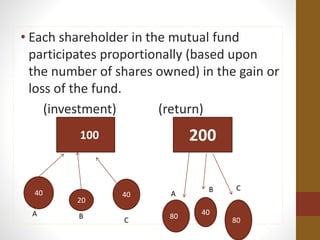
• Each shareholder in the mutual fund
participates proportionally (based upon
the number of shares owned) in the gain or
loss of the fund.
(investment) (return)
40
20
40
100 200
80 80
40A
A
B
B
C
C
History of Mutual funds
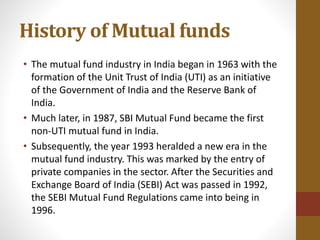
• The mutual fund industry in India began in 1963 with the
formation of the Unit Trust of India (UTI) as an initiative
of the Government of India and the Reserve Bank of
India.
• Much later, in 1987, SBI Mutual Fund became the first
non-UTI mutual fund in India.
• Subsequently, the year 1993 heralded a new era in the
mutual fund industry. This was marked by the entry of
private companies in the sector. After the Securities and
Exchange Board of India (SEBI) Act was passed in 1992,
the SEBI Mutual Fund Regulations came into being in
1996.
• As the industry expanded, a non-profit organization,
the Association of Mutual Funds in India
(AMFI), was established on 1995.
• Its objective is to promote healthy and ethical
marketing practices in the Indian mutual fund
Industry.
• SEBI has made AMFI certification mandatory
for all those engaged in selling or marketing mutual
fund products.
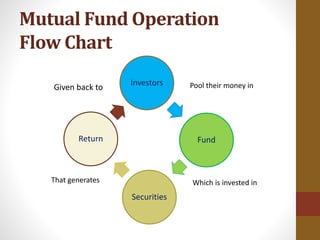
Investors
Fund
Securities
Return
Mutual Fund Operation
Flow Chart
Given back to Pool their money in
That generates Which is invested in
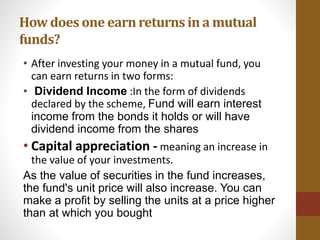
• After investing your money in a mutual fund, you
can earn returns in two forms:
• Dividend Income :In the form of dividends
declared by the scheme, Fund will earn interest
income from the bonds it holds or will have
dividend income from the shares
• Capital appreciation - meaning an increase in
the value of your investments.
As the value of securities in the fund increases,
the fund's unit price will also increase. You can
make a profit by selling the units at a price higher
than at which you bought
How does one earnreturns in a mutual
funds?
What the investor has to pay:
• The company that puts together a mutual fund is called an
AMC(Asset management company)
• The AMC hires a professional money manager, who buys
and sells securities in line with the fund's stated objective.
• In return for such services, Asset Management Companies
charge small fees. AMCs charge an annual fee, or expense
ratio that covers administrative expenses, salaries,
advertising expenses, brokerage fee, etc.
• So along with the amount invested you have
to just pay an annual fees to the AMC.
Advantages
• Professional management: The investment
management skills, along with the needed research into
available investment options, ensure a much better
return as compared to what an investor can manage on
his own.
• Reduction/Diversification of Risks: The potential losses
are also shared with other investors.
• Liquidity: Investors may be unable to sell shares directly,
easily and quickly. When they invest in mutual funds,
they can cash their investment any time by selling the
units to the fund if it is open-ended and get the intrinsic
value. Investors can sell the units in the market if it is
closed-ended fund.
• Convenience and Flexibility: Investors can easily
transfer their holdings from one scheme to other, get
updated market information and so on. Funds also offer
additional benefits like regular investment and regular
withdrawal options.
• Transparency: Fund gives regular information to its
investors on the value of the investments in addition to
disclosure of portfolio held by their scheme, the
proportion invested in each class of assets and the fund
manager's investment strategy and outlook
• Affordability :The minimum initial investment for a
mutual fund is fairly low for most funds (as low as Rs500
for some schemes).
DISADVANTAGES
• Delay in redemption: It takes 3-6 days for redemption of
the units and the money to flow back into the investor’s
account.
• No control over costs: The investor pays investment
management fees as long as he remains with the fund,
even while the value of his investments are declining. He
also pays for funds distribution charges which he would
not incur in direct investments.
• Managing a portfolio of funds: Availability of a large
number of funds can actually mean too much choice for
the investor. So, he may again need advice on how to
select a fund to achieve his objectives.
CONFUSION BETWEEN
Mutual Fund Scheme & Portfolio
Management Scheme
In case of Mutual Fund schemes, the funds of large number of
investors is pooled to form a common investible corpus and the
gains / losses are same for all the investors during that given
period of time.
On the other hand, in case of Portfolio Management Scheme,
the funds of a particular investor remain identifiable and gains
and losses for that portfolio are attributable to him only. Each
investor's funds are invested in a separate portfolio and there is
no pooling of funds.
Organization of a Mutual
Fund
•
Fund Sponsor
Trustees
Asset Management Company
Depository Agent
Custodian
• Mutual Funds in India follow a 3-tier structure.
• The first tier is the sponsor who thinks of starting the
fund.
• The second tier is the trustee. The Trustees role is not
to manage the money. Their job is only to see,
whether the money is being managed as per stated
objectives. Trustees may be seen as the internal
regulators of a mutual fund.
• Trustees appoint the Asset Management Company
(AMC) who form the third tier, to manage investor’s
money. The AMC in return charges a fee for the
services provided and this fee is borne by the
investors as it is deducted from the money collected
from them
SPONSORS
• Any corporate body which initiates the launching of a
mutual fund is referred to as “The sponsor”.
• The sponsor is expected to have a sound track record and
experience in financial services for a minimum period of
5 years and should ensure various formalities required in
establishing a mutual fund.
• According to SEBI, the sponsor should have professional
competence, financial soundness and reputation for
fairness and integrity. The sponsor contributes 40% of
the net worth of the AMC. The sponsor appoints the
trustee, The AMC and custodians in compliance with the
regulations.
TRUSTEE
• Sponsor creates a public trust and appoints trustees.
Trustees are the people authorized to act on behalf of the
Trust. They hold the property of mutual fund.
• Once the Trust is created, it is registered with SEBI after
which this trust is known as the mutual fund. The Trustees
role is not to manage the money but their job is only to
see, whether the money is being managed as per stated
objectives. Trustees may be seen as the internal regulators
of a mutual fund.
• Trustees appoint the Asset Management Company (AMC),
to manage investor’s money.
Asset Management
Company (AMC)
• Trustees appoint the Asset Management Company (AMC), to
manage investor’s money. The AMC in return charges a fee for
the services provided and this fee is borne by the investors as
it is deducted from the money collected from them.
• The AMC’s Board of Directors must have at least 50% of
Directors who are independent directors. The AMC has to be
approved by SEBI. The AMC functions under the supervision of
it’s Board of Directors, and also under the direction of the
Trustees and SEBI.
• It is the AMC, which in the name of the Trust, floats new
schemes and manage these schemes by buying and selling
securities. In order to do this the AMC needs to follow all rules
and regulations prescribed by SEBI and as per the Investment
Management Agreement it signs with the Trustees.
• The role of the AMC is to manage investor’s money on a
day to day basis. Thus it is imperative that people with
the highest integrity are involved with this activity.
• The AMC cannot deal with a single broker beyond a
certain limit of transactions.
• The AMC cannot act as a Trustee for some other Mutual
Fund.
• The responsibility of preparing the OD lies with the AMC.
• Appointments of intermediaries like independent
financial advisors (IFAs), national and regional
distributors, banks, etc. is also done by the AMC.
• Finally, it is the AMC which is responsible for the acts of
its employees and service providers.
Custodian
• A custodian’s role is keeping custody of the securities that are
bought by the fund manager and also keeping a tab on the
corporate actions like rights, bonus and dividends declared by
the companies in which the fund has invested.
• The Custodian is appointed by the Board of Trustees. The
custodian also participates in a clearing and settlement system
through approved depository companies on behalf of mutual
funds, in case of dematerialized securities.
• Only the physical securities are held by the Custodian. The
deliveries and receipt of units of a mutual fund are done by
the custodian or a depository participant at the instruction of
the AMC and under the overall direction and responsibility of
the Trustees. Regulations provide that the Sponsor and the
Custodian must be separate entities.
Registrar and transfer
agents
• The registrar and transfer agents are appointed by the AMC.
AMC pay compensation to these agents for their services.
They carry out the following functions
• Receiving and processing the application forms of investors
• Issuing unit certificates
• Sending refund orders
• Giving approval for all transfers of units and maintaining
records
• Repurchasing the units and redemption of units
• Issuing dividend or income warrents
Fund accountants
• Fund accountants are appointed by the AMC. The are in
charge of maintaining proper books of accounts relating to the
fund transactions and management. The perform the
following functions
• Computing the net asset value per unit of the scheme on a
daily basis
• Maintaining its books and records
• Monitoring compliance with the schemes, investment
limitations as well as SEBI regulations
• Preparing and distributing reports of the schemes for the unit
holders and SEBI and monitoring the performance of mutual
funds custodians and other service providers.
Lead manager
• Lead manager carry out the following functions:
• Selecting and coordinating the activities of
intermediaries such as advertising agency,
printers, collection centers.
• Carrying out extensive campaign about the
scheme and acting as marketing associates to
attract investors.
• Assisting the AMC to approach potential
investors through meetings, exhibitions,
contacts, advertising, publicity and sales
promotion.
Investment advisors
• Investment advisors carry out market and
security analysis.
• Advising the AMC to design its investment
strategies on a continuous basis.
• They are paid for their professional advice
regarding fund investment on the average
weekly value of the fund’s net assets.
Legal advisors
• Legal advisors are appointed to offer
legal guidance about planning and
execution of different schemes.
• A group of advocates and solicitors
may be appointed as legal advisors.
• Their fee is not associated with net
assets of the fund.
TYPES OF MUTUAL FUNDS:
• Investors have the option of choosing from a wide variety
of schemes in a mutual fund depending upon their
requirements. MF’s are classified as follows:
• Operational classification:
• Open ended scheme: when a fund is accepted and
liquidated on a continuous basis by a MF manager,
it is called as open ended scheme. The fund
manager buys and sells units constantly as
demanded by the investors. The scheme provides
excellent liquidity facility to the investors. The
buying and selling of units takes place at a declared
NAV(Net Asset Value)
• Close ended scheme: when a units of a scheme
is liquidated only after the expiry of a specified
period it is known as close ended fund.
Managing a close ended scheme is
comparatively easy for the fund Manager. The
fund can be liquidated after a specified period.
• Interval scheme: it is kind of close ended scheme
with a feature that it remains open during a
particular part of the year for the benefit of
investors, to either off load or to undertake
purchase of units at a NAV.
Return based classification
• Income fund scheme: this scheme is customised to suit
the needs of investors who are particular about regular
returns. The scheme offers maximum current income
where by the income earned by the units is distributed
periodically there are 2 types of such schemes, one that
earns a target constant income at relatively low risk while
the other offers maximum possible income.
• Growth scheme: it is a MF scheme that offers the
advantage of capital appreciation of the underlying
investment such funds invest in growth oriented
securities that are capable of appreciating in the long
run. The risk attached with such funds is relatively higher.
• Conservative fund Scheme: a scheme that aims at
providing a reasonable rate of return, protecting the
value of investment and achieving capital appreciation is
called a conservative fund scheme. It is also known as
middle of road funds as it offers a blend of the above
features. Such funds divide their portfolio in stocks and
bonds in such a way that it achieves the desired
objective.
Investment based classification
• Equity fund: such fund invest in equity shares they carry a high
degree of risk such fund do well in favorable market
conditions. Investments are made in equity shares in diverse
industries and sectors.
• Debt funds: Such fund invest in debt instruments like bonds
and debentures. These funds carry the advantage of secure
and steady income there is little chance of capital
appreciation. Such funds carry no risk. A variant of this type of
fund is called liquid fund which specializes in investing in short
term money market instruments.
• Balanced funds: such scheme have a mix of debt and equity in
their portfolio of investments. The portfolio is often shifted
between debt and equity depending upon the prevailing
market conditions.
• Sectoral fund: Such fund invest in specific sectors of the
economy. The specialized sectors may include real estate
infrastructure, oil and gas etc, offshore investments,
commodities like gold and silver.
• Leverage funds: the funds that are created out of
investments with not only the amount mobilized from
investors but also from borrowed money from the capital
markets are known as leveraged funds. Fund managers
pass on the benefit of leverage to the mutual fund
investors. Additional provisions must be made for such
funds to operate. Leveraged funds use short sale to take
advantage of declining markets in order to realize gains.
Derivative instruments like options are used by such
funds.
• Gilt fund : These funds seek to generate returns through
investment in govt. securities. Such funds invest only in
central and state govt. securities and REPO/ reverse REPO
securities. A portion of the corpus may be invested in call
money markets to meet liquidity requirements. Such funds
carry very less risk. Their prices are influenced only by
moment in interest rates.
• Indexed funds: these funds are linked to specific index.
Funds mobilized under such schemes are invested in
securities of companies included in the index of any
exchange. The fund performance is linked to the growth in
concerned index.
Evaluation of Mutual Funds
• It is essential that the performance of Mutual fund is
evaluated and appraised. Such appraisal helps the fund
to compare itself with other funds besides being a
potential source of information to the present and
prospective investors.
• Evaluation includes simple evaluation tools to
sophisticated models which take into consideration the
risk and uncertainty associated with the returns. Some of
the models used are Treynor’s Model and Sharpe’s
Model
Sharpe’s model
• Sharpe’s Performance Index: It offers a single value for
performance ranking of different funds or portfolio. It
measures the risk premium of the portfolio in terms of
its total risk.
• Sharpe’s Index = Average portfolio return – Risk free
rate of return
Standard Deviation of
Portfolio
= Rp – Rf
σp
Treynor’s model
• Treynor’s Performance Index: Here the fund’s
performance is measured against the market
performance. It is used to calculate return per
unit of market risk.
• Treynor’s Index = Average portfolio return –
Risk free rate of return
Market risk of Portfolio
= Rp – Rf
βp
Operational Efficiency of Mutual
funds
• Net Returns: the operational efficiency of a mutual fund
is best judged by its ability to earn for the investors
better and safe returns in the form of capital
appreciation and the dividends or income received on
such investment.
• Returns are calculated keeping in mind the expenses
incurred while earning such returns which include
trusteeship fee, management fee, administrative fee,
fund accounting fee, initial charges, brokerage etc.
SEBI has fixed an overall limit on expenses as per the
regulations.
• Net Asset Value: It is another parameter to measure the
operational efficiency of the fund. The intrinsic value of a unit
under a specific scheme is referred to as the NAV of the
scheme. The value gives an idea of the amount that may be
obtained by the unit holder on sale of the unit to the mutual
fund company
NAV (per unit) = Total Market Value – Fund liabilities
No. of outstanding Units
• Load : The initial expenses that are incurred by a mutual fund
in relation to the scheme operated by it is referred to as the
load of the scheme. According to SEBI guidelines a certain
percentage of load must be borne by the expected scheme.
• Disclosures: A highly transparent nature of mutual fund is said
to operate to benefit the investors and service their needs.
MFs are supposed to follow certain norms and ample
disclosures for their operation. Disclosures are made through
half yearly and annual reports where all the information
relating to the scheme is disclosed.
Mutual  funds

Mutual funds

  • 1.
  • 2.
    What are mutualfunds. • Mutual funds are a type of investment that takes money from many investors and uses it to make investments based on a stated investment objective. or • A mutual fund is a common pool of money into which investors place their contributions that are to be invested in different types of securities in accordance with the stated objective.
  • 3.
    • Each shareholderin the mutual fund participates proportionally (based upon the number of shares owned) in the gain or loss of the fund. (investment) (return) 40 20 40 100 200 80 80 40A A B B C C
  • 4.
    History of Mutualfunds • The mutual fund industry in India began in 1963 with the formation of the Unit Trust of India (UTI) as an initiative of the Government of India and the Reserve Bank of India. • Much later, in 1987, SBI Mutual Fund became the first non-UTI mutual fund in India. • Subsequently, the year 1993 heralded a new era in the mutual fund industry. This was marked by the entry of private companies in the sector. After the Securities and Exchange Board of India (SEBI) Act was passed in 1992, the SEBI Mutual Fund Regulations came into being in 1996.
  • 5.
    • As theindustry expanded, a non-profit organization, the Association of Mutual Funds in India (AMFI), was established on 1995. • Its objective is to promote healthy and ethical marketing practices in the Indian mutual fund Industry. • SEBI has made AMFI certification mandatory for all those engaged in selling or marketing mutual fund products.
  • 6.
    Investors Fund Securities Return Mutual Fund Operation FlowChart Given back to Pool their money in That generates Which is invested in
  • 7.
    • After investingyour money in a mutual fund, you can earn returns in two forms: • Dividend Income :In the form of dividends declared by the scheme, Fund will earn interest income from the bonds it holds or will have dividend income from the shares • Capital appreciation - meaning an increase in the value of your investments. As the value of securities in the fund increases, the fund's unit price will also increase. You can make a profit by selling the units at a price higher than at which you bought How does one earnreturns in a mutual funds?
  • 8.
    What the investorhas to pay: • The company that puts together a mutual fund is called an AMC(Asset management company) • The AMC hires a professional money manager, who buys and sells securities in line with the fund's stated objective. • In return for such services, Asset Management Companies charge small fees. AMCs charge an annual fee, or expense ratio that covers administrative expenses, salaries, advertising expenses, brokerage fee, etc. • So along with the amount invested you have to just pay an annual fees to the AMC.
  • 9.
    Advantages • Professional management:The investment management skills, along with the needed research into available investment options, ensure a much better return as compared to what an investor can manage on his own. • Reduction/Diversification of Risks: The potential losses are also shared with other investors. • Liquidity: Investors may be unable to sell shares directly, easily and quickly. When they invest in mutual funds, they can cash their investment any time by selling the units to the fund if it is open-ended and get the intrinsic value. Investors can sell the units in the market if it is closed-ended fund.
  • 10.
    • Convenience andFlexibility: Investors can easily transfer their holdings from one scheme to other, get updated market information and so on. Funds also offer additional benefits like regular investment and regular withdrawal options. • Transparency: Fund gives regular information to its investors on the value of the investments in addition to disclosure of portfolio held by their scheme, the proportion invested in each class of assets and the fund manager's investment strategy and outlook • Affordability :The minimum initial investment for a mutual fund is fairly low for most funds (as low as Rs500 for some schemes).
  • 11.
    DISADVANTAGES • Delay inredemption: It takes 3-6 days for redemption of the units and the money to flow back into the investor’s account. • No control over costs: The investor pays investment management fees as long as he remains with the fund, even while the value of his investments are declining. He also pays for funds distribution charges which he would not incur in direct investments. • Managing a portfolio of funds: Availability of a large number of funds can actually mean too much choice for the investor. So, he may again need advice on how to select a fund to achieve his objectives.
  • 12.
    CONFUSION BETWEEN Mutual FundScheme & Portfolio Management Scheme In case of Mutual Fund schemes, the funds of large number of investors is pooled to form a common investible corpus and the gains / losses are same for all the investors during that given period of time. On the other hand, in case of Portfolio Management Scheme, the funds of a particular investor remain identifiable and gains and losses for that portfolio are attributable to him only. Each investor's funds are invested in a separate portfolio and there is no pooling of funds.
  • 13.
    Organization of aMutual Fund • Fund Sponsor Trustees Asset Management Company Depository Agent Custodian
  • 14.
    • Mutual Fundsin India follow a 3-tier structure. • The first tier is the sponsor who thinks of starting the fund. • The second tier is the trustee. The Trustees role is not to manage the money. Their job is only to see, whether the money is being managed as per stated objectives. Trustees may be seen as the internal regulators of a mutual fund. • Trustees appoint the Asset Management Company (AMC) who form the third tier, to manage investor’s money. The AMC in return charges a fee for the services provided and this fee is borne by the investors as it is deducted from the money collected from them
  • 15.
    SPONSORS • Any corporatebody which initiates the launching of a mutual fund is referred to as “The sponsor”. • The sponsor is expected to have a sound track record and experience in financial services for a minimum period of 5 years and should ensure various formalities required in establishing a mutual fund. • According to SEBI, the sponsor should have professional competence, financial soundness and reputation for fairness and integrity. The sponsor contributes 40% of the net worth of the AMC. The sponsor appoints the trustee, The AMC and custodians in compliance with the regulations.
  • 16.
    TRUSTEE • Sponsor createsa public trust and appoints trustees. Trustees are the people authorized to act on behalf of the Trust. They hold the property of mutual fund. • Once the Trust is created, it is registered with SEBI after which this trust is known as the mutual fund. The Trustees role is not to manage the money but their job is only to see, whether the money is being managed as per stated objectives. Trustees may be seen as the internal regulators of a mutual fund. • Trustees appoint the Asset Management Company (AMC), to manage investor’s money.
  • 17.
    Asset Management Company (AMC) •Trustees appoint the Asset Management Company (AMC), to manage investor’s money. The AMC in return charges a fee for the services provided and this fee is borne by the investors as it is deducted from the money collected from them. • The AMC’s Board of Directors must have at least 50% of Directors who are independent directors. The AMC has to be approved by SEBI. The AMC functions under the supervision of it’s Board of Directors, and also under the direction of the Trustees and SEBI. • It is the AMC, which in the name of the Trust, floats new schemes and manage these schemes by buying and selling securities. In order to do this the AMC needs to follow all rules and regulations prescribed by SEBI and as per the Investment Management Agreement it signs with the Trustees.
  • 18.
    • The roleof the AMC is to manage investor’s money on a day to day basis. Thus it is imperative that people with the highest integrity are involved with this activity. • The AMC cannot deal with a single broker beyond a certain limit of transactions. • The AMC cannot act as a Trustee for some other Mutual Fund. • The responsibility of preparing the OD lies with the AMC. • Appointments of intermediaries like independent financial advisors (IFAs), national and regional distributors, banks, etc. is also done by the AMC. • Finally, it is the AMC which is responsible for the acts of its employees and service providers.
  • 19.
    Custodian • A custodian’srole is keeping custody of the securities that are bought by the fund manager and also keeping a tab on the corporate actions like rights, bonus and dividends declared by the companies in which the fund has invested. • The Custodian is appointed by the Board of Trustees. The custodian also participates in a clearing and settlement system through approved depository companies on behalf of mutual funds, in case of dematerialized securities. • Only the physical securities are held by the Custodian. The deliveries and receipt of units of a mutual fund are done by the custodian or a depository participant at the instruction of the AMC and under the overall direction and responsibility of the Trustees. Regulations provide that the Sponsor and the Custodian must be separate entities.
  • 20.
    Registrar and transfer agents •The registrar and transfer agents are appointed by the AMC. AMC pay compensation to these agents for their services. They carry out the following functions • Receiving and processing the application forms of investors • Issuing unit certificates • Sending refund orders • Giving approval for all transfers of units and maintaining records • Repurchasing the units and redemption of units • Issuing dividend or income warrents
  • 21.
    Fund accountants • Fundaccountants are appointed by the AMC. The are in charge of maintaining proper books of accounts relating to the fund transactions and management. The perform the following functions • Computing the net asset value per unit of the scheme on a daily basis • Maintaining its books and records • Monitoring compliance with the schemes, investment limitations as well as SEBI regulations • Preparing and distributing reports of the schemes for the unit holders and SEBI and monitoring the performance of mutual funds custodians and other service providers.
  • 22.
    Lead manager • Leadmanager carry out the following functions: • Selecting and coordinating the activities of intermediaries such as advertising agency, printers, collection centers. • Carrying out extensive campaign about the scheme and acting as marketing associates to attract investors. • Assisting the AMC to approach potential investors through meetings, exhibitions, contacts, advertising, publicity and sales promotion.
  • 23.
    Investment advisors • Investmentadvisors carry out market and security analysis. • Advising the AMC to design its investment strategies on a continuous basis. • They are paid for their professional advice regarding fund investment on the average weekly value of the fund’s net assets.
  • 24.
    Legal advisors • Legaladvisors are appointed to offer legal guidance about planning and execution of different schemes. • A group of advocates and solicitors may be appointed as legal advisors. • Their fee is not associated with net assets of the fund.
  • 25.
    TYPES OF MUTUALFUNDS: • Investors have the option of choosing from a wide variety of schemes in a mutual fund depending upon their requirements. MF’s are classified as follows: • Operational classification: • Open ended scheme: when a fund is accepted and liquidated on a continuous basis by a MF manager, it is called as open ended scheme. The fund manager buys and sells units constantly as demanded by the investors. The scheme provides excellent liquidity facility to the investors. The buying and selling of units takes place at a declared NAV(Net Asset Value)
  • 26.
    • Close endedscheme: when a units of a scheme is liquidated only after the expiry of a specified period it is known as close ended fund. Managing a close ended scheme is comparatively easy for the fund Manager. The fund can be liquidated after a specified period. • Interval scheme: it is kind of close ended scheme with a feature that it remains open during a particular part of the year for the benefit of investors, to either off load or to undertake purchase of units at a NAV.
  • 27.
    Return based classification •Income fund scheme: this scheme is customised to suit the needs of investors who are particular about regular returns. The scheme offers maximum current income where by the income earned by the units is distributed periodically there are 2 types of such schemes, one that earns a target constant income at relatively low risk while the other offers maximum possible income. • Growth scheme: it is a MF scheme that offers the advantage of capital appreciation of the underlying investment such funds invest in growth oriented securities that are capable of appreciating in the long run. The risk attached with such funds is relatively higher.
  • 28.
    • Conservative fundScheme: a scheme that aims at providing a reasonable rate of return, protecting the value of investment and achieving capital appreciation is called a conservative fund scheme. It is also known as middle of road funds as it offers a blend of the above features. Such funds divide their portfolio in stocks and bonds in such a way that it achieves the desired objective.
  • 29.
    Investment based classification •Equity fund: such fund invest in equity shares they carry a high degree of risk such fund do well in favorable market conditions. Investments are made in equity shares in diverse industries and sectors. • Debt funds: Such fund invest in debt instruments like bonds and debentures. These funds carry the advantage of secure and steady income there is little chance of capital appreciation. Such funds carry no risk. A variant of this type of fund is called liquid fund which specializes in investing in short term money market instruments. • Balanced funds: such scheme have a mix of debt and equity in their portfolio of investments. The portfolio is often shifted between debt and equity depending upon the prevailing market conditions.
  • 30.
    • Sectoral fund:Such fund invest in specific sectors of the economy. The specialized sectors may include real estate infrastructure, oil and gas etc, offshore investments, commodities like gold and silver. • Leverage funds: the funds that are created out of investments with not only the amount mobilized from investors but also from borrowed money from the capital markets are known as leveraged funds. Fund managers pass on the benefit of leverage to the mutual fund investors. Additional provisions must be made for such funds to operate. Leveraged funds use short sale to take advantage of declining markets in order to realize gains. Derivative instruments like options are used by such funds.
  • 31.
    • Gilt fund: These funds seek to generate returns through investment in govt. securities. Such funds invest only in central and state govt. securities and REPO/ reverse REPO securities. A portion of the corpus may be invested in call money markets to meet liquidity requirements. Such funds carry very less risk. Their prices are influenced only by moment in interest rates. • Indexed funds: these funds are linked to specific index. Funds mobilized under such schemes are invested in securities of companies included in the index of any exchange. The fund performance is linked to the growth in concerned index.
  • 32.
    Evaluation of MutualFunds • It is essential that the performance of Mutual fund is evaluated and appraised. Such appraisal helps the fund to compare itself with other funds besides being a potential source of information to the present and prospective investors. • Evaluation includes simple evaluation tools to sophisticated models which take into consideration the risk and uncertainty associated with the returns. Some of the models used are Treynor’s Model and Sharpe’s Model
  • 33.
    Sharpe’s model • Sharpe’sPerformance Index: It offers a single value for performance ranking of different funds or portfolio. It measures the risk premium of the portfolio in terms of its total risk. • Sharpe’s Index = Average portfolio return – Risk free rate of return Standard Deviation of Portfolio = Rp – Rf σp
  • 34.
    Treynor’s model • Treynor’sPerformance Index: Here the fund’s performance is measured against the market performance. It is used to calculate return per unit of market risk. • Treynor’s Index = Average portfolio return – Risk free rate of return Market risk of Portfolio = Rp – Rf βp
  • 35.
    Operational Efficiency ofMutual funds • Net Returns: the operational efficiency of a mutual fund is best judged by its ability to earn for the investors better and safe returns in the form of capital appreciation and the dividends or income received on such investment. • Returns are calculated keeping in mind the expenses incurred while earning such returns which include trusteeship fee, management fee, administrative fee, fund accounting fee, initial charges, brokerage etc. SEBI has fixed an overall limit on expenses as per the regulations.
  • 36.
    • Net AssetValue: It is another parameter to measure the operational efficiency of the fund. The intrinsic value of a unit under a specific scheme is referred to as the NAV of the scheme. The value gives an idea of the amount that may be obtained by the unit holder on sale of the unit to the mutual fund company NAV (per unit) = Total Market Value – Fund liabilities No. of outstanding Units • Load : The initial expenses that are incurred by a mutual fund in relation to the scheme operated by it is referred to as the load of the scheme. According to SEBI guidelines a certain percentage of load must be borne by the expected scheme. • Disclosures: A highly transparent nature of mutual fund is said to operate to benefit the investors and service their needs. MFs are supposed to follow certain norms and ample disclosures for their operation. Disclosures are made through half yearly and annual reports where all the information relating to the scheme is disclosed.