FUND STRUCTURE &
LEGAL ENVIRONMENT
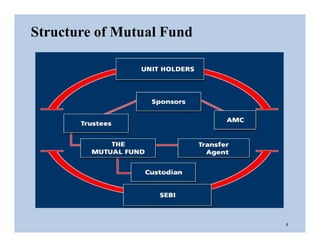
Structure of Mutual Fund
2
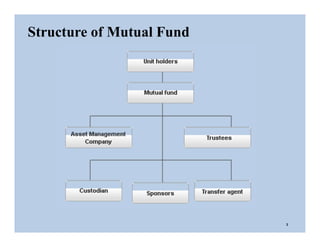
Structure of Mutual Fund
3
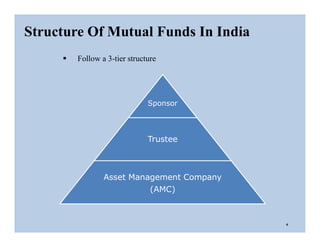
Structure Of Mutual Funds In India
 Follow a 3-tier structure
Trustee
Asset Management Company
(AMC)
Sponsor
4
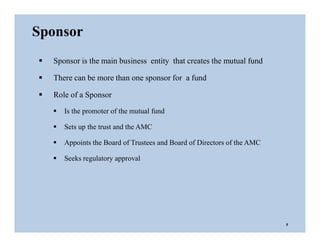
 Sponsor is the main business entity that creates the mutual fund
 There can be more than one sponsor for a fund
 Role of a Sponsor
 Is the promoter of the mutual fund
 Sets up the trust and the AMC
 Appoints the Board of Trustees and Board of Directors of the AMC
 Seeks regulatory approval
Sponsor
5
 Eligibility criteria
 At least 5 years experience in the financial services industry
 Positive net worth over the last 5 financial years
 Profits over the last 3 out of 5 years
 At least 40% contribution to the capital of the AMC
Sponsor
6
Trustees
 Holds assets on behalf of unit holders in trust.
 Trustees are caretakers of unit holders’ money.
 Two third of the trustees shall be independent persons (not associated
with the sponsor).
 Ensure that the system, processes & personnel are in place.
 Resolve unit holders grievances.
 Appoint AMC & Custodian, & ensure that all activities are in
accordance with the SEBI regulation.
7
 Hold the cash and securities of the mutual fund
 Appointed by the Trustees
 Only constituent NOT directly appointed by the AMC
 Must be independent of the Trustees and its associates
 Functions of the Custodian
 Delivering and accepting securities and cash
 Tracking and completing corporate actions and payouts on the securities
 Coordinating with the DPs
 Custodial functions cannot be done in-house by the AMC.
Custodian
8
 AMC is the investment manager of the mutual fund
 Investment Management Agreement between the trustees and the AMC
 Required to invest seed capital of 1% of the amount raised subject to a
maximum of Rs.50 lakh in all open ended schemes
Asset Management Company
9
 AMC is appointed by the trustees, with Sebi approval
 AMC should have a net worth of at least Rs.50 crore at all times
 At least 50% of members of the board of an AMC have to be independent.
 The AMC of one mutual fund cannot be an AMC or trustee of another
fund.
 AMCs cannot engage in any business other than that of financial advisory
and investment management
Asset Management Company
10
 Mutual fund constituents (except custodians) are appointed by the
AMC with the approval of the trustees.
 They are usually paid fees for their services
 All mutual fund constituents have to be registered with Sebi
Other Fund Constituents
11
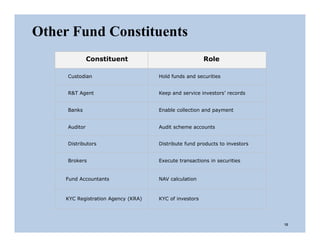
Other Fund Constituents
Constituent Role
Custodian Hold funds and securities
R&T Agent Keep and service investors’ records
Banks Enable collection and payment
Auditor Audit scheme accounts
Distributors Distribute fund products to investors
Brokers Execute transactions in securities
Fund Accountants NAV calculation
KYC Registration Agency (KRA) KYC of investors
12
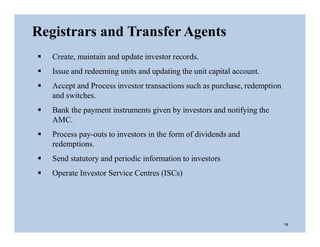
 Create, maintain and update investor records.
 Issue and redeeming units and updating the unit capital account.
 Accept and Process investor transactions such as purchase, redemption
and switches.
 Bank the payment instruments given by investors and notifying the
AMC.
 Process pay-outs to investors in the form of dividends and
redemptions.
 Send statutory and periodic information to investors
 Operate Investor Service Centres (ISCs)
Registrars and Transfer Agents
13
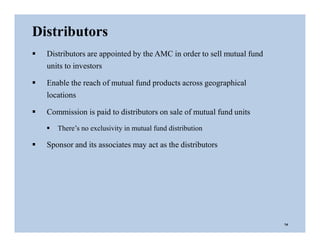
 Distributors are appointed by the AMC in order to sell mutual fund
units to investors
 Enable the reach of mutual fund products across geographical
locations
 Commission is paid to distributors on sale of mutual fund units
 There’s no exclusivity in mutual fund distribution
 Sponsor and its associates may act as the distributors
Distributors
14
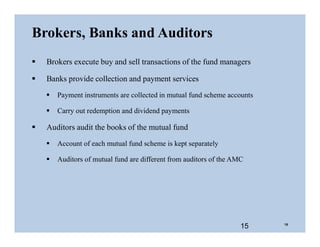
Brokers, Banks and Auditors
 Brokers execute buy and sell transactions of the fund managers
 Banks provide collection and payment services
 Payment instruments are collected in mutual fund scheme accounts
 Carry out redemption and dividend payments
 Auditors audit the books of the mutual fund
 Account of each mutual fund scheme is kept separately
 Auditors of mutual fund are different from auditors of the AMC
15 15
Lead Manager
 Selecting and coordinating the activities of intermediaries such as
advertising agency, printers, collection centers.
 Carrying out extensive campaign about the scheme and acting as
marketing associates to attract investors.
 Assisting the AMC to approach potential investors through
meetings, exhibitions, contacts, advertising, publicity and sales
promotion.
16
Investment Advisors
 Does market and securities analysis
 Advises AMC on its investment strategies
 Paid for their professional advice regarding fund investment on the
average weekly value of the fund’s net assets.
17
Legal Advisors
 Appointed to offer legal guidance about planning and execution of
different schemes.
 A group of advocates and solicitors may be appointed as legal
advisors.
 Their fee is not associated with net assets of the fund.
18
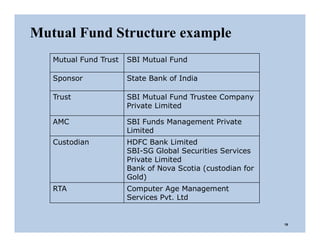
Mutual Fund Trust SBI Mutual Fund
Sponsor State Bank of India
Trust SBI Mutual Fund Trustee Company
Private Limited
AMC SBI Funds Management Private
Limited
Custodian HDFC Bank Limited
SBI-SG Global Securities Services
Private Limited
Bank of Nova Scotia (custodian for
Gold)
RTA Computer Age Management
Services Pvt. Ltd
Mutual Fund Structure example
19
Association Of Mutual Funds In India
20
 Association of Mutual Funds in India (AMFI) was incorporated on 22nd
August, 1995.
 Modeled on the lines of a Self Regulating Organization (SRO)
 It follows the principle of both protecting and promoting the interests of
mutual funds as well as their unit holders.
21
Objectives Of AMFI
 Interacts with SEBI and works according to SEBI’s guidelines in the
mutual fund industry.
 To recommend and promote best business practices and code of conduct
to be followed by members and others engaged in the activities of
mutual fund
 Develops a team of well qualified and trained Agent distributors
 Undertakes all India awareness programme for investors in order to
promote proper understanding of the concept and working of mutual
funds.
Objectives Of AMFI
22
 AMFI Guidelines & Norms for Intermediaries (AGNI):
 AMFI has also framed a set of guidelines and code of conduct for
intermediaries, consisting of individual agents, brokers, distribution
houses and banks engaged in selling of mutual fund products
AMFI Code Of Ethics
23
 INTEGRITY
 Members and their key personnel, in the conduct of their business shall
observe high standards of integrity and fairness in all dealings
 DUE DILIGENCE
 Members in the conduct of their Asset Management business shall at all
times
 Render high standards of service.
 Exercise due diligence.
 Exercise independent professional judgment
24
AMFI Code Of Ethics
 DISCLOSURES
 Members shall ensure timely dissemination to all unitholders of adequate,
accurate, and explicit information
 Presented in a simple language about the investment objectives, investment
policies, financial position and general affairs of the scheme.
 PROFESSIONAL SELLING PRACTICES
 Members shall not use any unethical means to sell, market or induce any
investor to buy their products and schemes
 SEBI is primarily responsible for safeguarding the interests of the
investors.
 Indian mutual funds are supervised and regulated by SEBI (Mutual
Funds) Regulations, 1996
 SEBI was set up by the SEBI Act, 1992 and is supervised by
Ministry of Finance
SEBI as the Regulator
25
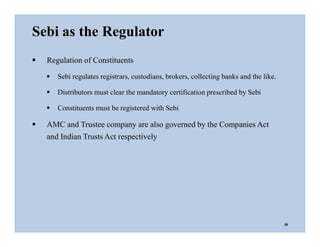
 Regulation of Constituents
 Sebi regulates registrars, custodians, brokers, collecting banks and the like.
 Distributors must clear the mandatory certification prescribed by Sebi
 Constituents must be registered with Sebi
 AMC and Trustee company are also governed by the Companies Act
and Indian Trusts Act respectively
Sebi as the Regulator
26
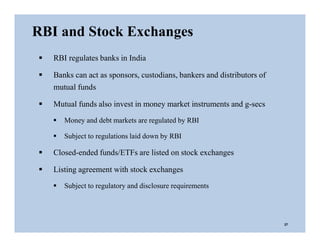
 RBI regulates banks in India
 Banks can act as sponsors, custodians, bankers and distributors of
mutual funds
 Mutual funds also invest in money market instruments and g-secs
 Money and debt markets are regulated by RBI
 Subject to regulations laid down by RBI
 Closed-ended funds/ETFs are listed on stock exchanges
 Listing agreement with stock exchanges
 Subject to regulatory and disclosure requirements
RBI and Stock Exchanges
27
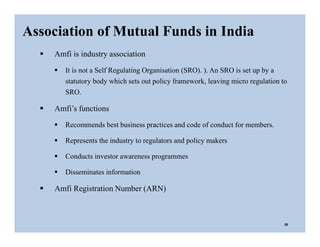
 Amfi is industry association
 It is not a Self Regulating Organisation (SRO). ). An SRO is set up by a
statutory body which sets out policy framework, leaving micro regulation to
SRO.
 Amfi’s functions
 Recommends best business practices and code of conduct for members.
 Represents the industry to regulators and policy makers
 Conducts investor awareness programmes
 Disseminates information
 Amfi Registration Number (ARN)
Association of Mutual Funds in India
28
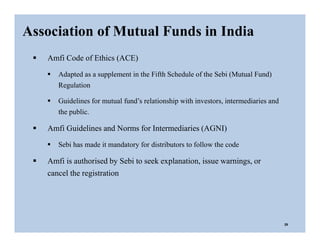
 Amfi Code of Ethics (ACE)
 Adapted as a supplement in the Fifth Schedule of the Sebi (Mutual Fund)
Regulation
 Guidelines for mutual fund’s relationship with investors, intermediaries and
the public.
 Amfi Guidelines and Norms for Intermediaries (AGNI)
 Sebi has made it mandatory for distributors to follow the code
 Amfi is authorised by Sebi to seek explanation, issue warnings, or
cancel the registration
Association of Mutual Funds in India
29
 Investor must first approach the Investor Service Centre (ISC)
 If not resolved, then approach the personnel at senior levels in the
AMC
 If not resolved, then the investor may approach Sebi
 If the investor is not satisfied with the Sebi ruling, the investor may
approach Securities Appellate Tribunal (SAT)
 Mutual funds should annually disclose details of complaints received
from all sources on their website, AMFI website and in annual report
 Compliant can also be initiated through SCORES (SEBI Complaint
Redress System).
Redressal of Investor Complaints
30
 Centralized web based system for lodging and tracking investor
complaints.
 Complaint against a listed company or against any market intermediary
can be filed using SCORES.
 Complaint is scrutinized by SEBI and forwarded to the concerned
entity
 A written reply to the investor needs to be given by the concerned entity
 An action taken report to be filed in SCORES within 30 days.
SCORES
31
Thank You

null (3).pdf

  • 1.
  • 2.
  • 3.
  • 4.
    Structure Of MutualFunds In India  Follow a 3-tier structure Trustee Asset Management Company (AMC) Sponsor 4
  • 5.
     Sponsor isthe main business entity that creates the mutual fund  There can be more than one sponsor for a fund  Role of a Sponsor  Is the promoter of the mutual fund  Sets up the trust and the AMC  Appoints the Board of Trustees and Board of Directors of the AMC  Seeks regulatory approval Sponsor 5
  • 6.
     Eligibility criteria At least 5 years experience in the financial services industry  Positive net worth over the last 5 financial years  Profits over the last 3 out of 5 years  At least 40% contribution to the capital of the AMC Sponsor 6
  • 7.
    Trustees  Holds assetson behalf of unit holders in trust.  Trustees are caretakers of unit holders’ money.  Two third of the trustees shall be independent persons (not associated with the sponsor).  Ensure that the system, processes & personnel are in place.  Resolve unit holders grievances.  Appoint AMC & Custodian, & ensure that all activities are in accordance with the SEBI regulation. 7
  • 8.
     Hold thecash and securities of the mutual fund  Appointed by the Trustees  Only constituent NOT directly appointed by the AMC  Must be independent of the Trustees and its associates  Functions of the Custodian  Delivering and accepting securities and cash  Tracking and completing corporate actions and payouts on the securities  Coordinating with the DPs  Custodial functions cannot be done in-house by the AMC. Custodian 8
  • 9.
     AMC isthe investment manager of the mutual fund  Investment Management Agreement between the trustees and the AMC  Required to invest seed capital of 1% of the amount raised subject to a maximum of Rs.50 lakh in all open ended schemes Asset Management Company 9
  • 10.
     AMC isappointed by the trustees, with Sebi approval  AMC should have a net worth of at least Rs.50 crore at all times  At least 50% of members of the board of an AMC have to be independent.  The AMC of one mutual fund cannot be an AMC or trustee of another fund.  AMCs cannot engage in any business other than that of financial advisory and investment management Asset Management Company 10
  • 11.
     Mutual fundconstituents (except custodians) are appointed by the AMC with the approval of the trustees.  They are usually paid fees for their services  All mutual fund constituents have to be registered with Sebi Other Fund Constituents 11
  • 12.
    Other Fund Constituents ConstituentRole Custodian Hold funds and securities R&T Agent Keep and service investors’ records Banks Enable collection and payment Auditor Audit scheme accounts Distributors Distribute fund products to investors Brokers Execute transactions in securities Fund Accountants NAV calculation KYC Registration Agency (KRA) KYC of investors 12
  • 13.
     Create, maintainand update investor records.  Issue and redeeming units and updating the unit capital account.  Accept and Process investor transactions such as purchase, redemption and switches.  Bank the payment instruments given by investors and notifying the AMC.  Process pay-outs to investors in the form of dividends and redemptions.  Send statutory and periodic information to investors  Operate Investor Service Centres (ISCs) Registrars and Transfer Agents 13
  • 14.
     Distributors areappointed by the AMC in order to sell mutual fund units to investors  Enable the reach of mutual fund products across geographical locations  Commission is paid to distributors on sale of mutual fund units  There’s no exclusivity in mutual fund distribution  Sponsor and its associates may act as the distributors Distributors 14
  • 15.
    Brokers, Banks andAuditors  Brokers execute buy and sell transactions of the fund managers  Banks provide collection and payment services  Payment instruments are collected in mutual fund scheme accounts  Carry out redemption and dividend payments  Auditors audit the books of the mutual fund  Account of each mutual fund scheme is kept separately  Auditors of mutual fund are different from auditors of the AMC 15 15
  • 16.
    Lead Manager  Selectingand coordinating the activities of intermediaries such as advertising agency, printers, collection centers.  Carrying out extensive campaign about the scheme and acting as marketing associates to attract investors.  Assisting the AMC to approach potential investors through meetings, exhibitions, contacts, advertising, publicity and sales promotion. 16
  • 17.
    Investment Advisors  Doesmarket and securities analysis  Advises AMC on its investment strategies  Paid for their professional advice regarding fund investment on the average weekly value of the fund’s net assets. 17
  • 18.
    Legal Advisors  Appointedto offer legal guidance about planning and execution of different schemes.  A group of advocates and solicitors may be appointed as legal advisors.  Their fee is not associated with net assets of the fund. 18
  • 19.
    Mutual Fund TrustSBI Mutual Fund Sponsor State Bank of India Trust SBI Mutual Fund Trustee Company Private Limited AMC SBI Funds Management Private Limited Custodian HDFC Bank Limited SBI-SG Global Securities Services Private Limited Bank of Nova Scotia (custodian for Gold) RTA Computer Age Management Services Pvt. Ltd Mutual Fund Structure example 19
  • 20.
    Association Of MutualFunds In India 20  Association of Mutual Funds in India (AMFI) was incorporated on 22nd August, 1995.  Modeled on the lines of a Self Regulating Organization (SRO)  It follows the principle of both protecting and promoting the interests of mutual funds as well as their unit holders.
  • 21.
    21 Objectives Of AMFI Interacts with SEBI and works according to SEBI’s guidelines in the mutual fund industry.  To recommend and promote best business practices and code of conduct to be followed by members and others engaged in the activities of mutual fund  Develops a team of well qualified and trained Agent distributors  Undertakes all India awareness programme for investors in order to promote proper understanding of the concept and working of mutual funds.
  • 22.
    Objectives Of AMFI 22 AMFI Guidelines & Norms for Intermediaries (AGNI):  AMFI has also framed a set of guidelines and code of conduct for intermediaries, consisting of individual agents, brokers, distribution houses and banks engaged in selling of mutual fund products
  • 23.
    AMFI Code OfEthics 23  INTEGRITY  Members and their key personnel, in the conduct of their business shall observe high standards of integrity and fairness in all dealings  DUE DILIGENCE  Members in the conduct of their Asset Management business shall at all times  Render high standards of service.  Exercise due diligence.  Exercise independent professional judgment
  • 24.
    24 AMFI Code OfEthics  DISCLOSURES  Members shall ensure timely dissemination to all unitholders of adequate, accurate, and explicit information  Presented in a simple language about the investment objectives, investment policies, financial position and general affairs of the scheme.  PROFESSIONAL SELLING PRACTICES  Members shall not use any unethical means to sell, market or induce any investor to buy their products and schemes
  • 25.
     SEBI isprimarily responsible for safeguarding the interests of the investors.  Indian mutual funds are supervised and regulated by SEBI (Mutual Funds) Regulations, 1996  SEBI was set up by the SEBI Act, 1992 and is supervised by Ministry of Finance SEBI as the Regulator 25
  • 26.
     Regulation ofConstituents  Sebi regulates registrars, custodians, brokers, collecting banks and the like.  Distributors must clear the mandatory certification prescribed by Sebi  Constituents must be registered with Sebi  AMC and Trustee company are also governed by the Companies Act and Indian Trusts Act respectively Sebi as the Regulator 26
  • 27.
     RBI regulatesbanks in India  Banks can act as sponsors, custodians, bankers and distributors of mutual funds  Mutual funds also invest in money market instruments and g-secs  Money and debt markets are regulated by RBI  Subject to regulations laid down by RBI  Closed-ended funds/ETFs are listed on stock exchanges  Listing agreement with stock exchanges  Subject to regulatory and disclosure requirements RBI and Stock Exchanges 27
  • 28.
     Amfi isindustry association  It is not a Self Regulating Organisation (SRO). ). An SRO is set up by a statutory body which sets out policy framework, leaving micro regulation to SRO.  Amfi’s functions  Recommends best business practices and code of conduct for members.  Represents the industry to regulators and policy makers  Conducts investor awareness programmes  Disseminates information  Amfi Registration Number (ARN) Association of Mutual Funds in India 28
  • 29.
     Amfi Codeof Ethics (ACE)  Adapted as a supplement in the Fifth Schedule of the Sebi (Mutual Fund) Regulation  Guidelines for mutual fund’s relationship with investors, intermediaries and the public.  Amfi Guidelines and Norms for Intermediaries (AGNI)  Sebi has made it mandatory for distributors to follow the code  Amfi is authorised by Sebi to seek explanation, issue warnings, or cancel the registration Association of Mutual Funds in India 29
  • 30.
     Investor mustfirst approach the Investor Service Centre (ISC)  If not resolved, then approach the personnel at senior levels in the AMC  If not resolved, then the investor may approach Sebi  If the investor is not satisfied with the Sebi ruling, the investor may approach Securities Appellate Tribunal (SAT)  Mutual funds should annually disclose details of complaints received from all sources on their website, AMFI website and in annual report  Compliant can also be initiated through SCORES (SEBI Complaint Redress System). Redressal of Investor Complaints 30
  • 31.
     Centralized webbased system for lodging and tracking investor complaints.  Complaint against a listed company or against any market intermediary can be filed using SCORES.  Complaint is scrutinized by SEBI and forwarded to the concerned entity  A written reply to the investor needs to be given by the concerned entity  An action taken report to be filed in SCORES within 30 days. SCORES 31
  • 32.